


Breast cancer, which accounts for 30% of female malignancies and has a high mortality and morbidity rate, is a major health problem for women (Refs Reference Siegel1, Reference Kashyap2). Chemotherapy and targeted therapy are the mainstays of advanced cancer treatment. Nevertheless, medication resistance frequently limits the effectiveness of treatment due to a variety of mechanisms present in tumours, including cancer stem cells (CSCs) and drug resistance genes (Refs Reference Dong3, Reference Koual4). The Wnt signalling pathway is a highly conserved signal that is crucial for controlling both cancer growth and embryogenesis (Ref. Reference Merikhian5). Wnt/β-catenin is the canonical Wnt signalling pathway, and its activation plays a critical role in human cancer development (Ref. Reference Merikhian5). At the same time, this pathway can also promote multiple pathways directly or indirectly involved in the resistance of breast tumours to chemotherapeutic drugs. Current research has found that traditional Chinese medicine has significant advantages in overcoming tumour drug resistance. Therefore, the therapeutic strategy of integrating traditional Chinese and modern medicine to target and inhibit the Wnt/β-catenin pathway has important value in relieving the drug resistance of breast tumours (Ref. Reference Bugter6).
Introduction to Wnt/β-catenin pathway
Wnt gene was first discovered in mice in 1982. There are 19 Wnt genes in the Wnt gene family, and their transcriptional expression products are lipid-modified glycoproteins called Wnt proteins that contain several conserved cysteines. The Wnt signalling pathways involved in animal growth and development are highly conserved in eukaryotic cells, and the aberrantly activated Wnt signalling cascade is involved in mediating the occurrence and development of many diseases. The Wnt/β-catenin pathway, the canonical Wnt pathway, is involved in various physiological processes such as cell proliferation, differentiation and migration, which have been shown to play a regulatory role in most human cancers (Refs Reference Xu7, Reference Nusse8, Reference Zhang9, Reference Zhan10). As a crucial signalling transducer in the Wnt signalling pathway, β-catenin accumulates in the nucleus after entering the nucleus, interacting with T-cell factor/lymphoid enhancer factor (TCF/LEF) family genes to activate c-myc, MMP-7, SNAIL, EGFR, MDR1 and other target genes, thereby mediating the development of tumour growth and drug resistance. In the presence of Wnt signalling, the ligand Wnt binds to the transmembrane receptor Frizzled (FZD) receptor and low-density lipoprotein receptor-related protein 5/6 coreceptor to form a trimerisation. It recruits and activates the cytoplasmic dishevelled protein (DVL) at the plasma membrane. The activated DVL protein dissociates the β-catenin destruction complex, which includes adenomatous polyposis coli, AXIN1, casein kinase 1 and glycogen synthase kinase 3β (GSK3β). This accumulates β-catenin in the cytoplasm upon phosphorylation by GSK3β, ubiquitination by E3 ubiquitin ligase (β-trcp) and degradation by the proteasome. The β-catenin accumulated in the cytoplasm is then transferred to the nucleus, where it accumulates and mediates the transcriptional expression of downstream genes. In normal mature organisms, without abnormal Wnt signalling, β-catenin in the cytoplasm will be degraded, thereby preventing it from entering the nucleus. TCFs lacking binding to β-catenin interact with Groucho transcriptional repressor, thereby preventing the transcription of relevant targeted genes (Refs Reference Agostino11, Reference Katoh12, Reference Raut13).
The direct involvement of the Wnt/β-catenin pathway in the drug resistance of breast cancer
Currently, many studies have shown that the target genes of the Wnt/β-catenin pathway, epidermal growth factor receptor (EGFR) and multi-drug resistance gene (MDR1) are directly involved in the process of chemoresistance in breast cancer through multiple pathways. What's more, the expression and accumulation of β-catenin also induce mutations in multi-drug resistance (MDR) genes in breast cancer. The MDR protein (ABCB1) contributes to the acquisition of the MDR phenotype in breast cancer cells, and the promoter of the human ABCB1 gene contains multiple Wnt/β-catenin target gene TCF4/LEF binding motifs, while the activation of this pathway enhances the expression of ABCB1, thus confirming the direct link between the Wnt/β-catenin pathway and chemotherapy resistance (Ref. Reference Nusse8). Recent studies have found that the Wnt/β-catenin pathway can also be regulated by Nek2B kinase, which in turn is involved in the resistance of TNBC to paclitaxel (Ref. Reference Shen14). Jia et al. (Ref. Reference Jia15) found that breast cancer cells after drug cessation will autocrine inflammatory factors, which in turn induce the activation of the Wnt/β-catenin pathway, resulting in the enrichment of CSCs and the generation of drug resistance in tumour cells. Wnt/β-catenin pathway inhibitor has a better curative effect. Therefore, it is of great research value to discover drugs that target and inhibit the Wnt/β-catenin pathway and determine the time node of targeted drugs in the process of relieving breast cancer chemotherapy resistance.
Wnt pathway and cancer stem cells
CSCs play an important role in tumour resistance. The Wnt/β-catenin pathway can promote the ability of proliferating and migrating of breast cancer stem cells (BCSCs), it then indirectly participates in mediating the resistance of breast tumours to chemotherapeutic drugs. At the same time, the Wnt/β-catenin pathway can also directly mediate the drug resistance of BCSCs (Ref. Reference Katoh12).
CSCs and breast tumour drug resistance
In general, the term CSCs refers to a type of cell that can infinitely renew themselves, differentiate into progeny tumours of different lineages, lead to tumour formation and highly resistant to chemotherapeutic drugs (Ref. Reference Pan16). BCSCs are a small fraction of CSC cells found in breast tumours (Ref. Reference Palomeras17). CSCs are also known as tumour initiating cells, and are involved in tumorigenesis, metastasis, invasion, proliferation and other processes (Refs Reference Raut13, Reference Pan16).
The environment of CSCs is a special niche for this stem cell, and this three-dimensional niche structure can act as a barrier to protect BCSCs from the effects of chemotherapeutic drugs (Ref. Reference Shen14).
The genetic or epigenetic evolution of CSCs has led to a series of drug-resistant CSCs (Ref. Reference Merikhian5). ATP-binding cassette (ABC) transporters, including efflux pumps P-glycoprotein 1 (also known as ABCB1) and ABC subfamily member 2 (ABCG2), normally control the efflux of cytotoxic drugs, and CSCs express high levels of ABC transporters at the same time. Several studies have also shown that CSCs are involved in the induction of tumour MDR (Refs Reference Du18, Reference Kakarala19).
Chemotherapy can lead to the generation of hypoxic environments and the accumulation of reactive oxygen species (ROS), and BCSCs have strong anti-hypoxia abilities (Ref. Reference Song20). Hypoxia-inducible factor-1 (HIF-1) activation by hypoxic environment and ROS accumulation can contribute to drug resistance (Ref. Reference Song20). In addition, in BCSCs, ALDH1 can stabilise the function of CSCs by producing antioxidant compounds and directly reducing ROS (Ref. Reference Liu21). Similarly, activating the PERK-NRF2 signalling pathway in BCSCs can protect BCSCs from chemotherapy damage (Ref. Reference Shen14). The survival of BCSCs mainly depends on mitochondrial oxidative phosphorylation (mtOXPHOS), which can increase both the production of ROS and the expression of HIF-1α, thereby enhancing the drug resistance of BCSCs (Ref. Reference Li22).
Since CSC has been dormant for a long time, its potent capacity to repair DNA damage and interact with the tumour microenvironment may contribute to the development of resistance to chemotherapeutic drugs (Ref. Reference Palomeras17). Dormant cells that do not undergo cell division will preferentially become resistant to chemotherapy. Studies have shown that BCSCs will appear dormant and stable through a variety of mechanisms in hypoxic environments, which includes regulating the up-regulation of autophagy pathways (Ref. Reference Lee23). The study by Chang et al. showed that BCSCs are more resistant to apoptosis-inducing chemotherapeutic drugs and exhibit higher DNA repair activity in the DNA damage response (Refs. Reference De Angelis24, Reference Chang25). Yin et al. (Refs. Reference Chang25, Reference Yin26) found that Myc/MDA-468 cells with higher levels of CSCs were only resistant to cisplatin combined with iniparib (PARP inhibitor), paclitaxel, docetaxel and iniparib. At the same time, the interaction between CSC and the tumour microenvironment (Ref. Reference Yin26) and the process of lipid metabolism (Ref. Reference Zhang9) are all involved in the drug resistance process of CSCs. In clinical studies, it was found that the proportion of CSCs in the residual tumours of triple-negative breast cancer (TNBC) patients increased after neoadjuvant chemotherapy, indicating that CSCs are involved in the process of breast tumour drug resistance (Ref. Reference Liu21).
Wnt/β-catenin and cancer stem cells
Studies have shown that BCSCs have higher Wnt pathway activity and that the Wnt/β-catenin pathway can stimulate the gene transcription of cyclin D1 (cyclin D1) in CSCs. Many studies have also shown that cyclin D1 protein and its associated kinase-overexpression of cyclin-dependent kinase 4 (CDK4) can lead to the proliferation of BCSCs (Refs Reference Ryu27, Reference Li28). MYC is a transcriptional regulator involved in many biological processes, such as regulating cell proliferation, inhibiting terminal differentiation and apoptosis. In CSCs of TNBC patients, the canonical Wnt signalling pathway can also up-regulate the expression of c-Myc through the binding of β-catenin to target genes, thereby increasing the proliferation of tumour cells (Refs Reference Klein29, Reference Liu30). It has also been found that Myc can interact with myeloid cell leukaemia factor 1 to promote drug resistance in TNBC cells by enhancing mtOXPHOS and increasing ROS concentration (Ref. Reference Li22). At the same time, the Wnt/β-catenin pathway can also increase the expression of surviving protein in CSCs, which inhibits the apoptosis of CSCs (Refs Reference Yin26, Reference Liu30). In other cancers such as pituitary adenomas, it has been confirmed that the Wnt/β-catenin signalling pathway can promote the expression of the DNA repair enzyme o-6-methylguanine-DNA methyltransferase, which leads to the chemoresistance of CSCs (Ref. Reference Yin26). However, this pathway has not yet been confirmed in the chemoresistance process of BCSCs. Pan et al. (Ref. Reference Pan35) detected the expression of transmembrane protein 119 (TMEM119) in breast cancer and adjacent tissues, and proved that TMEM119 mediates the promotion of stem cell properties of BCSCs by forming a positive feedback loop with β-catenin (Ref. Reference Pan35). At the same time, the Wnt/β-catenin pathway can also lead to tumour drug resistance by promoting autophagy in CSCs (Ref. Reference Ryu27). Collectively, this pathway plays an important role in maintaining the properties of breast CSCs, promoting their proliferation and enhancing drug resistance.
Wnt/β-catenin and EMT
The epithelial to mesenchymal transition (EMT) is a critical event that occurs when epithelial cells lose their epithelial properties and acquire a mesenchymal phenotype (Ref. Reference Yang31). Through the EMT process, breast cancer cells can acquire a dormant phenotype, a stem cell-related phenotype, and greater resistance to chemotherapy (Ref. Reference Liao32). EMT is a significant chemoresistance factor in the treatment of breast cancer, primarily mediating tumour migration and invasion. Breast cancer resistance protein (BCRP), or mitoxantrone resistance protein, is the second member of the G subfamily of the ABC transporter superfamily (ABCG2), which is involved in the process of MDR of breast tumours (Ref. Reference Wang33). Studies in recent years have shown that EMT can promote BCRP-mediated MDR (Refs Reference Gooding34, Reference Pan35). The EMT process of breast cancer cells is mediated by Wnt/β-catenin (Ref. Reference Pan35). Recent studies have found that activation of the Wnt/β-catenin signalling pathway is necessary for Epithelial cell adhesion molecule (EpCAM) to regulate breast cancer drug resistance (Ref. Reference Shi36). At the same time, EMT-mediated Snail-2 protein is abundant in healthy mammary stem cells and binds to SRY-related HMG box-containing 9 (SOX9) protein, which can cause mammary tumours, the emergence of BCSCs, and the conversion of differentiated mammary epithelial cells into mammary stem cells (Ref. Reference Ye37).
The crosstalk between the Wnt/β-catenin pathway and other pathways
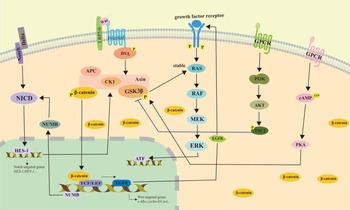
The crosstalk between signalling pathways partly explains tumour drug resistance. It mainly includes the activation of one pathway leading to the activation of another pathway and the activation of one pathway inhibiting the activation of the other pathway, which are important reasons for enhancing tumour drug resistance (Figs 1 and 2).
The crosstalk of relative signal pathways. T-cell factor/lymphoid enhancer factor (TCF/LEF), Frizzled (FZD), low-density lipoprotein receptor-related protein 5/6 (LRP5/6), cytoplasmic dishevelled protein (DVL), adenomatous polyposis coli (APC), casein kinase 1 (CK1), glycogen synthase kinase 3β (GSK3β), MAP kinase (MEK), extracellular regulated protein kinases (ERK), epidermal growth factor receptor (EGFR), human phosphoinositide-3 kinase (PI3K), serine/threonine protein kinase (AKT), tuberous sclerosis complex 2 (TSC2), cyclic AMP (cAMP), protein kinase A (PKA), Notch intracellular domain (NICD).

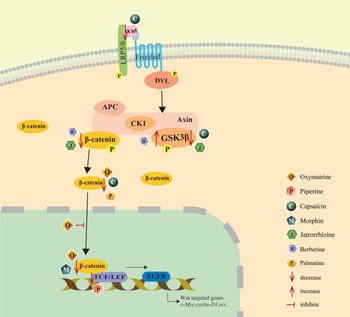
Schematic representation of the effects of alkaloids extracted from traditional Chinese medicine on regulatory mechanism of the Wnt/β-catenin signalling pathway.

Wnt/β-catenin and Ras/ERK pathway
Rat sarcoma virus (Ras) protein is a small guanosine 5'-triphosphate (GTP)-binding protein and oncogenic protein that is highly expressed in many human cancers (Ref. Reference Nakanishi38). Protein tyrosine kinase receptors such as the EGFR and platelet-derived growth factor receptor normally activate Ras (Ref. Reference Black39). Breast cancer cells may express more MDR-1 drug pump and anti-apoptotic B-cell lymphoma-2 Bcl-2 protein due to the transcriptional mechanism of transcription factor phosphorylation induced by downstream target kinases of the Ras/MAP kinase/extracellular regulated protein kinases (ERK) pathway, which in turn increases resistance to drugs like adriamycin and paclitaxel (Ref. Reference Yang31). Current studies have confirmed that the Wnt/β-catenin pathway is involved in the activation of the Ras/ERK pathway through the expression of EGFR (Fig. 1) (Ref. Reference Simanshu40). Moreover, RAS proteins are subjected to degradation by GSK3β when the Wnt signal is off, while it would be stable and thus activate the Ras/ERK pathway when GSK3β is phosphorylated (Refs Reference Wang33, Reference McCubrey41).
Wnt/β-catenin and PI3K/Akt pathway
The phosphoinositide 3-kinase (PI3K) signalling pathway is frequently overactivated in cancer, and PI3K activation is a key determinant of resistance to standard anti-cancer treatments (Ref. Reference Guerrero-Zotano42). According to recent research, the abnormal activation of PI3K/Akt can make breast cancer cells resistant to chemotherapy, endocrine therapy (Ref. Reference Araki43), HER2-targeted therapy (Ref. Reference Janiszewska44), PARP inhibitors (Ref. Reference Husna45) and immunotherapy (Ref. Reference Sobral-Leite46). Therefore, targeted blockade of PI3K/Akt can enhance the sensitivity of tumour cells to drugs and reverse tumour cell resistance (Ref. Reference Dong47). Crosstalk between the Wnt/β-catenin and PI3K/Akt pathways occurs concurrently and is primarily induced by the interaction of the TSC2 protein, a key player in the PI3K/Akt pathway, with GSK3β, a key player in the Wnt/β-catenin pathway, which inactivates GSK3β. The inactivation of GSK3β is the main reason for the crosstalk between the two pathways (Fig. 1). It has also been found that the crosstalk of this pathway can also lead to the resistance of TNBC cells to the pan-PI3K inhibitor GDC-0941 both in vivo and in vitro (Refs Reference Tzeng48, Reference Jabbarzadeh Kaboli49). Therefore, combined targeted therapy has a good prospect of reversing the drug resistance process of breast cancer cells.
Wnt/β-catenin and Notch pathway
Notch signalling plays a key role in breast cancer initiation, progression and chemotherapy resistance. When Notch receptors bind to ligands, Notch signalling is activated (Ref. Reference Kontomanolis50). The current study shows that in mammals, there are four Notch receptors and five ligands, of which the receptor Notch1 transmembrane receptor is involved in cell proliferation, invasion and chemotherapy resistance, while Notch4 is involved in breast cancer endocrine therapy resistance and EMT (Refs Reference Kontomanolis50, Reference Yuan51). The interaction of Notch signalling with the tumour microenvironment also contributes to chemoresistance in breast tumours, and at the same time, it promotes the growth and drug resistance of BCSCs (Ref. Reference Nandi52). The crosstalk between Wnt/β-catenin and the Notch pathway is primarily carried out via the NUMB protein. NUMB is a downstream target gene transcription product of the Wnt/β-catenin signalling pathway (Fig. 1) and an upstream inhibitor of the Notch pathway, so the overexpression of NUMB caused by Wnt/β-catenin signalling can inhibit tumour development by antagonising Notch signalling (Refs Reference Saha53, Reference Zhang54). In the MDA-MB-231 cell line, it was found that down-regulation of keratin 19 (KRT19) gene expression significantly down-regulated the expression of target genes in the Wnt/β-catenin pathway, while the expression of Notch1 signalling pathway-related proteins was increased. This process was shown to be mediated by inhibiting the expression of NUMB (Ref. Reference Saha55). At the same time, in another study, it was found that the crosstalk between the two pathways was related to the expression of the HES-1 gene (Ref. Reference Nasser56).
Wnt/β-catenin and cAMP/PKA pathway
Cyclic adenosine monophosphate (cAMP) is a secondary messenger that regulates many physiological and pathological processes, primarily through protein kinase A (PKA) regulating various downstream target genes. Studies have found that abnormal activation of this pathway can promote cancer progression in various malignancies, such as lung cancer (Ref. Reference Zhang57), while PKA activation is associated with trastuzumab resistance in HER2 positive breast cancer cells. This pathway promotes phosphorylation of GSK3β and thus promotes nuclear metastasis of β-catenin, leading to crosstalk with Wnt/β-catenin pathway (Fig. 1) (Ref. Reference Moody58). However, this crosstalk has not been proven in breast cancer, and its role in breast cancer needs to be further studied.
Therefore, single-passage inhibitors are often ineffective in reversing breast cancer resistance when the advantages of multi-targeted drugs or combinations thereof are apparent.
Research progress of alkaloids extracted from traditional Chinese medicine in targeting this pathway
Currently, chemotherapy is a major treatment for breast cancer (Ref. Reference Katoh59) and many inhibitors targeting the Wnt/β-catenin pathway, such as PORCN inhibitors (Ref. Reference Covey60), Wnt ligand antagonists and FZD antagonists/monoclonal antibodies, have been used in clinical trials (Ref. Reference Fisusi61). However, the use of these inhibitors in clinical practice often leads to some serious side effects. For example, FZD antagonists can cause symptoms such as diarrhoea, constipation, vomiting, abdominal pain, fatigue and disorders of bone metabolism in patients (Ref. Reference Covey60). Simultaneously, numerous studies have shown that many single-targeted chemotherapeutic drugs do not have a good anti-tumour effect, and tumour cells are susceptible to developing resistance to them. The advantage of traditional Chinese medicine in increasing the sensitivity of anti-tumour drugs or reversing tumour resistance lies in its multi-component and multi-target characteristics as well as its mild effects, which can improve the tolerance to chemotherapy and reduce the pain of the patient to some extent (Ref. Reference Qi62). Therefore, combining and integrating traditional Chinese medicine with modern therapy has good potential research value in reversing the drug resistance process of breast cancer.
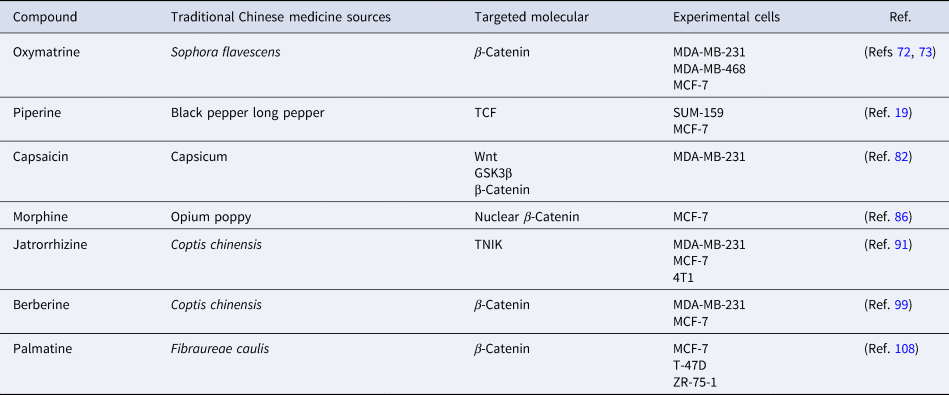
Alkaloids, a type of nitrogen-containing basic organic compound, are one of the important active ingredients in Chinese medicine (Ref. Reference Mondal63). According to the chemical structure classification (Ref. Reference Hu64), alkaloids are nitrogen-containing compounds derived from secondary, or specialised, metabolism (Refs Reference Lichman65, Reference Liu66), which contain nitrogen in the ring and can be divided into piperidine alkaloids, isoquinoline alkaloids, indole alkaloids, terpenoids alkaloids, steroidal alkaloids, quinoline alkaloids and so on. Alkaloids that are extracted from traditional Chinese medicine play an important role in the treatment of cancer and the reversal of cancer drug resistance (Table 1).
Relative compounds and their molecular mechanisms

Oxymatrine
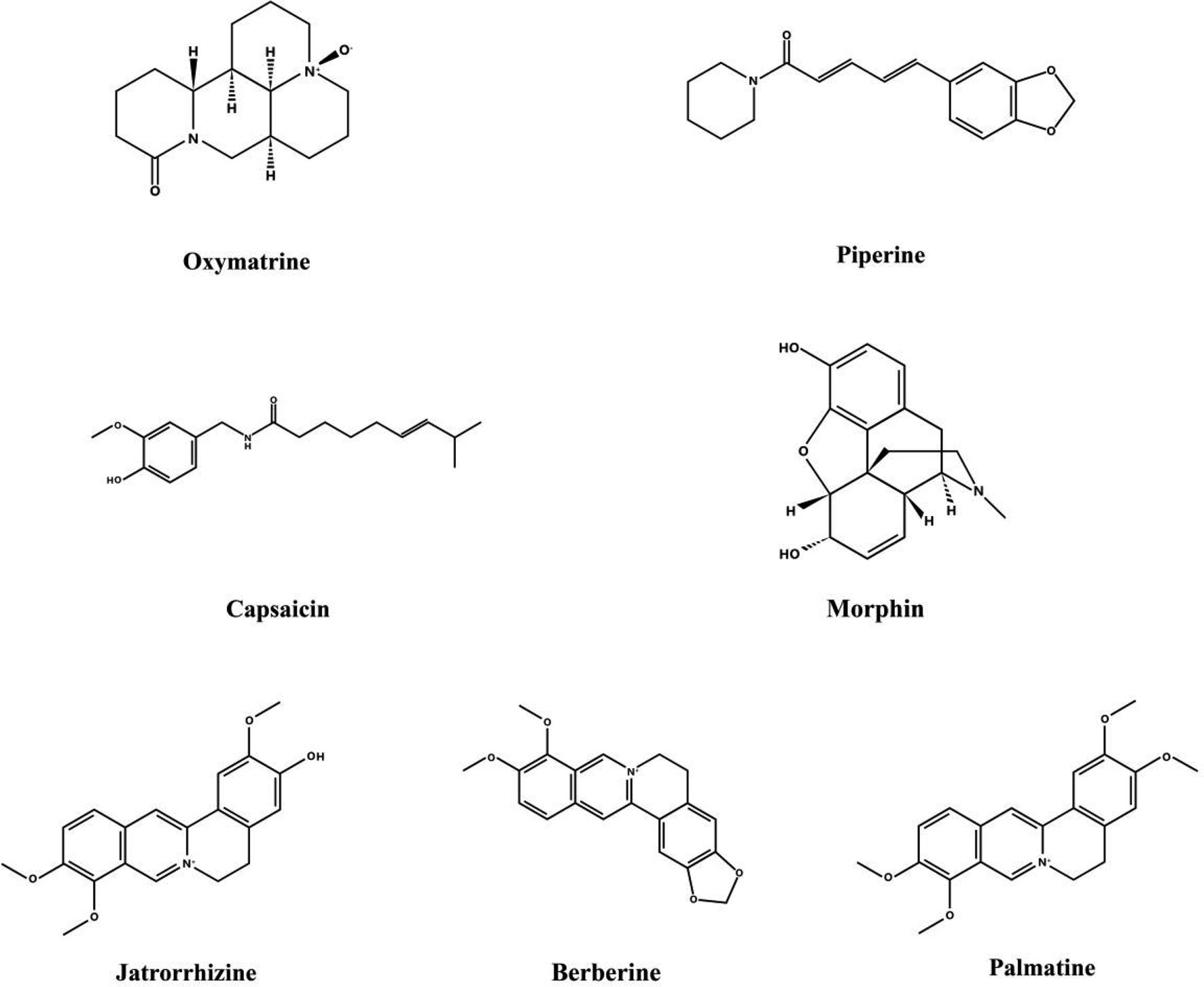
Sophora flavescens is a plant of Sophora in Leguminosae, and its dried roots can be used as traditional Chinese medicine. With bitter flavour and cold property, Sophora flavescens has been shown to have the following effects of clearing heat, drying dampness, killing insects and diuresis. As a quinoline alkaloid, oxymatrine is also a characteristic component of Sophora flavescens (Ref. Reference He67). With the chemical formula C15H24N2O2 (Fig. 3) and a molecular weight of 264.369 g/mol (Ref. Reference Chen68), it has been reported to effectively inhibit the proliferation of breast cancer cells, including ER-positive MCF cells, HER2-positive BT-474 cells and TNBC MDA-MB-231 cells (Refs Reference Wang69, Reference Garcia70).
Chemical structure of alkaloids.

As a recombinant humanised monoclonal antibody that blocks angiogenesis by inhibiting VEGF-A, bevacizumab has been used recently as an anticancer drug (Ref. Reference Zhang71). Bevacizumab use, however, frequently results in a bad prognosis, mostly because it activates the Wnt/β-catenin signalling pathway excessively, which facilitates tumour cell proliferation, migration and invasion. In vivo, the combination of oxymatrine and bevacizumab significantly reversed the tumour EMT process caused by aberrant activation of the Wnt/β-catenin pathway due to the use of bevacizumab in two TNBC cell lines, MDA-MB-231 and MDA-MB-468 (Ref. Reference Xie72), which also significantly down-regulated the transcription of c-Myc, Cyclin D1 and CD44, the downstream genes of the Wnt/β-catenin pathway, thereby enhancing bevacizumab tumour inhibition. Also in MCF-7 cell lines, the action of oxymatrine inhibited the Wnt/β-catenin pathway as well as BCSCs (Ref. Reference Zhang73).
Piperine
Pepper, a dried ripe fruit of Piper nigrum L, can be used as traditional Chinese medicine, which has the effects of warming the middle jiao, relieving pain, making qi descend, transforming phlegm and stimulating appetite (Ref. Reference Zheng74). Piperine is the main functional substance in pepper fruit, with the chemical formula C17H19NO3 (Fig. 3) and a molecular weight of 258.34 g/mol. It has been reported to have a variety of pharmacological effects, including anti-inflammatory activity, antioxidant activity, etc. (Ref. Reference Lim75).
It was shown that in MCF-7 and SUM-159 cell lines, the use of piperine resulted in the inhibition of the Wnt/β-catenin signalling pathway in the cells (GFP expression decreased from 13 to 2.39%) as revealed by the detection of TCF transcripts, and its combination with curcumin had an even more pronounced inhibitory effect on this pathway (GFP expression decreased from 13 to 0.89%). The combination of curcumin and piperine inhibited the stem cell properties of breast tumour cells, thereby reversing their insensitivity to chemotherapeutic agents (Ref. Reference Kakarala19).
Capsaicin
Chili pepper is the fruit of Capsicum annuum, which can also be used as traditional Chinese medicine. It offers the following effects of warming middle warmer, dispelling cold, harmonise qi and promoting digestion (Ref. Reference Barceloux76). Capsaicin is a phenolic alkaloid isolated from chili peppers with the chemical formula C18H27NO3 (Fig. 3) and a molecular weight of 305.40 g/mol (Ref. Reference Rajagopal77). Capsaicin, known for its analgesic and anti-inflammatory effects, has been reported to be effective in the treatment of obesity, cardiovascular diseases, gastrointestinal disorders, cancer, rhinitis, skin diseases and other diseases (Refs Reference Chapa-Oliver78, Reference Fokkens79).
Targeted inhibition of the Wnt/β-catenin signal pathway by capsaicin in cancer was first demonstrated in pancreatic cancer, where it inhibited phosphorylation of GSK3β, an important element of the pathway, which in turn induced degradation of β-catenin protein (Ref. Reference Pramanik80). Also in prostate cancer, capsaicin inhibited the expression of Wnt-2, p-GSK3β and β-catenin and the transcriptional down-regulation of c-myc and cyclinD1, the downstream targets of this pathway (Ref. Reference Zhu81). In the TNBC cell line MDA-MB-231, the use of capsaicin significantly inhibited the growth of breast cancer cells, while Wnt and β-catenin protein expression levels were down-regulated, indicating that this signal pathway was inhibited. Also in this cell line, G2/M cell cycle arrest, CDK8 expression levels decreased, and PI3K and Akt phosphorylation decreased, indicating that capsaicin significantly inhibited important signalling pathways in breast cancer as well as their crosstalk (Ref. Reference Wu82).
Morphine
Opium poppy, obtained by drying the latex from the fruit of the poppy plant, is a traditional Chinese medicine. It is bitter in taste, warm property and poisonous. It is effective in relieving pain, astringent to the intestines and suppressing cough. It is often used for heart and abdominal pain, prolonged diarrhoea, prolonged dysentery and cough without phlegm (Ref. Reference Canton-Alvarez83). Morphine is an alkaloid isolated from opium with the molecular formula C17H19NO3 (Fig. 3) and a molecular weight of 285.3 g/mol (Ref. Reference De Gregori84). As an alternative to narcotic medications for the treatment of cancer pain, morphine is increasingly being utilised in clinical settings to treat cancer metastases. It has been proven to impede the growth of MCF-7 and MDA-MB-231 tumour cells at high concentrations (>10 M) in nude mice (Ref. Reference Gach85). Morphine is typically administered to cancer patients together with anti-cancer medications.
However, morphine use in breast cancer patients can also have negative side effects, such as increasing drug resistance. In MCF-7 and BT549 cell lines, morphine at 10 μM increased the expression of CD44/CD24, a tumour stem cell marker. Morphine at 10 μM also promoted the expression of β-catenin in the nucleus of both cell lines, which in turn promoted the EMT process and metastasis of breast cancer (Ref. Reference Niu86).
In a study on morphine protection against recurrence in TNBC, the use of morphine reduced the risk of recurrence. Identifying the patient's cancer subtype is crucial information for using morphine in clinical practice because the drug's impact on a particular type of cancer may vary (Ref. Reference Montagna87).
Jatrorrhizine
Jatrorrhizine is a tetrahydroisoquinoline alkaloid, mostly derived from the traditional Chinese medicine, such as Limacia sagittata, Rhizoma coptidis and Golden cypress. Its structure is similar to that of berberine, which is a quaternary ammonium base formed by the thickening of two isoquinoline rings, and belongs to the berberine and proto-berberine group. It has the effect of clearing heat and drying dampness, draining fire and removing toxins (Ref. Reference Rolle88). With the chemical formula C20H20NO4+ (Fig. 3) and a molecular weight of 388.38 g/mol (Ref. Reference Rolle88), jatrorrhizine has reportedly been shown to have unique therapeutic effects in the treatment of diseases including diabetes and neuroinflammation as well as a vital function in antibacterial and antioxidant activities (Ref. Reference Zhong89).
The anticancer activity of jatrorrhizine has been demonstrated in a variety of cancers, including breast, thyroid and bladder cancers (Refs Reference Lu90, Reference Sun91, Reference Qin92). Targeted inhibition of the Wnt/β-catenin pathway has also been demonstrated in breast and colorectal cancers (Ref. Reference Wang93). In breast cancer MDA-MB-231, MCF-7 and 4T1 cell lines, jatrorrhizine targeted the inhibition of TNIK, a germinal centre kinase, whose inhibition resulted in the down-regulation of β-catenin expression and reduced phosphorylation of GSK3β (Ref. Reference Sun91).
Berberine
Coptidis rhizoma, the dried rhizome of Coptis chinensis Franch., Coptis deltoidea C. Y. Cheng et Hsiao or Coptis teeta Wall., is a relatively common traditional Chinese medicine. It has the effect of clearing heat and drying dampness, draining fire and removing toxins (Ref. Reference Wang94). Berberine is an isoquinoline alkaloid, which is isolated from many kinds of medicinal plants, such as Hydrastis canadensis, Berberis aristata, Coptis chinensis, Coptis japonica, Phellondendorn amurense and Phellondendron chinese Schneid, with the chemical formula C20H20NO4+ (Fig. 3) and a molecular weight of 388.36 g/mol (Ref. Reference Ortiz95). Berberine has not only been reported to have a protective effect on the central nervous system, but it also plays an important role in improving hyperlipidaemia and hyperglycaemia (Refs Reference Rauf96, Reference Li97).
Berberine has been shown to have the ability to naturally block Wnt/β-catenin signalling in tumours (Ref. Reference Albring98). Berberine inhibited Wnt/β-catenin signalling in breast cancer cells by decreasing β-catenin expression and increasing GSK3β expression, thereby inhibiting the EMT process in MDA-MB-231 and MCF-7 breast cancer cell lines, resulting in a decrease in metastatic and invasive properties (Refs Reference Dian99, Reference Feng100).
Palmatine
Fibraurea is a traditional Chinese medicine derived from the stem of Fibraurea recisa Pierre. With cold property and bitter flavour, fibraurea has the effects of clearing heat and detoxicating, draining fire and promoting bowel movements (Refs Reference Zheng101, Reference Su102). The main chemical composition of fibraurea is alkaloids, and the content of palmatine is as high as 3%. Palmatine has a wide range of pharmacological and biological activities, including anti-inflammatory, antiviral and anti-cancer, and has the effect of enhancing leukocyte phagocytosis (Refs Reference Zhang103, Reference Zhang104). With the chemical formula C21H22NO4+ (Fig. 3) and a molecular weight of 387.86 g/mol (Ref. Reference Chen105), palmatine has been used for the treatment of jaundice, dysentery, hypertension, inflammation and liver-related diseases (Ref. Reference Long106).
In a study on osteoarthritis, palmatine was found to reduce β-catenin expression in chondrocytes, which explains the protective effect of palmatine on articular chondrocytes by inhibiting Wnt/β-catenin signalling pathway, resulting in a reduction in the expression of matrix metalloproteinases and tissue inhibitors of metalloproteinases (Ref. Reference Zhou107). Palmatine inhibits the proliferation and viability of breast cancer cell lines MCF-7 in a dose-dependent manner, while having no significant effect on normal human breast epithelial cells. This growth inhibitory property of palmatine is associated with its induction of apoptosis. In addition, palmatine resulted in increased sensitivity of MCF-7 tumour cells to doxorubicin (Ref. Reference Grabarska108).
Conclusion
Wnt/β-catenin signalling pathway plays an important role in the occurrence, development and drug resistance of breast cancer (Ref. Reference Eslahi109). In the drug resistance process of breast cancer, the Wnt/β-catenin pathway is directly involved in promoting the expression of MDR genes or indirectly involved in the drug resistance of breast cancer cells by promoting the growth and accumulation of tumour stem cells and promoting the EMT process of breast cancer cells. At the same time, the Wnt/β-catenin pathway can activate PI3K/Akt and Ras/ERK pathways, or inhibit the expression of Notch signalling pathways, and participate in the drug resistance of breast cancer cells through crosstalk between these pathways. Therefore, selecting drugs that target and inhibit the Wnt/β-catenin pathway has high research value in improving the process of breast cancer drug resistance. Chemical drugs targeting this pathway are the main research direction at present. However, existing chemotherapy drugs typically have disadvantages such as severe side effects and a limited number of targets. The mild and multi-target properties of traditional Chinese medicine have a lot of potential for reversing breast cancer drug resistance. The alkaloids extracted from traditional Chinese medicine can greatly relieve and treat various diseases such as inflammation, and they also play an important role in anti-tumour. However, there are relatively few studies on the anti-tumour effects of alkaloids extracted from traditional Chinese medicines and even fewer on their role in relieving breast tumour drug resistance by targeting Wnt/β-catenin. Therefore, more traditional Chinese medicines have been explored. Extracting alkaloids and studying their mechanisms of action is beneficial in improving the methods of breast cancer chemotherapy. In conclusion, it is very promising to find traditional Chinese medicine extracts targeting the Wnt/β-catenin pathway in improving the sensitivity of breast tumours to drugs and reversing the drug resistance of breast tumours.
Competing interests
None.