1 Introduction
This paper concentrates on the lexical component of the faculty of language. It deals with two major interrelated questions that have been at the heart of far-reaching controversies regarding the nature of the lexical component. First, the Word vs. Root question: What kind of entries make up the mental lexicon? Does the lexicon include words (Jackendoff Reference Jackendoff1975, Aronoff Reference Aronoff1976, Di Sciullo & Williams Reference Di Sciullo and Williams1987, among others)? Or is it a storehouse of more basic elements, such as roots, whether consonantal roots as in Semitic languages or roots in the wider sense, as argued for other languages (by e.g. Marantz Reference Marantz, Dimitriadis, Siegle, Surek-Clark and Williams1997, Borer Reference Borer2005, Pylkkänen Reference Pylkkänen2008 and Ramchand Reference Ramchand2008)? The second question concerns the workings of the lexical component. Words often seem to derive from other words or from more basic units, for example, the Hebrew verb hudlak ‘got.lit’ (verbal passive) may derive from its transitive counterpart, hidlik ‘light’ (transitive), or possibly from the consonantal root, d.l.k. Is the lexicon an active component that involves valence changing operations setting the diathesis (adjectival passive, unaccusative, etc.) of the predicate? Or does it comprise only lists of underived (atomic) entries, while the derivation operations all occur in the syntax? We report an experiment, whose findings, we believe, provide support that the lexicon includes words and allows derivational operations, contra syntacticocentric approaches (Marantz Reference Marantz, Dimitriadis, Siegle, Surek-Clark and Williams1997, Harley & Noyer Reference Harley and Noyer1999, Borer Reference Borer2005, Pylkkänen Reference Pylkkänen2008, Ramchand Reference Ramchand2008, among many others).
Bolozky (Reference Bolozky1978), Horvath (Reference Horvath and Thomas-Flinders1981), Bat-El (Reference Bat-El1994), and Ussishkin (Reference Ussishkin1999) have argued, on the basis of morphological evidence, that the basic unit of the lexicon is the word (and not the root). These studies show that the input to certain morphological processes is necessarily a word and not a root. Assuming that these morphological processes occur in the lexicon, they conclude that the lexical component must contain words. However, the assumption that morphological processes occur in the lexicon is no longer a consensus: Recent models assume that words are associated with their morpho-phonological ‘clothing’ only after the syntactic derivation (e.g. Halle & Marantz Reference Halle, Marantz, Hale and Jay Keyser1993). If so, then the conclusion that morphological processes can take words as their inputs does not prove that words are listed in the lexicon.
This study deals with the thematic derivation of verbs and adjectives, that is, the derivation setting their semantic and syntactic valence, their diathesis, and not their morpho-phonological derivation.Footnote [2] It reports an experiment that tests the effect various diatheses have on speakers’ perception of idiom distribution. Idioms, as is well known, exhibit an intriguing duality: On the one hand, they are complex entities whose internal makeup reflects structural properties of phrasal units; on the other hand, their meaning is conventionalized and cannot be predicted on the basis of semantic composition, and therefore, they must be stored in mental representations. Owing to their dual nature, idioms turn out to constitute a unique source of information regarding the structure of the lexicon, and its storage techniques. The present study provides experimental support for the existence of constraints diathesis imposes on idiom storage and consequently on idiom distribution, as explained directly.
The set of idioms in a language is fixed the way the set of vocabulary items is. Of course, the set can be expanded, but it is not productive in the way syntactic derivations are. Indeed, most studies of idioms rely on data concerning the idioms that actually exist in the language. A stronger kind of evidence, however, could be provided if humans can judge what would be an acceptable pattern of idiom distribution in a given language and what would not be. A major claim of our study is that the human linguistic competence predicts particular patterns of idiom distribution: Certain patterns can exist and other patterns cannot. The paper reports experimental work testing subjects’ decisions with regard to the patterns of productivity of idioms. We teach adult speakers invented idioms in their native language and test them on these new idioms, aiming to shed light on their pattern of productivity. This seems to us important for assessing the properties of a finite entity like the set of idioms.
The structure of the paper is as follows: Section 2 defines the empirical array (Section 2.1), discusses the storage options for idioms (2.2), explains what the relevance is of data regarding the cross-diathesis distribution of idioms to the understanding of the structure of the lexicon (2.3), and delineates the current research question (2.4). Section 3 reports the experiment we conducted on native Hebrew speakers to test their perception of the distribution of idioms, and Section 4 discusses the findings, and evaluates various possible accounts.
2 Idioms: Background
As was mentioned above, idioms exhibit an inherent duality. On the one hand, they have syntactic structure similar to phrases built by the syntactic component. On the other hand, they have conventionalized meaning that cannot be predicted by semantic composition. This means that they must be stored. Since they involve syntactic structure, the question as to how they are stored is especially intriguing. Before discussing the storage options available for idioms, we delineate our empirical domain.
2.1 Defining the empirical array
Along the lines suggested by Horvath & Siloni (Reference Horvath and Siloni2016), we focus on the core set of idioms defined as follows: fixed multilexemic expressions whose meaning is unpredictable and figurative. We should note here that it has often been argued that there is no difference between special meaning of words and special meaning of idioms (Jackendoff Reference Jackendoff1997, Marantz Reference Marantz, Dimitriadis, Siegle, Surek-Clark and Williams1997, among others), we limit our investigation to multilexemic expressions because they involve special meanings of lexical items relative to one another. Therefore they raise questions that the storage of special meanings of single lexical items does not.Footnote [3] In our investigation, we focus on expressions with unpredictable (conventionalized) meaning. That is, the meaning of these fixed combinations of words cannot be calculated by semantic composition based on the meaning of their building blocks (see (1a–b) below). Finally, we look at expressions whose meaning is figurative, not literal (e.g. (1c–d) below). By ‘figurative’ we roughly mean that the (most often concrete) event or state described by the expression is representative of some other (more abstract) event or state. Thus, while (1a–b) are idioms in the above sense, as their meaning (‘chat casually and without purpose’ and ‘get to the point’, respectively) is both unpredictable and figurative, (1c–d) are fixed expressions (neither the verb nor the complement can be replaced), whose meaning is rather predictable and literal. Footnote [4]

Note that speakers are often unaware of the rationale behind the figuration in idioms (see (1a), for instance), but they do perceive that figuration is involved (as observed by Nunberg, Sag & Wasow Reference Nunberg, Sag and Wasow1994).
Horvath & Siloni (Reference Horvath and Siloni2016) distinguish between clausal idioms and phrasal idioms, as illustrated by (2a) vs. (2b) (and (1a–b) above) respectively, and explained directly.

Clausal idioms include sentential functional structure as part of their fixed material (e.g. fixed tense, modals, negation, or complementizers), for instance, can’t in (2a). In phrasal idioms, in contrast, the fixed combination of words, e.g. spill the beans in (2b), does not involve sentential functional material. Horvath & Siloni show that clausal idioms differ substantially from phrasal idioms. In this study we concentrate on phrasal idioms to ensure a coherent empirical array. Henceforth, when we use the term ‘idiom’ (with no further specification), it is a shorthand for phrasal idiom.
A basic question about idiom storage is whether they are stored as part of our linguistic knowledge or as part of our general, non-linguistic information, like historical or geographical facts. The choice between these two basic approaches seems to us quite uncontroversial. Knowledge of idioms involves form–meaning associations, which is linguistic in nature, and distinct from knowledge of facts of history and other language-independent knowledge. As such, it should a priori be stored with linguistic knowledge (see also Jackendoff Reference Jackendoff1997). Section 2.3 and the findings of the present research provide further support for the claim that idioms are stored with linguistic knowledge. The next question is how they are stored.
2.2 Storage
There are various options as to how idioms are stored. It has often been suggested that idioms are stored as independent entries, ‘big units’ of their own (e.g. the psycholinguistic studies by Bobrow & Bell Reference Bobrow and Bell1973, Swinney & Cutler Reference Swinney and Cutler1979, Gibbs Reference Gibbs1980).Footnote [5] The idea that idioms are stored as subentries of other existing entries has also been entertained. Specifically, it has been suggested that they are stored by multiple storage, that is, as subentries of the lexical entries of their constituents, namely, the head and its dependents (Everaert Reference Everaert, Rappaport-Hovav, Doron and Sichel2010), or as subentries of the Encyclopedic entries of their constituents (Harley & Noyer Reference Harley and Noyer1999). Alternatively, it has been proposed that they are stored under the lexical entry of the head of the idiom (Baltin Reference Baltin, Baltin and Kroch1989, Horvath & Siloni Reference Horvath and Siloni2009).Footnote [6] These storage hypotheses are summarized in (3).

Options (3bi) and (3bii) above share the claim that idioms are stored under the entry of their head. They differ as to whether idioms are stored in addition under the entries of their other constituents. We put the latter question aside here, and investigate the hypothesis of storage under the head – a claim shared by (3bi) and (3bii).Footnote [7]
A priori, two options come to mind as to how idioms are listed (stored) under their head: Either they are stored under the root of the head or they are stored under the actual predicate heading the idiom. Which of these options is available depends on the nature of listed entries. For concreteness consider the Hebrew idiom in (4), which appears in both the transitive (4a) and the unaccusative diathesis (4b).Footnote
[8]
 $^{,}$
Footnote
[9]

If the lexical entry is an abstract verbal representation, unspecified for diathesis, such as the consonantal root y.c.a., then the idiom is stored under that root, and can therefore be realized in both diatheses. If both diatheses (i.e. both the transitive and the unaccusative verb) are entries in the lexicon, then the idiom can be stored under its corresponding verbal diathesis. The same holds for the transitive (5a) and adjectival passive (5b) pair:

Regarding the sharing of idiomatic meaning (which is illustrated in (4) and (5)), it has sporadically been observed in the literature that the verbal (eventive) passive always shares its idioms with its active alternant, while the adjectival passive can give rise to idioms that are not available to the corresponding active (see Ruwet Reference Ruwet1991, Dubinsky & Ron Simango Reference Dubinsky and Ron Simango1996, and Marantz Reference Marantz, Dimitriadis, Siegle, Surek-Clark and Williams1997). A first quantitative examination of these observations is reported in Horvath & Siloni (Reference Horvath and Siloni2009), who also discuss their relevance for idiom storage. This is briefly summarized in the next section.
2.3 Horvath & Siloni (Reference Horvath and Siloni2009): Distribution across diatheses and storage
Horvath & Siloni (Reference Horvath and Siloni2009) present a survey of Hebrew idioms designed to examine their distribution across diatheses in order to shed light on their storage and the nature of listed entries. For the purposes of the study, the notion ‘unique idiom’ was defined. An idiom is unique to a given diathesis
 $\unicode[STIX]{x1D6FC}$
, if
 $\unicode[STIX]{x1D6FC}$
does not share the idiom with its (existing) root-counterpart
 $\unicode[STIX]{x1D6FD}$
, which
 $\unicode[STIX]{x1D6FC}$
would most directly be related to by derivation. The formulations in (6) give the explicit definition of uniqueness for the various diatheses examined in the study: the verbal passive, the unaccusative, the adjectival passive, and the transitive.Footnote
[10]

The study examined whether phrasal idioms show cross-diathesis distribution or can give rise to unique idioms for the above-mentioned diatheses.
Horvath & Siloni argue that the distribution of unique idioms across diatheses is revealing with regard to idiom storage: If the idiom is stored as a subentry of the bare root, a priori, idiom sharing across diatheses is expected, that is, idiomatic meanings should be shared by the different diatheses associated with their root, except for gaps due to independent reasons. Robust, systematic occurrence of unique idioms is not expected. If, in contrast, the entry under which the idiom is stored is the actual predicate (diathesis) heading it, idiom sharing is not dictated. Rather, unique idioms should be possible, as long as their head itself is an entry, under which the idiom can be stored. That is, the occurrence of unique idioms is expected. Finally, if idioms are stored as independent entries (not as subentries), their storage is not dependent on the existence of any other entry. Consequently, idiom distribution (occurrence) should in this case be indifferent to the diathesis of the head: Unique idioms should be able to be headed by any diathesis (predicate) independently of whether or not the particular diathesis itself constitutes an entry. This is summarized below.

Horvath & Siloni (Reference Horvath and Siloni2009) sampled 60 predicates of each of the four diatheses from a verb dictionary, and checked whether or not they appear in unique idioms.Footnote [11] For each diathesis type, the number of predicates heading one or more unique idioms was counted. The results are presented in Table 1.
The distribution of unique phrasal idioms across diatheses.

Out of the 60 verbal passive predicates, none appeared in unique idioms. The difference between this result and the number of predicates participating in unique idioms in each of the other diatheses (unaccusatives, transitives, adjectival passives) was statistically significant. The difference between the number of unaccusatives, transitives, and adjectival passives that participated in unique idioms was insignificant.
The findings show that idioms are sensitive to the diathesis of their head. This sensitivity reinforces the claim that idioms are stored as linguistic knowledge, since otherwise there is no reason for them to be affected by a grammatical factor such as the diathesis of their head. Likewise, they show that phrasal idioms are not stored as independent entries of their own; if they were, any diathesis would be able to appear in unique idioms independently of whether or not it is listed. Moreover, the pervasive occurrence of unique idioms attests against storage by the root (7a), which erroneously predicts sharing of idioms across diatheses. The findings favor storage under the word, i.e. the diathesis heading the idiom (7b), which predicts considerable occurrence of unique idioms.
Let us now see how the specific pattern of idiom distribution across diatheses was accounted for by Horvath & Siloni (Reference Horvath and Siloni2009). First, it is suggested that transitive verbs, unaccusative verbs, and adjectival passives are entries listed in the lexicon. It then follows that an idiom may be uniquely listed under each of them, resulting in a unique idiom. The verbal passive, in contrast, is assumed not to be formed and listed in the lexicon. Hence, it cannot head unique idioms at all, because there is no lexical entry whose subentry the idiom could be. Indeed, in the linguistic literature it is a widely held view that the verbal passive is not formed in the lexical component but constitutes a post-lexical output (Baker, Johnson & Roberts Reference Baker, Johnson and Roberts1989, Collins Reference Collins2005, Horvath & Siloni Reference Horvath, Siloni, Armon-Lotem, Danon and Rothstein2008, Meltzer-Asscher Reference Meltzer-Asscher, Everaert, Marelj and Siloni2012, among others).
As for the other diatheses, it is debated where they are formed, but there are studies that argue that transitives are lexical entries, which can serve as input for diathesis derivation (Reinhart Reference Reinhart2002, Horvath & Siloni Reference Horvath and Siloni2011, Siloni Reference Siloni2012), and that unaccusatives and adjectival passives are derived by a lexical operation (see Levin & Rappaport-Hovav Reference Levin and Rappaport-Hovav1995, Reinhart Reference Reinhart2002, Chierchia Reference Chierchia, Alexiadou, Anagnostopolou and Everaert2004, Koontz-Garboden Reference Koontz-Garboden2009, Horvath & Siloni Reference Horvath and Siloni2011 for unaccusatives; and Levin & Rappaport-Hovav Reference Levin and Rappaport-Hovav1986, Horvath & Siloni Reference Horvath, Siloni, Armon-Lotem, Danon and Rothstein2008, Meltzer-Asscher Reference Meltzer-Asscher2011 for adjectival passives). Further discussion of this approach and of alternative accounts is provided in Section 4 below.
Before turning to the present experiment, we reiterate that the existence of unique idioms for the transitive, unaccusative, and adjectival passive does not mean, of course, that all the phrasal idioms they head are unique; phrasal idioms can appear in two (or more) diatheses, as illustrated in (4)–(5) above.Footnote [12]
2.4 Goal and research questions
In light of the above results, we set out to reexamine the distribution (uniqueness vs. sharing) of idioms across diatheses – using a different technique – and reevaluate its theoretical consequences. The empirical question we addressed was whether the diathesis heading the idiom affects speakers’ evaluation as to whether the corresponding transitive version of this idiom (i.e. the corresponding idiom headed by the transitive alternant) exists. We therefore limited ourselves to the following three nontransitive diatheses: verbal passives, adjectival passives and unaccusatives.
To check that, we designed an idiom-teaching experiment overriding the fact that idioms constitute a closed set per language by using invented idioms. Given that mastering new idioms means storing them the way other idioms are stored, the experiment opened a window on speakers’ linguistic competence in the domain of idioms and their storage. Native speakers of Hebrew were taught invented Hebrew phrasal idioms, which were inspired by existing idioms in French. The idioms were headed by an unaccusative, a verbal passive, or an adjectival passive. After learning and assimilating the new idioms, the participants were presented with each idiom again and were asked to estimate how likely it seemed to them that the corresponding transitive version of the idiom would exist. In this way, we examined for each idiom to what extent it was perceived to be able to be unique because if an idiom is highly likely to have a transitive counterpart, then it is highly likely not to be unique.
Our assumption was that if there indeed is a systematic pattern of idiom distribution across diatheses, then it would manifest itself in speakers’ evaluations of nonextant (i.e. invented) idioms as well. Our prediction was as follows: If Horvath & Siloni’s (Reference Horvath and Siloni2009) findings indeed represent a linguistic pattern, then the results should show a significant difference between the verbal passive and the other diatheses with regard to their likelihood to head unique idioms, as reflected in speakers’ evaluations.
3 The experiment
3.1 Method
3.1.1 Participants
Participants were thirty-five native speakers of Hebrew, undergraduate students at Tel Aviv University and at the Tel Aviv-Yafo Academic College, with no knowledge of French. Their age ranged from twenty to thirty-five years (mean age 27.5 years).
3.1.2 Materials and design
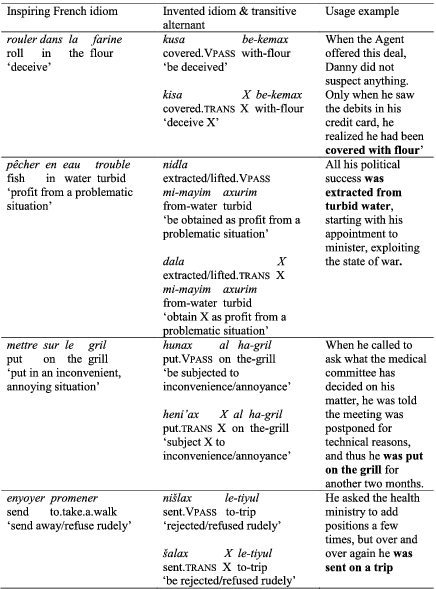
The stimuli consisted of twelve phrasal idioms in Hebrew especially composed for the purpose of the experiment, inspired by existing idioms in French. Out of the twelve idioms, four were headed by a verbal passive, four – by an unaccusative, and the remaining four – by an adjectival passive.Footnote [13] All the predicates have a morphologically distinct transitive alternant, and all the idioms rely on a verbal/adjectival meaning that the corresponding transitive alternant shares. Six speakers concurred that all idioms had unpredictable meaning and involved figuration (see Section 2.1 above). The transitive versions of the idioms – presented independently of their alternants – were judged by six (other) speakers as possible idioms. Each idiom was read in various tenses, together with a concise explanation of its meaning, and a matching example of usage in context. Table 2 includes examples for each idiom type, with a translation of its meaning and an example of usage. For the full list including the transitive versions and the inspiring French idioms, see appendix.
Examples of stimuli for each condition.

aThe unaccusatve yaca ‘went/got.out’ has a transitive alternant, hoci ‘took/got.out’.
Four forms were composed. Form I contained the list of idioms in pseudo-random order. Form II had the list of idioms (in the same pseudo-random order), each accompanied by its meaning and an example of usage. Form III included two tasks: (i) a completion task – idiom completion based on the beginning of the idiom – and (ii) a multi-choice comprehension question for each idiom in context, as illustrated in (9) and (10), respectively, for the idiom in (8). Subjects were asked to fill in this form for purposes of practice and to ensure the idioms were incorporated in their lexicon.

Form IV was the target questionnaire: For each of the twelve idioms, subjects had to rank the extent to which they perceived the idiom as likely to exist in its transitive version, on an ordinal scale from 1 (least likely) to 5 (most likely). A translation of the target question corresponding to the idiom in (8) is given in (11). The transitive form was presented in the impersonal, third person plural (past, which is the citation form).

3.1.3 Procedure
The experiment proceeded in two steps. In the first session, the experimenter handed out Form I (bare idiom list) to the participants. Next, she explained the idioms based on Form II, by reading each idiom aloud in various tenses, along with its meaning and an example of usage. Participants had only Form I in order to direct their attention to the experimenter’s explanation. At the end of the session, the experimenter handed out Form II to the participants, who were asked to study the idioms again at their leisure before the second session. The second session took place three days later.
The experimenter reviewed the idioms, by reading them aloud again one-by-one alongside their meanings. Next, Form III (the testing form), which checked idiom assimilation, was handed out and participants were asked to fill in the completion tasks and answer the multi-choice questions. Immediately afterwards, participants received the target questionnaire (Form IV) and were asked to rate the likelihood that the transitive version of the idiom existed.
3.2 Results
The statistical analyses were performed on the thirty-five subjects (no participant was excluded as they all filled in Form III correctly). A Wilcoxon signed-rankFootnote
[14]
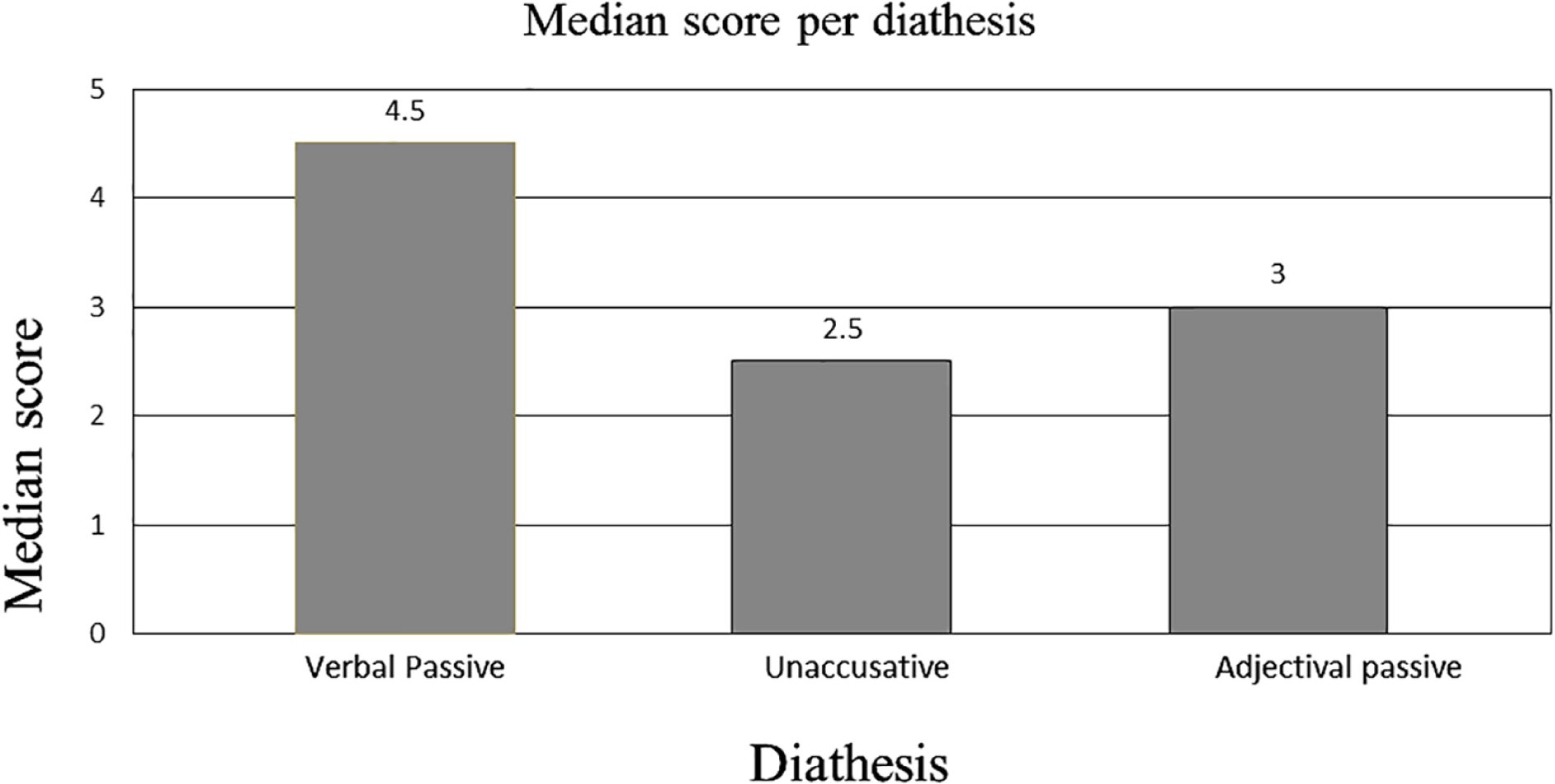
test comparing participants’ median ratings per diathesis (see the chart in Figure 1) revealed the following pattern. Subjects ranked idioms headed by the verbal passive (median
 $=$
4.5, interquartile range
 $=$
0.75, standard deviation
 $=$
0.9) as significantly more likely to share idiomatic meanings with their transitive counterparts than they ranked idioms headed by the unaccusative (median
 $=$
2.5, interquartile range
 $=$
1.12, standard deviation
 $=$
0.8; two-tailed: W(26)
 $=$
324,
 $p<0.0001$
) and the adjectival passive (median
 $=$
3, interquartile range
 $=$
0.75, standard deviation
 $=$
0.7; two-tailed: W(25)
 $=$
296,
 $p=0.0001$
). The likelihood of the unaccusative and the adjectival passive to share their idiomatic meanings with their transitive alternant was not significantly different (two-tailed: W(26)
 $=$
142,
 $p=0.072$
).
Median score for each diathesis.

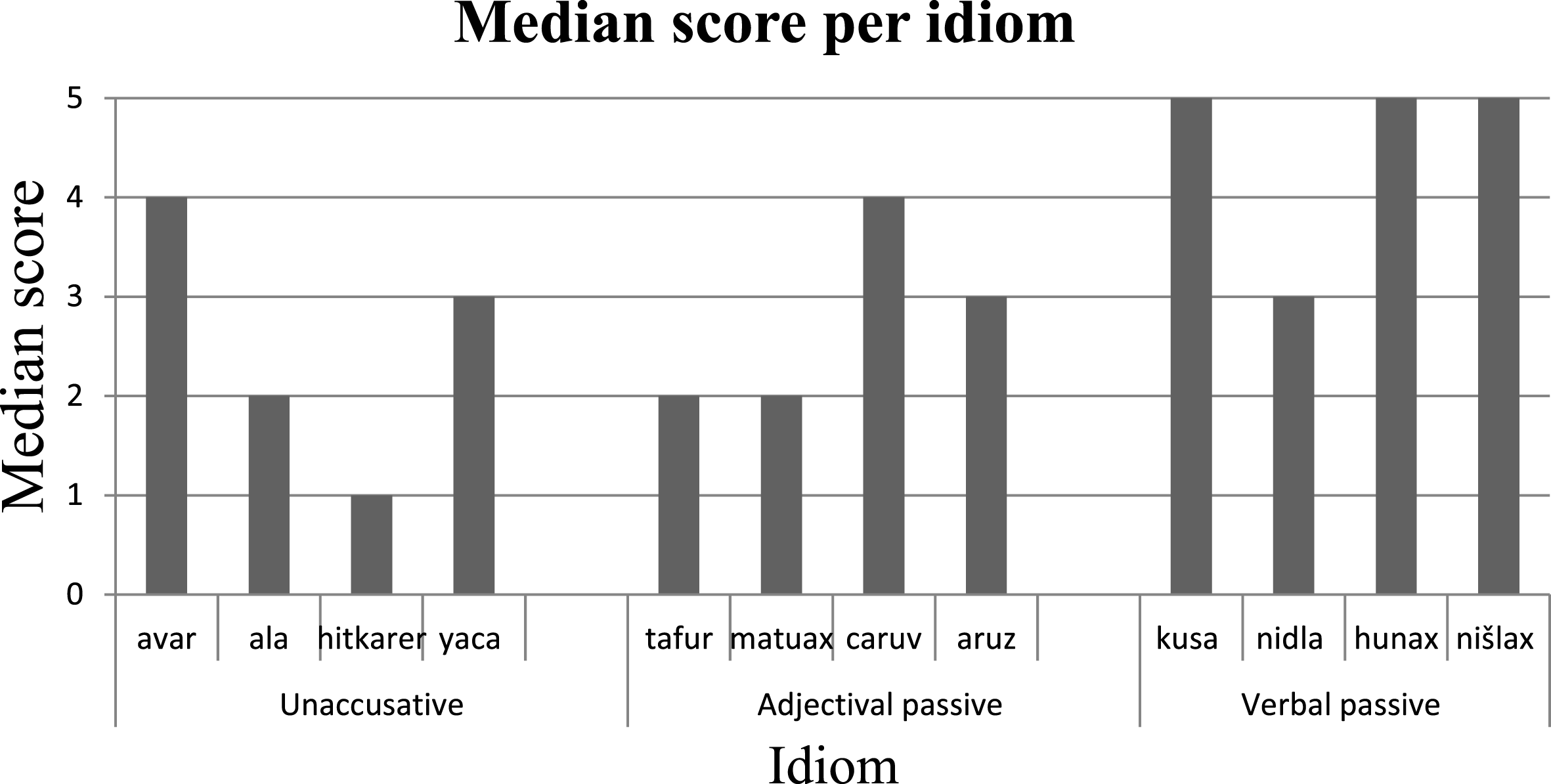
The median score of each idiom in the three conditions (diatheses) is shown in Figure 2. Idioms are referred to by their head and according to the order in which they appear in the appendix.
The patterns of median scores per participant observed for the verbal passive were compared to 5, the highest possible score. A Wilcoxon signed-rank test shows that the verbal passive median scores (4.5) were significantly lower than 5 (two-tailed W(17)
 $=$
153,
 $p=0.0003$
).
4 Discussion
4.1 No unique verbal passive idioms
The experiment reveals that there is a significant difference between speakers’ perception of idioms headed by a verbal passive versus their perception of idioms headed by either an unaccusative or an adjectival passive. Speakers perceive idioms headed by the verbal passive as significantly more likely to share idiomatic meanings with their transitive alternants compared to idioms headed by either the unaccusative or the adjectival passive. No significant difference was found between idioms headed by the unaccusative versus those headed by the adjectival passive. Both scored at the mid-range of the scale.
Median score for each idiom.

For these diatheses, there does not seem to be any criterion systematically determining when an idiomatic meaning (potentially plausible also for the transitive) is unique to the diathesis and when it is available in the transitive, too. For example, there is no obvious reason why (12a) is a unique idiom in Hebrew while (4b) above, repeated as (12b), exists also in the transitive diathesis (see (4a)). (Of course, there may be idiosyncratic factors excluding a potential alternant in certain cases.)Footnote [15]

If so, then the participants had no guiding criterion to decide whether or not the unaccusative and adjectival passive idioms share their idiomatic meaning with the corresponding transitive. This individual uncertainty as to whether or not the transitive idiom is possible translated into scores at the mid-range of the scale (3 for the adjectival passive and 2.5 for the unaccusative); no large individual variance is observed, as shown by the interquartile ranges, and standard deviation values.
As mentioned, speakers perceive idioms headed by the verbal passive as significantly more likely to share idiomatic meanings with their transitive alternants compared to idioms headed by the unaccusative or the adjectival passive. There must be a factor that has driven responses in the case of the verbal passive in this direction (as will be discussed in Section 4.2). However, the median scores per participant observed for the verbal passive (4.5) were found to be significantly lower than the highest possible score (5). A second glance at the chart in Figure 2 reveals that the median score of three of the idioms in the verbal passive condition was 5. The median score 4.5 was driven by the median score of one single idiom, the one in (13) (no such distribution is observed for the other conditions).

Examining this invented idiom again, we realized that the verb heading it was clearly much less frequent than the verbs heading the other idioms, and more importantly, that certain speakers may not even be acquainted with the verb. This was verified on the basis of Frost & Plaut’s (Reference Frost and Plaut2005) word-frequency database for printed Hebrew. The fact that the verb is rare and the form may not be known to speakers may have affected their evaluations. If the idiom is excluded, the median score of the verbal passive condition is 5. That is, subjects ranked idioms headed by the verbal passive as necessarily having a transitive alternant.
4.2 Support for Horvath & Siloni’s (Reference Horvath and Siloni2009) approach
The results of the experiment thus reproduce the pattern of distribution of phrasal idioms reported in Horvath & Siloni’s (Reference Horvath and Siloni2009) idiom survey. More specifically, subjects’ evaluations exhibited a significant difference between the verbal passive and the other diatheses with regard to their likelihood to head unique idioms.
The findings provide support for the claim that idioms are stored in the lexicon, where linguistic knowledge is stored.Footnote [16] If idioms were stored as part of general knowledge with other memorized data, speakers’ perception of their distribution should not be sensitive to a grammatical feature such as the diathesis of the predicate. Since speakers do show such sensitivity, it reinforces the claim that idioms are stored in the lexicon together with other form–meaning associations.
The results also reinforce the claim that phrasal idioms are stored as subentries of their lexical head, and not as independent entries of their own. If phrasal idioms were not stored as subentries but as independent units, there would be no reason for speakers to treat them differently depending on the diathesis of their head. Further, the root-storage option turns out to be implausible, because if phrasal idioms were stored under the root of their head, all other things being equal, we would expect the three diatheses to be perceived by speakers as equally likely to share idiomatic meanings with their transitive alternants; recall that the transitive alternants of the experimental items had been judged as possible idioms. Rather, the results support the claim that idioms must be stored as subentries of the predicate (actual diathesis) heading them – a word, not a root.Footnote [17] In the rest of this section, we first analyze the results under Horvath & Siloni’s (Reference Horvath and Siloni2009) approach, and then discuss alternative analyses.
On Horvath & Siloni’s approach, the results would be accounted for as follows. The speakers perceived idioms headed by the verbal passive as having a transitive alternant because verbal passives, being formed post-lexically (as has been claimed by Baker et al. Reference Baker, Johnson and Roberts1989, Collins Reference Collins2005, Horvath & Siloni Reference Horvath, Siloni, Armon-Lotem, Danon and Rothstein2008, Meltzer-Asscher Reference Meltzer-Asscher, Everaert, Marelj and Siloni2012 on independent grounds), are not entries in the lexicon.Footnote [18] The unaccusative and the adjectival passive were perceived as significantly more likely than the verbal passive to head unique idioms. This is accounted for by the claim that the former diatheses are listed in the lexicon, and thus can have idioms as their subentries. No significant difference was found between speakers’ perception of unaccusative and adjectival passive idioms regarding uniqueness. If both diatheses are lexical entries, a priori there should not be a difference between them regarding the tendency to occur in unique idioms.
It has been independently suggested that unaccusatives as well as adjectival passives are derived in the lexicon (Levin & Rappaport-Hovav Reference Levin and Rappaport-Hovav1995, Reinhart Reference Reinhart2002, Chierchia Reference Chierchia, Alexiadou, Anagnostopolou and Everaert2004, Koontz-Garboden Reference Koontz-Garboden2009, Horvath & Siloni Reference Horvath and Siloni2011 for unaccusatives; and Wasow Reference Wasow, Culicover, Wasow and Akmajian1977, Levin & Rappaport-Hovav Reference Levin and Rappaport-Hovav1986, Horvath & Siloni Reference Horvath, Siloni, Armon-Lotem, Danon and Rothstein2008, Meltzer-Asscher Reference Meltzer-Asscher2011 for adjectival passives). Our findings that unaccusatives and adjectival passives are lexical entries provide support for these studies. If a particular derived diathesis is shown to be listed in the lexicon, its derivation must be lexical, assuming that the lexicon is the component systematically providing input for the syntax, but not vice versa, that is, assuming that productive syntactic derivations do not regularly feed the lexical component.Footnote [19] If these diatheses are indeed derived by lexical operations, it means that the lexicon must be an active component of Grammar (as argued by Reinhart Reference Reinhart2002, Siloni Reference Siloni2002, among others), and not a mere storehouse of atomic items, in contrast with the view of syntacticocentric approaches (Marantz Reference Marantz, Dimitriadis, Siegle, Surek-Clark and Williams1997, Harley & Noyer Reference Harley and Noyer1999, Borer Reference Borer2005, Pylkkänen Reference Pylkkänen2008, Ramchand Reference Ramchand2008, among many others).
Note that it also follows that unaccusatives and adjectival passives are not lexically derived anew upon each retrieval (use); they must be listed as lexical entries or else they could not have their own subentries. That is, the organization of the lexical component should, of course, capture the relation between derived diatheses and their input, but the derivation itself does not apply with each use of the diathesis by the speaker, as the diathesis (the derived item) itself is listed.Footnote
[20]
 $^{,}$
Footnote
[21]
Horvath & Siloni’s (Reference Horvath and Siloni2009) approach indeed accounts for the findings. But other approaches seem a priori plausible too. We examine them directly.
4.3 Alternative approaches
A potential alternative explanation could be that the results are reflections of the productivity found at the diathesis level, that is, that they reflect inheritance from the verb level to the idiom level. Specifically, since there are no verbal passives that lack a corresponding transitive alternant, there are also no verbal passive idioms that lack a transitive counterpart. And the same way that there are sporadic gaps in the transitive–unaccusative alternation (certain unaccusatives idiosyncratically lack a transitive alternant in a given language, and vice versa), unaccusative and transitive idioms can similarly lack a corresponding transitive/unaccusative counterpart. Indeed, in the case of the verbal passive, an inheritance approach from the verb to the idiom level can be envisioned. However, as far as the transitive–unaccusative alternation is concerned, this approach is implausible. While uniqueness of unaccusative and transitive idioms is a pervasive phenomenon, as shown in Table 1 (and exemplified in (12a) above and (14) below), unaccusative verbs systematically have a transitive alternant (with a Cause external role) and vice versa, except isolated sporadic gaps (Haspelmath Reference Haspelmath, Comrie and Polinsky1993, Reinhart Reference Reinhart2002). Therefore, idiom uniqueness regarding unaccusatives and transitives does not reflect a parallel phenomenon at the verb level.

Thus, the ‘inheritance’ approach cannot account for the entire set of findings (for more evidence against this approach, see Horvath & Siloni Reference Horvath, Siloni, Bowern, Horn and Zanuttini2017). An anonymous JL referee proposes another possible approach, one that relies on a difference in valence between verbal passives, which have two arguments available (including the implicit external argument), versus unaccusatives and adjectival passives, which are one-place predicates. The contrasting findings of the experiment may then follow, so the argument goes, from the fact that when speakers are asked to estimate the likelihood of the active transitive version based on a verbal passive idiom, they are dealing with predicates of the same valence (both two-place), but when they have to relate an unaccusative or an adjectival passive idiom to a potential transitive version, speakers need to convert a one-place predicate into a two-place, transitive version of the same idiom. The addition of an argument necessary in the unaccusative and adjectival passive cases but not in the verbal passive may add some extra difficulty to the task, and thus it might be claimed to be the source of the difference in the results found between these diatheses.
However, such an approach does not seem to explain the total lack of verbal passive idioms reported by Horvath & Siloni’s (Reference Horvath and Siloni2009) survey of existing idioms. Suppose it is easier to ‘transitivize’ a verbal passive idiom – this still would not explain why the latter always has a transitive alternant.
Marantz (Reference Marantz, Dimitriadis, Siegle, Surek-Clark and Williams1997), advancing the Distributed Morphology framework, which has a single structure-building engine, the syntax, suggests that the syntactic head introducing the external argument (Agent) is the boundary delimiting the domain of special (idiomatic) meanings. He thus argues that the fact that the verbal passive involves an external argument (explicit or implicit) is the reason why it cannot be associated with special meanings (that is, cannot head unique idioms). The unaccusative, in contrast, lacks an external argument and can head unique idioms. It is, however, not obvious how this line of reasoning can account for the fact that transitive verbs can head unique idioms, although they involve an external argument. Further, it has been shown in recent literature that a subset of the set of adjectival passives does involve an external argument (Anagnostopoulou Reference Anagnostopoulou, Alexiadou, Rathert and von Stechow2003, Meltzer-Asscher Reference Meltzer-Asscher2011, McIntyre Reference McIntyre, Alexiadou and Schäfer2013, Gehrke & Marco Reference Gehrke and Marco2014). Among the adjectival passives used in the present study, one finds adjectival passives involving an Agent (aruz ‘packed’ and tafur ‘sewed’), contra the predictions made by an account along these lines. Adjectival passives involving an Agent are also found in Horvath & Siloni’s (Reference Horvath and Siloni2009) survey of unique idioms discussed in Section 2.3 above.
The syntactic boundary delimiting the domain for idiosyncratic meanings could then be argued to be higher than the head responsible for the Agent, say, the head responsible for the formation of verbal passives. The verbal passive would not give rise to unique idioms because it would be beyond the syntactic domain of special meanings. Such a proposal would be at odds with Arad’s (Reference Arad2005) arguments that the domain of idiosyncrasy is the local domain of the root, the domain delimited by the first category-assigning head above the root; the domain of any higher head is argued by Arad to have no access to meanings associated with the root. If so, then a syntactic account extending the locality domain of the root to cover the split behavior of idioms (in the verbal passive versus the other diatheses) seems unfeasible.Footnote [22]
As is clear from the above discussion, we believe that the above alternative proposals are less adequate than the one proposed by Horvath & Siloni (Reference Horvath and Siloni2009) to account for our findings.
5 Conclusion
The paper reports an experimental study allowing a glimpse into speakers’ linguistic competence in the domain of idioms and their storage. It provides experimental support for the pattern of cross-diathesis distribution of phrasal idioms reported in previous literature (in particular, Horvath & Siloni Reference Horvath and Siloni2009). Speakers evaluated the likelihood of the verbal passive to share idiomatic meanings with its transitive counterpart as significantly higher than that of both the adjectival passive and the unaccusative. The results contribute to our understanding of the nature of the lexicon, the derivations of several diatheses, and the storage of phrasal idioms. First, they suggest that the lexicon includes words and is an active component of Grammar, where valence-changing operations can apply. Specifically, they suggest that adjectival passives and unaccusatives are listed in the lexicon, and are derived by lexical operations, contra syntacticocentric approaches. The verbal passive is distinct: The findings reinforce the view that it is a post-lexical output, not listed in the lexical component, in concert with common approaches. As for the storage of phrasal idioms, given that their distribution has turned out to be sensitive to a grammatical property, i.e. the diathesis of their head, they cannot be stored in an extra-grammatical component, where such grammatical features are irrelevant for storage of information. The fact that the diathesis of the head crucially affects speakers’ perception of the distribution of phrasal idioms suggests that phrasal idioms are stored as subentries of their actual head.
APPENDIX
The list of invented idioms
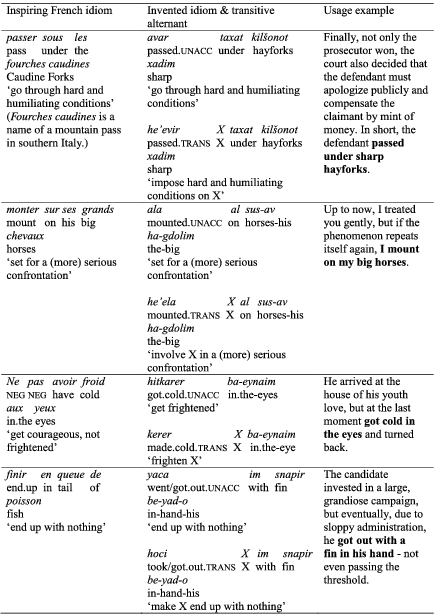
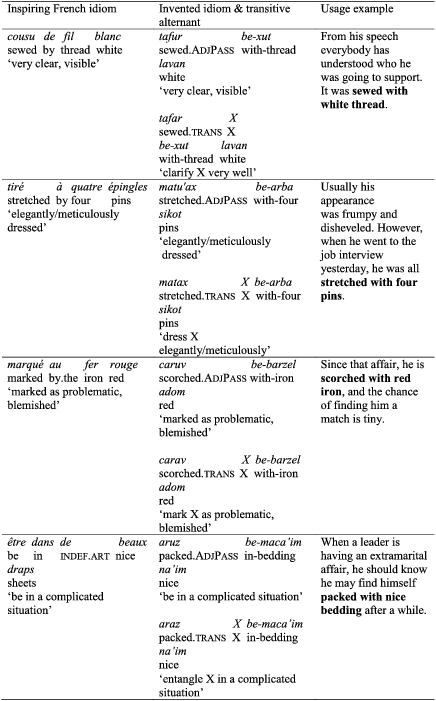
The full list of invented idioms in Hebrew is given below in three tables according to the diathesis of the verb heading the idiom. The tables include the English translations of the usage examples and the French idioms that inspired the Hebrew ones.Footnote
[23]
 $^{,}$
Footnote
[24]
Unaccusatives.

Adjectival passives.

Verbal passives.