1. Introduction
Time is a social institution because all human societies must decide how to organize the temporal rhythms of their collective activity (Durkheim, Reference Durkheim1965 [1915], p. 23). They may use the shadow that moves across a sundial, the sand that falls through an hourglass, the steady dripping of water from a clepsydra, the periodic pealing of church bells, the hands that traverse the face of a clock, or the oscillations of cesium atoms. Human societies construct divergent ways to measure time, and, in turn, the rhythms of activity in these societies are conditioned by their respective systems of time reckoning. Arbitrary in their origins, these techniques gradually become conventional.
It follows that systems of temporal organization vary historically and culturally. Unlike those who make their living from hunting and gathering, for example, agrarian people typically establish a regular day of rest (Sorokin & Merton, Reference Sorokin and Merton1937, p. 620). Time reckoning is also variable. The people in one society may agree to meet at a certain hour, but in a society without clocks, people may agree to meet when the sun is at a certain point in the sky (Bohannan, Reference Bohannan1953, p. 252). In short, the social construction of time entails the creation of temporal systems that are products of human ingenuity and artifacts of social interaction. These temporal systems have histories, and they are culturally relative; they are neither natural nor inevitable. Yet they are also real or objective features of cultural arrangements, and once they have been established, it is very difficult to alter them. Indeed, subsequent to their establishment, these temporal systems act back upon the individuals who enact them with exteriority and constraint.
The seven-day week is a prime example of the social construction of time. It is so familiar that we take it for granted, but its arbitrary origins are rooted in the seven ‘planets’ of Babylonian astrology and the creation stories of the ancient Hebrews (Zerubavel, Reference Zerubavel1985). The seven-day week does not correspond to any naturally occurring periodicity, yet it structures the rhythm of our activity. Each day of the week seems to have intrinsic qualities, but these characteristics quickly evaporate when we go on vacation or extraordinary circumstances free us from our usual schedule. Moreover, the seven-day week is certainly not universal. Historical and cross-cultural research reveals that various societies have had weekly rhythms that are three, four, five, six, eight, nine, ten, twelve, thirteen, nineteen, and twenty days in length (Zerubavel, Reference Zerubavel1985, p. 139). In two instances, those who espouse radical philosophies have tried to abolish the seven-day week in an effort to rid their respective societies of religious rhythms. Following the French Revolution, the new regime attempted to enforce a ten-day week, and, 140 years later, Soviet Bolsheviks tried to establish a five-day week. Each of these efforts lasted for more than a decade, and each of them offered a feasible alternative, but the people of both societies rejected these revolutionary temporal systems because of their cultural commitment to the traditional seven-day rhythm.
Likewise, the international standardization of time is a socially constructed temporal system. The decision to place the prime meridian at Greenwich, England; the number and width of the time zones; the location of the International Date Line in the Pacific Ocean – these are social conventions negotiated at an international conference during the latter part of the nineteenth century (Zerubavel, Reference Zerubavel1982). Although it is not easy to revise temporal conventions, they are subject to change. In the twentieth century, for example, the international community agreed to redefine a second. The older (but now too imprecise) definition was one 86,400th of a mean solar day. As of 1967, however, a second is defined as exactly 9,192,631,770 oscillations of the cesium atom. Currently, our lives are organized on the basis of Coordinated Universal Time, which is maintained by synchronizing approximately eighty atomic clocks at laboratories around the world. Of course, our use of the word ‘Universal’ is something of a conceit. As of this writing, there are undoubtedly people in various corners of the world who have no idea that today is Thursday, March 5, 2015.
Most of us, however, must come to terms with this objective (if ultimately conventional) system of time reckoning. Learning the intricacies of this system is a crucial aspect of socialization and subsequent ability to coordinate our actions with others. Zerubavel (Reference Zerubavel1981, p. 61) makes an indispensable contribution when he observes that standard temporal units are the building blocks for this architecture of time:
As quantities of duration, our time units are uniform, that is, standard. We call a certain period of time a “year,” whether it begins on 1 January (the civil New Year’s Day), the first week of September (the beginning of the academic year), or 25 November (my birthday), because it is always of the same length. Similarly, unlike the ancient Egyptian-Roman “hour,” whose length varied across seasons as well as across latitudes, the modern “hour” is always of the same standard length, whether its measurement begins at 6:22 A.M. or at 11:18 P.M., during the winter or during the summer, in Finland or in Sudan.
There is, then, a continuum of standard temporal units, including the century, decade, year, month, week, day, hour, minute, and second. Each of these units represents a category of intervals within which, presumably, we find an identical quantity of “abstract duration” to be used in the objectification of time (Zerubavel, Reference Zerubavel1985, p. 96).
There is scattered evidence in the anthropological literature suggesting that comparable processes operate even in societies without clocks or calendars. In his book, Primitive Time-Reckoning, Nilsson (Reference Nilsson1920, p. 42) reports that for the people of Madagascar, “‘rice cooking’ often means half an hour, ‘the frying of a locust,’ a moment”. It is urgent that anthropologists address this issue with systematic ethnography before such cultural arrangements are destroyed by the onslaught of globalization.
2. Time in subjective experience
It may seem strange to begin a paper that concerns the perceived passage of time by considering the objective time of clocks and calendars, but it is, in fact, necessary to do so. Variation in the passage of time is only perceived against the backdrop of the standardization of time (however that is understood within a particular society). Put differently, at the level of individual subjectivity, variation in the passage of time is experienced as distortion in the normal flow of standard temporal units.
Typically, this distortion is marked by a peculiar attempt to translate an otherwise uncanny temporal feeling into an intersubjective version of time. A wedding announcement provides the following instance of protracted duration (i.e., the perception that time is passing slowly). “Although his English is excellent, Mr. Palafox decided to prepare a speech” for that moment when he would ask his fiancée’s father for her hand in matrimony (Malkin, Reference Malkin2015, p. 22). After some delay, he found his future father-in-law on the terrace. “But it was too dark and Mr. Palafox could not read what he had written.” Time alters as he mumbles what little he could recall of his speech: “‘It was probably five, ten minutes,’ he said, ‘but to me it seemed like an hour.’” Here, we witness translation from the standard temporal units of objective time (i.e., minutes) to a standard temporal unit that more accurately expresses perceived distortion in subjective time (i.e., an hour).
Alternatively, those who struggle to tell us about protracted duration often translate their subjective temporal experience into an idiomatic terminology. A relatively brief episode is said to have felt like ‘a lifetime’, ‘eternity’, or ‘forever’. In recent decades, moreover, subjects may avail themselves of our technological capacity to reproduce action in slow motion videos for tacit contrast with the objective time of standard temporal units. We find a rich vein of such data among athletes who enter an extraordinary zone of concentration (Lowitt, Reference Lowitt1994, p. 1C):
Today, thanks to an incendiary fourth-quarter performance by Reggie Miller and a shocking disintegration by the New York Knicks, the Pacers are within one victory of their first NBA final.
Miller, with 25 of his 39 points in the final period, including an NBA-record 5 of his 6 three-pointers, almost singe-handedly led the Pacers to a 93-86 victory Wednesday night over the Knicks.
“Everything felt like it was in slow motion,” said Miller, who made 14 of 26. “You see plays before they happen. You read defenses as soon as the ball’s coming your way. You know what your defender’s going to do before he does it.”
In this situation, as well as others of its type, the emotions that bedevil Mr. Palafox are not in evidence because they would be quite counter-productive.
Thus, in one way or another, people who tell us about protracted duration invoke some variation on this formula: “I know it only took _______ [objectively], but it felt like _______ [subjectively].” At the other end of the spectrum, we have the perception that time has passed quickly (i.e., temporal compression) which, in natural settings, is marked idiomatically with the language of retrospective shock. These idiomatic expressions may take the form of statements (“I can’t believe this semester is almost over!”) or questions (“Where has the evening gone?”). Whether one’s circumstances bring about protracted duration or temporal compression, we observe kindred efforts to communicate distortion in the perceived passage of time, and this distortion is clearly distinguishable from the customary tempo of social interaction.
With this distinction, we come to the crux of the matter. Objective time is invariant, but there is variation in subjective time (or, if you will, lived duration). Despite the system of standard temporal units, where every minute is the same, the perceived passage of time is remarkably inconstant. Time is perceived to pass slowly in particular circumstances. On other occasions, time seems to have passed quickly. In between, there are countless situations where our subjective temporal experience is roughly synchronized with the time of clocks and calendars. One can, for example, agree to meet a friend in ten minutes and arrive at the right time, without the aid of a watch, simply because one knows what ten minutes (typically) feel like subjectively. In short, we can conceptualize three positions along a continuum that represents the full range of variation in the perceived passage of time. For the sake of convenience, let us refer to them as protracted duration, synchronicity, and temporal compression.
Why does lived duration vary in spite of the invariant properties of standard temporal units? An explanation is called for, but we cannot hope to formulate an adequate theory unless we first comprehend the full range of variation in subjective temporal experience. As obvious as this may seem, it has rarely been the case in prior research. When, for example, James (Reference James1890, p. 624) addresses the subject of protracted duration, he theorizes from only a narrow segment of its empirically available variation: “In general, a time filled with varied and interesting experiences seems short in passing, but long as we look back. On the other hand, a tract of time empty of experiences seems long in passing, but in retrospect short.” It is easy to think of supporting evidence, such as cooling one’s heels in a doctor’s waiting room, but if we turn our attention to a different segment of the empirical variation in protracted duration, we quickly find a wealth of evidence with unkind implications for James’ suppositions.
In 1955, Christopher Mayhew took mescaline and, while in this altered state of consciousness, was interviewed by Humphry Osmond. In video filmed by the BBC (YouTube), both of these gentlemen sit comfortably in stuffed chairs throughout the experiment, and it is clear that Mayhew (later, a member of the House of Lords) found the episode fascinating and enjoyable. “Perhaps half a dozen times during the experiment”, he reports, “I would be withdrawn from my surroundings and myself and have an experience, a state of euphoria, for a period of time that didn’t end for me. Didn’t last for minutes or hours, but for months.” His observations recapitulate those of his famous compatriot, Aldous Huxley (1954, p. 21), and corroborate the findings of subsequent studies (Cheek & Laucius, Reference Cheek, Laucius, Yaker, Osmond and Cheek1971).
Christopher Mayhew and the aforementioned Reggie Miller perceive the passage of time in parallel ways despite finding themselves in circumstances that are, in other respects, quite different. Nonetheless, we can be confident that neither of them view these situations as “empty of experiences”, to borrow a phrase from James. On the contrary, it is clear that their respective intervals are “filled with varied and interesting experiences”, as James might have put it. However, instead of moments that seem “short in passing”, both of them perceive time to pass slowly during the episode, not in retrospection. None of this is in accord with what James’ theory would predict.
Writing decades later, Ornstein (Reference Ornstein1969, p. 43) fares no better, and for the same reason: he generalizes from only a narrow segment of variation in the perceived passage of time. The segment in question is precisely the one ignored by James, making their respective theories explicitly contradictory: “We would expect that an increase in the number of events occurring within a given interval, or an increase in the complexity of these events … would each lengthen the experience of duration of that interval.” This formulation fits the facts reported by Miller and Mayhew, but it cannot account for another equally large (and rather more familiar) body of evidence. Time is perceived to pass slowly in situations that clearly lack a normal level of stimulus complexity. Such circumstances include a boring night at work, the proverbial waiting room, and solitary confinement.
James and Ornstein disregard those segments of protracted duration that serve as the empirical foundation for each other’s theory. To be sure, these are sins of omission, not commission, but they are no less negligent for that. Recognizing this complementary oversight, Hogan (Reference Hogan1978) sought to reconcile their respective theories by suggesting that they represent the two halves of a U-shaped curve. Paradoxically, then, time is perceived to pass slowly when situated stimulus complexity is abnormally high or low. Yet, on the face of it, the empirical materials at each end of this U-shaped curve are strikingly divergent, so why do they have the same impact on lived duration? At one end, we find ourselves in situations that are ‘full’ of overt stimulus complexity; at the other end, they are nearly ‘empty’. Beneath surface differences, however, there must be a fundamental underlying commonality. These respective circumstances are, in fact, equally full or equally empty, but which is it? This is a key analytical conundrum.
Mistakenly, Hogan elects to argue that they are equally empty. He has no trouble accounting for that side of the curve where we find situations that lack overt stimulus complexity. Such circumstances, he asserts (1978, p. 423), are “boring” due to a “lack of stimulation”. The other side of the curve, however, is far more challenging. Objectively, these situations are characterized by abnormally high stimulus complexity. How is it that we experience them as ‘empty’ such that they have a parallel effect on the perceived passage of time? Hogan (p. 423) can only speculate that “boredom also follows from the experience of being subjected to more stimulation (i.e., to sensory overload) than the individual’s experiential system can accommodate”.
Unequivocally, the data do not support this line of interpretation. Those who report protracted duration in situations of high stimulus complexity are rarely bored, and their detailed descriptions of what transpires within those intervals belie any assumptions concerning ‘sensory overload’. Mike deGruy recounts one such incident in the ‘Shark Encounters’ episode of the television series National Geographic Explorer:
I was scuba diving with a friend of mine at about fifty feet. Beautiful day, a beautiful dive. Everything was going according to plan. I was taking still pictures. There was a variety of sharks around, and they were coming particularly close. And as a matter of fact, I remember thinking, “Boy this is a great roll; I’m getting good close-ups of this fish.” Then we reached the edge of the pinnacle, and several grey reef sharks appeared. One of them in particular, a five-foot female, was going through a very dramatic posture where its nose was up, its pectoral fins were lowered, its mouth slightly open. And I looked at it, and my immediate reaction was that this was a warning I was seeing—that it is a threat posture. The more I looked at it, the more injured it appeared, so I took its picture. The moment the strobe fired, so did the shark, and it broke out of the posture. Before the mirror in the camera even returned so that I could see through the viewfinder again, it had halved the distance between us. So all I could do was just push the camera out toward it, and at that moment it seemed like things were happening in slow motion. I could see the shark coming right at me, and right as it got to the camera, it started opening its mouth and pushed the camera to the side, which naturally presented my elbow. And again in slow motion—it was as though it had rehearsed it a hundred times—it just grabbed my arm in its mouth, shook, and took off the top of my arm.
Like so many others (including Palafox, Miller, and Mayhew), deGruy is neither bored nor unable to remember the particulars of the occasion in question. This is not what we would expect to see if ‘sensory overload’ had shut down his perception of events at hand. A comparable ability to recall what happened during the situation is ubiquitous in my empirical materials. Our procedures must not only capture the full range of variation in the perceived passage of time, but also put us in touch with the actualities of temporal distortion.
3. Methods
Lived duration is an aspect of subjective experience, but perceived distortion in the flow of standard temporal units does not occur of its own accord. As we have seen, variation in the perceived passage of time is brought about and modulated by the dynamics of social interaction in natural settings. Indeed, subsequent to socialization, even a solitary person is engaged in social interaction. As such, lived duration cannot be reduced to physical, biological, or psychological processes. Rather, the relevant data will give us access to human subjectivity as well as the social situation to which it responds.
In the HBO documentary, Monica in Black and White, Lewinsky narrates the events of January 16, 1998, when she was seized by FBI agents and taken to a nearby hotel for interrogation. They threaten her with arrest and pressure her for help with prosecuting President Clinton. Finally, she is allowed to call her mother, but bad weather delays her arrival. While waiting for her, Lewinsky experiences protracted duration: “Maybe one minute would pass and it felt like an hour.” Palafox, Miller, Mayhew, deGruy, and Lewinsky find themselves in circumstances that would be difficult or impossible to recreate in a laboratory.
Denzin (Reference Denzin1971, p. 166) has conceptualized the “logic of naturalistic inquiry”. He calls for “theory that is grounded in the behaviors, languages, definitions, attitudes, and feelings of those studied”. It follows that our data must encompass both the objective and subjective sides of lived duration. Moreover, in keeping with the principles of naturalistic inquiry, our empirical materials should represent what transpires in everyday life. Yet Zelditch (Reference Zelditch1962,p. 572) was correct when he noted that “a single observer cannot be everywhere at the same time, nor can he be ‘everywhere’ in time”. How, then, should we collect the necessary data?
Our tools must be appropriate to the task at hand: understanding variation in the perceived passage of time. Much of our temporal experience, however, is barely noticeable because it reflects a socialized submission to the regime of standard temporal units. Under ordinary circumstances, asking people about temporal experience is akin to asking fish about water. Ichheiser’s (Reference Ichheiser1970, p. 8) astute statement concerning social reality is also an important methodological principle: “Nothing evades our attention so persistently as that which is taken for granted.” It is useful, therefore, to start with distortion in the perceived passage of time because it makes variation in temporal experience visible.
Given that there is a subjective side to distortion in the perceived passage of time, our informants must tell us about their temporal experience in one of two ways. The first involves finding references to temporal experience in previously published sources. In so doing, we emulate Goffman’s (Reference Goffman1974, p. 14) procedures in his study of the social organization of experience. As he puts it, “throughout the book very considerable use is made of anecdotes cited from the press and from popular books in the biographical genre”. This is a slow process until one learns where to look, but the resulting data are not artifacts of reactivity to our research (Webb, Campbell, Schwartz, Sechrest, & Grove, Reference Webb, Campbell, Schwartz, Sechrest and Grove1981). Typically, however, we cannot ask such informants to elaborate on their statements, so it is helpful to supplement these ‘found data’ with a second source of empirical materials: interviews conducted with people from all walks of life concerning distortion in the perceived passage of time. We can ask this set of informants open-ended questions concerning divergent temporal experience as well as its context, but, of course, the price we pay for this intrusiveness is a measure of reactivity. In short, both of these methods give us access to the requisite data while their respective advantages (and disadvantages) are complementary.
Since 1978, I have collected instances of protracted duration in everyday life. These empirical materials consist of 423 cases found in previously published sources and 317 interviews. Together, these informants have produced 740 narratives that read as if the researcher had been the respondent, present at the scene, and thereby able to record not only the objective features of the situation but also his or her subjective experience of time. With these procedures, each informant becomes what Zelditch (Reference Zelditch1962, p. 572) calls “the observer’s observer”. In the following example (Times Wires, 2011, p. 1C), shocking circumstances make for the perception that action transpires in slow motion:
Rangers leftfielder Josh Hamilton doesn’t make a habit of tossing foul balls to fans.
So when he fielded one during the second inning Thursday against the A’s, he turned it over to the ball girl. As he did, he heard a shout from behind the leftfield fence. There stood a father and son.
“Hey, Hamilton, how about the next one?” the father asked.
“I just gave him a nod,” Hamilton said Friday.
Later in the inning, Conor Jackson sent a foul ball to left.
“When I got it, I found them again,” Hamilton said of the father and son.
Hamilton tossed the ball to the father. It was a touch short, and so Shannon Stone, a firefighter from Brownwood, Texas, leaned in front of his 6-year-old son, Cooper, to grab the ball. In an instant, Stone flipped over the railing and fell 20 feet to the concrete pavement below.
Fire officials said Stone, 39, was conscious when leaving the stadium but “went into full arrest” in the ambulance and was pronounced dead at a hospital.
“It happened in slow motion,” Hamilton, his eyes moist, said as he met reporters before Friday’s game. “I threw the ball and saw him go for it and saw him just tip right over the edge there. When it happened, it was just disbelief.”
With this approach, one can collect empirical materials from a wide variety of cultural and historical contexts. Such data enable us to apprehend the actualities of temporal experience, but, as is evident above, these empirical materials take quite a lot of space. In a paper of this length, consequently, the size of these narratives restricts the presentation of data to a small number of illustrations.
4. Descriptive analysis
In an ultimate sense, each episode of protracted duration is unique, but my descriptive analysis is directed toward theory construction by means of an inductive logic. To that end, we must look for themes in the empirical materials that serve as the basis for our classification of sufficient causation. Put differently, what abstract circumstances suffice to bring about the perception that time is passing slowly? These circumstances can be classified in disparate (though equally valid) ways, but my own review of the data reveals several distinct themes. In descending order of frequency, these themes are (1) suffering and intense emotions, (2) violence and danger, (3) waiting and boredom, (4) altered states of consciousness, (5) concentration and meditation, and (6) shock and novelty. These themes can be viewed as the sufficient causes of protracted duration. Each of these factors is capable of bringing about the perception that time is passing slowly, but none of them are necessary (Flaherty, Reference Flaherty1999).
Any form of suffering, physical or mental, makes for a feeling of protracted duration. When Palafox proposes marriage, his nervousness and embarrassment create the sensation that time is passing at an altered rate, but illness and pain have comparable effects. As variations on this theme, it is also worth noting that the suffering may be voluntary or involuntary. The former includes having one’s teeth cleaned by a dental hygienist, whereas the latter is epitomized by torture. Moreover, the relevant emotions, while intensely felt, can be pleasant or unpleasant. When, for example, John Stamos meets the beautiful Rebecca Romijn, his future bride (Levine, Reference Levine1999, p. 229), he experiences protracted duration: “It was total love at first sight … There was this big empty white room, and she walked in. It was like a dopey, romantic movie. Everything was in slow motion.”
It is useful, then, to distinguish violence and danger from suffering and intense emotions even if there is no cordon sanitaire between these categories. Time is perceived to pass slowly by those who find themselves in the midst of natural disasters (earthquakes, tornadoes, floods, etc.). Interestingly, both victims and perpetrators report time passing slowly during episodes of interpersonal violence. Individuals who are in automobile accidents commonly experience protracted duration, as is evident in this excerpt from an interview: “As the other car ran the red light, time slowed down. While it might have been only three or four seconds, it felt like a lifetime, and I was able to fully read the driver’s license plate and [see the] color, make, and model of the car before it sped off.” His detailed description of this incident, like that of deGruy during the shark attack, is typical of what we find in a host of similar circumstances. Danger galvanizes our attention even when we merely witness it vicariously or willingly pay for the semblance of it in amusement parks and risky forms of recreation.
With waiting and boredom, contrastingly, it is tempting to think that the intervals in question lack stimulus complexity, but the evidence does not support this assumption. When a student tells us that she was bored during Calculus, her temporal experience cannot be attributed to a dearth of potentially stimulating information. Rather, she cannot or will not find the available material interesting (despite the fact that another student in the same setting is utterly engrossed by that material). This may seem to suggest ‘sensory overload’, but interviews with persons in situations of this type (Flaherty, Reference Flaherty2003, p. 22) repeatedly reveal that, in actuality, they are busily filling these intervals with self-consciousness concerning their alienation and discomfort as well as compensatory distractions of one kind or another (e.g., doodling). Footnote 1 Monica Lewinsky is subjected to a period of waiting that is stressfully stimulating, but there are certainly situations, such as solitary confinement or a doctor's waiting room, where little or no stimulus complexity is objectively available. Here again, however, we must recognize that individuals who find themselves in these latter circumstances assiduously fill them with subjective concern for self and situation as well as time itself. Consider what transpires subjectively during Arthur Koestler's (Reference Koestler1946, pp. 119–120) paradigmatic description of his imprisonment during the Spanish Civil War:
The astonishing thing, the puzzling thing, the consoling thing about this time was that it passed. I am speaking the plain unvarnished truth when I say that I did not know how. I tried to catch it in the act. I lay in wait for it, I riveted my eyes on the second hand of my watch, resolved to think of nothing else but pure time. I held it like the simpleton in the fable who thought that to catch a bird you had to put salt on its tail. I stared at the second hand for minutes on end, for quarters of an hour on end, until my eyes watered with the effort of concentration and a kind of trance-like stupor set in … Time crawled through this desert of uneventfulness as if lame in both feet.
Clearly, there is very little happening in this situation from the objective standpoint of an outside observer, yet it is also apparent that Koestler has filled this interval with an extraordinary level of subjective involvement.
Protracted duration can be occasioned by altered states of consciousness. This is a diverse category. In addition to drug-induced experiences akin to that of Christopher Mayhew, it includes sexual ecstasy, dreams and reverie, alleged supernatural or alien encounters, near-death experiences, religious or mystic rapture, fainting, nervous breakdowns, and psychotic interludes. Unlike waiting, altered states of consciousness are characterized by a rich flow of exciting, albeit at times eerie or surreal sensations. And unlike suffering, at least some altered states have pleasure as their raison d’être. The level of overt stimulus complexity varies. Most of the variations on this theme involve little or no observable activity, although sexual ecstasy is an exception. Davis (Reference Davis1983, p. 20) suggests that the transformational effects of sexual ecstasy issue from the way it narrows attention to the here and now: “Those who leave everyday reality to enter erotic reality … become less attentive to both spatial (distant) and temporal (past and future) extremities but more attentive to their centers (local and present).” According to one of his informants (p. 72), this focus on the here and now brings about protracted duration: “The best moments in sex come when both lovers really seem to merge into one. You know, those moments that seem to go on forever.”
Suffering and intense emotions are not necessary components of protracted duration. Instead, we often find extreme forms of concentration or meditation. As in the case of Reggie Miller, athletes are a common source of such data. Great athletic performances reflect mental as well as physical prowess, and athletes who are capsized by their emotions tend to flail about ineffectually. Even though they compete in very different events – basketball, race car driving, soccer, football, downhill skiing, Olympic gymnastics – athletes repeatedly testify to an extraordinary level of concentration with attendant effects on the perceived passage of time. Footnote 2 Crucially, however, we must recognize that they share this marshaling of attentional resources with others who are in quite different circumstances. As we have seen, Arthur Koestler described “the effort of concentration” he brought to bear on time itself during his imprisonment. Moreover, that same level of concentration is generated by those who engage in meditation, and their practices (which involve little if any overt stimulus complexity) reliably produce a comparable degree of “time dilation” (Wittmann et al., Reference Wittmann, Otten, Schötz, Sarikaya, Lehnen, Jo, Kohls, Schmidt and Meissner2015, p. 1).
Shocking or novel circumstances provide another empirical path to protracted duration. Like Josh Hamilton, the individuals in question are spellbound rather than threatened or frightened. In fact, the evidence suggests that the temporal effects of shocking or novel situations precede any particular emotional response (typically because one is uncertain concerning the self-relevance of what transpires). These circumstances can be arrayed along a continuum. At one end, we have vacations in exotic locales (Mann, Reference Mann1968,pp. 104–105). At the other end, there are bizarre encounters, such as an American soldier in Vietnam (Baker, Reference Baker1981, p. 164) witnessing his comrades photograph the bodies of enemy combatants:
Out of nowhere, all these Instamatic cameras began to appear and flashbulbs began to pop simultaneously. I had a very strange feeling as if I was projected somewhere outside of it. Pop. Pop. Pop. I saw it as if it were in pantomime, slow motion. All these guys reaching gracefully and deftly into some hidden pocket in their fatigues, the strobe light effect of the flashcubes. They’re smiling these big smiles of great joy, like something wonderful had just happened.
The narrator notes temporal distortion in the usual manner. As is the case with previous factors, these situations narrow one’s attention to the present moment, thereby dilating it in stunning fashion.
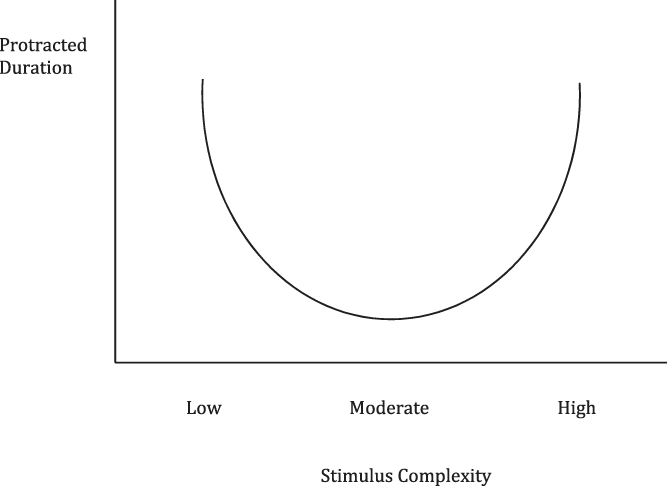
We have examined six abstract conditions (with concrete illustrations) that occasion the perception that time is passing slowly. Each is sufficient; none is necessary. Undeniably, they are divergent in regard to overt stimulus complexity. Some of these situations are ‘full’ of observable activity, whereas others seem quite ‘empty’. Nonetheless, any effort to conceptualize this relationship with a U-shaped curve is fraught with a number of analytical defects. Consider, for example, Figure 1. How do these apparently diverse circumstances have the same causal impact on lived duration? The U-shaped curve does not answer this question. It describes, but it does not explain. Obviously, protracted duration is not a by-product of overt stimulus complexity. The central issue is subjective involvement with self and situation. Protracted duration occurs when overt stimulus complexity is high or low, but what temporal experience is generated by a moderate level of stimulus complexity? Following the uncorroborated logic of ‘sensory overload’, Hogan (Reference Hogan1978, p. 423) is forced to assume that settings with objectively moderate stimulus complexity are experienced as ‘fuller’ than those of objectively high stimulus complexity: “It therefore remains for moderately complex stimuli to be experienced as comparatively, relatively ‘fuller,’ hence shorter, than either minimally or maximally stimulating time intervals.” If we reject this dubious assumption, Figure 1 is left incomplete. Where do we put synchronicity or temporal compression? In short, the U-shaped curve does not even enable us to conceptualize, let alone theorize, the full range of variation in the perceived passage of time.
Relationship between stimulus complexity and perception of time.

5. Explanatory analysis
Having surveyed the sufficient causes of protracted duration, we can dispense with a number of working hypotheses that are not in accord with the data. Clearly, the liveliness of the episode is irrelevant. No specific emotion is requisite. The pleasantness or unpleasantness of the incident does not matter. Volition is immaterial. Personality is inconsequential. When individuals with divergent personalities are thrust into comparable circumstances, they perceive the passage of time in similar ways. Likewise, one and all experience protracted duration, synchronicity, and temporal compression given the appropriate conditions. Variation in the experience of time occurs not because there are different kinds of people, but because people find themselves in different kinds of circumstances (Flaherty, Freidin, & Sautu, Reference Flaherty, Freidin and Sautu2005).
Under certain conditions, we perceive time to be passing slowly (i.e., protracted duration). In other settings, our subjective temporal experience is roughly synchronized with the objective time of clocks or calendars (i.e., synchronicity). And given different circumstances, we perceive time to have passed quickly (i.e., temporal compression). These are the elementary forms of temporal experience. They represent variation in the perceived passage of time relative to standard temporal units. What factors are analytically essential if we are to formulate a theory that accounts for the tripartite structure of temporal experience? This question shifts our focus from description to explanation, from sufficient to necessary causation. From the empirical materials, we must try to extract the underlying features they share in common. Let us begin with protracted duration.
Time does not suddenly begin to pass slowly under ordinary circumstances. The tails of the U-shaped curve appear to represent divergent settings, but all of them share a fundamental factor in common: marked departure from that which is typical in social interaction (Flaherty, Reference Flaherty1991). By definition, protracted duration is a species of temporal distortion. As such, it should come as no surprise that its empirical niche is found in abnormal conditions. Each individual is ceaselessly assessing the self-relevance of everything that transpires in social interaction (Mead, Reference Mead1934, p. 176), but the volume of one’s attention to ongoing events varies (Goffman, Reference Goffman1974, p. 345). Footnote 3 More specifically, the magnitude of involvement is dictated by the dynamics of social interaction. At one end of this elasticity, there is desultory attention to familiar or taken for granted matters. At the other end, however, the individual responds to problematic circumstances with the extreme levels of cognitive involvement we have witnessed in the empirical materials. It follows that, regardless of whether they are extremely eventful or extremely uneventful, abnormal circumstances provoke intensified subjective involvement with self and situation.
The mind operates at the juncture of two environments for self-consciousness. There is the internal environment of thoughts, emotions, and feelings (pain, hunger, etc.); and there is the external environment of action and events (or the absence of same). We can conceptualize the density of experience per standard temporal unit as the sum of these various dimensions of self-consciousness. Standard temporal units (days, hours, minutes, etc.) are akin to a sequence of identical boxes, open on top and thereby capable of carrying a variable load of experience. Heightened cognitive involvement with self and situation fills these containers with far more experience than they carry under less challenging circumstances. Thus, time is perceived to pass slowly when the density of experience per standard temporal unit is greatly amplified by our attention to problematic circumstances.
The U-shaped pattern confronts us with the paradoxical fact that time is perceived to pass slowly when stimulus complexity is low or high. Yet now we see that protracted duration is not a product of stimulus complexity, per se. The latter is a function of overt activity and events, but they represent only one way to generate subjective involvement with immediate circumstances. Indeed, Koestler and those who engage in meditation show us that a person can become transfixed by a situation that is nearly devoid of events or activity. It is cognitive involvement, not overt activity, that is necessary for the experience of protracted duration. Why is it that time is perceived to pass slowly within the context of ‘empty’ intervals as well as intervals that are full of overt activity? The resolution of this paradox is that ‘empty’ intervals are nothing of the sort. In actuality, such intervals are filled with an extraordinary level of cognitive involvement per standard temporal unit. Consequently, seemingly ‘empty’ intervals and intervals that are full of overt activity bring about comparable effects on the perceived passage of time.
The foregoing analysis gives us important clues for theorizing synchronicity. If protracted duration is found where stimulus complexity is high or low, it is logical to look for synchronicity where stimulus complexity is moderate. And if, furthermore, protracted duration is generated by abnormal conditions, then we should expect to see synchronicity emerge from customary situations. By the same token, protracted duration is a relatively uncommon sensation, whereas synchronicity is the predominant form of temporal experience (despite being mostly overlooked by those who study time). Its predominance is neither natural nor accidental. Our capacity for synchronicity is the foundation for temporal coordination with others in all manner of social interaction. Yet the temporal anarchy created by human infants is proof that we are not born with synchronicity. Primary socialization establishes our capacity for synchronicity, and this capacity is reinforced by the routine social rhythms of society that regularize the density of experience per standard temporal unit.
We experience synchronicity when our perception of the passage of time is nearly identical with the time of clocks and calendars (i.e., one does not sense time passing quickly or slowly). In other words, synchronicity only becomes possible when the individual learns to translate subjective experience into standard temporal units, and vice versa. This cognitive capacity assumes a routine consistency in the density of experience per standard temporal unit, and, in turn, this consistency is an artifact of structuring processes in both the internal and external environments of mind. From the outside, clocks, calendars, schedules, habits, and seasons organize the rhythms of social interaction in repetitive and predictable patterns. From the inside, primary socialization instills familiarity with the typical load of experience carried by various standard temporal units during ordinary encounters. The upshot is a generally stable volume of experience per standard temporal unit.
Normal social interaction is the necessary context for synchronicity. Given unproblematic circumstances, there is only a moderate level of cognitive involvement with self and situation. The degree of stimulus complexity is equally moderate. There is, then, a moderate and familiar density of experience per standard temporal unit. This familiarity provides the basis for one’s acquired ability to grasp the usual exchange rate between the internal stream of consciousness and the external progression of standard temporal units. With ordinary circumstances, consequently, and without the aid of any clock, one can estimate the passage of time with fair accuracy. Thus, it would not be amiss to put synchronicity at the bottom of the U-shaped curve. Doing so would be an improvement, but there would still be no place for temporal compression. Even this revised version of the U-shaped curve would be inadequate at depicting the full range of variation in lived time.
Temporal compression is a facet of retrospection. Unlike protracted duration and synchronicity, both of which are primarily phenomena of the present, temporal compression is uniquely associated with the past. It is marked as the (often uncanny) feeling that a particular interval of time has passed more quickly than is usually the case. In other words, those who experience temporal compression sense that much less time has elapsed than has actually been measured by a clock or calendar. Its most common manifestation is a shocked look backward that is expressed in recurrent questions: “Where have the hours (days, weeks, months, or years) gone?” The perceived passage of time is characterized by protracted duration when the density of experience per standard temporal unit is high, and it is characterized by synchronicity when the density of experience per standard temporal unit is moderate. Given what we already know, it follows that we can extend the emerging theory by conceptualizing temporal compression as a product of situations in which standard temporal units carry less experience than is typically the case.
Two factors, operating independently, lower the retrospective density of experience per standard temporal unit. The first of these factors is routine complexity. Problematic complexity intensifies concentration on the present moment, thereby making for protracted duration. Contrastingly, routine complexity is found in habitual forms of social interaction where extensive training or repeated exposure obviate the necessity for self-conscious attention to matters at hand. When, for example, an individual drives home from work via a regular route, he or she does so by means of what we call automaticity or automatic processing (Ashcraft, Reference Ashcraft1989). This means that one does not have to think about (or devote self-conscious attention to) what one is doing. In retrospect, these standard temporal units seem to have carried much less experience than they normally do.
Routine complexity does not bring about boredom (or protracted duration). The circumstances in question are habitual but complex and challenging for anyone who lacks the proper training or repeated exposure. From an objective standpoint, there is some stimulus complexity. Crucially, however, the individual is prepared to deal with it in habitual (i.e., mostly unthinking) fashion. These occasions are epitomized by a busy night at work. At the end of it, the employee is pleasantly shocked to realize that the preceding (and largely unnoticed) hours have flown by and it is already time to go home. Social interaction that takes the form of routine complexity generates a low level of cognitive involvement with self and situation. In turn, this makes for a lower than normal density of experience per standard temporal unit. These units of time, nearly empty of remembered experience, seem to have passed quickly in retrospect.
Paradoxically, some ‘busy’ intervals result in protracted duration while other ‘busy’ intervals produce temporal compression. These situations are often lumped together in common parlance, but, in truth, they are quite different. The resolution to this paradox can be found in the fact that there are two kinds of situated complexity: problematic and routine. Problematic circumstances demand attentional resources and intensify cognitive involvement with self and situation, thereby increasing the density of experience per standard temporal unit. The upshot is protracted duration. With routine complexity, the individual devotes less than normal attentional resources to the challenging but habitual task at hand, cognitive involvement with self and situation is decreased, and the density of experience per standard temporal unit is low. Temporal compression is the result.
The second causal factor for temporal compression is the erosion of episodic memory. Whereas routine complexity affects some people under certain conditions, the erosion of episodic memory affects almost everyone. As time goes by, there is little or no deterioration in semantic memory (knowledge) or procedural memory (technique), but episodic memory concerns the minutiae of social interaction, and it erodes with the passage of time. Who can recall the details of a day chosen at random from the month before this one? Individual biographies differ, of course, but nearly everyone observes that the past seems to have gone by quickly. All of us confront the inexorable fact that time erodes episodic memory. As a general rule, the loss of episodic memory reduces the volume of experience originally carried by standard temporal units during a past interval of time. Hence, the past is constantly contracting in our memories, and the speed at which it seems to have transpired quickens as each quantum of experience is forgotten. The past is perceived to have passed quickly and, moreover, is perceived to have passed at an increasing rate, as the ongoing loss of episodic memory erodes the density of remembered experience per standard temporal unit. Footnote 4
Predictably, Koestler (Reference Koestler1946, p. 120) perceives time to pass slowly during his solitary confinement, but he is astonished to observe that, in retrospect, “these interminable hours, days and weeks … passed more swiftly than a period of times has ever passed for me before”. How can the same interval of time be experienced as passing slowly in the present but be remembered as having passed quickly in retrospect? The preceding analysis enables us to resolve a third temporal paradox. As time passes, the details of situated experience fade from memory. In effect, the situation ‘contracts’ in one’s memory and, consequently, seems to have passed more quickly than it did as measured by the clock or calendar. Episodic memory is oriented toward the recollection of activity. As we have seen, situations in which there is an abnormally low level of stimulus complexity generate the perception that time is passing slowly. However, while these situations may seem to last forever as one endures them, little or nothing ‘happens’, and they leave only a faint and waning residue in one’s episodic memory.
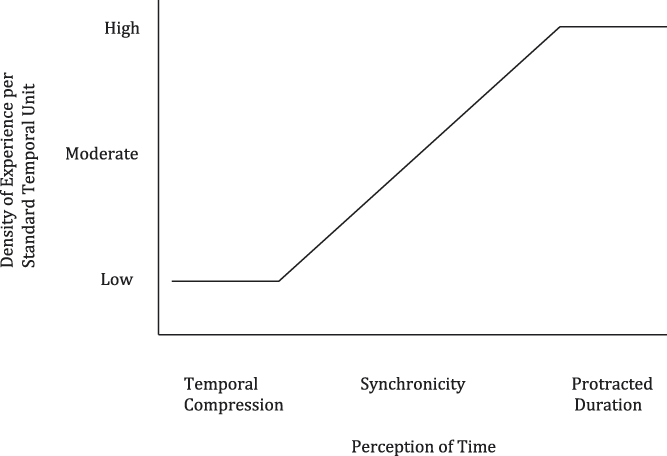
We perceive the passage of time as protracted duration when the density of experience per standard temporal unit is high. We perceive the passage of time as synchronicity when the density of experience per standard temporal unit is moderate. And we perceive the passage of time as temporal compression when the density of experience per standard temporal unit is low. Figure 2 summarizes this pattern as an S-shaped curve.
Relationship between perception of time and density of experience per standard temporal unit.

Figure 2 offers a number of advantages over prior efforts to theorize lived duration. It has been derived from a sizable corpus of empirical materials, and the validity of key propositions has been confirmed by another, quite different set of data. Unlike previous models, the S-shaped curve embraces the full range of variation in the perceived passage of time. It identifies the particular circumstances that give rise to each of the three elementary forms of temporal experience: the perception that time is passing slowly, the perception that time is roughly synchronized with clocks or calendars, and the perception that time has passed quickly. With this theory, moreover, we are able to resolve otherwise paradoxical facets of temporal experience.
Variation in the perceived passage of time reflects variation in the density of experience per standard temporal unit. In turn, the density of experience per standard temporal unit is conditioned by the dynamics of social interaction.
6. Time work
As it stands, this theory would seem to assume that one’s circumstances shape one’s temporal experience in deterministic fashion. We might say, for instance, that boredom and violence cause one to perceive time as passing slowly. These situations appear to be thrust upon passive (indeed, reluctant) subjects. It is against their will that they experience protracted duration. Yet our data include a number of instances where subjects ‘choose’ or ‘volunteer’ to change the contour of their own temporal experience. Examples include meditation and recreational drug use. Even some forms of suffering (such as going to the dentist) are more or less voluntary. In the writings of Goffman (Reference Goffman1959, p. 114), “individuals attempt to buffer themselves from the deterministic demands that surround them”. How does our understanding of temporal experience change when we assume his perspective?
In this regard, there is noteworthy contrast between Pavlov’s famous experiment and Mead’s (Reference Mead1934, p. 25) description of human intelligence:
Our whole intelligent process seems to lie in the attention which is selective of certain types of stimuli. Other stimuli which are bombarding the system are in some fashion shunted off. We give our attention to one particular thing. Not only do we open the door to certain stimuli and close it to others, but our attention is an organizing process as well as a selective process. When giving attention to what we are going to do we are picking out the whole group of stimuli which represent successive activity. Our attention enables us to organize the field in which we are going to act. Here we have the organism as acting and determining its environment.
In contrast to the environmental determinism at work in Pavlov’s experiment, Mead conceptualizes the basis for self-determination in human experience. Tacitly contradicting earlier theories concerning temporal experience, Mead helps us understand that stimulus complexity cannot be viewed as simply anything objectively available in one’s setting. His mentor, William James (Reference James1890, p. 402), puts the matter more succinctly: “My experience is what I agree to attend to.” In accord with the writings of Goffman, Mead, and James, Menaghan (Reference Menaghan1995, p. 323) adds that “the individual is increasingly conceived as an active agent who may be more powerful in shaping his or her own trajectory and even in altering social arrangements than prior formulations have recognized”.
A tragic example is the recent phenomenon of ‘suicide by cop’. Individuals who want to die but cannot bring themselves to do what is necessary sometimes threaten police officers in an intentional effort to provoke the officers to do the killing for them. Here, we see the individual set in motion events that are designed to loop back on this same individual with a particular effect. There is a linear determinism in classical causal analysis (e.g., Pavlov), but, in contrast, what we see in instances of suicide by cop is a loop of causal circularity or self-determination. One attempts to modify the situation in an effort to modify one’s own experience. What role, if any, does self-determination play in the etiology of temporal experience? Is temporal experience more analogous to murder (where the outcome is imposed upon an unwilling victim) or suicide by cop (where the individual chooses, arranges, and desires the outcome)?
Our experience of time reflects desires as well as circumstances. By weaving our desires and circumstances together, we create much of what we experience as the textures of time. We need a concept that sensitizes us to temporal agency – that is, the ways in which we try to modify our own experience of time or that of others. By ‘time work’, I refer to intrapersonal or interpersonal effort directed toward provoking or preventing various forms of temporal experience (Flaherty, Reference Flaherty2003). This temporal agency implicates the micromanagement of one’s own involvement with self and situation. As such, time work is the self-selected cause of one’s own temporal experience.
To examine this concept empirically, I have asked 406 people from all walks of life to describe the ways in which they attempt to control, manipulate, or customize their own experience of time or that of others (Flaherty, Reference Flaherty2011). In effect, my informants ask themselves, “What kind of temporal experience would I prefer to have?” Then, having answered this question, they employ folk theories and practices, which I call ‘time work’, to bring into being circumstances that provoke the desired form of temporal experience. They have constructed their own circumstances, and have done so, moreover, with the intention to modify their experience of time. Rather than be at the mercy of forces beyond their ken or control, these people exercise a measure of self-determination or temporal agency.
Time is a multidimensional phenomenon. Not surprisingly, then, our efforts to modulate temporal experience are heterogeneous, but not endlessly so. Common features in my data track related forms of attention to particular dimensions of time, thereby serving as the basis for a classification of these practices into several broad themes that represent different types of time work. To begin with, there are efforts to influence perceived duration; that is, many respondents report trying to make an interval seem longer or shorter than its objective length as measured by a clock or calendar. Other respondents focus on the manipulation of frequency by deciding how often something happens per standard temporal unit, thereby exercising control over the rate at which they experience it. Every event transpires within a temporal sequence; that is, some things precede it while others follow. Hence, a number of respondents try to customize the order or succession (first, second, third, etc.) of their activities or experiences. It is also possible to seek the optimal timing of an event, which involves choosing when something should happen (e.g., deciding what day of the week is best for a certain activity or experience). In addition, there are efforts to determine the allocation of time. Many of us recognize that, unless we set an hour or day aside, there may be no time left for purely personal experiences, once our various duties have been discharged. And some respondents admit stealing or taking time for themselves while they are ostensibly ‘on the clock’ at work.
7. Conclusion
Where should we go from here? What should we do next? The empirical and analytical developments presented in this paper provide a number of directions for future research. In conclusion, then, here is a tentative agenda for further investigation: two issues with implications for cross-cultural inquiries and two issues with implications for our understanding of temporal agency.
Do people who enact very different cultural arrangements perceive the passage of time in parallel ways? In our own societies, variation in temporal experience is perceived as distortion of standard temporal units. Is it possible to recognize such distortion in a society that lacks the linguistic resources we have for depicting variation in the perceived passage of time? For instance, Whorf (Reference Whorf1956, p. 58) observed that “the Hopi language contains no reference to ‘time,’ either explicit or implicit”. Does an individual experience distortion in the perceived passage of time if his or her society has no word for time? Intriguingly, we have witnessed how individuals such as Koestler work around the impediments of language when trying to describe an uncanny temporal experience. Can the same be said of people who inhabit other societies? In 1867, Native American warriors massacred General Custer and all 209 soldiers under his command at the Battle of the Little Big Horn. “The fighting, one warrior remembered, had lasted no longer than a hungry man needed to eat his dinner” (Ward, Reference Ward1996, p. 302). Is the S-shaped model for variation in the perceived passage of time only applicable to our own culture? This is an important empirical issue, and it will be resolved only by systematic observation in cross-cultural settings.
In a related vein, we can ask a second set of questions. Is the theory of time work (or temporal agency) applicable to people who live in societies that differ from our own? Do they attempt to control, manipulate, or customize aspects of their own temporal experience? If so, what dimensions of temporal experience do they try to alter, and what folk theories or practices do they employ? Happily, this line of research has been initiated by a team of Danish anthropologists at Aarhus University (Dalsgård, Frederiksen, Højlund, & Meinert, Reference Dalsgård, Frederiksen, Højlund and Meinert2014). They have found evidence of time work in Brazil, Cameroon, the Republic of Georgia, Nepal, the Philippines, Romania, and Uganda, as well as Denmark and the United States. Some of this time work is culturally specific, but much of it runs strikingly parallel to temporal agency in our own societies. To be sure, further research is called for, but these early studies suggest that time work may be a universal feature of social interaction. Moreover, these studies exemplify what must be done if we are to examine the cross-cultural applicability of the S-shaped model for variation in the perceived passage of time.
The S-shaped model and the conceptualization of time work confront us with divergent assumptions concerning causality in temporal experience. Whereas the former is deterministic, the latter invokes some degree of self-determination. How much of our temporal experience is determined by our circumstances, and how much is an artifact of temporal agency? Meticulous ethnographic procedures would be necessary, but this question is ultimately quantitative in nature. Is temporal determinism more or less frequent than temporal self-determination? Those who undertake this project would want to restrict their observations to a definite social setting or organizational context, within which they can be sure to record nearly all instances of social interaction during a prescribed period of time. Doing so would put them in a position to parse the resulting data into categories that represent, respectively, temporal determinism and temporal agency. The relative number of cases in these categories would constitute an empirical basis for addressing this question.
From another standpoint, however, there are not two distinct causal processes operating in social interaction; there is only one. As an alternative, then, we can ask a markedly different question: Are there empirically grounded reasons for subsuming one of these causal processes within the other? Put differently, does determinism actually operate where there appears to be agency, or, upon closer inspection, does the semblance of determinism really represent an elective or consensual complicity with one’s circumstances? What looks like determinism may turn out to be a pale shade of self-determination (albeit realized by means of a specious fatalism). Rather than trying to integrate the S-shaped model with time work, this line of inquiry would seek to demonstrate that, in fact, either all forms of temporal experience reflect situated determinism or all forms of temporal experience are rooted in agency. Bluedorn and Standifer (Reference Bluedorn and Standifer2006, p. 200) assert the latter view, and inaugural evidence supports this perspective (Flaherty, Reference Flaherty2011), but further investigation is called for on an issue of this magnitude.
These questions do not begin to exhaust the possibilities for continued research. On the contrary, there is a great deal of work for us to do if we are to advance our understanding of lived time. We can be confident, however, that there is an S-shaped pattern in the perceived passage of time, and it represents the density of experience per standard temporal unit during episodes of social interaction. This pattern is brought about by fluctuations of self-consciousness in response to the particulars of one’s circumstances.