Introduction
Epidemiologic and preclinical studies have suggested associations between maternal infection, prenatal exposure to inflammatory cytokines and risk for schizophrenia (SCZ) (McGrath & Murray, Reference McGrath, Murray, Hirsh and Weinberger2003; Brown & Derkits, Reference Brown and Derkits2010). Earlier studies investigated maternal immune function and later onset of SCZ in offspring using direct measures of maternal infection, such as antibody titers in sera collected during pregnancy. Brown et al. (Reference Brown, Begg, Gravenstein, Schaefer, Wyatt, Bresnahan, Babulas and Susser2004a , Reference Brown, Vinogradov, Kremen, Poole, Deicken, Penner, McKeague, Kochetkova, Kern and Schaefer2009) provided serologic evidence of elevated maternal antibodies to influenza virus and/or toxoplasmosis during the pregnancies of cases with psychoses versus controls. Our group (Buka et al. Reference Buka, Tsuang, Torrey, Klebanoff, Bernstein and Yolken2001a ) and others (Brown & Derkits, Reference Brown and Derkits2010) reported that offspring of mothers with elevated immunoglobulin (Ig)G and IgM levels and antibodies to herpes simplex virus type 2 during pregnancy were at increased risk for SCZ and other psychoses. The diversity of microbes across these studies suggested that cytokines and other inflammatory markers generated in response to maternal obstetric conditions may function as a common pathway that alters the offspring's early brain development and increases risk for SCZ and other psychoses (Gilmore & Jarskog, Reference Gilmore and Jarskog1997; Patterson, Reference Patterson2007; Brown & Derkits, Reference Brown and Derkits2010; Hornig, Reference Hornig2013).
In similar studies, our group (Buka et al. Reference Buka, Tsuang, Torrey, Klebanoff, Wagner and Yolken2001b ) and Brown et al. (Reference Brown, Hooton, Schaefer, Zhang, Petkova, Babulas, Perrin, Gorman and Susser2004b ) reported significant associations of risk for SCZ and SCZ spectrum respectively with elevated tumor necrosis factor (TNF)-α and/or interleukin (IL)-8 levels in maternal serum collected during late pregnancy. Consistent with neuropathologic changes reported in SCZ, in vitro and in vivo animal studies have complemented these findings. Thus, rat neuronal cultures (human late second-trimester equivalent) exposed to IL-1β, IL-6 and TNF-α resulted in a dose-dependent reduction in dendritic length and number in the frontal cortex (Marx et al. Reference Marx, Jarskog, Lauder, Lieberman and Gilmore2001; Gilmore et al. Reference Gilmore, Jarskog, Vadlamudi and Lauder2004). Furthermore, multiple studies (Zuckerman & Weiner, Reference Zuckerman and Weiner2003; Smith et al. Reference Smith, Li, Becker and Kapur2007a ,Reference Smith, Li, Garbett, Mirnics and Patterson b ) have noted a relationship between prenatal cytokine exposure and behavioral or brain abnormalities in the offspring. Peripheral induction of cytokines through administration of the innate immune activator and viral mimic polyinosinic:polycytidylic acid (poly I:C) was shown to alter latent inhibition (LI) in rodents, demonstrating post-pubertal emergence of LI disruption and pronounced alterations in hippocampal morphology (Zuckerman & Weiner, Reference Zuckerman and Weiner2003). This was consistent with demonstration of persistent hyperactivity and hippocampal and cerebellar abnormalities in rodents subsequent to exposure to virus-induced, pro-inflammatory cytokine elevations during a period analogous to the early third trimester (Hornig et al. Reference Hornig, Weissenbock, Horscroft and Lipkin1999). Taken together, these animal and human studies support the view that prenatal exposure to inflammatory cytokines results in altered neurocellular development information processing deficits and increased SCZ risk.
Population-level studies investigating the neurobehavioral consequences of gestational immune changes have examined the effects of obstetric conditions occurring during the second and third trimesters of pregnancy, such as pre-eclampsia (Dalman et al. Reference Dalman, Allebeck, Cullberg, Grunewald and Koster1999; Eide et al. Reference Eide, Moster, Irgens, Reichborn-Kjennerud, Stoltenberg, Skjærven, Susser and Abel2013). This is particularly relevant for studies of sex differences in the risk for psychosis, as this is a crucial period of the organizational effects of gonadal hormones on sexually differentiated brain development (Handa et al. Reference Handa, Burgess, Kerr and O'Keefe1994; Kawata, Reference Kawata1995; Tobet, Reference Tobet2002). In fact, previous studies linked conditions suggesting maternal immune disruption during pregnancy (e.g. influenza, pre-eclampsia) to higher SCZ risk among male offspring (Dalman et al. Reference Dalman, Allebeck, Cullberg, Grunewald and Koster1999), explaining, in part, the higher risk of SCZ in males than females (Castle et al. Reference Castle, Wessely and Murray1993; O'Connell et al. Reference O'Connell, Woodruff, Wright, Jones and Murray1997). For the past 25 years, we have been investigating the hypothesis that fetal disruptions during the middle to latter half of pregnancy will contribute to sex differences in risk for SCZ (Goldstein & Walder, Reference Goldstein, Walder, Sharma and Harvey2006). IL-1β, IL-6, IL-8, TNF-α and IL-10 receptors are located in, among other regions, the hippocampus, ventromedial and paraventricular hypothalamic nuclei, amygdala and locus coeruleus (Harbuz et al. Reference Harbuz, Stephanou, Sarlis and Lightman1992; Schobitz et al. Reference Schobitz, de Kloet, Sutanto and Holsboer1993; Szelenyi & Vizi, Reference Szelenyi and Vizi2007), brain regions that are normally sexually dimorphic at the volume level (Goldstein et al. Reference Goldstein, Seidman, Horton, Makris, Kennedy, Caviness, Faraone and Tsuang2001) or at the nuclei level in animals (Handa et al. Reference Handa, Burgess, Kerr and O'Keefe1994; Kawata, Reference Kawata1995; Tobet, Reference Tobet2002; Stratton et al. Reference Stratton, Searcy and Tobet2011) and are found to be abnormal in SCZ. These normally sexually dimorphic brain regions, implicated in the fetal hormonal programming of the brain (Seckl, Reference Seckl2001; Seckl & Walker, Reference Seckl and Walker2001), also co-localize with immune markers, suggesting that hormonal–immune interactions play an important role in regulating the sex-dependent development of these key brain areas.
The current investigation used a nested case–control design and prospectively collected prenatal sera from a cohort followed from pregnancy to age 48 years to investigate the associations of the pro-inflammatory cytokines IL-1β, IL-6, IL-8, TNF-α, and the anti-inflammatory cytokine IL-10, with the sex-dependent risk for SCZ. We hypothesized that levels of these pro-inflammatory cytokines would be significantly higher among SCZ cases compared with controls whereas levels of the anti-inflammatory cytokine IL-10 would be lower, with the most significant effects among male offspring with SCZ.
Method
Participants were selected from 17 741 pregnancies enrolled between 1959 and 1966 into the Boston and Providence sites of the Collaborative Perinatal Project (CPP), also known as the New England Family Study (NEFS) (Goldstein et al. Reference Goldstein, Buka, Seidman and Tsuang2010, Reference Goldstein, Cherkerzian, Seidman, Petryshen, Fitzmaurice, Tsuang and Buka2011; Seidman et al. Reference Seidman, Cherkerzian, Goldstein, Agnew-Blais, Tsuang and Buka2013). The CPP of the National Institute of Neurological and Communicative Disorders and Stroke was initiated over 40 years ago to prospectively investigate prenatal and familial antecedents of childhood neuropsychiatric disorders by ascertaining 50 000 pregnancies and following offspring to age 7 (Niswander & Gordon, Reference Niswander and Gordon1972). In a series of studies, we identified participants with psychoses among the original parents (Goldstein et al. Reference Goldstein, Buka, Seidman and Tsuang2010, Reference Goldstein, Cherkerzian, Seidman, Petryshen, Fitzmaurice, Tsuang and Buka2011) and offspring now adults in their late 40s (Goldstein et al. Reference Goldstein, Buka, Seidman and Tsuang2010; Seidman et al. Reference Seidman, Cherkerzian, Goldstein, Agnew-Blais, Tsuang and Buka2013).
As detailed in the online Supplementary material, through our ascertainment procedures we identified 200 offspring with possible, probable or definite psychotic and/or bipolar disorder. Of these, 114 had a DSM-IV major psychotic disorder; nine were determined from medical charts alone; and the remainder completed diagnostic interviews (most with medical charts as well). For the current study, we included only those subjects for whom third-trimester maternal sera were available. Diagnoses were grouped based on previous literature (Faraone & Tsuang, Reference Faraone and Tsuang1985; Kendler et al. Reference Kendler, Gruenberg and Tsuang1985; Gottesman, Reference Gottesman1991; Tsuang et al. Reference Tsuang, Faraone and Lyons1993; Goldstein et al. Reference Goldstein, Buka, Seidman and Tsuang2010). The final sample included 44 with schizophrenia psychoses (40 SCZ; four with schizo-affective disorder – depressed type) and 44 with affective psychoses (AP: 21 bipolar disorder with psychosis; 15 schizo-affective disorder – bipolar type; eight with major depressive disorder with psychosis).
Controls were selected from families participating in a parallel high-risk study that identified original study parents with psychotic disorders and unaffected control parents (Goldstein et al. Reference Goldstein, Buka, Seidman and Tsuang2010, Reference Goldstein, Cherkerzian, Seidman, Petryshen, Fitzmaurice, Tsuang and Buka2011). Controls were NEFS adult offspring for whom parents and grandparents, along with the parents' siblings, were free of any known lifetime history of psychosis, bipolar, schizotypal, recurrent major depressive disorder, suicide attempts or psychiatric hospitalizations, as described previously (Goldstein et al. Reference Goldstein, Buka, Seidman and Tsuang2010). Siblings of the controls were also free of any lifetime history of psychosis or bipolar disorder. Although controls were free of any psychotic diagnoses, 59% (64 of 108) had some lifetime Axis I psychiatric diagnosis, the most common being substance abuse.
Human subjects approval was granted by Harvard University, Brown University, Partners Healthcare system and local psychiatric facilities. Written consent was obtained from all study participants interviewed, and subjects were compensated for participating.
Biological samples
From 1959 to 1966, maternal serum samples were collected approximately every 2 months from prenatal to delivery and stored at −20°C at the National Institutes of Health (NIH) repository. We selected five immune molecules (IL-1β, IL-6, IL-8, TNF-α and IL-10) for assay because their associated receptors are located in highly sexually dimorphic brain regions in stress circuitry. Assays from the beginning of the third trimester were analyzed (measured in pg/ml), given that this time point is within the period of hormonal regulation of sexual brain differentiation, and the primary hypotheses in this study involved sex-dependent risk estimates. Sera samples were available for 88 cases and 100 controls. Missing data reflect 2% of draws that were not performed and absence of samples from the NIH repository or cracked vials obviating their use.
Maternal cytokine levels were assessed using a multiplexed, bead-based immunoassay (Milliplex™ human cytokine panel, MPXHCYTO-60 K, Millipore, USA) on a Luminex 3D™ detection platform (Luminex Corporation, USA) (Vignali, Reference Vignali2000). Assay sensitivities ranged from 0.1 to 0.4 pg/ml. Twenty-five microliters of each serum sample were diluted 1:1 in Assay Buffer and run with six serial dilutions (3.2–10 000 pg/ml) of cytokine standards, two quality control and one normal serum standards on each 96-well plate (Martins, Reference Martins2002). All samples, standards and controls were run in duplicate. Assays were completed according to the manufacturers' protocols, with overnight incubation at 4°C on a shaker prior to detection of the mean fluorescence intensity (MFI) of analyte-specific immunoassay beads by Luminex 3D. Raw data (MFI) were captured using Luminex xPONENT™ software (v. 4.0.846.0) and concentrations of immune factors in each sample were interpolated from standard curves using a five-parameter, weighted, logistic regression curve equation in Milliplex Analyst™ (v. 3.5.5.0). Measurements below the lower limit of detection were excluded. For measurements at or above the upper limit of analyte detection, samples were assayed again at multiple serial dilutions using Assay Buffer to bring concentrations into a detectable range.
Statistical analyses
The pro-inflammatory cytokines included IL-1β, IL-8, IL-6 and TNF-α. Although IL-6 can also be anti-inflammatory, its impact has been considered pro-inflammatory in many contexts (Elenkov, Reference Elenkov2008; Drexhage et al. Reference Drexhage, Knijff, Padmos, Heul-Nieuwenhuijzen, Beumer, Versnel and Drexhage2010) and it was therefore categorized here as pro-inflammatory. The impact of IL-10, an anti-inflammatory cytokine, on psychosis risk was also examined. Cytokine data were positively skewed (skew > |0.8|) and thus natural log (ln) transformed to minimize departures from Gaussian distributions. With the exception of ln(TNF-α), the distributions of ln transformed variables were not skewed.
Sex-stratified analyses were conducted to test the impact of prenatal immune abnormalities on risk for SCZ, predicting that levels of cytokines would be higher among SCZ males versus controls using a two-step approach. We first screened the five cytokines to identify those for which levels differed between SCZ cases and controls by sex. Given the skew of the ln(TNF-α) distribution, and for consistency across all cytokines, group comparisons were conducted using non-parametric tests, primarily the Wilcoxon rank-sum test. If the two populations differed in spread (using the Ansari–Bradley test), the Kolmogorov–Smirnov test was used. Multiple comparisons for each screen set were adjusted using the ‘step-up’ procedure of Hochberg (Reference Hochberg1988).
Considering the limited statistical power, given our sample size, we used a liberal threshold of p⩽0.20 when adjusting for multiple comparisons to improve sensitivity of the initial screen. For cytokines with a median difference that met this adjusted threshold, we conducted analyses based on deviant subgroups. For differences in which cases had higher levels of prenatal cytokines than controls, the deviant subgroup was created above the highest quartile (75th percentile) of the control ln transformed levels. For differences in which cases had lower levels of prenatal cytokines than controls, the deviant subgroup was created below the lowest quartile (25th percentile) of the control ln transformed levels. The frequency of subjects, by SCZ status, in the deviant subgroup was calculated and tested using χ 2 unless there were ⩽5 subjects in a cell, in which case Fisher's exact test was applied. Similar analyses were conducted for APs to determine specificity of the SCZ results. Adjusted odds ratios (ORs) from the deviant subgroup analyses were calculated using the generalized estimating equation (GEE) method, adjusted for intrafamilial correlation and demographic variables for which there were significant differences by SCZ and sex. For male-specific analyses, these variables were ethnicity, marital status and study site. There were no significant differences between female cases and controls on any of the potential confounding variables examined.
Results
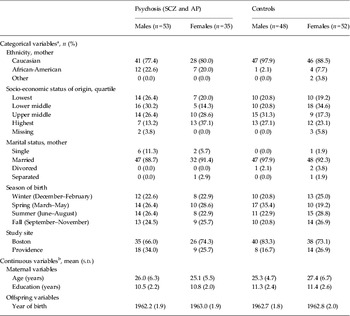
As shown in Table 1 (for combined sex results, see Supplementary Table S1), subjects were primarily Caucasian, married and from Boston. Male cases included significantly more African-Americans (χ 2 2 = 9.49, p = 0.002), single mothers (χ 2 3 = 6.77, p = 0.03) and participants from Providence (χ 2 1 = 3.94, p < 0.05) than controls. There were no significant differences between female cases and controls for any of the potential confounding variables examined.
Demographic information on the 188 subjects with third-trimester cytokine data from the schizophrenia (SCZ) case–control study stratified by sex

AP, Affective psychoses; s.d., standard deviation.
a Cases versus controls (categorical variables). Compared with male controls, among male SCZ cases there were more African-Americans (χ 2 2 = 9.49, p = 0.002), single mothers (χ 3 2 = 6.77, p = 0.03) and participants from Providence (χ 1 2 = 3.94, p < 0.05). Among the categorical variables, there were no differences between female cases and controls.
b Cases versus controls (continuous/count variables): there were no significant differences between cases and controls by sex among the continuous variables.
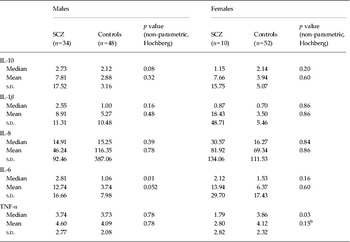
Table 2 presents the sex-stratified non-parametric results of the cytokine assays for the SCZ and control subject groups (for combined sex results, see Supplementary Table S2). Median levels of IL-1β and IL-6 were higher among male SCZ cases than controls, significantly for IL-6 alone (2.81 pg/ml v. 1.06 pg/ml, p Hochberg = 0.05). Median levels of TNF-α were similar among male cases and controls (3.74 pg/ml v. 3.73 pg/ml, p Hochberg = 0.78). Among females, median levels of IL-1β, IL-8 and IL-6 were higher among subjects with SCZ compared with controls, but maternal prenatal levels of TNF-α were lower among SCZ versus controls (1.79 pg/ml v. 3.86 pg/ml, p Hochberg = 0.15).
Differences in cytokine levels (in pg/ml) between SCZ cases and controls by sex using non-parametric methods a

SCZ, Schizophrenia psychoses; IL, interleukin; TNF, tumor necrosis factor; s.d., standard deviation.
a Comparisons between cases and controls made with the non-parametric Wilcoxon test using the ln transformed cytokine values. The Wilcoxon rank-sum test investigates differences in medians, with the assumption of identical spreads. If the two populations differed in spread using the Ansari–Bradley test, the more generalized Kolmogorov–Smirnov test was used. Tests assume observations from both groups are independent of each other; however, intrafamilial correction adjustment not made.
b Comparisons between cases and controls for individual cytokines, p⩽0.20 after using the Hochberg method of adjustment for multiple comparisons.
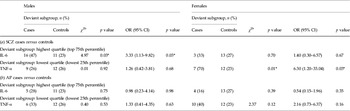
About two times the number of male SCZ subjects had IL-6 levels above the highest quartile than controls (47% v. 23%, Table 3 a), with a 3.33 adjusted odds [95% (confidence interval (CI) 1.13–9.82] of having IL-6 levels above this threshold. Above the deviant threshold, female SCZ cases and their controls were similar in prevalence (33% v. 27%, Table 3 a; for combined sex results, see Supplementary Table S3). The interaction between case status and sex for IL-6 was not significant (Z = 1.43, p = 0.15). In these analyses, there were no significant differences between AP cases and controls (Table 3 b; for combined sex results, see Supplementary Table S3). For males and females, deviant levels of IL-6 were non-significantly elevated among SCZ cases compared with AP (OR 2.04 and 2.66 respectively; Table 4). In fact, given that ORs were of similar magnitudes in male and female SCZ subjects, combining both sexes resulted in a significantly higher likelihood of SCZ subjects being in the deviant subgroup of IL-6 compared with AP (OR 3.14, 95% CI 1.12–8.79, see Supplementary Table S3), suggesting that high levels of IL-6 may be specific to SCZ psychoses, but not dependent on sex.
Differences in third trimester cytokine levels between (a) SCZ cases and (b) AP cases and controls by sex using multivariate deviant subgroup analysis a

SCZ, Schizophrenia psychoses; AP, affective psychoses; OR, odds ratio; CI, confidence interval; IL, interleukin; TNF, tumor necrosis factor; s.d., standard deviation.
a For those case versus control comparisons in which a difference of p⩽0.20 was observed using non-parametric methods adjusted for multiple comparisons. Comparisons between cases and controls using multivariate deviant subgroup analyses at the 75th (IL-6) or 25th (TNF-α) percentile of the control ln transformed levels (referent) conducted using the generalized estimating equation (GEE) method, adjusted for intrafamilial correlation and demographic variables for which there were significant differences by (a) SCZ or (b) AP status and sex. For the male-specific analyses, these demographic variables were ethnicity, marital status and study site. There were no significant differences between female cases and controls on any of the potential confounding variables examined.
b χ 2 used to compare groups by deviant subgroup status. For those comparisons in which there were cells with ⩽5 subjects, Fisher's exact test was used.
* p⩽0.05.
Differences in third-trimester cytokine levels between psychoses subtypes (SCZ and AP) by sex using multivariate deviant subgroup analysis a

SCZ, Schizophrenia psychoses; AP, affective psychoses; OR, odds ratio; CI, confidence interval; IL, interleukin; TNF, tumor necrosis factor; s.d., standard deviation.
a For those case versus control comparisons in which a difference of p⩽0.20 was observed using non-parametric methods adjusted for multiple comparisons. Comparisons between SCZ and AP using multivariate deviant subgroup analyses at the 75th (IL-6) or 25th (TNF-α) percentile of the control ln transformed levels (referent) conducted using the generalized estimating equation (GEE) method, adjusted for intrafamilial correlation and demographic variables for which there were significant differences by case status and sex. For the male-specific analyses, these demographic variables were ethnicity, marital status and study site. There were no significant differences between female cases and controls on any of the potential confounding variables examined.
b χ 2 used to compare groups by deviant subgroup status. For those comparisons in which there were cells with ⩽5 subjects, Fisher's exact test was used.
Despite the small sample of SCZ females, it was among these females that low levels of TNF-α (values below the lowest quartile of the control distribution) were significantly more prevalent than among female controls (70% v. 23%, Fisher's exact, p = 0.01; see Table 3 a) or SCZ males (70% v. 26%, Fisher's exact, p = 0.02, data not presented), with a trend toward a higher prevalence in female SCZ versus female APs (70% v. 40%, Fisher's exact, p = 0.11; see Table 4). The interaction between case status and sex for TNF-α was significant (Z = 2.48, p = 0.01).
Discussion
Among the five cytokines examined in this study, we found differences by SCZ case status for IL-6 and TNF-α. Exposure to high maternal levels of IL-6 was significantly more prevalent among SCZ cases than controls, particularly male SCZ cases. By contrast, and despite having a smaller female case sample size, the association of low levels of TNF-α to SCZ was specific for females, with low levels being significantly or marginally significantly more prevalent in female SCZ than in female controls, female APs or SCZ males. The differential findings by sex cannot be explained by sampling bias from age at follow-up, given that we ascertained subjects up to the age of 48 years, that is through the major risk period for SCZ.
Our findings suggest that prenatal exposure to different immune markers may differentially affect the development of psychoses, an effect that is dependent on psychosis type, offspring sex and the gestational timing of the serum draw. These factors may explain the inconsistency of our findings relative to those from earlier studies. Our earlier study in a small sample (Buka et al. Reference Buka, Tsuang, Torrey, Klebanoff, Wagner and Yolken2001b ) and the study by Brown et al. (Reference Brown, Hooton, Schaefer, Zhang, Petkova, Babulas, Perrin, Gorman and Susser2004b ) reported higher levels of maternal TNF-α and IL-8 respectively, in cases with psychoses compared with controls. The inconsistency of our findings with those previous findings may result, in part, from the lack of sample stratification by psychosis subtype and the inclusion of non-psychotic cases within the SCZ spectrum (e.g. schizotypal personality disorder) (Brown et al. Reference Brown, Hooton, Schaefer, Zhang, Petkova, Babulas, Perrin, Gorman and Susser2004b ). Furthermore, partly because of sample size, neither previous study tested for sex effects. In addition, the timing of sample acquisition differed in both previous studies (delivery, Buka et al. Reference Buka, Tsuang, Torrey, Klebanoff, Wagner and Yolken2001b ; second trimester, Brown et al. Reference Brown, Hooton, Schaefer, Zhang, Petkova, Babulas, Perrin, Gorman and Susser2004b ), possibly resulting in differential impact of gestational immune markers (Meyer et al. Reference Meyer, Nyffeler, Engler, Urwyler, Schedlowski, Knuesel, Yee and Feldon2006; Aguilar-Valles & Luheshi, Reference Aguilar-Valles and Luheshi2011), and as a function of sex (Goldstein & Walder, Reference Goldstein, Walder, Sharma and Harvey2006). The difference in gestational timing of the sera draws is an important point as the maternal immune system exhibits considerable fluctuation during the course of pregnancy (Sargent, Reference Sargent1992). In Buka et al. (Reference Buka, Tsuang, Torrey, Klebanoff, Wagner and Yolken2001b ), term levels of TNF-α were significantly greater among psychotic cases (predominately male) compared with controls. However, among male SCZ in the current study, where samples were drawn at the early third trimester, TNF-α levels were similar to those among controls. Comparing term sample assays with samples from the early third trimester, we found that the mean TNF-α levels from the former samples were elevated above those reported from the latter, particularly among the cases. The mean TNF-α level among mothers of SCZ males was 34% higher at term than at early third trimester (6.18 pg/ml v. 4.60 pg/ml) whereas the mean level among controls was 10% higher (4.57 pg/ml v. 4.09 pg/ml).
IL-6, a regulator of white matter growth, can enter the fetal brain during a key period of sexual differentiation (Dahlgren et al. Reference Dahlgren, Samuelsson, Jansson and Holmäng2006). Altered IL-6 levels found in the brain tissue of male, but not female, rat offspring as a result of hypothyroxinemia prompted by prenatal insult with polychlorinated biphenyls (PCBs) are associated with sex-specific alterations in cerebellar white matter proteins (Miller et al. Reference Miller, Kahnke, Neu, Sanchez-Morrissey, Brosch, Kelsey and Seegal2010). Furthermore, in response to lipopolysaccharide (LPS) stimulation, blood from human male fetuses revealed a pro-inflammatory response of elevated IL-6 concentrations not found in females (Kim-Fine et al. Reference Kim-Fine, Regnault, Lee, Gimbel, Greenspoon, Fairbairn, Summers and de Vrijer2012). However, in response to mild maternal asthma, placental levels of IL-6 were significantly, and only, elevated among the female fetuses (Scott et al. Reference Scott, Hodyl, Murphy, Osei-Kumah, Wyper, Hodgson, Smith and Clifton2009). Animal models have also established that injection of pregnant mice with IL-6 alters offspring behavior and cortical brain development, although specificity by offspring sex has not been examined. When administered in late second trimester in animal models of psychosis, IL-6, IL-1β and TNF-α reduced the number and length of frontal cortical dendrites (Marx et al. Reference Marx, Jarskog, Lauder, Lieberman and Gilmore2001; Gilmore et al. Reference Gilmore, Jarskog, Vadlamudi and Lauder2004) and induced deficits in prepulse and latent inhibitions (Zuckerman & Weiner, Reference Zuckerman and Weiner2003; Smith et al. Reference Smith, Li, Garbett, Mirnics and Patterson2007b ). Likewise, mimicking infection in pregnant rodents through peripheral introduction of poly I:C, or LPS, had lasting offspring effects, such as increased levels of IL-6 in amniotic fluid and placenta (Urakubo et al. Reference Urakubo, Jarskog, Lieberman and Gilmore2001; Gilmore et al. Reference Gilmore, Jarskog and Vadlamudi2003), reduced neurogenesis (De Miranda et al. Reference De Miranda, Yaddanapudi, Hornig, Villar, Serge and Lipkin2010) and behavioral deficits in offspring (Zuckerman & Weiner, Reference Zuckerman and Weiner2003; De Miranda et al. Reference De Miranda, Yaddanapudi, Hornig, Villar, Serge and Lipkin2010). Administration of non-steroidal anti-inflammatory drugs abrogated the effects of prenatal poly I:C on offspring neurogenesis and behavior (De Miranda et al. Reference De Miranda, Yaddanapudi, Hornig, Villar, Serge and Lipkin2010). Rodent studies demonstrated specific effects of gestational IL-6 injection on offspring memory/working memory circuitry (Sparkman et al. Reference Sparkman, Buchanan, Heyen, Chen, Beverly and Johnson2006), deficits found in SCZ, particularly in men (Goldstein et al. Reference Goldstein, Seidman, Goodman, Koren, Lee, Weintraub and Tsuang1998; Abbs et al. Reference Abbs, Liang, Makris, Tsuang, Seidman and Goldstein2011), and that may be related to prenatal infection (Brown et al. Reference Brown, Vinogradov, Kremen, Poole, Deicken, Penner, McKeague, Kochetkova, Kern and Schaefer2009).
Animal studies are consistent with clinical studies demonstrating higher adult IL-6 levels in SCZ compared to healthy controls (Behrens & Sejnowski, Reference Behrens and Sejnowski2009; Patterson, Reference Patterson2009; Watanabe et al. Reference Watanabe, Someya and Nawa2010). Effect sizes of IL-6 in acutely relapsed and first-episode patients were comparable and associated with longer illness duration (Ganguli et al. Reference Ganguli, Yang, Shurin, Chengappa, Brar, Gubbi and Rabin1994) and paranoid hallucinations (Müller et al. Reference Müller, Dobmeier, Empl, Riedel, Schwarz and Ackenheil1997), and reduced by antipsychotic treatment (Sugino et al. Reference Sugino, Futamura, Mitsumoto, Maeda and Marunaka2009; Mutlu et al. Reference Mutlu, Gumuslu, Ulak, Celikyurt, Kokturk, Kir, Akar and Erden2012). Population studies, including the current one, demonstrated that fetal exposure to cytokines, as reflected by levels detected in maternal gestational sera, had a significant impact on sex-dependent SCZ risk, underscoring the etiologic contribution of immune processes prior to illness onset.
Our finding of lower maternal TNF-α in maternal prenatal sera of female offspring with SCZ, but not in males, was unexpected but intriguing. TNF-α has neuroprotective and neurotoxic effects on brain function (Twohig et al. Reference Twohig, Cuff, Yong and Wang2011), and decreased levels could result from an increased glucocorticoid response due to pregnancy complications or other stressful events. Gonadal hormone and metabolic factors during pregnancy could also affect TNF-α. High-dose estradiol treatment (at levels similar to pregnancy) reduced T-helper (Th)1 cytokines (including TNF-α), and shifted the balance toward a Th2 anti-inflammatory state (Correale et al. Reference Correale, Arias and Gilmore1998), whereas increased TNF-α was seen with low-dose estradiol exposure. Perhaps a maternal TNF-α deficit (in the context of a higher estradiol pregnant state) is further enhanced in mothers carrying a female versus male fetus, resulting in higher risk for SCZ in females associated with low maternal TNF-α. Lower maternal TNF-α was also associated with a higher mean glycemic index during the third trimester, implicating a potential role for metabolic pathways during pregnancy (Moreli et al. Reference Moreli, Morceli, De Luca, Magalhães, Costa, Damasceno, Rudge and Calderon2012). Reduced maternal TNF-α levels could also result from dysregulation of the parasympathetic autonomic nervous system (ANS) following immune challenge. Nicotinic cholinergic signals transmitted by the vagus nerve to the central nervous system (CNS) after LPS (endotoxin) exposure inhibited TNF-α responses (Borovikova et al. Reference Borovikova, Ivanova, Zhang, Yang, Botchkina, Watkins, Wang, Abumrad, Eaton and Tracey2000) and decreased TNF-α-mediated neuroprotection (Carlson et al. Reference Carlson, Wieggel, Chen, Bacchi, Rogers and Gahring1999). Consistent with this, abnormal patterns of autonomic arousal during social cognition tasks were reported in SCZ (Jáuregui et al. Reference Jáuregui, Costanzo, de Achával, Villarreal, Chu, Mora, Vigo DE Castro, Leiguarda, Bär and Guinjoan2011). Female offspring of mothers who smoked during pregnancy might be dually affected by nicotine exposure, with effects through nicotine's capacity to drive vagal inhibition of TNF-α (thereby decreasing neuroprotective mechanisms), and through the more direct (perhaps sex-dependent) effects of nicotine on developing cholinergic brain circuitry (Nunes-Freitas et al. Reference Nunes-Freitas, Ribeiro-Carvalho, Lima, Dutra-Tavares, Manhães, Lisboa, Oliveira, Gaspar de Moura, Filgueiras and Abreu-Villaça2011). It is likely that multiple mechanisms regulate the effects of cytokines on offspring brain development, with specific mechanisms depending on timing of exposure. These include: dysregulation of nerve growth factors (Schobitz et al. Reference Schobitz, de Kloet, Sutanto and Holsboer1993; Anisman & Merali, Reference Anisman and Merali2002; Gilmore et al. Reference Gilmore, Jarskog and Vadlamudi2003; Twohig et al. Reference Twohig, Cuff, Yong and Wang2011); loss of dendritic connections (Marx et al. Reference Marx, Jarskog, Lauder, Lieberman and Gilmore2001; Gilmore et al. Reference Gilmore, Jarskog, Vadlamudi and Lauder2004; Twohig et al. Reference Twohig, Cuff, Yong and Wang2011) and white matter connectivity (Yoon et al. Reference Yoon, Romero, Yang, Jun, Kim, Choi and Syn1996; Dammann & Leviton, Reference Dammann and Leviton1997); apoptosis (Hu et al. Reference Hu, Yuri, Ozawa, Lu and Kawata1997); dysregulation of neurotransmitters (Zalcman et al. Reference Zalcman, Green-Johnson, Murray, Nance, Dyck, Anisman and Greenberg1994; Behrens et al. Reference Behrens, Ali and Dugan2008); and hormonal dysregulation (Schobitz et al. Reference Schobitz, de Kloet, Sutanto and Holsboer1993; Anisman & Merali, Reference Anisman and Merali2002) impeding healthy sexual differentiation of the brain (Handa et al. Reference Handa, Burgess, Kerr and O'Keefe1994; Kawata, Reference Kawata1995; Tobet & Hanna, Reference Tobet and Hanna1997; Goldstein et al. Reference Goldstein, Seidman, Horton, Makris, Kennedy, Caviness, Faraone and Tsuang2001; Tobet, Reference Tobet2002) and brain aging (Zietz et al. Reference Zietz, Hrach, Scholmerich and Straub2001).
It should be emphasized that our findings of sex-differentiated relationships between maternal immune activation signals and SCZ risk are based on comparisons within a sample set subjected to identical handling conditions. However, samples were frozen for up to 48 years, raising the possibility of sample dehydration or degradation. Dehydration was unlikely given that we eliminated any samples coming from tubes that were cracked or had faulty seals. Although some cytokines may be less stable than others, previous work using samples stored under similar conditions, and for a similar length of time (>40 years) (Stroud et al. Reference Stroud, Solomon, Shenassa, Papandonatos, Niaura, Lipsitt, Lewinn and Buka2007; Klebanoff et al. Reference Klebanoff, Zhang, Zhang and Levine2009), demonstrated long-term stability of many analytes. To ensure comparability of samples across all recruitment years (1959–1966), we also ruled out any relationship of cytokine levels with sample acquisition year (Spearman's correlation all < 0.1). Assay controls (purchase of all reagents from the same lot and completion of all assays within the same 2-month period) served to further minimize potential sources of variability in cytokine measurements. Given the range of procedural safeguards we used with this sample set, in addition to excluding all cytokine values below the level of detection, the unexpected finding of an association of SCZ risk with lower TNF-α levels in female offspring cannot be explained by differential sample handling or artifacts of assay methods. The fact that there was a sex difference in risk due to lower TNF-α levels supports the validity of the assay measurement as it is highly unlikely that there would be a bias in maternal assay measurement by sex of the fetus. Similarly, our finding of an association of SCZ risk with elevated IL-6 levels, particularly in males, is also independent of effects due to differences in sample handling or assay conditions across the sample set.
The findings regarding specificity by sex or psychosis type should be replicated, given our small sample sizes, particularly female SCZ. In fact, IL-6 was higher in female SCZ cases, but not significantly, which may be due to low power. This may also have been true for IL-1β for which all cases showed higher levels (albeit non-significantly) than controls. TNF-α was also lower (non-significantly) in AP females versus controls. These results were not significant probably because of the substantial standard deviations and lower effect sizes compared with SCZ females. Potential low statistical power, however, cannot explain the significant risks for increased maternal IL-6 exposure among SCZ males and decreased maternal TNF-α exposure among SCZ females, even though the specificity of these effects should be further tested. As described in the online Supplementary material, based on analyses of the considerable amount of information available from this longitudinal study, it does not seem that the ascertained cases differ considerably from expectations, for instance in terms of gender distribution, socio-economic level or family history of mental illness, even though we had a low rate overall. Therefore, we anticipate that these study results should be generalizable to other psychotic samples and populations.
Several genes implicated in SCZ are also known to regulate immune processes (Carter, Reference Carter2009). Infection and other factors disrupting maternal prenatal immune responses may interact with genetic susceptibility, increasing risk for SCZ (Patterson, Reference Patterson2009; Brown & Derkits, Reference Brown and Derkits2010). For example, gestational injection of IL-6 into pregnant IL-6 receptor knockout (KO) mice, or wild-type mice with an antibody directed against IL-6, did not induce behavioral changes typically observed after prenatal poly I:C injection (Smith et al. Reference Smith, Li, Garbett, Mirnics and Patterson2007b ). Neurogenesis and behavior also remained intact in offspring of toll-like receptor (TLR)-3 KO dams after poly I:C exposure (De Miranda et al. Reference De Miranda, Yaddanapudi, Hornig, Villar, Serge and Lipkin2010). Furthermore, cytokine production after infection or immune challenge may not be limited to the pregnant mother, as placental levels of IL-6 were increased after poly I:C administration to IL-6 KO mated with a wild-type father, suggesting that poly I:C reached the fetal component of the placental unit (Mandal et al. Reference Mandal, Marzouk, Donnelly and Ponzio2010).
In summary, the findings in this study demonstrate that prenatal immune disturbances in the early third trimester significantly increased the risk for psychoses in a sex-dependent manner more than 40 years later. Male offspring were most strongly affected by maternal IL-6 elevations; female offspring were affected when maternal TNF-α levels were lower. The results underscore the importance of immunologic processes in brain development and timing of exposure (i.e. timing of the sexual differentiation of the brain) as potential etiologic contributors to the sex-dependent development of SCZ. The findings also highlight the importance of considering the type of psychosis and offspring sex in the study design to improve our understanding of the gestational impact of immunologic processes on psychosis risk. Finally, our findings may have implications for other neurodevelopmental disorders, given the report by Hsiao et al. (Reference Hsiao, McBride, Chow, Mazmanian and Patterson2012) on prenatal immunologic processes implicated in the risk for autism, which has a 4:1 ratio of boys to girls (Yeargin-Allsopp et al. Reference Yeargin-Allsopp, Rice, Karapurkar, Doernberg, Boyle and Murphy2003).
Supplementary material
For supplementary material accompanying this paper visit http://dx.doi.org/10.1017/S0033291714000683.
Acknowledgments
This study was supported by National Institute of Mental Health (NIMH) RO1 MH56956 (J.M.G.). Original sample ascertainment was in part also supported by grants from the Stanley Medical Research Institute (S.L.B. and J.M.G., 1994–1997) and NIMH R01MH63951 (L.J.S.). The research was also conducted with support from the Harvard Catalyst|Harvard Clinical and Translational Science Center (NIH Award UL1 RR025758). We thank M. Landi and J. Wolf for their contributions to clinical interviewing and diagnoses respectively, and C. Provencal for her contribution to project management during the original sample acquisition.s We also thank S. Tobet and R. Handa (ORWH-NIMH P50 MH082679; J.M.G., S.T. and R.H.) for their input on understanding the findings regarding disruptions of the sexual differentiation of brain development.
Declaration of Interest
None.