HERITAGE LEGISLATION AS A PRESERVATION STRATEGY
Imposing laws and legal protection is often a response by national governments to the increasing perceived dangers stemming from globalization, modernization, population growth, and environmental degradation of heritage resources. Usually these measures accompany the establishment of management institutions and the introduction of preservation policies and plans that are aimed at safeguarding perceived heritage resources. An interesting aspect in this respect is the extent to which such initiatives are really effective as a preservation strategy. Several studies have shown that protective legislation does not automatically guarantee the effectiveness of a strategy. For example, a case study by Techera (Reference Techera2011) into the effectiveness of laws and policies in Fiji showed some clear recognizable shortcomings especially the fragmentation in administration between the different departments involved in the management of heritage resource conservation with various government departments and agencies being responsible for different aspects of the process of heritage management. This resulted in slow and bureaucratic processes and sometimes even to contradictory interests and actions. It showed that more collaboration is essential if legislation is to be effective. Another concern is a lack of public support and participation in the initiation of heritage and conservation legislation. It is of central importance that a legal framework is part of a holistic social context, which includes economic, sociocultural, environmental, and political interests.
In a case study by Elsorady (Reference Elsorady2011) on the tensions between ownership and legislation in heritage conservation in Alexandria, Egypt, some interesting features are explored and related with other studies that showed similar tensions. For example, property values may decrease as a result of restrictive laws and stringent local regulations, as discussed by Haughey and Basolo (Reference Haughey and Basolo2000) in a case study on the historic district in New Orleans. The fear that heritage regulations may lead to a drop in the economic value of properties creates a serious antipathy between historic property owners and heritage institutions and agencies. Also interesting in this respect is a quotation of Staley (Reference Staley2006, p. 5) in a case study about Australia, “affected landowners go to extraordinary lengths to avoid the controls, either by letting buildings deteriorate to such an extent that all heritage value is lost and they are condemned, or by illegally bringing in the bulldozers at midnight and risking the consequences.” In the earlier mentioned case study of Alexandria, the drafting and implementation of the legislation occurred without the participation of the community, which resulted in tensions between owners and legislators. A top-down approach in imposing such legislation may be a major cause of tensions and problems and a disturbance of the much-needed balance between public and private interests.
That these various problems as outlined in the case studies mentioned above are not exceptional is shown by an empirical study conducted into the monumental built environment from the colonial period in Suriname and its interpretation, preservation, and management. The case study presented in the following section is the result of this field research.
MULTIETHNIC SURINAME AND ITS COLONIAL HERITAGE
Suriname, covering an area of 163,000 square kilometers, is located in the northern part of the South American continent. It borders French Guyana to the east and Guyana (former British Guyana) to the west. The north of Suriname borders on the Atlantic Ocean; the south borders Brazil. The political demarcation of contemporary Suriname results from an eventful history. From the seventeenth century onward, inhabitants of Spain, Portugal, the Dutch Republic, France, and England settled especially in the coastal areas in this region, where they built the first plantations along the rivers. Suriname's tropical climate is largely determined by its geographical position close to the equator. The plantation as an agricultural system was considered the most appropriate in such a climatic regions.
Most of the approximately 500,000 inhabitants of Suriname live in the northern part of the country, especially in the capital Paramaribo, the only large city within the country. The natural landscape is the most determining explanation of this. The landscape can be divided roughly into lowlands and an interior that consists of low mountains and hills. The lowlands are characterized by a coastal area composed of river deltas, estuaries, swamps, and sandy embankments. To the south of this coastal area lies a zone of savannah landscape consisting of predominantly infertile soils. Further south, begins the interior that comprises 80% of the total surface of Suriname and is mostly covered by rainforest. It is sparsely populated and relatively difficult to access.
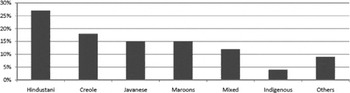
The socioeconomic and sociocultural developments in Suriname have their origins in the typical plantation economy. The existence of a diverse composition of Suriname's population today is an important consequence of this plantation economy. This economy, together with the phenomenon of slavery, laid the foundation for the ethnic diversity in Suriname. This immense cultural diversity is manifested in the composition of its population, comprising a variety of ethnic groups. While the East Indian “Hindustani” and Afro-Suriname “Creole” dominate the population with 27% and 18% respectively, there are sizable groups of Javanese, accounting for 15% of the total population and 15% “Maroons” or Bush Negroes who are descendants from escaped slaves. People who are of mixed descent represent 12%. The indigenous Amerindian population comprises almost 4% of the total population, while Chinese, Lebanese, Jews, Europeans, and others constitute 9% (ABS, 2006).
Suriname population by ethnicity.

Paramaribo was founded by the English around 1660 with the construction of Fort Willoughby on this spot along the Suriname River. When the Dutch took over in 1667, they strengthened this fortification and renamed it Fort Zeelandia. From this fort, the town started to develop in a westward direction. Although Paramaribo was only a small hamlet when the Dutch took over from the English, urban development started slowly but steadily. In 1718, it was reported that the city consisted of approximately 500, mostly wooden, houses. By 1772, the number of wooden houses had grown to a total of 867 and continued growing to 1015 in 1789 (Temminck Groll & Tjin a Djie, Reference Temminck Groll and Djie1973). The growth of Paramaribo during the eighteenth century is partly due to the increase in the number of plantations. As a result, the number of colonists steadily increased. In 1821, the city had already grown to 1382 wooden houses (Uden Masman, Reference Uden Masman1821). Most of the buildings and houses built during this period were wooden constructions. Only halfway through the nineteenth century did the urban growth of Paramaribo slow down. As a colonial city Paramaribo functioned as an intermediary between the colonial hinterland and its motherland, the Netherlands. In those days Paramaribo functioned as the sole center of administration, finance, commerce, and residence for many plantation owners who preferred to live in relatively more urban surroundings.
The process of nominating the historic city center of Paramaribo for inscription on the World Heritage List began in the early 1990s. It started with a request from the Suriname government (independent since 1975) to the Netherlands for the further professionalization and operationalization of listed buildings and heritage management in Suriname. This has led to a cooperative venture between a number of Suriname's counterparts, including the Union of Architects, the Committee for the Preservation of Listed Buildings (est. 1989), and the Suriname National Trust (est. 1967), with the Dutch State Agency for the Preservation of Historic Buildings and Sites and Delft University of Technology. This cooperative venture has resulted in three reports, setting forth proposals for a completely integrated approach with regard to the preservation and management of listed buildings (Van Dun & Van Oers, Reference Van Dun and Van Oers1994, Reference Van Dun1995a, Reference Van Dun1995b).
One of the most important recommendations that was made, was “[f]ormulating an integral plan for the city centre, which is supposed to constitute the foundation for securing foreign funding for this plan and for nomination for inclusion on UNESCO's World Heritage List.”
With the ratification of the World Heritage Convention in 1997 by the Suriname government, it became possible to propose the historic city center of Paramaribo for inscription on the World Heritage List. UNESCO's decision to place the historic city center of Paramaribo on this list was based on the following criteria:
Criterion (ii): Paramaribo is an exceptional example of the gradual fusion of European architecture and construction techniques with indigenous South America materials and crafts to create a new architectural idiom.
Criterion (iv): Paramaribo is a unique example of the contact between the European culture of the Netherlands and the indigenous cultures and environment of South America in the years of intensive colonization of this region in the 16th and 17th centuries.
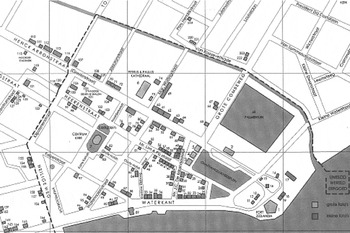
(UNESCO, 2002)Of all listed buildings still existing (229), almost half (49.8%) are situated within the boundaries of the UNESCO World Heritage site. The oldest listed building is Fort Zeelandia that dates from 1667. Some of the most important listed buildings are centered around Fort Zeelandia and Independence Square (formerly Orange Square). These listed buildings are featured prominently in the nomination dossier as well as on Paramaribo's monuments map. Figure 1 shows the conservation zone that comprises the world heritage site of the historic city center.
Map showing the designated Conservation Zone of the World Heritage site of the historic inner city of Paramaribo. Source: Monument card “Monumenten in Paramaribo,” Aimee de Back, Reference De Back2008.

METHODOLOGY
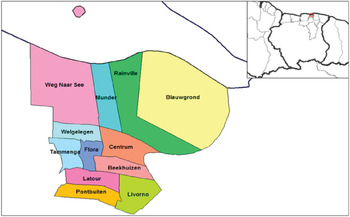
The research area is the district of Paramaribo, geographically divided into 12 neighborhoods, locally known as ressorts.
Map showing the district of Paramaribo with its ressorts.

For the purpose of this case study, one phase of data collection was based on questionnaires, taken from a random sample of the population under investigation, that is, officially registered residents of the district of Paramaribo. The second phase of data collection comprised structured interviews. These interviews focused on the phenomenon of heritage for national and local policymakers, agencies in heritage planning and management, entrepreneurs, tourism industry, residents, and so forth, the aim of these interviews was to contribute to a better understanding of the meaning and importance of heritage to all those involved in the process of preservation, legislation, conservation, identity formation, and even exploitation.
This sampling frame of the officially registered residents of the district of Paramaribo, from the 2004 population census of Suriname by the General Bureau of Statistics was stratified by ethnicity. The ethnic population groups that constituted the subject of this research were the East Indian Hindustani, Creoles, Maroons, Javanese, and mixed people. Numerically, these are the most important groups. The sample, consisting of five ethnic groups, was made up of a total of 3150 addresses, that is, 630 residents for each ethnic group.
Interpretation of colonial heritage is about awareness, beliefs, opinions, values, motives, and attitudes. Consequently, the questionnaire used was a combination of factual questions measuring some relevant factual variables, and the measurement of subjective variables through attitude scaling, multiple-question, and in-depth interview techniques. For the purpose of this research—clarifying the sociopsychological meaning of colonial heritage—several dimensions or elements were distinguished.
The most important ones were:
• Personal appreciation of the heritage (i.e., recognition, identification, solidarity, interest, idea)
• Population group engagement with the heritage (i.e., use, collectivity, identity, ownership)
• Management and administration of the heritage (i.e., decision process, involvement, access, voice)
These categories served as the reference point for designing a research instrument based on attitude measurement. The items developed are directed toward the measurement of the following variables:
• Personal items (i.e., gender, age, ethnicity, birth place and residence)
• Socioeconomic items (i.e., educational level, income, daily activities [employment, etc.])
• Attitude toward colonial heritage (i.e., aesthetic appreciation, perception, visit and use of the historic inner city, preservation and restoration, identification and [group] identity, personal and national interest, contribution to well-being, and attachment to and sense of place, national bond with colonial heritage)
• Active participation (i.e., having a say or voice, active involvement in institutes involved in the administration of colonial heritage, provision of information, active choices, accessibility of public inquiry procedures)
In addition to the questionnaires, in-depth interviews were conducted with experts as well as with residents. These interviews focused on the phenomenon of heritage for (local) policymakers, agencies in heritage planning and management, entrepreneurs, the tourism industry, residents, and so forth. The aim of these interviews was to contribute to a better understanding of the meaning and importance of heritage to all those involved in the processes of the preservation, conservation, and exploitation of the heritage sites.
THE ADMINISTRATIVE AND LEGAL FRAMEWORK
In Suriname, people were becoming increasingly aware of the importance of the preservation of monuments and historic buildings as early as during the Dutch colonial period. The first initiatives in this respect date from the 1960s. It was in this period that the first steps were taken and conditions were created that were supposed to lead to better structured management and preservation practices with regard to built heritage in Suriname. This gave rise to the development of laws and regulations in the sphere of preservation and heritage management (Fokké, Reference Fokké2009). A number of the initial, structured studies that were conducted of the listed buildings in Paramaribo and outside, date from this period (Ozinga, Reference Ozinga1961, Reference Ozinga1963; Temminck Groll & Tjin a Djie, Reference Temminck Groll and Djie1973; Volders, Reference Volders1973). These studies served as the foundation for the formation of the current listed buildings. Of the total number of listed buildings registered (244 in July 2008), 229 still exist (De Back, Reference De Back2008). Fifteen were illegally demolished and/or burnt down over the years. One of the factors that contributed to the disappearance of listed buildings is the lack of a legal framework to support the register. It took quite some effort for this legal framework to be realized. It was not until August 1999 that the register of listed buildings assumed its current legal form, by decree of the Ministry of Education and Community Development (hereafter referred as MINOV; Advertentieblad van de Republiek Suriname, 1999). The previous decree from 1987 turned out to be legally invalid, because it had not been published, as prescribed in the Listed Buildings Act from 1975 as a successor to the Monument Regulations from 1963. Moreover, the required procedures to designate landed property as listed buildings, as specified in the law, were not followed. Finally, it is the Listed Buildings Act from 2002 that gave Suriname's built heritage the necessary legal protection. An important component of this Act is its potent to designate village or urban conservation areas. This means that the act is not restricted to just monumental objects. For example, the historic city center of Paramaribo is on UNESCO's World Heritage List as a whole, not each building separately. Initially, all on the list were situated in the district of Paramaribo. However, from 2004 onward, listed buildings outside this district were also included. Examples of this are the former police post on the old coffee plantation of Frederiksdorp (2004) and Fort Nieuw Amsterdam (2005), both located in the district of Commewijne. In 2007, Paramaribo's only remaining plantation house was included on the list (Fokké, Reference Fokké2009).
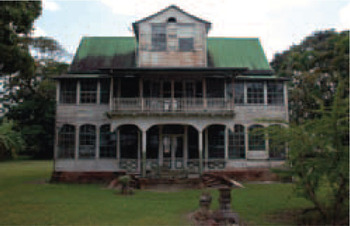
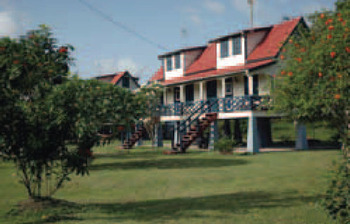
The Geyersvlijt plantation house. Photograph courtesy of Eugenio van Maanen.

The Frederiksdorp plantation at Commewijne. Photograph courtesy of Eugenio van Maanen.

A growing awareness of the importance of the development of a system for the preservation of monuments and historic buildings ultimately led to the emergence of various institutions and foundations in Suriname, each involved in the management of built heritage resources in their own way. However, it is the Suriname National Trust, the Suriname Urban Heritage Foundation, and the Committee for the Preservation of Listed Buildings that are nationally active. All are government supported and embedded in different ministries. For example, the Committee for the Preservation of Listed Buildings falls under the responsibility of the Ministry of Public Works. Members of this committee all operate on a voluntary basis and are experts in the field of architecture, law, and so forth. The Suriname Urban Heritage Foundation is embedded within MINOV.
The inscription on the World Heritage List of UNESCO obliges the Surinamese government to manage the historic city center in a structured manner. To be able to comply with this obligation, they are required to design a management plan. The Surinamese government, represented by the Suriname Urban Heritage Foundation has been working together with Delft University of Technology since 2008 on this Paramaribo World Heritage Site Management Plan. One of the key concerns of this management plan is the formation of a management institute, by means of a public-private partnership. However, the formation of a public-private management institute is a slow and difficult process. This is shown by the fact that the Suriname Urban Heritage Foundation, after its establishment in 1997, still serves as an institute, whereas at that time, it was considered an interim measure as a transition to the establishment of the Suriname Heritage Management Corporation Limited (NV Surinaamse Monumenten Beheersmaatschappij; ICOMOS, 2002). In concrete terms, this means that the Suriname Urban Heritage Foundation has, to date, been fulfilling the role of site management authority, which bears responsibility—on behalf of the government—for the management and supervision of the historic city center. In addition, it acts as a counterpart to the World Heritage Centre of UNESCO in Paris. However, the legal framework for this function and task has not yet been formulated. The 2002 Listed Buildings Act is the only legal recourse that the foundation has at its disposal, and on the basis of which it can take action against offences. An important problem in the management of the historic city center is that the area is under the direct responsibility of several ministries. For example, the Culture Directorate, as a part of MINOV, is responsible for culture policy and heritage preservation. However, management and maintenance of all monumental government buildings is in the hands of the Ministry of Public Works. This ministry is also authorized to handle applications for demolition and building permits (reconstruction or new development) in the historic city center. The fact that the historic city center falls within the sphere of activity of different government departments, is considered by the Suriname Urban Heritage Foundation as one of the main problems in the management of the historic city center. It is also considered to be the reason why a properly functioning public-private management institute cannot get off the ground.
Another significant factor in relation to the management of listed buildings is the ownership issue. In principle, there are three ownership categories. One of these is the Surinamese government itself. The government owns about one-fifth of the listed buildings situated within the boundaries of the heritage site. The other two categories are listed buildings that are fully privately owned, for example by private individuals, corporations, and foundations, or fall within the domain of an undivided estate. Apart from a few similarities, each category has its own specific problems where the management and maintenance of listed buildings is concerned. For example, the problems in the management of government-listed buildings are largely caused by the government itself. This is shown by an analysis of a number of interviews with various government officials closely involved in policy formulation with regard to heritage preservation and management. A recurring argument is that because of a lack of awareness within the various government departments and the lack of efficient coordination between the various departments and other implementing bodies, problems arise in the implementation and enforcement of government policy and legislation. In addition, the devolution of ministerial responsibilities, where the historic city center is concerned, is not really conducive to an effective and properly functioning listed buildings management system. These problems are manifested in the overdue maintenance of the listed buildings. This is partially caused by the fact that the necessary funds for maintenance have to be derived from the budget of the ministry that occupies the listed building. In other words, the Ministry of Public Works is responsible for the management of government-listed buildings, but depends on other ministries for funding. Another example of the lack of coordination between ministries is the order in which infrastructural adjustments to the historic city center are expedited. More often than not, parking facilities, sidewalks, and green areas are realized before the mains services are connected, as a result of which everything has to be done twice.
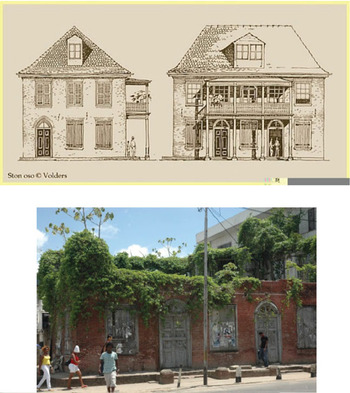
The possible problems with respect to listed buildings that are part of an undivided estate mainly occur when there is disagreement between the heirs. Many buildings of this sort are in a state of disrepair because the heirs do not have the financial resources, or do not want to make financial resources available, to maintain the building. It is precisely because of the type of construction of many historic buildings and the building materials used, mostly wood, that it is a costly affair to restore buildings to their original state, and to keep them in this condition, especially in Suriname's tropical climate. Additionally, land in the historic city center is scarce and thus expensive. The market value of a piece of land, however, is considerably lower if there is a monument on it. When a building is listed, the owner is required—under the 2002 Listed Buildings Act—to follow all sorts of procedures, in the event the owner wants to demolish, restore, or otherwise alter the property. This means that, from a purely economic perspective, letting the building decay may be a more attractive option to the owner. At some point in time, the building will have disappeared altogether, increasing the price of the land. It is difficult for the government to take action against these types of practices such as neglect, omitting to carry out maintenance work, because there is not a single legal framework for the government to coerce owners or heirs to undertake the necessary maintenance. Two striking examples in this respect are the listed buildings Ston Oso and plantation house Geyersvlijt. Ston Oso, or Stone House, was privately owned until recently. Because of the historical character, the government tried to compel the owners to agree to an exchange. These negotiations lasted more than 10 years, while the building continued to deteriorate. In the end, after years of negotiations, the property was acquired by the government. Now, plans for its restoration can finally be made.
Another example is Geyersvlijt plantation house, situated at Anton Dragteweg in the suburb of Blauwgrond. This suburb is one of the most prosperous parts of the city of Paramaribo. This last plantation house of Paramaribo is now in private hands. The plantation house stands on a large parcel of land directly on the bank of the Suriname River, making it a top location by real estate standards. The fact that restoration of the plantation house is not a priority to the owner is shown by the protracted negotiations concerning its sale to the government. The initial asking price of around US$1 million, however, is disproportionate. The owner, who resides in the United States, only benefits—in economic terms—from the land without the monument on it. This will enable him to divide the land into several sections, sell these sections separately, and thus achieve a greater profit. Since the government does not have the legal capacity to expropriate the property, it does not have an effective instrument to put a stop to the decay and deterioration of these types of buildings.
Ston Oso, in earlier days (Volders, Reference Volders1973) and at present. Photograph courtesy of Eugenio van Maanen.

Apart from the problems with regard to acquiring ownership, there is a problem in terms of financing the restoration works once the property has been acquired. Buying listed buildings is a very costly matter, and that is before the restoration and/or maintenance work has started. An aspect that not only applies to the context of government listed buildings, but also to private owners. There is no provision in Suriname that supports private owners of listed buildings in the financing of restoration and maintenance. There is no restoration fund, there are no tax benefits or other facilities that make it attractive for owners to restore or maintain their historic properties. Although formally responsible for the maintenance of the historic city center themselves, some government bodies argue that the government falls short in actually taking this responsibility. This lack of sense of responsibility is partially expressed in the frame of mind that predominates in the public sector, namely that one is entitled to grant oneself certain privileges. It is generally believed that, as government bodies and owners of a large number of listed buildings, one is not obliged to abide by the laws and regulations formulated by the government itself. What follows naturally from the above, is the question of how the Surinamese government devotes attention and priority to formulating and implementing cultural policy and particularly policy that focuses on the preservation of historic built environments.
CULTURAL POLICY
The “long-term development programme 2006–2011” (MOP, 2006), is the development strategy that serves as a point of departure for the long-range policy of the government, the private sector and nongovernmental organizations (NGOs) in Suriname. It constitutes the guiding principle to most ministries in the formulation and coordination of policy as described in the ministries' respective specific policy documents. One of the basic conditions mentioned for the success of this development strategy, is the freedom of expressing one's own culture. This freedom serves as the foundation for further cultural expression, innovation, and experience. The cultural policy as set forth in the program is primarily aimed at widening the possibilities for all citizens to take part freely in cultural life in Suriname. This is explicitly specified in the policy principles, responsibilities, and organizational processes. The government formally describes this as follows:
Due to the cultural diversity of the Surinamese society, the policy is based on a cultural democracy in which recognition and equality of all cultures is of primary importance. This is supposed to guarantee that:
• All individuals, without exception, can freely take part in cultural life.
• The rich diversity of cultural values is maintained and further developed.
• All cultural sources will be drawn upon in order to develop and strengthen Suriname's cultural identity, creativity and national unity.
Realizing these points of departure is the responsibility of the Culture Directorate. The emphasis of the responsibilities can especially be found in the field of initiating and developing artistic expression and cultural production as well as developing cultural education and encouraging culturally oriented academic research. What is also part of the responsibilities, is the stimulation of the performing arts at all levels and the creation of cultural and community activities. In conclusion, the preservation, documentation, and making accessible of so-called cultural heritage is also mentioned as a responsibility of the Directorate (MINOV, 2006; Staatsblad, 2007).
The department of “Cultuurstudies” (Cultural Studies) within the Ministry of Education and Community Development and the Suriname Urban Heritage Foundation are coresponsible for the implementation of these responsibilities. Where the long-term development program mentions the preservation of cultural heritage, it is explicitly referred to in terms of “tangible” as well as “intangible” heritage resources. However, analysis of the policy documents as well as the interviews both show that the stress in the preservation of cultural heritage is on the various expressions of ethnic specific cultures, such as dance, music, art, and theater, and not on the built environment. This is confirmed by the fact that the Culture Directorate typically spends most of its budget on activities that relate to the preservation of these various expressions of all ethnicities and cultures in Suriname.
The policy documents briefly described above confirm that little priority is given to the preservation of historic built environments. In the long-term development program and in the MINOV policy documents, colonial built heritage receives only fleeting attention. For example, of the total of 35 objectives outlined in the program, only 3 are related to the material built environment. These three objectives are that the number of restorations of listed buildings should have doubled in five years, that a restoration fund needs to be created, and that “Jodensavanna,” a Jewish settlement from the seventeenth century and the Cassipora cemetery should have been nominated in 2008 for the World Heritage List. These two sites were proposed for nomination in 1998 and since then, they have been on UNESCO's tentative list. The implementation of cultural policy in general and especially the part concerned with the building preservation is progressing slowly for a number of reasons. One of the most important of these is Suriname's macroeconomic situation, which is largely founded on imported goods and services. There is a fundamental balance-of-payments deficit, and huge emigration flows as well as a relatively high unemployment rate (ABS, 2006; MOP, 2006). It is this economic situation that the government argues is the primary factor in explaining the lack of development in the cultural heritage of the Surinamese people. The failure to execute the proposed cultural policy is caused by the limited decisiveness of the Culture Directorate, which in turn is caused by the lack of resources. This is manifested in a lack of qualified staff, financial resources, and adequate accommodation (MINOV, 2006). This situation of a discrepancy between objectives and means of achieving them is widely understood by both heritage experts and the local population.
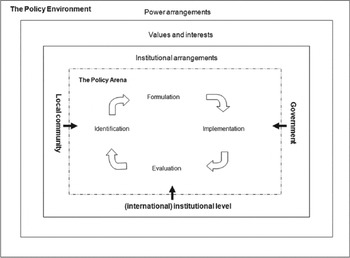
The problems outlined above are not confined to Suriname. A case study by Sedky (Reference Sedky2005) of the conservation of the historic city center of Cairo, Egypt, which is also a World Heritage Site, found similar problems. What is interesting about this study, is that the area conservation policy is approached using a theoretical model, which is also applicable to the situation in Suriname. This model, adapted and derived from Hall (Reference Hall1994), presents the dynamics of the process of policymaking for heritage resource preservation. The guiding principle in this model is that there are three categories of stakeholders, each involved in their own way. These are the local community and individuals, national and international authorities, and organizations like UNESCO and the International Council on Monuments and Sites (ICOMOS), and finally, the government itself.
The components of a policymaking process. Source: After Hall ( Reference Hall1994) and Sedky ( Reference Sedky2005).

Priorities are established, choices made, and policy formulated within what is termed the policy arena, in which an interplay of forces occurs between the actors described. Interaction between the actors takes place on each of the three levels (power arrangements, values and interests, and institutional structures). Policy success, therefore, partly depends on the prevailing political climate, the meaning that is attached to the heritage concerned, and the adequacy of the institutional framework. Looking at the situation in Suriname, the component of “power arrangements” is particularly significant and the Surinamese government plays a crucial role. The position of the institutional framework as well as the local community is relatively insignificant. For example, the entire process of policy formulation is dominated by the central government, especially MINOV and the Ministry of Public Works. The fact that the role of the institutional level in policy formulation is negligible is confirmed by institutions like the Suriname National Commission for UNESCO and ICOMOS, which did not play a role of any significance in the nomination process, nor in the policy formation process.
The role of the local community, represented in local NGOs, for example, in terms of involvement and public participation, is similarly ineffective. Summarizing, the approach of the Surinamese government is characterized by a strong top-down approach. The extent to which this happens depends strongly on the priority that is given to this by the people primarily responsible within the various ministries. In other words, the success of policy and implementation mostly depends on the vision and priorities of a few high-ranking officials within the various ministries. Consequently, policy is reduced to a personal matter. The success of policy formulation and implementation as well as legislation and enforcement, partially depends on the extent to which the government supports the efforts of individuals. However, the interviews show that the government is seriously failing in this duty.
CONCLUSIONS
An important reflection based on the outcomes of the questionnaires is that there are differences between respondents in the degree to which one derives sense of involvement and identity from colonial heritage. However, in deriving and/or attaching sense of involvement and identity to colonial heritage, ethnic background does not play a role of significance. All population groups, more or less, derive a sense of involvement and identity from colonial heritage. In this respect, one group is not significantly different from the others. What is different, however, is the foundation that underlies this. The role that the Creole and Maroon community have played ever since Suriname's early days, and Paramaribo's early days in particular, is probably much more decisive and significant in awarding sociopsychological meaning to colonial heritage and heritage preservation compared to the other ethnic groups in this study. This means that possible differences in involvement and attitude toward colonial heritage and heritage preservation cannot be explained by ethnicity. Differences in ethnicity do not lead to different expressions of sociopsychological meaning and a difference of involvement. Where significant ethnic differences occurred, they related to the process of attitude formation with regard to colonial heritage and heritage preservation. Ethnicity as such does not lead to a different expression in sociopsychological meaning attached to colonial heritage or the degree of involvement. Furthermore, the research results have shown that colonial heritage contributes to the creation of national unity and identity. This leads to the conclusion that colonial heritage as such can act as a binding factor between the various ethnic population groups. Nevertheless, there are differences in the extent to which one ascribes this role to colonial heritage. Despite the fact that colonial heritage is considered, by many, as a part of the shared Surinamese history, colonial heritage is interpreted in different ways. In other words, it is precisely in a complex, multiethnic community, like Suriname and Paramaribo, that a simultaneous plural and subjective interpretation and meaning can be attached to existing resources that date back to an era of colonial rule and that, ultimately, were labeled as heritage. This communal, historical fact is what makes up the frame of reference in this respect. It is merely the physical presence of these resources that constitutes the foundation for the emergence of a sense of involvement, which contributes and/or may lead to a sense of national unity or identity. The interpretation of these same resources and the way in which this process leads to attitude formation, differs across the various ethnicities.
With the inscription of Paramaribo's historic city center on UNESCO's World Heritage List, the Surinamese government has set itself a major challenge, which has two components. On the one hand, it involves policy formulation and implementation, and on the other hand, it relates to legislation and enforcement. The question that arises from the interviews with the relevant heritage experts is whether this inscription should be seen as a heavy burden and responsibility for the government, given the economic limitations and the present lack of political will, rather than as a challenge? At present there seems to be a popular consensus that the government is failing seriously in heritage policy. The formulation of policy for the preservation of built colonial heritage, as a part of a wider cultural policy, is still in its infancy with action programs being developed for this specific purpose only in the last few years. These programs, as described in MINOV's policy document 2005–2010, relate to the implementation of the 2002 Listed Buildings Act, including applying for subsidies for the restoration and maintenance of listed buildings. The other items mentioned are the nomination of Jodensavanna and Cassipora cemetery for the World Heritage List and the privatization of Fort Nieuw-Amsterdam open-air museum (MINOV, 2006). However, incorporating policy for the monumental built environment from the colonial period as one, relatively small, part of a wider cultural policy is the least one can expect of the government that proposed it for the World Heritage List of UNESCO. Although this topic has been receiving more attention from policymakers over the last few years, an attendant problem is the translation of policy into practice, which in concrete terms means releasing financial resources that currently are devoted mostly to the preservation, study, documentation, and making accessible the cultural manifestations of the different groups in Suriname.
Another important problem that is frequently referred to concerns the legal framework and its enforcement. The legal framework is specified in the 2002 Listed Buildings Act, which purely focuses on protecting listed buildings, and rural and urban conservation areas. However, the general problem as observed by heritage experts does not relate to the interpretation of the law but to its enforcement. After all, what is meant by listed buildings, village conservation areas, and urban conservation areas is clearly defined in the 2002 Listed Buildings Act. In addition, the Act provides information about the procedures to be followed for the designation of listed buildings, objection and appeal procedures, prohibition provisions, coercive measures and penal provisions, and repair and maintenance obligations. The importance of the enforcement of this law is shown by the completion of new housing developments in the core area of the historic city center, which is in conflict with the provisions of the 2002 Act. Additionally, the unbridled growth of outdoor advertising in the city center is regarded as a threat to the preservation of the urban conservation area as specified in the law. The cause of this problem is attributed by the majority of heritage experts in Suriname to inadequate organization, cooperation, and coordination between the various government services, which will all have to be improved in order for heritage policy to become efficient and effective.
The problems observed with regard to policy, laws, and enforcement also affect the management of the historic city center. An important topic that is not covered in the 2002 Listed Buildings Act is the creation of a legal management framework. This, however, is a crucial topic and it means that, at the moment, there is no legal framework for the management of the listed buildings. The lack of this framework is regarded as problematic by a wide range of heritage experts, and according to them, it deserves a high priority on the agenda of heritage management. As early as the World Heritage site nomination process, there was talk of setting up a management authority especially for the historic city center. For example, in the recommendation for nomination to the World Heritage Centre, ICOMOS stipulated as a precondition in 1999 that in order to qualify for nomination, action needed to be taken to protect and manage the site (Iamandi, Reference Iamandi2008; ICOMOS, 2002). This has led to the establishment of the Suriname Heritage Management Corporation Limited by government decree in 2001. However, this management corporation has not yet become operational. The most important causes for this can be attributed to the existence of conflicting interests, both between stakeholders involved within the Surinamese community, and within certain authorities, especially the Surinamese government. Moreover, bureaucratic processes may also be an explanatory factor, but the slowness of the formation process of a management corporation is, however, not only attributable to this. Another aspect that plays a role is the question of who should become shareholders in this management corporation. The Culture Directorate clearly sees a role in this respect for insurance companies, banks, real estate businesses, and the corporate community. It is precisely this latter category, which, in addition to the government, is strongly represented in the historic city center, and which makes intensive use of the city center. Moreover, trust is an important factor. Not only trust between the potential shareholders of the management corporation, but also trust in the functioning of this organization. The fact that trust is an issue is basically shown by the hesitation of the owners of listed buildings to hand over peremptorily their property to a new management corporation.
What is striking, however, is that in their vision on setting up a management corporation, the responsible government authorities do not explicitly refer to the role and position of the local community or an organization such as the Suriname National Commission for UNESCO. The latter describes itself as the liaison organization between UNESCO and the Surinamese government and in this capacity the principals of the Suriname National Commission for UNESCO believe that it should have a greater say in the matter and should at least be part of any such management corporation. The situation can be labeled as striking because, in the past couple of years, the principle of sustainable management has become an integrated component within world heritage planning and management. Since 2002, heritage is regarded by the World Heritage Committee as an instrument that contributes to the sustainable development of all societies. While not addressing the complex discussion of the meaning of the vague concept of sustainable development, it nevertheless argues that sustainability in the planning and management of built colonial heritage will only be achieved when there is long-term planning and active participation of multiple stakeholders in that planning process (Landford, Reference Landford2009). In this process, informal and local interest groups and individual citizens are regarded as an indispensable factor, both in the phase of nomination as well as in later decision-making and management.
This study in Paramaribo has shown that, in none of these phases, did the local community or individual citizens participate structurally in the nomination process, by being given the opportunity to exert influence or make themselves heard in the various decision-making processes, nor were they involved in the planning and management of the built heritage in any form whatsoever, either in organized and/or representative manner. For example, Landford (Reference Landford2009) believes that where formal, cooperating partnerships are involved in setting targets relating to heritage planning and management, it is precisely the role of the local community that is easily overlooked.
The overriding problem with regard to the success of the planning and management of built colonial heritage is that it requires a process that is based on an equal balance between economic, social, cultural, and political interests among all stakeholders. Only when the needs and wants of local communities and individual citizens are recognized and heard by formal institutional stakeholders, will the basic conditions be created under which a sustainable form of heritage management may possibly be developed. However, as for the built colonial heritage in Paramaribo, no such conditions have yet been created. On the contrary, the signals given by the various heritage experts beg the question of just how much the built colonial heritage in the historic city center of Paramaribo is actually regarded as heritage by the Surinamese government itself?
What does this insight mean for policy formulation and implementation by the government authorities directly involved with heritage planning and management? This concluding section ends with a perspective on how the conclusions can be interpreted and how they may have an impact on the area for which these authorities are responsible.
With the submission of the nomination application, of the historic city center of Paramaribo for inscription on the UNESCO World Heritage List, and the ensuing approval by UNESCO, the national government of Suriname has taken on the responsibility and best-effort obligation to ensure a sustainable management of the colonial heritage. However, the problem the government is facing in fulfilling this task has several facets and can partially be blamed upon the government itself. In the first place, there is the priority issue. Does the management and preservation of the historic city center have a high enough priority for the government itself? This does not seem to be the case. A significant factor that is part of the explanation for the government's low priority for investing in preservation and management, is the limited experience, awareness, and capacity of the government in these respects. What is important is that the government should recognize its own shortcomings. In reality, a positive attitude toward monument preservation and historic area management strongly depends on the position that a local community takes in these processes. If a local community is offered the opportunity to participate actively in the decision making process, then the level of awareness, involvement, and appreciation among the local population is likely to increase. As a result, it becomes easier for a local community to identify with and create a sense of ownership of the heritage in question. This, in its turn, will affect the way in which the government pays attention and gives shape and form to heritage management. After all, civil servants who are responsible for the pursuit of the policy are part of the local community themselves. In concrete terms, this means that if the Surinamese government wishes to take seriously the responsibility and best-efforts obligation it has assumed in relation to the colonial heritage buildings, it needs to start investing in increasing local participation.
What the study does point out is that there is a discrepancy between the formal organizations involved in built environmental heritage on the one hand and the local residents on the other. The study gives the impression that the local population has a need to be involved and be informed and that this need is much greater than many official organizations suspect. However, in the end it does not matter whether this discrepancy actually manifests itself or whether it is based on just a feeling. The fact remains that local participation generally has a positive impact on the success of any chosen heritage policy direction. This fact alone makes investing in participation desirable and necessary, especially in the context of a multiethnic society in which the different groups, each in their own way, interpret, identify with, and appreciate the colonial heritage buildings. It is precisely these different interpretations that necessitate the provision of information, the opportunity of participation, and influence being exerted on decision-making processes. As a result, the transparency of the government's actions in this area will increase, and the degree of support and understanding within the community will grow, in relation to the policy pursued and choices made, regardless of the fact that there will always be interpretational differences between the various ethnic groups. By placing a greater emphasis, within the frameworks and existing possibilities, of a bottom-up approach, a more decisive and effective heritage policy, heritage law and heritage management can be developed. The fact that an important aspect of this process is made up of information and education directed toward the local population, may come as no surprise. However, if the national government wants to devote serious attention and priority to this, it should create and facilitate such enabling conditions for the implementing organizations.
The lessons drawn from the experience of the city of Paramaribo raise issues of heritage property ownership that are much wider than just legal title. In particular, the heritage of a colonial era, and one dominated by the existence of the North Atlantic slave trade, raises the issue of identification and claim. The old “Whose heritage is it?” question and the answer, “whoever identifies with it and thus claims it as theirs” is complicated by the attitudes and involvement of both the former colonizer and the former colonized. To what extent is historic Paramaribo Dutch as well as Surinamese heritage and what therefore should be the role of Dutch agencies and individuals in expressing any such ownership claim by financial or managerial support? Similarly the multiethnic nature of Suriname and especially the different histories of the ethnic groups render it likely that the identification and thus ownership claim will vary between such groups. There is, finally, also the nation-building question, namely “What is the role of this colonial heritage in the shaping of a specifically Suriname national identity?” Such questions and their ambiguous answers are not unique to this case but will be equally applicable for any “exclave” heritage (as introduced by Tunbridge & Ashworth, Reference Tunbridge and Ashworth1996) but will be especially applicable worldwide to multiethnic societies seeking inclusivity and unity and postcolonial societies engaged in nation-building.