Global and local: putting the observatory story in its place
Opened in 1884, the Hong Kong Observatory (HKO) joined an established regional network of world-leading observatories within, and without, the British Empire. High-level employees were hired via the Royal Observatory at Greenwich; most tools were manufactured by British instrument-makers, and the building and staff were funded and regulated by the colonial service.Footnote 1 On an everyday basis, however, regional connections were more significant. These included the Jesuit facilities at Zikawei (Shanghai) and Manila and the Japanese Meteorological Observatory at Tokyo, with whom HKO's director and assistant director kept a regular correspondence. There were close links too with the network of registering stations run by the Chinese Maritime Customs Service (CMCS) based in Shanghai. These meteorological nodes were increasingly linked by the maturing web of the Eastern Extension and Great Northern Telegraph Companies and the Chinese Telegraph Administration.Footnote 2
This regional web is usually remembered through its big names: William Doberck (HKO); Father Federico Faura (Manila); Marc Dechevrens (Zikawei), Arai Ikunosuke (Tokyo) and Robert Hart (CMCS). Yet it could not have existed without its army of meteorologists, human computers, assistants, clerks, telegraphists and weather observers. That was just within the observatory. In Hong Kong itself, the observatory relied on information gathered by observers from the Harbour Master's Office, the Nautical Almanac Office and tidal observatory, local hospitals, the botanic garden, lighthouses and ships docked in port.Footnote 3 To convey this information there was another layer of telegraph operators and coolies (the latter especially important when telegraph lines went down during a storm) and the local press, who received and printed weather reports and storm warnings. In addition to these formal channels, each year volunteer observers were issued instructions by the observatory for making weather readings, which would then be verified in-house.Footnote 4 Even Hong Kong's prisoners were engaged in meteorological work in a small way. In 1910, for example, inmates at Victoria Gaol printed 29,870 forms and bound 116 publications for the observatory.Footnote 5
This article offers a close lens through which to view the stories of some of these people. It argues that these stories say much about the circumstances of producing meteorology in colonial settings, at a time when both service and science were undergoing transition. It responds directly to the call put forward by Martin Mahony and Angelo Matteo Cagliotti in 2017 for the history of meteorology to learn from history of science studies of invisible labour to investigate ‘the lives and careers of not only the institution-builders and the knowledge-leaders, but of those who were drawn into the ranks of those institutions from a range of cultural backgrounds, performing the monotonous works of observation and data processing, feeding local weather into the centres of colonial climate calculation’.Footnote 6 Indeed, although this subject has been addressed in other areas in the history of science, Mahony and Matteo Cagliotti were right to note the absence of the ‘middle men and women, and their role in the broader development of meteorological knowledge’ within the history of weather science.Footnote 7
It draws from several interlinked themes in the history of science and the history of colonial meteorology.Footnote 8 In the late 1970s, the social constructivist turn influenced a generation of scholars to think around the social production and contexts of production of scientific knowledge.Footnote 9 Historians of meteorology came to this late, persuaded by scholars including David Livingstone, Kapil Raj and James Secord to explore the geographies, circulations and exchanges of knowledge across local, regional and global scales.Footnote 10 Meteorology was, of course, well placed to provide evidence of such exchanges, and recent studies have revealed how observatories and ships operated as hubs and channels in global meteorological knowledge networks.Footnote 11 Yet the discussion of people in this vast information network has been relatively neglected, with studies of observatories often focusing on the observatory itself as site or space of science, in many respects abstracted from their workforces.Footnote 12 This is somewhat surprising given that successful meteorology relied on the collation and analysis of immense instrumental data sets by manifold weather observers and assistants. As the global teleconnections of monsoons or of exceptionally wet or dry weather were recognized and the telegraph enabled storm-warning cooperation at local and regional scales to predict storms, meteorology required ever more human resources.Footnote 13
This leads us to the second theme: the hidden role of women and men who undertook and shaped meteorological research. The publication of Steven Shapin's study of ‘invisible technicians’ was a pivotal moment in scholarship highlighting the lives of scientific workers.Footnote 14 As Shapin wryly noted, the technicians or assistants of his study of early modern England were (at his time of writing) ‘doubly invisible’, ignored by both contemporaries and historians. While interest was slow to develop (as Robert Iliffe pointed out thirty years later, technicians still remained absent in many historical accounts), there has been significant progress recently.Footnote 15 There are now many studies which range across time and space, including Londa Schiebinger's rendering of botanical assistants and of knowledge exchanges between colonial explorers and indigenous peoples in the Americas, studies of lab workforces or female computers in different scientific environments, and even a contribution by Gabrielle Hecht on people working in hazardous uranium production in South Africa.Footnote 16 Most recently, Lydia Barnett has considered the invisible ‘earth worker’ – those people who undertook the physical aspects of fossil hunting on behalf of eighteenth-century naturalist employers.Footnote 17 Much impetus has also come from studies of women in science, which have re-evaluated the role of female ‘assistants’, technicians and computers who had previously been obscured in a history that, as Patricia Fara notes, once favoured the lives of great men.Footnote 18 As Hannah Gay rightly stated, these women provided a support network without which the scientific innovations and successes credited to those great men might not have reached fruition.Footnote 19 Meteorological history has more recently turned to some of these women but there still remains a great deal to be done, especially for the late nineteenth century.Footnote 20
This paper aims to fill this gap for meteorological history through a close study of the rich surviving records of the Hong Kong Observatory, now scattered worldwide between Hong Kong, Cambridge and London. As is so often the case when studying colonial history, however, these records are invariably top-down and biased. The assistants and workers surface only in letters of complaint, appointment or dismissal, or in an occasional acknowledgement of their service by a superior officer. Only rarely were their contributions to science – for example, in published research reports or papers – credited. Indeed, as Gay noted in her own study, part of the reason for the continued absence of technicians in history is the difficulty in recovering their lives.Footnote 21 Thus much of the contribution of the Hong Kong Observatory staff is implied, rather than fully known. In order to try and move beyond this constraint, the article starts by setting the scene to help the reader envisage a context. The discussion then follows the types of records available, which are invariably related to salary, performance, workload or complaint. While this has led inevitably to painting a somewhat negative picture of the relationship between employer and employees, it is hoped that the small glimpses of positive interaction and the longevity of many staff in their roles might go some way toward redressing the balance.
A new observatory for Hong Kong
The road to establishing an observatory at Hong Kong had been long and winding. Whilst easily persuaded of the need to develop a better time service for ships visiting the busy port, the British government were less convinced of the value of a large facility to study astronomy, magnetism and the weather. First proposed in 1874, construction work on the building did not commence until 1881. The men largely responsible for drawing up the plans and budget for the new observatory were Major Henry Spencer Palmer and Edward Bowdler. Palmer was a surveyor, engineer and trained astronomer, who served under governor of Hong Kong Pope Hennessey as chief engineer between 1878 and 1880.Footnote 22 Bowdler, then acting surveyor general, had previously served in similar roles in Mauritius, where, it has been suggested, he would have been exposed to the workings of the Royal Alfred Observatory there.Footnote 23 They both advised on how the facility ought to be run, how many staff to hire and how much to pay them. A compliment of twelve people was necessary, claimed Palmer, which number should include the director and senior European staff, two ‘trustworthy and accurate’ clerks, two or three Chinese coolies to run messages and undertake maintenance jobs, a gardener, nightwatchmen and an ‘intelligent’ local to work the time ball, weather signals and tide gauge.Footnote 24 It would not surprise anybody (then or now) to note the wide discrepancy between the proposal and the reality, mostly due to the lack of funding allocated the new service by the government.
A description of the observatory written in 1883 gives some sense of how the observatory would have looked in the early years. The building was small; a rectangular block, eighty-three feet long by forty-five feet wide (not including the transit room). Walking into the entrance hall you would find the telegraphic apparatus. This gave the observatory a direct link to two local police stations which could be quickly notified if an incoming typhoon was detected. Contained within the main building was an office and a library, a clock room, galvanic battery room, a computing room and an instrument room, and behind the latter a photographic laboratory. The instrument room and lab required special conditions. First, the temperature had to be constant. To achieve this, three large kerosene lamps were kept lit in the room all year round, adjusted according to the season. Second, the ceiling, walls, floor and furniture were decorated entirely in dark red. With the tropical humidity of Hong Kong's late spring and summer, working here must have felt like working in a scene from Dante's Inferno. The upper storey was earmarked for the director's personal quarters and the few servants who lived on site were allocated small rooms in an adjoining block adjacent the storerooms.Footnote 25
As the building drew nearer to completion, William Doberck was appointed director. Doberck had previously served as director at Mackree Observatory in Ireland before applying to Hong Kong.Footnote 26 Trained in Denmark, he had beaten a long line of international applicants for the post.Footnote 27 His second in command was Frederick Figg, a British man who would work at HKO for almost thirty years, succeeding Doberck as director in 1907.Footnote 28 London's Greenwich Observatory facilitated recruitment of Europeans for the senior positions and appointees would normally be on a career track, either within the Hong Kong Observatory or across the broader network of colonial or home-based meteorological institutions. Doberck and Figg, however, had to recruit locally for the more junior posts. These people were drawn from various backgrounds and levels of education, the more skilled roles hired through competitive colonial civil service examinations held at the Government Central School in Hong Kong.
Understaffed and underpaid
Doberck and Figg had only a shoestring budget with which to hire staff in 1883. They started by placing an advert for the two most senior positions: a second assistant and a Chinese clerk. The second assistant was expected to have a solid foundation in mathematics and would make meteorological observations and manage the photographic laboratory. The clerk's role was essentially that of accountant, translator (between English and Chinese) and correspondent. Like the subjects of Mark Franks's article in this section, it was specified that candidates also be young and in good health, of which more later. The advertised salaries were $480 per annum for each role, with potential for a $120 rise for the assistant post-probation – rather less than Palmer had originally proposed.Footnote 29 The job specification also noted a standard working day from ten until four, including Saturdays. As we shall see, long hours and overwork were in fact the norm, especially during typhoon season (typically May to November).
Mr Solomon Reuben Solomon and Mr Sung Man-Hoi were appointed as second assistant and clerk respectively in December 1883, after a disappointing round of only four applications. Neither man lasted long in his new role. Solomon resigned for reasons unknown within only a few months, forcing a new hiring round in May 1884.Footnote 30 This time the examination attracted ten candidates, of whom Mr Mahomed Alarakia became the successful second assistant. Unfortunately, not much is known about Alarakia as a person, but we know that his job entailed tabulating thermograms, maintaining the galvanic batteries and managing the photographic laboratory, and, as Figg's chief assistant, he also recorded the magnetic and meteorological observations and compiled the monthly weather reports. Indeed, Alarakia appears to have undertaken the bulk of the observatory's meteorological work, which underpinned many of the observatory's research outputs. In 1888, for example, Doberck published a paper on the climate of south-east China in the Quarterly Journal of the Royal Meteorological Society. Although he put his own name on the article, it was actually based on a year's worth of Alarakia's data.Footnote 31 The meteorological community did not think much of the paper, though it was not Alarakia's work that was faulted but Doberck's lack of analysis. His critics noted that he had simply reproduced the data to present a general summary of annual conditions, missing, for example, the opportunity to comment on or investigate the monsoon, or the dangerous and misunderstood typhoon.Footnote 32 What is also interesting is that Alarakia contributed to the astronomical knowledge produced by the observatory. In July 1888, for example, he had observed a double solar halo.Footnote 33
Within a year, clerk Sung had also left, leaving an opening filled by Mr Lau-Shau in June 1885.Footnote 34 Lau-Shau also had an extensive workload, seemingly responsible for a great deal of the everyday work. He managed all correspondence, business transactions and accounts; acted as a telegraphic clerk; wrote out and issued the daily weather reports; collected meteorological observations; and had the very important role of communicating storm warnings to the colony.Footnote 35 The excessive demands of the observatory staff's jobs resulted from changing expectations of the facility's role over the first few years. In Palmer's original proposals, the observatory's chief functions were provision of a time service for shipping and astronomy. In his annual report for 1885, however, Doberck complained of being expected to issue daily weather reports and storm warnings, when his budget only covered scientific observations and calculations. In order to support what was arguably an extremely important public service, they would need an additional clerk and messenger. This would take pressure off Lau-Shau, then physically relaying the daily weather reports or storm warnings to the various press and telegraphic outlets in lieu of the coolies whom they could not then hire.Footnote 36 The request was not immediately accepted and Doberck was asked to justify exactly why he felt these additional staff (and thus expenditure) were necessary. He penned a rather acerbic note to the Colonial Secretary in response, arguing that the present situation of ‘overwork’ had led to the staff's health breaking down. They had only managed, he continued, because the typhoon season that year had not been very severe. If the weather had been worse, Doberck claimed, the meteorological service would have broken down altogether.Footnote 37 Funds to hire new staff were eventually awarded, but with the very firm caveat that ‘any application for a further addition to the staff … will not be entertained’.Footnote 38
Coolies were employed out of these funds, probably to Lau-Shau's great relief. In 1890, for instance, a coolie was employed at six dollars per month to run storm warnings between the Eastern Extension Telegraph Office, the Harbour Office, a noticeboard at Peddar's Wharf (used to alert the seafaring community of a storm or typhoon) and the various newspaper and police offices.Footnote 39 This could also be a dangerous job as, when the telegraph broke down in bad weather conditions (frequently),Footnote 40 coolies were responsible for physically carrying messages at considerable risk. Exceedingly little information survives about these men, however – often they are not even mentioned by name. An exception is from 1889, where the annual salary statement reports the hire of Tang Po (eight dollars per month), Tang Tung (six dollars) and Tang Wan (six dollars). Tang Po was an ‘office coolie’; the latter two men were ‘chair coolies’.Footnote 41 In 1896, the chair coolies were given a rise of one dollar per month, because the observatory simply could not find anyone to work for such a low wage any more.Footnote 42 Indeed, throughout the 1890s there was a series of querulous correspondence between Doberck, the Colonial Secretary's Office and various other departments, including the Harbour Master's Office, which made the point that storm warnings would not be deployed quickly and effectively when they could only offer such poor wages to those carrying them.
Subsequent to Doberck's application for more staff, Mr Mok Lai-Chi also joined the observatory as a second clerk. Far from the situation improving, however, things carried on much the same as before with a high staff turnover and service delays. Two years later Lau-Shau handed in his resignation.Footnote 43 We do not know why he left, but we can speculate. When hired he had been told that if he completed his probationary year satisfactorily, his salary would rise by ten dollars per month to $600 per annum. Toward the end of his probation, Doberck had written to the Colonial Secretary's Office with a good performance report, requesting the expected increment. His application was turned down. Offered an extra five dollars per month instead, Lau-Shau was informed that he would only receive another (unspecified) increment on completion of one more year's good service.Footnote 44 Lau-Shau's situation was not unique. In 1889, second assistant Alarakia only took home forty-five dollars per month, despite being in his fifth year of employment and on a higher level than Lau-Shau. This was large drop from Figg's salary, who as first assistant had three times Alarakia's wage.Footnote 45 Alarakia finally resigned in late 1889, his position filled by J.B. Eça Da Silva in January 1890. Mok Lai-Chi likewise encountered the same recalcitrance from the colonial service to increase his pay. Placed on a probationary period for the first six months of his term, Mok faced a series of failures, not least the that of the service to provide him with quarters as originally stipulated.Footnote 46 Soon after this discovery, Mok become ‘incapacitated’, requesting a transfer to another department.Footnote 47 Offered a place as usher in the Magistracy, he demanded a rise of ten dollars per month (which would have brought him to the full salary of $600 per annum he had wanted at the observatory). The service refused, arguing that the salary increase was linked to the commencement of a post within a department, not within the colonial service as a whole.Footnote 48
Doberck clearly believed that the HKO salaries were below standard for the colonies. In 1890 and again in 1894, he had requested a salary review for all his staff. Not only were all the salaries far less than those laid out in Palmer's original recommendations, he argued, but all other government departments – except the observatory – had received a 35 per cent increase in 1890. With rising living costs since the early 1880s, their salaries had actually declined in value.Footnote 49 Doberck may have had a point but examples from home and from other colonies suggest that poor pay was rife across the service. At Greenwich, for example, British assistants had petitioned William Christie, Astronomer Royal, about their pay on several occasions across 1906–7,Footnote 50 and looking at the salaries of subordinate staff and clerks in Malaya, the staff in Hong Kong were on a not dissimilar scale.Footnote 51 The next formal salary review did not take place until 1900, however, and until then any rises were ad hoc, made as and when Doberck could convince the authorities of an individual's special merit. The 1900 review was part of a major inquiry into all Hong Kong civil service salaries by a special investigative committee. Their report acknowledged that there was a general problem arising – in their opinion – from the gradual evolution of different departments without any coherent overall planning (certainly we can see this in the case of the HKO). Nevertheless, their final recommendations favoured the more senior staff (usually the British and Europeans) to the detriment of the junior (usually locals), prioritizing those ‘old and tired servants’ in ‘responsible’ positions. Remarking on the practice of the ten-to-four day, the committee suggested that this was ‘altogether too short’, implying that if junior staff requested more money, then they should do more to earn it. Indeed, the whole report favoured the top man, insinuating that by increasing remuneration and hours, in some departments ‘the work might be done … by a smaller staff with greater efficiency and economy’. This was an exercise in streamlining and cost cutting.Footnote 52
Events from 1889 to 1891 provide a clear sense of how the situation affected the observatory's operations. In 1889, for example, first assistant Figg took extended sick leave. The second assistant resigned a few weeks later to take up a better position elsewhere. Doberck was ‘left without Assistants and had to do the work as well as could be effected with the help of two young Chinese clerks’. There were ten members of staff in total, but of the ten, five were ‘subordinate’ staff – coolies, watchmen and telegraphists. With Figg and Alarakia gone, there were only three staff left to undertake all the main scientific duties. Between them, they barely managed to keep up the daily work of hourly readings and meteorological observations, let alone undertake anything more complex. Worried that working under such pressure would result in errors, Doberck instructed Ho Toshang, one of the two Chinese clerks, to help make and check the whole year's observations and calculations.Footnote 53 Ho had come on board in 1887 as second clerk and showed a talent for meteorology. As reward for his service and his obvious skill, Ho was promoted to second assistant in 1891, a significant rise to the most senior member of local staff.Footnote 54 Even with all the staff back in place, it was obvious that they still needed help. In 1891, Doberck once again wrote to the Colonial Secretary explaining their situation: ‘At present, aided by only Chinese clerks, there is but little prospect of my being able to keep up anything beyond the meteorological record, for any length of time and sickness may put a stop to that too. Then we will have to begin again where we were six years ago’.Footnote 55
Given the demands of the workload, long and occasionally unsocial hours, limited leave and frequent sickness due to overwork, it comes as no surprise that advertisements for staff stipulated youth and health as essential requirements for candidates. Even the recommendation for the ideal director had been a ‘young gentleman of undoubted physical energy’ in order to manage day and night observations and recalibrate instruments, a job which could be ‘tedious, difficult and highly complicated’.Footnote 56 An advertisement placed in 1889 for a second assistant also specified that the candidate be ‘strong, active’ and young enough to carry out the various requirements of the job.Footnote 57 When new first assistant Benjamin Evans joined in 1912, he had been subject to a full test of his physical fitness. Recommended for the position because of his youth, alongside other attributes, Evans was twenty-five years old when he left Greenwich to go to Hong Kong. At Greenwich, he had worked as computer since the age of fifteen.Footnote 58 Some of the jobs were physically demanding in other ways too, such as cranking and dropping the time ball, a task reserved for the second assistant. Even the desk-bound jobs like telegraphist necessitated an element of stamina. Wan Suit Ngam, for instance, had started at the observatory as telegraphist in January 1890 on $240 per annum.Footnote 59 Wan worked shifts – mornings between eight and two, or afternoons between two and seven, with a Sunday shift from four until six. If severe weather was expected, he had to be on hand regardless of day or time for the duration of the storm, but there were no quarters allocated him on site.Footnote 60 Such details do not appear to have put him off, however, as he became one of the longest-serving members of staff.Footnote 61
Indeed, from the early 1890s, staff generally began to stay for longer, suggesting that the observatory had entered a new phase after its early teething troubles. John Isaac Plummer started as chief assistant in May 1891.Footnote 62 An astronomer, he had previously worked at the Orwell Park Observatory in England.Footnote 63 Then, in 1892, Anna Doberck (Doberck's sister) arrived as assistant meteorologist, a newly created post.Footnote 64 Ho, Ngam, Figg, Anna Doberck and one Mr Elia J.F. Gomes, who had joined in 1890 as second clerk,Footnote 65 all continued at the observatory beyond the waning of the old century and into the new. Figure 2 is a rare example of some of these people at work.
Sketch of HKO in 1883 by Leonard Starbuck, extracted from Leonard Starbuck, A Brief General History of the Hong Kong Observatory, Hong Kong: Royal Observatory, 1951, p. 14.

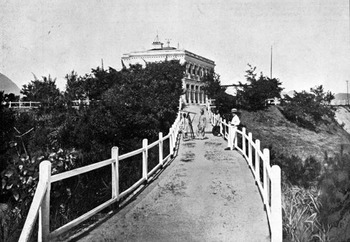
The Hong Kong Observatory, extracted from John Clark Ridpath, Royal Photograph Gallery, Philadelphia, St Louis: Historical Publishing Co., 1893, p. 112.

The photograph is undated but must have been taken some time between the completion of the observatory building in 1883 and the compilation of the photograph collection in early 1893. It is tempting to think that the Caucasian man in the foreground may have been Figg and that the slightly more senior of the two Chinese men standing on the immediate right of the telescope may have been Ho Toshang.
Across the first two decades of the twentieth century, the staff stabilized and the service evolved. The roles of clerks and assistants morphed into the more specialist positions of computers and telegraphists – a trend that escalated over the coming few years with the introduction of grading within roles, so titles such as first computer or first telegraphist became commonplace.Footnote 66 Yet, with the exception of head computer Fung Mun Chak, for many years salaries remained commensurate with the earlier generalist job titles, resulting in a decline in real wages compared to inflation.
Race and the workplace
Local assistants working for the British colonial service also had another raft of problems to contend with. In 1886, the Colonial Office attempted to address rapid turnover by insisting that all new hires go through a one-month trial period before commencing probation.Footnote 67 Responding, Doberck wrote, ‘Considerable difficulty has been and will in future be experienced … owing to the resignation of native assistants’. He explained that the young men used the observatory as a post-school training ground, before moving on to a department where they had better prospects for advancement. While there was most likely some truth in this (certainly there were few avenues for promotion in the small observatory team), his solution – to employ only staff educated in England and trained at Greenwich – would likely have produced identical results.Footnote 68 The lynchpin of Doberck's statement, however, was that one scientifically trained Englishman could undertake the role of two ‘young native clerks’.Footnote 69 More than once during the period of his incumbency Doberck had remarked that ‘the natives are useless for such work’,Footnote 70 and that local candidates for job roles were generally poor with terrible maths.Footnote 71 Even when Doberck promoted local staff, the underlying reason was often necessity. For example, Ho Toshang's promotion and the hiring of a local electrical engineer both occurred when the observatory had been short-staffed. He also appeared to resent having to work in close quarters with locals. In 1893, for instance, he noted how in other colonial departments ‘foreign officials have each a separate office apart’.Footnote 72 The observatory lacked space for this – aside from Doberck's private apartments and the lab, there was only one office. At that time, there were seven employees who worked day and night side by side in this thirteen-by-twenty-foot space, which became quite unbearable during the long, hot and humid Hong Kong summers.Footnote 73 Disappointingly for Doberck, it appeared almost impossible to recruit from England for junior positions: the one and only overseas hire in this period was short-lived. This was James Henry Grimes, who replaced Lau-Shau as first clerk in 1888.Footnote 74 Grimes stayed for two years, roughly the same length of time as his predecessor. Very little is known about Grimes or his sojourn at the observatory, but it is certain that his appointment had led to hopes in some circles that ‘Dr Doberck should now be able to give us a weather report less than six months old.’Footnote 75 After Grimes, however, there were no new British appointments below the level of assistant. A young, local man named Lam Tsun Kwai replaced Grimes. Lam had actually been a candidate for the job two years previous but had been passed over in favour of Grimes.Footnote 76
The crux of the matter was not simply Doberck's racism, but what Suman Seth has called the ‘racialised practices of colonial administration in the last half of the nineteenth century’: as Gyan Prakash has pointed out, in British eyes, the native was ‘always less than adequate, always lacking some key attribute’ and somehow less rational.Footnote 77 As they rightly note, this attitude pervaded all the colonial service's meteorological establishments, not just Hong Kong. In Singapore, for example, complaints about the observing staff were frequently heard across the period. On the observations made at the short-lived Singapore Observatory between 1841 and 1845, for instance, contemporary commentators William Jacob, astronomer at Madras Observatory, was quoted as remarking,
We are just now printing the Singapore observations, the whole series of 5 years; they are not first rate, I think, much seems to have been left to the Sapper assistants, who doubtless loved a drop when they could get it and neglected or fudged their work, as we used to say at Addiscombe.Footnote 78
By the 1920s, similar attitudes are still seen. On proposing plans for a new meteorological department for Malaya in 1927, for example, George Maxwell and Herbert Robinson denigrated the quality of subordinate staff, suggesting that, for the most part, they were not ‘reliable or conscientious’.Footnote 79 Indeed, the chief problem for an improved meteorological service was ‘attracting, and retaining, the right class of Asiatic observer’.Footnote 80
Back in Hong Kong, one of the most devastating typhoons of this period starkly revealed ingrained biases toward subordinate staff. Over the first twenty years of its existence, it had become apparent that tracking typhoons and early warning would be the most important role the observatory could fulfil. Time and again, however, the observatory was called to account for not providing ample warning of a serious typhoon, a call which only intensified as knowledge of typhoon systems improved and expectations of the observatory's abilities of prediction proceeded in tandem.Footnote 81 On 18 September 1906, a major typhoon and storm surge devastated Hong Kong,Footnote 82 one of the worst natural disasters the nation suffered during the twentieth century.Footnote 83
Aside from the magnitude of the storm, which passed directly over northern Hong Kong, it was queried whether the scale of the terrible loss of life might have been prevented by earlier advance warning. By the time the observatory had raised the black storm signal that morning, fishing vessels and sampans had already left safe harbour. It was estimated that thousands of these fishermen and sailors lost their lives.Footnote 84 Bowing to public outcry, the government held a formal inquiry to understand whether Doberck and his team had failed in their duty to detect and give adequate warning of the impending storm. An inquiry board was set up, comprising prominent European men drawn from the colonial service, the local shipping industry and the regional telegraph company.Footnote 85 In the course of their deliberations, which mainly centred on when and what meteorological readings were made and received at the observatory, it was asked whether any European – that is to say, a senior staff member, authorized to send out a warning – had been at work between 10 p.m. and 7 a.m., the hours in which the typhoon had manifested near Hong Kong's shores. Figg responded that no Europeans worked at night, unless the weather was very severe (which it had not been before ten), and that the regular overnight observers were Chinese computers.Footnote 86 One might have imagined that the computers would have been interviewed as to their observations that night but they were not. Instead one Captain Unsworth, superintendent of the wharf-based Godown Company, was examined next. The committee were attempting to determine how early the typhoon could have been predicted in advance, and traditional methods of prognostication such as the colour of the sky, cloud formations and winds were important to their line of inquiry. Unsworth's confirmation that the weather had been strange that morning prompted the interviewer – Sir Henry Berkeley – to ask if anyone else had been around to witness the same phenomena, to which Unsworth responded, ‘No European but myself was about’.Footnote 87
In both examples, the ‘native’ voice was excluded. While the director, on account of his seniority in the organization, would ultimately have been held accountable for serious errors, the language that distinguished between European and non-European betrays deeper biases at work, appearing to suggest that the Chinese computers, or indeed Chinese workers on the wharf that morning, were not considered credible witnesses. This despite the fact that all the men in question would have had their own experiential knowledge of typhoons and, in the case of the observatory staff, scientific knowledge of the events. The incident is a clear confirmation of Prakash's observation that natives were not considered knowing subjects when it came to scientific knowledge, and of the supposed – if not entirely accurate – interposition of Western (scientific) superiority over local practitioners.Footnote 88
Eventually, the observatory – specifically Doberck – was exonerated. The inquiry found that the storm had been unusual, advancing on the settlement with a stealth and rapidity that could not have been predicted. Indeed, a subsequent scientific study noted that the 1906 event was only around 100 miles in size and thus would not have registered high winds on the colony's shores until it was already almost on top of them, a view confirmed by modern scientific investigation.Footnote 89 It is perhaps with some irony, then, that a ‘native’ assistant was to prove instrumental in helping resolve some of the early problems with the storm-warning system. Fung Mun Chak had joined the observatory in 1901. He was to play a significant role in many aspects of observatory business, not least the creation of a workable regional storm-warning system. The issue had already proved contentious for at least ten years prior to Fung's arrival, largely because the HKO and their counterparts in Shanghai, Manila and Tokyo could not settle on one course of action. The issue centred on three main points: observational uniformity, ensuring effective and fast telegraphic communications in the event of an oncoming storm, and ensuring a regionally understandable system of storm signalling.Footnote 90 A uniform system across the region, with no margin for error in the local interpretation of telegraphed code or signal shapes and colours, was vital for the safety of shipping as well as for inhabitants. In 1917, Fung had modified the translation of the code in Chinese characters and in so doing eliminated prior inaccuracies. His work was critical to the evolving system.Footnote 91
Knowledge of local languages was also necessary for effective day-to-day operations. The Chinese staff thus performed an essential role as intermediaries and translators without which Doberck could not have properly done his job. Within the observatory, the more senior Chinese staff were placed in direct charge of the Chinese subordinate staff. In a country with a majority Chinese population and with close connections with the CCMS, observatory clerks had to be able to communicate not only with employees internally but with staff at different local and regional organizations and institutions. The regional telegraph service is a good example. Operating across Hong Kong and China, Chinese was as important a lingua franca as was English. Written storm warnings and messages from the observatory also had to be quickly translated into Chinese before being placed on noticeboards around the harbour for the local fishermen. Local contexts and local experience, then, were critical to the execution of meteorological science. Local should, in this instance, not be equated with ‘indigenous’, however, but remains firmly within the colonial setting.Footnote 92
A scientific woman
The situation for Anna Doberck, assistant meteorologist and the first woman to be employed at the observatory in any role, was considerably different from that of the other staff, neither local nor a European man.Footnote 93 Her experiences share some similarities, however, with those of other women of the same time period, who had to battle the ingrained biases against women in the scientific workplace. This was a period when women were being hired in observatories as assistants, as computers and in other roles across Europe, Britain and America. One of the better-known examples was Harvard College Observatory's female computing team, but two women were employed as weather observers at Urga, Mongolia, under the auspices of the Russian Observatory at Peking.Footnote 94 Anna's hiring experience would have been familiar to her many contemporaries, whereby a strong male supporter and, ideally, a well-connected referee were paramount.Footnote 95
Anna held (or had sat) a degree from the University of Copenhagen,Footnote 96 and had previously worked as meteorologist at Mackree Observatory in Ireland while her brother was director.Footnote 97 She had ample credentials for the Hong Kong role, including an understanding of ‘theoretical physics and the knack of the calculus required for the study of Ferrel's and Mohn's advanced treatises’.Footnote 98 Senior appointments were made by the Astronomer Royal at the observatory at Greenwich, at this time William Christie. Christie was broadly supportive; indeed, the 1890s saw him hiring five women at Greenwich, including Cambridge University-educated Annie Maunder, née Russell.Footnote 99 The Colonial Office, however was not so keen.
Her brother approached Christie for help, asking him to use ‘his influence’ to get his sister appointed.Footnote 100 He also wrote letters to the Colonial Secretary appealing on the basis of Anna's academic abilities, skills and experience, significantly making a key selling point the claim that she would be at his ‘beck and call day and night’.Footnote 101 Presumably he meant that, as a family member, she would devote herself more entirely to the role under him than a regular paid employee.Footnote 102 She was reluctantly hired – with caveats. The first was that the longevity of her job would be tied to that of her brother's. When he retired, she was expected to follow suit. The second was that her probationary period would extend for three years, considerably longer than that of the local staff. Unlike them, however, her salary was the higher sum of $1,000 per annum.Footnote 103 While still relatively poor, it was similar to the earnings of her colonial service contemporaries, for example Isis Pogson at the Madras Observatory.Footnote 104
At the observatory, Anna took on a great deal of the day-to-day meteorological work, especially concerning typhoons. She coordinated the collation of the many observations reported by ships then docked in port, tabulating these and compiling the figures into synoptic charts. This was an important part of monitoring and predicting typhoon tracks and constructing pilot charts.Footnote 105 Leonard Starbuck, assistant director in the late 1940s, referred to her as ‘a sort of early Marine Liaison Officer’.Footnote 106 Ironically, this was one of the more physically dangerous jobs at the observatory, requiring stamina and a healthy constitution. When a typhoon was expected, she would go to the Kowloon wharves, about half a mile from the observatory, or to the more easterly docks at Hung Hom, to collect logbooks from the ships recently docked in port. Their data would help the observatory plot a typhoon's possible course. Previously, the job of collecting the books would have fallen to the Harbour Master's Office, but after Anna began, she did this work herself with aid of a boat coolie, a rented yacht and a rowing boat.Footnote 107 As Anna noted in 1902, she had ‘without grudging risked my life over and over again for the sake of gathering information for the construction of typhoon paths’.Footnote 108 Her work collating this data earned her the nickname ‘Typhoon Annie’. With Figg and Ho, Anna also helped produce the daily weather forecast and compile the monthly and annual observations from the daily observational means to publish in the government gazette.Footnote 109 Like Isis Pogson and her father, Anna took on the meteorological services so that her brother could focus on his astronomical interests.Footnote 110
Despite a lack of support from the colonial service, she was well regarded at the observatory itself. In line with the common practice of moving up the hierarchy to replace superiors when on extended leave, she worked directly under Plummer and Figg during Doberck's leaves of absence. In 1892, for instance, she was appointed responsible for the building, grounds and all correspondence during his sabbatical, and was created acting first assistant during 1894 (when Ho replaced her as acting meteorological assistant), 1902, 1903 and 1904.Footnote 111 Moving up the ranks in Doberck's absence was not a given, however, as it was in Figg's case. In 1902, for example, we see Anna writing a strongly worded petition to a recalcitrant Colonial Secretary making her case for this temporary promotion on grounds of her performance.Footnote 112 However, the fact that she remained at the observatory for seven years after her brother retired in 1907 – despite the original stipulation by the Colonial Secretary that she leave with himFootnote 113 – strongly suggests that despite her issues with promotion, she had proved her worth as a vital member of staff.Footnote 114 She was even pensioned in 1914, despite official correspondence in the 1890s that intimated she ought not to qualify for such. The last entry for her pension was in 1934, at the age of seventy-four for $810 (£710 19s 6d).Footnote 115
At the end of her career, Anna had not achieved the heights of some of her better-known contemporary female scientists, say Annie Maunder at Greenwich and her work on sunspots; Margaret Huggins at the forefront of astrophotography at Tulse Hill Observatory, London; or Isis Pogson at Madras, the first woman to be elected to the Royal Astronomical Society. However, Anna's long career, especially after her brother's close support ended, reveals a determined and ambitious woman. At each stage of her career, from hire, to temporary promotions, to pension, she was told ‘no’. Yet she persevered. Despite this, the observatory employed no more women until 1932,Footnote 116 and no more female scientific officers until 1975.Footnote 117
Conclusions: colonial meteorology in Hong Kong
Seen through tantalizing glimpses only, the working conditions, relationships and contributions of the observatory staff are hard to re-create. Little remains of their lives beyond official reports detailing formal or exceptional occurrences, such as job applications or complaints over pay or conditions. From these we can infer long hours, poor pay and unjust treatment based on race and gender. More than this, we can even see how these people, despite performing vital roles, were considered little more than tools in the production of scientific knowledge. As the case of the 1906 typhoon aptly demonstrates, the voices of local staff were silent. Although separated by time and space, the scientific assistants of Steven Shapin's seventeenth-century lab had much in common with the men and women of the observatory.Footnote 118
Arguably, though, while this article has put forward a somewhat negative picture of what it was like to work at the Hong Kong Observatory at the turn of the nineteenth century, it should be noted that the records, by default, generally only record problems (such as pay disputes or queries over leave) rather than revealing points of consensus or even pleasure. While this should not belittle the vast inequalities or the limited working opportunities within the colonial service, the mere fact that employees, including Fung Mun Chak, Ho Toshang, Wan Suit Ngam, or Anna Doberck, remained for many years, in some cases until retirement, suggests an alternative picture, one perhaps where friendships were formed and people took pleasure in their work. They also had some opportunity to negotiate their roles by writing formal complaints, or by petitioning, just as Anna had done in 1902, or simply by leaving. The role that people like Ho Toshang, Anna Doberck, Fung Mun Chak, Mahomed Alarakia and the many others like them had in producing scientific knowledge is unquantifiable. But from what we can see, research outputs and development of the local storm-warning system and the signal system for predicting typhoons relied as much on their tireless efforts as on those of the director at that time, if not more so. Understanding more about the staff at the observatory thus sheds light the processes and exchanges involved in the production of meteorological expertise regionally, as well as on the everyday cultural and social contexts of colonial meteorology.