Introduction
Spiders (Arachnida: Araneae) are a species-rich and abundant arthropod group in agricultural ecosystems (Wise Reference Wise1993). They are typically generalist, obligate insectivorous predators, and are capable of capturing a wide variety of prey types and sizes (Olszak et al. Reference Olszak, Luczak, Neimczyk and Zajac1992; Wise Reference Wise1993; Miliczky et al. Reference Miliczky, Calkins and Horton2000; Weibull et al. Reference Weibull, Östman and Granqvist2003; Miliczky and Horton Reference Miliczky and Horton2005). They are relatively long-lived, predaceous at all stages of their development, and can survive long periods of starvation (Wise Reference Wise1993; Marc et al. Reference Marc, Canard and Ysnel1999). Spiders are excellent biological pest management candidates, capable of fulfilling both pest reduction and stabilisation requirements (Wise Reference Wise1993; Greenstone Reference Greenstone1999; Sunderland Reference Sunderland1999; Harwood et al. Reference Harwood, Sunderland and Symondson2003). Numerous studies have reported that a diverse group of spider species may be more effective at biological control and reducing prey densities than a single species due to a range of hunting strategies, habitat preferences, and active periods (Greenstone Reference Greenstone1999; Marc et al. Reference Marc, Canard and Ysnel1999; Sunderland Reference Sunderland1999).
However, because they are sensitive to disturbance, spiders may be best used for biological control in perennial agro-ecosystems, such as orchards, where there is minimal disruption and human intervention (Riechert and Lockley Reference Riechert and Lockley1984; Marc et al. Reference Marc, Canard and Ysnel1999). Indeed, spiders have proven to be effective predators of major insect pests in apple (Malus domestica Borkhausen; Rosaceae) orchards (Marc and Canard Reference Marc and Canard1997; Wisniewska and Prokopy Reference Wisniewska and Prokopy1997; Mathews et al. Reference Mathews, Bottrell and Brown2004; Pekár and Kocourek Reference Pekár and Kocourek2004). They were repeatedly observed feeding on apple aphids (Wyss Reference Wyss1996; Fréchette et al. Reference Fréchette, Cormier, Chouinard, Vanoosthuyse and Lucas2008), including the most damaging Aphididae (Hemiptera) species on apples: the rosy apple aphid, Dysaphis plantaginea (Passerini) (Hemiptera: Aphididae). Wyss et al. (Reference Wyss, Niggli and Nentwig1995) found that spiders in autumn may have contributed to a significant reduction in D. plantaginea numbers through interception of alates returning from its summer host plants, Plantago Linnaeus (Plantaginaceae) species. In North American (Brown and Mathews Reference Brown and Mathews2007), Spanish (Miñarro et al. Reference Miñarro, Hemptinne and Dapena2005), and French (Dib et al. Reference Dib, Sauphanor and Capowiez2010a, Reference Dib, Simon, Sauphanor and Capowiez2010b, Reference Dib, Sauphanor and Capowiez2016) experimental insecticide-free and organic apple orchards, spiders were frequently observed in the rolled leaves caused by D. plantaginea infestation.
Conservation and management decisions about the most important natural enemies are made based mainly on biodiversity information about the richness and relative abundance of species in a given area (Kremen et al. Reference Kremen, Colwell, Erwin, Murphy, Noss and Sanjayan1993; Prendergast et al. Reference Prendergast, Quinn, Lawton, Eversham and Gibbons1993). Thus, the study of spider population dynamics and species composition is an important step for improving their practical use in pest biological control programmes. Such knowledge may help in management of their populations in the context of crop protection methods based on preserving biodiversity. For example, the installation of weed strips in an apple orchard (Wyss et al. Reference Wyss, Niggli and Nentwig1995) and creation of within-field overwintering refuges (Thomas et al. Reference Thomas, Wratten and Sotherton1992) led to an increase in spider numbers and enhanced levels of pest biological control in spring near the strips and refuges. In addition, studies of spider populations may give reliable information on the optimal timing of some management practices that are known to disrupt spider populations such as mowing (Horton et al. Reference Horton, Broers, Lewis, Granatstein, Zack and Unruh2003), soil disturbance by ploughing that destroys overwintering sites (Marshall and Rypstra Reference Marshall and Rypstra1999), and pesticide application (Markó et al. Reference Markó, Keresztes, Fountain and Cross2009). The application of synthetic chemical pesticides led to a decrease in both their abundance and diversity (Olszak et al. Reference Olszak, Luczak, Neimczyk and Zajac1992; Bogya et al. Reference Bogya, Markó and Szinetár2000; Miliczky et al. Reference Miliczky, Calkins and Horton2000; Markó et al. Reference Markó, Keresztes, Fountain and Cross2009).
Spider faunas have been sampled using pitfall traps (Weibull et al. Reference Weibull, Östman and Granqvist2003; Mazzia et al. Reference Mazzia, Pasquet, Caro, Thénard, Cornic, Hedde and Capowiez2015), suction sampling (McLachlan and Wratten Reference McLachlan and Wratten2003), beating trays (Wyss Reference Wyss1996; Scharff et al. Reference Scharff, Coddington, Griswold, Hormiga and Bjørn2003; Pekár and Kocourek Reference Pekár and Kocourek2004; Miliczky and Horton Reference Miliczky and Horton2005; Markó et al. Reference Markó, Keresztes, Fountain and Cross2009), sweep nets (Wyss Reference Wyss1996; Scharff et al. Reference Scharff, Coddington, Griswold, Hormiga and Bjørn2003), and sticky traps (Holland et al. Reference Holland, Oaten, Southway and Moreby2008). However, in orchards, none of these sampling methods alone is ideal for determining spider community composition or to study their population dynamics. Thus, the combined use of different methods is preferred (Scharff et al. Reference Scharff, Coddington, Griswold, Hormiga and Bjørn2003; Holland et al. Reference Holland, Oaten, Southway and Moreby2008) because spiders may occupy different regions of the agricultural habitat: on the ground, in the vegetation under the trees, and in the tree canopy (Mazzia et al. Reference Mazzia, Pasquet, Caro, Thénard, Cornic, Hedde and Capowiez2015). We thus investigated a new sampling method, which seems well adapted to this kind of study concerning spiders as predators. Corrugated cardboard traps, traditionally used for earwig (Dermaptera) sampling, have been mainly used in fall or winter (Horton et al. Reference Horton, Miliczky, Broers, Lewis and Calkins2001; Alzubik Belkair et al. Reference Alzubik Belkair, Mazzia, Pasquet and Capowiez2018) and are believed to attract spiders looking for shelters under cold conditions. Like any other method, this method is biased because cardboard traps may preferentially sample nocturnal spiders and female spiders looking for nesting sites.
In general, the role of spiders in orchard biocontrol has received less attention than the role of insect predators and parasitoids (Miliczky and Horton Reference Miliczky and Horton2005). In addition, species composition and field population development of spiders in apple orchards in southeastern France have not been well researched. We conducted a two-year study based on weekly surveys of spider predators in one insecticide-free and four organic apple orchards in southeastern France using rolls of corrugated cardboard and shoots infested by D. plantaginea. Our aim was to determine spider species present in these orchards, particularly those associated with aphid colonies, and to determine the temporal abundance and phenology of main spider families using in situ sampling in these orchards.
Material and methods
Study sites
Spider populations in apple trees were assessed throughout the 2008 and 2009 spring seasons in five orchards of 3.63 ha in total: one Institut National de la Recherche Agronomique (French National Institute for Agricultural Research) experimental insecticide-free orchard located close to Avignon, France, and four commercial organic orchards (number 1, 2, 3, and 4) located 10–20 km south of Avignon (coordinates in the WGS84 system from 43.777°N to 43.858°N and from 4.854°E to 4.959°E). They were planted with four cultivars susceptible to D. plantaginea infestation: Golden Delicious (number 1 and 2), Akane (number 3), Royal Gala (Institut National de la Recherche Agronomique and number 4), and Granny Smith (Institut National de la Recherche Agronomique). Trees were about nine (Institut National de la Recherche Agronomique, number 1 and 2) and 15 years old (number 3 and 4). Monthly mowing between tree rows and tillage between trees within the rows were performed to control spontaneous weeds in all orchards. The hedgerows consisted of monospecies (Cupressus Linnaeus; Cupressaceae) and multispecies plants in the Institut National de la Recherche Agronomique and organic orchards, respectively. The Institut National de la Recherche Agronomique experimental orchard was under a minimal pesticide management programme. The fungicides penconazole (18 May) and bupirimate (19 June) were only applied in 2009 to control the powdery mildew fungal disease Podosphaera leucotricha (Ellis and Everhart) Salmon (Erysiphaceae). No insecticides were used in either season. The organic orchards were managed following organic production guidelines and no synthetic pesticides or fertilisers were used. A fungicide programme using copper and sulphur preparations was used to control apple scab (Venturia inequalis (Cooke) Winter; Venturiaceae) and/or powdery mildew diseases (Erysiphales). Insecticides were applied to control codling moth (Cydia pomonella (Linnaeus); Lepidoptera: Tortricidae) and aphids. The codling moth control relied on granulosis virus treatments (all organic orchards) and mating disruption technique (number 1 and 3). Two (1 and 10 March 2008) and five sprays (between 13 and 26 March 2009 at three-day intervals) of mineral oils were applied to control aphids on number 3 orchard. Two paraffin oil sprays were applied in late March and early April to control aphids on number 4 orchard. In contrast, the number 1 and 2 orchards received two treatments of kaolin (in early March) and one of rotenone (in early April) to control aphids.
Identification of spider species (destructive sampling)
To identify the spider species in the studied orchards in the conditions of southeastern France, we sampled the spiders using two methods.
First, in each orchard, bands of corrugated cardboard (50 cm long × 10 cm wide) were attached with iron wire to the trunks of 10 random, nonadjacent trees (one band per tree) at about 20 cm from the ground. The inner holes of the corrugated cardboard were 4 mm in diameter. Smaller spider and earwigs hide in these inner holes, whereas larger spiders are found in between the layer of corrugated cardboard or between this cardboard and the trunk. Two sampling series, that is, 100 bands, were carried out per year (in May and June). At the end of each sampling series, the bands were removed, put in a plastic bag, and transferred to the laboratory for further identification of the spiders found.
Second, each week, 10 D. plantaginea colonies per orchard were randomly and destructively sampled during D. plantaginea development period from 7–8 April (infestation beginning) to 3 July–19 June (migration to its secondary host plant), respectively, in 2008 and 2009. A total of six (number 4), seven (number 3), eight (number 1 and 2), and nine (Institut National de la Recherche Agronomique) series was sampled in 2008. In 2009, seven (Institut National de la Recherche Agronomique, number 2, 3, and 4) and eight (number 1) series were sampled to collect the spiders found.
In the two sampling methods and when spider juvenile specimens were present, they were reared individually in the laboratory until adult emergence in plastic boxes (10 × 5 × 2 cm) with a piece of damp cotton and food (flies of appropriate size). Each spider adult was then individually stored in a numbered tube containing a small amount of 70% ethyl alcohol for further identification. Adults were identified to the species level in the laboratory under a dissecting microscope using the free online identification key of Nentwig et al. (Reference Nentwig, Blick, Bosmans, Gloor, Hänggi and Kropf2017) and the identification key of Jones (Reference Jones1990). Voucher specimens were not deposited in an institutional collection but are conserved by the authors and are available on demand.
Spring spider population dynamics
To study their population dynamics, spiders were sampled using two shelter types. First, shelters consisted of corrugated cardboard (40 cm long × 5 cm wide) rolled to form cylinders (5-cm diameter) and inserted in polyvinyl chloride tubes (5-cm diameter, 5 cm high) for weather protection. Cardboard rolls were attached horizontally with metal wire to tree trunks at about 40 cm above the ground. Twenty shelters per orchard were attached in four rows, and five shelters were thus installed per row (one every five trees). Trees with bands of corrugated cardboard being used for the population composition study were excluded from this sampling. Every week, we removed all spiders from the shelters by strongly blowing into them so that all the arthropods fell into a plastic box (25 × 25 × 10 cm), the inner sides of which were coated with liquid Teflon (Fluon, Whitford, Runcorn, United Kingdom) to prevent escape. Spider sampling started one week after the shelter installation. We sampled spider populations weekly from 5 May–9 March to 3–9 July, respectively, in 2008 and 2009 depending on orchard and spring development of D. plantaginea on apple trees in each orchard. Once counted, spiders were released at the base of the sampled tree, and the shelter was replaced at the same location. The spiders directly monitored in the cardboard rolls were recorded at the family level.
Second, 50 terminal one-year-old shoots per orchard were randomly selected early in spring among those infested with D. plantaginea and marked using coloured ribbons. Spider presence was assessed visually weekly on the 10 apical leaves of each shoot, depending on the orchard, during the D. plantaginea spring development period on apple trees from 7–8 April to 3 July–19 June, respectively, in 2008 and 2009. A new infested shoot was randomly chosen on the same tree if the original shoot disappeared.
Data analysis
Total spider abundance per cardboard roll or aphid-infested shoot was pooled across the sampling dates. The number of spiders, pooled across orchards and years, in each family sampled in the cardboard rolls was also computed. Then the effect of shelter type and spider family on these abundances was analysed using nonparametric tests of Mann–Whitney U and Kruskal–Wallis (followed by post hoc comparison test), respectively, with a significance level of 5%. Data were analysed using XLSTAT Version 2009/05/01 (Addinsoft, Paris, France).
Results
Spider species (destructive sampling)
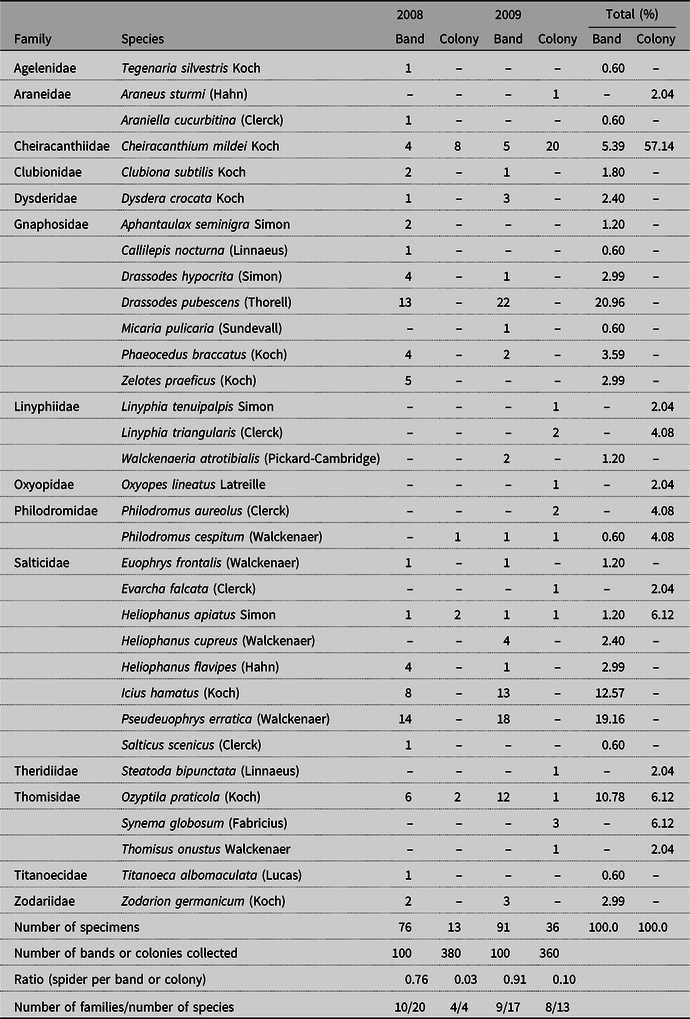
Thirty-three spider species belonging to 14 families were identified from both sampling methods (the cardboard bands and D. plantaginea colonies) over the two study years in the five orchards (Table 1).
Species composition of the spiders sampled in the 200 bands of corrugated cardboard and the 740 colonies of Dysaphis plantaginea during the 2008 and 2009 spring seasons in the five apple orchards in southeastern France (pooled numbers across each season: 7 April–3 July 2008 and 8 April–19 June 2009)
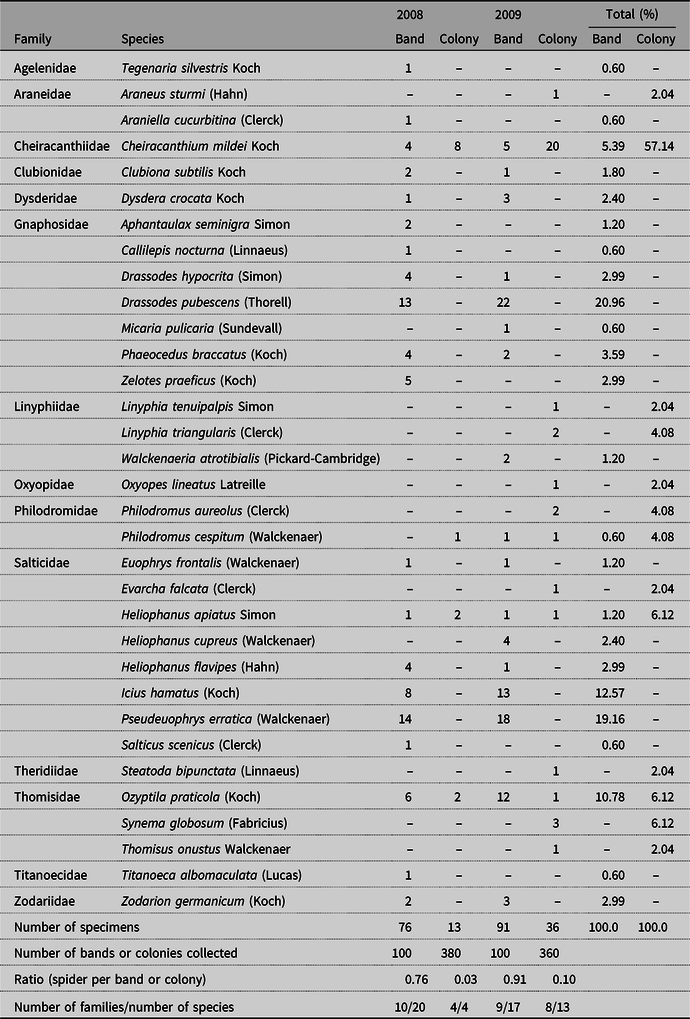
A total of 167 spiders were collected from 200 cardboard bands (0.84 spiders per band on average) in the five orchards during the two study years. Twenty-four spider species belonging to 12 families were thus recorded from the sampled bands, among which Drassodes pubescens (Thorell) (Araneae: Gnaphosidae), Pseudeuophrys erratica (Walckenaer) (Araneae: Salticidae), and Icius hamatus (Koch) (Araneae: Salticidae) were the most common. These three species comprised 52.7% of the total catch. It is also of note that Salticidae and Gnaphosidae were the most abundant families, representing 73.0% of the total observed spiders (Table 1).
Destructive sampling of 740 D. plantaginea colonies identified a total of 49 spiders (i.e., 0.07 spiders per colony) during the two study years in the five orchards. They included 13 species belonging to eight families. In 2008, the 13 individuals sampled represented only four species belonging to four families but in 2009 all 13 species (36 individuals) were recorded within the eight families. The most abundant spider species was Cheiracanthium mildei Koch (Araneae: Cheiracanthiidae), which represented 57.1% of all spiders recorded in D. plantaginea colonies (Table 1).
Four species belonging to four different families of Araneae were commonly recorded in both sampling methods. These were C. mildei, Philodromus cespitum (Walckenaer), Heliophanus apiatus Simon, and Ozyptila praticola (Koch) belonging to Cheiracanthiidae, Philodromidae, Salticidae, and Thomisidae, respectively (Table 1).
Spring spider population dynamics
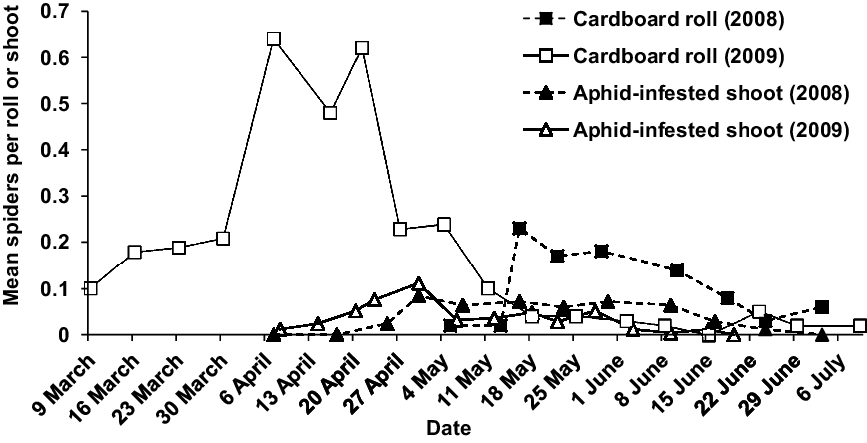
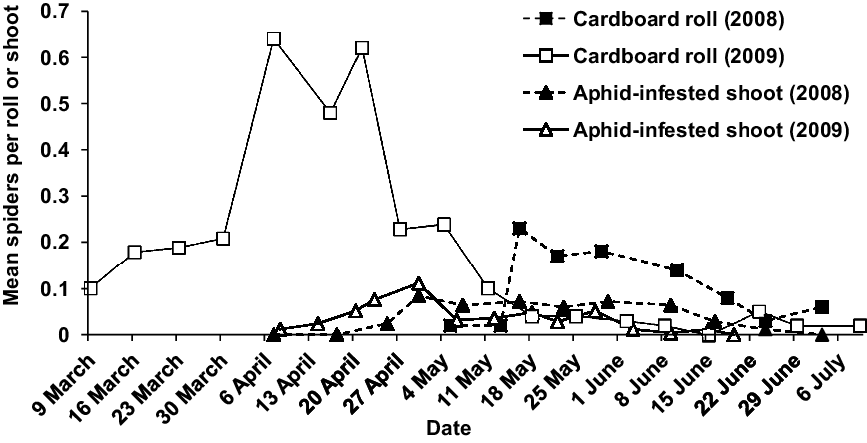
The spiders sampled using cardboard rolls (0.17 ± 0.02, mean ± standard error for pooled orchards and years) were significantly (U = 4209.500; P value < 0.0001) more abundant than those sampled in the aphid-infested shoots (0.05 ± 0.01). In general, spiders were present in the cardboard rolls at all observation periods (Fig. 1). However, the abundance of spiders fluctuated during the study seasons and reached its maximum on 16 May in 2008 and on 7 April in 2009 (Fig. 1). Regarding data obtained from aphid-infested shoots, spiders were present at almost all sampling dates. Spiders were not observed on the marked shoots during the first two weeks in 2008 and during the last week (in 2008 and 2009) of our observations (Fig. 1). However, during the period of spider presence in D. plantaginea colonies, spider numbers clearly fluctuated, having a maximum peak on 30 April during the two study years (Fig. 1).
Temporal pattern of the mean numbers of spider population sampled in the cardboard rolls and shoots infested by Dysaphis plantaginea throughout the 2008 and 2009 spring seasons in the five apple orchards in southeastern France.
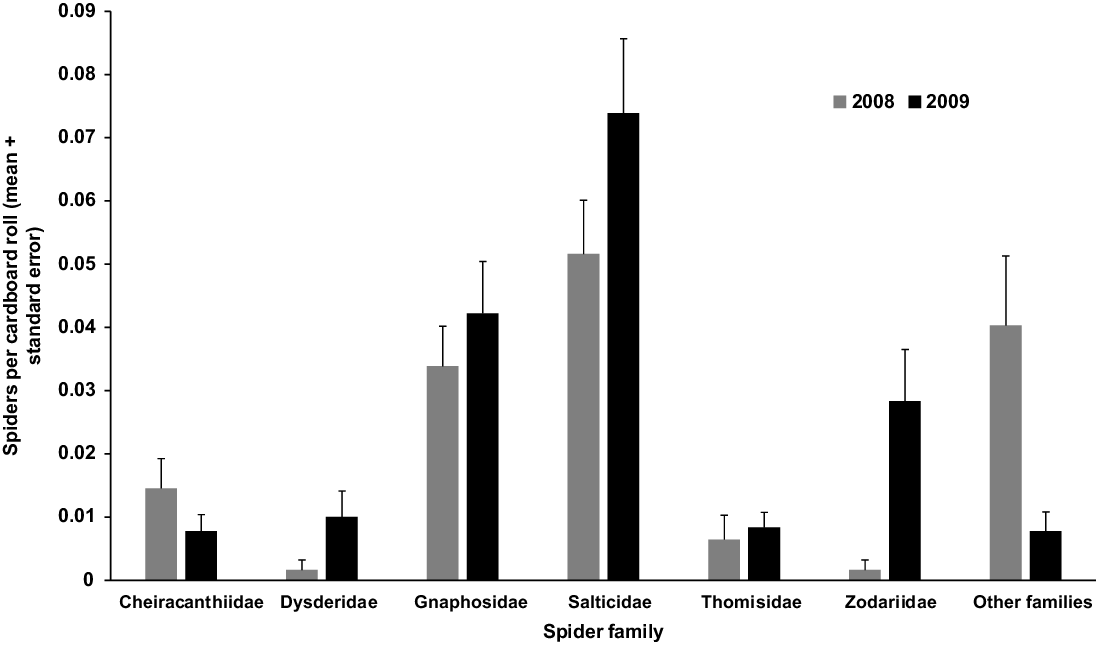
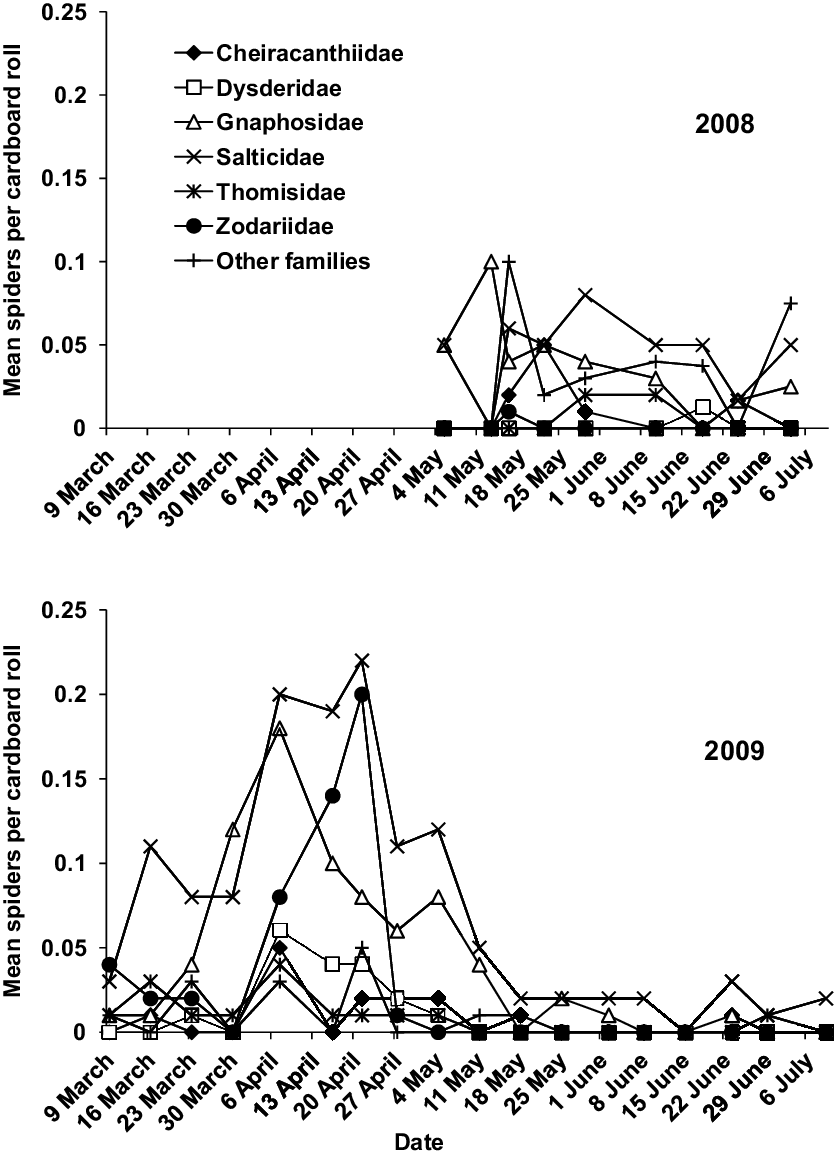
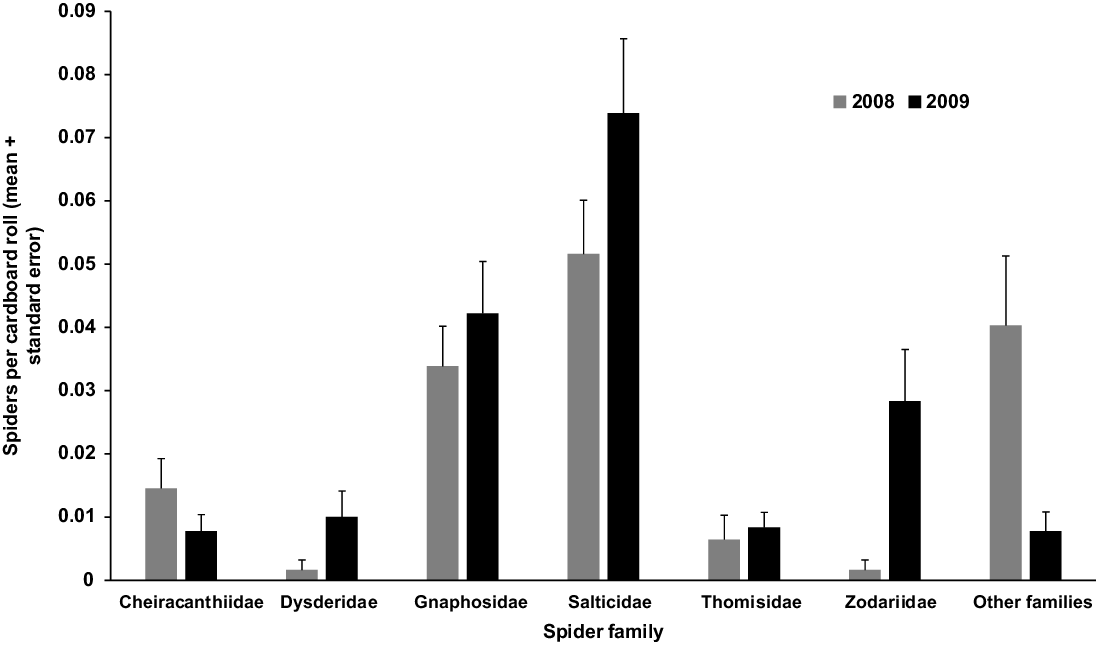
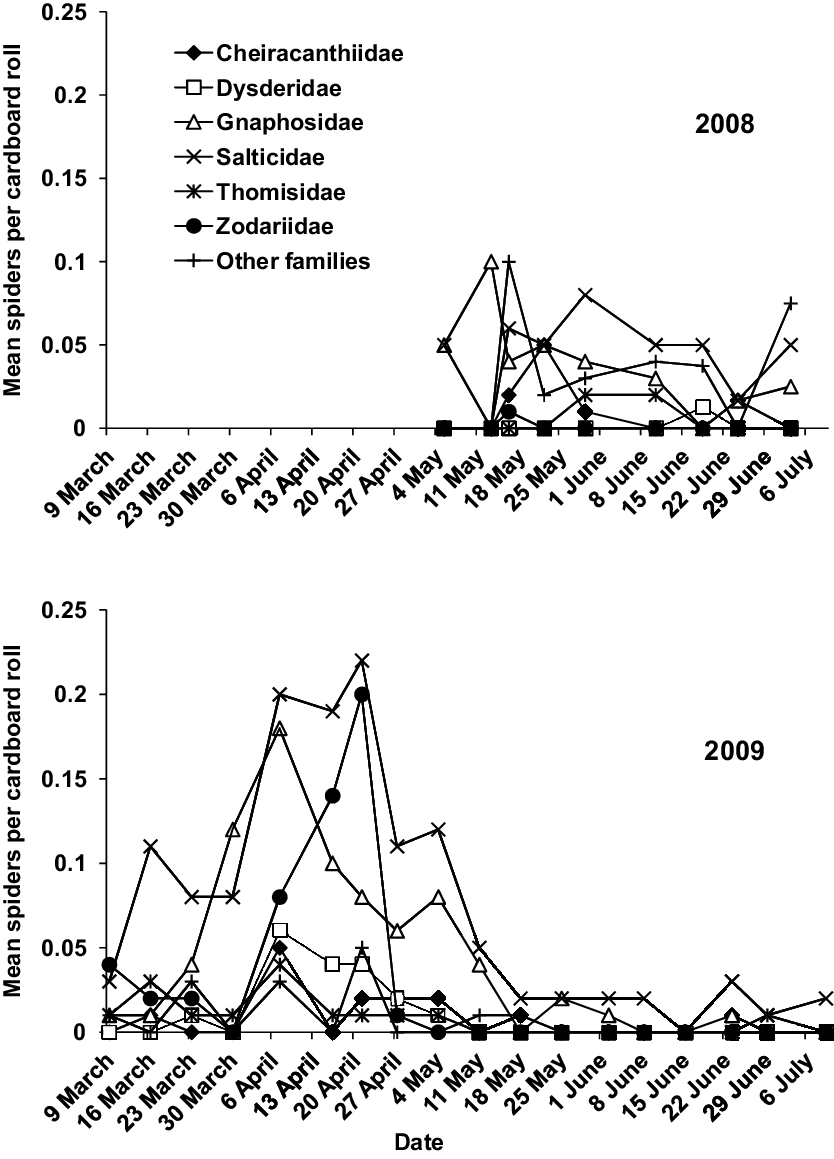
The Salticidae (39.9% of the total spiders recorded for pooled orchards and years) and Gnaphosidae (23.4%) families dominated significantly (K = 130.876; df = 6; P value < 0.0001) the spider assemblages observed in the cardboard rolls followed by Zodariidae (12.7%), Cheiracanthiidae (5.6%), and Thomisidae and Dysderidae (4.6% each) (Fig. 2). The two dominant families were present on almost all sampling dates (Salticidae: 92.6% of all sampling dates and Gnaphosidae 77.8%) compared to other recorded families (Cheiracanthiidae 40.7%, Dysderidae 25.9%, Thomisidae 44.4%, Zodariidae 29.6%, and other families 44.4%) (Fig. 3). These two families reached their maximum on 13 (Gnaphosidae) and 29 (Salticidae) May in 2008 and on 7 (Gnaphosidae) and 21 (Salticidae) April in 2009 (Fig. 3). However, the abundances of spider families in 2008 had one (Dysderidae, Thomisidae, and Zodariidae), two (Cheiracanthiidae), three (Gnaphosidae and other families), and four (Salticidae) peaks (Fig. 3). These abundances fluctuated in 2009 with two (Dysderidae and Zodariidae), three (Thomisidae), four (Gnaphosidae), five (Cheiracanthiidae and other families), and six (Salticidae) peaks (Fig. 3).
Total abundance of spiders classified by family (mean + standard error per shelter) sampled in the 20 cardboard rolls throughout the 2008 and 2009 spring seasons in the five apple orchards studied in southeastern France.
Temporal pattern of the mean numbers of spider population, classified by family, sampled in the cardboard rolls throughout the 2008 and 2009 spring seasons in the five apple orchards in southeastern France.
Discussion
In this field study, we obtained detailed information on spider populations in organic apple orchards in southeastern France, both in the tree canopy (in D. plantaginea colonies) and near the tree trunk using cardboard shelters. The cardboard shelters offer the advantage of construction from low cost and readily obtained materials and, additionally, the ability to shelter large numbers of spiders (Dib et al. Reference Dib, Sauphanor and Capowiez2017). These shelters are traditionally used to catch earwigs; they, however, are less efficient for spiders as they did not catch all the spider families present in apple orchards and may not reflect the absolute density of spiders in these. For example, web-building species (such as Araneidae and Tetragnathidae) would not readily use shelters on trunks, preferring retreats on smaller vegetation instead (Jones Reference Jones1990; Wise Reference Wise1993).
Among the 13 arboreal spider species belonging to eight families in D. plantaginea colonies, C. mildei (previously placed in the Clubionidae family but actually in the Cheiracanthiidae) was clearly the predominant spider species accounting for more than 57% of all spiders. This domination may be attributed in part to the fact that these night-active foliage runners (Clubionidae or Cheiracanthiidae) could hide in rolled D. plantaginea leaves in our study during the day. In contrast, ambushers (Philodromidae and Thomisidae), for example, were possibly directly exposed to the applied insecticides since they are active on foliage during the day (Pekár Reference Pekár1999). Moreover, their diurnal activity makes them less prone to be observed in these traps. Our finding was in disagreement with the study by Miliczky and Horton (Reference Miliczky and Horton2005). In this last study, the Linyphiidae and Salticidae families together comprised more than 50% of total spiders sampled using beat trays in 10 pear and eight apple orchards in the United States of America, and Cheiracanthium genus represented only 4.5% of sampled spiders. In Canada, the main spiders present on apple trees were hunting spiders belonging to the Salticidae, Thomisidae, and Clubionidae families (Fréchette et al. Reference Fréchette, Cormier, Chouinard, Vanoosthuyse and Lucas2008). These Canadian authors twice observed individuals of Clubionidae feeding on aphids. In other systems, Romero and Vasconcellos-Neto (Reference Romero and Vasconcellos-Neto2003) have reported that Thomisidae individuals feed on aphids. As ant (Hymenoptera: Formicidae) presence favours the establishment of large D. plantaginea colonies (Dib et al. Reference Dib, Sauphanor and Capowiez2010a, Reference Dib, Simon, Sauphanor and Capowiez2010b, Reference Dib, Sauphanor and Capowiez2016), the importance of the dominant arboreal spider families in our study comes from the fact that they could also indirectly influence D. plantaginea density through predation on aphid-tending ants. In a two-year field experiment, Fréchette et al. (Reference Fréchette, Cormier, Chouinard, Vanoosthuyse and Lucas2008) noted that Clubionidae and Thomisidae were observed feeding on ants, presumably Lasius Fabricius (Hymenoptera: Formicidae). In addition, a number of species of jumping spiders (Salticidae) are also behaviourally adapted to feeding on ants (Nyffeler et al. Reference Nyffeler, Sterling and Dean1994; Jackson and Pollard Reference Jackson and Pollard1996).
Among the spiders collected from cardboard bands, more than half belonged to three species of the total 24 species recorded: D. pubescens (Gnaphosidae), P. erratica, and I. hamatus (Salticidae), and about three quarters of the spiders belonged to only these two families, that is, Salticidae and Gnaphosidae. The dominance of these two families (more than 60% of the total spiders recorded) was confirmed by the survey data on spider communities observed in the cardboard rolls used to study their spring population dynamics.
In the two shelter types, the abundance curves of total spiders and spider families have a clear poly-modal shape, especially in 2009. Similar curves were also obtained in Switzerland (Wyss Reference Wyss1996) and Czech Republic (Pekár and Kocourek Reference Pekár and Kocourek2004) apple orchards. In a four-year study, in southern United Kingdom, Markó et al. (Reference Markó, Keresztes, Fountain and Cross2009) found that there were two peaks of canopy spider abundance in the apple orchards, one in the spring dominated by adults and another in the autumn dominated by juveniles, and between mid-June and the beginning of August, spider abundance was very low in all of the orchard plots. In our case, the establishment of the causes for this variation in spider abundance is an important and difficult task. This may be due to the sequential arrival of some spider species or their dominance in a certain period of year. Pekár and Kocourek (Reference Pekár and Kocourek2004) noted that the spider abundance fluctuated during the seasons with two peaks, one first in May (when Philodromidae was more abundant) and the second in August (when Theridiidae was more abundant).
We studied spider populations in D. plantaginea colonies as natural microhabitats because the typical leaf curling symptoms caused by D. plantaginea feeding in spring can provide spiders with shelter from unfavourable conditions (e.g., contact acting insecticides and environmental factors). The presence of spiders observed in these rolled leaves (and their absence at the end of the D. plantaginea season) raised the question of their potential role in D. plantaginea biological control. However, because spiders were absent in early spring when D. plantaginea populations were already well established and growing, their effect on D. plantaginea populations appears to be negligible. We assumed that D. plantaginea are somehow unsuitable as food for spiders, explaining their low abundance in the aphid colonies. Although most spiders catch and eat anything small enough for them, they may avoid or reject prey that is of low nutritional value, toxic, or whose cuticle is too hard to penetrate (Nentwig Reference Nentwig1983; Riechert and Harp Reference Riechert, Harp, Slansky and Rodriguez1987). They usually only eat prey that is 50–80% smaller than their size, with web weavers more adapted to catching larger prey, and thus typically ignoring smaller prey (Nyffeler et al. Reference Nyffeler, Sterling and Dean1994; Marc and Canard Reference Marc and Canard1997; Marc et al. Reference Marc, Canard and Ysnel1999) such as D. plantaginea. However, by making webs on the trees (Araneidae, Theriididae) in which D. plantaginea become trapped and die, spiders may still have detrimental effects on pest populations (Wyss and Daniel Reference Wyss and Daniel2004; Cahenzli et al. Reference Cahenzli, Pfiffner and Daniel2017).
We considered two new sampling methods to study spider populations in the canopy and near the trunk in spring, but the relatively low numbers of spiders observed suggest that these methods may not be the most suitable for studying spiders. Nevertheless, the two techniques appeared to be complementary as the main family sampled in each shelter type greatly differed. This argues for their combined use, especially in spring, a period where cardboard traps are less efficient compared to fall or winter (Alzubik Belkair et al. Reference Alzubik Belkair, Mazzia, Pasquet and Capowiez2018).
Several studies demonstrated that spider communities in organic systems were more abundant (Pfiffner and Luka Reference Pfiffner and Luka2003; Cardenas et al. Reference Cardenas, Ruano, Garcia, Pascual and Campos2006; Prieto-Benitez and Mendez Reference Prieto-Benitez and Mendez2011) or more species were rich (Pekár and Kocourek Reference Pekár and Kocourek2004) than those managed with synthetic pesticides. However, we cannot exclude the negative effects of many organically permitted pesticides used in organic farming on the aphidophagous arthropods such as spiders (Pasquet et al. Reference Pasquet, Turpinier, Mazzia and Capowiez2016), which may explain the low abundance of this predator group observed in our orchards. For example, rotenone, which was only banned in 2009 in Europe, is known to have a broad-spectrum action (Stoffel Efrom et al. Reference Stoffel Efrom, Redaelli, Meirelles and Ourique2011). In our study, we did not note any significant differences between the two organic orchards that used this pesticide compared to the two others that did not. The microbial insecticide granulosis virus was reported to have a low direct toxicity towards spiders (Bajwa and Aliniazee Reference Bajwa and Aliniazee2001). Markó et al. (Reference Markó, Blommers, Bogya and Helsen2008) found that the spring treatment with kaolin not only increased level of D. plantaginea infestation but also reduced the abundance of polyphagous predators like Forficula auricularia Linnaeus (Dermaptera: Forficulidae), predaceous Heteroptera, Coleoptera, and spiders. Summer oil applications can also have unfavourable effects on controlling pests by creating a hostile and unfamiliar environment for beneficial arthropods (Wyss and Daniel Reference Wyss and Daniel2004).
Conclusions
This descriptive study of the spring dynamics and composition of spider populations may be of great value in developing phenological models to limit spider mortality due to horticultural management in an inappropriate time of their life cycle. In addition, such studies that improve the understanding of spider natural history and ecology are a prerequisite for taking full advantage of their potential contributions in pest biological control programmes. To conserve and encourage the spider populations that were almost persistently present in D. plantaginea colonies, apple orchards could be manipulated to shift the balance in agricultural communities towards natural enemies such as these spiders to promote their role as biological control agents. For example, habitat management using ecological infrastructures such as floral strips or tailored hedgerows may promote spider populations before the presence of D. plantaginea colonies in the orchards.
Acknowledgements
We would like to thank Odile Mascle for technical assistance. Thanks go equally to growers of organic apple orchards.