Introduction
Research leaders at various types of institutions do a very good job of producing technically proficient scientists via graduate training programs. This fact became obvious during oral and poster presentations at the 12th Triennial Conference of the International Society for Seed Science (ISSS). However, graduate students often express concerns related to lack of career readiness in terms of acquired non-technical skills such as outreach communication, risk assessment, negotiation and conflict resolution (Table 1). Specific program and curricular requirements, research project timelines, mentor–mentee relationships, and academic or research institute inertia, among other factors, often out-compete opportunities for development of non-technical skills. Furthermore, the incongruity between graduate education and expansion of non-technical skills is chronic, global and multi-disciplinary (Leming, Reference Leming1977; Muir and Schwartz, Reference Muir and Schwartz2009; Wiek et al., Reference Wiek, Withycombe and Redman2011; Hou et al., Reference Hou2014; Cake et al., Reference Cake2016; Rowan and Townend, Reference Rowan and Townend2016). Simply put, graduate education is not keeping up with demands for professional development of non-technical skills deemed essential for entry and success in the workplace (Golde and Dore, Reference Golde and Dore2001; Blickley et al., Reference Blickley2012; Chhinzer and Russo, Reference Chhinzer and Russo2018).
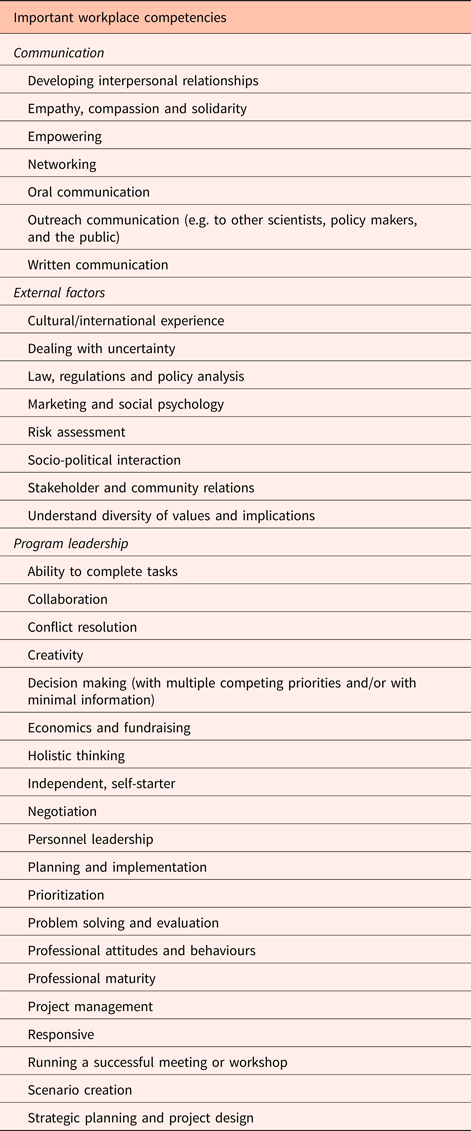
A sample of desirable, non-technical, professional competencies adapted from multiple sources (Pérez, Reference Pérez2005; Muir and Schwartz, Reference Muir and Schwartz2009; Wiek et al., Reference Wiek, Withycombe and Redman2011; Blickley et al., Reference Blickley2012; Chhinzer and Russo, Reference Chhinzer and Russo2018)

The competencies are arranged into three general categories. Note that some individual competencies fit across the categories.
Simultaneously, academics often hold the false notion that graduate student management of research projects constitutes a sufficient signal to prospective employers for achievement of non-technical skills (Blickley et al., Reference Blickley2012). In addition, Blickley et al. (Reference Blickley2012) noted that various career sectors within the same field of study value non-technical skills differently. Therefore, graduate students require broader training beyond thesis or dissertation projects to obtain requisite skill sets (Table 1). Paradoxically, the breadth of important non-technical skills precludes training in most areas during graduate training programs. This tension, while important for sharpening a students' focus on the most important non-technical skills to attain, should not lead to desperation. In fact, Muir and Schwartz (Reference Muir and Schwartz2009) point out that on-the-job training for several non-technical skills exceeds that of any training experienced in academia.
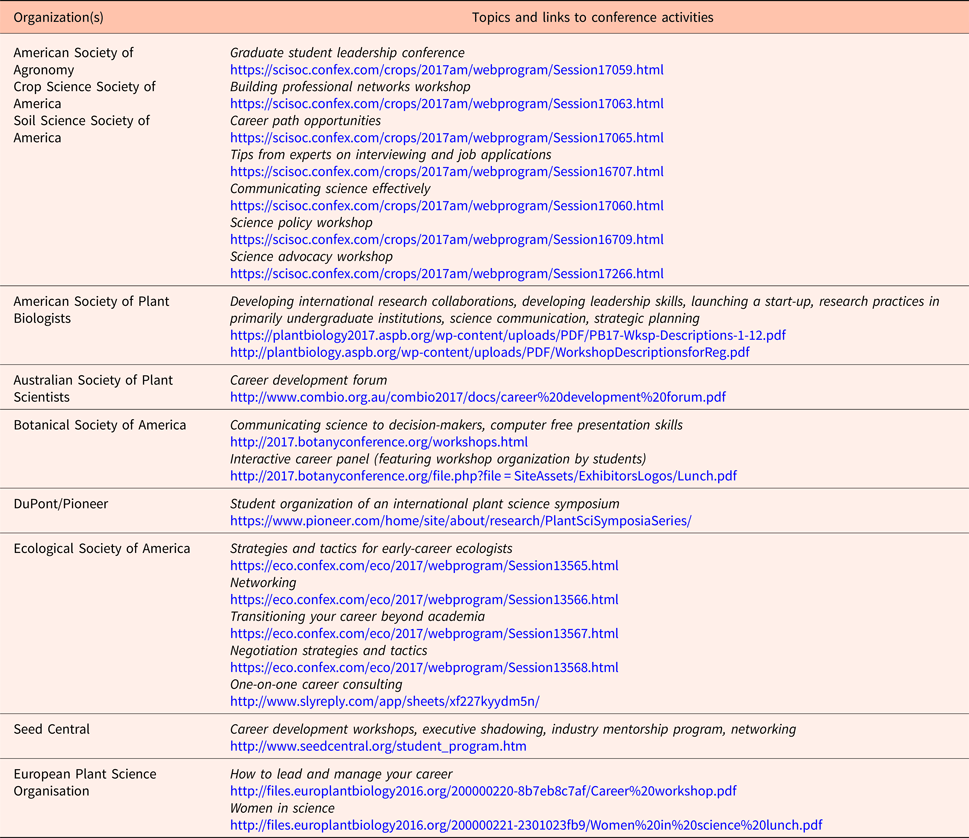
Graduate students, research leaders, professional societies and various career sectors within some broad fields (e.g. crop and plant science, ecology, conservation biology) coalesced around the issue of developing non-technical skills for next generation experts. Now some professional meetings concurrently host robust scientific programs, graduate student workshops on diverse topics related to growth of non-technical skills, and graduate student involvement in program planning and delivery (Table 2). In one case, graduate students created their own conference (http://gecp.ucdavis.edu/) to address continued professional development. Nonetheless, it seems that pre-career professional development in highly specialized fields, such as seed science, requires even more attention given: (1) a continued loss of academic positions (TeKrony, Reference TeKrony2006) especially following research leader retirements; (2) we probably produce more graduate students than available academic positions; and (3) a high level of competition for industry openings. Therefore, I briefly outline professional development activities conducted during the most recent ISSS meeting and offer some ideas to augment non-technical skills training for our early career professionals.
Graduate student professional development activities sponsored by several plant science societies and industry groups

Recent ISSS efforts to advance pre-career professional development
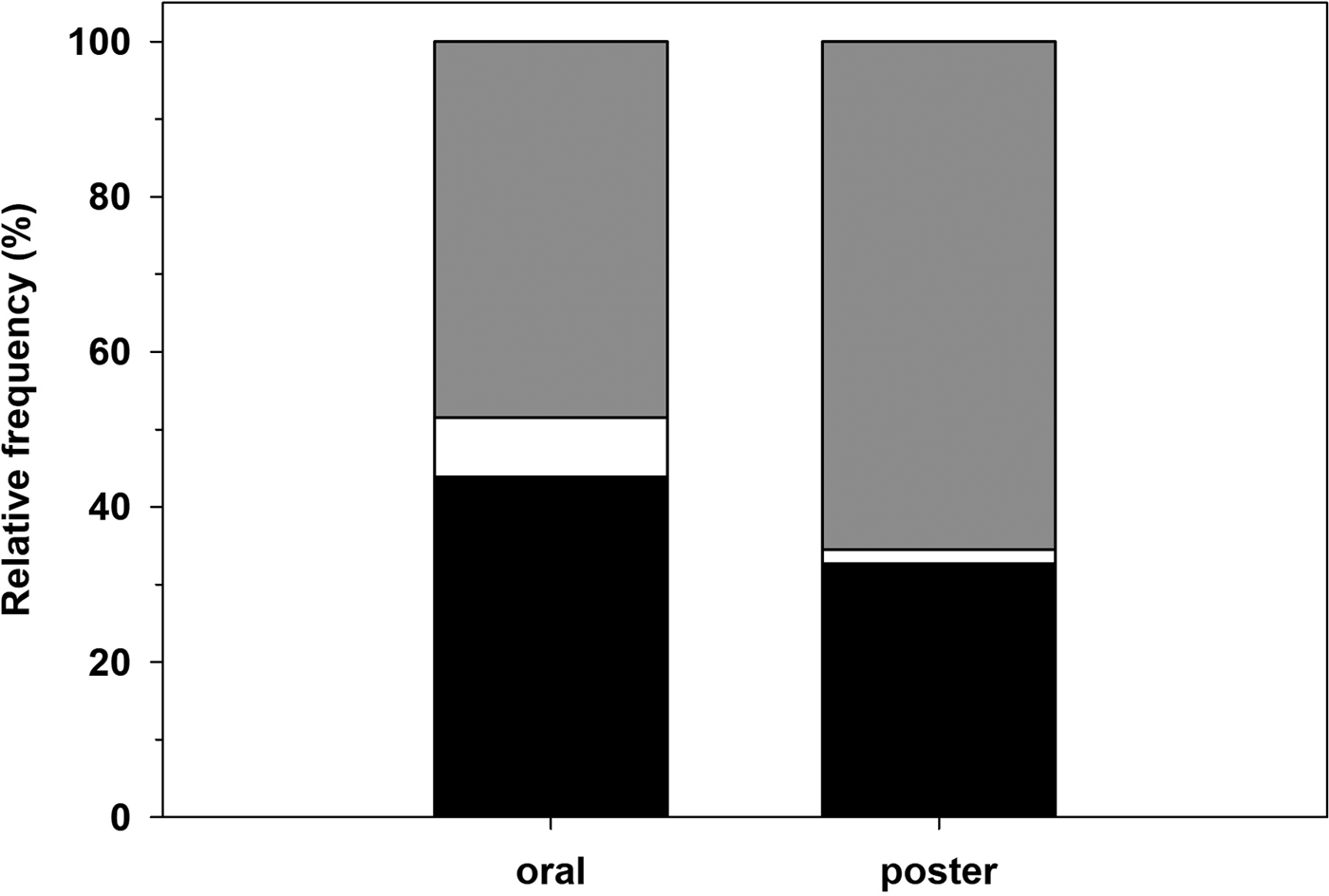
One goal of the latest ISSS meeting was to improve educational experiences and career prospects of future seed scientists. Consequently, a group of ISSS members serving on the organizing, scientific and special events committees collaborated to provide a dynamic program for pre-career professionals (i.e. graduate students and post-doctoral researchers). The program consisted of activities such as invited oral presentations and submitted poster presentations that featured strong participation from pre-career professionals (Fig. 1). We went further, however, by creating other professional development opportunities.
Percentage of graduate students, post-doctoral researchers and research leaders providing oral (n = 66) or poster (n = 55) communications at the 12th Triennial Conference of the International Society for Seed Science held in Monterey, California in 2017. Black, white and grey bars denote graduate students, post-doctoral researchers and research leaders, respectively.

First, we invited pre-career professionals to participate as scientific session co-chairs. Our aim was to expand their program leadership skills (Table 1). We enlisted eight graduate students (four females, four males; three from Europe and five from USA) to serve as co-chairs. Students interacted with international research leaders to determine speaker introductions and manage individual sessions. Second, we organized a speed networking activity in conjunction with Seed Central (http://www.seedcentral.org/), which is a public–private partnership between University of California–Davis Seed Biotechnology Centre and Seed Quest. Here, pre-career professionals discussed career opportunities and readiness with an industry representative for four minutes before moving on to the next representative. Thirteen seed companies and 88 students (65 undergraduates from local universities, 20 graduate students, three post-doctoral researchers; 40 females, 48 males) participated in this activity. Next, 17 pre-career professionals participated in the Seed Science Career Panel. The five panellists (two females, three males; four from Europe, one from USA) provided career readiness advice and international perspectives on career planning. Finally, seven (28%) graduate students participated in 1-minute oral previews (n = 25) of posters. This opportunity presented an additional forum to engage in oral communication within a professional setting. The informal feedback I received from program participants indicated that these activities contributed to improved knowledge of potential employment opportunities while also demonstrating how to strengthen a few non-technical skills. These are good outcomes at face value. However, the question then arises – are we doing enough as a discipline and society of colleagues to advance professional development for our pre-career professionals?
What more can we do?
Here I present some general suggestions for consideration. Information about student-oriented activities facilitated by Seed Central provides another excellent starting point (Table 2). Obviously, interested parties need to work out logistical details. The ideas by no means represent a definitive or exhaustive list. My goal is to contribute to the discussion of non-technical skill development for pre-career professionals throughout seed science.
1. Look Inward – I suggest beginning with a survey of current pre-career professionals, research leaders and various industry delegates within seed science to identify and then compare non-technical skills deemed essential for success outside of training programs. Survey results may facilitate recognition of skills gaps between the three groups and development of future activities to enhance professional development. Establishing the survey instrument and analysing results using web-based platforms may also create opportunities for international collaboration among pre-career professionals, research leaders and industry representatives, thereby strengthening competencies (Table 1). Repinski et al. (Reference Repinski2011) used the Delphi method to identify specific plant breeding competencies favoured in the private and public sectors.
2. Digital Internships – learning by doing is perhaps the best way to acquire a new skill. Furthermore, we are no longer limited to in-person internships considering the quantity of no-fee or low-fee web-based collaboration and communication tools. Digital internships can take on many forms that address various non-technical skills. However, allowing graduate students to earn program or curricular credits (e.g. practicum, special topics) can serve as a method to diminish competition for the individual's time.
a. Assistant Editor or Reviewer In-residence Internship – Catlow (Reference Catlow2017) expressed concern regarding the state of research evaluation and argued for more training to hone assessment expertise. Clearly, a requirement for technical expertise exists when evaluating manuscripts, projects and funding proposals. However, the art of good assessment also requires knowledge of many non-technical skills. Perhaps pre-career professionals can benefit by shadowing journal editors or assistant editors. Likewise, a journal or agency could offer a Reviewer In-residence program whereby the intern receives training on how to conduct reviews then provides a pre-determined number of reviews.
b. Conference Planning Internship – assisting with conference planning and implementation touches on almost every competency described in Table 1. Perhaps professional organizations can introduce this type of internship. Interns could work directly with local organizing and scientific committees to organize future conferences (Table 2). I think it is important for interns to experience the many moving parts associated with this type of project management.
3. Pre-career Professional Working Group – this type of group could collaborate to identify important professional development topics within the discipline. Subsequently, the group may decide to work with survey administrators and conference planning interns to develop workshops or break-out sessions that enhance non-technical skill achievement. Pre-career professionals may decide to create this as a stand-alone virtual group or seek more formal organization under the auspices of a professional society.
4. Leadership Positions within Professional Societies – research leaders often serve in governance positions within professional societies. This type of service demands various types of non-technical competencies. Allowing pre-career professionals to participate in society administration will undoubtedly expand their development. Pre-career professionals could work closely with executive committee members in an internship-type capacity. Alternatively, societies could create executive committee positions such as pre-career liaisons, social media co-ordinators, or working group representatives to elevate the types of development endeavours experienced by pre-career professional.
Opposing the disconnection between pre-career professional training programs and development of non-technical skills necessary for workplace success takes more than ideas. We need tangible actions from many members within seed science. Hopefully, the information presented here provides a starting point and moves us towards accomplishments.
Acknowledgements
I thank Kent Bradford, Julie Tillman, Susan DiTomaso, François Korn and all scientific program committee members for their support of pre-career professional programs during the 12th Triennial ISSS Conference. I am also grateful to Corine de Groot, Alfred (Heqiang) Huo, Manuela Nagel, Steven Penfield and Wim Soppe for generously providing their time during professional development activities at the conference.
Financial support
This work was supported by the United States Department of Agriculture-National Institute of Food and Agriculture (grant number 2017-67013-26132).
Conflict of interest
None.