

Parallel to the Elbe River flows the stream of life's joy—the Reeperbahn. Its pleasure factories are springs of frivolity and enjoyment whose water nymphs aren't exactly prudish.
—Hamburg Tourism and Congress Center pamphlet (1961–62)Footnote 1Commerce and romance, in that respect Hamburg's got something to look at.
—Billy Childish, Notebooks of a Naked Youth Footnote 2Hamburg, as any tourist guide will tell you, occupies a unique position within Germany. Now, every city can make this claim, so what constitutes Hamburg's uniqueness? Natives would say it is the harbor (Germany's largest) and the water that flows through the metropolis that claims more bridges than Venice. But ask an outsider, German or not, and he or she will likely say the Reeperbahn, Hamburg's notorious red-light district, known also to music fans as the incubator of The Beatles. Historically speaking, the harbor has been this Hanseatic city's source of trade and prosperity, as well as a major transit point for overseas travelers; the nearby Reeperbahn has long been a magnet for those seeking pleasure and distraction from the cares of life. In the 1950s and 1960s—the years of West Germany's “Economic Miracle” (Wirtschaftswunder)—Hamburg saw greater numbers of visitors than ever before. These guests included Germans from west and east (before the Berlin Wall was erected in 1961); international tourists, particularly from neighboring countries; British NATO troops stationed in the northern Federal Republic; and seamen from around the world. Some chose Hamburg specifically as their destination, others passed through on their way to someplace else.
In the postwar period visitors flocked to the Reeperbahn from all over Germany and the world to forget the stresses of the present and the sorrows of the past, generating some $25 million for the local economy annually.Footnote 3 The Reeperbahn was (and still is) defined as a zone of pleasure, a place to consume an array of sensations and to “let loose” anonymously without fear of community censure. As such, it became a harbinger of many trends that would hit the nation with such force in the late 1960s, such as more open sexuality or broader tolerance of interracial couples and homosexuality. Thus, in many ways the Reeperbahn's importance resides in its cutting-edge quality. But this place also mirrored larger trends in West Germany, particularly economic ones, with its aggressive selling of sexualized commodities appearing as one extreme manifestation of a revved-up postwar capitalism. By exploring how various actors talked about and visually represented Hamburg and the Reeperbahn in the period before 1968, we can catch glimpses of evolving attitudes about sex, consumption, and leisure, with broad implications for the history of West German society and of citizenship as conceived in terms of consumer choice and the everyday meanings of democracy.Footnote 4
We will glean insight into these issues by examining the many tour guides, travel accounts, and picture books devoted to Hamburg from this period. Such texts were produced in many languages for many audiences: business travelers, day trippers, even locals. Some were produced by natives, others by outsiders, both German and foreign. Such guides are not, as historian Rudy Koshar stresses, transparent records of tourists' “tactical operations”Footnote 5—we will never know exactly what visitors thought as they experienced the places mentioned in the guidebooks or whether they even visited those sites. But we can read guidebooks for clues as to how people moved in space and what they found interesting enough to put themselves through the experience of displacement in order to see and hear and taste. These texts reveal some of the desires and fantasies people played out in their precious hours of fun. They also offer new insights into broader questions about the evolving relationship between daily life, work, and leisure during the turbulent years of the Economic Miracle, particularly the issue of how travel produced new forms of identification and understanding of one's own culture, as well as others'.
Guidebooks are “the map of a different sort of human experience [than] the one defined by invasions, migrations, edicts, and treaties.”Footnote 6 Since the late nineteenth century, mass market guidebooks such as Baedeker's and Fodor's have shaped travel cultures, which Koshar defines as “different horizons of knowledge and expectation to which individuals were oriented as they traveled for pleasure and interacted with new peoples and environments.”Footnote 7 Guides decipher a place to outsiders and have considerable power to shape perceptions, as well as foster mythologies, about a place.Footnote 8 As artifacts of culture, they also reveal shifting definitions of normality. And, lest we forget, guidebooks serve the tourist industry, which took on tremendous importance for West Germany's economic recovery and international rehabilitation in the postwar era. This essay uses tourist guidebooks, as well as picture books and other travel narratives devoted to the city, to explore the place of Hamburg—in particular, the Reeperbahn—in the postwar imagination during the peak years of the Economic Miracle.
As this paper traces new practices and discourses of tourism, it also aims to contribute to our understanding of broader processes at work during the “Miracle Years” between 1949 and 1966. The long-standing tendency to see the West Germany of this period merely as a time of suffocating philistinism, anxious conformity, and sexual repression only broken by the revolts of 1968 has been eroding.Footnote 9 Historians have begun to explore the profound changes at work beneath the shiny plastic surfaces of the young Federal Republic—shifts that occurred less in the realm of politics than on the terrain of daily life with its trends toward greater consumerism, leisure, and mobility. The expansion of consumer society, for example, was more than just an increase in the amount of things one could buy. It constituted, as historian Michael Wildt puts it, “the development of new experiences” and a series of “lessons in plurality” that altered the nature of subjectivity as West Germans grappled with the changes in their material environment. Another important change was the widespread informalization of West Germany—a literal “loosening up” of physical and social behavior spearheaded by those born in the 1940s and spurred by contact with Americans and their popular culture. Connected to this was the establishment of cultural democracy, in which elites were finally forced to accept mass culture as a central, irrefutable component of West German society and culture.Footnote 10 Hamburg is an ideal site for thinking about all of these processes, as it cultivated and showcased popular culture forms, both those that filtered out to the country at large and those that remained confined to its unique entertainment quarter.
* * *
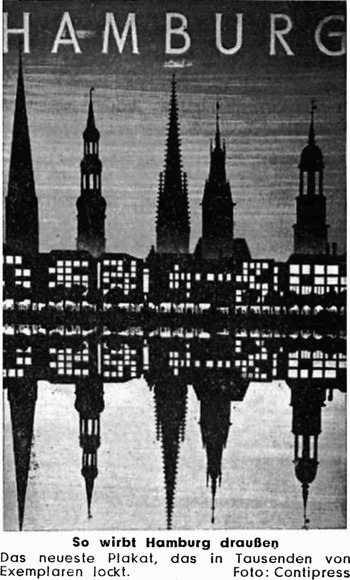
Selling Hamburg for the purposes of tourism has always posed certain challenges. Hamburg lacks the dramatic landscapes, medieval monuments, and spa resorts of other German destinations.Footnote 11 The great fire of 1842 laid waste to the pre-modern city; a century later Allied bombers, followed by postwar urban renewal enthusiasts, leveled all but a few remnants of picturesque Alt-Hamburg. This forced tourist industry professionals to come up with other ways of framing Hamburg's appeal. In 1956 the Hamburg Vorschau (a free weekly arts and entertainment calendar) urged tourists not to take the “American” approach of zipping through a predetermined list of sights, but to take time to encounter Hamburg on the level of its “houses and streets, buildings and plazas, views and tableaus”—then the visitor will discover that “this city is not only beautiful but very beautiful.”Footnote 12 An advertising poster that same year from the city tourism board foregrounds elements that officials saw as a successful formula for marketing Hamburg: the traditional, represented by Hamburg's four main church spires and the Rathaus tower; the modern, represented by new commercial buildings lit with activity even at dusk; and nature, particularly the water in which past and present are reflected (Fig. 1). These elements also mark the list of Hamburg sights highlighted in every guidebook since the invention of the genre: the harbor, the Michel (St. Michaelis Church, whose tower offers panoramic views), Lake Alster, Hagenbeck's Zoo, and the botanical garden Planten un Blomen.
Advertising poster from 1956.
And the Reeperbahn, the final “must-see” on this list. The main artery of the St. Pauli harbor district, the Reeperbahn was the center of a nightlife described by Fodor's 1959 guide as “the most roaring” in Germany.Footnote 13 Hamburg's “sinful mile” (or as rock bard Udo Lindenberg called it, “du geile Meile”Footnote 14) had long been a place where seamen, musicians, bartenders, showgirls, gays, gangsters, and prostitutes, and some 13,000 St. Pauli residents (many of whom were immigrants) rubbed elbows with tourists and slumming natives.Footnote 15 Prostitutes had been tolerated in this wild frontier beyond the city walls since the eighteenth century, with the Hamburg Senate lifting the ban on prostitution during the Napoleonic occupation and establishing a system of registration and police control that held sway, with minor modifications, well into the twentieth century.Footnote 16 The Reeperbahn's mix of burlesque and serious theater had attracted both middle- and working-class audiences since the 1830s, even if Baedeker deemed the area's amusements typical of “Hamburg low life” in 1900.Footnote 17 In 1901 Eberhard Knopf began showing moving pictures in a hall formerly occupied by Karl Hagenbeck's zoological and ethnographic shows. Striptease arrived around 1925, as did organized crime, but the area's popularity persisted. After 1933 the Nazis clamped down on the most visible street criminality—and used allegations of spying and drug trading to uproot its Chinese community—but never really chased out the strippers or the jazz bands, whose services were seemingly enjoyed by certain men in power.Footnote 18 Indeed, business was good for club owners despite rationing and the on-again, off-again prohibitions on dancing during World War II. Even with interruptions in the power supply, the area's many movie houses also flourished both before and after the devastating air raids of 1943.Footnote 19 All of this lends credence to the claim of one postwar guide: “St. Pauli has given many generations the gift of joy and forgetting.”Footnote 20
Immediately after the war, although some sixty percent of its establishments lay in ruins, nightlife in the Kiez Footnote 21 boomed, despite the early closing times imposed by British occupation authorities. A new public, including Allied soldiers and black marketeers, converged in a veritable dance-mania (Tanzwut), even if the cocktails were more sugar water than alcohol.Footnote 22 This boom only accelerated through the miracle years, an age of “great boozing” and an insatiable hunger for pleasure.Footnote 23 While some venerable dance halls, such as the Trichter and the Café Heinze, had been destroyed, others were rebuilt and new ones appeared. The number and variety of sexualized amusements also mushroomed. Indeed the 1950s are widely portrayed as the Reeperbahn's golden age, an era in which a diverse public could partake of a range of raucous nighttime pleasures in relative safety.Footnote 24 So how to market a place known primarily for vice during the Adenauer era (1949-1963), whose official tenor was one of sexual repressiveness?Footnote 25
Abundant tourism literature in many languages exists for Wirtschaftswunder-era Hamburg, some of it produced by the city's own tourism board, the rest by commercial concerns. While these materials were surely consumed by readers of all kinds (including armchair tourists who never left home), their language and content seem to have been aimed at middle-class travelers, particularly businessmen.Footnote 26 Postwar guides, for example, focused on the city's physical rebuilding and modern commercial architecture, in contrast to those published before 1945, which routinely began with a lengthy dissertation on Hanseatic history aimed at an educated bourgeoisie seeking cultivation through travel. And whereas earlier guides in both German and English tended to bypass the Reeperbahn, all the postwar guides contained at least some mention of it as the place to fulfill one's “need” for amusement. Several guides from the 1950s and 1960s even focused on the strip, so strong was its attraction in this increasingly prosperous consumer society. Travel guides' shifting emphasis from history and high culture to commerce and entertainment reflects shifting desires on the part of travelers, as well as an expansion of the traveling public itself.
Guides for both German and international travelers clearly served the interests of commerce, with many featuring advertisements from establishments described in the books, and nearly all bearing evidence of cooperation with official tourist and business associations. In so doing, they also participated in the broadening out of a sexual consumer culture, which, as Elizabeth Heineman argues, was a key part of the broader consumer revolution in this period.Footnote 27 Tourism guides both constructed and revealed new understandings of leisure by painting amusement—including “erotic” amusement—as a basic adult need and right. They illuminate evolving attitudes about sex and gender on the eve of the sexual revolution. They also attest to certain social and cultural shifts in this period, such as the establishment of the two-day weekend, the dawn of youth as a consumer group, and the sunset of an older proletarian style of amusements. Finally, these guides aggressively promoted an image of Germans—or at least Hamburgers—as tolerant and “open to the world” (weltoffen) as a way to win back foreign tourists and contribute to the country's integration into the Cold-War west.Footnote 28
* * *
The German tourist industry was ravaged by World War II: in 1950 it was a mere third of its size in 1936. But with reconstruction reemerged Germans' and others' desire for travel, spurred in part by the efforts of reconstituted tourism boards at both the national and local levels, as well as the rise of new companies such as Touropa that made pleasure travel more affordable than ever before. By 1955, a majority of West Germans reportedly viewed vacation travel no longer as a luxury but a “social norm” and the travel sector grew even faster than the West German economy as a whole.Footnote 29 Travel for pleasure became more widely accessible as wages climbed and three weeks' vacation became standard for West German workers.Footnote 30 Indeed the desirability of tourist travel—which is, after all, the voluntary experience of displacement—serves as a marker of growing postwar stability (one could also say normalcy) as the war's forced dislocations receded into the past.Footnote 31 At the same time, ninety percent of West German travelers before 1958 ventured no more than 600 kilometers from home.Footnote 32 Thus regional competition for tourist dollars intensified, with cities such as Hamburg hoping to capture their share from Berlin and more scenic locales in the south, especially Munich, which ranked first in overnight hotel stays in this period. Armed with market research that cast the typical tourist to Hamburg as an urban dweller from Germany or a neighboring country seeking a quick getaway, in 1958 Hamburg's Tourism and Congress Center instituted “World-City Weekends” to attract more overnight visitors, especially during the off-season. It also courted journalists with paid excursions. Advertising and promotional gimmicks helped Hamburg ride the waves of rising prosperity and the institutionalization of the two-day weekend: as early as 1953 it recorded 1.6 million hotel bookings, a figure that continued to rise into the 1960s.Footnote 33
Hamburg also worked hard to win the business of its European neighbors.Footnote 34 By summer 1949 the city had already opened a tourist office in German-speaking Basel, linked with a new direct train to the Swiss city. The Dutch also became frequent visitors. But Norwegians, Swedes, and above all Danes logged the most overnight stays by foreigners. In addition to hosting journalists and advertising in the Scandinavian press, Hamburg officials lobbied in Bonn for more liberal visa requirements and currency limits for northern guests, as well as regulations that would allow Danish tourists who stayed at least seventy-two hours in West Germany to import liquor tax-free. Indeed, Hamburg's comparatively cheap beer prices featured prominently in Scandinavian guidebooks.Footnote 35
Against the backdrop of conditions highly favorable to the expansion of tourism—a rising personal income, guaranteed vacation time, the expansion of transportation infrastructure (including the increase in automobile ownership starting in the 1950s), and the maturation of the advertising industry—how was Hamburg “sold” in tourism literature? An analysis of guides to Germany that mention Hamburg; books and travelogues devoted solely to the Hansestadt published by German, Swedish, Swiss, and British concerns (American publications on Hamburg are scarce, for reasons discussed below); as well as “alternative” guidebooks devoted to Reeperbahn nightlife reveals a persistent set of clichés that romanticize the Kiez and create a fantastic tableau of exotic sights flashed before the reader like so many postcards. We will also see attempts to question those clichés and develop alternative strategies of tourism for those seeking the increasingly desired experience of the “insider.”
* * *
The Hamburg conjured up in all-Germany guides, such as the English-language Fodor's Germany and the Michelin Green Guide, as well as the German-language Baedeker's, stands out little from other major German cities, with the fine hotels, museums, and parks bourgeois travelers were presumed to expect. Only the port distinguishes Hamburg, along with its “thoroughly modern aspect,” which Baedeker's had noted as far back as 1900.Footnote 36 As others have pointed out, Baedeker's cities are devoid of human life; editions of the guide from both during and before our period reduce Hamburg's “busy and picturesque” harbor to a series of shipping and engineering marvels. One searches its pages in vain for a prostitute or even a real live sailor.Footnote 37
And when the guidebook in question is American, one is hard-pressed to find much of Hamburg at all. The bestselling perennial Fodor's, which advertised itself in 1954 as the only guide in English to postwar Germany, devotes barely ten pages to West Germany's second largest city—less than the amount on either the Black Forest or the Romantic Road. If, as Koshar writes, Fodor's recreated Germany for Cold-War-era Americans in the interest of inter-social understanding, that Germany wore lederhosen and spoke with a southern accent (indeed, an Oktoberfest image still graces the cover of the 2005 Fodor's See It Germany). Country guides issued by the U.S. Army to its troops—the vast majority of whom were stationed in the south—fail to mention Hamburg at all, perhaps because the Army would have rather seen GIs use their free time hiking the Alps than cruising the Reeperbahn. But American disinclination toward Hamburg was not strictly a postwar phenomenon. Clara E. Laughlin, in her 1930 guide So You're Going to Germany and Austria!, complained that the city lacked “old time loveliness” and she did “not find much in Hamburg that I think many travelers will care to see.” Despite its ur-capitalist ethos and tradition of city-state independence, which were foregrounded in German language guides, Hamburg had never penetrated the American tourist itinerary in significant measure, and real live Americans (with the exception of some sailors, merchant seamen, and entertainers) remained exotic specimens along the Elbe.Footnote 38
Recent history is also absent from the guides, veiled by the selective language of tourist promotion and what Roland Barthes has called the “splendid myth-alibi … of the prosperity of the country.”Footnote 39 Hamburg was aided in this regard by its lack of sites overtly reminiscent of Nazism, as Hitler's grand plans for the harbor had never made it off the drawing board. Postwar editions of the major bestselling guides skate over the Nazi era—the Michelin Green Guide skips the thorny 1919-1949 period altogether—noting only the effects of bombing raids on buildings and harbor infrastructure. If West Germans made tourism a medium to portray the nation as innocent victim of war and occupation, as Alon Confino argues,Footnote 40 their English-speaking allies willingly collaborated in that project. Fodor's 1959 London edition deemed Hamburg a “city of great vitality” that has “refused to be ruined.”Footnote 41 German-produced city guides also flogged this message. One 1955 text for British readers opines, “Walking through the streets of Hamburg City you can hardly imagine how much it was destroyed in the last war.”Footnote 42 A multi-language picture book (the kind of pocket-sized artifact sold at souvenir stands) states, “the last War engraved [many wrinkles] on my face … but my municipal architects have proved to be good surgeons and cosmeticians.”Footnote 43 Guides produced by Hamburg's tourism board linked discourses of bombing and rebuilding with the business spirit, typified in a 1951 text by the Mönckebergstrasse, a downtown shopping area where “the holes are being filled in” and a stronger city is growing atop the old.Footnote 44 These texts stress Hamburg's identity as a bustling metropolitan port that is by definition forward-looking and open to outside influence. The first sentence of Hamburg: What You Need to Know invokes the city's unofficial slogan, “gateway to the world” (das Tor zur Welt).Footnote 45Hamburg. Ein Wegweiser für Fremde und Einheimische (A Guide for Foreigners and Natives) also invokes the harbor to present the city as an open place where one is not hemmed in (unlike, say, Berlin). These guides fashion a new postwar identity rooted in a usable past but moving forward with an “unbendable industriousness” (Emsigkeit) and “faith in the world” (Weltglauben).Footnote 46
A cursory review of guides from earlier periods indicates that this motif of the “open door” was not new, as tourist promotion had long spotlighted the harbor as Hamburg's most defining and unique feature. Indeed, over the long term one sees a similar set of clichés, but the emphases and meanings ascribed to the harbor change in different political contexts. For example, a 1927 guide from the Consortium of Hamburg Tourism Associations portrayed the harbor as integral to the vitality not only of Hamburg but also Germany as a whole, using statistics on declining shipping tonnage to militate against the Versailles treaty. It also represented Hamburg as a very German place, highlighting as sites worth visiting the memorial to Hamburg's regiment in the Franco-Prussian War and the Bismarck monument, “one of the most impressive and beautiful monuments anywhere in the world.”Footnote 47 Even a 1922 guide that posited travel as a path to “connection with those who strive toward the light” and an antidote to “the dark Lucifer forces” of war, used the harbor—“whose ships and docks wandered from Hamburg's harbor to those of ‘the victors’”—to present Hamburg as emblematic of a Germany “shackled” by Versailles.Footnote 48 Nazi-era guides pushed this message even further. The official guide produced for visitors to the 1936 World Congress on Leisure and Recreation claimed that “the world war and years of adversity (Notzeit) from 1918 to 1933 almost totally annihilated sea trade,” but Hitler's Reich had made Hamburg “a picture of flourishing life, industriousness, respectability, and pride.”Footnote 49 Indeed, Nazi planners envisioned remaking Hamburg as one of five Führer cities, with a grandiose new harbor that would serve as both an expression of Hamburg's status as gateway to the world and as a projection of German power that would impress visitors arriving by ship. The 1935 edition of the city tourism board's guide (which now featured a handy reference list of local Nazi officials) reflected this new vision as it proclaimed, “today the German flag again stands in first place in Hamburg harbor.”Footnote 50
This Hamburg was strictly a place of work, which paused only at night to catch its breath for a “new day of cheerful labor.” With this emphasis it is not surprising to see the Reeperbahn mentioned in only one sentence of the 1927 guide as the locus of “entertainment places frequented by seamen.”Footnote 51 Nazi-era narratives also stress industriousness. The 1935 city guide, for example, urged visitors not to miss the World Economic Archive (Weltwirtschaftsarchiv). And while it acknowledged the value of downtime by noting St. Pauli's dance halls and Bierstuben (an ad in its back pages from Hamburg's breweries touted beer as “the healthiest people's drink” [Volksgetränk]), it ultimately admonished readers that the best relaxation is done in green spaces.Footnote 52
Postwar guides, in contrast, put increasing emphasis on the harbor as a site of play, humanizing Hamburg as a place where “business and heart go hand in hand.”Footnote 53 At a time when pornography was not yet a mainstream commodity, the thing that distinguished Hamburg from all other German destinations was its wide range of sexualized entertainment. As a 1961 brochure from the Tourism and Congress Center put it, the Reeperbahn was “the assembly line of joys,” the necessary complement to the office or the shop floor in an age where leisure was now perceived as an entitlement. Hamburg's attributes were reworked to make “the open door of our Heimat” a new model for the post-fascist nation: industrious and open-minded, an old place with a young heart and a healthy sense of fun.Footnote 54
Open-mindedness, for example, was exemplified by the international flavor of St. Pauli, with its harbor and its street-level palette of faces from around the world at a time when Hamburg-based passenger ships still dominated overseas travel. If Fodor's recreated postwar Germany for American travelers as a “melting pot” accepting of foreign influence,Footnote 55 Hamburg concretely epitomized that notion as the “crossroads of the world.” Rudolf Leonhardt's 1961 best seller, X-mal Deutschland, described Hamburg as “contain[ing] more of the world in its walls than any other city in Germany.”Footnote 56 And while such openness had once appeared as cause for concern (one Nazi-era guidebook painted the harbor's human traffic as a risk to public hygieneFootnote 57), guides from the Miracle Years celebrated internationalism, presenting it as a desirable spectacle to be consumed, often in the form of cuisine. For example, Wofe's guide from the late 1950s raved that one could find Italian, Chinese, Swedish, and Indonesian restaurants within blocks of each other in St. Pauli: “That, too, is Hamburg. Or precisely that is Hamburg.”Footnote 58 Another guide claimed that St. Pauli was so international that Hamburgers didn't even look twice at the “exotics” (listed as “Neger,” Chinese, and Saxons) in their midst.Footnote 59 A city press release declared in 1958 that Hamburg attracted visitors from other big cities because of its reputation as a Weltstadt where one could experience “truly unique things,” implying that visiting the city practically constituted a lesson in liberalism. Celebrating internationalism became a way to close the door on Nazi-era notions of Weltstadt-Hamburg as an expression of German nationalism by repositioning the city as independent, tolerant, and sophisticated, its progressive face written in the “must-see” neon lights of the Reeperbahn.Footnote 60
But as several guides pointed out, St. Pauli was not Paris. This place of “Grosse Freiheit” (great freedom) bore an earthy authenticity that was distinctly north German and spoke plattdeutsch. Tourist guides, particularly those aimed at German audiences, and the city itself touted the harbor and its seamen's culture as Hamburg's repository of folksy Heimat virtues at a time when other signifiers of Old Hamburg had fallen to the forces of war and urban renewal. Wofe's guide noted that here one could still find “secret locales where they really have Labskaus and Ründstuck warm.”Footnote 61 A romanticized version of that seamen's culture had been immortalized on celluloid in Große Freiheit Nr. 7 (1944) and Auf der Reeperbahn nachts um halb eins (1954), major postwar hits starring beloved native son Hans Albers.Footnote 62 The songs in these films—which are still sung in certain pubs to this day, testifying to the lingering power of nostalgia in framing this place—sealed a vision of St. Pauli in the popular consciousness as a place of good times and boozy camaraderie, tinged with the melancholy of the sailor who is forever saying goodbye. (German pop icon Freddy Quinn, Hamburg-based singer of the 1956 million-seller Heimweh [Homesickness] and star of the 1962 stage show Heimweh nach St. Pauli, built his career on the ubiquity of this emotion.) They also bore heavy traces of nostalgia for a seamen's culture that was disappearing as shipping became increasingly mechanized. All of these images surfaced in the mainstream guides, which uncomplicatedly presented the jaunty sailor as a stock figure in the Reeperbahn tableau, but “alternative” guides (discussed below) pointed out that St. Pauli was rapidly becoming a touristic simulation of its former self. One such guide noted the sailors' dispersal to cheap bars off the strip where they could “be themselves” and asked, “who can blame them for no longer wanting to be a show object for camera-wielding tourists? The old St. Pauli—a thing of the past.”Footnote 63 As another guide to the “real” Hamburg put it, the area now had more Sehleute than Seeleute (more rubberneckers than seamen).Footnote 64
* * *
As central as the Reeperbahn was becoming to Hamburg's tourism profile, it remained a liminal place in many respects—physically, culturally, and morally. Historically it had arisen as a guild-free zone just outside the city gate at Millerntor; the name of one of its best-known side streets, Grosse Freiheit, harks back to this legacy of both trade and religious freedom.Footnote 65 The neighboring Heiligengeistfeld (Holy Spirit Field) served as a plague quarantine and a dump in pre-modern times. St. Pauli had long been home to “outsiders” of all stripes, as well as a tough working class that populated the quarter's backstreets; the same harbor that generated Hamburg's burgher elite also lured the immigrant, the sailor, and the prostitute. Postwar tourists (as well as most Hamburgers, who rarely ventured down to the Reeperbahn anymore) cared little about the rich history and life of this neighborhood. It was the openness of licensed vice that made St. Pauli attractive and exotic, a place literally outside one's own cultureFootnote 66 where normal rules of conduct seemed suspended. George Chauncey's observations about pre-World War II New York can be applied to the Reeperbahn: “Slumming gave men, in particular, a chance to cultivate and explore sexual fantasies by opening up to them a subordinate social world … which … allowed them to escape the norms of middle class propriety and, in particular, to shed the constraints they felt imposed on their behavior by the presence of respectable women of their own families or class.”Footnote 67 On the Reeperbahn, female amazons wrestled in mud. “Beauty dancers” shed their clothes on stage, then posed naked for a split second before the spotlight dimmed. Horses drank beer and smoked cigarettes at the Hippodrom. And one could consume it all, then return home to impress the local Stammtisch with tales of the urban jungle.
The Reeperbahn flourished throughout the 1950s, attracting visitors from all over Germany and Europe.Footnote 68 But the dark side of this “gold rush” became increasingly hard to ignore. Illegal drugs reemerged after the crackdowns of the 1940s, and unregulated prostitution became more visible, now fed by a stream of refugees from East Germany.Footnote 69 The real alarm bells sounded when “legitimate” businesses saw their trade threatened by a wave of bad press. In 1960 the powerful BILD-Zeitung cried, “an avalanche of rip-off parlors is ruining the Reeperbahn,” while a 1965 column by Manfred Schmidt in the mass-circulation magazine Quick witheringly depicted the “anchor-place of joy” as an unappetizing haven for con artists and drunks.Footnote 70 Authorities in Denmark and Sweden began to distribute lists at the border of the most dishonest establishments. The sensational 1964 trial of a protection racket (the Black Gang of Sankt Paulchen), along with films such as 1964's Polizeirevier Davidwache, made the Reeperbahn increasingly synonymous with crime. Anxious city officials, led by Kurt Falck (also known as “Mr. Clean”) and senator Helmut Schmidt, visibly strove to rein in the gangsters by conducting undercover surveillance, staging dramatic raids, revoking operating licenses, and pressuring the underworld to police itself.Footnote 71 The St. Pauli Bürgerverein, a business owners' association led by powerful landlord Willi Bartels, targeted the most unscrupulous operators and awarded its “good star” to those who adopted its pricing suggestions. Its new public relations campaign produced signs in German, English, French, and Swedish declaring that “St. Pauli is here for everyone” (St. Pauli ist für alle da). The Tourism and Congress Center launched its own media campaign, arguing that “ten percent” of crooked establishments “don't represent Hamburg as a whole.” For their part, the producers of guidebooks worked to reassure the public that they could enjoy a night on the Reeperbahn without fear. Fodor's, for example, declared that St. Pauli “is blazing with light and places blazing with light are unpropitious to crime.”Footnote 72 Where Nazi-era crackdowns on St. Pauli targeted “asocials” (especially habitual unlicensed prostitutes) and ethnic minorities such as the Chinese in an effort to police the nation's racial boundaries, Falck and his allies were clearly driven by economic concerns. They understood that visitors came to the Reeperbahn for a walk on the wild side, but also knew that “real” danger had to be contained, lest it kill the goose that laid the golden egg.Footnote 73
Parallel to these economic concerns was a wide-ranging moral panic over the state of the nation's youth that came to a head during the teenage “Halbstarken” and (Elvis) Presley riots of the late 1950s.Footnote 74 In Hamburg this manifested itself in a gathering crusade to protect youth from the “moral dangers” that the Reeperbahn showcased in abundance. Under the rubric of Jugendschutz, politicians, civil servants, and police moved to implement more forcefully provisions of the 1951 Law for the Protection of Youth, which banned children under sixteen from establishments that served alcohol and set a 10:00 p.m. curfew for patrons aged sixteen to eighteen in venues with alcohol and dancing. This law was used to harass the owners of establishments catering to young people, such as the popular Star Club, which received visits from the Youth Protection Squad almost nightly since its opening in 1962.Footnote 75 The head of Hamburg's Youth Welfare Office in this period, Walter Becker, also applied the law with particular severity to gay bars and homosexual men in public spaces, as well as the teenage hustlers who worked out of several area bars. Becker found an ally in future chancellor Helmut Schmidt, who from 1961 to 1965 served as Hamburg's Chief Senator of the Interior. Schmidt's aspirations to national office spurred his drive to “clean up” Hamburg's reputation, with the city's gay scene—West Germany's most vibrant—paying the price in the form of club closures and a general loss of vitality.Footnote 76
Alternative guidebooks focused on St. Pauli nightlife vividly illustrate the degree to which the Reeperbahn was a repository of anxieties about sex, crime, and even capitalism. Representations in these guidebooks both acknowledged such fears and chipped away at them. They urged readers to shun churches and museums (“milestones of boredom,” as Curt Moreck dryly put it in his landmark Führer durch das lasterhafte Berlin from 1931) in order to experience the totality of the metropolis, especially the places “where opposites meet … [and] humanity mixes like a spicy ragout.”Footnote 77 On the surface, such alternative guides mirror Fodor's and the like, in that they provide basic information on where to see a show or have a good meal. But their narrative approach—more travel account than list of resources—allows a fuller picture of contemporary attitudes and leisure practices to emerge. Koshar sees the very existence of alternative guidebooks as evidence of individual German tourists trying to resolve the social contradictions embedded in mainstream tourism and to establish new patterns of meaning that pointed toward a “more hospitable and humane future.”Footnote 78 Regardless of whether these guides actually constitute a more progressive approach to tourism, they do highlight a central issue in the study of tourism: its relationship to everyday life and existing norms. These guidebooks consistently frame the Reeperbahn as an escape from the pressures of work and domesticity.Footnote 79 They reveal the existence of alternative cultures with the potential to destabilize existing social hierarchies. But they also expose the ways hierarchies of class, gender, and race cross the boundary between the “straight” world and the demimonde, in that they often replicate prevailing prejudices in their readings of the “exotic” cultures found in nightlife.
One such work, Hamburg bei Nacht, published in 1962 by “amusologist” Horst Günther as the first in a series on German cities at night, joined the tradition of guides that documented “what's not in Baedeker's.” This series, published by a house with ties to one of West Germany's largest mail-order erotica firms, was likely to have been purchased through a catalog for consumption at home; unlike the mainstream guides, its descriptions were too lengthy to be practical for the walking tourist (although each volume did include a handy “quick guide”).Footnote 80 This bolsters Günther's stated aim to present a piece of contemporary history to “open-minded” (and presumably male) readers. The author knew his audience, thus he focused his text on the search for the most “truly erotic” spectacles—a quest that often took him off the well-trod tourist path, making his one of the first Hamburg guides written from the position of the insider. Günther also worked to teach tourist-consumers how to comport themselves in what he painted as a film noir-ish landscape of cons, cops, and desperate dames.
Hamburg bei Nacht set out to teach newly flush readers how to handle themselves in the world of nightlife, “the most expensive, turbulent, and flamboyant recreational form of any economic boom.”Footnote 81 For example, it instructed tourists not to flash their money, to leave their cars at home (noting that more and more tourists now had them), and to avoid ordering champagne (a gesture that screamed “hick” [Provinzonkel]). This advice was most urgent for visitors to Hamburg, which, unlike drowsy Düsseldorf (whose nightlife Günther deemed Germany's most “charming”) or bleak Berlin (a “sick patient” whose nightlife mostly fed off its golden past), epitomized the hardnosed spirit of contemporary capitalism.Footnote 82 The St. Pauli depicted here was business-like and modern, a place to be approached with calculated detachment. A hard-bitten cynicism pervades this guide, as well as a brutally frank sexuality that had been suppressed elsewhere by 1950s domesticity but still openly walked the streets of the Kiez. Günther aimed to describe Reeperbahn denizens as they were, “not as some ideal philosophy would have them.”Footnote 83 Hence, he denounced prohibitions on sexual vice, including homosexuality—not (in his words) because he approved or disapproved, but because prohibition drove those practices underground, subjecting those who engaged in them to exploitation or blackmail. Indeed, in this as well as his other city guides, Günther rejected passing moral judgment on his subjects and argued that since many people were now seeking to experience nightlife, it was better to do so equipped with knowledge and cool instead of with narrow-minded misconceptions. In this aspect, Hamburg bei Nacht participated in a broader western phenomenon of the late 1950s, the emergence of the playboy.Footnote 84
In the 1950s the Reeperbahn became a repository for what was forbidden elsewhere in Germany. Guidebooks of all kinds were particularly beguiled by two popular Reeperbahn attractions of the era: striptease and topless mud wrestling.Footnote 85 Günther focused nearly all of his text on these and other opportunities to view female bodies in both fetishized and fully naked form. Indeed, his book (like the mainstream guides) promoted voyeurism, the one kind of non-genital sexuality that was not just permissible but “actively cultivated” in the 1950s and early 1960s.Footnote 86 It opened up access to titillating spectacle at a comfortable distance for those willing to pay, evidence of a thriving libidinal economy percolating just below the surface of Adenauer's Germany. Whether consumed on site or in the privacy of one's easy chair, “Hamburg at night” constituted a smorgasbord of visual displays, both straight and queer, that thrived in the gap between official repression, hegemonic domesticity, and the actual practices and desires of Germans and other consumers, whose growing addiction to voyeurism would jam the gears of censorship by the late 1960s.Footnote 87
As Hamburg bei Nacht fed scopophilia, its other main theme was how to negotiate the pervasive problem of the Nepp (the rip-off). It presented St. Pauli as a shadowy netherworld (its foreignness signified by the use of an Arabian font on the title page), populated by characters bent on separating tourists from their money. St. Pauli had always been “the ancient seaman's bride, honest and open,” but now, when the number one business was “selling bodies,” she was calculating.Footnote 88 To Günther, that was no great sin: these were hard-working folks simply striving for their own piece of the economic miracle. In fact, the dance-hall women and hucksterish porters he profiled ultimately appeared more honest than the businessmen they served because they were frank about the nature of their trade.
This text aimed to teach another lesson: “One should not forget that, in the world of nightlife, one is dealing with human beings.”Footnote 89 While the Reeperbahn was widely perceived as a zone where “anything goes,” Günther laid out rules of behavior that would allow the tourist both to have a good time and to connect on a human level with those who worked the pleasure zone. His guide constituted a plea for understanding, especially of the women who worked in the district—women who appeared as persons displaced from the idealized family life so aggressively promoted in the Adenauer era.Footnote 90 These women were not the merry “sailor's brides” or “big-hearted” strippers that adorned the mainstream guides, but workers who toiled in the pleasure industry without experiencing much pleasure of their own.Footnote 91 We meet Nora, who complained that “men think they can do whatever they want around us,” when she was just there to sell drinks. (Her salt-of-the-earth bonafides were established by her plattdeutsch brush-off to unwanted peddlers: “dat löpt nich!”) Another “taxi girl,” struggling to make a living as a stripper, had to surrender her children to the welfare authorities; Günther commented, “that may be correct, but it makes these women feel degraded.”Footnote 92 Günther also used numerous examples of boorish behavior—a businessman “from the east” who molested a taxi girl; a slumming female patron who heckled the strippers; a woman who argued in a letter to the editor that an atomic bomb should be dropped on St. Pauli—to convince readers that those who worked in this sexual consumer culture were human beings “with a soul and a sense of honor.”Footnote 93 (Prostitutes, it must be said, were not given voice, and other female workers actively distanced themselves from them.) His text bears traces of the period's preoccupation with the “problem” of the single mother and the sexually active single woman, coming down squarely on the side of liberal tolerance.Footnote 94
The book's discussions of Hamburg's gay scene also preached tolerance for those outside the nuclear family ideal, albeit an uneasy tolerance laced with aversion toward “men who are different.” The chapter on a night at Atelier le Monocle, a “respectable” piano bar in the ABC-Strasse, found Günther on one level feeding prevailing stereotypes about gay men and transvestites (whom he lumped together).Footnote 95 His disorientation in their space comes through in his use of terms such as “grotesque” and “shrill” (grell) to describe the bar's denizens, even as he praised the quality of the entertainment and the good “humor that the people in such establishments have.” An unexpected twist comes when Günther began to grapple on the page with his own attitudes about homosexuality, perhaps as a rhetorical strategy to create identification with male readers at a time when homosexuality was still commonly viewed through the lens of mental illness and polls showed that a majority favored retention of the infamous paragraph 175.Footnote 96 On the one hand, he set gay men and transvestites apart from the “normal”: “if one wants to view homosexuality as a type of illness,” he wrote, then transvestites, “just like the fattest woman in St. Pauli or the two-headed baby in the carnival sideshow,” were pitiable because they “exhibit their illness for show and live off of it.”Footnote 97 Yet Günther swiftly undermined the authority of this stance by revealing that his date, a St. Pauli barmaid named Lu, found his prejudices disgusting. Lu derided him as a normalen Spiesser—a “square,” the worst insult to someone seeking the status of insider, which Günther clearly strove for and what he was coaching the reader to become as well. In the end, the author held up his own prejudice as something not to be emulated if one wanted to be “hip” and get the most pleasure out of Hamburg at night.
Equally striking is the author's unambiguous rejection of persecution against homosexuals, particularly at a time when Hamburg authorities were cracking down hard on the gay scene in the name of protecting youth. Recounting a moment when one of his male companions hissed, “Gas them!” upon entering a transvestite bar, Günther stated, “[that] is a bloody symbolism that we cannot afford, especially today.”Footnote 98 Taken in the broader context of when this book was produced—the Eichmann trial of 1961, which pushed the Holocaust to the forefront of public consciousness; the anti-nuclear bomb protests in the late 1950s; Hans Giese's work at Hamburg's Eppendorf Clinic to demystify human sexuality as Kinsey had done in the U.S.; and the debate over reform of the criminal code with respect to sexual matters such as contraception, pornography, and homosexuality—Günther's guide to Hamburg was in line with other displays of the more tolerant attitudes gathering momentum in West Germany at this time.
* * *
Another “alternative” guide, Frank H. Miller's St. Pauli und die Reeperbahn. Ein Bummel durch die Nacht, also presented itself as a “realistic” portrait of the area from the strip to the Fischmarkt, with stops in the jazz cellars and the police station. Miller's book took a wider view than Hamburg bei Nacht, even giving glimpses into St. Pauli's tenement courtyards and seediest dives, positioning itself as a source with the potential to challenge the “myth-alibi” of commercial prosperity dominant in mainstream tour guides. It told its story primarily through more than one hundred photographs, credited to Jochen Asta and Hanns Konrad. These images set up a parallel narrative to the more sanitized written text, depicting the often ugly and desperate reality of the Kiez that formed the backdrop to “a stroll through the night.” Indeed, these photographs, particularly a still from a stag film of a woman covered by nothing but a pair of heels and a teddy bear, induced the Bavarian Minister of Culture in 1961 to petition that Miller's book be placed on the index of youth-endangering publications.Footnote 99
Miller's guide was a portrait of an evening out, told through the eyes of a male tourist who traveled with a female companion. Unlike Günther's scenario of the lone male, Miller reminded us that women also consumed the spectacles the Reeperbahn had to offer. The most famous marker of women's presence was the Café Keese/Ball Paradox, started in 1953 as a ballroom where only the women could ask the men to dance (a scenario made plausible, so to speak, by the stark demographic preponderance of women over men after the war). Women also partook of less wholesome amusements, appearing often in Asta and Konrad's photographs of the audiences at strip clubs. They were among the drunken revelers in beer halls and dive bars. They danced with foreign servicemen and listened raptly at jazz performances. One woman was even shown getting a tattoo, although whether she was a Reeperbahn worker or a tourist is open to question.Footnote 100
Another set of faces distinguished Miller's guide, those of Blacks (I hesitate to use the term African-Americans because, while some people in these photographs can be identified by dress as Americans, others cannot be definitively identified as such). They appeared frequently in this guide's photographs (but not its text) as both performers and consumers of Reeperbahn entertainments. Their presence evoked a host of associations, from foreignness and taboo to cultural “authenticity.” For example, we see photographs of a female singer and of a club called New Harlem. These images projected a positive aura: the singer was beautiful, the club enticing. They also presented the Reeperbahn as a locus of cultural authenticity: here you could hear “genuine” black music. Blackness equaled authenticity for the “Existentialists” (or Exis) in their Jazzkeller and for many rock-and-roll fans, as it had for Nazi-era Swing Youth; as the Adenauer era wore on, authenticity gained currency among youths seeking release from the prevailing aura of conformity.Footnote 101 Miller's book depicted many such moments of release, and its generally positive portrayal of Black men and women also bolstered the notion of Hamburg as liberal and tolerant.
But images of Blacks carried other messages as well. One particularly striking photograph in Miller showed an interracial couple in a drunken embrace. The man, an American sailor, could barely lift his head but his German date cast a defiant, if heavy-lidded, glance at the camera.Footnote 102 The ubiquity of photographs of Black sailors and interracial couples in picture books about Hamburg from this period suggests that the presence of Blacks was a defining feature of the Reeperbahn, a feature unusual enough to be noteworthy. While this could appear as a mark of tolerance, the placement of such photographs also framed racial mixing as, at best, part of the exotic tableau in Germany's own backyard, or at worst, as part of the “freak show” that was the Reeperbahn. For example, Hamburg in Licht und Schatten [Hamburg in Light and Shadow] had a two-page spread with a photo of a boy and his mother feeding pigeons on one side, and a picture of a black man and a white woman at a club nervously holding hands on the other; the caption reads, “Täubchen/Little Doves,” which means both “little birds” as well as “young couple in love.”Footnote 103 In an artistically ambitious book built around images of contrast, the juxtaposition of a wholesome daytime scene with a nighttime tableau centered around the stark visual contrast between black and white hands reinforced notions of the Reeperbahn as a place of shadowy encounters and violated taboos. Other images of Blacks added to this, such as a spread in Hamburg: Gesicht einer Weltstadt that juxtaposed topless white female wrestlers, smeared from head to toe with mud like primitive amazons, with jaunty African-American sailors. While images of Blacks in isolation played to the notion of Hamburg as weltoffen, montages made them appear more as part of the bizarre carnival one expected—nay, hoped—to find on the Reeperbahn.Footnote 104
Linking this back to Miller, we have Hamburg offered up as an exotic spectacle to be mastered, and mastered ultimately by the male spectator. The cover of Miller's book made this clear by depicting a self-assured chap strolling the Reeperbahn with one woman on his arm, turning to ogle another who was clearly a prostitute (Fig. 2). Even if the conceit of Miller's written text included a female traveling companion, its visual element—studded with photographs of scantily clad women—made clear that this was a book primarily by, for, and about men. In this way, Miller contributed to the ongoing remasculinization of the West German male who exhibits mastery through possession and consumption, in this case, of sexualized experiences and erotic sights.Footnote 105
The cover of F. H. Miller's guidebook, St. Pauli und die Reeperbahn.

Such attitudes filtered into this guide's descriptions of St. Pauli women. Superficially, they resembled those in Günther with their matter-of-factness, though Miller seemed saddened by the passing of older models of femininity: “Did the seaman's bride of song ever really exist? She certainly doesn't exist today… . The one who day and night thinks only of him … got tired of waiting” and went to work. Miller profiled several prostitutes and strippers and, like Günther, attempted to portray these women as workers. For example, he told the story of “Strip-Tease Trixi,” by day Erna Weikert, who fled the “grey,” “dead” East German city of Breslau to pursue her dream of being a dancer.Footnote 106 Erna's story reads like a morality tale, in which the promise of money and glamour masked the dead end of Herbertstrasse, Hamburg's most notorious locus of prostitution.Footnote 107 Like the taxi girls in Hamburg bei Nacht, Miller's strippers vehemently insisted on their superiority to prostitutes. Miller's portraits of prostitutes reproduced this hierarchy, vacillating between pity and disdain. For example, he described Renate, who had rebelled against a strict father and ended up “selling love” as a way to satisfy her taste for crocodile handbags, designer clothes, and fast cars. She seemed not to care, Miller wrote, that she and other prostitutes faced a grim future once their bodies were spent. His call for a pragmatic approach to prostitution notwithstanding, Miller's portraits of these women reinforced stereotypes of the irrational, rapacious female consumer whose desire for material goods paved a path to self-destruction.Footnote 108
Indeed, Miller's text did a great deal to uphold hegemonic Adenauer-era moral codes and notions of normalcy. One particularly revealing chapter described in both text and image the act of La Conchita—“a woman like you've never seen.” Miller told the story as a conversation overheard between some “province uncles” at the Indra-Club, which was known for some of St. Pauli's raciest shows. We watch as Conchita dances with castanets to a Spanish guitar, entrancing the audience as she sheds one piece of clothing after another. Soon Conchita is down to a “skimpy bikini, which covers her charms.” She then grasps her bustier and rips it open, simultaneously tearing off her wig to reveal—“a man!” The club erupts in wild applause; men pound the tables and praise Conchita's acting abilities. But then a sense of unease spreads as “Karl” asks his mates, “Do you think it's one of them—you know, who don't know whether they're a man or a woman? Poor devils. Nah, I don't believe it—this is a respectable club here.”Footnote 109 While on one level Miller was having a bit of fun at these rubes’ expense (and thus also affirming the sophistication of those of us who get the joke), this episode also revealed the unease generated when the porous boundary between normalcy and deviance was exposed. Clearly, in order for the world to remain intelligible, it was vital to define what constituted respectability: playacting was harmless but gender confusion and homosexuality were not. Notions of respectability were affirmed in other parts of Miller's text that were less overtly about sexuality, such as its positive portrayals of the Salvation Army (“they belong to the landscape here, too”) and the local police (“the most important men” on the Reeperbahn). Whereas Günther's noirish and subtly anti-authoritarian portrayal of “Hamburg at night” cast doubt on many heteronormative conventions, Miller's Reeperbahn appeared far less subversive because it was ultimately just a well-ordered carnival where one could let off steam before returning to the “real” world.Footnote 110
While Miller illuminated layers of Reeperbahn life that other guides ignored, in the end his account reassured the reader that all was in order. His closing vignette described a couple walking home at dawn, satiated by their night of amusement, when they encountered a trio of sailors with an accordion singing a sentimental yarn about “a girl from the Reeperbahn.” The woman said to her date, “you know, the stag films [schwule Sittenfilme], the strip-tease, the lady mud wrestlers, the whole razzmatazz—ok. But the way those three lads just sang that song—that will be my memory of St. Pauli.”Footnote 111 Perhaps the Bavarian Interior Minister's fears about this book's detrimental impact on morals were misplaced.
* * *
In retrospect, the Reeperbahn depicted in both the mainstream and the alternative guides was starting to lose its luster in the mid-1960s. A 1965 feature on Hamburg in the popular magazine twen—a glossy style manual for the young bourgeoisie—dismissed the Reeperbahn as “hardly worth a look,” unless one could embrace the kitsch value of a place like the Hippodrom “where we allowed ourselves to be ripped off” in order to gawk at the patrons drunkenly riding the horses.Footnote 112 A younger generation of tourists was descending on the Reeperbahn, however, not for mud wrestling or camel rides but for live music. Beginning in 1960, with rock and roll increasingly popular, several backstreet clubs hired unknown English acts such as Tony Sheridan and The Beatles to lure customers and pump up beer sales. The Beatles didn't go over well when they played the Indra—both the punters and the neighbors wanted their old strip club back. But they were a hit with the rowdy crowds down the street at the Kaiserkeller, where they soon fell in with a group of art students who defied the conventions of their bourgeois upbringing to experience the thrill of live rock and roll in a smoky cellar in the Grosse Freiheit. Around the corner, on the more brightly lit Reeperbahn, students and young workers flocked to the Top Ten, at first to dance to records but soon also to see live bands starring young people like themselves. This trend reached a milestone in 1962 with the opening of the Star Club at Grosse Freiheit 39, a venue that eventually produced Germany's first magazine devoted to rock music and drew large crowds from all over north Europe.Footnote 113 The Star Club's success spawned several imitators in the area; even the venerable Kaffeehaus Menke, which had survived the Depression and World War II but was now struggling as few seemed to want a traditional sex-free dance hall on the Reeperbahn, opened a beat music club in its Keller.Footnote 114
Did this “youthquake”Footnote 115 register in tourism literature? Not in the mainstream guides, aimed as they were at an older, established clientele who were presumably not interested in scruffy “kids' stuff.” Despite postwar Hamburg's status as a music city (a jazz hub, it was also home to West Germany's major record labels), guidebooks' discussions of the music scene only went as deep as this passage from Wofe's Stadtführer: “Music is made on the Reeperbahn, in the service of amusement”Footnote 116—put bluntly, music as accompaniment for stripping and drinking. Günther's narrative also overlooked young people, though they did appear in several of his photo captions as objects of ridicule for their seeming lack of interest in the commercialized sex that for Günther defined nightlife; one caption dryly commented that young people preferred a “bunker band” to striptease, while another mocked the unkempt appearance and even the sincerity of the “Existentialists” (asking “if the philosophy is as real as the beard?”).
Only Miller depicted in any sustained way the young consumers of entertainment before the mid-sixties. Miller described a subterranean world “that has nothing in common with the pleasure-bustle up on the Reeperbahn” where teens and “twens” set the tone. He profiled the Kaiserkeller, whose owner, a former circus acrobat named Bruno Koschmider, had installed one of St. Pauli's first jukeboxes (the fact that Koschmider was also the person who first brought The Beatles to Hamburg was not yet worthy of note when this book was written in 1960). Miller also described the scene at several other youth clubs—most of which were not in St. Pauli, illustrating the degree to which nightlife in Hamburg was erroneously equated with the Reeperbahn—as an earnest, almost healthy scene where the patrons preferred Coca-Cola to beer. Miller approved of the “good music” and “pretty girls” in these clubs, though like Günther he could not resist getting in some digs at youth fads (such as the Exis' alleged “aversion to soap”).Footnote 117 At a time when Hamburg's Youth Protection Squads were out in force, Miller implied that the kids were, in fact, all right.
These young consumers would set the tone for the entertainment industry over the next decade, as several prescient entrepreneurs, such as Koschmider and Star-Club owner Manfred Weissleder—who sold off a string of lucrative strip clubs and peep shows to finance his music venue—soon realized. Perhaps the starkest symbol of this transformation was the November 1960 opening of the Top Ten Club in one of the Reeperbahn's former hippodromes. As the sixties commenced, an older, more proletarian entertainment regime with early-twentieth-century roots in burlesque and animal shows was eclipsed by a new, youth-based one driven by media consumption (namely records and magazines) and a desire for more intense, direct, and “authentic” experiences.
Tourism literature tailored to the tastes of young people only emerged with 1966's Hamburg von 7 bis 7 by Walter Stahl and Dieter Wien. This guide (which went into a second printing just two months after its initial publication) immediately announced the interests and aesthetics of the new generation, quickly skipping past the usual long-winded acknowledgments of Hamburg's status as a free and worldly port city found in other guidebooks to its focus on reasonably priced eateries, amusing theater, and the music scene. This book offered an annotated listing of hundreds of establishments ranked by stars. The young consumer of Hamburg von 7 bis 7 presumably wanted quick information, organized in easily digestible sections, on where under-eighteens could have fun, places that stayed open after 4:00 a.m., where to take a date, where a woman could go on her own, and where no one should go alone.Footnote 118 While the inclusion of a separate chapter on the theater implied a middle-class student readership, other elements, such as the guide's informal, contemporary tone (it presented itself as “friend and helper”) spoke to youth as a discreet cross-class category unified by an interest in pop music. While Stahl and Wien did not shun the many strip-clubs on and around the Reeperbahn (they visited many and gave high marks to those with “skilled” or “artistic” presentations), they put even greater emphasis on opportunities to dance or hear live music. They also encouraged readers to explore “authentic” (echten) spots off the beaten path. Indeed, this text built on the new touristic ideal first sketched by Horst Günther by serving as a guide for the hip insider who could move with ease from the most risque sex show through the hottest discotheque to the authentic seamen's haunt.
Over the long term (namely the turn of the twenty-first century), this hipster ideal would inject new lifeblood into the Reeperbahn as entertainment consumers embraced the kitschy frivolity of retro-themed burlesque shows and gay cabarets such as Schmidt's Tivoli, as well as the Beatles tourism promoted by both public and private organizations. But in the short term, the shifts in taste first exhibited by the generation that came of age in the 1960s, as well as declining patronage among a broader public weary of the area's increasing sleaze and rip-offs (a problem that Falck, Bartels, and their allies had never been able to eradicate), posed huge challenges for the old Reeperbahn. After the “golden age” of the Miracle Years, the area experienced decades of decline marked by the advent of hard drugs in 1969, rising violence between rival crime gangs, and the AIDS epidemic of the 1980s. The exploding availability of pornography starting in the late 1960s also made the Reeperbahn seem less necessary, as the public's “need” for sexual amusement could now be met closer to home. Sexual consumerism on the Reeperbahn by no means died out, however: the Star Club, which once epitomized the new entertainment regime, went broke in 1969, only to reopen as a live sex show theater.Footnote 119
* * *
This brief tour of tour guides to the Reeperbahn reveals several things about both postwar Hamburg and West Germany. First, these works offer a snapshot of a historical moment before overseas holidays and pornography became widely available, making the Reeperbahn one of the few accessible places for Germans and neighboring Europeans to fulfill their desire for exotic entertainment. A wide range of actors worked vigorously to capitalize on this, from the authors of guidebooks to Hamburg city officials to women and men who worked on the strip. Hamburg provides a brilliant example of the operations of consumer culture as it matured in this period, particularly the significant role of sexual commodification in that economy as, to quote Lisa Heinemann, “West Germans made sexual consumption one of many strategies to recover from material want and emotional strain.”Footnote 120 The marketing of the Reeperbahn played a crucial part in both promoting and satisfying a growing perceived need by the masses for erotic amusement—an analog to West Germans' legendary industriousness in this age of reconstruction. A trip to the Reeperbahn became the reward for hard work, though the grim realities often depicted in the alternative guides served as a reminder that not everyone had found their footing in the postwar world.
The fact that an aura of suffering frequently poked through the guidebooks' highlighting of the possibilities for pleasure also reveals that the society of the Economic Miracle was pervaded with nostalgia for lost people and places. Guidebooks also spoke to the past, including ongoing attempts by both Germans and non-Germans to come to grips with Germany's recent history, by casting Hamburg as Germany's school for liberal tolerance and by exhibiting a “better” Germany to the rest of the world. These texts' shift from marketing Hamburg as a Germanic “gateway to the world” to their postwar emphasis on the city's international, independent, and open-minded spirit constituted an attempt to forge a new image of Germany itself. Hamburg bei Nacht's plea to renounce the more vicious lingering prejudices about those on society's margins, from transvestites and single mothers to women who made their living selling sex appeal, also spoke to a desire to overcome the past and move toward a more liberal future. In these ways, all of these texts pointed to the potential of travel—even of the armchair variety—to produce new forms of identification and understanding of one's own culture, as well as others'.
Leisure and consumption for pleasure, more than the political arena, became the terrain on which such changes in perception were produced. Ironically, as “sin” became normalized through the kind of tolerance shown in the guidebooks (especially the alternative guides), the Reeperbahn began to lose its uniqueness as a “sin city” by the late 1960s. The changing notions of sex and leisure that these works reveal were preconditions of the sexual revolution, but on another level the sexual revolution's new emphasis on “natural” sexuality would make the Reeperbahn's brand of peek-a-boo fetishism appear outmoded. The voyeuristic, commercialized Economic Miracle-era eroticism designed to appeal to an older, established, and markedly male clientele would also be questioned by a younger generation of tourists seeking a more “authentic” experience in St. Pauli's beat clubs and music cellars.
Ultimately, all who participated in the marketing of “the heart of St. Pauli,” agreed on a clear message (a message consciously intended to maintain the area's economic health): the Reeperbahn may have its con artists and rip-off parlors, but most who worked on Germany's “most sinful mile” were good-hearted people trying to bring pleasure to all who came their way. And the pleasure one could find along the “assembly line of joy” was a necessary component of life in the modern age. The Reeperbahn nachts um halb eins thus became an experience too exciting, too authentically Hamburg, to be missed.Footnote 121 In the end, guidebooks, tourist associations, entrepreneurs, and city officials all worked together to reassure readers that deep down, the Reeperbahn was like the proverbial prostitute with a heart of gold: a little scandalous, but ultimately loveable and worth the occasional visit.



