Seasonal influenza is a perennial public health issue of major concern. In the United States (US) 2018-2019 influenza season, there were an estimated 35.5 million total cases of illness accounting for 34,200 deaths. 1 Worldwide, a given influenza season can result in an estimated 3-5 million cases of severe illness with 650,000 respiratory deaths. 2 In the United States alone, the average influenza season between 1972 and 2003 resulted in 25,470 deaths. Reference Thompson, Weintraub and Dhankhar3 The best prevention of seasonal influenza is good hand hygiene, social distancing among sick persons, and an annual vaccine. 4,Reference Aledort, Lurie and Wasserman5 The US Centers for Disease Control and Prevention (CDC) unequivocally recommends the influenza vaccine annually for all persons 6 mo or older, absent a medical contraindication. Reference Grohskopf, Sokolow and Broder6 Despite these recommendations, influenza vaccine coverage varies widely throughout the United States by age and geography. In the 2018-2019 season, 62.6% of children (< 18 y old) and 45.3% of adults (≥ 18 y old) were estimated to have received the vaccine. 7
For healthcare providers in particular, preventing cases of influenza due to the risk of occupational exposure is critically important. The Advisory Committee on Immunization Practices (ACIP), a committee of the CDC, recommends all healthcare workers receive a seasonal influenza vaccine, noting the risk of nosocomial transmission, especially to medically high-risk patients. Reference Shefer, Atkinson and Friedman8 Despite these recommendations, Joint Commission requirements to offer the vaccine, and various campaigns throughout the United States, only 78.4% of healthcare providers surveyed by the CDC received the vaccine in the 2017-2018 season. Reference Black, Yue and Ball9 This is below the United States’ Healthy People 2020 goal of 90% coverage among healthcare providers. 10
Within the healthcare field, prehospital emergency medical services (EMS) clinicians are a critical asset on the frontlines of patient care. As a component of the US Healthcare and Public Health (HPH) critical infrastructure, 11 this subspecialty consists of than 21,000 EMS agencies nationwide with varying level of care, staffing employment models (eg, career, volunteer, or combination), types of response (eg, 911 vs interfacility) and payment models. 12 Within these agencies, influenza vaccination requirements vary widely. Despite their frequent interactions with vulnerable populations across the healthcare system and their opportunity to become vectors for the spread of disease, EMS clinicians’ influenza vaccination rates have historically been found to range from 21 to 59.1%. Reference Barnett, Levine and Thompson13-Reference Glaser, Chui and Webber16 This deficit, well below the healthcare community overall, is all the more striking as public health planning for an influenza pandemic ranks EMS clinicians as the third-highest priority group overall for vaccination during times of “extremely short supply.” 17
Thus, we seek to explore 2 main research questions: (1) In a single large state, what is the percentage of EMS clinicians who annually obtain an influenza vaccine? and (2) What factors are associated with increased vaccine compliance among EMS clinicians?
Methods
To address these questions, we conducted an online survey distributed to all EMS clinicians statewide, assessing the following major categories: (1) general demographics of those licensed as EMS clinicians throughout the state, (2) influenza vaccination status, (3) knowledge and attitudes toward the influenza virus and vaccine, and (4) common practices when treating a patient with suspected respiratory infection in an EMS setting. Specifically, this study was a cross-sectional analysis of certified EMS clinicians using email-delivered surveys.
A custom survey instrument was developed using the CDC’s 2017 National Health Interview Survey (Adult Questionnaire) as a template to standardize questions and responses. The draft survey instrument was built using Qualtrics (Qualtrics, Provo, UT) and pilot-tested with a small volunteer fire department in Baltimore County, Maryland. Using the feedback from the pilot survey, a final version was developed and distributed by means of email by the Virginia Department of Health, Office of EMS, to all 32,190 certified EMS clinicians throughout Virginia. The final survey included major sections focusing on the following: personal demographics, EMS background, influenza vaccination status, attitudes toward the seasonal influenza vaccine, and behaviors when treating a patient with a possible respiratory infection (ie, enhanced personal protective equipment, enhanced decontamination, etc.). The questions assessing attitudes and beliefs were presented on a 10-point Likert-style scale, with a response of “1” indicating not concerned, not confident or no impact, and a response of “10” indicating very concerned, very dangerous, very severe, or very frequent, respectively. The study protocol was reviewed by the Johns Hopkins Medicine Institutional Review Board (IRB).
Inclusion Criteria
Licensed EMS clinicians throughout Virginia who received the survey were eligible to participate if they (1) maintained active licensure through the Virginia Office of EMS, and (2) were 18 years or older. Survey completion was anonymous and voluntary, with no compensation or other incentive offered. The primary outcome of interest was the percentage of EMS clinicians who received an influenza vaccination in the 2018-2019 influenza season. Secondary outcome measures included factors that influenced influenza vaccination. The survey was available for 12 weeks from February to May 2019.
Statistical Analysis
Data analysis was performed using R statistical software (R Foundation for Statistical Computing, Vienna, Austria; Version 3.6.0). Statistical significance was determined by P < 0.05. Continuous variables were summarized as means and standard deviations (s). Categorical variables were summarized as a proportion, often represented as a percentage. Univariate intergroup comparisons were made between vaccinated and nonvaccinated groups, using Student t-tests for continuous variables and chi-squared tests for binary or categorical variables. Finally, predictors of influenza vaccination were modeled using multiple logistic regression. This model was built iteratively, first through exploratory univariate logistic regression, then through lasso regression for feature selection to determine the best fitting model.
All Likert style variables, as described above, were measured on a 1-10 range, inclusive. These variables were treated as continuous for summary statistics and as binary (values 1-5 vs 6-10) for chi-squared tests for group comparisons and in the regression model. The standard EMS licensure levels for Virginia were used in the following rank order: First Responder (FR), Emergency Medical Technician (EMT), Advanced or Enhanced EMT (AEMT/EMT-E), EMT Intermediate (EMT-I), and Paramedic.
Results
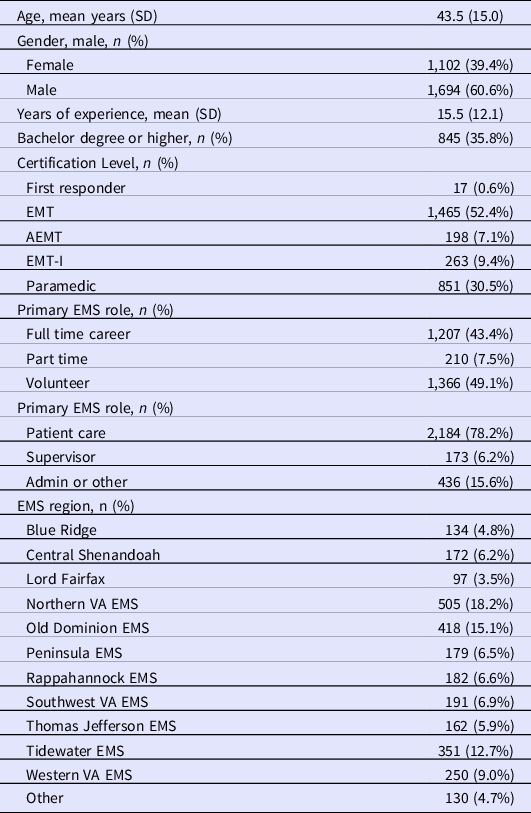
At close of the study period, 3050 responses were received from throughout Virginia for a 9.5% response rate. A total of 2796 survey responses were sufficiently complete for use in the final analysis. Overall, participants were 43.5 y old (s = 15.0) and 60.6% (n = 1694) male. Respondents included the full range of certifications with 52.4% (n = 1465) EMTs, 7.1% (n = 198) AEMTs, and 30.5% (n = 851) paramedics, represented all EMS regions in Virginia, and had been certified for a mean of 15.5 y (s = 12.1). Full demographics are shown in Table 1.
Demographics of Virginia EMS provider survey respondents (n = 2,796)

AEMT = Advanced EMT; EMS = Emergency Medical Services; EMT = Emergency Medical Technician; EMT-I = EMT-Intermediate; SD = standard deviation.
During the 2018-2019 influenza season, 79.4% (n = 2221) of surveyed EMS clinicians received a seasonal flu vaccine. A total of 74% (n = 2078) of respondents had previously had the flu while 18% (n = 505) self-reported side effects from the flu vaccine. Furthermore, 20% (n = 565) reported avoiding the influenza vaccine in the past out of concerns over adverse reactions. In 2009, the most recent pandemic flu season, 52% (n = 1447) of respondents reported receiving the pandemic specific vaccine. The immediately previous flu season (2017-2018), which the CDC classified as a “high severity” season, was subjectively rated as severe by 59.9% (n = 1655) of respondents.
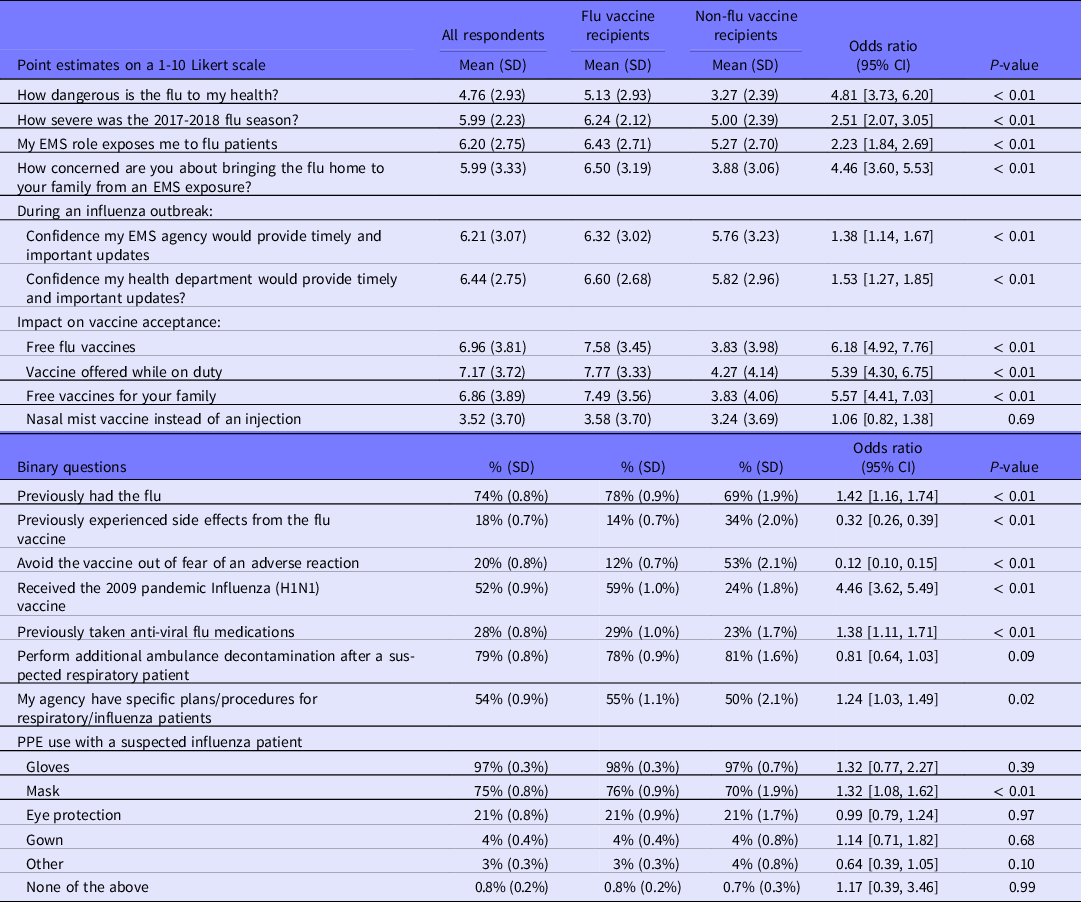
On a 1-10 Likert scale, respondents on average ranked the dangerousness of the flu as 4.76 (s = 2.93) (Table 2). Vaccinated EMS clinicians were 4.8 times as likely to believe that the flu is dangerous to their health as compared to their unvaccinated counterparts (P < 0.01). Similarly, clinicians accepting the vaccine were 4.5 times as likely to be worried about an occupational flu exposure being transmitted to family at home (P < 0.01). In terms of incentives for vaccination, free flu vaccines for EMS clinicians elicited 5.2 times higher impact among vaccinated clinicians as their unvaccinated counterparts (P < 0.01), and free vaccines for clinicians’ families showed 4.6 times higher impact among vaccinated respondents as compared to unvaccinated respondents (P < 0.01).
Differences in attitudes and beliefs toward influenza among Virginia EMS providers by vaccination status

EMS = Emergency Medical Services; PPE = Personal Protective Equipment; SD = standard deviation.
Overall, 52% (n = 1447) of respondents indicated they had received the 2009 H1N1 pandemic influenza vaccine, although seasonal flu vaccine respondents were 3.5 times more likely to have also received the pandemic vaccine than their seasonally unvaccinated counterparts (P < 0.01). Only 54% (n = 1515) of respondents overall knew or believed their agency has specific infection control plans or procedures in place for treating suspected influenza or respiratory patients. Seasonal influenza vaccine recipients were 38% and 53% more likely to believe their EMS agency or the health department, respectively, would provide timely and important updates during an influenza outbreak (P < 0.01 for both). Finally, while 97% (n = 2725) of respondents would use gloves with a suspected influenza patient, vaccinated clinicians were 32% more likely to wear a mask (P < 0.01), and only 21% (n = 594) of clinicians overall ascribed to wearing eye protection.
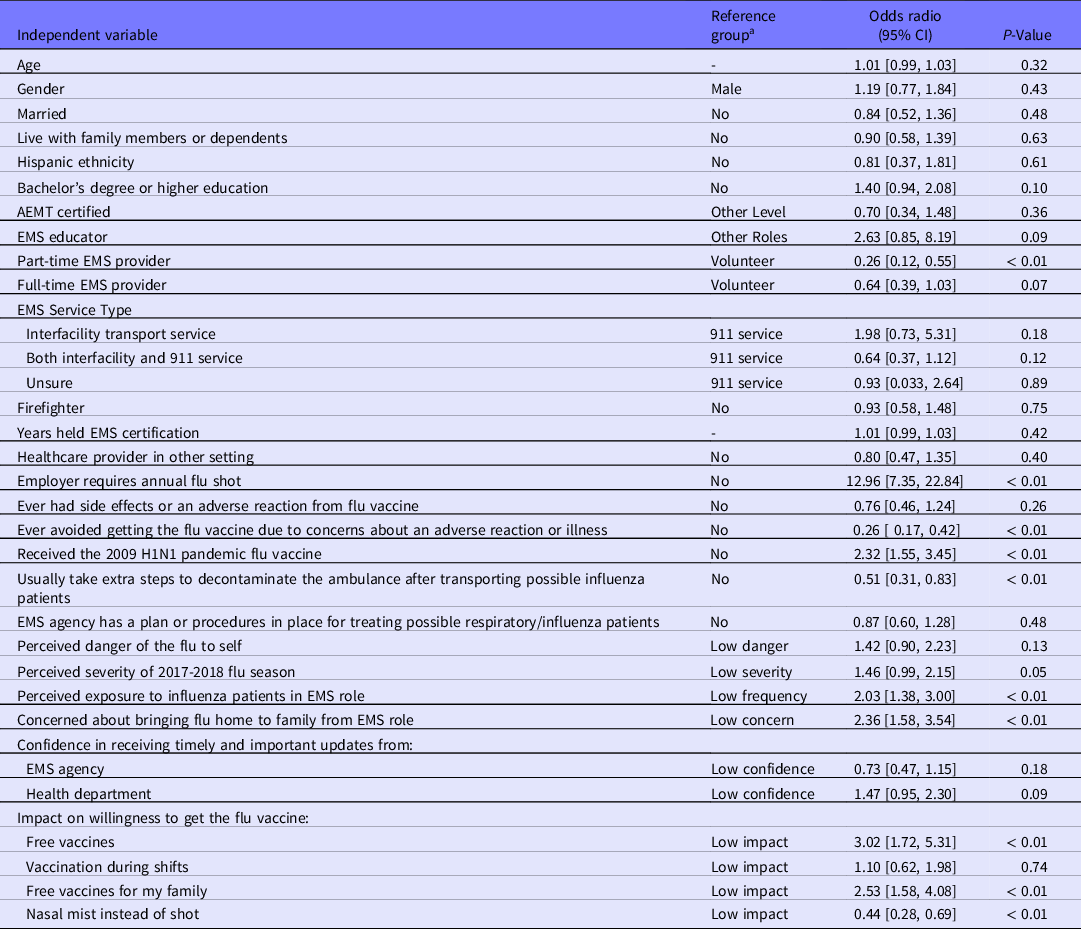
A multiple logistic regression model was built iteratively looking at predictors of influenza vaccine uptake. Employer requirement of vaccination was the strongest association with vaccination (odds ratio [OR] = 12.96; 95% confidence interval [CI]: [7.35, 22.84]; P < 0.01). Primarily part-time EMS clinicians were overall less likely to receive the vaccine than their volunteer (OR = 0.26; 95% CI: [0.12, 0.55]; P < 0.01) or full-time counterparts (OR = 0.64; 95% CI: [0.39, 1.03]; P = 0.07). Overall, those who take extra steps to decontaminate an ambulance post-influenza patient were 49% less likely to receive the flu vaccine (OR = 0.51; 95% CI: [0.17, 0.69]; P < 0.01). EMS clinicians who received the 2009 H1N1 pandemic vaccine were 1.3 times more likely to obtain a seasonal influenza vaccine (P < 0.01).
Finally, those who had ever avoided the flu vaccine out of concerns about adverse reactions were 74% less likely to get the seasonal vaccine in the 2018-2019 season (OR = 0.26; 95% CI: [0.58, 0.83]; P < 0.01). Results of the full model are shown in Table 3.
Adjusted multivariate logistic regression model for predicting EMS provider influenza vaccination

a If independent variable is categorical
AEMT = Advanced Emergency Medical Technician; EMS = Emergency Medical Services.
Discussion
This study presents encouraging results about EMS clinicians trending upward in influenza vaccine uptake. Overall seasonal influenza vaccine uptake in our sample was 79.4% (n = 2221), moving in line with the broader US healthcare population, which was surveyed to have an 81.1% vaccination rate during the same season. 18 While this is higher than previous estimates of EMS clinicians influenza vaccination coverage, there is more work to be done. EMS clinicians are on the frontlines of patient care daily: entering patients’ homes and providing care and counseling. As such, this critical component of the United States health infrastructure needs to be protected from infectious disease wherever possible. In the context of an estimated 4.4 million influenza illnesses, 58,000 hospitalizations, and 3500 deaths during the 2018-2019 influenza season, the importance of vaccination among the public generally, and healthcare providers specifically, remains vital. Reference Chung, Rolfes and Flannery19
Many factors may contribute to vaccine uptake. This study found offering free vaccines and a vaccination on duty favorably impacted 60.4% (n = 1689) and 60.5% (n = 1691) of respondents in deciding to receive the vaccine, respectively. This conforms with past research from other EMS systems that found during the 2005-2006 influenza season, 58.7% and 70.6% of EMS clinicians would be more likely to get the flu vaccine the following year if it was free or available without waiting while at work, respectively. Reference Rueckmann, Shah and Humiston14 Also, EMS clinicians do not appear to be needle adverse, with a nasal mist, rather than injectable vaccine, favorably impacting only 17.9% (n = 500) of respondents on their vaccination decision. This presents interesting policy considerations for EMS agencies seeking to improve vaccine uptake. Perhaps, not surprisingly, the greatest predictor identified for an individual’s vaccine uptake was their employer requiring the vaccine. While mandated vaccination may be a useful strategy for fully career EMS agencies, it may not be readily implementable for the 49% (n = 1366) of our sample or one-third of US states that primarily rely on volunteers. 12
The results from this study also demonstrate areas in which EMS agencies can educate their clinicians about staying safe and effectively treating patients with influenza. Only 54% (n = 1515) of respondents overall were aware of or believed that their agency had a specific plan for the treatment of patients with suspected influenza or respiratory infection. This represents either a gap in knowledge of how to manage patients with suspected infectious respiratory illness, a lack of awareness of such policies, or a lack of agency policies about the appropriate treatment of these patients. Also, of all respondents, 75% (n = 2086) reported mask usage, but only 21% (n = 594) and 4% (n = 118) reported routinely using eye protection or a gown, respectively, with a suspected influenza patient. This is in contrast with CDC recommendations that healthcare providers treating a suspected seasonal influenza patient wear standard and droplet PPE, which includes gloves, a mask, eye protection, and a gown. 20,Reference Siegel, Rhinehart and Jackson21 EMS agencies should work to increase PPE usage to fall in line with CDC recommendations and ensure protection of this vital healthcare workforce.
Pandemic Preparedness
While the health risks of a standard influenza season are significant, the public health contingency for an influenza pandemic must also be actively considered. The world’s most recent experience with an influenza pandemic, 2009 H1N1, resolved itself as milder than initially thought and a vaccine was quickly developed. Reference Girard, Tam and Assossou22 Although below the threshold of a pandemic, the flu season immediately preceding this survey was particularly severe, breaking records for hospitalizations and influenza and pneumonia associated deaths (10.8%). Reference Garten, Blanton and Elal23,Reference Jester, Uyeki and Jernigan24 While subtype A(H1N1) rightfully drew much public attention following its reemergence as a pandemic in 2009, other subtypes of influenza A continue to reemerge and reassort. Influenza A(H3N2), for example, was estimated to be responsible for an average twice as many hospitalizations over the past 6 y. Reference Jester, Uyeki and Jernigan24 Beyond nonpharmaceutical interventions, seasonal vaccination remains a core primary prevention strategy for influenza. In the event of a novel strain, the search for an effective vaccine would be of utmost importance.
But the vaccine would only be as useful as society is willing to receive it. Despite a mere estimated 29% adjusted overall vaccine effectiveness during the survey year (2018-2019), Reference Flannery, Kondor and Chung25 modelling estimates suggest the number needed to vaccine (NNV) was 43 to avert one A(H1N1)pdm09-associated illness, and vaccination overall prevented 4.4 million illnesses and some 3500 deaths (all subtypes). Reference Chung, Rolfes and Flannery19 In a pandemic flu event, just as in other outbreaks and noninfluenza pandemics including COVID-19, EMS clinicians will be on the frontlines of responding to patients. Reference Hoffman26 Given the concerns about a concurrent influenza and COVID outbreak in forthcoming winter seasons, Reference Gostin and Salmon27 protecting EMS clinicians with available vaccines must be a key public health priority.
Limitations
This study is limited by several factors. While this survey was distributed to the 32,190 clinicians throughout Virginia, only 3050 responses were received (9.5%), with 2796 responses used in the final analysis. Accordingly, a nonresponse bias analysis was conducted using data provided by the Virginia Office of Emergency Medical Services (VA OEMS) through personal communication and a Freedom of Information Act (FOIA) request. While the low response was a limitation, our sample was substantially similar to the state’s EMS population overall. The mean age of our sample was 43.5 y old (s = 15.0), while the FOIA dataset had a mean age of 39.2 y old (s =13.2). Certification levels and EMS regions also roughly paralleled the state with no appreciably large discrepancies. Additionally, this survey revolved around self-reported data that may suffer from bias, and all data were from a single state, which may limit generalizability. Of note, however, this remains one of the largest influenza-based surveys of EMS clinicians to date, and includes respondents from every region, certification level, and employment status along the full age spectrum in a large and diverse state, providing useful insights into areas for policy improvement. Finally, this study can only be interpreted as a 1-y point estimate of vaccination status in a single state, which may not be representative of EMS clinicians nationwide. It would be useful for future studies, or accrediting agencies such as state offices of EMS or the National Registry of EMTs, to continuously survey and trend vaccination status among the EMS population nationwide.
Conclusions
In a large, state-wide study of EMS clinicians, overall influenza vaccination coverage was 79.4%. Understanding the attitudes and beliefs of EMS clinicians remains a critical priority for protecting this subset of frontline healthcare providers. Agencies should consider practical policies and approaches to increase influenza vaccine uptake, such as offering vaccines to clinicians on duty and their families for free, as well as educating their personnel about agency-specific treatment plans and appropriate PPE for suspected influenza patients.
Acknowledgments
The authors thank the Rosedale Volunteer Fire Company, Baltimore County, Maryland and the Virginia Office of Emergency Medical Services generally, and Director Gary Brown, and Marian Hunter specifically, for their invaluable support of this research.