Introduction
Ant–plant interactions, particularly protection mutualisms (Heil & McKey Reference Heil and McKey2003), are widespread in tropical rain forests. In addition to numerous non-symbiotic interactions mediated by plant-provided food sources such as extrafloral nectar (Heil Reference Heil2015), symbiotic mutualisms also occur. In these, myrmecophytic plants provide nesting space in the form of hollow twigs, petioles, stipules, leaf pouches, etc. – more or less specialized structures termed domatia – and food in the form of extrafloral nectar, food bodies, secretions of plant-nourished hemipteran trophobionts, or combinations of these, to their host ants (Davidson & McKey Reference Davidson and McKey1993, McKey et al. Reference McKey, Gaume, Brouat, Di Giusto, Pascal, Debout, Dalecky, Heil, Burslem, Pinard and Hartley2005). In return, ants defend their host plant against herbivores and pathogens (Letourneau Reference Letourneau1998, Rosumek et al. Reference Rosumek, Silveira, Neves, Barbosa, Diniz, Oki, Pezzini, Fernandes and Cornelissen2009). About 700 plant and 110 ant species are involved in this type of symbiosis (Chomicki & Renner Reference Chomicki and Renner2015, Davidson & McKey Reference Davidson and McKey1993). In some cases, the interaction is obligatory for one or even both partners (Gaume & McKey Reference Gaume and McKey1999, Moog Reference Moog2009, Yu & Davidson Reference Yu and Davidson1997).
Protection of myrmecophytic plants by ants has been thoroughly studied (Janzen Reference Janzen1966, Rosumek et al. Reference Rosumek, Silveira, Neves, Barbosa, Diniz, Oki, Pezzini, Fernandes and Cornelissen2009). Like many other plants, myrmecophytic plants release volatile compounds, to which their resident ants are attracted (reviewed in Blatrix & Mayer Reference Blatrix, Mayer, Baluska and Ninkovic2010). Whereas the role of chemical signalling in ant–plant symbioses has been demonstrated by several studies, a smaller number of studies show that vibrations produced by herbivore movement also induce ant patrolling (Dejean et al. Reference Dejean, Djiéto-Lordon and Orivel2008, Reference Dejean, Grangier, Leroy and Orivel2009; Federle et al. Reference Federle, Maschwitz and Fiala1998, Lapola et al. Reference Lapola, Bruna and Vasconcelos2003, Madden & Young Reference Madden and Young1992).
Protection level often differs among systems depending on the capacity of the ants to counter plant enemies (Bruna et al. Reference Bruna, Lapola and Vasconcelos2004, Lapola et al. Reference Lapola, Bruna and Vasconcelos2003). This capacity may partly depend on colony size (Duarte Rocha & Godoy Bergallo Reference Duarte Rocha and Godoy Bergallo1992), which in turn depends strongly on plant investment in the resident ant colony. Both protective behaviour and the level of plant investment in ants are driven by co-evolution. However, studies comparing the efficiency with which different ants protect the same plant species have so far compared ants belonging to different genera that have independently evolved associations with the same host plant (Bruna et al. Reference Bruna, Lapola and Vasconcelos2004, Lapola et al. Reference Lapola, Bruna and Vasconcelos2003). These studies thus cannot distinguish differences that may have resulted from co-evolutionary interactions with the host plant from those that already existed prior to their host associations.
In this study we compare the level of protection conferred on host plants by two closely related species of Tetraponera (Pseudomyrmecinae), T. aethiops Smith, 1877 and T. latifrons (Emery, 1912), that both live in symbiotic associations with myrmecophytes of the genus Barteria (Passifloraceae), suggesting that their common ancestor was also a symbiont of the plants’ common ancestor. Differences in their protective behaviour thus evolved in the context of this symbiosis. Comparison of their protective behaviour can thus shed light on differences driven by co-evolutionary interactions. As association specificity seems weaker for B. dewevrei than for B. fistulosa, coevolution between B. fistulosa and T. aethiops might be more intensive than between B. dewevrei and T. latifrons. We postulated that more intensive co-evolution of ant and plant may have resulted in better protection of B. fistulosa by its ant associate T. aethiops. We tested the following hypotheses: (1) protective behaviour is elicited by vibration and/or chemical signals, (2) protective behaviour of each ant species is more pronounced toward its main host plant than toward the other Barteria species, (3) T. aethiops shows a more pronounced protective behaviour than T. latifrons.
Methods
Study species and study sites
The genus Barteria (Passifloraceae) comprises four tree species (Breteler Reference Breteler1999) endemic to central Africa. Barteria solida Breteler does not host ants. Barteria fistulosa Mast., B. dewevrei De Wild. & T. Durand and B. nigritana Hook. f. are myrmecophytes with hollow lateral branches. Barteria nigritana hosts various opportunistic species of ants, some of which provide some protection to their host (Djiéto-Lordon et al. Reference Djiéto-Lordon, Dejean, Gibernau, Hossaert-McKey and McKey2004). Barteria dewevrei and B. fistulosa have three potential ant symbionts: Tetraponera aethiops, T. latifrons and Crematogaster sp. However, B. dewevrei preferentially hosts T. latifrons or Crematogaster sp., whereas B. fistulosa hosts T. aethiops preferentially, even when both Barteria and both Tetraponera species occur in syntopy (Kokolo et al. Reference Kokolo, Atteke, Ibrahim and Blatrix2016). Barteria fistulosa is restricted to the tropical rain-forest environment, whereas B. dewevrei occurs in a wider range of habitats: rain forest, forest gallery and the forest/savanna ecotone. Protection of B. dewevrei by its ants has never been studied. The vigorous protection of B. fistulosa by T. aethiops is well-known by local people and has been the subject of several studies (Dejean et al. Reference Dejean, Djiéto-Lordon and Orivel2008, Janzen Reference Janzen1972, McKey Reference McKey1974). The association between the two Barteria and their two Tetraponera ants shows a high degree of specificity: Tetraponera aethiops and T. latifrons have never been found nesting outside either B. fistulosa or B. dewevrei. Moreover, B. fistulosa does not grow well if not occupied by one or the other of these two Tetraponera species. Barteria dewevrei seems to be less dependent upon Tetraponera ants, at least in some habitats, as many individual trees in some savanna sites are occupied by Crematogaster.
The experiments were conducted on 20 individuals of B. dewevrei occupied by T. latifrons in Souba (01°36’S, 14°03’E) and 20 individuals of B. fistulosa occupied by T. aethiops in Bongoville (1°37’S, 13°54’E). Souba is located at ~550 m asl on the Batéké Plateau, a highland covered by grassland and wooded savanna, criss-crossed by gallery forest. Bongoville is located at the foot of the Batéké Plateau, at ~400 m asl, along a stream in a tropical rain-forest environment.
Behavioural response of the ants to host plant disturbance
Behavioural tests were conducted in three steps. The first step aimed at measuring the spontaneous level of ant patrolling activity on leaves, i.e. without any disturbance of the tree, as a control. Two leaves were randomly selected among the young leaves of two upper branches on each Barteria individual (one leaf per branch). Starting at an arbitrary time, we recorded the time lapse before each leaf was reached by a resident ant, once per leaf. We averaged the time lapse over the two leaves for each tree. This average was meant to temper the effect of heterogeneity expected with low levels of patrolling, and was used as a single value for each tree (undisturbed leaf = control leaf). The second step aimed at testing the effect on ant reaction of physical damage to a leaf (simulating an attack by a small herbivore, such as a phytophagous insect) and of slight vibration, which inevitably accompanies such experimental infliction of damage. Two leaves were randomly selected among the young leaves of two upper branches on each Barteria individual (one leaf per branch). The apex of one of the two leaves was cut with scissors (damaged leaf), and the other leaf was simply gently scraped superficially with the tip of scissors without inflicting damage (‘scraped leaf’). For each of the two leaves simultaneously we recorded the time lapse before it was reached by a resident ant, and the number of ants that touched the site of damage (damaged leaf only) over 30 min The two focal ant species, T. latifrons and T. aethiops, are very sensitive to physical disturbance of their host tree by an experimenter. They literally pour out of the hollow branches as soon as an experimenter manipulates, or even touches, the leaves. Any vibration, even weak, such as cutting a leaf with scissors, may thus induce such a reaction. Damaging the leaf necessarily implies also provoking vibrations. The level of vibration we applied to the leaf by scraping it with the tip of the scissors was meant to mimic that experienced by the leaf damaged with scissors. We recognize that scraping a leaf does not exactly reproduce the same physical disturbance caused by cutting the leaf blade with scissors. However, slightly scraping the leaf was the best proxy we could use to control for a possible effect of the physical disturbance of cutting with scissors to test for the effect of emission of volatile compounds after such damage. Thus, the effect of damaging the leaf was tested by comparing the scraped and the damaged leaves (because the damage treatment corresponds to vibration + physical damage). The effect of scraping the leaf was tested by comparing the undisturbed and the scraped leaves. The third step aimed at testing specificity of the behavioural response of the ant species to physical damage of the two plant species. On a leaf of each Barteria individual we placed a damaged leaf (apex cut with scissors) of the other Barteria species and recorded the time lapse before it was contacted by a resident ant. The host leaf upon which the damaged non-host leaf was placed was gently scraped to mimic the level of vibration of a leaf damaged with scissors, so we could compare time lapse of response to the damaged host leaf and to the damaged non-host leaf. We also compared responses of the two ant species to each treatment.
Statistical tests were performed with R 3.1.0. P values were adjusted using Holm’s method in the case of multiple comparisons.
Results
The time lapse before the ants reached the focal leaves varied significantly across treatments (host leaf undisturbed, host leaf scraped, host leaf damaged, non-host leaf damaged) for T. aethiops (Friedman test, statistic = 38, P = 0.000000036) and for T. latifrons (Friedman test, statistic = 36, P = 0.000000050).
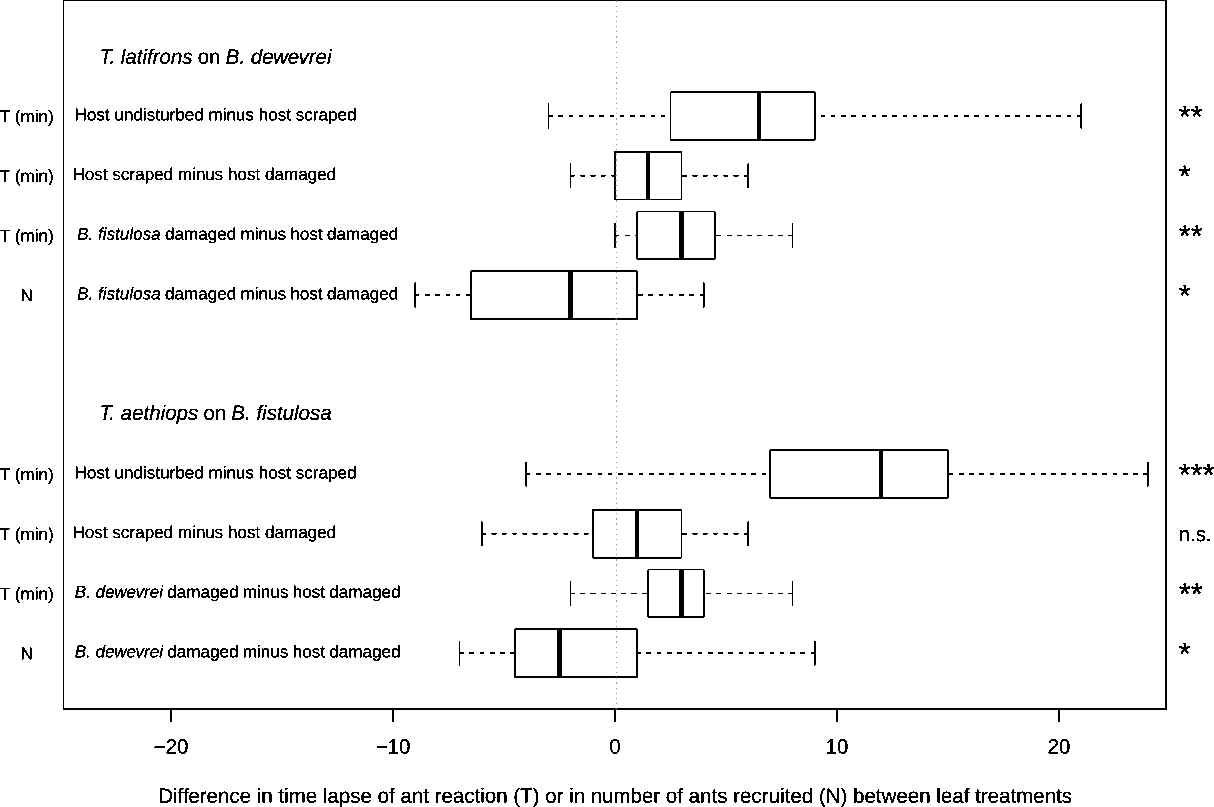
Tetraponera latifrons ants reached the scraped host leaf significantly more quickly than the undisturbed leaf (mean ± SD, scraped: 9.5 ± 1.9 min, undisturbed: 16.3 ± 5.7 min; Wilcoxon signed-rank test, V = 8, Padj = 0.0025, Figure 1), the damaged host leaf significantly more quickly than the scraped host leaf (damaged: 7.8 ± 1.9 min, scraped: 9.5 ± 1.9 min; V = 96, Padj = 0.020, Figure 1), and the damaged host leaf (B. dewevrei) significantly more quickly than the damaged non-host leaf (B. fistulosa) (damaged host: 7.8 ± 1.9 min, damaged non-host: 10.8 ± 2.1 min; V = 171, Padj = 0.0014, Figure 1). Moreover, the number of ants of this species that touched the damaged site was significantly greater for the host leaf (B. dewevrei) than for the non-host leaf (B. fistulosa) (damaged host: 9.1 ± 3.5 ants, damaged non-host: 6.6 ± 2.1 ants; V = 152, Padj = 0.045, Figure 1).
Behavioural response of the ants Tetraponera aethiops and T. latifrons to treatments on leaves of their host plants, Barteria fistulosa and B. dewevrei, expressed as differences in time lapse (‘T’, min) before the ants reached the focal leaves and in number of ants (‘N’) that touched the damaged site. Treatments were tested in a paired design as follows: host leaf undisturbed vs host leaf scraped with the tip of scissors, host leaf scraped vs host leaf damaged, non-host leaf damaged vs host leaf damaged. Damage was performed with scissors, and thus damaged leaves were inevitably also subjected to slight vibration that we mimicked by gently scraping the leaf with the tip of scissors. Experiments were conducted in Gabon. Vertical lines represent median, boxes represent interquartile range, and whiskers extend to the data extremes. n.s.: not significant, *: P < 0.05, **: P < 0.01, ***: P < 0.001.

Tetraponera aethiops ants reached the scraped host leaf significantly more quickly than the undisturbed leaf (mean ± SD, scraped: 5.2 ± 3.0 min, undisturbed: 16.6 ± 5.3 min; Wilcoxon signed-rank test, V = 1, Padj = 0.00087, Figure 1). The time lapse before T. aethiops ants reached the host leaf did not differ significantly between scraped and damaged leaves (scraped: 5.2 ± 3.0 min, damaged: 4.5 ± 2.6 min; V = 114; Padj = 0.46, Figure 1). Tetraponera aethiops ants reached the damaged host leaf (B. fistulosa) significantly more quickly than the damaged non-host leaf (B. dewevrei) (damaged host: 4.5 ± 2.6 min, damaged non-host: 7.15 ± 2.5 min; V = 178, Padj = 0.0036, Figure 1). Moreover, the number of ants of this species that touched the damaged site was significantly greater for the host leaf (B. fistulosa) than the non-host leaf (B. dewevrei) (damaged host: 15.2 ± 4.0 ants, damaged non-host: 13.3 ± 3.3 ants; V = 162, Padj = 0.045, Figure 1).
The time lapse before the ants reached the undisturbed leaf did not differ significantly between the two ant species (mean ± SD, T. latifrons: 16.3 ± 5.7 min, T. aethiops: 16.6 ± 5.3 min; Mann–Whitney U-test, W = 191, Padj = 0.81), indicating no significant difference in the spontaneous level of patrolling activity. Tetraponera aethiops ants reached their host leaf (B. fistulosa) significantly more rapidly than T. latifrons reached theirs (B. dewevrei), whether leaves were simply scraped (T. aethiops: 5.2 ± 3.0 min, T. latifrons: 9.5 ± 1.9 min; W = 344, Padj = 0.00084) or damaged (T. aethiops: 4.5 ± 2.6 min, T. latifrons: 7.8 ± 1.9 min; W = 336, Padj = 0.0014). Moreover, the number of T. aethiops ants that contacted the damaged host leaf during 30 min was significantly larger than for T. latifrons (T. aethiops: 15.2 ± 4.0 ants, T. latifrons: 9.1 ± 3.5 ants; W = 345, Padj = 0.0000029). Tetraponera aethiops ants were significantly faster and more numerous than T. latifrons in contacting the damaged non-host leaf (T. aethiops on B. dewevrei: 7.15 ± 2.5 min, 13.3 ± 3.3 ants; T. latifrons on B. fistulosa: 10.8 ± 2.1 min, 6.6 ± 2.1 ants; time lapse: W = 55, Padj = 0.00078; number of ants: W = 383, Padj = 0.0000029).
Discussion
Behavioural response of Tetraponera ants to disturbance of their Barteria host plants
Most ants associated with myrmecophytes respond to leaf damage in less than 5 minutes (reviewed in Blatrix & Mayer Reference Blatrix, Mayer, Baluska and Ninkovic2010). The time lapse before T. aethiops and T. latifrons reached a damaged leaf appeared comparatively long (4.5 ± 2.6 and 7.8 ± 1.9 min, respectively), when we consider that the Tetraponera ants associated with Barteria are well known for their particularly prompt aggressive reaction to human intruders (Janzen Reference Janzen1972). As we were aware of this particularity, we took special care to limit physical disturbance as much as possible when manipulating experimental leaves (‘scraped’ and ‘damaged’ treatments). The treatments we applied were probably more representative of the disturbance induced by small insects than that induced by mammals. Comparing the African Barteria/Tetraponera symbiosis with the American Acacia/Pseudomyrmex symbiosis, Janzen (Reference Janzen1972) noted that the protection behaviour displayed by Tetraponera aethiops is particularly adapted to protect its host plant against large herbivores such as mammals. For instance, the number of workers of Tetraponera aethiops patrolling Barteria fistulosa is much lower than in the Acacia/Pseudomyrmex symbiosis. The relatively slow reaction time measured in our experiments with Tetraponera on Barteria likely reflects the low spontaneous patrolling activity of these ants and their weaker reaction to insect herbivory than to mammal herbivory.
Our experiments showed that both ant species, T. latifrons and T. aethiops, reached the leaves more rapidly when these were scraped than when they were undisturbed, demonstrating their response to vibrations. Dejean et al. (Reference Dejean, Djiéto-Lordon and Orivel2008) already showed that T. aethiops responds to vibration induced by herbivory. However, only T. latifrons responded more strongly to physical damage than to scraping. Behavioural response of T. aethiops did not differ between a scraped and a damaged (thus also vibrated) leaf of its host plant, B. fistulosa, but T. aethiops proved to react more rapidly than T. latifrons in both cases. This difference between the two ants cannot be due to varying levels of spontaneous patrolling, as these did not differ significantly. These results suggest that perception of chemical signals (volatile compounds emitted from the damaged site) improves protection of B. dewevrei by its host ant T. latifrons. Given that damaged leaves were also vibrated by the investigator and that T. aethiops reacts very strongly to scraping, the effect of chemical signals on T. aethiops may have been masked by the effect of scraping in our experimental design. Thus, we cannot conclude on the effect of chemical signalling on T. aethiops. We hypothesize that the responses of T. aethiops to chemical signals and vibration could have evolved to target respectively small insects feeding on the leaves (which are unlikely to induce detectable vibration) and large herbivores such as mammals. Response of T. aethiops to chemical signals should be tested in a vibration-free context. Similar chemical signalling of leaf damage has been demonstrated in many ant–plant symbioses (reviewed in Blatrix & Mayer Reference Blatrix, Mayer, Baluska and Ninkovic2010). Perception of chemical signals indicating herbivory should improve protection efficiency because it allows the ants to locate sites of herbivory quickly and accurately (Agrawal Reference Agrawal1998, Gonçalves-Souza Reference Gonçalves-Souza2016, Pacheco & Del-Claro Reference Pacheco and Del-Claro2018). In various myrmecophytic interactions, ant patrolling is focused on young leaves and shoots, even when these are not disturbed (reviewed in Blatrix & Mayer Reference Blatrix, Mayer, Baluska and Ninkovic2010). Such directed patrolling is most likely driven by chemical signalling to provide constitutive protection of the most vulnerable plant parts. Plant chemical signalling of herbivore damage and ant behavioural response to it are expected to co-evolve because both partners benefit from deterrence of herbivores.
Specificity of ant behavioural response to host plant species
Our study revealed a certain level of specificity in the behavioural response of the two ant species to disturbance of the plant. We showed that both ant species, T. aethiops and T. latifrons, responded more strongly (faster recruitment and more ants recruited) to damage to leaves of their usual host plant species (B. fistulosa and B. dewevrei for T. aethiops and T. latifrons, respectively) than to damage on leaves of the non-host plant species (B. dewevrei and B. fistulosa for T. aethiops and T. latifrons, respectively). As there is a preferential association between T. aethiops and B. fistulosa on the one hand and between T. latifrons and B. dewevrei on the other hand (Kokolo et al. Reference Kokolo, Atteke, Ibrahim and Blatrix2016), specificity of the behavioural response might be a product of ant–plant co-evolution within each pair of species. Alternatively, specificity of ant response in the Barteria–Tetraponera system might result from ants acquiring familiarity with the signals of the plant species they presently live on. For instance, arboreal ants have been shown to nest preferentially on plant species to which they have been exposed during development (Djiéto-Lordon & Dejean Reference Djiéto-Lordon and Dejean1999), probably because of a pre-imaginal imprinting process directed on plant odour.
Notwithstanding the specific responses of the ants to damage of their host plant, we showed that T. aethiops responded more strongly to leaf disturbance (scraping and damage), a signal of potential herbivory, than T. latifrons. This difference is expected to translate into better protection conferred by T. aethiops than by T. latifrons. As the association between T. aethiops and B. fistulosa is more specific than the association between T. latifrons and B. dewevrei (Janzen Reference Janzen1972, Kokolo et al. Reference Kokolo, Atteke, Ibrahim and Blatrix2016), we speculate that the difference in response level might be the result of a tighter co-evolution between T. aethiops and B. fistulosa. Tetraponera aethiops and T. latifrons are sister species (Ward Reference Ward, Huxley and Cutler1991) and are the only African species of their species-group (Ward Reference Ward2006). The differences we observed in their protective behaviour have thus probably evolved after their divergence from a common ancestor that was also in symbiosis with Barteria. This situation is different from those studied by Bruna et al. (Reference Bruna, Lapola and Vasconcelos2004) and Lapola et al. (Reference Lapola, Bruna and Vasconcelos2003), where comparisons involved phylogenetically distant ant species that independently colonized the same plant. The differences between the two species of Tetraponera much more likely reflect co-evolution with their Barteria hosts. From a mechanistic point of view, our study demonstrates that these differences are not due to different levels of spontaneous patrolling activity. However, the shorter time lag before reaching the disturbed leaves and the larger number of ants recruited for T. aethiops than for T. latifrons could result from colonies of T. aethiops being larger, leading to more ants involved in defending the plant. It would be worth investigating the level of food rewards provided by the two Barteria species to their ant symbionts to test the hypothesis that B. fistulosa invests more resources into its symbiont to sustain a higher level of protection, and to see whether such a difference has translated into larger, denser colonies of T. aethiops in its host than of T. latifrons in its host.
Acknowledgements
We thank the Department of Biology of the Université des Sciences et Techniques de Masuku, Franceville (Gabon) for allowing us to perform phytochemical analyses in the Laboratory of Electrophysiology and Pharmacology.
Financial support
This study benefited from funding by the Agence Nationale des Bourses du Gabon (ANBG).