



Introduction and Methods
Fungi are obligate heterotrophs and possess a diverse suite of molecular tools for accessing and processing exogenous carbon. In lichenized fungi, the transfer of photosynthate from photobiont to mycobiont is central to carbohydrate economy; however, major differences in total carbon metabolism are expected to exist between components of the holobiont, that is photoautotrophy in the photobiont versus heterotrophy in the mycobiont and associated microbiota. As well as the nutritional role of sugar monomers, fungi and algae also modify polysaccharide polymers as part of their core cellular processes, for example maintaining cell wall structure (Yoshimi et al. Reference Yoshimi, Miyazawa and Abe2016; Fuertes-Rabanal et al. Reference Fuertes-Rabanal, Rebaque, Largo-Gosens, Encina and Mélida2025) and processing storage compounds (Wilson et al. Reference Wilson, Roach, Montero, Baroja-Fernández, Muñoz, Eydallin, Viale and Pozueta-Romero2010), while associated microbiota can be involved in scavenging, recycling (Sigurbjörnsdóttir et al. Reference Sigurbjörnsdóttir, Andrésson and Vilhelmsson2016) or an as-yet undetermined role in the lichen symbiosis (Hawksworth & Grube Reference Hawksworth and Grube2020). This multi-organismal processing of organic carbon is carried out by a large number of diverse macromolecules collectively known as carbohydrate-active enzymes (CAZymes) which are responsible for the construction and breakdown of long-chain biopolymers such as cellulose, lignin and chitin. CAZymes (including glycoside hydrolases, glycosyltransferases, polysaccharide lyases, carbohydrate esterases, and auxiliary activity enzymes) have been extensively characterized and collected together in the CAZy database (Drula et al. Reference Drula, Garron, Dogan, Lombard, Henrissat and Terrapon2022), which has proved an invaluable toolkit for interrogating fungal biology. For example, it has been used to show that most fungi employ a set of housekeeping enzymes for their own cell-wall management, whereas specialist species produce specific enzymes depending on their substrates (Yao et al. Reference Yao, Berrin, McKee and Bissaro2025). Within these housekeeping enzymes, glycoside hydrolases (GHs) are a major group responsible for cleaving polysaccharides into their constituent monomer subunits and have been shown to be enriched in many lichen genomes (Resl et al. Reference Resl, Bujold, Tagirdzhanova, Meidl, Freire Rallo, Kono, Fernández-Brime, Guðmundsson, Andrésson and Muggia2022).
Carbon processing in lichens may vary based on a variety of factors, and processes may be partitioned within the lichen holobiont according to fungal taxonomy, thallus structure, life history, and environment (Palmqvist Reference Palmqvist2000). Such structuring of carbon-related metabolic processes has important implications for organic matter processing in lichen-dominated habitats, especially those where cryptogams are primary photoautotrophs such as tundra and alpine heath. Ochrolechia frigida (Sw.) Lynge is a species of lichen with a circumpolar, arctic-alpine distribution. In the UK, it is abundant on windswept heath at over 1000 m on the highest mountains and down to sea level in the far north. It has a terricolous habit, growing on soil and in close association with moss and senescent or decaying parts of living plants, raising the question as to its capacity to access and process organic carbon found within these substrates. It has two distinct growth stages: an encrusting primary thallus with small papillae, and a semi-fruticose secondary thallus of spine-like projections. These growth stages may contrast in their carbon cycling capabilities since the primary thallus is the main photobiont-containing part of the lichen while the spines comprise mainly fungal material and are thought to break off and act as wind-dispersed propagules (Gaßmann & Ott Reference Gaßmann and Ott2000). Ochrolechia frigida is in the Ostropomycetidae, a subclass of the Lecanoromycetes with a notable expansion of GHs (Resl et al. Reference Resl, Bujold, Tagirdzhanova, Meidl, Freire Rallo, Kono, Fernández-Brime, Guðmundsson, Andrésson and Muggia2022).
To determine the metabolic potential for GH activity in O. frigida and its associated community, we generated GH profiles from unassembled metagenomes of the two growth stages. Specimens of the primary and secondary thalli of O. frigida were collected in triplicate from cryptogam-dominated alpine heath at c. 900 m in the Cairngorm mountains, Scotland, UK (57.0917, −3.8482) (Fig. 1A), where it is frequently found overgrowing bryophytes (e.g. Racomitrium lanuginosum) and decaying stems of prostrate ericaceous shrubs (e.g. Calluna vulgaris and Empetrum nigrum) (Fig. 1B–E). In the laboratory, subsamples were cleaned to remove particles of soil and plant matter, with the cleanest possible fragments sent for sequencing. Metagenomes of each growth stage were generated by the NERC Environmental Omics Facility (NEOF) with taxonomy and function assigned to reads using MetaPhlAn (Blanco-Míguez et al. Reference Blanco-Míguez, Beghini, Cumbo, McIver, Thompson, Zolfo, Manghi, Dubois, Huang and Thomas2023) and HUMAnN v. 3.9 (Franzosa et al. Reference Franzosa, McIver, Rahnavard, Thompson, Schirmer, Weingart, Lipson, Knight, Caporaso and Segata2018) respectively. Gene abundances were calculated as reads per kb of gene family (RPK) and further normalized to counts per million (CPM). Pfam (protein families and domains; Paysan-Lafosse et al. Reference Paysan-Lafosse, Andreeva, Blum, Chuguransky, Grego, Pinto, Salazar, Bileschi, Llinares-López and Meng-Papaxanthos2025) entries for all 194 GH families on the CAZy database were searched for on InterPro (Blum et al. Reference Blum, Andreeva, Florentino, Chuguransky, Grego, Hobbs, Pinto, Orr, Paysan-Lafosse and Ponamareva2025), revealing a total of 82 available GH Pfams. Genes in the metagenomes that were classified as Pfams belonging to these 82 GH families were searched for, extracted, and further analyzed in R v. 4.3 (R Core Team 2024). Sequence data are available on NCBI SRA under BioProject PRJNA1417572. Additional methods are available in Supplementary Material File S1 (available online).
A, alpine heath, Cairngorms, Scotland. Location of field site (inset) indicated with a star. B & C, primary thallus of Ochrolechia frigida. D & E, secondary thallus of O. frigida. Scales = 1 cm. In colour online.

Figure 1. Long description
Panel A is a wide-angle photo of a brown and green alpine heath under a foggy sky. In the bottom-right corner, a green map of the British Isles includes a yellow star in the Northeast of Scotland.
Below the landscape are four macro photos, each with a white 1 cm scale bar in the bottom-right corner.
Panel B, top-left, shows a primary thallus of O. frigida as a dense, white, crust-like growth over dark organic matter.
Panel C, top-right, shows a different view of the primary thallus with small, tan, disc-shaped structures interspersed among the white lichen and reddish-brown plant debris.
Panel D, bottom-left, displays the secondary thallus of O. frigida, which appears as a complex, branching, coral-like network of fine white filaments. A small red leaf is visible on the left side.
Panel E, bottom-right, provides a close-up of the secondary thallus, highlighting the intricate, spindly, and highly branched nature of the white lichen structure.
Results and Discussion
Over the six samples, a mean value of 120 811 177 reads per sample was generated (see Supplementary Material Table S1, available online) and assigned to a total of 5152 Pfams, 1796 of which were assigned to the class to which Ochrolechia belongs (Lecanoromycetes) (Supplementary Material Table S2, available online). Since no reference genome for O. frigida currently exists, reads were matched to Pfams from the closest reference in the database, with 1628 matching Lasallia and 168 matching Cladonia. Reads matching to Pfams belonging to both of these references may be attributed to either i) multiple copies or ii) small amounts of contaminating material. Of the 82 GH Pfams searched, 23 corresponded to GHs that occurred at > 1 Count Per Million (CPM) (Supplementary Material Table S3, available online), 15 of which were found in both the primary and secondary thallus (Fig. 2). Of these > 1 CPM Pfams, 11 were assigned to Lecanoromycetes as expected, while other fungal Pfams were assigned to Dothidiomycetes (11 Pfams), Eurotiomycetes (16 Pfams), Leotiomycetes (22 Pfams), Sordariomycetes (five Pfams) and Xylonomycetes (four Pfams), representing either i) non-lichen fungal diversity or ii) spurious taxonomic assignment to genes poorly represented by existing lichen genomes. Prokaryote Pfams were assigned to Actinomycetes (five Pfams), Alphaproteobacteria (four Pfams), Betaproteobacteria (one Pfam), Ktedonobacteria (one Pfam) and Terriglobia (16 Pfams) (Supplementary Material Table S4, available online). Any GH Pfams that may have been attributed to the photobiont failed to be taxonomically classified.
A, abundance of genes (CPM) assigned to glycoside hydrolase (GH) Pfams at > 1 CPM in the primary and secondary thallus. B, taxonomic assignment for each GH family in the primary and secondary thallus. CPM = counts per million; Pfams = protein families and domains. In colour online.
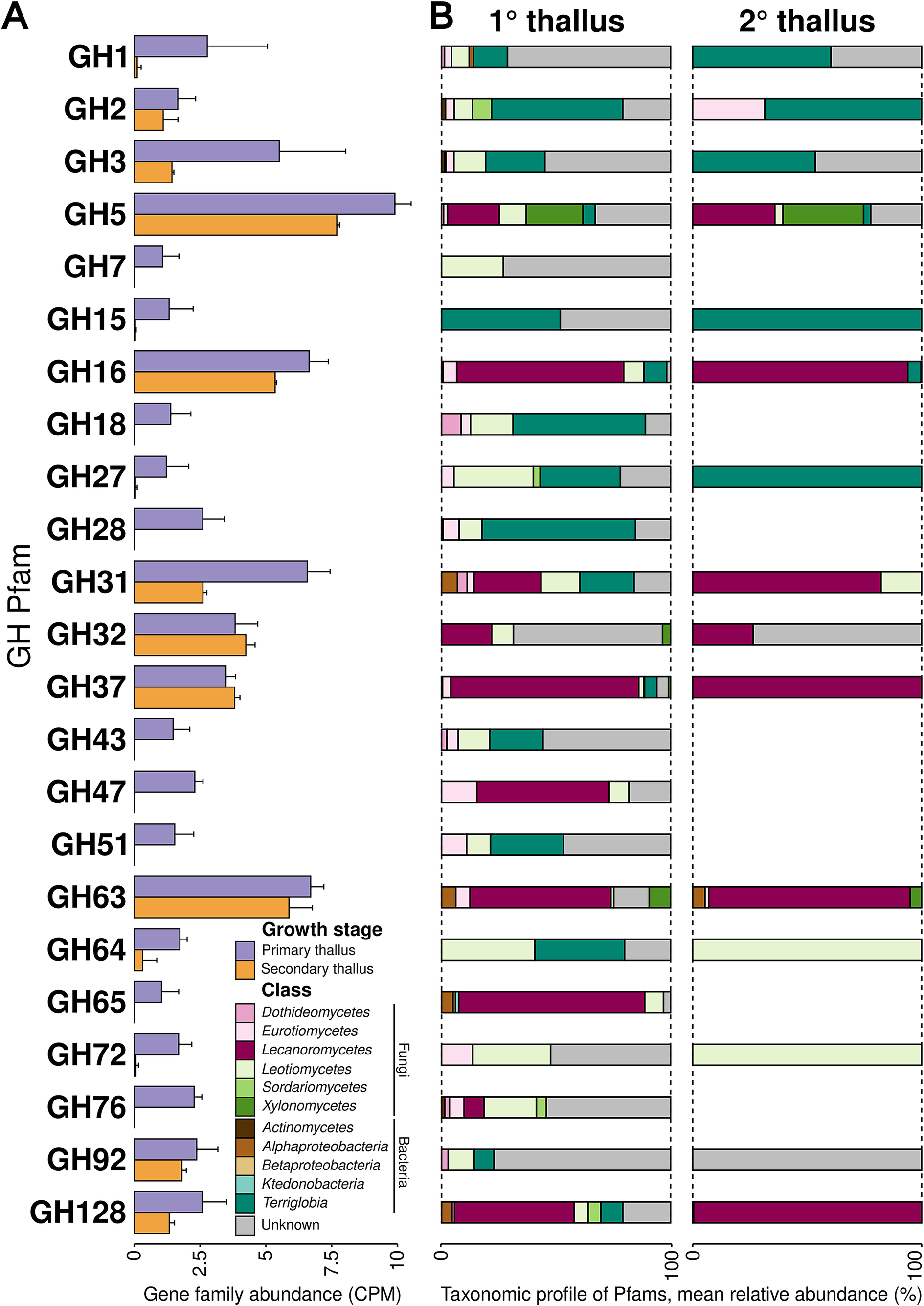
Figure 2. Long description
Panel A is a horizontal bar chart titled Gene family abundance (C P M). The Y-axis lists 22 G H Pfam categories from G H 1 at the top to G H 128 at the bottom. The X-axis ranges from 0 to 10 C P M. Each category has two bars: purple for primary thallus and orange for secondary thallus. G H 5 shows the highest abundance, exceeding 7.5 C P M in primary thallus. G H 16 and G H 31 also show high primary thallus abundance near 6 C P M.
Panel B is titled Taxonomic profile of Pfams, mean relative abundance (percent). It contains two columns of stacked horizontal bars labeled 1 degree thallus and 2 degree thallus. The X-axis for both ranges from 0 to 100 percent. The bars are color-coded by taxonomic class.
Fungi classes include:
- Dothideomycetes (light pink)
- Eurotiomycetes (pale yellow)
- Lecanoromycetes (maroon)
- Leotiomycetes (light green)
- Sordariomycetes (medium green)
- Xylonomycetes (dark green)
Bacteria classes include:
- Actinomycetes (brown)
- Alphaproteobacteria (tan)
- Betaproteobacteria (teal)
- Ktedonobacteria (light blue)
- Terriglobia (dark blue)
- Unknown (grey)
In the 1 degree thallus, many G H families like G H 16, G H 37, and G H 65 are dominated by Lecanoromycetes (maroon). In the 2 degree thallus, G H 15 and G H 27 are entirely composed of Xylonomycetes (dark green), while G H 37 and G H 128 are almost entirely Lecanoromycetes.
GH families involved in core processes
Many fungal GHs identified in the Ochrolechia frigida metagenomes are probably involved in core cellular processes (Yao et al. Reference Yao, Berrin, McKee and Bissaro2025), including GH16, GH31, GH37 and GH63. Glycoside hydrolases within the GH16 family (β-glucanases), which are well represented by Lecanoromycetes in both the primary and secondary thallus, are known to play an important role in remodelling and restructuring fungal cell walls (Patel & Free Reference Patel and Free2022; Wang et al. Reference Wang, Song, Li, Huo, Huang, Lu, Qin, Luo and Zhang2025). GH31 family CAZymes are essential α-glucosidases in ascomycete and basidiomycete fungi where they are implicated in starch degradation and processing of storage polysaccharides (Chen et al. Reference Chen, Xie, Shao and Chen2012). GH37s are trehalases; while extracellular trehalases (GH65) (Parrou et al. Reference Parrou, Jules, Beltran and François2005) have been proposed to play a role in accessing photobiont-derived carbon (Chrismas et al. Reference Chrismas, Tindall-Jones, Jenkins, Harley, Bird and Cunliffe2024), enzymes in the GH37 family are typically intracellular and used for processing trehalose used as a storage compound. GH63s (α-glucosidases and α-mannosidases) are a near universal component of the fungal secretome and have been suggested to play a fundamental role in fungal carbon metabolism (Pérez-Izquierdo et al. Reference Pérez-Izquierdo, Morin, Maurice, Martin, Rincón and Buée2017). Together, these are all essential requirements for fungal cells.
GHs implicated in fungal-algal interactions
Fungal GH5s were frequent in both the primary and secondary thallus, with many attributed to Lecanoromycetes. First classified as cellulases (Henrissat et al. Reference Henrissat, Claeyssens, Tomme, Lemesle and Mornon1989), GH5s are now known to have a wide variety of functions (Aspeborg et al. Reference Aspeborg, Coutinho, Wang, Brumer and Henrissat2012), many of which are typically related to the modification of plant cell walls (Minic & Jouanin Reference Minic and Jouanin2006; Minic Reference Minic2008). Common in fungal lineages with known plant associations, GH5s have also been shown to occur widely in the genomes of Lecanoromycetes (Resl et al. Reference Resl, Bujold, Tagirdzhanova, Meidl, Freire Rallo, Kono, Fernández-Brime, Guðmundsson, Andrésson and Muggia2022), implying that lichen fungi carry the metabolic capacity to interact directly with plant or algal cells. GH32s act on plant sugars (fructose and sucrose) and are a fundamental part of the machinery necessary for utilizing the products of photosynthesis. The majority of GH32s were not assigned a taxonomy but may belong to lichen photobionts, although some GH32s were assigned to Lecanoromycetes. Fungal GH32s have been linked to the ability of fungi to access plant-derived sugars (Parrent et al. Reference Parrent, James, Vasaitis and Taylor2009; Barrett et al. Reference Barrett, Jensen, Meyer, Frisvad and Lange2020); they are known to be expressed by other lichens (Chrismas et al. Reference Chrismas, Tindall-Jones, Jenkins, Harley, Bird and Cunliffe2024) and may indicate a pathway for algal photosynthate to lichen fungal cells.
Functionally diverse GHs detected exclusively in the primary thallus
Several GH genes were identified only in the primary thallus. These belonged to families acting on a diverse array of substrates including xylan (GH7, GH43), chitin (GH18), pectin (GH28), mannose (GH47), hemicellulose (GH51), trehalose (GH65) and mannan (GH76). The presence of some GH genes only in the primary thallus may reflect a higher diversity of organisms (i.e. bacteria, algae, non-lichen fungi) and substrate in this closely soil-associated environment. Many of the above polysaccharides are important structural compounds in plants and algae (e.g. xylan, pectin, hemicellulose). Since the primary thallus colonizes areas rich in organic matter, these will also be a resource for associated microbial and fungal communities. For example, pectinases are known to be particularly important for saprotrophic and necrotrophic fungi (Sprockett et al. Reference Sprockett, Piontkivska and Blackwood2011) and non-Lecanoromycete GH28 genes may belong to other soil-associated fungi. Thallus age may also play a role in the restructuring of associated microbial communities, and a deeper exploration into the microbiomes of the two growth stages and their surrounding environment may yield insight into the nature of microbial diversity and resource usage between these adjacent microhabitats. Lecanoromycete plant-associated genes may also play a role in the adhesion of Ochrolechia frigida to organic substrates (Gaßmann & Ott Reference Gaßmann and Ott2000), although the absence of these from the secondary thallus makes their relationship to the O. frigida mycobiont uncertain. Since the primary thallus is thought to be the main photobiont-containing part of the lichen (Gaßmann & Ott Reference Gaßmann and Ott2000), unassigned GH genes involved in the metabolism of plant polysaccharides might belong to the photobiont.
Terriglobia may be functionally important components of lichen associated communities
The class Terriglobia (Acidobacteria) accounts for a significant proportion of many of the GH genes in the primary thallus (and are also present in the secondary thallus to a lesser extent; Fig. 2). Acidobacteria are important for carbon processes in soils (García-Fraile et al. Reference García-Fraile, Benada, Cajthaml, Baldrian and Lladó2016), are important members of tundra soil communities (Rawat et al. Reference Rawat, Männistö, Bromberg and Häggblom2012; Belova et al. Reference Belova, Ravin, Pankratov, Rakitin, Ivanova, Beletsky, Mardanov, Sinninghe Damsté and Dedysh2018), and have been shown to be major components of lichen-associated communities (Tagirdzhanova et al. Reference Tagirdzhanova, Saary, Tingley, Díaz-Escandón, Abbott, Finn and Spribille2021; Waterworth et al. Reference Waterworth, Egbert, Sorensen, O’Keefe and Beutler2025) especially in bog and tundra environments (Pankratov Reference Pankratov2012; Messyasz et al. Reference Messyasz, Männistö, Kerkhof and Häggblom2024). In the secondary thallus of Ochrolechia frigida, GH15 and GH27 genes were assigned exclusively to Terriglobia (albeit at very low read counts). GH15s are glucoamylases acting on glucose polymers such as starch, while GH27 are α-galactosidases acting on lactose polymers. These polysaccharides are produced by algae as storage compounds (starch) and in cell walls (hemicellulose). Although it is thought that algae are not major components of the O. frigida secondary thallus (Gaßmann & Ott Reference Gaßmann and Ott2000), the presence of genes for these GHs in both the primary and secondary thallus suggests a possible link between lichen-associated Acidobacteria and lichen photobionts (or other algae in the environment), and they may play an as-yet unrecognized role in the cycling of lichen-associated organic matter. It should be noted that Acidobacteria are also capable of growing on compounds derived from lichen fungi (Pankratov Reference Pankratov2012). Other bacteria in the Alpha- and Betaproteobacteria (along with Actinomycetes and Ktedonobacteria) appear to play a smaller role (Fig. 2), but Alphaproteobacteria have also been shown to have consistent associations with lichens (Li et al. Reference Li, Huang, Wronski and Huang2023; Waterworth et al. Reference Waterworth, Egbert, Sorensen, O’Keefe and Beutler2025) and account for a small proportion of GH63 abundance in the secondary thallus, as well as GH31, GH63, GH65 and GH128 in the primary thallus.
Ecological implications
The variety of potential lichen-associated GH activities shown here indicates the possibility of processes with ecosystem level significance in cryptogam-dominated habitats. For example, degradation of ground cover bryophytes and shrubs by Ochrolechia frigida and its associated micro/mycobiota may create opportunities to open up dominant shrub canopies in prostrate ericoid ecosystems. Furthermore, lichen-associated bacteria and fungi may play a role in the turnover of lichen fungal necromass, thereby contributing to carbon mobilization (Cantoran et al. Reference Cantoran, Maillard, Baldrian and Kennedy2023). Future work focusing on these processes is now necessary.
Methodological limitations
Read-based approaches to metagenome profiling are commonly used in the characterization of microbial communities; however, our results suggest that these methods may provide an incomplete picture in poorly studied systems such as this. While functional profiling using read-based approaches is effective, comprehensive taxonomic characterization of our samples proved elusive. The database used by MetaPhlAn (Blanco-Míguez et al. Reference Blanco-Míguez, Beghini, Cumbo, McIver, Thompson, Zolfo, Manghi, Dubois, Huang and Thomas2023) is limited in its ability to classify eukaryotes and has a bias towards prokaryotes and complete genomes (Chorlton Reference Chorlton2024). The taxonomic profile of mixed environmental samples such as these, which contain high numbers of both micro-eukaryotes and unsequenced prokaryotes, must therefore be treated with caution. This is exemplified by the poor classification of reads belonging to the Trebouxiophyceae, which are expected to constitute a significant portion of the dataset (as in Tagirdzhanova et al. (Reference Tagirdzhanova, Scharnagl, Sahu, Yan, Bucknell, Bentham, Jégousse, Ament-Velásquez, Onuț-Brännström and Johannesson2025)) but appear to be under-represented in the portion of our dataset with successful taxonomic assignment. The absence of assigned reads for Lecanoromycete GH47, GH65 and GH76 in the secondary thallus is also unclear and may be down to incomplete recruitment of reads (genes below a < 50% read coverage threshold are treated as unmapped), or alternatively, those genes mapping to Lecanoromycetes in the primary thallus do not belong to Ochrolechia. The high read counts for GH63 are unexpected since GH63 family CAZymes are typically infrequent in Lecanoromycete genomes (for example, one each in Cladonia grayi, Usnea florida and Acarospora strigata). While it is possible that these are spurious assignments due to contaminating sequences, a more compelling explanation for this is an expansion of GH63 enzymes within the O. frigida genome, potentially related to a role in processing carbon. These points together indicate the need for either i) an increased number of high-quality complete genomes for inclusion in curated databases or ii) an alternative approach involving metagenomic binning, MAG assembly and classification using more comprehensive databases of environmental taxa or otherwise incomplete genomes. Indeed, a complete genome of O. frigida will also help to resolve questions regarding multiple copy numbers of genes and will greatly aid future transcriptomic studies.
Conclusion
This study represents a first insight into the functional diversity of carbon processing in Ochrolechia frigida, a major component of cryptogam-dominated alpine heath. The GH profiles shown here are undoubtedly incomplete, for example low frequency genes are not included, GH18 chitinases are missing from the secondary thallus but must be present, and no evidence for lignin processing auxiliary enzymes (AAs) was detected. Furthermore, the majority of metagenomic reads failed either taxonomic or functional assignment and the poor assignment of reads to algae highlights how little we understand lichen photobionts. We are in considerable need of a larger library of both lichen mycobiont and photobiont reference genomes. Despite this, we are able to show the presence of a diverse suite of CAZymes associated with O. frigida and that the potential for GH activity is heterogeneous between i) fungal and microbial components of the lichen holobiont and ii) thallus growth stage. This insight demands that cryptogam-dominated systems are not only seen as a diverse functional mosaic of microbial processes, but also that the relative abundance of lichen species and growth forms can define functions at microhabitat to landscape scales.
Supplementary Material
The Supplementary Material for this article can be found at https://doi.org/10.1017/S0024282926101510.
Acknowledgements
NAMC and JT would like to thank the NERC Environmental Omics Facility (NEOF) and Liverpool Centre for Genomic Research staff Richard Gregory, Charlotte Nelson and Ecaterina Edith Vamos. Funding for this work was provided through the NERC Pushing the Frontiers project ‘Functional ecology of the alpine cryptogamasphere in the face of change (CryptFunc)’ (NE/Y000978/1 and NE/Y000412/1 to NAMC, RY and RTEM), and by a NEOF grant ‘The effect of seasonality on the functional diversity of alpine cryptogam holobionts’ (NEOF1604 and NERC ACCE DTP studentship NE/S00713X/1 to JT). We wish to acknowledge the supportive and constructive comments of the two referees who helped to improve the final version of this manuscript.
Author Contribution
NAMC devised the study, collected and processed specimens, and performed downstream Pfam analysis. JT performed DNA extractions. SH performed preliminary bioinformatic steps and functional profiling. NAMC wrote the manuscript with additional comments and suggestions from RY and RTEM.
Author ORCID
Nathan Alexis Mitchell Chrismas, 0000-0002-2165-3102.
Competing Interests
The authors declare none.



