Introduction
The connection between sleep disturbances and depression is well documented. Nearly 90% of patients with major depressive disorder (MDD) report sleep disturbances (Sunderajan et al. Reference Sunderajan, Gaynes, Wisniewski, Miyahara, Fava, Akingbala, DeVeaugh-Geiss and Trivedi2010) and co-morbid insomnia exacerbates MDD severity (Ford & Kamerow, Reference Ford and Kamerow1989; Roberts et al. Reference Roberts, Shema, Kaplan and Strawbridge2000; Pigeon et al. Reference Pigeon, Hegel, Unutzer, Fan, Sateia, Lyness, Phillips and Perlis2008). Persistent insomnia is a common residual symptom in patients treated with a selective serotonin reuptake inhibitor (SSRI) (Nierenberg et al. Reference Nierenberg, Keefe, Leslie, Alpert, Pava, Worthington, Rosenbaum and Fava1999; Iovieno et al. Reference Iovieno, van Nieuwenhuizen, Clain, Baer and Nierenberg2011; McClintock et al. Reference McClintock, Husain, Wisniewski, Nierenberg, Stewart, Trivedi, Cook, Morris, Warden and Rush2011) and is associated with an increased risk of onset or recurrence of a depressive episode. This highlights the importance of reducing sleep disturbances in patients with MDD (Fava et al. Reference Fava, Grandi, Canestrari and Molnar1990; Perlis et al. Reference Perlis, Giles, Buysse, Tu and Kupfer1997; Riemann & Voderholzer, Reference Riemann and Voderholzer2003; Dombrovski et al. Reference Dombrovski, Cyranowski, Mulsant, Houck, Buysse, Andreescu, Thase, Mallinger and Frank2008; Nierenberg et al. Reference Nierenberg, Husain, Trivedi, Fava, Warden, Wisniewski, Miyahara and Rush2009). Indeed, targeted pharmacological (Fava et al. Reference Fava, McCall, Krystal, Wessel, Rubens, Caron, Amato and Roth2006) and psychotherapy (Manber et al. Reference Manber, Edinger, Gress, San Pedro-Salcedo, Kuo and Kalista2008) augmentation for persistent insomnia has been reported to improve MDD treatment outcomes. It has been postulated that exercise may also improve residual sleep disturbance in patients with MDD (Trivedi et al. Reference Trivedi, Greer, Grannemann, Chambliss and Jordan2006a, Reference Trivedi, Greer, Grannemann, Church, Galper, Sunderajan, Wisniewski, Chambliss, Jordan and Finleyb; Greer & Trivedi, Reference Greer and Trivedi2009).
There is experimental evidence that exercise positively impacts sleep quality. Acute exercise increases total sleep time, slow-wave sleep and rapid eye movement (REM) sleep latency (Youngstedt et al. Reference Youngstedt, O'Connor and Dishman1997). Exercise interventions result in improved self-reported sleep quality, sleep-onset latency and sleep duration in middle-aged and older adults with sleep complaints (King et al. Reference King, Oman, Brassington, Bliwise and Haskell1997, Reference King, Pruitt, Woo, Castro, Ahn, Vitiello, Woodward and Bliwise2008; Buman et al. Reference Buman, Hekler, Bliwise and King2011) and self-reported sleep quality in patients with minor or major depression (Singh et al. Reference Singh, Clements and Fiatarone1997, Reference Singh, Stavrinos, Scarbek, Galambos, Liber and Fiatarone Singh2005). Similarly, experimental evidence supports the efficacy of exercise in the treatment of MDD (Blumenthal et al. Reference Blumenthal, Babyak, Moore, Craighead, Herman, Khatri, Waugh, Napolitano, Forman, Appelbaum, Doraiswamy and Krishnan1999, Reference Blumenthal, Babyak, Doraiswamy, Watkins, Hoffman, Barbour, Herman, Craighead, Brosse, Waugh, Hinderliter and Sherwood2005; Dunn et al. Reference Dunn, Trivedi, Kampert, Clark and Chambliss2005; Rethorst et al. Reference Rethorst, Wipfli and Landers2009). Exercise is efficacious not only as a stand-alone treatment for MDD but also as an adjunctive or augmentative treatment (Blumenthal et al. Reference Blumenthal, Babyak, Moore, Craighead, Herman, Khatri, Waugh, Napolitano, Forman, Appelbaum, Doraiswamy and Krishnan1999; Babyak et al. Reference Babyak, Blumenthal, Herman, Khatri, Doraiswamy, Moore, Craighead, Baldewicz and Krishnan2000; Mather et al. Reference Mather, Rodriguez, Guthrie, McHarg, Reid and McMurdo2002; Trivedi et al. Reference Trivedi, Greer, Church, Carmody, Grannemann, Galper, Dunn, Earnest, Sunderajan and Henley2011).
The Treatment with Exercise Augmentation for Depression (TREAD; Trivedi et al. Reference Trivedi, Greer, Church, Carmody, Grannemann, Galper, Dunn, Earnest, Sunderajan and Henley2011) study examined the efficacy of two doses of aerobic exercise as an augmentation treatment for MDD patients who had not remitted with antidepressant treatment. Results from the TREAD study indicated a trend toward higher remission rates in the high-dose exercise group (adjusted remission rates 28.3% v. 15.5%; resulting in a number needed to treat of 7.8). The purpose of the current study was to conduct a secondary analysis of TREAD data to examine the effect of augmentation of SSRI treatment with a 12-week exercise intervention on self-reported sleep quality in the TREAD sample. We also examined baseline sleep symptoms as a potential moderator of the treatment effect on depression severity. We hypothesized that: (1) self-reported sleep quality would improve following the exercise intervention; (2) a more vigorous exercise program would result in greater improvement in self-reported sleep quality; and (3) baseline self-reported sleep quality would moderate the effect of exercise on depression severity.
Method
TREAD was a randomized controlled trial in which participants were randomized to receive augmentation of SSRI treatment with one of two aerobic exercise doses. The research protocol was approved and monitored by the institutional review boards of the University of Texas Southwestern Medical Center at Dallas and the Cooper Institute, Dallas, Texas, and by a Data and Safety Monitoring Board composed of experts who were not part of the study team (board members were affiliated with the University of Texas Southwestern Medical Center at Dallas or with the Epidemiology Data Center, Graduate School of Public Health, University of Pittsburgh, Pennsylvania). Study activities commenced after potential participants provided informed consent following explanation and discussion of study procedures. TREAD study design details have been published previously (Trivedi et al. Reference Trivedi, Greer, Grannemann, Church, Galper, Sunderajan, Wisniewski, Chambliss, Jordan and Finley2006b, Reference Trivedi, Greer, Church, Carmody, Grannemann, Galper, Dunn, Earnest, Sunderajan and Henley2011). A brief description of the design aspects relevant to the current study is given in the following sections.
Participants
Of 126 randomized patients in TREAD, three higher-dose subjects and one lower-dose subject provided no post-baseline data and were not evaluated. Thus, participants for the current analysis included 122 adult out-patients, aged 18–70 years, with non-remitted MDD. MDD diagnosis was based on the Structured Clinical Interview for DSM-IV Axis I Disorders (SCID-I) and non-remission was defined as a score of ⩾ 14 on the Hamilton Depression Rating Scale (HAMD) following >2 and <6 months of treatment with an SSRI, with at least 6 weeks at an adequate dose.
Exercise intervention
Participants received augmentation treatment with either a public health dose [16 kilocalories per kilogram of bodyweight (KKW)] or a low dose (4 KKW) of aerobic exercise for 12 weeks. The public health dose was chosen to approximate to the current physical activity guidelines published by the American Heart Association and the American College of Sports Medicine (Haskell et al. Reference Haskell, Lee, Pate, Powell, Blair, Franklin, Macera, Heath, Thompson and Bauman2007). The selection of a low-dose exercise group was based on the findings of Dunn et al. (Reference Dunn, Trivedi, Kampert, Clark and Chambliss2005), demonstrating a significantly greater reduction in depressive symptoms following a high dose of aerobic exercise compared to a low dose. Participants completed a combination of supervised and home-based exercise sessions. Supervised sessions were conducted at the Cooper Institute with additional home-based sessions as needed to fulfill the weekly exercise prescription. Participants received three supervised sessions during week 1 and two supervised sessions during week 2. During the third week and each subsequent week, participants reported to the Cooper Institute to complete one supervised exercise session and address any exercise-related concerns with staff. During supervised sessions, participants could use treadmills, cycle ergometers, or a combination of both. Training intensity was self-selected. Participants recorded the frequency, duration and intensity of all exercise sessions on the study website. Data from each home-based exercise session were recorded on a heart rate monitor (Polar S610) and downloaded during visits to the Cooper Institute.
Outcome measures
Depressive symptoms were assessed by blinded raters using the 30-item clinician-rated Inventory of Depressive Symptomatology (IDS-C; Rush et al. Reference Rush, Carmody and Reimitz2000, Reference Rush, Trivedi, Ibrahim, Carmody, Arnow, Klein, Markowitz, Ninan, Kornstein, Manber, Thase, Kocsis and Keller2003; Trivedi et al. Reference Trivedi, Rush, Ibrahim, Carmody, Biggs, Suppes, Crismon, Shores-Wilson, Toprac, Dennehy, Witte and Kashner2004) with the four sleep items excluded from the total score. A higher score on the IDS-C represented a greater severity of depressive symptoms. The four sleep-related items on the IDS-C (Sleep Onset Insomnia, Mid-Nocturnal Insomnia, Early Morning Insomnia, and Hypersomnia) were used to assess self-reported sleep quality. Each sleep item was scored on a scale of 0 to 3, with higher scores indicating greater symptom severity. A total insomnia score, which ranged from 0 to 9, was also created by summing the first three insomnia-related items (Sleep Onset Insomnia, Mid-Nocturnal Insomnia, and Early Morning Insomnia). All clinical ratings were completed at baseline and at each of the 12 weekly visits. Outcome measures (ratings) were collected prior to the first exercise session of the week.
Statistical analysis
Demographic and clinical characteristics for the sample and for both exercise groups were described using the sample mean and standard deviation for continuous variables and the frequency and percentage for categorical variables. An independent two-sample t test (for continuous variables) and a χ2 test (for categorical variables) were used to compare the two exercise treatment groups (16 KKW v. 4 KKW) on the various demographics and clinical characteristics.
The change over time in each sleep symptom and total insomnia was compared between the two exercise treatment groups (16 KKW v. 4 KKW) using a linear mixed model analysis of repeated measures. A separate mixed model was conducted on each sleep outcome measure. The model contained fixed effects terms for exercise treatment group, time, and treatment group × time interaction. The intercept was included as a random effect. Restricted maximum likelihood estimation and Type 3 tests of fixed effects were used, with the Kenward–Roger correction (Kenward & Roger, Reference Kenward and Roger1997) applied to the first-order autoregressive covariance structure. Baseline insomnia score, baseline IDS-C total (without sleep items), family history of MDD, recurrent MDD, gender, race (African American versus non-African American), and SF-36 Mental Health Summary scores were included as covariates in each model (all covariates were centered). To assess the effect on sleep symptoms independent of changes in other depressive symptoms, additional mixed model analyses similar to that described above were conducted with IDS-C total (without sleep items) included as a time-varying covariate (across weeks 1–12). For an explanation of the choice of the covariates, see Trivedi et al. (Reference Trivedi, Greer, Church, Carmody, Grannemann, Galper, Dunn, Earnest, Sunderajan and Henley2011).
We conducted similar analyses treating exercise dose as a continuous variable. We examined the relationship between exercise dose and change over time in each sleep symptom and total insomnia in separate linear mixed model analyses of repeated measures. Each model contained fixed effects terms for KKW, time, and KKW × time interaction. The intercept was included as a random effect. Time was log transformed to provide a more linear relationship with outcome. Restricted maximum likelihood estimation was used, with the Kenward–Roger correction applied to the spatial power covariance structure. The mixed model analysis was adjusted for the same covariates as described above (including the time-varying covariate of IDS-C total minus sleep items).
A similar linear mixed model analysis of repeated measures was used to examine the moderator effect of baseline sleep (insomnia) status on change in depression severity (IDS-C total, with the sleep items excluded) following exercise treatment (16 KKW v. 4 KKW dose-exercise) across the 12-week study. Time was log transformed to provide a more linear relationship with outcome. Restricted maximum likelihood estimation was used, with the Kenward–Roger correction applied to the spatial power covariance structure. The mixed model analysis, adjusting for the same covariates as described above (except for the time-varying covariate of IDS-C total), evaluated the main effects and the two- and three-way interaction effects (incorporating exercise treatment group, baseline sleep item/total insomnia score, and time). Sleep items and total insomnia score were centered. Moderator effects, if present, would be observed in a significant three-way interaction of sleep (insomnia) item by exercise treatment group by time (along with all two-way interactions).
Finally, we carried out linear mixed model repeated measures analyses to examine whether each baseline sleep item predicted depression severity (IDS-C total, with the sleep items excluded) following exercise treatment across the 12-week study. Each model contained fixed effects terms for baseline sleep item, time, and sleep item × time interaction. Time was log transformed to provide a more linear relationship with outcome. Restricted maximum likelihood estimation was used, with the Kenward–Roger correction applied to the spatial power covariance structure. The mixed model analysis was adjusted for the same covariates as described above (except for the time-varying covariate of IDS-C total). Covariates and sleep items/total insomnia score were centered. A predictor effect, if present, would be observed in a significant two-way interaction of sleep (insomnia) item by time. The parameter estimate was interpreted from the solution for fixed effects in the mixed model analysis.
All analyses were carried out using SAS software, version 9.2 (SAS Institute Inc., USA). The level of significance for all tests was set at α = 0.05 (two-tailed) and p values were left unadjusted for multiple testing.
Results
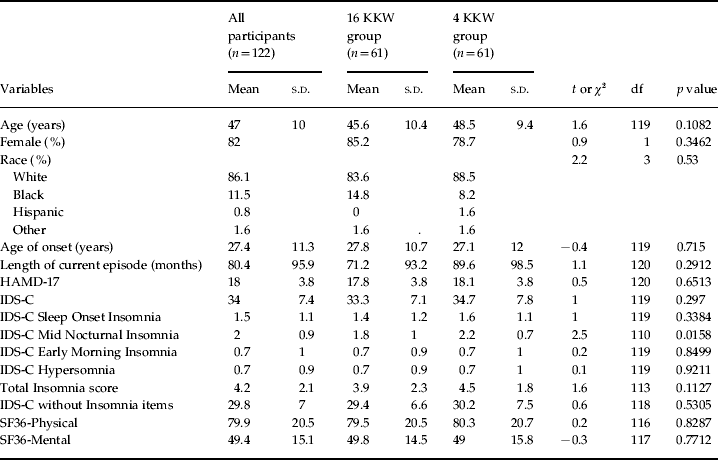
Baseline characteristics and demographic data for the sample are displayed in Table 1. There were no significant differences in depressive symptoms between the two exercise treatment groups at baseline. The two groups did differ on mid-nocturnal insomnia at baseline but did not differ on any other baseline sleep symptom.
Baseline characteristics
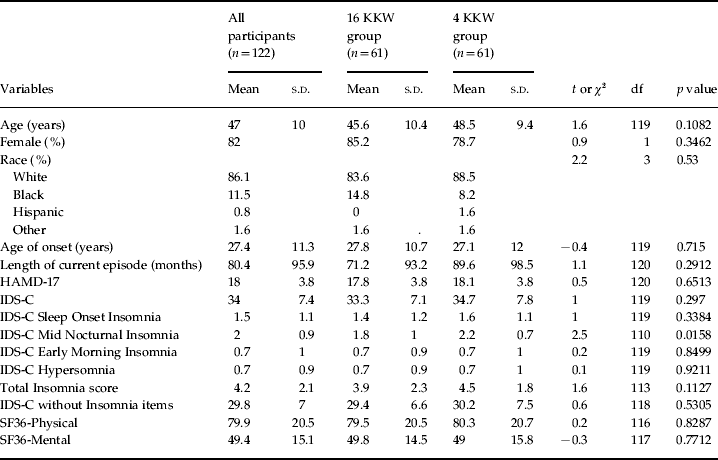
KKW, Kilocalories per kilogram of body weight per week; IDS-C, Inventory of Depressive Symptomatology clinician rated; HAMD, Hamilton Depression Rating Scale; SF-36, 36-item Short Form Health Survey; s.d., standard deviation.
Of the 122 evaluable participants, 21 (17.2%) exited the trial before completion of the 12-week intervention. However, all evaluable participants were included in the analyses. The median adherence rate was 63.8% for the 12 KKW group and 99.4% for the 4 KKW group. The median caloric expenditure in weeks 3 to 12 for the 12 KKW group was 824 kcal versus 290 kcal for the 4 KKW group. Similarly, the median exercise time was 132 min/week in the 12 KKW group compared to 60 min/week in the 4 KKW group. The median exercise intensity across the two groups was 79.5% of maximum heart rate and did not differ across the two groups.
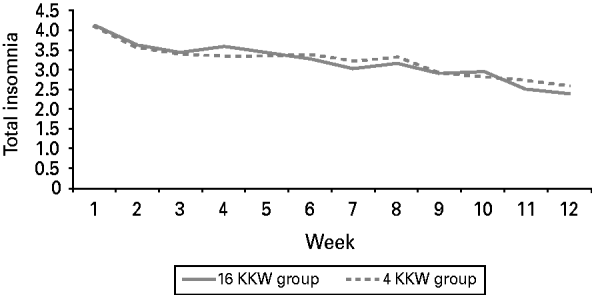
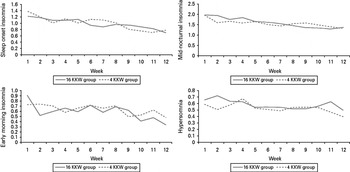
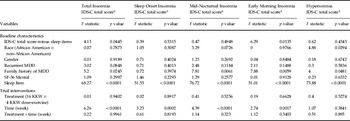
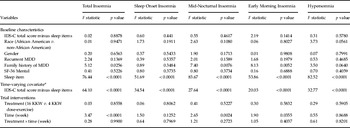
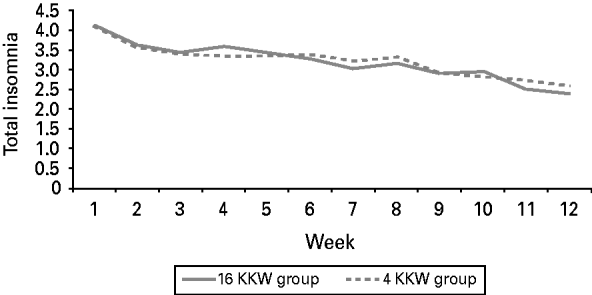
The results of the linear mixed model repeated measures analysis (with the IDS-C time-varying covariate not included) revealed a significant improvement (decrease) in total insomnia (time effect, p < 0.0001) (Fig. 1). Similarly, sleep onset insomnia, mid-nocturnal insomnia and early-morning insomnia significantly improved (decreased) during the 12 weeks of the study (p's <0.002); however, no significant differences between exercise treatment groups were observed on any sleep item (Fig. 2). Hypersomnia did not change significantly over the 12 weeks (time effect, p = 0.38). There were no significant differences between exercise treatment groups on total insomnia score or any individual sleep item (Table 2).
Plot of adjusted least squares means for total insomnia by week for each treatment group. KKW, Kilocalories per kilogram of body weight per week.
Plot of adjusted least squares means for sleep symptoms by week for each treatment group. KKW, Kilocalories per kilogram of body weight per week.

Changes in total insomnia and sleep symptoms from the linear mixed model repeated measures analysis

IDS-C, Inventory of Depressive Symptomatology clinician rated; MDD, major depressive disorder; SF-36, 36-item Short Form Health Survey; KKW, kilocalories per kilogram of body weight per week.
a Sleep items were excluded from IDS-C total score.
When the IDS-C time-varying covariate was added to the model, the effect on total insomnia remained significant (time effect, p < 0.0001), indicating that the improvement was independent of changes in other depressive symptoms. Similarly, mid-nocturnal and early-morning insomnia remained significantly improved (decreased) during the 12 weeks of the study (p's <0.035). However, the effect on sleep onset insomnia became non-significant (time effect, p = 0.12) whereas the change in hypersomnia (time effect, p = 0.86) remained non-significant over the 12 weeks. As with the previous model, there were no significant differences between exercise treatment groups on total insomnia score or on any individual sleep item (Table 3). When exercise dose (KKW) was treated as a continuous variable, no significant two-way interactions (KKW × time) emerged on change in total insomnia (parameter estimate = −0.00013, p = 0.45), sleep onset insomnia (parameter estimate = 0.00005, p = 0.59), mid-nocturnal insomnia (parameter estimate = −0.00013, p = 0.14), early-morning insomnia (parameter estimate = −0.00006, p = 0.39), and hypersomnia (parameter estimate = −0.00002, p = 0.67).
Changes in total insomnia and sleep symptoms from the linear mixed model repeated measures analysis controlling for changes in depressive symptoms

IDS-C, Inventory of Depressive Symptomatology clinician rated; MDD, major depressive disorder; SF-36, 36-item Short Form Health Survey; KKW, kilocalories per kilogram of body weight per week.
a IDS-C total score minus sleep items was a time-varying covariate across the 12-week study (weeks 1–12 ).
Linear mixed model analyses of repeated measures were conducted to examine the moderating effect of total insomnia and each sleep item (symptom) on change in depression severity across the 12-week study. Mixed models examining the three-way interaction (exercise treatment group × sleep × time) and all two-way interactions indicated no significant moderating effect of any baseline sleep item or total insomnia on change in depression severity (p's >0.05).
Linear mixed model analyses of repeated measures examined the predictor effect of baseline measures of total insomnia and each sleep item on change in depression severity across the 12-week study. The results of the analysis revealed a significant two-way baseline hypersomnia × time interaction (parameter estimate = −0.9180, p = 0.0057) on the treatment outcome of IDS-C total (with the sleep items excluded) over the 12-week exercise study, indicating that higher scores of baseline hypersomnia were related to a decrease in depression severity (IDS-C total, with the sleep items excluded) following exercise treatment (16 KKW v. 4 KKW dose-exercise) across the 12-week study. All other baseline sleep items (total insomnia, sleep onset insomnia, mid-nocturnal insomnia, and early morning insomnia) did not significantly predict the treatment outcome over the 12-week exercise intervention (p's >0.34).
Discussion
The results of this study confirm our hypothesis that self-reported sleep improves following exercise augmentation of SSRIs in individuals with non-remitted MDD. Improvements in total insomnia, and also in two insomnia symptoms (mid-nocturnal and early morning), were observed in both exercise groups following the 12-week intervention. However, there was no significant difference in changes in sleep quality between the two groups. Furthermore, the improvements in self-reported sleep quality were independent of improvements in depressive symptoms. The improvement in self-reported sleep quality in the current study suggests that exercise may have a positive effect on persistent residual symptoms of antidepressant treatment.
Our findings may have important clinical implications. First, treatment of co-occurring sleep disturbances has been shown to improve MDD treatment outcomes. A clinical trial in which patients with depression and insomnia were randomized to receive fluoxetine with either placebo or eszopiclone (Lunesta) found that those receiving eszopiclone showed improved sleep continuity and depression scores compared to the placebo group, while also demonstrating faster onset of antidepressant response (Fava et al. Reference Fava, McCall, Krystal, Wessel, Rubens, Caron, Amato and Roth2006). Similarly, augmentation of escitalopram with cognitive behavior therapy (CBT) aimed at sleep disturbances results in higher remission rates (Manber et al. Reference Manber, Edinger, Gress, San Pedro-Salcedo, Kuo and Kalista2008). With this previous research taken into account, our findings suggest that exercise augmentation could potentially improve depression treatment outcomes by improving sleep quality. Second, insomnia is a common residual symptom of SSRI treatment (Nierenberg et al. Reference Nierenberg, Keefe, Leslie, Alpert, Pava, Worthington, Rosenbaum and Fava1999; Iovieno et al. Reference Iovieno, van Nieuwenhuizen, Clain, Baer and Nierenberg2011; McClintock et al. Reference McClintock, Husain, Wisniewski, Nierenberg, Stewart, Trivedi, Cook, Morris, Warden and Rush2011) and is associated with an increased risk of recurrence of a depressive episode in patients treated with SSRIs (Fava et al. Reference Fava, Grandi, Canestrari and Molnar1990; Perlis et al. Reference Perlis, Giles, Buysse, Tu and Kupfer1997; Riemann & Voderholzer, Reference Riemann and Voderholzer2003; Dombrovski et al. Reference Dombrovski, Cyranowski, Mulsant, Houck, Buysse, Andreescu, Thase, Mallinger and Frank2008; Nierenberg et al. Reference Nierenberg, Husain, Trivedi, Fava, Warden, Wisniewski, Miyahara and Rush2009). Our findings would suggest that exercise augmentation of SSRI treatment might prevent the recurrence of depression by reducing a known risk factor for relapse. Third, although not the focus of the current hypotheses, our analysis indicated that family history of MDD predicted sleep quality following the 12-week intervention. Similarly, we found family history to be a moderator of change in depressive symptoms following the exercise intervention (Trivedi et al. Reference Trivedi, Greer, Church, Carmody, Grannemann, Galper, Dunn, Earnest, Sunderajan and Henley2011). This suggests that family history may be an important factor in predicting treatment response in MDD.
Our results are congruent with past research demonstrating improvements in sleep quality following an exercise intervention (King et al. Reference King, Oman, Brassington, Bliwise and Haskell1997, Reference King, Pruitt, Woo, Castro, Ahn, Vitiello, Woodward and Bliwise2008; Singh et al. Reference Singh, Clements and Singh2001, Reference Singh, Stavrinos, Scarbek, Galambos, Liber and Fiatarone Singh2005; Buman et al. Reference Buman, Hekler, Bliwise and King2011). However, this is the first study to examine the effects of exercise as an augmentation to SSRI treatment in patients with MDD who had insufficient improvement on SSRI alone. Of note, although the high-dose exercise was associated with higher adjusted remission rates (Trivedi et al. Reference Trivedi, Greer, Church, Carmody, Grannemann, Galper, Dunn, Earnest, Sunderajan and Henley2011), there were no significant differences in sleep quality improvement between the two exercise treatment groups.
This is contrary to previous research that reported greater improvements in self-reported sleep quality with high-intensity exercise compared to low-intensity exercise in a sample of depressed older adults (Singh et al. Reference Singh, Stavrinos, Scarbek, Galambos, Liber and Fiatarone Singh2005). Several differences in study design may explain these conflicting findings. First, Singh et al. (Reference Singh, Stavrinos, Scarbek, Galambos, Liber and Fiatarone Singh2005) enrolled participants who were not currently receiving treatment for MDD, whereas the current study enrolled participants who had received at least 8 weeks of SSRI treatment. This might suggest that even a small dose of exercise augmentation is effective in improving sleep quality in this population whereas a greater dose of exercise is necessary to improve sleep quality when exercise is used as a monotherapy. Second, participants in our study engaged in aerobic exercise whereas participants in the Singh et al. trial engaged in resistance training. Third, in the Singh et al. (Reference Singh, Stavrinos, Scarbek, Galambos, Liber and Fiatarone Singh2005) trial, the two treatment groups engaged in the same duration of exercise at different intensities (80% of maximum versus 20% of maximum). In our study, the treatment groups exercised at a self-selected intensity for different durations.
Finally, we examined the moderator and predictor effects of baseline sleep quality on changes in depressive symptoms following the exercise intervention. Baseline sleep disturbances have been associated with poorer treatment outcomes for both antidepressant medications (Kupfer et al. Reference Kupfer, Spiker, Coble, Neil, Ulrich and Shaw1981) and psychotherapy (Buysse et al. Reference Buysse, Kupfer, Frank, Monk, Ritenour and Ehlers1992). The results of our analysis show that baseline sleep quality did not moderate the treatment effect of exercise augmentation on depression severity across the 12-week study. This may indicate that exercise is effective in reducing depressive symptoms regardless of baseline sleep disturbances, even in those patients who typically have poorer treatment response. Conversely, this finding may be the result of our examination of an augmentative treatment, whereas previous research has examined the moderating effect of sleep during initial treatment.
We did, however, observe a significant predictor effect for baseline hypersomnia, by which higher levels of baseline hypersomnia were associated with greater decreases in depressive symptoms following the exercise intervention. This is a particularly intriguing finding given that hypersomnia is a symptom most often associated with atypical depression. Atypical depressive symptoms include hypersomnia, interpersonal sensitivity, leaden paralysis, increased appetite and/or weight, and phobic anxiety. Differential treatment response has been observed in patients with atypical features, with better treatment response to monoamine oxidase inhibitors (MAOIs) compared to tricyclic antidepressants (TCAs). However, significant side-effects might limit MAOI effectiveness. More-tolerable SSRIs have not been studied extensively in atypical depression (Nierenberg et al. Reference Nierenberg, Alpert, Pava, Rosenbaum and Fava1998; Henkel et al. Reference Henkel, Mergl, Allgaier, Kohnen, Möller and Hegerl2006; Pae et al. Reference Pae, Tharwani, Marks, Masand and Patkar2009), although participants with atypical depression treated with citalopram in the STAR*D trial had longer times to remission and lower remission rates (Stewart et al. Reference Stewart, McGrath, Fava, Wisniewski, Zisook, Cook, Nierenberg, Trivedi, Balasubramani, Warden, Lesser and John Rush2010). Our results suggest that exercise augmentation may improve treatment efficacy of SSRIs in patients with atypical depression.
Although our findings indicate that sleep quality improves following exercise in patients with non-remitted MDD, the current study does have limitations that highlight the need for further investigation. First, our study compared two doses of aerobic exercise and did not use a traditional control group. The use of a low-dose aerobic exercise group was meant to provide a dose of exercise shown not to affect depressive symptoms in treatment-naive MDD patients (Dunn et al. Reference Dunn, Trivedi, Kampert, Clark and Chambliss2005), while providing control for the attention received by the high-dose group. However, no significant differences in changes in sleep quality were observed between the two groups. Although this might suggest that even a small dose of exercise can be efficacious when used as augmentative treatment, future trials with a control group are needed to confirm this finding. Second, this study assessed sleep quality using four items from the IDS-C. Although not designed to specifically assess sleep quality, the IDS-C is a valid assessment of depressive symptom severity, including sleep disturbances (Rush et al. Reference Rush, Gullion, Basco, Jarrett and Trivedi1996, Reference Rush, Trivedi, Ibrahim, Carmody, Arnow, Klein, Markowitz, Ninan, Kornstein, Manber, Thase, Kocsis and Keller2003, Reference Rush, Bernstein, Trivedi, Carmody, Wisniewski, Mundt, Shores-Wilson, Biggs, Woo, Nierenberg and Fava2006; Trivedi et al. Reference Trivedi, Rush, Ibrahim, Carmody, Biggs, Suppes, Crismon, Shores-Wilson, Toprac, Dennehy, Witte and Kashner2004; Bernstein et al. Reference Bernstein, Rush, Stegman, Macleod, Witte and Trivedi2010). Furthermore, residual symptoms, as assessed by the IDS, are predictive of recurrence of a depressive episode (Nierenberg et al. Reference Nierenberg, Husain, Trivedi, Fava, Warden, Wisniewski, Miyahara and Rush2009). Future work should use an independent assessment of subjective sleep quality and objective measures of sleep to control for expectancy effects observed through self-report sleep data. We also did not exclude participants with known sleep difficulties, such as sleep apnea. Inclusion of these participants may have influenced our results. Finally, we did not have data on sleep quality at the onset of SSRI treatment, which would have allowed for characterization of sleep symptoms at initiation of augmentation as either residual or treatment emergent symptoms.
The impact of sleep disturbances on treatment outcomes (Kupfer et al. Reference Kupfer, Spiker, Coble, Neil, Ulrich and Shaw1981; Buysse et al. Reference Buysse, Kupfer, Frank, Monk, Ritenour and Ehlers1992), the prevalence of persistent residual sleep deficits following treatment (Nierenberg et al. Reference Nierenberg, Keefe, Leslie, Alpert, Pava, Worthington, Rosenbaum and Fava1999; Iovieno et al. Reference Iovieno, van Nieuwenhuizen, Clain, Baer and Nierenberg2011; McClintock et al. Reference McClintock, Husain, Wisniewski, Nierenberg, Stewart, Trivedi, Cook, Morris, Warden and Rush2011) and the associated risk of MDD recurrence (Perlis et al. Reference Perlis, Giles, Buysse, Tu and Kupfer1997; Nierenberg et al. Reference Nierenberg, Keefe, Leslie, Alpert, Pava, Worthington, Rosenbaum and Fava1999; Dombrovski et al. Reference Dombrovski, Cyranowski, Mulsant, Houck, Buysse, Andreescu, Thase, Mallinger and Frank2008) highlight the need for depression treatments that improve sleep quality. The results of the current study indicate that sleep quality improves following exercise augmentation in patients with non-remitted MDD. These findings add to the established literature supporting the use of exercise in the treatment of MDD (Rethorst et al. Reference Rethorst, Wipfli and Landers2009). Furthermore, our findings suggest that exercise may be effective in the prevention of MDD recurrence and indicate the need for future research examining the role of exercise in the prevention of MDD recurrence.
Acknowledgments
This work was supported by the National Institute for Mental Health (NIMH 1-R01-MH067692-01; PI: M.H.T.) and in part by a National Alliance for Research on Schizophrenia and Depression (NARSAD) Independent Investigator Award (M.H.T.), Young Investigator Awards (T.L.G.).
Clinical Trials Registration: Adding Exercise to Antidepressant Medication Treatment for Depression. Official Title: Treatment With Exercise Augmentation for Depression (TREAD). Registration identification number: NCT00076258. URL for the registry: www.clinicaltrials.gov/ct2/show/NCT00076258?term=TREAD&rank=2.
Declaration of Interest
M. H. Trivedi reports that he has received research support from the Agency for Healthcare Research and Quality (AHRQ), Corcept Therapeutics, Inc., Cyberonics, Inc., Merck, NARSAD, the NIMH, National Institute on Drug Abuse, Naurex, Novartis, Pharmacia & Upjohn, Predix Pharmaceuticals (Epix), Solvay Pharmaceuticals, Inc., Targacept, and Valient. He has received consulting and speaker fees from Abbott Laboratories, Inc., Abdi Ibrahim, Akzo (Organon Pharmaceuticals Inc.), Alkermes, AstraZeneca, Bristol-Myers Squibb Company, Cephalon, Inc., Evotec, Fabre Kramer Pharmaceuticals, Inc., Forest Pharmaceuticals, GlaxoSmithKline, Janssen Pharmaceutica Products, Libby, LP, Johnson & Johnson PRD, Eli Lilly & Company, Meade Johnson, Medtronic, Neuronetics, Otsuka Pharmaceuticals, Parke-Davis Pharmaceuticals, Inc., Pfizer Inc., Sepracor, SHIRE Development, Sierra, Tal Medical/Puretech, Transcept, VantagePoint, and Wyeth-Ayerst Laboratories. T. L. Greer has received grant/research support from NARSAD and the NIMH. T. J. Carmody has been a consultant for Cyberonics.