Implications
Early weaning can be used in beef cattle to improve reproductive rates, but may provoke a strong stress response in cows, as the bond with its calf is still strong. Two-step weaning with nose flaps attenuates the typical stress behaviour response in cows, which includes increased vocalizations and activity and reduced grazing. This management technique may be advantageous compared with conventional, abrupt early weaning as it reduces the stress response of cows and thus improve cows’ welfare, and through the reduction of pacing and walking it may reduce negative effects on pasture quality and consequently may improve soil conservation.
Introduction
Prolonged postpartum anoestrous in suckled beef cows is one of the main restrictions to obtain one calf per year. According to Short et al. (Reference Short, Bellows, Staigmiller, Berardinelli and Custer1990) prolonged sucking, nutritional deficiencies, in addition to climatic stress, parity, time of the year and management practices are determinants of the long calving interval. Considering the current demand for ‘green, clean and ethical’ products (Martin et al., Reference Martin, Milton, Davidson, Hunzicker, Lindsay and Blache2004), the development of hormone-free management systems for animal breeding is required. In this context, suckling managements can be used to stimulate ovulation and consequently early pregnancy rate in beef cows (Quintans et al., Reference Quintans, Vazquez and Weigel2009 and Reference Quintans, Banchero, Carriquiry, Lopez-Mazz and Baldi2010). In extensive grazing systems in which cows usually have a low body condition after calving due to the high dependence on native pastures, early weaning has been developed as an alternative that provided good results to farmers by advancing postpartum rebreeding and increasing pregnancy rates (Williams, Reference Williams1990; Arthington and Kaimbacher, Reference Arthington and Kaimbacher2003; de Castro et al., Reference de Castro, Ibarra, Valdez, Rodriguez, Benquet, Lagos and Rubianes2006; Vaz and Lobato, Reference Vaz and Lobato2010).
Weaning elicits a stress response in both cows (Lefcourt and Elsasser, Reference Lefcourt and Elsasser1995; Haley, Reference Haley2006; Lynch et al., Reference Lynch, Earley, McGee and Doyle2010a) and calves (Blanco et al., Reference Blanco, Casasus and Palacio2009; Lynch et al., Reference Lynch, Earley, McGee and Doyle2010b and Reference Lynch, McGee, Doyle and Earley2012), thus reducing their welfare. For example, cows begin pacing and vocalizing immediately after their calves are weaned, showing that it is a stressful event for them (Ungerfeld et al., Reference Ungerfeld, Hötzel, Scarsi and Quintans2011 and Reference Ungerfeld, Hötzel and Quintans2015). Moreover, some authors consider weaning as the greatest stressor in the life of beef cattle (Stookey and Watts, Reference Stookey and Watts2007). The time during which cows pace and vocalize after traditional weaning (5 to 6 months after parturition) is strikingly high (Ungerfeld et al., Reference Ungerfeld, Hötzel, Scarsi and Quintans2011 and Reference Ungerfeld, Hötzel and Quintans2015), which indicates stress and also may affect the soil and pasture quality. This problem would be even greater when calves are early weaned, since shortly after birth (~2 months) the cow–calf bond is strongest (see review by (Enríquez et al., Reference Enríquez, Hötzel and Ungerfeld2011)).
The stress response of both the cow and the calf may be minimized with management strategies that separate the moment of the end of sucking from the total and permanent physical separation of the calf–dam pair (two-step weaning). This may be done using nose flaps that prevent the calf from sucking (Haley et al., Reference Haley, Bailey and Stookey2005), thereby separating the end of the access to the udder and milk ingestion from the physical separation from the dam. When it is applied in association with traditional weaning (usually when the calf is between 5 and 6 months old), this weaning method reduces the behavioural stress response of the cow (Ungerfeld et al., Reference Ungerfeld, Hötzel and Quintans2015) and the calf (Enríquez et al., Reference Enríquez, Ungerfeld, Quintans, Guidoni and Hötzel2010). It is thus possible that this method could also attenuate the response at early weaning. The objective of this experiment was to compare the behavioural response and change in weight gain of cows when calves were weaned early (~60 days postpartum), either abruptly or with two-step weaning with nose flaps, with that of cows still nursing calves.
Material and methods
Location, animals and management
This experiment was carried out at the Unidad Experimental Palo a Pique of the Instituto Nacional de Investigación Agropecuaria (INIA), Treinta y Tres, Uruguay (33° S, 56° W) during May (autumn). The experiment was conducted in accordance with the Experimental Unit Directives concerning the use of animals for experimentation.
Thirty-six crossbred multiparous Aberdeen Angus×Hereford cows and their calves were managed together on native pastures. At the beginning of the experiment, cows weighed 436±5 kg (mean±SEM), had a body condition of 4.7±0.1 (on a scale from one to eight; Vizcarra et al., Reference Vizcarra, Ibañez and Orcasberro1986) and had 58.2±1.8 days postpartum.
The animals were assigned to one of three experimental groups of 12 dyads each, similar in BW, postpartum time and calves’ male : female ratio (six to seven from each sex in each group). The animals were allocated in three 6-ha paddocks with similar pasture availability. In each paddock there were four dyads from each treatment, thus, 12 dyads/paddock. This was done to reduce the potential of factors associated to the paddock or group confounding the effects of treatment. Cows and calves were weighed (Tru-Test Limited, Auckland, New Zealand; precision of 0.1 kg) on days −10, 0, 6, 13 and 43.
Treatment groups and experimental periods
On day 0 of the experiment, the calves assigned to the nose flap treatment (NF group, 12 cow-calf pairs) were fitted with anti-sucking nose-flap devices made of flexible plastic, measuring 12.5×12.5 cm (El Destete, Buenos Aires, Argentina; see picture in Enríquez et al., Reference Enríquez, Ungerfeld, Quintans, Guidoni and Hötzel2010). Nose-flaps prevent the calves from accessing the teats but allow them to graze, consume ration, drink water and allow the calves to remain near their dams (Hötzel et al., Reference Hötzel, Quintans and Ungerfeld2012). Nose flaps are left usually left in place between 7 and 28 days (Alvez et al., Reference Alvez, Quintans, Hötzel and Ungerfeld2016). However, in early weaned calves the duration of the use of the nose flaps may be shorter, so calves are not prevented access to the udder so long before being separated from the dam. On the morning of the 6th day, nose flaps were removed, and calves were relocated to a different paddock more than 1000 m away. A second group of cow–calf pairs (AS group, n=12) were abruptly and permanently separated on day 5, and the calves were moved together with those from the NF group. A third group of cow–calf pairs remained together throughout the experiment as non-weaned controls (NW group, n=12).
Behaviour recordings
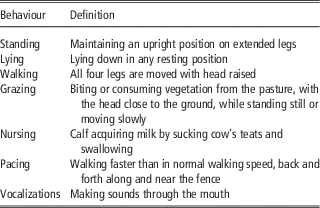
Behaviours of individual cows were recorded as reported by Enríquez et al. (Reference Enríquez, Ungerfeld, Quintans, Guidoni and Hötzel2010), using direct, visual instantaneous sampling, at 10 min intervals. The cows were tagged and large numbers were painted on both sides of the body. Data were recorded 50 times/day, during two observation periods, from 0800 to 1200 h and 1400 to 1800 h. Recordings were carried out daily from day −3 to day 11 (except on days 0 and 6 due to the management of the animals, and on days 3 and 9 due to strong rains). In each scan the following cow behaviours were recorded for each cow: standing, walking, lying, grazing, nursing and pacing. Vocalizations were recorded as in previous studies (Enríquez et al. Reference Enríquez, Ungerfeld, Quintans, Guidoni and Hötzel2010; Ungerfeld et al., Reference Ungerfeld, Hötzel, Scarsi and Quintans2011), for a 30 s period every 10 min, using zero/one sampling (Lehner, 1996). At the end of each 30-s period each cow was assigned either a 1 (if it had vocalized) or a 0 (if it had not vocalized). All the behaviours are defined in Table 1.
List of cow behaviours observed and their respective definitions

Data analysis
BW and frequency of the behaviours of the cows in the three treatments were compared with Proc Mixed (SAS 2003; SAS Institute, Cary, NC, USA). The model considered the treatment (NF, AS or NW) and the time, as well as the interaction between treatments and time as fixed effects, and the cow into each treatment as a random effect. Frequencies for each behaviour were transformed to the percentage of observations in which each event was recorded for comparisons. A mean value was calculated for data from the 3 days before the application of nose flaps and used for the analysis (BN). When fixed effects were significant, post hoc comparisons were done with least significant difference. Differences were considered significant when P<0.05.
Results
Behaviours
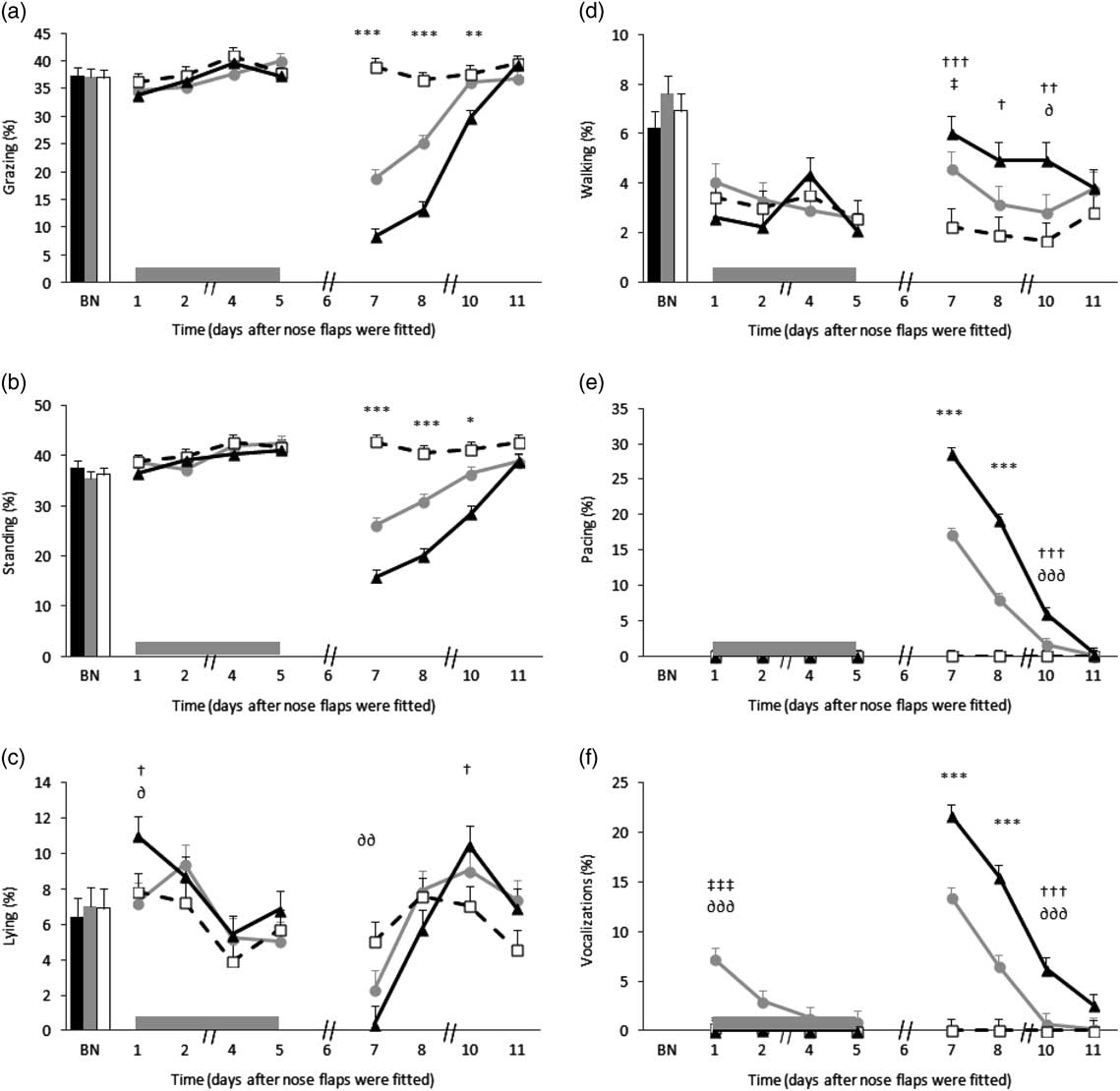
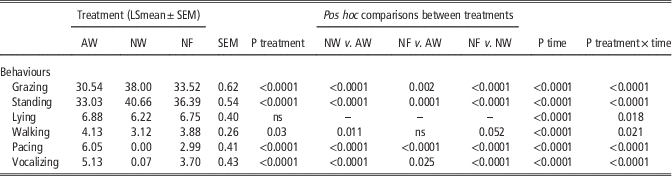
All the behaviours varied with time, and all except lying were affected by treatments (Table 2). In all the recorded behaviours there were interactions between treatment and time (Table 2). On the 3 days following permanent separation, NW cows were observed grazing and standing more frequently than NF cows, which also were observed engaged in these same behaviour patterns more frequently than AS cows (Figure 1a and b). On day 11, NW cows tended to stand more frequently than NF (P=0.067) and AS cows (P=0.074).
Frequency of observations of (a) grazing, (b) standing, (c) lying, (d) walking, (e) pacing and (f) vocalizing in cows before and after a two-step weaning process with nose flaps (NF;  ), weaned by abrupt separation (AW, weaned on day 14;
 ) or not weaned (NW;
 ). BN=mean value from the 3 days before application of nose flaps. The grey area indicates the period during which the NF calves remained with the cow, with the nose flaps fitted; the discontinuous arrow indicates definitive separation from the cow of NF and AW calves. Data are the mean frequency±SEM. Asterisks indicate significant differences between the three treatments at the same time point (*P<0.05; **P<0.01; ***P<0.001); other symbols indicate differences between two groups (†AW v. NW; ‡NF v. NW; ∂NF v. AW; one symbol: P<0.05; two symbols: P<0.01; three symbols: P<0.001).

Effects of treatments, time and interaction of treatment and time in the percentage of recordings in which cows were observed performing the different behaviours before and after a two-step calf weaning process with nose flaps (NF), abruptly separated (AW) or not weaned (NW)

AW=cow–calf pairs were abruptly and permanently separated on day 5; NW=cow–calf pairs remained together throughout the experiment as non-weaned controls; NF=calves were fitted with anti-sucking nose-flap devices on day 0 and and permanently separated from the cow on day 5; P = probability.
On day 1, AS cows were observed lying more frequently than NW and NF cows (P<0.05; Figure 1c). On day 7, AS cows were not observed lying, which was significantly different than for NW cows (P<0.01); on the same day, NW cows tended to be observed lying more frequently than NF cows (P=0.074). However, a rebound effect was observed, as 2 days later AS cows were observed lying more frequently than NW cows (day 10; P<0.05). On day 11 NF cows tended to lie more frequently than NW cows (P=0.065). After weaning, on days 7 and 10, AS cows were observed walking more frequently than NW cows (P<0.001, <0.05 and <0.01, respectively), and on day 10 also more frequently than NF cows (P<0.05; Figure 1d). On day 7 NF cows walked more than NW cows (P<0.05), and on day 8 NF cows tended to walk more than AS cows (P=0.08). On days 7 and 8, AS cows paced more than NF cows, and NF cows more than NW cows (P<0.0001 for all, Figure 1e). On day 10 AS cows also paced more than NF and NW cows (P<0.0001 for both) with no difference between these two groups. While NF cows vocalized on day 1 – immediately after nose flaps had been placed – the cows of the two other treatments did not vocalized (P<0.0001 for comparisons with both treatments, Figure 1f). Also, on day 2, NF cows tended to vocalize more than NW (P=0.08) and AS (P=0.06). AS cows vocalized more than NF cows, and NF cows more than NW cows (P<0.0001 for all, Figure 1f). On day 10 AS cows also vocalized more than NF and NW cows (P<0.0001 for both) without difference between these two groups. On day 11 AS cows tended to vocalize more than NW cows (P=0.1).
Cows’ BW
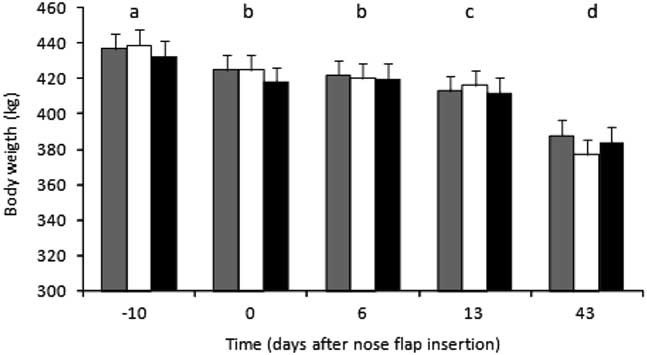
BW was affected by day (P<0.0001), but not affected by treatment, and there was no interaction between treatment and day (Figure 2). BW decreased with time, being greater on day −10 than 0 (P<0.0001), decreased again from day 0 to day 13 (P=0.03) and from day 13 to day 43 (P<0.0001).
BW (mean±SEM) of cows during a two-step calf weaning with nose flaps (NF; nose flaps from days 0 to 5 and then separation; grey bars), abruptly weaned (AW; weaned on day 5; black bars) or not weaned (NW; white bars).

Discussion
Our results clearly demonstrate that step weaning strongly benefits cows when calves are weaned earlier, as in this study; this weaning method reduced the typical behaviours indicative of stress observed in cows at weaning (Ungerfeld et al., Reference Ungerfeld, Hötzel, Scarsi and Quintans2011 and Reference Ungerfeld, Hötzel and Quintans2015). Also the overall reduction of the stress response in cows obtained with the use of nose flaps after permanent separation from the calves seems to be greater than that previously reported when the same treatment was used before traditional weaning, at 6 to 8 months of age (Ungerfeld et al., Reference Ungerfeld, Hötzel and Quintans2015). This demonstrates the effectiveness of the two-step weaning method to reduce stress and thus improve cows’ welfare when cows and calves are separated when their bond is still very strong.
Apart from the reduction in the behaviour response when calves were permanently separated from the cows, few changes in behaviour were observed in the cows after their calves were fitted with the nose flaps. In calves, step weaning with nose flaps gives rise to different behavioural responses in the two periods – the first after the insertion of nose flaps, and the second after permanent separation (Enríquez et al., Reference Enríquez, Ungerfeld, Quintans, Guidoni and Hötzel2010; Hötzel et al., Reference Hötzel, Quintans and Ungerfeld2012). This, however, does not seem to be the case in cows, in which the only response observed after fitting the nose flaps was a small, short-lived increase in vocalizations. As reviewed by others (Watts and Stookey, Reference Watts and Stookey2000; Weary et al., Reference Weary, Jasper and Hötzel2008) vocalizations occur in cattle in the context of maternal care, and also may signal pain or distress. Thus, the vocalizations observed after the nose flaps were fitted to the calves may reflect a response to the increase in udder pressure because calves were prevented from sucking (Ungerfeld et al., Reference Ungerfeld, Hötzel, Scarsi and Quintans2011), or may be a response to the calls of the calves, which have been shown to vocalize in the first days after nose flaps are fitted (Enríquez et al., Reference Enríquez, Ungerfeld, Quintans, Guidoni and Hötzel2010; Hötzel et al., Reference Hötzel, Quintans and Ungerfeld2012). Overall our results indicate that in cows the method produced a true reduction in the post weaning stress response.
Compared to the response of abruptly weaned cows, step weaning decreased behaviours such as pacing, walking and vocalizing, and produced a minor decrease in the time grazing, resting or even standing. Although it was not measured in this study, this may imply a decrease of the energetic cost for the cow with the step weaning method. However, this difference was not reflected in the BW, as the weight loss observed throughout the study was similar in all the groups. This may be related with the time of the year when the study was performed (autumn), a period when native pasture quantity and quality decrease, as winter approaches. Therefore, the decrease of BW observed in all groups may be enough to mask any differences attributable to different weaning methods. Another possible explanation for the lack of differences is the short period of evaluation of BW. In any case, it remains to be tested if the BW of cows is maintained when calves are early weaned with the two steps method while having access to greater availabilities of food. Although not quantified in this study, the shorter time dedicated to walking and pacing in NF cows may have the additional advantage of preventing damage caused to soil and pasture quality in the paddocks, as cows pace on the edge of fences when they are separated from the calves, a behaviour reported in other studies covering the behaviour of cows at weaning (Ungerfeld et al., Reference Ungerfeld, Hötzel, Scarsi and Quintans2011 and Reference Ungerfeld, Hötzel and Quintans2015).
As early weaning is done with the objective of advancing the first ovulation in postpartum cows under range conditions (Parfet et al., Reference Parfet, Marvin, Allrich, Diekman and Moss1986; Quintans et al., Reference Quintans, Vazquez and Weigel2009; Vaz and Lobato, Reference Vaz and Lobato2010), the reduction of cows’ stress may contribute positively to reproductive outcomes. Our results showing minimal behavioural responses indicative of stress responses in the cows when the calves were prevented from sucking with the nose flaps may also be relevant for those using temporary sucking restriction regimes to induce ovulation in postpartum cows, as in some cases these involve preventing calves of the same age as in this study from sucking for a short period of time (e.g. Quintans et al., Reference Quintans, Vazquez and Weigel2009; de Castro et al., Reference de Castro, Ibarra, Rodriguez, Valdez, Benquet and Rubianes2011).
The ethical assessment of any animal management practice requires consideration of all its animal welfare, economic, environmental and social implications. The main goal of early weaning in pasture based beef operations is to improve reproduction rates in the herd (Quintans et al., Reference Quintans, Vazquez and Weigel2009), which positively contributes to the economic and environmental sustainability of the production system. However, there is extensive evidence that early weaning is detrimental to the young (see review by Newberry and Swanson, Reference Newberry and Swanson2008). In the case of beef calves, in addition to the separation from the mother, the animal welfare impact of early weaning hinges heavily on an adequate nutrient supply in the postweaning period (see Enríquez et al., Reference Enríquez, Hötzel and Ungerfeld2011), which may be hard to ensure in pasture-based systems, particularly when the pasture condition is suboptimal for ovulation in the cows. The present study contributes information on the cows’ welfare that may be useful for those making these kinds of ethical decisions.
Overall, these results support the use of two-step weaning with nose flaps before permanent separation in early-weaned beef calves as a way to reduce all the behaviours indicative of stress observed in cows after separation of their calves.
Acknowledgements
Authors acknowledge Fernanda Nin, Damián Pérez, Luciana Varela, Rosalía Morales and Santiago Machado for their help in data recording. M.J. Hötzel acknowledges the fellowship funded by CNPq, Brazil (PQ 304123/2012–9).