Introduction
Trichotillomania (TTM) and skin picking disorder (SPD) are characterized by repeated pulling out of hair resulting in hair loss or picking at skin resulting in tissue damage, respectively. These disorders have been conceptualized under the larger umbrella concept of body-focused repetitive behavior (BFRB) disorders. Despite decades of research, effective treatments for BFRBs remain elusive.Reference Rothbart, Amos and Siegfried 1 -Reference Snorrason, Berlin and Lee 2 One issue that has thwarted treatment development for BFRBs is the lack of any clear pathophysiological targets (multiple brain areas and circuits have been examined in small studies and oftentimes conflicting studies.Reference Swedo, Rapoport, Leonard, Schapiro, Rapoport and Grady 3 -Reference Wabnegger and Schienle 18)
In the related area of obsessive–compulsive disorder (OCD), recent research suggests that subtypes of OCD may in fact have partially distinct biological underpinnings. Using magnetic resonance imaging (MRI) in 37 OCD patients and 37 matched controls, Okada et al found significant negative correlations between symptomatic dimension scores and regional gray matter (GM) volumes such as decreased right cerebellum in “aggression/checking” and decreased right insula in “contamination/washing.”Reference Okada, Nakao and Sanematsu 19 In another study, this time using a different approach to subtyping in OCD, Subirà et alReference Subirà, Alonso and Segalàs 20 examined the structural biology using a two-group classification of OCD, in 95 people with OCD and 95 controls. They found that in comparison with the autogenous group, reactive patients showed larger gray matter volumes in the right Rolandic operculum. When compared with healthy controls, reactive patients showed larger volumes in the putamen (bilaterally), whereas autogenous patients showed a smaller left anterior temporal lobe. What becomes clear from this limited research is that if one is to find meaningful biological differences in subtypes of a disorder, that those subtypes should be well established.
Toward that end, we recently completed the largest and most comprehensive multisite phenomenological study of BFRBs.Reference Grant, Peris and Ricketts 21 Using multiple clinical and cognitive measures and advanced statistical methodology, we found evidence for three subtypes of TTM with unique clinical presentations: one subtype referred to as “sensory sensitive pullers” characterized by highly focused pulling, but infrequent and low intensity urges to pull; another referred to as “low awareness pullers” characterized by automatic pulling and pulling due to emotional triggers; and a final subtype of “impulsive/perfectionist pullers” who pull to control unpleasant feelings and feel unable to resist their pulling. In terms of SPD, we identified two potential subtypes: “emotional/reward pickers” with strong and frequent urges to pick, picking from negative emotions as well as automatic picking, and reporting little control; and a second subtype of “functional pickers” who have fairly mild SPD, lower urges to pick, and overall little distress or impact from the picking.Reference Grant, Peris and Ricketts 21
Although our recent research allows for greater understanding of the clinical heterogeneity of these disorders, a similar understanding of the neurobiology of BFRBs remains limited. Therefore, if the clinical subtypes are potentially meaningful, it would require that there be an identifiable neurobiology of the subtypes. Thus, the objective of this study was to examine brain structure across the subtypes of TTM and SPD to determine if the clinical subtyping reflected unique biological underpinnings.
Methods
Participants included 251 adults recruited from the community and identified as having either a BFRB (meeting DSM-5 criteria for TTM, SPD, or both as their primary psychiatric problem) or being a healthy control. Four sites were involved in recruitment: the University of Chicago, University of California, Los Angeles, Massachusetts General Hospital/Harvard Medical School, and Stellenbosch University. Recruitment started in October 2017 and ended in March 2019.
Inclusion criteria for the clinical sample were: (a) DSM-5 diagnosis of TTM and/or SPD; (b) aged 18 to 65 years; (c) fluency in English; and (d) capable of providing informed consent. Inclusion criteria for the healthy controls were the same except they could have no current or lifetime history of any DSM-5 psychiatric disorder based on screening (see below).
Exclusion criteria for the clinical sample and healthy controls were: (a) current or lifetime diagnosis of any serious medical or psychiatric illness that would preclude successful study participation, based on screening; (b) neurological conditions that would preclude completion of neurocognitive tasks; (c) use of psychotropic medications unless the dose had been stable for at least the past 3 months; (d) change in frequency or type of psychotherapy for at least the past 3 months; (e) body metal other than dental fillings (assessed using a neuroimaging screening form); (f) positive pregnancy test for females of childbearing age; and (g) medical condition or other factor that would interfere in the subject’s ability to participate in the study.
Procedures
Potential participants were screened by the study site coordinator, who then scheduled an interview date. After receiving a complete description of the study, participants provided written informed consent. Participants received a cash incentive for participation to reimburse them for their time and transport costs. The authors assert that all procedures contributing to this work complied with the ethical standards of the relevant national and institutional committees on human experimentation and with the Helsinki Declaration of 1975, as revised in 2008. All procedures involving human subjects were approved by the Institutional Review Boards at each of the participating universities. Data sharing agreements were arranged across all sites.
Assessments
All participants completed a comprehensive diagnostic interview (Mini International Neuropsychiatric Interview 7.0)Reference Sheehan, Lecrubier and Sheehan 22; BFRB diagnostic modules and symptom severity scales; and self-report questionnaires regarding BFRB symptoms, general psychopathology, quality of life, and family environment. A detailed list of the assessments is provided in an earlier publication.Reference Grant, Peris and Ricketts 21
MRI neuroimaging
All participants were asked to complete an “MR Screening Form” to rule out any conditions that preclude MR scanning. We used a multisite neuroimaging design involving participants across four sites: (a) MRI Research Center at the University of Chicago; (b) Massachusetts General Hospital Martinos Center for Biomedical Imaging; (c) Staglin Center for Cognitive Neuroscience at the UCLA Semel Institute for Neuroscience and Human Behavior, and (d) the Cape Universities Body Imaging Centre, Cape Town. As described above, participants were screened for scanner compatibility at the outset, and we scanned eligible participants sequentially. Imaging was performed on a 3-Tesla MRI scanner at all four sites with all scanners synchronized via TTL pulse. In addition, a set of parameters compatible with all scanners, particularly those directly affecting image contrast or signal-to-noise, were devised and held constant across sites. Another quality control procedure which was implemented at each site was using a phantom scan to provide information about geometric distortions and signal uniformity related to hardware differences in radiofrequency coils and gradient systems, image contrast, and temporal stability. Each MRI scanning session lasted no more than 75 minutes. We first acquired high-resolution, anatomical images, typically about 15 minutes.
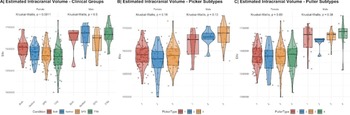
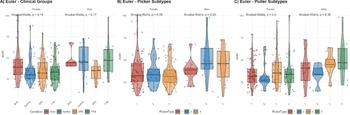
Structural T1-weighted Magnetization Prepared Rapid Acquisition Gradient Echo (MPRAGE) data for 251 adult subjects were preprocessed with Freesurfer (v6.0.1).Reference Fischl, van der Kouwe and Destrieux 23 Recon-all reconstruction included bias field correction, registration to stereotaxic space, intensity normalization, skull stripping, and white matter segmentation. Freesurfer’s qcache option was used to obtain fsaverage maps at different full width at half maximum Gaussian smoothing kernels for postprocessing and statistical analyses. Quality control to explore potential group differences in quality or known confounders included the extraction of the Euler index,Reference Rosen, Roalf and Ruparel 24 a proxy for the quality of the image reconstruction, and an assessment of potential group differences in total intracranial volume (Figure 1). Quality control revealed no systematic differences in reconstruction quality (Figure 2), and small but significant systematic group differences in the female clinical groups for total brain volume. Thus, any subsequent analyses included total intracranial volume as a covariate.
Intracranial volumes estimates across subtypes of trichotillomania and skin picking disorder.

Examination of image quality across subtypes of trichotillomania and skin picking disorder.

Subject morphometric maps for volume, thickness, and surface area were all registered to fsaverage space using the mris_preproc method implemented in Freesurfer for the three different smoothing kernels (5, 10, and 15 mm). Previously reported subtypes on two dimensions, pickers and pullers, were analyzed using the general linear model framework implemented in Freesurfer accounting for sex, age, site, and estimated intracranial volume. Subtype comparisons within each morphological feature were corrected for multiple comparisons using a cluster threshold of P < .001 as recommended by Greve and FischlReference Greve and Fischl 25 to avoid false positives. Only results that showed consistent effects across all three levels of smoothness were considered significant, but all results across smoothness kernels are included in the Supplementary Material.
Results
Sample characteristics
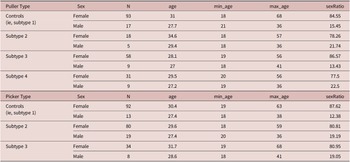
The sample included 251 adults [193 with a BFRB (85.5% [n = 165] female) and 58 healthy controls (77.6% [n = 45] female)]. Based on previously conducted mixture modeling analysis, individuals were categorized as belonging to various subtypes of pulling or picking (Table 1).
Clinical Subtypes of Pulling and Picking Participants Based on Mixture Modeling (Grant et al, Reference Grant, Peris and Ricketts2021)

Puller subtypes: Subtype 2: sensory sensitive pullers; Subtype 3: low awareness pullers; Subtype 4: impulsive/perfectionist pullers.
Picker subtypes: Subtype 2: emotional/reward pickers; Subtype 3: functional pickers.
Puller subtypes
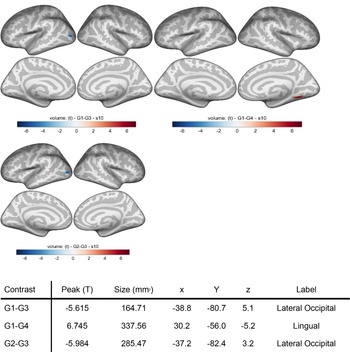
Puller subtype 3 (low awareness pullers) showed increased cortical volume in the lateral occipital lobe relative to both subtypes 1 (controls) and 2 (sensory sensitive pullers). In addition, subtype 4 (impulsive/perfectionist pullers) showed relatively decreased volume near the lingual gyrus of the inferior occipital–parietal lobe compared with controls (Figure 3).
Cortical volume differences across hair pulling subtypes.

Picker subtypes
No regions showed robust significant group differences at the rigorous criteria thresholds. Some regions showed small volumetric differences between group 1 (controls) and group 3 (emotional/reward pickers), but these did not retain significance at the coarse smoothness level of 15 mm FWMH (see the Supplementary Material).
Discussion
This study is the first in the area of BFRBs to examine whether the clinical subtypes of pulling and picking have distinct neurobiological profiles. Partially supportive of our hypotheses, we found that two subtypes of people with TTM had distinct structural findings on MRI. First, low awareness hair pullers demonstrated increased cortical volume in the lateral occipital lobe (Figure 3). Low awareness hair pullers appear to be the most common subtype of TTM and are best characterized as having more automatic hair pulling, and more pulling due to emotional triggers. In addition to visual perception, the lateral occipital cortex is involved in touch- and proprioception-related sensory activation.
The other key finding was that our data demonstrate that impulsive/perfectionist hair pullers showed relatively decreased volume near the lingual gyrus of the inferior occipital–parietal lobe compared with controls and relative to sensory sensitive pullers. Research consistently shows that the lingual gyrus is associated with visual memory and motion imagery. In addition, there is some indication that the lingual gyrus plays a role in response inhibition in the context of negative emotionsReference Ding, Wang and Wang 26 and in reward processing.Reference Chikara, Chang, Lu, Lin, Lin and Ko 27 Adults with TTM have demonstrated deficits in response inhibitionReference Chamberlain, Fineberg, Blackwell, Robbins and Sahakian 28 compared to individuals with no family history of BFRBs, and have exhibited dysfunctional reward processing as well.Reference White, Shirer, Molfino, Tenison, Damoiseaux and Greicius 29 The fact that certain findings such as response inhibition have been somewhat mixed in TTMReference Odlaug, Chamberlain, Derbyshire, Leppink and Grant 30 may speak to the fact that earlier studies were unaware of subtypes and that the impulsive/perfectionist subtype may be more likely to demonstrate these deficits.
Taken together, what do we make of these findings? These data are important because they show that, albeit in small ways, the clinical heterogeneity previously found in TTM may have partially distinct biological underpinnings. These particular volumetric differences may, however, only be part of the larger picture, because it is doubtful that the size of any single area tells the complete picture. In fact, we have yet to examine other factors such as white matter integrity and functional connectivity, and so this is likely the first finding of a yet to be determined complex understanding of the clinical heterogeneity of TTM.
It is also important to note nonsignificant results herein. We did not find that one subtype referred to as “sensory sensitive pullers,” differed from the other clinical subtypes or controls in any structural manner. Similarly, the clinical phenotyping of SPD did not show significant differences in brain structure in those subtypes either. The lack of structural differences in these other subtypes leads to several possible explanations: perhaps these subtypes are less meaningful biologically. In fact, there was some suggestion based on the clinical phenotyping data that perhaps the subtypes of skin picking were actually reflective of symptom severity differences.Reference Grant, Peris and Ricketts 21 If so, then neuroimaging of structural biology may be less useful in understanding the picking subtypes. Another explanation is that certain subtypes may have more subtle biological differences and thereby require a larger sample or a different imaging modality.
Several limitations should be considered in relation to the current study. Although the total size of the study was fairly large, the number of participants with individual BFRBs may have been too small to detect differences between the subtypes. In addition, the sample was not large enough to examine the role of comorbidities. Finally, the current research was undertaken in a cohort that was largely female and of white racial–ethnic type and thus may not be representative of the larger population of people with BFRBs.
In summary, this is the first neuroimaging study to explore data-driven subtypes of BFRBs. We found evidence of some volumetric brain differences between specific hair pulling subtypes, which were robust with stringent statistical correction. Future work should further explore neurobiological underpinnings of BFRB subtypes using a range of imaging modalities, and explore whether the subtypes show differential response to treatments—both in terms of changes in symptoms and brain structure/function.
Acknowledgements
This study was funded by the Body-Focused Precision Medicine Initiative granted by The TLC Foundation for Body-Focused Repetitive Behaviors to the University of Chicago (Dr. Grant), Massachusetts General Hospital (MGH)/Harvard (Dr. Keuthen), and University of California, Los Angeles (UCLA; Dr. Piacentini). Dr. Chamberlain’s involvement in this study was funded by a Wellcome Trust Clinical Fellowship (refs. 110049/Z/15/Z and 110049/Z/15/A). The TLC Foundation for Body-Focused Repetitive Behaviors had no role in the design and conduct of the study; collection, management, analysis, and interpretation of the data; preparation, review, or approval of the manuscript; and decision to submit the manuscript for publication. This study was completed with support from the REDCap project at the University of Chicago, which is hosted and managed by the Center for Research Informatics and funded by the Biological Sciences Division and by the Institute for Translational Medicine, CTSA grant number UL1 TR000430 from the National Institutes of Health.
Disclosures
Dr. Grant has received research grants from Biohaven, Promentis, and Otsuka Pharmaceuticals. Dr. Grant receives yearly compensation from Springer Publishing for acting as Editor-in-Chief of the Journal of Gambling Studies and has received royalties from Oxford University Press, American Psychiatric Publishing, Inc., Norton Press, and McGraw Hill. Dr. Chamberlain previously consulted for Promentis (in the past 3 years), and receives stipends from Elsevier for editorial journal work (Comprehensive Psychiatry and Neuroscience & Biobehavioral Reviews journals). The other authors report no conflicts. Dr. Dougherty receives research support and honoraria from Medtronic, Inc. Dr. Woods has received royalties from Oxford University Press and Springer Press. Dr. Piacentini has received research grants from NIMH, the Tourette Association of America, and Pfizer. He receives travel support and honoraria from the Tourette Association of America and the International OCD Foundation and book royalties from Guilford Publications and Oxford University Press. Dr. Keuthen has received prior research grants from The TLC Foundation for Body-Focused Repetitive Behaviors and royalties from New Harbinger, Inc. The remaining authors have nothing to disclose.
Author Contributions
The authors made substantial contributions to the conception or design of the work as well as the acquisition, analysis, or interpretation of data; they all aided in drafting the work, gave final approval of the version to be published, and agree to be accountable for all aspects of the work in ensuring that questions related to the accuracy or integrity of any part of the work are appropriately investigated and resolved.
Supplementary Materials
To view supplementary material for this article, please visit http://doi.org/10.1017/S109285292100095X.