Introduction
Managers and consultants use a wide variety of frameworks to support their analysis and/or decision-making. Many researchers and practitioners have had difficulty advocating for the usefulness of management frameworks (Hill & Westbrook, Reference Hill and Westbrook1997; Miller, Hartwick, & Le Breton-Miller, Reference Miller, Hartwick and Le Breton-Miller2004; Spell, Reference Spell1999). Only a few theorists or practitioners ask themselves why a certain management framework, for example, the Business Model Canvas (‘BMC’), has become a de facto standard in their realm. The unique value of well-known frameworks employed in organizations seems to be only one of the reasons why numerous frameworks have spread swiftly (Sturdy, Reference Sturdy2004). Other reasons for the existence and use of management frameworks are the following: First, they decrease the number of uncertainties when a new phenomenon is tackled. Second, frameworks can support the achievement of organizational strategies and prompt ‘intra-company connectedness’ (Lambert, García-Dastugue, & Croxton, Reference Lambert, García-Dastugue and Croxton2005). Third, the use of management frameworks adds to managers' reputations by showing that a manager is credible and capable of dealing with uncertainties in the future (Mamman, Reference Mamman2002). Finally, frameworks can depict features of various phenomena (Priem & Butler, Reference Priem and Butler2001), compare and guide numerous organizational practices (Heylighen, Reference Heylighen1998), support the execution of tasks (Andrew & Evans, Reference Andrew and Evans2011), and refute or confirm a particular management approach (Schwartz & Carroll, Reference Schwartz and Carroll2008). For instance, the BMC has become an apt ontology for investigating organizations on a new level-of-analysis (business model). Also, the BMC can guide a number of marketing-, logistics-, and strategy-related activities in the domain of managers.
As frameworks such as the BMC gain enough popularity within a particular realm, they become widely used by managers, researchers, and consultants to provide a supporting rationale for decisions (Jung & Lee, Reference Jung and Lee2016).
We argue that memetics offers a comprehensive explanation of the way in which frameworks are developed. Memetics is the study of the transmission of the so-called memes between people in particular realms (Whitty, Reference Whitty2005). We draw on the understanding of a meme as a cultural element with the ability to replicate, similar to the biological replication of a gene, and the ability to pass from one human being to another (Dawkins, Reference Dawkins1976; Lord, Reference Lord2012).
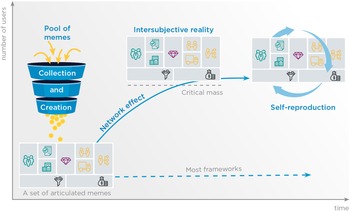
We claim that the origins of management frameworks can usually be traced back to the creator and to the period in which it was conceived. In case of the BMC, the creation happened during the post-millennial expansion of e-businesses (2004) whilst the author was Alexander Osterwalder (Osterwalder, Reference Osterwalder2004). Our study explains how contemporary management ideas – memes – from a certain time period and a particular realm contributed to the emergence of a framework. Management ideas on which a framework is built ‘do not spring forth full blown but are made somewhere by somebody’ (Peterson, Reference Peterson1979), and, analogously, the dissemination of these ideas is an outcome of active transmission among people (Bazin & Naccache, Reference Bazin and Naccache2016; Braganza, Awazu, & Desouza, Reference Braganza, Awazu and Desouza2009). When a renowned management framework achieves critical mass, the rate of adoption becomes self-sustaining. Management frameworks that gained critical mass self-reproduce through management education, consultancies, business trainings, and give rise to their expected value with the continuous assistance of the network effect. This development is shown in Figure 1.
The development, adoption, and value of management frameworks

To understand ‘how people interpret, act, and ascribe meaning’ (McCabe, Reference McCabe2002) to management frameworks, we integrate intersubjective reality. Within the adoption of management frameworks, intersubjectivity resonates as ‘mutual engagement and participation between independent subjects, which directly conditions their respective experience’ (de Quincey, Reference de Quincey2000). As an intersubjective reality for two or more independent subjects, a framework entails engagement. Within the engagement of the subjects, management frameworks communicate shared beliefs and allow for mutual understanding (Luhmann, Reference Luhmann1992). Each of the subjects can reasonably assume that the other subject is familiar with the framework and it is then less difficult (i.e., less cognitively demanding) to discuss a shared belief in a particular realm.
The structure of this paper is as follows: First, we review the existing body of knowledge on management frameworks. Then, elaborating on the analogy between social and biological systems, we utilize the theory of memetics to undertake an explanation of the existence of well-known management frameworks. We then introduce the concepts of intersubjectivity and network effect to encompass the determinants of a management framework's success in particular realms where the frameworks are being continuously reproduced. Finally, we discuss theoretical contributions and avenues for future research regarding observations of management frameworks.
Management Frameworks
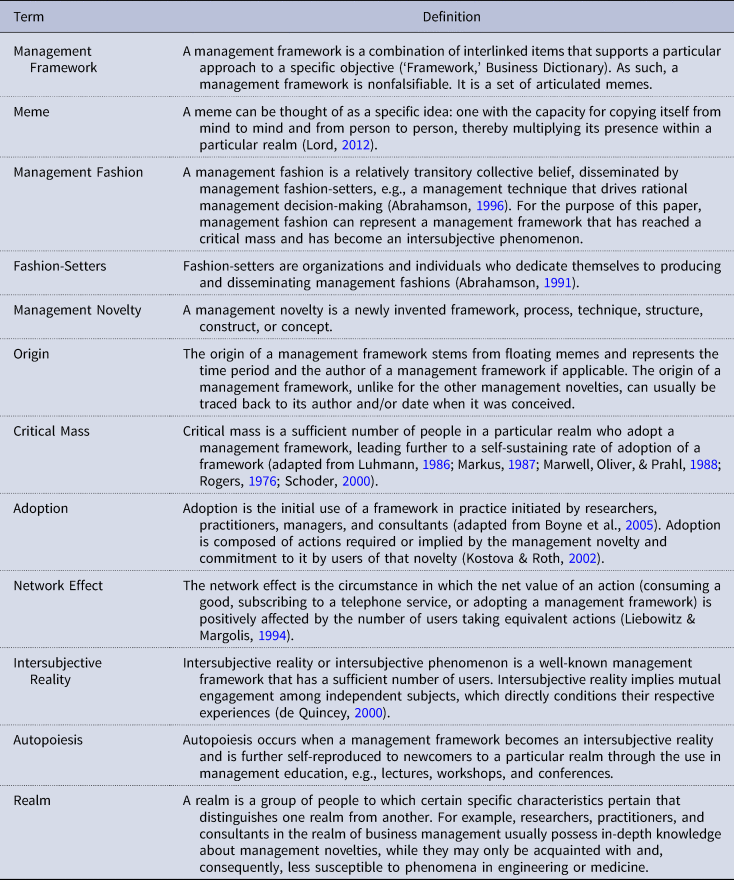
In organizations, frameworks enable a comparison of principles and techniques (Rezaei, Chiew, & Lee, Reference Rezaei, Chiew and Lee2014), hold or support a theory (Swanson, Reference Swanson2007), and are seen as sets of premises, values, and practices that promote dealing with contemporary issues (Andrew & Evans, Reference Andrew and Evans2011). Management frameworks ‘emerge from people's minds and enter into a form that can be perceived by others’ (Heylighen, Reference Heylighen1998). This paper combines several terms from various fields, many of them with different definitions and colloquial uses. Table 1 introduces the main terms that are used in this paper.
Key terminology
Even though many studies discuss the development of novelties and their diffusion, management frameworks require – to some extent – realm-specific reasoning (Cornelissen & Durand, Reference Cornelissen and Durand2014). However, due to the complexity of management phenomena, previous research not only advocates plausibility of multiple-lens perspective but also firmly believes in the complementariness of compound theoretical approach (Okhuysen & Bonardi, Reference Okhuysen and Bonardi2011). Notwithstanding the (dis)similarity of compounded perspectives, the compound approach that seeks for analogies can yield alternative insights on existing phenomena (Oswick, Fleming, & Hanlon, Reference Oswick, Fleming and Hanlon2011).
The question arose whether frameworks are valuable or solely sets of ideas shared among people who have similar attitudes (Schwartz & Carroll, Reference Schwartz and Carroll2008). Framework development remains an ambiguous field (Andrew & Evans, Reference Andrew and Evans2011; Priem & Butler, Reference Priem and Butler2001). We claim that every framework is inherently fictional; it does not exist in the real world. Frameworks cannot be attached to specific observations but are seen as an abstract statement of the elements of these observations. Thus, the ‘scientific correctness’ of management frameworks cannot be tested, and they are – by definition – nonfalsifiable.
Namely, almost anything can be divided based on two dimensions and shown in a matrix. For example, SWOT divides factors based on internal/external origin and favorable/unfavorable traits; the Kraljic purchasing portfolio model divides items based on financial impacts and supply risks (Kraljic, Reference Kraljic1983), and the BMC is a business model ‘ontology’ which includes certain business model elements. Because falsification has been neglected by management society (Armstrong, Reference Armstrong1983), theories are sometimes declared ambiguously, without allowing other theorists to refute the theory or its framework. Management society could benefit from Popper's essential principles of testing theories, where ‘testing’ means deliberate efforts to falsify the theory until this falsification fails (Faran, Reference Faran2009; Popper, Reference Popper1961). Other typical examples of successful arbitrary frameworks include Carter and Roger's (Carter & Rogers, Reference Carter and Rogers2008) sustainable management framework, the balanced scorecard (Kaplan & Norton, Reference Kaplan and Norton1995), Porter's five forces (Porter, Reference Porter1989), and aforementioned Kraljic's purchasing portfolio matrix.
While BMC or SWOT as frameworks is per se nonfalsifiable, their results in practice are questionable. Typical procedural guidelines consist largely of catch-all questions devoid of explicit theoretical underpinnings and often produce shallow, misleading results (Valentin, Reference Valentin2001). For example, the usefulness of SWOT analysis is highly questionable since organizations failed to reap any benefits from the ‘meaningless descriptions’ resulting from SWOT analyses (Hill & Westbrook, Reference Hill and Westbrook1997). The example of SWOT analysis demonstrates that managers prefer frameworks that generate descriptions in a simplistic manner to process the information more effectively. Also, managers favor ‘understandable, feasible, and internally consistent’ outcomes (Postma & Liebl, Reference Postma and Liebl2005). On the other hand, a framework's ease-of-use accounts for the oversimplified division of various factors based on two dimensions (Beck, Reference Beck1982). Consequently, cumbersome environments perplexed with uncertainties are represented too simplistically (Bell & Rochford, Reference Bell and Rochford2016). This is why ‘the more carefully and systematically managers analyze a complex and uncertain environment, the more successful the strategies they formulate will be,’ premise of SWOT analysis often results in meaningless descriptions (Postma & Liebl, Reference Postma and Liebl2005) and only adds to generalities and ambiguity (Eisenberg, Reference Eisenberg1984; Ford & Ford, Reference Ford and Ford1995). Useful outcomes, if any, can result from using SWOT analysis; however, the empirical research has shown that ‘no-one (in organizations, particularly) used the outcomes later’ (Hill & Westbrook, Reference Hill and Westbrook1997).
However, it remains unknown which framework will a priori turn out to be successful. Researchers generate novel management frameworks with an underlying relationship between their constitutive elements – memes – without devoting considerable attention to testing the causality of those relationships (adapted from Alvesson & Sandberg, Reference Alvesson and Sandberg2011). So far, almost no attention was devoted to gauging how the ‘surface evaluations’ resulting out of SWOT helped (or not) developing strategies and decision-making (Bell & Rochford, Reference Bell and Rochford2016). Only few attempts to investigate whether a framework delivers new value have been studied after it has been adopted for a while and with the use of rudimentary experiments such as the ‘table-napkin test’ (Arjen, Reference Arjen2015; Snowden, Reference Snowden2011).
The origins of management frameworks
In line with Birkinshaw, Hamel, and Mol (Reference Birkinshaw, Hamel and Mol2008), we argue that a management framework is a management innovation in a certain moment. That innovation is an organized expression of memes. Most frameworks can be attributed to a few individuals who organized the expression of memes. At the time of the BMC development, some of the contemporary ideas floating in the meme pool were related to a business model. The sporadic and inconsistent use of the terms related to the business model established the need for a proper framework. Osterwalder (Reference Osterwalder2004) was one of the few researchers who developed an ‘ontology’ for the business model concept. He drew on contemporary ideas with the greatest psychological appeal and relevance for a business model research. Using his own creativity, he conveniently labelled and organized a set of articulated memes – the BMC.
Those expressions of memes have some merits that enable the surge of a certain framework among its alternatives in competition for preeminence (Goldkuhl, Reference Goldkuhl1996; Schwartz & Carroll, Reference Schwartz and Carroll2008). Among these merits, sense-making is of key importance (Kurtz & Snowden, Reference Kurtz and Snowden2003). For example, Kurtz and Snowden (Reference Kurtz and Snowden2003) emphasized that their framework is a sense-making tool, whose value is not logical arguments or empirical verifications but rather the enhanced sense-making and decision-making capabilities.
In a similar vein, our study demonstrates how a partly-arbitrary management framework usually lacks rigorous foundations, acts as a shared belief, and hence structures the cognition of a reality within management (adapted from Marquis & Lounsbury, Reference Marquis and Lounsbury2007). Rather, management frameworks are developed as sets of the seized meme(s) – articulated ‘management ideas.’ Memes are small carriers of on-going contemporary beliefs (e.g., companies need to be aware of the value proposition of their products) in particular realms. When organizations started observing their business models, ontology such as the BMC seized memes that addressed organizational requirements (e.g., the need to re-think the value proposition) and were both relevant and timely to the needs of the framework users.
Towards Understanding the Nature of Particular Realms
Well-known frameworks tend to be ‘ubiquitous’ in their use within the management realm (Bell & Rochford, Reference Bell and Rochford2016), due to the simplicity of frameworks such as SWOT and the BMC. It should not be forgotten that the majority of created frameworks do not gain a large number of users (beyond the creator him or herself): thousands of frameworks are created in companies, academia, and consulting reports but the most remain unused. The BMC, for instance, has been disseminated to management and gained a sufficient number of users with the mechanisms underlying the nature of well-known management frameworks (adapted from Huczynski, Reference Huczynski1993; Williams, Reference Williams2000).
In management, a framework is often understood as a ‘false proxy’ for inspecting the real-world situations (Bell & Rochford, Reference Bell and Rochford2016; Meyer & Land, Reference Meyer and Land2005). Whilst this line of thinking explains why frameworks, such as the BMC, Porter's five forces, the balanced scorecard, or the SWOT matrix, are, despite their several shortcomings, continuously used, analogical reasoning for comparisons of biological and social systems enhances our understanding of the creation and transmission of the origins of frameworks.
Luhmann (Reference Luhmann2018) drew on biological systems to derive his own definition of social systems ‘as of systems that reproduce their own elements on the basis of their own elements.’ Such systems are called autopoietic systems (Luhmann, Reference Luhmann1986). Both biological and social systems are characterized by their self-referential nature. Luhmann devoted substantial attention to enhance the understanding of analogies between biological and social systems and what consequences such reasoning could have had (Seidl & Becker, Reference Seidl and Becker2005). Thus, he did not only ‘duplicate’ the principles of self-reproduction from biological systems, rather, Luhmann established a more generic, trans-disciplinary autopoiesis, in which he abstracted and applied generalizable insights to social systems.
In social domains such as the particular realm of management, the self-referential nature manifests throughout specific pathway mechanisms – a ‘chain-of-events’ (adapted from Luhmann, Reference Luhmann2018). Those pathway mechanisms reveal how and why the elements of a particular realm, namely management frameworks, reproduce as a result of being used. Unlike biological systems, social systems grow on the basis of communication (Luhmann, Reference Luhmann1995). Elements of meaning that ‘communicate’ can be management frameworks. Communications activate during management education, consultancies, business trainings, lectures, conferences, and imply a mutual engagement between the users of a management framework. In that ‘ritualized manner’ within management (Meyer & Land, Reference Meyer and Land2005), a management framework then continues to ‘communicate’ as an ‘element of meaning’ to self-reproduce itself in order to prevail over the alternatives (adapted from Luhmann, Reference Luhmann1992).
A framework resonates articulated meaning derived from its memes (Dawkins, Reference Dawkins1976). The conceptualization of a meme stems from the analogy with genes in biological systems and draws on the concept of replication (Dawkins, Reference Dawkins1976). For Dawkins, genes and memes are successful replicators due to their inherently-embedded high copying-fidelity, an aptitude that allows a meme to set itself apart from a pool of memes.
A meme is, in a broad sense, a constitutive element of culture. In a narrow sense, memes are specific ideas with the ability to replicate themselves among people's psyches to affect particular realms (Lord, Reference Lord2012). Analogously to the reproduction in biological systems, the transmission of cultural elements, namely memes, can account for the evolution of a new management novelty (adapted from Dawkins, Reference Dawkins1976). Prior to becoming a piece of a framework, memes can either coexist with the rival memes in a meme pool or cause the extinction of their predecessors (Morris & Lancaster, Reference Morris and Lancaster2006), but a new meme has to bring something that is believed to be at least at the same or a higher level than its predecessors (Whitney & Tesone, Reference Whitney and Tesone2001). This train of thought explains why fresh management ideas imply the obsolescence of previous management fashions. Memes are transmitted through biological, physiological, and social ways (Whitty, Reference Whitty2005); however, a human influence is necessary for the transmission of memes (Dawkins, Reference Dawkins1976). Researchers, in particular, are accountable for lecturing or writing about floating memes in a particular realm. However, what facilitates the replication of ideas, thoughts, and culture in that particular realm are unique characteristics of memes, namely copying-fidelity, fecundity, and longevity (Dawkins, Reference Dawkins1976).
For Dawkins, some memes are subjects to ‘continuous mutation’ – when an idea is passed from researcher to researcher, it is likely to change. On the contrary, memes with greater psychological appeal and fidelity transmit with ‘blending.’ An idea (e.g., sustainability is of key importance for organizations) is blended with rival memes when researchers advance the existing well-known frameworks. Sustainability as an idea was self-perpetuating because of a strong psychological appeal and, therefore, easily coincided with the existing framework. This train of thought explains the development of frameworks such as Triple-layer BMC that drew on Osterwalder's BMC (Joyce & Paquin, Reference Joyce and Paquin2016).
Within transmission, memes propagate, imitate, and parasitize. First, when a meme is incepted in one's mind, it propagates itself by leaping from one mind to another. Among the memes in a meme pool, those with ‘psychological appeal’ are more successful in remaining alive and become contagious (Dawkins, Reference Dawkins1976). This appeal is similar for well-known frameworks and accountable for some frameworks prevailing over the alternatives. Frameworks with aforementioned unique characteristics and thus a greater ‘survival value’ then replicate with imitation. Fecundity of a meme is of key importance in spreading management ideas. Without a sufficient number of particular copies, management frameworks will not reach a critical mass of people familiar with it. Dawkins (Reference Dawkins1976), for instance, suggested that ‘a rough measure of its [meme] survival value could be obtained by counting the number of times it is referred to in successive years in scientific journals’ (Dawkins, Reference Dawkins1976).
Memes will not reproduce just by themselves; reproducing is dependent upon how the replicating process of memes interacts with externalities, such as employees, stakeholders, communities, and other articulated ideas (O'Mahoney, Reference O'Mahoney2007). As memetics holistically redeems ‘a human construct as a collection of feelings, expectations, and sensations, cleverly conjured up, fashioned, and conveniently labelled by the human brain’ (Whitty, Reference Whitty2005), its rhetorical viral and memetic properties have found their way into managerial discourse (Green, Reference Green2004). In management, the development of ideas, concepts, conceptual models, methodologies, and practices may all be driven by memes. Successful memes have a longevity that is sufficient to enable the emergence of the so-called ‘environmental niches’ (Lisack, Reference Lisack2003) and subsequently act as ‘catalysts’ in the survival of the most contagious and psychologically appealing management frameworks.
The Role of Memetics in Understanding Management Frameworks
An intriguing question comes to mind: how are memes seized, and how do they fall into (the theory of) management (Whitney, Tesone, & Blackwell, Reference Whitney, Tesone and Blackwell2003)? Management novelties have been recognized as possible examples of memes spreading through business discourse (O'Mahoney, Reference O'Mahoney2007; Price, Reference Price2012). Memes facilitate message transmission or opinion sharing within particular realms (Knobel & Lankshear, Reference Knobel and Lankshear2007). The expected yield of memetics in management is a better understanding of the structures, processes, and origins of management ideas and, consequently, management novelties. Baldridge and Okimi (Reference Baldridge and Okimi1982) argued that management novelty first strikes the business community, then the government, and finally academia. On the contrary, several authors agree that frameworks emerge mainly through academic publications. Essentially, some frameworks succeed and become communications that are self-reproduced continuously. During self-reproduction, frameworks do not change substantially despite being spread widely since the frameworks are sets of successful and already explicitly expressed memes.
Furthermore, for the development of a successful framework, the way in which management ideas (memes) have been seized and contextualized is important (Benders & Van Veen, Reference Benders and Van Veen2001; Mamman, Reference Mamman2002). Fashion-setters – those who present management frameworks as a universally applicable solution in a particular realm (see e.g., Abrahamson, Reference Abrahamson1996) – are eager to identify the needs of organizations and managers. Moreover, fashion-setters need to successfully present novel frameworks as the solution to organizational issues and transmit this opinion across the board as soon as possible. Another objective of fashion-setters is to assist managers in detecting and evaluating new management frameworks (Clark, Reference Clark2004). That being said, contingent management frameworks often ‘linger’ since their longevity is dependent upon how well the memes are refined and organized (Røvik, Reference Røvik2011).
Various management frameworks originating in memes prosper due to their replicating ability and result in a surge of a new management fashion (e.g., the BMC). The determinants for enhancing the replication of a meme and, consequently, management novelty remain vague. One of the deterrents might be the level of ambiguity associated with a novelty due to limited knowledge about its value (Birkinshaw, Hamel, & Mol, Reference Birkinshaw, Hamel and Mol2008; Røvik, Reference Røvik2011). Management novelties will continue entering the business as fashions because it is almost impossible to evaluate an idea's outcome in advance without perfect foresight about its value (Jung & Lee, Reference Jung and Lee2016; Scarbrough & Swan, Reference Scarbrough and Swan2001). What managers often rely on is the expected value of a management novelty, which increases with the number of users. Usually, a novelty attracts more users due to its appeal and as a result of memes having been contagious.
Adoption of Management Frameworks
Adopting frameworks has become a craze because it allows organizations to signal that they are progressive (Nohria & Berkley, Reference Nohria and Berkley1994). A framework comes with benefits and drawbacks (Lambert, García-Dastugue, & Croxton, Reference Lambert, García-Dastugue and Croxton2005). Because the alternatives, outcomes, and value of a framework are often not considered, the adoption of a framework requires scant effort and is easily facilitated (Secchi & Gullekson, Reference Secchi and Gullekson2015). The adoption of a management framework is not mainly determined by the rigor of developing frameworks (Iivari, Reference Iivari2007) but by other determinants, such as interorganizational memetic pressures that encourage managers to put a novel management framework into practice (Lawton & Wholey, Reference Lawton and Wholey1993). After development, the framework's widespread adoption is dependent upon the network effect and its ability to self-reproduce after it had become an intersubjective reality. Without the self-reproduction of a framework, the use in a particular realm would degrade and entail new management frameworks to originate (adapted from Luhmann, Reference Luhmann1986). By extending this train of thought, the current study demonstrates how a trans-disciplinary concept of autopoiesis applies to management.
Abrahamson (Reference Abrahamson1996) established the term ‘management fashion’ and developed a stepping stone toward understanding the success of adopted management novelties. He used Meyer and Rowan's (Meyer & Rowan, Reference Meyer and Rowan1977) explanation of why managers seek appropriate management frameworks: to represent themselves as rational in front of stakeholders. Managers strive for the adoption of successful management frameworks and more or less efficiently use the novelties from the field of management to present themselves as rational. By doing so, the stakeholders perceive them as progressive (Spell, Reference Spell1999).
When a number of users adopt a management novelty, others are prompted to join the bandwagon. Abrahamson and Rosenkopf (Reference Abrahamson and Rosenkopf1993) argue that such pressures occur when nonadopters would like to follow early adopters. Analysis of this phenomenon enables the identification of the conditions under which organizations can limit the rise of potential management fashions (Secchi & Gullekson, Reference Secchi and Gullekson2015). Moreover, research has shown that the adoption of a management novelty is usually decoupled from the potential adjustments that might have to be made by the organization that adopts a framework (Scarbrough & Swan, Reference Scarbrough and Swan2001). Finally, when a framework reaches critical mass, efficiency concerns are replaced by social pressures from outside stakeholders, forcing organizations to employ frameworks without considering the adequateness of a framework in a different environment (Ansari, Fiss, & Zajac, Reference Ansari, Fiss and Zajac2010).
Management fashions, in a manner analogous to memes, compete for replication and obtainable resources in the broader managerial discourse (Pratt, Reference Pratt2016; Price, Reference Price2012). Frameworks are often adopted irrespective of other determinants, potentially causing damage to an organization or impeding the adoption of more suitable frameworks (Benders & Van Veen, Reference Benders and Van Veen2001; Mamman, Reference Mamman2002). Clark (Reference Clark2004) claimed that management novelties are adopted and spread in two stages: first, the preferences of a novelty's potential consumers are identified, and second, a successful novelty reinforces these preferences, resulting in the consumers' belief that the novelty is at the ‘forefront of managerial progress’ (Abrahamson, Reference Abrahamson1996; Benders & Van Veen, Reference Benders and Van Veen2001; Pratt, Reference Pratt2016). The future adoption continues at a self-sustaining rate as the number of users deem a management (fashion) framework to be a de facto standard within their realm. Instead of explaining a framework to others before its use, a framework becomes a self-reproductive communication. Since the use of a framework that has become an intersubjective reality for a particular realm is simplified, its expected value increases.
The Value of Management Frameworks
A framework assists by improving collaboration, disseminating information, and developing and maintaining initiatives, such as training programs (Rodrigues, Reference Rodrigues1995). Also, a framework can be deemed valuable if it is associated with successful management or improved management performance. The latter remains an important indicator of how valuable frameworks and other management novelties are in, for instance, the realm of the project (Raz & Michael, Reference Raz and Michael2001) or forest managers (Trigkas, Anastopoulos, Papadopoulos, & Lazaridou, Reference Trigkas, Anastopoulos, Papadopoulos and Lazaridou2019). Those two examples indicate the possibility for a management framework to ‘communicate’ beyond the borders of a particular realm. Even though this seems to be in a stark contrast to Luhmann's diction on ‘operatively closed’ autopoietic systems (Luhmann, Reference Luhmann1995), we see this phenomenon as a result of some memes having mutated more substantially and partly as a mere consequence of a two-way exchange process between management and other domains. Managers who adopt the novelties are deemed innovative, progressive, and better regardless of the value that was extracted from a framework (Whitney & Tesone, Reference Whitney and Tesone2001).
A framework can be deemed a ‘communication.’ As a communication, the purpose of a framework is to reveal the assumptions of other researchers, managers, and consultants, and to enhance the connectedness within a particular (management) realm (Heemskerk, Wilson, & Pavao-Zuckerman, Reference Heemskerk, Wilson and Pavao-Zuckerman2003). In a similar vein to Luhmann (Reference Luhmann1986), we do not refer to the conventional understanding of communication as of information exchange between the messenger and recipient but as of a process that entails mutual engagement among the users in a particular realm. For example, the BMC as a communication in management facilitates business model innovation by, for example, shifting the focus on the elements and dimensions necessary for a re-design. The BMC is a ‘communication’ produced as a part of a particular realm (management society).
Frameworks allow managers and researchers from the realm to abstract information or procedures, notwithstanding the physical distance between them (Martín, Martínez, Martínez Carod, Aranda, & Cechich, Reference Martín, Martínez, Martínez Carod, Aranda and Cechich2003). By abstracting information and communicating via a framework, managers and researchers match one mind with another (Duranti, Reference Duranti2010) and contribute to establishing an intersubjective reality for a particular realm (adapted from Postma & Liebl, Reference Postma and Liebl2005; Tenaglia & Noonan, Reference Tenaglia and Noonan1992). The boundaries of the society are the boundaries of a framework's role of communication (Luhmann, Reference Luhmann1992, Reference Luhmann1995), whereas the role of a management framework within another realm can be different. While in the management realm, frameworks in general support mutual engagement, they can be used in other realms as either source of new information or support abstracting information in distant domains.
Since the adoption of management frameworks entails the inclusion of multiple users from a particular realm, the frameworks are deemed ‘genuinely social’ (adapted from Luhmann, Reference Luhmann1997). The well-known frameworks are not lingering in one's own mind; rather, they are an explicit intersubjective reality for an entire realm. As an intersubjective reality, a framework communicates a ‘single system of meaning’ (Luhmann, Reference Luhmann1997). It also hinders the efforts, if any, to search for an alternative novelty, and subsequently enhances mutual understanding between the users of a framework.
The value of a certain framework can be magnified when its use entails interactions among people, organizations, and technology and when the framework's adequacy for overcoming barriers in decision-making can be recognized (Klein & Myers, Reference Klein and Myers1999). The framework can become a common ground for interactions and elaborations. For instance, the more recent discussions about digital transformation have organized around a digital transformation framework (Westerman, Calméjane, Bonnet, Ferraris, & McAfee, Reference Westerman, Calméjane, Bonnet, Ferraris and McAfee2011). Its ease of use, due to a matrix layout and the simplicity of ‘dividing the digital transformation’ into three pillars, supports the framework in becoming an intersubjective reality in several realms, such as strategic management and the information systems. The value of the digital transformation framework has increased because its introduction to new users can now be seamless, and its users are therefore required to use less cognitive resources.
In line with Gibson and Tesone (Reference Gibson and Tesone2001), we assert that management frameworks should be adopted when they fit existing organizational practices. For instance, the BMC framework can only be a useful framework for firms that focus on their business models. Second, prior to the widespread use of a framework, managers, team leaders, and researchers should provide specific, measurable, and attainable outcomes and answers to how a framework can facilitate the accomplishment of a specific approach.
The existence of many frameworks established a need for ‘testing, enhancing, and embellishing’ of these frameworks (Banville & Landry, Reference Banville and Landry1989). However, models for predicting the success of a viral management novelty in its early stages or for forecasting the ‘longevity of a meme’ have not yet been developed (Bauckhage, Reference Bauckhage2011). As it is difficult to ex-ante evaluate the usefulness of a framework (Sturdy, Reference Sturdy2004), the answers to the question of the value of frameworks are inadequate (Heusinkveld, Sturdy, & Werr, Reference Heusinkveld, Sturdy and Werr2011).
Interestingly, the research on whether the outcomes of management frameworks are decoupled from or translated into practice has so far been inconclusive (Røvik, Reference Røvik2011). Dirk (Reference Dirk1999) claims that the purpose of the research is to draw management novelties from ‘confused, vague, and inchoate’ experience and practices. However, the user should determine whether a framework is vaguely conceptualized, how its elements are linked to and based (or not) on empirical groundings, and if the framework overlaps with other (related) management novelties (adapted from Dembek, Singh, & Bhakoo, Reference Dembek, Singh and Bhakoo2016). In line with Pech and Slade (Reference Pech and Slade2004), we argue that managers' decisions for the adoption of a framework are partly evidence-based; however, the choice is inevitably arbitrary to a certain extent. Abrahamson (Reference Abrahamson1996) discovered that this inclination could be encouraged by fashion-setters, who promote a certain management novelty. Even though fashion-setters play only supporting roles in the success of a management framework, they can induce the network effect and increase the likelihood of a framework achieving its critical mass (Clark, Reference Clark2004). Fashion-setters persuade managers to believe that some of these novelties are of greater value than existing tools, even though the metrics for defining the ‘newness’ of a management framework are almost nonexistent (Volberda, Van Den Bosch, & Heij, Reference Volberda, Van Den Bosch and Heij2013).
Even though the value of management frameworks can be easily elicited if they are well-known, simple, and explainable ‘universally applicable quick-fix solutions’ (Birnbaum, Reference Birnbaum2000), criteria for evaluating the simplicity and explanatory nature of a framework are subjective and neither absolute nor universal (Granovetter, Reference Granovetter1979; Schwartz & Carroll, Reference Schwartz and Carroll2008). Therefore, it is nearly impossible to predict which framework will reach critical mass in the academic or business communities. After it reaches its critical mass, a framework becomes an intersubjective reality, and it is highly likely that it will self-reproduce.
Management Frameworks as Intersubjective Reality
Intersubjectivity can be interpreted ‘as the matching of one person's mental state with another's mental state’ (Duranti, Reference Duranti2010). Intersubjectivity activates whenever people's thoughts and feelings are mutually influenced (Liebowitz & Margolis, Reference Liebowitz and Margolis1994). Moreover, intersubjectivity is not only the convergence of these thoughts among multiple participants but, more importantly, convergence among the doers of an action – –users of the frameworks who depict ‘interactional and social reality’ (Schegloff, Reference Schegloff1992). Intersubjectivity plays an important role in human experience, and it can open new frontiers for understanding how people perceive, adopt, and distribute management novelties. Hereby both Luhmann (Reference Luhmann1995) and Husserl (Reference Husserl1980) emphasize the process of ‘phenomenological reduction,’ especially for researchers from particular realms where strong beliefs are often shared. In a simplified manner, a user from a particular realm can be aware of the nature of the management frameworks only if the user dismisses its firm beliefs, and witnesses the framework as such. Even though the reduction importantly complements the understanding of how we (should) interpret management novelties, the theory of intersubjectivity cannot completely explain a transmission of shared beliefs between users from a particular realm (Luhmann, Reference Luhmann1995). However, by employing the theory of intersubjectivity, one can enhance its understanding of social implications of a shared belief.
In fact, intersubjectivity is a state in which people maintain the premise that their perception of a proper management novelty, namely, a framework, is the same as other people's perception (adapted from Duranti, Reference Duranti2010). In other words, a framework becomes an intersubjective phenomenon when it is known well enough in a particular realm that it can be expected that the other people from that realm are familiar with the framework (e.g., a manager can ask for the BMC analysis with a reasonable assumption that his or her subordinates will know what the BMC is). A management framework becomes a common ground for a particular realm as a result of individuals believing that others share the same beliefs (Husserl, Reference Husserl1970). Since the spread of well-known management frameworks requires shared systems of meaning among participants (Trompenaars, Reference Trompenaars1995), intersubjectivity is an existential prerequisite that can lead to mutual understanding.
Mutual understanding is not solely an outcome of interactions between the users from a particular realm. The understanding is largely dependent upon the ‘appeal’ of communications. The frameworks facilitate mutual understanding in a particular realm by communicating a shared system of meaning (Luhmann, Reference Luhmann1986). More importantly, mutual understanding reaffirms the ‘position’ of a well-known framework and the establishment of the existing realms. The issue is that realms such as management society work as ‘comprehensive social systems’ (Bechmann & Stehr, Reference Bechmann and Stehr2002), meaning the realms are reluctant to accept alternatives to intersubjective realities.
Because users come from different backgrounds, certain frameworks are well known in one realm, while they might not have reached another (Spee & Jarzabkowski, Reference Spee and Jarzabkowski2009). Considering that partly arbitrary frameworks are not ‘ontically pre-given’ (adapted from Luhmann, Reference Luhmann1995), that is, their structures do not exist before memes are collected, a new framework usually enters a different realm in its adapted form. For instance, the Triple-layer BMC (Joyce & Paquin, Reference Joyce and Paquin2016), an upgrade of the original BMC, continuously attract more users from environmentalism and sustainability.
Intersubjectivity is not an experience limited to within an organization's boundaries since it can influence various interactive participants (Karayiannis & Fullbrook, Reference Karayiannis and Fullbrook2002). This is especially important for frameworks used as a medium for inter-organizational connectedness. Intersubjectivity is what guides a framework as a set of articulated memes to inhabit people within interactions initiated by communications. This process is swift, since memes are considered to be very proactive during social interaction (Shepherd & McKelvey, Reference Shepherd and McKelvey2009). Users perceive management frameworks and organize them on the basis of intersubjectivity (Lord, Reference Lord2012), meaning that the management frameworks become palatable to users in particular realms as the sharing of similar beliefs further increases the adoption among users and, subsequently, the expected value of the frameworks.
The Network Effect
The network effect happens when ‘the value of an action is affected by the number of agents taking equivalent actions’ (Liebowitz & Margolis, Reference Liebowitz and Margolis1994). In management, the network effect occurs when the utility a given user derives from a novelty depends upon the number of other users who are in that particular realm (Minniti, Reference Minniti2005). With the increasing number of existing users of a framework, more new users are enticed into the users' network (Leibenstein, Reference Leibenstein1950). The network effect drives a framework to gain a sufficient number of users (critical mass) to the point where it becomes an intersubjective reality. Then, well-known frameworks self-reproduce and reinforce their position by establishing a wider network of relations (Maturana & Varela, Reference Maturana, Varela, Bokulich, Renn, Massimi and Divarci1980). For instance, whenever a researcher or lecturer introduces the BMC to the audience, it reproduces the framework by implying mutual engagement of new users. As the framework is being reproduced and the number of users grows, the network effect is also greater. Further, a framework in a particular realm maintains, grows, and strengthens relations between the users with its self-reproduction.
Ample decisions, including the adoption of management novelties, are to some extent the result of the network effect, mainly due to the ‘network externalities’ (Liebowitz & Margolis, Reference Liebowitz and Margolis1994) that the network effect entails. People are thought to be ‘docile’ (Simon, Reference Simon1993) – having an affinity for information received from other users – which is why users of a framework provide affirmation in a particular realm by clearing the alternative available resources out of one's mind (Bardone, Reference Bardone2011). Maier (Reference Maier1995) emphasizes the importance of communication when the network effect occurs, enabling users to exchange opinions. The outcome of this mutual process, which infects our thoughts, ideas, and the development or adoption of management frameworks (Liebowitz & Margolis, Reference Liebowitz and Margolis1994), is that a framework then represents an intersubjective reality – a common ground for a particular realm.
The network effect is not a linear information transfer but a process of interrelating and sense-making between two or more entities (Jacky, Sue, Harry, & Donald, Reference Jacky, Sue, Harry and Donald1999). The network effect enables information sharing among potential users and promotes additional adoptions (Minniti, Reference Minniti2005). Some users start using a framework not because of the comparison of actual and desired utility but due to their anticipation of the expected utility (Thun, Größler, & Milling, Reference Thun, Größler and Milling2000). The network effect results in a higher number of users and, hence, indirectly facilitates the expected value of a framework.
To express it in the words of Luhmann ‘it is the network of communications that ‘produces’ the communications’ (Luhmann, Reference Luhmann1992). However, in a similar vein to Luhmann (Reference Luhmann1992), we believe the value of the communications (frameworks) is context-dependent: by encouraging more people to use the same management framework, its expected value rises, thereby making the framework more viable, more palatable, and less vague in its adoption.
Discussion
The development and adoption of management frameworks have been fostered substantially due to managers' great efforts to represent themselves as progressive and rational in front of stakeholders (Meyer & Rowan, Reference Meyer and Rowan1977). Managers are believed to have been adopting ‘bold theory,’ ‘breaking new ground,’ and ‘innovative research’ (Arjen, Reference Arjen2015) as management frameworks are sometimes ostensibly at the forefront of novelties. One of the first aims of the current study was to demonstrate how a management framework is developed from memes with greater psychological appeal and curated by the creator. The person-component plays an important role in the identification and collection of floating memes that ‘parasitize’ a particular realm as well as in dissemination of the frameworks.
Memetics teaches us about the time-dependency and relevance of floating management ideas and explains why certain frameworks became psychologically-appealing in particular time periods. Had the internet not enabled the surge of online companies that have been operating in fundamentally different ways than traditional brick-and-mortar ventures (DaSilva & Trkman, Reference DaSilva and Trkman2014), management reality might not have been interested in the BMC and rather focused on a new unit-of-analysis. Ultimately, in a manner similar to Teresa Bolivar-Ramos (Teresa, Reference Teresa2019), our findings support the importance of other determinants in a ‘chain-of-events’ that underlies the nature of well-known management frameworks as of (self-)reproductive elements in particular realms.
Building on prior research (Hill & Westbrook, Reference Hill and Westbrook1997; Valentin, Reference Valentin2001), our paper highlights the lack of falsifiability. Because well-known frameworks are often designed in a form of matrices and building blocks to convey simplicity and psychological appeal, they have been continuously used as universally-applicable management tools and ‘jointly-social communications’ that imply an iterated process of mutual engagement of users from a particular realm. Ultimately, we assert that the scholars from the management society try to decipher the value of management frameworks by engaging in a continuous, interrelated process of sense-making.
As researchers, we should be interested in testing rival management novelties to increase their precision. Whether it is called ‘dialectical interrogation’ (Alvesson & Sandberg, Reference Alvesson and Sandberg2011) or simply ‘questioning,’ the presence of a number of well-known frameworks established the need for a future research to challenge the theoretical grounding, applicability, and value of those frameworks. Memes do not possess the ability to ‘know’ or ‘plan’ the future (Hill & Westbrook, Reference Hill and Westbrook1997; Pech, Reference Pech2003a, Reference Pech20113b; Valentin, Reference Valentin2001) and thus cannot be precise predictors of a framework's success. In fact, memes tend to be an integral part of management frameworks due to their psychological appeal and ability to transmit ‘practices and rules’ into forms of management novelties (Volberda, Van Den Bosch, & Heij, Reference Volberda, Van Den Bosch and Heij2013).
Given the challenges to translate good management ideas into practice (see e.g., Ferguson & Blackman, Reference Ferguson and Blackman2017), this study corroborates how and why a framework becomes a common ground for a management realm. In a broad sense, the purpose of a framework in becoming an intersubjective reality is to communicate a shared system of meaning. However, most frameworks are suggested but do not become widely used (as shown in Figure 1).
Particular realms have been deemed operationally-closed systems in which management novelties are adopted by the individuals belonging to a particular realm. Due to firm boundaries of such realms, self-reproduction of its own elements, namely management frameworks, increases and reinforces their own position and hinders the efforts to develop and adopt an alternative (adapted from Cornelissen & Durand, 2012; Letscher, Reference Letscher1990; Luhmann, Reference Luhmann1992). A management framework that finds its way into a different realm in a ‘modified version’ has to, therefore, vary on average more than its counterparts.
Intersubjectivity supports our explanation of the nature of management frameworks by introducing the concept of a realm in which individuals ascribe meaning to objects that can be humanly understood, such as the frameworks (adapted from Husserl, Reference Husserl1970). As users do not make an effort to question its existence and value, a different reality (e.g., an alternative framework) becomes a less desirable choice because the use of the common ground is preferred as it can be assumed that everyone within the realm is familiar with the framework. Only if the adopted framework improved a particular approach such as rational decision-making (Karataş-Özkan & Murphy, Reference Karataş-Özkan and Murphy2010) and facilitated organizational goals, such as ‘functional effectiveness’ (Patel, Reference Patel2017), then the framework would be valuable.
Conclusion
The central concern of this paper was to enhance the understanding of the origins of management frameworks through memetics. We provide an alternative perspective on the adoption and value of management frameworks by theorizing about the network effect, intersubjectivity, and autopoietic social systems.
Our study moves beyond deciphering the introduction and adoption of innovations throughout communication channels (see e.g., Strang & Soule, Reference Strang and Soule1998) and attempts to explain why several management frameworks have spread in business discourse without a clear understanding of the value of a particular framework. We asserted that the expectations about the value of a framework are a result of the critical mass of a framework's users. The continuous (and increasing) use of a framework is a result of a network effect that reaches a threshold when a framework becomes an intersubjective phenomenon. As an intersubjective phenomenon, a framework starts to self-reproduce and communicates a shared belief to facilitate mutual engagement in a particular realm.
This paper shows that intersubjectivity should be considered an integral part of explanations of the reproduction of management novelties that are socially constructed (Duranti, Reference Duranti2010; Zanotti, Reference Zanotti2007). Intersubjectivity allows us to understand how memes leave ‘footprints’ and teaches us why well-known management frameworks will be more palatable if accompanied by mind-compatible memes. Following the idea of people being ‘docile’ (Simon, Reference Simon1993), we acknowledge the importance of fashion-setters and their role in promoting the management frameworks to prevail over other alternatives. Ultimately, the current study shows that the success of a management novelty ‘is often found from applying all domains of reality, intersubjective, in particular’ (McKeown, Reference McKeown2019).
Acknowledgements
Peter Trkman and Marko Budler acknowledge the support of the Slovenian Research Agency (core research project Business analytics and business models in supply chains, J5-9329). Marko Budler also acknowledges the support of Slovenian Research Agency in young researchers program.
Marko Budler is a full-time lecturer and researcher at School of Economics and Business, University of Ljubljana (SEB LU). His research interests include business models, business logistics, co-opetition, purchasing, and supply-chain networks. His work was published in highly-ranked journals such as Supply chain management: an International Journal and Tourism Economics and/or presented at top-ranked conferences such as AOM Meeting, R&D in Management, TEMSCON, DSI, and AMCIS among the others.
Peter Trkman's research interests encompass various aspects of business models, business process, supply chain and operations management as well as technology adoption and e-government. He published over 80 papers/book chapters, including papers in highly-rated journals such as Decision Support Systems, International Journal of Information Management, International Journal of Production Economics, Journal of Strategic Information Systems, Long Range Planning and Supply Chain Management. He was a visiting professor at several universities. He serves as a reviewer for 35 (S)SCI indexed journals, several funding agencies and PhD theses. He won several research awards. His work has been cited over 5,000 times with an h-index of 30. Five of his papers (on business analytics, business process management, business models, and supply chain risk management) are among the 1% most cited papers in Scopus.