This article describes and discusses a pedagogic practice used within the Master of Teaching program at the Melbourne Graduate School of Education. The practice, which builds on earlier work by the South Australian educator Sue Sifa, is designed to challenge normative understandings about Australian history, the teaching of Indigenous Australian students, and to encourage beginning teachers, most of whom are white and middle class, to engage with the German-American Jewish philosopher and political theorist Hannah Arendt's provocative question ‘What are we doing?’ (Arendt, Reference Arendt1998, p. 5).
The article commences with an outline of the popular teen movie The Hunger Games (2012) as a way of illustrating, through reference to popular culture, the normative power of hegemonic ideas and practices. In choosing The Hunger Games as a point of reference, the authors seek to make apparent the contemporary warrant of notions such as hegemony, ‘thoughtlessness’ (Arendt, Reference Arendt1971, p. 423), and the ‘terrible and terrify[ing]’ (Arendt, Reference Arendt2006, p. 276) normalcy of those who participate in everyday practices that produce and reinforce dispossession and injustice. The success of the books and the films suggests that the ideas represented within them resonate among many young people, even if those young people do not, or cannot, articulate why they sense a resonance. As contemporary texts, the films and books provide teacher educators with a means through which to introduce ideas about hegemony, the invisibility of privilege to those ‘securely housed within its borders’ (Frankenburg, Reference Frankenburg1993), and what it means to ‘take responsibility’ (Arendt, Reference Arendt1998). In this article we use The Hunger Games as a metaphor for our analysis to introduce provocative ideas that are then linked to material practices in the current context. This section highlights how even in situations of excess, evil is frequently banal, and that excess itself can be produced, and is certainly upheld, by seemingly innocuous acts. The article moves to a brief discussion of Arendt's understanding of what it means to ‘think’, before describing and discussing the pedagogic practice and concluding with a challenge to re-think current policies and practices in the education of Indigenous Australians.
The Hunger Games
In late 2012, the two authors watched the first film of the teen fiction trilogy The Hunger Games and were reminded of the pervasiveness and danger of political and cultural hegemony. That is, we were reminded of the way in which ideas, practices, mores and values emerging from a dominant class at a particular time in history are frequently so pervasive and powerful that everyone, including those most subordinated by them, accept them as truth and find it impossible to imagine life outside of the existing regime. Or, as Bates (Reference Bates1975) describes the central premise of Gramsci's notion of hegemony, ‘man is not ruled by force alone, but also by ideas’ (p. 351).
Set in a not-so-far future, the screenplay depicts a class-based society centred on a largely middle-class metropolis that enjoys the fruits of ‘peace’. This peace is built on the labour of those who live on the margins in districts surrounded by electrified fences, the presence of which ensures maintenance of the existing order. The Hunger Games are an annual event in which two young people (one male and one female) between the ages of 12 and 18 are ‘reaped’ from each of 12 districts to engage in a fight to the death, with one eventually being crowned victor. The cruel and vicious games are justified as a way of maintaining peace and prosperity after a previous rebellion against the established order.
In the movie, President Snow, the key antagonist, explains that the continuation of the games keeps the peace because the games give hope to the 12 districts whose ongoing subordination must persist if order is to be maintained. He explains that hope is the only thing stronger than fear. It is more powerful in keeping order. However, hope needs to be contained because too much hope can be dangerous.
The storyline is chilling in that it poses questions for the ways in which those who are located at the political and social centre engage with those who are at the margins, and whose continued marginality guarantees the maintenance of privilege for those at the centre. Its representation of adults as largely malevolent and/or impotent is also confronting for the adult viewer.
Besides the depiction of explicit violence, other striking aspects of the film include the representation of subordination as differentiated rather than singular (different districts experience subordination differently) and the varying responses to that subordination (some districts respond by actively embracing the games and training their children to be killers, while others sit passively and hope that it will not be their child who will be chosen). However, all accept that the current order is the result of a past in which they did something wrong, and that that past will endlessly determine a future the same as today, even while the current reality is unjust, violent, painful and frightening.
While The Hunger Games is, at one level, absurd, it reminds us of what Arendt called the ‘banality of evil’ (Arendt, Reference Arendt2006, p. 252) — that is, that acts of evil, rather than being the sole acts of the aberrant, psychopath, or fanatic, are often committed by ordinary people who accept, unquestioningly, the premises of the state and then participate in what is unthinkable, as though they are no longer ‘master of [their] own deeds’ and ‘unable to change anything’ (Arendt, Reference Arendt2006, p. 136). That is, they cease to ‘think’, and in ceasing to think they abandon all agency to abstracted, and often geographically distant, authority/authorities.
Perhaps one of the most chilling aspects of The Hunger Games is not so much the games themselves, but rather the ‘curiously quite authentic inability to think’ (Arendt, Reference Arendt1971, p. 417) displayed by the majority of people regardless of their location in the existing order. Most particularly, this is true of the middle classes in the metropolis who delight in the spectacle of ‘the unthinkable’, while the subordinate classes participate in ‘the unavoidable’ as though it were the natural order of things. It was this ‘inability to think’ in relation to the everyday that prompted us to reconsider Arendt's proposal that we must learn to think what we do and take responsibility for what we see in the world (Arendt, Reference Arendt1998).
Think What We Do
As teacher educators, the idea that we should ‘think what we do’, and ‘take responsibility’ — as well as work with beginning teachers to assist them in doing the same — seems common sense. But, what exactly does it mean to ‘take responsibility’, what do we mean by ‘thinking’, and how do we think well? It is, after all, possible to think badly.
For Arendt (Reference Arendt1971, Reference Arendt1998), thinking is more than a mere process of abstracting ourselves from the world to observe the world from without, as though it were an object for us to consider at a distance to find Truth. Rather, thinking is what we do in the world as it appears to us. For example, most participants in The Hunger Games are abstracted from the world, seeing other participants as objects to be eliminated or survived. This abstraction serves both a protective purpose and a subject obliterating purpose. It enables participants to kill and/or tolerate the killing around them. However, the abstraction impacts their own subjectivity and they become objects to themselves as well as those around them. Neither life nor death has meaning, and participants who have become objects in their own lives are rendered unable to answer for their own life and respond to, and for, the other. For the few participants who see the world as it appears, a world of subjects whose hunting, killing and struggles for survival are manipulated from outside and who also want to live, there appears to be a deep understanding that they are answerable to life itself. As the Holocaust survivor, doctor and therapist Viktor Frankl (Reference Frankl2011, p. 88) noted:
Ultimately, man should not ask what the meaning of his life is, but rather he must recognize that it is he who is asked. In a word, each man is questioned by life; and he can only answer to life by answering for his own life; to life he can only respond by being responsible. Thus, . . . responsibleness [is] the very essence of human existence.
It is this thinking ‘in the world’ and then ‘taking responsibility’ that leads us to find small truths that we then have to revise in response to others and the world as it appears. To remain abstracted from the world is to risk a slide into domination. Danielle Celermajer (Reference Celermajer2012), in her radio discussion with Alan Saunders, put it this way:
When we believe that there is a truth which is accessible through reason or through some intellectual leap — which certain people in the world are more able to do than others — and we create a blueprint of how the world ought to be from the journey of finding those ideal types, we then have the recipe for despotism. We know that the world ought to be like this: this is the utopia, this is the ideal type but the real world is like that and therefore the political project becomes about intervening in the world as it appears to manipulate it so that it can be more like the world as it ought to be. That then makes real human beings who engage with the world as it appears . . . no more than means to an end to produce something that certain people know to be the right way to do things.
When it comes to education in disadvantaged communities in general, and Indigenous communities in particular, responses have often been of this abstracted type. Frequently, well-meaning educators, bureaucrats and activists have abstracted themselves from the world to consider what, for them, are idealised outcomes and idealised forms of education that could be implemented in Indigenous communities and with Indigenous students if it were not for the failings of teachers, families, communities and government workers: ‘If only teachers would follow this or that form of instruction then the children would learn.’ ‘If only families would take education seriously and send their children to school then the children would learn.’ ‘If only the bleeding heart liberals would stop insisting that cultural relevance and bilingual education are important then the children would learn.’ ‘If only there was a move away from an emphasis on the basics then children would learn.’
In rendering the world as it appears to us as second rate and a mere shadow of the idealised forms that exist in our minds, Arendt (Reference Arendt1998) tells us that others are made into objects of our desires rather than subjects in their own lives. To think well, therefore, is to think in relation to the world as it appears to us, to think in the plural, to think with others, to move beyond simple binaries, and to open ourselves to the plurality of our own and others’ thinking.
This openness to plurality is evident in Griffith's (Reference Griffiths2011) recent comparative literature review, which drew on literature from Canada, the United States, Aotearoa and Australia, in which he identified six key factors that impact positively on outcomes for Indigenous students. These factors include education that is bilingual and culturally responsive; utilises Indigenous measuring processes alongside white mainstream processes; is undertaken by high quality committed teaching staff who have high expectations and take a holistic approach to Indigenous education; emphasises the ‘fundamentals’ of literacy and numeracy but not in isolation from the rest of the curriculum; and is committed to building partnerships between students, schools, families and communities.
However, some of the components outlined by Griffith (Reference Griffiths2011) are strongly contested and the issue of how to implement these practices, and by whom they should be implemented, also remains a matter of considerable contestation in both educational and political arenas. This is particularly the case where narrowly defined interventions have become the currency of the day (Sarra, Reference Sarra2011) and where quasi theories that infer the nature of a problem by drawing from an already identified (and ideological) cure (Hewitt & Hall, Reference Hewitt and Hall1973) continue to be used as the basis of policy and practice.
For some of us who are teaching in a pre-service teacher education program, keeping teacher candidates abreast of the plurality of standpoints in the field is of key importance. This is because attendance to plurality means also recognising the teacher candidates as subjects who can be active agents in the world rather than merely objects into which we pour our version of reality. It keeps debates in the foreground, challenging teacher candidates to think carefully about not only how and what they teach, but also who they teach. And it can encourage them ‘to understand that there is another reality outside of externally imagined government policies and negative public scrutiny’ (Osborne Reference Osborne2013, p. 179).
However, as The Hunger Games reminds us, thinking what we do in the midst of a life that is lived immersed in the world is often difficult. And this is not least the case when the thinking that has to occur is in relation to those at the margins and is done by those who occupy a place close to the racial, social, cultural, political and economic centre. This is the case with almost all the teacher candidates in the program. The majority are white and middle class.
Here, we use ‘white’ in a political sense to refer to institutional privilege, power and cultural, political and economic dominance by groups of people who may be recognised through physiological characteristics or cultural practices as White but for whom this racial subjectivity and the privilege, power and domination that is part of it, are frequently invisible (Brodkin, Reference Brodkin and McKay1999; Frankenburg, Reference Frankenburg1993; Razack, Reference Razack2001), or as Arendt might conclude, determined by a ‘curiously quite authentic inability to think’ (Arendt, Reference Arendt1971, p. 417) about their privilege or the impact this has on others and on their teaching. While White functions as an invisible category and is valorised through its invisibility and unthinkability, it is always produced through the visibility and subordination (what is frequently called ‘disadvantage’) of the racial other. It is therefore important to work with teacher candidates through a process of ‘active unlearning’ (Biermann & Townsend-Cross, Reference Biermann and Townsend-Cross2008) so they can begin to open up their thinking to what they may otherwise not see, not hear, and not think.
To this challenge we engage the work of people such as John Dewey (Reference Dewey1997) with his emphasis on ‘experience’, and Jean Piaget (Reference Piaget1985) for his insights into the role that disequilibrium plays in learning. For Dewey, experience is central to learning. Experience is not just ‘doing something’ or ‘being somewhere’, but it arises from two principles: continuity and interaction. People bring previous experiences with them to any learning encounter (continuity) and these previous experiences interact with a current situation to produce a new experience. The role of teachers is key in this formulation as they not only assist in constructing the current situation but also work with students to assist them in making sense of, and building, the new experience in light of previous ones.
For Piaget (Reference Piaget1985), learning involves a process of encounter with the new that causes disequilibrium. Because human beings seek equilibrium, the new has to be either assimilated into existing cognitive structures or accommodated through the production of new structures. Whether one is enamoured by the ideas of cognitive constructivism or not, for us at least, the importance of the notion of disequilibrium to making possible ‘thinking in the plural’ and Dewey's (Reference Dewey1997) notion of ‘experience’ informs the pedagogic practice we outline below.
The Drover's Boy
One of the learning activities in the core Educational Psychology subject in the Masters of Teaching is a critical inquiry into the Ted Egan song/story The Drover's Boy (Egan & Ingpen, Reference Egan and Ingpen1997; Marchant, Egan, & Evans, Reference Marchant, Egan and Evans1995). The activity is part of a seminar on Vygotsky and the role of language and other cultural tools in learning (Kozulin, Gindis, Ageyev, & Miller, Reference Kozulin, Gindis, Ageyev and Miller2003). In this seminar, we engage with two graphically different versions of the story.
The Drover's Boy tells the tale of a traditional outback ‘Aussie hero’, a drover (an Australian version of a cowboy) who travels with an Aboriginal boy. At the beginning of the story we learn of the boy's death in a droving accident. The other male (and white) drovers do not understand why the drover cries at the loss of the boy, and details of the drover's relationship with him begin to unfold. We learn that in fact the boy is not a boy at all but a woman who has been the ‘faithful wife’ of the drover for many years. We learn that she has ‘bred his sons for the cattle runs’ but that their union was never recognised legally, culturally or otherwise.
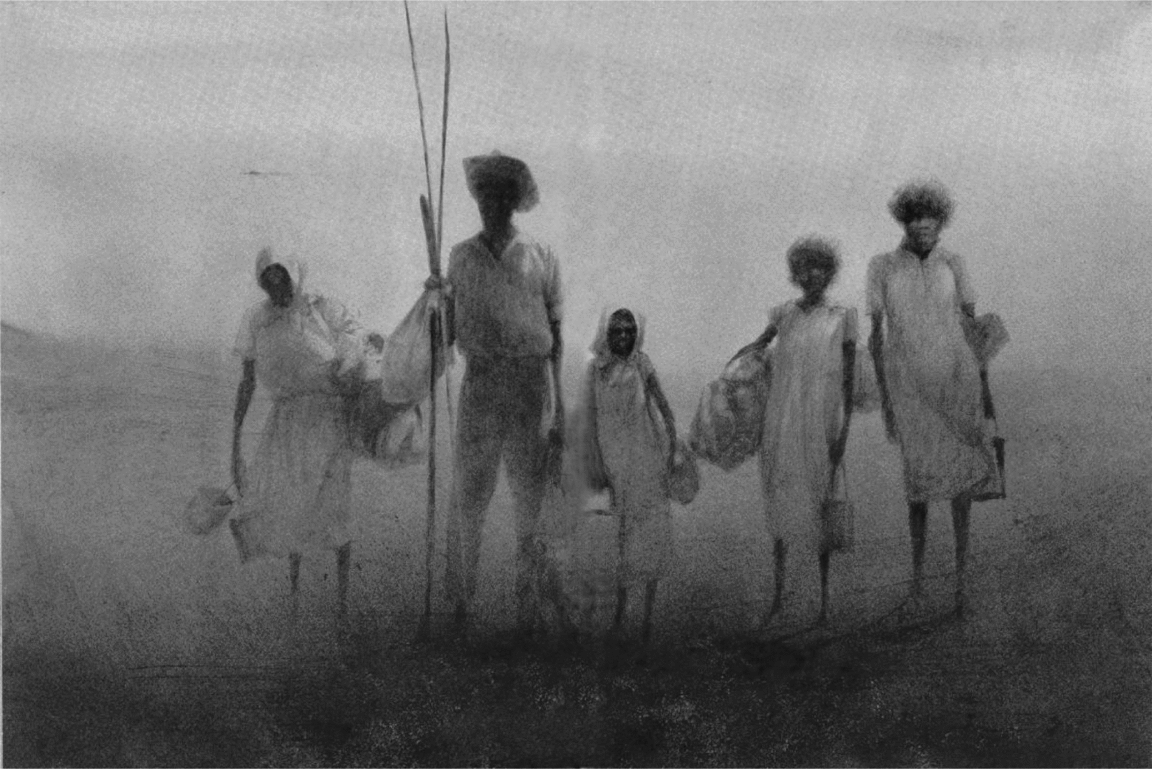
We also learn through a gathering of men in a country pub (hotel) about a ‘massacre in the west, barest details guess the rest’ and a link is drawn between this event and the origins of the drover's and woman's relationship. The image accompanying the story of the massacre shows an Aboriginal family appearing as refugees, dressed in white, coming from the bush seeking help (see Figure 1; Egan & Ingpen, Reference Egan and Ingpen1997).
Image from The Drover's Boy (Egan & Ingpen, Reference Egan and Ingpen1997).
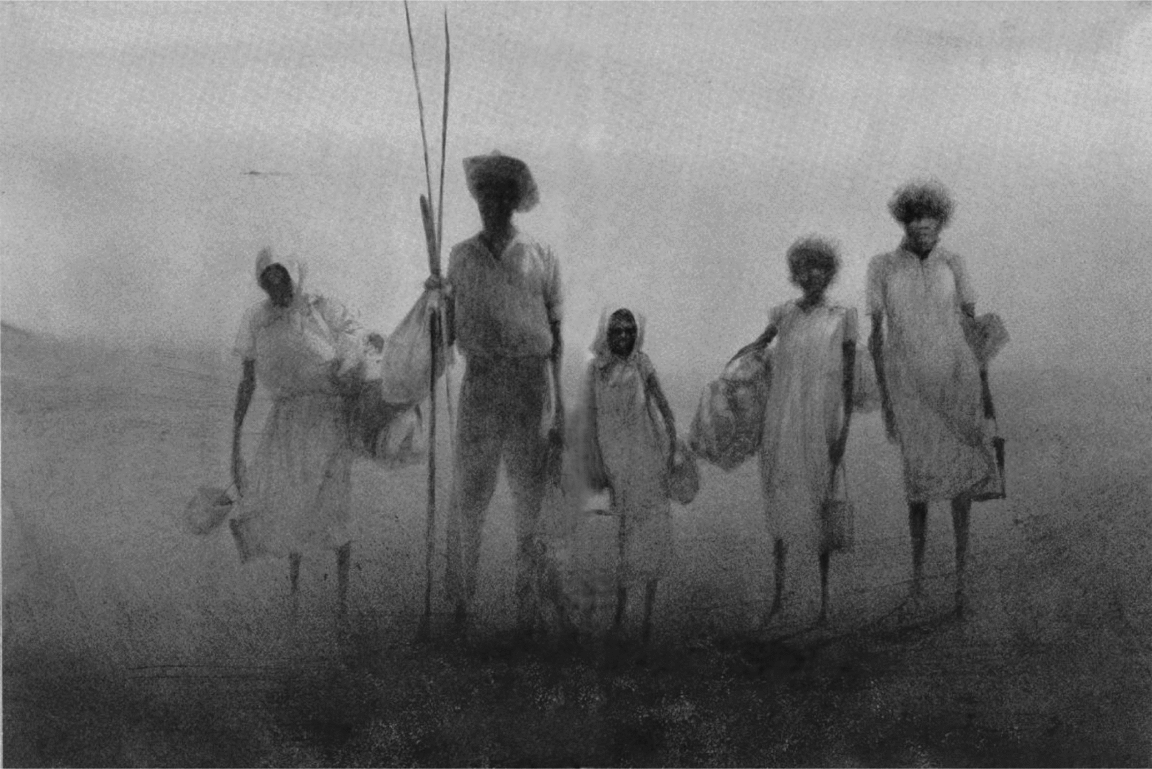
We, the readers and viewers, are positioned as benevolent onlookers and invited to come to their aid. The Aboriginal family has travelled a vast distance and are victims of some unknown violence — a violence from another place, another time, and perpetrated by another person.
The images in this book tell a gentle story. They show the soft side of this hard drover. His pain is visible in mourning. He is represented as a man who took in this Aboriginal woman and gave her a life that was better than she could have expected otherwise. As teacher educators we read the story while the images are projected onto a screen, pause, then ask, ‘Did he love her?’ This question is quite jarring for many of the teacher candidates and there is usually a few moments of silence while minds race and candidates gather their thoughts. The question is not one they expected. This is a university. Where does love belong here and what is this question of love in racial relationships? White Australians know how to play the game of historical engagement. We do not ask questions of love. The question comes as a surprise on top of a story that has already caused some disequilibrium, because while it may be part of Australian history, it is not the part they learnt about at school. However, as Biermann and Townsend-Cross (Reference Biermann and Townsend-Cross2008) note, a key part of ‘active unlearning’ is ‘presenting previously marginalised historical accounts, legal insight and social commentary’ (p. 150). Unlearning begins when the unanticipated, the occluded, the silent and the invisible are made visible, listened to, examined and engaged with on terms defined by those who are not at the centre.
Some teacher candidates are shocked at the story. Like The Hunger Games, the story seems absurd. Other students have not, until the very end, worked out that the boy is a woman. Some are relieved to discover that the boy is really a woman because if the drover's relationship had been with a boy it would clearly be wrong. The heteronormative nature of the relationship opens up a strong possibility that the Aboriginal woman wanted to be with the drover. Force, in this circumstance, must be proven! Again, as with The Hunger Games, the act of participation is taken as consent. No questions are asked.
Many of the teacher candidates, but definitely not all, will argue a case for the affirmative: ‘yes he loved her! He was so sad when she died’ they often say. Discussion ensues and can go in many different directions, but at some point their attention is directed to a second artistic representation of the story (Marchant et al., Reference Marchant, Egan and Evans1995).
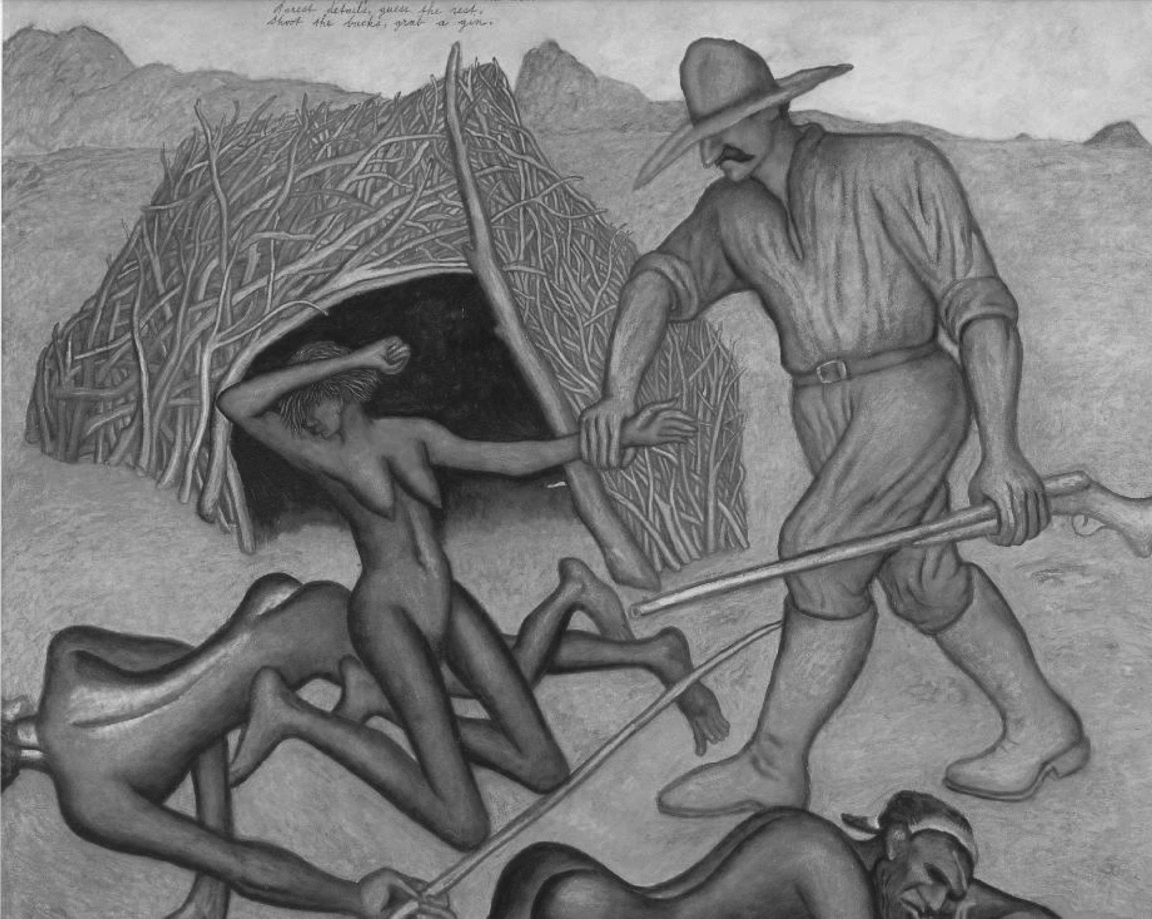
The images of the second version (see Figure 2) are starkly different from the first and tell us a different story even while the words remain the same. The soft colours of the previous version's images are replaced with reds and browns, and dark lined faces. The teacher candidates have frequently said that this set of images ‘portray an anger’. In this version we see acts of violence. We do not have to ‘guess the rest’. We are not drawn into the idea that some unknown force has massacred Aboriginal people and that we could save them. We, the viewers, are positioned differently in the second version, as if we are part of the massacre, and the drover is seen violently pulling the woman from her home and cutting her hair.
Image from ‘The Drover's Boy’ series of paintings (Marchant, Egan, & Evans, Reference Marchant, Egan and Evans1995).

After the second reading, the same question is asked: ‘Did he love her?’ At this point, many students who initially said ‘yes’ alter their response. Importantly, discussion arises from some critical questions.
• How do the different images act upon you to produce different types of responses?
• What stories are the artists trying to tell?
• What happens to knowledge and understanding of our lives in Australia when we do not tell Indigenous histories and perspectives?
• What does it mean to paint History White?
• For whom do we speak?
• For whom do we mourn? (Butler, Reference Butler2004)
• Why do we choose to tell some and not other cultural stories and histories?
• What happens to the children we teach when we only tell some histories and perspectives?
• How can we begin to ‘think what we do’ so we are less inclined to thoughtless injustice?
• How do we learn to take responsibility?
It is hoped that through participating in this activity the teacher candidates are shifted from thinking solely about what they will teach (content), how they will teach (pedagogy) and why they believe they are teaching (this is often limited to preparation for university or the world of work), to beginning to think what they do and to take responsibility. There are always a number of students who tell us that this encounter with the other and their own otherness, through experience and through disequilibrium, changes what they do with what they have learnt at the university and in their lives up to that point. These students begin to understand that the invisibility of their own privilege and its concomitant dominance of others is culturally produced and actively maintained through the choices they make and the practices in which they engage as beginning teachers and as citizens more broadly. Some tell us that they begin to learn to see the invisibility, or the absent presence, of whiteness and privilege in mainstream education, culturally produced expectations of Indigenous and non-Indigenous students and culturally determined obligations of teachers. They begin to ask questions about what is missing, what has been ‘left out’, and what might be the impact of what is visible. Thinking for these students becomes plural.
The teacher candidates, having been moved by the different visual representations, have learnt something of their shared history with Indigenous Australians. It is a more complicated history than many had previously imagined. It is a history whose representation has been dominated by those with power. The stark difference of the images, brought into even sharper relief by the sameness of the words, calls into question the ways in which representation works upon the viewer and calls her, invites him, into a discourse that maintains privilege.
Most, but not all, have also learnt that they cohabit the world with others with whom, and for whom, they have responsibility. To nullify another's existence, to erase their stories, or to ‘eradicate the plurality of life’ (Butler, Reference Butler2011, p. 288) is to participate in the unthinkable and to refuse responsibility. Through participation in this activity, teacher candidates are reminded that they too are culturally and historically located. They are reminded that having had their consciousness awakened, they now have a choice about how they will respond and that their response risks the potential of being seen as absurd, unjust and ‘unthinking’, or as ethical, responsible and just, by those who come after. After this day, many teacher candidates start the journey, as former Australian Prime Minister Paul Keating stated in his 1992 Redfern Park speech, ‘ever so gradually . . . to see Australia through Aboriginal eyes’ (Keating, Reference Keating1992).
This activity works to ‘unveil a compelling reality to students’ (Shor & Freire, Reference Shor and Freire1987, p. 43). However, people are often ‘moved by things other than simply the force of critical analysis’ (Yates, Reference Yates1992, p. 126) and so it is vital that these new understandings are followed up by both affective and practical support. This is particularly the case in working through how these beginning teachers will respond to policies and practices determined at the local, state and federal level, where trends towards simple and pre-packaged approaches to the improvement of educational outcomes for Indigenous students appear to be growing.
The Aboriginal educator and education activist, Chris Sarra, articulated the dangers of racing to simple solutions. In his keynote address at the Strong Start Bright Futures Conference in Darwin in 2011, he noted the following about one particular program that has been toted as the best way forward in Indigenous education:
A very scripted curriculum program like Englemann's Direct Instruction would never be embraced at Brisbane Grammar [an elite private school in Queensland, Australia], or any other high expectations learning environment, because it can only go as far as the script, written by some old guy in the USA, allows. This is a pedagogy for the poor that might deliver results that enable us to take up roles as domestics, farmhands or relatively unskilled workers, but can never seriously deliver an education that enables our children to be excellent. It undermines the learning potential of children and it severely undermines the teaching potential and professional integrity of teachers. It is an approach pursued only in places where we have surrendered our ability to attract quality teachers, and relinquished, if it existed at all, our capacity to perceive Aboriginal learners as potentially excellent. (Sarra, Reference Sarra2011, p. 7)
One is reminded here of President Snow's insight that hope is more powerful than fear, but that it needs to be contained because too much hope is dangerous. Narrowly defined interventions will produce narrow outcomes, at least in the short term. As Osborne's (Reference Osborne2013) retelling of the stories of Andy, Nganyinytja and Sheila reminds us, excellence and achievement comes through multiple pathways and formal education may be only a small part of that. A ‘strong sense of agency for voice, action and change, of capacity to aspire, and to imagine a future worth fighting for’ (Osborne, Reference Osborne2013, p. 178) are vital foundations for success and for lives well lived. Fogarty and Schwab (Reference Fogarty and Schwab2012), two other educators who seek to respond to the world in its plurality note:
In a time of increasingly strident programs related to English literacy and numeracy, and a desperate desire to close the gap in Indigenous education, it is important to continue to watch what is happening on the ground [in the world] between educators, local employment and development work, and Aboriginal people. We are currently seeing a re-emergence of educational programs that are geared to the reality of their locale and based on a blend of experiential and generic learning approaches. (p. 18)
Likewise, McCollow highlights, among other things, an emerging resistance to the polarisation of debates around different pedagogical approaches to literacy and numeracy, and the articulation of ‘a balanced approach’ (Reference McCollow2012, p. 107) in recent policy and practice. However, there remain some influential educators, politicians and commentators who continue to link different pedagogical approaches to specific political ideologies. Some refuse to engage with the powerful educative potential of any pedagogy deemed to be outside their own ideological standpoint. As teacher educators, our role is to continue to assist beginning teachers to ‘think in the plural’, to not close down debate, and to take responsibility in the world as it appears, not as an abstracted reality upon which actions are performed.
Conclusion
We live in a time of compliance but also in a time of resistance. Under the urge for compliance, value is determined by one's capacity to comply with ideologically construed and narrowly defined sets of norms rather than by one's capacity to think, to question, to disclose, and to act with one another. Ironically, current moves to compliance as a determiner of merit or value are being imposed upon Indigenous students and their teachers at precisely the same time as those occupying dominant roles within the economy and society are making claims that it is creativity and divergent thinking that will be the new currency. Although some advocate for the narrowing of the curriculum for Indigenous students and students in the most disadvantaged schools to ensure they ‘get the basics’, the already advantaged are simultaneously funded in ways that allow them to broaden and extend the curriculum so they are best able to become the leaders in an economy where ideas count. Effective education is vital for all young people and especially for those who are most disenfranchised. Under the urge for resistance is a determination to ‘shift the sense of Aboriginal identity, values and cultural norms in schools from one that is distanced to one that is centred’ (Osborne, Reference Osborne2013, p. 179).
Teaching is more than instrumental actions. It incorporates all of the person in relationship with others. As teacher educators, we understand ourselves as having a responsibility to respond to the world in its plurality, as it appears to us. We also understand ourselves as having a responsibility that extends beyond instrumental concerns and sets of pedagogic practices to assist teacher candidates to ‘think what they do’ and to ‘take responsibility’. Only when we engage in a process of critical clinical praxis, taking seriously the need to examine our practices both theoretically and morally for the impact they have on others, will we stop endlessly following (or worse still creating) the next best thing in education. The challenge is large but not impossible.
Acknowledgments
The authors would like to thank the many students who participated in the activity over the years and whose thoughtful and thought-provoking feedback often challenged and helped refine our own thinking and practices.
About the Authors
Barbara Kameniar is Program Director of the Academic Enrichment Program at Murrup Barak, Melbourne Institute for Indigenous Development at The University of Melbourne. She was formerly Program Director of the Master of Teaching Secondary program. Barbara has researched and published in the area of Indigenous early childhood education, whiteness, religion and education, and is currently examining ways in which to best support the transition of Indigenous young people into university.
Sally Windsor is a Lecturer in Humanities Education at the Melbourne School of Graduate Education at The University of Melbourne. She teaches in the Masters of Teaching program in the areas of Educational Psychology, Sociology and Indigenous Education and is currently completing a doctoral thesis examining teaching pathways designed to address disadvantage.
Sue Sifa is currently Principal at Raukkan Aboriginal School. She was previously a member of the Secondary Indigenous Education Team Catholic Education, South Australia.