Introduction
An estimated 1.5 million individuals are infected with HIV in the United States (US CDC, 2011). While highly active antiretroviral therapy (HAART) has resulted in decreased morbidity and mortality among HIV infected (HIV+) individuals (Valcour, Reference Valcour2013), cognitive impairments persist. However, prior clinical trials using adjunctive therapies to reduce cognitive impairment have had limited success (McGuire, Barrett, Vezina, Spitsin, & Douglas, Reference McGuire, Barrett, Vezina, Spitsin and Douglas2014). Since HIV-associated neurocognitive disorders (HAND) are still prevalent (as high as 50%) (Heaton et al., Reference Heaton, Clifford, Franklin, Woods, Ake and Vaida2010; Simioni et al., Reference Simioni, Cavassini, Annoni, Rimbault Abraham, Bourquin, Schiffer and Du Pasquier2010), research on alternative therapies and/or healthy lifestyle factors (e.g., exercise) on HIV-related dysfunction are necessary as HIV+ individuals continue to live longer.
Regular engagement in aerobic physical activity (PA) has been shown to improve cognitive function and brain health in normal aging populations (Chan, Yan, & Payne, Reference Chan, Yan and Payne2013; Chapman et al., Reference Chapman, Aslan, Spence, Defina, Keebler, Didehbani and Lu2013; Voss et al., Reference Voss, Prakash, Erickson, Basak, Chaddock, Kim and Kramer2010). Specifically, previous work has revealed that PA has neuroprotective effects as reported by delays in cognitive decline, improved neuropsychological performance (NP), and reduced atrophy in the hippocampus and prefrontal cortex (Chapman et al., Reference Chapman, Aslan, Spence, Defina, Keebler, Didehbani and Lu2013; Erickson, Leckie, & Weinstein, Reference Erickson, Leckie and Weinstein2014). The benefits of PA on brain integrity (cognitive performance and brain structure) have been extensively investigated in a variety of neurodegenerative conditions (e.g., Alzheimer’s and Huntington’s disease) (Cruickshank et al., Reference Cruickshank, Thompson, Dominguez, Reyes, Bynevelt, Georgiou-Karistianis and Ziman2015; Honea et al., Reference Honea, Thomas, Harsha, Anderson, Donnelly, Brooks and Burns2009; Okonkwo et al., Reference Okonkwo, Schultz, Oh, Larson, Edwards, Cook and Sager2014), but not HIV.
Observed improvements in brain integrity due to PA may occur by direct and/or indirect pathways (Cade et al., Reference Cade, Reeds, Lassa-Claxton, Davila-Roman, Waggoner, Powderly and Yarasheski2008; Fazeli et al., Reference Fazeli, Woods, Heaton, Umlauf, Gouaux, Rosario and Group2014; Lee et al., Reference Lee, Wang, Jang, Steiner, Haughey, Ming and Venkatesan2011; Phillips et al., Reference Phillips, Ottaway, Freedman, Kardish, Li, Singer and Fong1997). PA can directly affect molecular targets in the brain through up-regulation of growth factors (Rojas Vega, Knicker, Hollmann, Bloch, & Struder, Reference Rojas Vega, Knicker, Hollmann, Bloch and Struder2010; Voss et al., Reference Voss, Prakash, Erickson, Basak, Chaddock, Kim and Kramer2010; Whiteman et al., Reference Whiteman, Young, He, Chen, Wagenaar, Stern and Schon2014). These changes within the brain can lead to increases in neuronal survival and neurogenesis. PA can also have indirect effects on general health by improving physical fitness (cardiorespiratory capacity, muscle strength, and muscle mass) and attenuate atherosclerosis. These changes can lead to improved insulin control and decreased inflammation (Rojas Vega et al., Reference Rojas Vega, Knicker, Hollmann, Bloch and Struder2010; Whiteman et al., Reference Whiteman, Young, He, Chen, Wagenaar, Stern and Schon2014). Altogether, a healthy lifestyle with regular PA could provide benefits to HIV+ individuals where immune systems are known to be chronically compromised (Friis-Moller et al., Reference Friis-Moller, Thiebaut, Reiss, Weber, Monforte and De Wit2010; Nogueira Pinto, Reference Nogueira Pinto2005).
To date, most studies of PA in HIV+ individuals have focused on changes in body morphology and metabolism (Cade et al., Reference Cade, Overton, Mondy, de las Fuentes, Davila-Roman, Waggoner and Yarasheski2013, Reference Cade, Reeds, Lassa-Claxton, Davila-Roman, Waggoner, Powderly and Yarasheski2008; Yarasheski et al., Reference Yarasheski, Laciny, Overton, Reeds, Harrod, Baldwin and Davila-Roman2012, Reference Yarasheski, Scherzer, Kotler, Dobs, Tien and Lewis2011). Only a few have investigated relationships between PA and cognition (Cade et al., Reference Cade, Overton, Mondy, de las Fuentes, Davila-Roman, Waggoner and Yarasheski2013; Dufour et al., Reference Dufour, Marquine, Fazeli, Henry, Ellis, Grant and Group2013; Fazeli et al., Reference Fazeli, Woods, Heaton, Umlauf, Gouaux, Rosario and Group2014; Gomes-Neto, Conceicao, Oliveira Carvalho, & Brites, Reference Gomes-Neto, Conceicao, Oliveira Carvalho and Brites2013). Two studies reported a positive correlation between PA and cognition in HIV+ individuals, however, PA was defined as any activity that increased heart rate over the previous 72 hr (Dufour et al., Reference Dufour, Marquine, Fazeli, Henry, Ellis, Grant and Group2013; Fazeli et al., Reference Fazeli, Woods, Heaton, Umlauf, Gouaux, Rosario and Group2014). An additional study found a positive correlation between maximal oxygen uptake (VO2 MAX) on a treadmill test and cognitive performance in HIV+ individuals (Mapstone et al., Reference Mapstone, Hilton, Yang, Guido, Luque, Hall and Shah2013). These studies suggest that a physically active lifestyle is beneficial; however, PA measurements have typically not measured sustained engagement in exercise.
In the present study we used neuroimaging and neuropsychological measures to determine if a physically active lifestyle provides benefit to brain integrity in HIV+ individuals. We used a validated quantitative exercise history questionnaire to calculate weekly metabolic equivalent (MET) hr of PA and measured brain integrity (cognition and brain volumetrics) within a cohort of physically active and sedentary HIV+ individuals. We hypothesized that physically active HIV+ individuals would exhibit better cognitive performance, compared to sedentary individuals. In addition, we hypothesized larger brain volumes among physically active HIV+ individuals compared to sedentary HIV+ individuals.
Methods
Participants
Seventy HIV+ individuals were recruited from the Infectious Disease Clinic at Washington University in St. Louis (WUSTL). All participants provided informed consent using forms approved by the WUSTL Institutional Review Board. Participants were excluded if they reported a history of head injury with loss of consciousness >30 min, major psychiatric disorders, opportunistic CNS infections, or contraindications for MRI scanning.
Neuropsychological Performance Testing
All participants were administered a brief neuropsychological (NP) battery (including Trail Making Tests A and B (TMT-A and TMT-B) (Reitan, Reference Reitan1958), Hopkins Verbal Learning Test-Revised (HVLT-R) (Benedict, Schretlen, Groninger, & Brandt, Reference Benedict, Schretlen, Groninger and Brandt1998; Brandt & Benedict, Reference Brandt and Benedict2001), Digit-Symbol Modalities Test (DSMT) (Wechsler, Reference Wechsler1997), letter fluency (FAS) (Spreen & Benton, Reference Spreen and Benton1963), verb fluency (VF) (Piatt et al., Reference Piatt, Fields, Paolo and Troster1999), and Grooved Pegboard non-dominant (GPn) (Matthews & Klove, Reference Matthews and Klove1964) to assess cognitive domains commonly affected by HIV (Baker et al., Reference Baker, Paul, Heaps, Westerhaus, Chang, Williams and Ances2014; Overton et al., Reference Overton, Kauwe, Paul, Tashima, Tate, Patel and Clifford2011; Tozzi et al., Reference Tozzi, Balestra, Salvatori, Vlassi, Liuzzi, Giancola and Antinori2009). Performance on each neuropsychological test was converted to a standardized score (Z-score) based on published normative data with adjustments applied for age and where available, ethnicity, education, and/or sex (Au et al., Reference Au, Seshadri, Wolf, Elias, Elias, Sullivan and D’Agostino2004; Gladsjo et al., Reference Gladsjo, Schuman, Evans, Peavy, Miller and Heaton1999; Norman et al., Reference Norman, Moore, Taylor, Franklin, Cysique and Ake2011). Standardized cognitive scores were grouped into two primary domains for analyses based on previous studies: executive function (NPZe) was defined by HVLT-R learning efficiency, TMT-B, and FAS, and verb fluency while motor function (NPZm) was comprised of the DSMT, TMT-A, and GPn. NPZe and NPZm scores were derived based on prior studies in HIV- and HIV+ individuals (Duff, Schoenberg, Scott, & Adams, Reference Duff, Schoenberg, Scott and Adams2005; Parsons, Rogers, Hall, & Robertson, Reference Parsons, Rogers, Hall and Robertson2007; Vanderploeg, Schinka, & Retzlaff, Reference Vanderploeg, Schinka and Retzlaff1994; Woods et al., Reference Woods, Scott, Dawson, Morgan, Carey and Heaton2005). Individuals were not screened for HAND in the current study.
Substance Use
Lifetime substance use was evaluated using the Risk Assessment Battery (RAB). The RAB is a self-administered questionnaire designed for substance-abusing populations to assess HIV risk behavior (Metzger, Nalvaline, & Woody, Reference Metzger, Nalvaline and Woody2001). In the present study, we used a modified version of the RAB to determine the percentage of individuals in our sample that have engaged in substance use (alcohol, crack/cocaine, methamphetamines, opiates) in their lifetime. Additionally, current tobacco use was determined by self-report.
Physical Activity Quantification
A self-reported exercise questionnaire was used to quantify PA over the past year. Aerobic activity (running, walking, and jogging) history from the previous year including frequency and duration of exercise workouts was obtained from a standard questionnaire (Bowles, FitzGerald, Morrow, Jackson, & Blair, Reference Bowles, FitzGerald, Morrow, Jackson and Blair2004). Responses from questions were used to determine standardized MET values based on a compendium of various PAs (Bowles et al., Reference Bowles, FitzGerald, Morrow, Jackson and Blair2004; Bugg & Head, Reference Bugg and Head2011; Liang et al., Reference Liang, Mintun, Fagan, Goate, Bugg, Holtzman and Head2010; Pizzie et al., Reference Pizzie, Hindman, Roe, Head, Grant, Morris and Hassenstab2014; Head, Singh, & Bugg, Reference Head, Singh and Bugg2012; Berchicci, Lucci, Perri, Spinelli, & De Russo, Reference Berchicci, Lucci, Perri, Spinelli and Di Russo2014). Specifically, the MET-hr/week was calculated by multiplying the exertion rate (METs) for the PA by time engaged in the PA as a weekly average per year. For example, an individual who reported walking (a 4.0 MET activity) for 0.5 hr twice a week (2× a week), 6 months of the year would have a yearly average of 2.0 MET-hr/week of exercise for the year (Ainsworth et al., Reference Ainsworth, Haskell, Whitt, Irwin, Swartz, Strath and Leon2000; Bowles et al., Reference Bowles, FitzGerald, Morrow, Jackson and Blair2004). Participants were split into two groups—physically active (n=22) and sedentary (n=48)—based on self-reported history of engagement in PA. Individuals who did not report any exercise in the past year were classified as sedentary (MET-hr <1). Physically active HIV+ individuals were defined as expending energy above resting energy expenditure and had a reported weekly MET-hr ≥1 (Park et al., Reference Park, Miyashita, Takahashi, Kawanishi, Hayashida, Kim and Nakamura2014). The questionnaire was designed to accommodate both increased intensities (METs) and durations such that both athletes and casual walkers were accurately assessed.
Neuroimaging
All participants had neuroimaging performed on a 3 Tesla Siemens Tim Trio whole body MR scanner (Siemens AG, Erlangen, Germany) with a 12-channel transmit/receive head coil. Sagittal-oriented structural images were acquired using a T1-weighted three-dimensional magnetization-prepared rapid acquisition gradient echo (MPRAGE) sequence [time of repetition (TR) = 2400 ms, echo time (TE) = 3.16 ms, inversion time (TI) = 1000 ms, flip angle = 8°, 162 slices, and voxel size = 1×1×1 mm3].
Quantification of regional volumes was obtained using the FreeSurfer software suite (v5.1) (Martinos Center, Harvard University, Boston, MA; http://surfer.nmr.mgh.harvard.edu). Briefly, this freely available automated software program transformed MPRAGE images of an individual into a template space with the skull stripped and the brain segmented into white matter, gray matter, and ventricles. The brain was further parcellated into subcortical and cortical regions of interest (ROIs) using a surface deformation onto a common atlas (Dale, Fischl, & Sereno, Reference Dale, Fischl and Sereno1999; Desikan et al., Reference Desikan, Segonne, Fischl, Quinn, Dickerson, Blacker and Killiany2006; Fischl, Sereno, & Dale, Reference Fischl, Sereno and Dale1999). We analyzed brain regions commonly affected by HIV including the caudate, putamen, hippocampus, total gray matter, and total white matter (Ances, Ortega, Vaida, Heaps, & Paul, Reference Ances, Ortega, Vaida, Heaps and Paul2012). All brain regions were normalized to the intracranial volume across the entire cohort to account for potential variations in participant head size (Free et al., Reference Free, Bergin, Fish, Cook, Shorvon and Stevens1995).
Statistical Analyses
Demographic and clinical characteristics [age, education, recent and nadir CD4 count, HIV viral load, duration of infection, sex, and intracranial volume (ICV)] were compared between the two groups using the Wilcoxon rank-sum test for continuous variables, and Fisher’s exact test for binary and categorical variables.
The neuropsychological composite scores for executive (NPZe) and motor (NPZm) domains were compared between the physically active and sedentary groups in unadjusted and adjusted analyses. The unadjusted analyses used the independent samples t-test with pooled variance. The adjusted analyses corrected for the effect of confounders using multiple linear regression. The possible confounders considered were: recent and nadir CD4, viral load (log10-transformed and detectable/undetectable, with 20 copies/mL limit of detection), duration of infection, HAART, and body mass index (BMI). Since NPZe and NPZm composite scores had been already adjusted for age, sex, race, and education, these variables were not considered as confounders in the adjusted analyses. The model building strategy for the adjusted analyses was as follows: the starting multiple regression model for each outcome included the exercise group indicator and all covariates that were significant at p<.20 level in single-predictor analyses for that outcome. Then stepwise backward model selection was used, with a p<.20 threshold for inclusion in the final model (Vittinghoff, Glidden, Shiboski, & McCulloch, Reference Vittinghoff, Glidden, Shiboski and McCulloch2012). The association between exercise and NPZe and NPZm scores in the physically active group was examined using Pearson’s correlation.
The brain volumetrics for each of the five regions of interest were compared between the two groups using a similar approach as for neuropsychological outcomes, in unadjusted analyses, and adjusting for confounders using backward model selection with a threshold of inclusion of p<.20. The candidates for inclusion in the multivariable model were those mentioned above, in addition to age, sex, race, and education.
The relationship between each of the five regional brain volumes and each of the two composite NP scores (NPZe, NPZm) for the two groups combined was assessed using the Pearson correlation coefficient, including 95% confidence intervals. The test of no correlation was conducted both without controlling for multiple comparisons and with a Benjamini-Hochberg correction for 10 comparisons (Benjamini and Hochberg, Reference Benjamini and Hochberg1995). The normality of the outcome variables was confirmed with Shapiro-Wilk tests (all p>.1) (Shapiro & Wilk, Reference Shapiro and Wilk1965).
Results
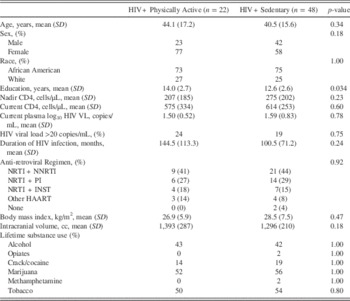
The physically active (n=22) and sedentary (n=48) HIV+ groups were similar with respect to demographic (age, sex, and ethnicity) and HIV-related variables (nadir and recent CD4 cell count, viral load, HAART, and duration of infection). The physically active group had higher education overall (14.0 years vs. 12.6 years; p-value=.034; Table 1). Additionally, both groups had similar reported current smoking status and lifetime drug use (Table 1). Most HIV+ individuals were on a stable HAART regimen (96%) and 80% of the individuals overall had undetectable plasma HIV viral loads (<20 virus copies/mL).
Demographic and clinical characteristics for physically active and sedentary HIV+ individuals

Note. Comparisons used Wilcoxon rank-sum test for continuous variables, and Fisher’s exact test for binary and categorical variables.
SD=standard deviation, VL=viral load, NRTI=nucleoside reverse transcriptase inhibitor, NNRTI=non-nucleotide reverse transcriptase inhibitor, PI=protease inhibitor, INSTI=integrase strand transfer inhibitor; HAART=highly active antiretroviral therapy.
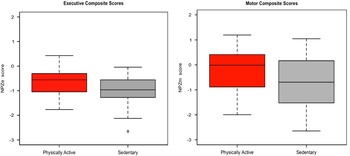
NPZ composite scores for both the executive and motor domains were higher in the physically active group compared to the sedentary HIV+ group. The difference was significant for the NPZe scores, in both unadjusted and adjusted analyses (Table 2 and Figure 1). Specifically, mean NPZe scores were −0.65 and −0.96 for physically active and sedentary groups, respectively (t[68]=2.09; p=.040). The adjusted analysis using a stepwise multiple regression model, adjusting for log10 viral load (VL), revealed an effect of physical activity on NPZe (exercise mean effect=+0.29; p=.043, Table 2). While the physically active group had higher mean NPZm scores than the sedentary group (−0.33 and −0.83, respectively), this difference was not significant (t[68]=1.40; p=.17) (Figure 1). No adjusted analysis was necessary for comparison of NPZm, as all univariate predictors were above the inclusion cut-off (p>.20).
Effects of aerobic exercise on neuropsychology performance in HIV+ individuals. Neuropsychological composite Z-scores for the executive (NPZe, left panel) and motor domains (NPZm, right panel), by physical activity groups. The mean Z-scores for executive function performance were higher in physically active compared to sedentary HIV+ individuals (p=.040 unadjusted). However, within the motor tests the sedentary and physically active groups had similar performance (p=.17, unadjusted).

Neuropsychological composite scores for executive (NPZe) and motor (NPZm) domains comparison between the physically active and sedentary HIV+ groups in unadjusted and adjusted analyses

Note. Adjusted analyses control for confounders significant at p>0.20 level in backward model selection. Final model for NPZe adjusted for log10 viral load. Final model for NPZm did not adjust for covariates, since none of them met the p>0.20 threshold of significance.
* Statistically significant correlation.
PA=physically active; SD=standard deviation; CI=confidence interval.
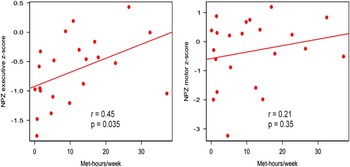
We further examined the association between the continuous measure of exercise engagement (MET hr/week) and NPZe or NPZm in the physically active group. The total amount of weekly exercise activity in METs was significantly positively correlated with NPZe (Pearson’s r=0.45, [95% confidence interval {CI}, 0.04, 0.73], p=.035), but not NPZm (r=0.21, 95% CI [−0.23, 0.58], p=.35) (Figure 2).
Relationship between neuropsychological performance and aerobic exercise within physically active HIV+ individuals. Scatterplots and linear regression slopes for NPZ by weekly Met-hr/week for the physically active cohort. (Left) NPZe scores were significantly positively correlated to amount of physical activity (PA) (p=.035). (Right) NPZm scores were not correlated to PA. Adjusted R-values are shown for both figures.

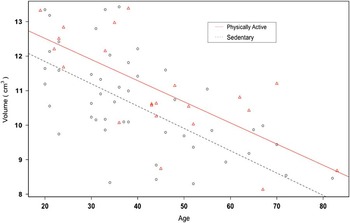
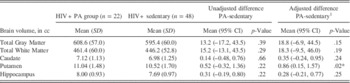
We found no volume differences between the exercise groups in the five brain regions of interest examined using independent sample t-tests (Table 3). However, there was a statistically significant difference between the two groups in the putamen in the adjusted analyses, but not for the other four regions. The putamen volume was significantly larger in the physically active group, by 0.86 cm3 (cc) 95% CI (0.15 cc, 1.57 cc), p=.019 (Table 3). In the adjusted model, that also included age, sex, and nadir CD4, older age was significantly correlated with smaller putamen volumes (p<.001) (Figure 3). For both physically active and sedentary HIV+ individuals, brain volume decreased with age at similar rates (p-value for age-by-PA interaction=0.41), but physically active HIV+ individuals had larger putamen volumes at any age. The estimated additive effect of exercise was equivalent to 14.1 fewer years of age, such that a 30-year-old sedentary HIV+ individual was equivalent to a 44-year-old physically active HIV+ individual.
Physically active individuals have a larger putamen than sedentary individuals across the age-span. Reduced physical activity (p=.043) and older age (p<.001) are independently associated with smaller putamen volumes. Physically active individuals: triangles, solid line; sedentary individuals: circles, dashed line.

Comparison of the five brain regions between the physically active and sedentary HIV+ groups, in unadjusted and adjusted analyses

Note. Adjusted analyses control for confounders significant at 0.20 level in backward model selection. All brain volumes are normalized for intra-cranial volume. Final adjusted (multivariable) model is controlling for the following covariates. Total gray matter: age, sex, education. Total white matter: age, sex, education. Caudate: age, nadir CD4, log10 viral load. Putamen: age, sex, nadir CD4. Hippocampus: age, education. For all five brain regions, age had a significant negative association with the brain volume.
* Statistically significant correlation.
PA, physically active; SD, standard deviation; CI, confidence interval
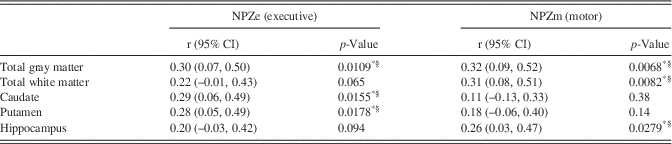
We examined the correlation of the brain volumes for the five brain regions with the composite neuropsychological scores (NPZe and NPZm). NPZe performance was modestly positively correlated to total gray matter (r=0.30; p=.011), caudate (r=.28; p=.016), and putamen (r=0.28; p=.018) volumes. Additionally, NPZm performance was associated with larger volumes of total gray matter (r=0.32; p=.007), total white matter (r=0.31; p=.008), and hippocampus (r=0.26; p=.028). All these associations remained statistically significant after correction for multiple comparisons keeping the false discovery rate level at 0.05 (Benjamini and Hochberg, Reference Benjamini and Hochberg1995).
Discussion
In the present study, results revealed that physically active HIV+ individuals had better executive function than sedentary HIV+ individuals. Additionally, results revealed that NPZe was positively associated with MET values of exercise. Physically active HIV+ individuals additionally had larger putamen volumes compared to sedentary HIV+ individuals. Lastly, executive and motor performance were associated with brain volumetrics across both groups.
Studies in seronegative individuals have demonstrated that PA benefits executive function and task switching (Barnes, Yaffe, Satariano, & Tager, Reference Barnes, Yaffe, Satariano and Tager2003). However, relatively few studies have investigated these relationships, with most using only acute measures of current activity (Dufour et al., Reference Dufour, Marquine, Fazeli, Henry, Ellis, Grant and Group2013; Fazeli et al., Reference Fazeli, Woods, Heaton, Umlauf, Gouaux, Rosario and Group2014; Mapstone et al., Reference Mapstone, Hilton, Yang, Guido, Luque, Hall and Shah2013). We captured PA values for aerobic activities over the past year with a concentration on running, walking, and jogging (Ainsworth et al., Reference Ainsworth, Haskell, Whitt, Irwin, Swartz, Strath and Leon2000; Bowles et al., Reference Bowles, FitzGerald, Morrow, Jackson and Blair2004). Our questionnaire was different than other studies that have typically used the international PA questionnaire (IPAQ), which focuses on activity over the past week. Intensive long-term exercise has been shown to lead to sustain benefits in neuropsychological performance in HIV- individuals (Dregan & Gulliford, Reference Dregan and Gulliford2013).
Results of the present study that that physically active HIV+ individuals may have better executive function than sedentary individuals, specifically since MET-hr/week was positively correlated to NPZe scores. These findings are similar to previous studies showing healthy lifestyles and PA was associated with greater working memory and cognitive benefits (Dufour et al., Reference Dufour, Marquine, Fazeli, Henry, Ellis, Grant and Group2013; Fazeli et al., Reference Fazeli, Woods, Heaton, Umlauf, Gouaux, Rosario and Group2014). However, the physically active HIV+ individuals did not perform significantly better on NPZm tests. The lack of relationship between PA and NPZm scores is similar to results observed in HIV- literature where exercise interventions improved executive function and working memory, but not motor performance (Barnes et al., Reference Barnes, Yaffe, Satariano and Tager2003; Chapman et al., Reference Chapman, Aslan, Spence, Defina, Keebler, Didehbani and Lu2013). Larger studies are still necessary to determine if PA attenuates cognitive decline by domain. Most importantly, NPZe was significantly positively correlated with amount of PA (Figure 2), thus larger gains and stronger effect sizes may be possible for those who increase the intensity or duration of aerobic PA.
Correlation of brain volumes for five regions of interest with neuropsychological composite scores for executive (NPZe) and motor (NPZm) domains in 70 HIV+ individuals (the two groups combined)

Note. Pearson correlation coefficient r (and 95% confidence intervals) and uncorrected p-values of the test of no correlation are given.
* Statistically significant correlation (uncorrected).
§ Statistically significant correlation after a Benjamini-Hochberg correction for multiple testing (all 10 tests)
Our neuroimaging findings indicate that physically active HIV+ individuals may have larger brain volumes in the putamen, a critical region affected by HIV (Ances et al., Reference Ances, Ortega, Vaida, Heaps and Paul2012; Pfefferbaum et al., Reference Pfefferbaum, Rosenbloom, Sassoon, Kemper, Deresinski, Rohlfing and Sullivan2012; Thompson et al., Reference Thompson, Dutton, Hayashi, Toga, Lopez, Aizenstein and Becker2005). Results are consistent with previous studies that have exhibited the benefits of exercise on brain volumes in HIV- individuals (Chapman et al., Reference Chapman, Aslan, Spence, Defina, Keebler, Didehbani and Lu2013; Law, Barnett, Yau, & Gray, Reference Law, Barnett, Yau and Gray2014). In particular, observed changes in putamen volume due to PA may be beneficial regardless of age for HIV+ individuals (Figure 3). These effects were not driven by BMI or duration of HIV infection, since these variables were not significantly contributing to the final adjusted model. However, since the effect of PA was limited to a single region, larger more comprehensive studies are needed to investigate the subtle effects of PA on brain integrity.
The volumetric results appear to fall outside of previous literature regarding correlations between the putamen and cognitive domains. Specifically, studies have defined the caudate as a region associated with executive function (Bonelli & Cummings, Reference Bonelli and Cummings2007; Paul et al., Reference Paul, Ernst, Brickman, Yiannoutsos, Tate and Cohen2008), however, we observed that larger putamen volume and better NPZe were seen in physically active HIV+ individuals. This result is supported by recent structural and functional MRI studies showing that anterior striatum (both caudate and putamen) areas receive projections from frontal cortex and are involved in task switching (Thames et al., Reference Thames, Foley, Wright, Panos, Ettenhofer, Ramezani and Hinkin2012; Walhovd et al., Reference Walhovd, Tamnes, Bjornerud, Due-Tonnessen, Holland, Dale and Fjell2015). Additionally, HIV infection is associated with greater atrophy in the anterior caudate and putamen (Becker et al., Reference Becker, Sanders, Madsen, Ragin, Kingsley, Maruca and Multicenter2011). Our volumetric methods only quantified total ROI volume, therefore, we cannot confirm whether PA ameliorated the anterior putamen. However, our NPZe results suggest a small protective effect on executive function may be associated with anterior striatum (Tziortzi et al., Reference Tziortzi, Haber, Searle, Tsoumpas, Long, Shotbolt and Gunn2014). Future studies mapping the morphology or functional changes occurring at the ROI level may resolve this ambiguity in a larger cohort.
Conclusions regarding the impact of PA on brain integrity should be tempered by several limitations of the present study. The calculated exercise measures result from a self-reported questionnaire and required individuals to recall details about their workout schedules during the past year. This may create a potential bias for athletic individuals with fixed exercise schedules and limit the ability for individuals that do not exercise in a consistent manner to recall the amount of exercise completed. Furthermore, due to a relatively small sample size, we were unable to test for differences between rigorous and low intensity exercise regimens. Future studies should perform physical function tests in addition to observational questionnaires to differentiate the effect and determine the amount of exercise necessary to have positive effects on brain integrity. Finally, it is important to note that the associations between PA and brain structure do not define a causal relationship, as it could also be argued that individuals with larger brain structures are more likely to be healthy and physically active. Nevertheless, well-controlled longitudinal studies examining the potential of PA to improve brain function among chronically infected HIV patients represents an important area of future work.
In summary, this cross-sectional study found modest beneficial effects of aerobic PA on brain structure and executive function in a HIV+ cohort. As the prevalence of HAND is likely to increase with age, it is important to find adjunctive therapeutic strategies to HAART. This study provides impetus to pursue larger longitudinal clinical trials to evaluate causality and the neuroprotective effects of exercise for HIV+ individuals.
Acknowledgments & Funding
The authors thank Jodi Heaps-Woodruff, PhD., Denise Head, PhD, Elizabeth Westerhaus, MA, and Gina Rhee for their assistance. This work was supported by the National Institutes of Health (NIH) (B.M.A., grant numbers R01NR12657, R01NR012907, R01NR014449, and R21MH0999979), Grossman Chancellor’s Fellowship (MO), the National Science Foundation (M.O., grant number IGERT 0548890), the Washington University School of Medicine Institute of Clinical and Translational Sciences (B.M.A., grant number UL1 TR000448), and Siteman Comprehensive Cancer Center and NCI Cancer Center Support Grant (P30 CA091842). The content is solely the responsibility of the authors and does not necessarily represent the official view of the NIH. Conflicts, or Potential Conflicts of Interest: The authors do not have a commercial or other association that might pose a conflict of interest (e.g., pharmaceutical stock ownership, consultancy, advisory board membership, relevant patents, or research funding). Drs. Ortega and Baker contributed equally to this work