Introduction
Generalized anxiety disorder (GAD) is a common psychiatric disorder that is characterized by excessive, uncontrollable worry and anticipatory anxiety. Recent epidemiological research estimates a lifetime prevalence of 4.1% (Grant et al. Reference Grant, Hasin, Stinson, Dawson, June Ruan, Goldstein, Smith, Saha and Huang2005) with significant impacts on healthcare systems (Hoffman et al. Reference Hoffman, Dukes and Wittchen2008). However, there have been relatively few studies of GAD compared with other psychiatric disorders (Dugas et al. Reference Dugas, Anderson, Deschenes and Donegan2010) and, in particular, very few functional imaging studies.
Recent functional magnetic resonance imaging (fMRI) studies have examined the response to emotional facial expressions in order to investigate the neural substrates of mood and anxiety disorders (Blair et al. Reference Blair, Shaywitz, Smith, Rhodes, Geraci, Jones, McCaffrey, Vythilingam, Finger and Mondillo2008; Lee et al. Reference Lee, Seok, Lee, Cho, Yoon, Lee, Chae, Choi and Ham2008a; Matthews et al. Reference Matthews, Strigo, Simmons, Yang and Paulus2008). A review of emotional processing in mood disorders reported that patients with major depressive disorder (MDD) generally show bias toward negative emotional stimuli and away from positive stimuli (Leppanen, Reference Leppanen2006). Compared with controls, patients with MDD show an increased blood oxygen level dependent (BOLD) signal in the amygdala and ventral striatum to increasingly sad stimuli and a decreased BOLD signal in these areas to increasingly happy stimuli (Leppanen, Reference Leppanen2006). However, another study specifically looking at fMRI face emotion processing results in patients with MDD found attenuation in frontolimbic and subcortical regions in response to negative (sad, angry) facial expressions (Lee et al. Reference Lee, Seok, Lee, Cho, Yoon, Lee, Chae, Choi and Ham2008a).
In studies of face processing in participants with GAD, the most consistent finding has been an increased ventrolateral prefrontal cortex (VLPFC) and/or anterior cingulate cortex (ACC) BOLD signal to negative face emotions (Monk et al. Reference Monk, Nelson, McClure, Mogg, Bradley, Leibenluft, Blair, Chen, Charney, Ernst and Pine2006, Reference Monk, Telzer, Mogg, Bradley, Mai, Louro, Chen, McClure-Tone, Ernst and Pine2008; McClure et al. Reference McClure, Adler, Monk, Cameron, Smith, Nelson, Leibenluft, Ernst and Pine2007; Blair et al. Reference Blair, Shaywitz, Smith, Rhodes, Geraci, Jones, McCaffrey, Vythilingam, Finger and Mondillo2008). The prefrontal cortex and the ACC both have connections to the amygdala and have been implicated in emotional processing (Hariri et al. Reference Hariri, Mattay, Tessitore, Fera and Weinberger2003; Ochsner et al. Reference Ochsner, Ray, Cooper, Robertson, Chopra, Gabrieli and Gross2004). These findings could indicate either a change in function in these areas due to anxiety or a compensatory response based on change in another connected area.
BOLD signal in the VLPFC and ACC during face emotion processing has also been found to predict treatment response in GADs. A recent fMRI study of adolescent GAD patients before and after treatment found increased right VLPFC activation in response to angry facial expressions following treatment with either cognitive behavioural therapy or the selective serotonin reuptake inhibitor fluoxetine (Maslowsky et al. Reference Maslowsky, Mogg, Bradley, McClure-Tone, Ernst, Pine and Monk2010). Increased ACC BOLD signal has also been found to predict treatment response in GADs (Nitschke et al. Reference Nitschke, Sarinopoulos, Oathes, Johnstone, Whalen, Davidson and Kalin2009), with one study finding that greater ACC responsivity to fearful faces predicted more successful reduction in anxiety after treatment (Whalen et al. Reference Whalen, Johnstone, Somerville, Nitschke, Polis, Alexander, Davidson and Kalin2008).
The brain areas that have been implicated in face emotion processing and treatment response in GAD participants have also shown abnormal activation in studies that do not involve facial expressions. When GAD participants were compared with controls during a resting state, they had significant increases in BOLD signal in the ACC and dorsal medial prefrontal cortex (Paulesu et al. Reference Paulesu, Sambugaro, Torti, Danelli, Ferri, Scialfa, Sberna, Ruggiero, Bottini and Sassaroli2010). A connectivity study of GAD participants found increased connectivity to frontal regions and decreased connectivity to the insula and cingulate (Etkin et al. Reference Etkin, Prater, Schatzberg, Menon and Greicius2009).
Mixed results have been found in amygdala activation during face emotion processing, with an increased BOLD signal to negative face emotions in adolescent GADs (Monk et al. Reference Monk, Nelson, McClure, Mogg, Bradley, Leibenluft, Blair, Chen, Charney, Ernst and Pine2006, Reference Monk, Telzer, Mogg, Bradley, Mai, Louro, Chen, McClure-Tone, Ernst and Pine2008; McClure et al. Reference McClure, Adler, Monk, Cameron, Smith, Nelson, Leibenluft, Ernst and Pine2007), but a decreased response to fearful relative to neutral faces in adults with GAD (Blair et al. Reference Blair, Shaywitz, Smith, Rhodes, Geraci, Jones, McCaffrey, Vythilingam, Finger and Mondillo2008). When GAD participants were asked to categorize facial affect while ignoring label words, compared with a control group, they had an increased BOLD signal in the amygdala (Etkin et al. Reference Etkin, Prater, Hoeft, Menon and Schatzberg2010). In another study, a warning cue to indicate aversive pictures led to an increased BOLD signal in the bilateral dorsal amygdala (Nitschke et al. Reference Nitschke, Sarinopoulos, Oathes, Johnstone, Whalen, Davidson and Kalin2009). In contrast with some of the other literature, a study involving passive viewing of fearful, neutral and happy facial expressions before and after treatment with venlafaxine found no group differences between GAD patients and controls in amygdala or rostral ACC activation (Whalen et al. Reference Whalen, Johnstone, Somerville, Nitschke, Polis, Alexander, Davidson and Kalin2008).
A body of literature has developed around the theory that part of the aetiology or maintenance of GAD is the avoidance of emotions (Borkovec & Roemer, Reference Borkovec and Roemer1995; Borkovec & Newman, Reference Borkovec, Newman, Salkovskis, Bellack and Hersen1998). Another potentially complementary theory has highlighted emotional dysregulation in GAD participants (Turk et al. Reference Turk, Heimberg, Luterek, Mennin and Fresco2005). Emotional avoidance or dysregulation could have implications for the processing of facial emotions. Recent research has found that people with GAD use cognitive avoidance to manage fear of emotion (Olatunji et al. Reference Olatunji, Moretz and Zlomke2010). If people with GAD are using cognition, or worry, to avoid emotions, it is possible that emotional brain areas such as the amygdala may be attenuated in GAD participants when compared with controls.
The literature on GAD is not as mature as the depression literature and the picture that has developed leaves unclear whether and in what direction frontal and subcortical areas that have been implicated are disrupted and what this means behaviourally. Positive stimuli (e.g. happy faces) have been found to discriminate between control participants and depressed patients, with depressed patients showing more attention to negative or aversive stimuli and less attention to positive stimuli (Leppanen, Reference Leppanen2006). However, the same affect has not been found in either social phobics (Luan Phan et al. Reference Phan, Fitzgerald, Nathan and Tancer2006) or adolescent GADs (Monk et al. Reference Monk, Nelson, McClure, Mogg, Bradley, Leibenluft, Blair, Chen, Charney, Ernst and Pine2006); therefore, reaction to positive stimuli may distinguish between depression and anxiety disorders.
Previous studies have typically focused on only one or two emotions and have used samples including both male and female participants. Evidence suggests that gender differences may be important in face emotion processing (Kesler-West et al. Reference Kesler-West, Andersen, Smith, Avison, Davis, Kryscio and Blonder2001) and these may interact with clinical symptoms. Emotional neurocircuitry is different in males and females, with fMRI research showing that women and men respond differently to both positive and negative emotional stimuli (Klein et al. Reference Klein, Smolka, Wrase, Gruesser, Mann, Braus and Heinz2003; Hofer et al. Reference Hofer, Siedentopf, Ischebeck, Rettenbacher, Verius, Felber and Fleischhacker2007). GAD is also more prevalent in females, with twice the number of females as males who report experiencing GAD (Wittchen et al. Reference Wittchen, Zhao, Kessler and Eaton1994). In the current study, we therefore focused on female participants with GAD and used a range of negative expressions as well as happy facial expressions. Further, we aimed to relate neuronal profiles to performance on a behavioural task. We hypothesized that GAD would be associated with an increased BOLD response in the VLPFC and ACC and attenuation in the amygdala to negative face emotions. In addition, we hypothesized that there would not be significant differences between the groups to happy face emotions.
Method and materials
Participants
In total, 15 female participants with GAD were recruited through university email and local press advertisement. Participants were diagnosed using the Structured Clinical Interview for DSM-IV (SCID: Spitzer et al. Reference Spitzer, Williams, Gibbon and First1992) by author M.E.P., who was SCID trained and participated in inter-rater tests of diagnosis and measurement prior to the study. Participants with a concurrent diagnosis of MDD were excluded, but eight of the participants reported prior episodes of MDD, one reported past alcohol dependence with sustained remission and 10 had other anxiety disorder diagnoses (social phobia, specific phobia, panic attacks). All of the participants had a primary diagnosis of GAD. Three of the GAD participants were taking selective serotonin reuptake inhibitors at the time of the study.
A total of 16 female control participants with no history of mental health problems were recruited through university email advertisement. The study was approved by the local National Health Service and University Research Ethics Committee and the participants provided written informed consent.
Assessments
In addition to the SCID, participants received the Hamilton Anxiety (HAMA) interview (Hamilton, Reference Hamilton1959) and Quick IQ Test (Ammons & Ammons, Reference Ammons and Ammons1962). They also completed the following questionnaires: State-Trait Anxiety Inventory (STAI; Spielberger, Reference Spielberger1983); Penn State Worry Questionnaire (PSWQ; Meyer et al. Reference Meyer, Miller, Metzger and Borkovec1990); Generalized Anxiety Disorder Inventory (GADI; Argyropoulos et al. Reference Argyropoulos, Ploubidis, Wright, Palm, Hood, Nash, Taylor, Forshall, Anderson, Nutt and Potokar2007); Beck Depression Inventory (BDI; Beck et al. Reference Beck, Ward and Mendelson1961).
Task paradigms
The behavioural face emotion recognition task used in the study was adapted from a task developed by Harmer et al. (Reference Harmer, Perrett, Cowen and Goodwin2001) . The Ekman & Friesen (Reference Ekman and Friesen1976) faces with expressions of anger, disgust, fear, happiness, sadness and surprise were presented at 10 different intensities (10–100% in steps of 10%, e.g. 10% sad, 20% sad, etc.) with each emotion shown three times using different faces at each level of intensity in a pseudorandom order. The facial expressions were shown in a within-subjects design to allow for comparability and they were interspersed with neutral expressions. Participants indicated which emotion they thought had been presented using a key press. The key assignments were the same for each participant and the task began with three trial blocks consisting of seven trials in order to teach participants which emotion each key represented. The task itself consisted of 62 trials. Each image was presented for 0.5 s; in total, the task lasted 20 min.
The fMRI implicit face emotion task also used the Ekman & Friesen (Reference Ekman and Friesen1976) faces. Participants were presented with expressions of anger, disgust, fear, happiness, sadness and neutrality. Expressions of each emotion were shown at 100% intensity in a block of eight pictures, followed by a block of eight neutral faces. Participants were asked to judge whether the faces were male or female by pressing a button on a hand-held button box. There were 20 blocks of eight faces, each presented for 3.25 s with a 0.5-s gap, making the task 10 min in length.
Data acquisition
fMRI was collected on a 1.5 T Philips Intera scanner (Philips Healthcare, The Netherlands). The T2*-weighted volumes were acquired using a single-shot echo-planar pulse sequence with each volume comprising 40 axial slices with 3.5 mm slice thickness and 3.5×3.5 mm in-plane resolution. The repetition time was 5000 ms and the echo time was 35 ms. The first two scans were dummy scans to account for scanner equilibrium.
Data analysis
Sociodemographic, questionnaire and behavioural data were analysed using SPSS version 15 (SPSS Inc., USA). Independent-sample t tests were used to compare means for age, IQ and questionnaire scores. Analyses of variance (ANOVA) were used to analyse the behavioural face emotion recognition task, with emotion as the within-subjects factor and group (control, GAD) as the between-subjects factor.
Imaging data were analysed using Statistical Parametric Mapping (SPM2) (http://www.fil.ion.ucl.ac.uk/spm/software/spm2/). Images were realigned to correct for any movement in the scanner using the six parameters (three translations and three rotations) of the first image. Standard mathematical algorithms were used to minimize the difference between the brain image and the Montreal Neurological Institute template, after which the images were smoothed with a 3D 10-mm Gaussian kernel to allow for better inter-subject averaging.
The task was a boxcar design in which emotional and neutral facial expressions were shown in an alternating pattern. Statistical parametric maps of each emotion minus neutral were created for both groups (control, GAD) and a significant increase or attenuation in the BOLD signal was determined using a one-sample t test. The groups were then contrasted by subtracting the parametric map of control participants from that of the GAD participants using a one-way ANOVA. This process was carried out twice; once with all of the GAD participants and a second time with the medicated participants removed from the analyses.
The primary analyses were based on key pre-hypothesized areas, which have been implicated in face emotion processing (Phan et al. Reference Phan, Wager, Taylor and Liberzon2002): medial prefrontal cortex; ventral prefrontal cortex; ACC; insula; amygdala. Whole brain analyses were carried out at a threshold of p unc <0.001 with cluster size of ⩾10 contiguous voxels. As this is an exploratory study, uncorrected results are presented and discussed.
Following the primary analyses, time modulation was carried out on each emotion for the GAD group, in order to make sure that the results were not affected by habituation over the length of the task. Correlational analyses were also carried out with the PSWQ as a measure of GAD and the BDI as a measure of depression.
Results
Participants
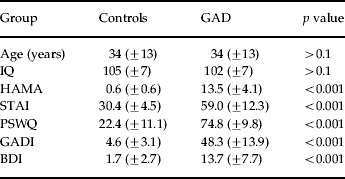
There were no significant differences in age or IQ between the groups (Table 1). GAD participants had significantly higher HAMA, STAI, PSWQ, GADI and BDI scores than control participants (Table 1). Two participants (one control and one GAD participant) exhibited excessive movement in the scanner (cut-off used was >1 voxel or 2 degrees) resulting in imaging data from 15 control and 14 GAD participants.
Participant demographics and questionnaire scores

GAD, Generalized anxiety disorder; HAMA, Hamilton Anxiety interview; STAI, State-Trait Anxiety Inventory; PSWQ, Penn State Worry Questionnaire; GADI, Generalized Anxiety Disorder Inventory; BDI, Beck Depression Inventory.
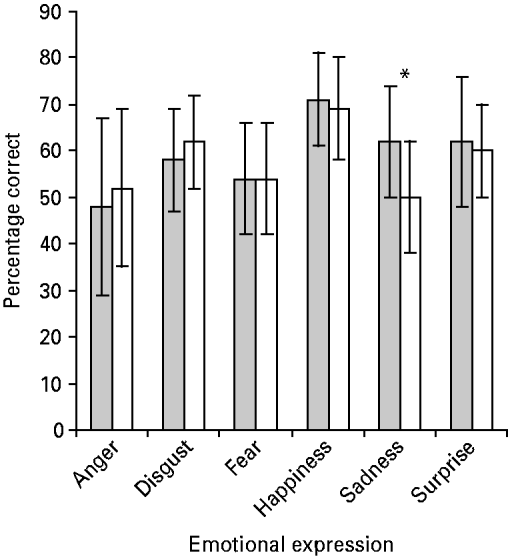
Face emotion recognition task
The ANOVA for accuracy of emotion recognition showed a significant effect of emotion (F 6,24=11.03, p<0.001), but not group (F 1,29=0.24, p>0.1). However, there was a significant emotion by group interaction (F 6,24=2.53, p<0.05). Post-hoc t tests showed that GAD participants recognized a lower percentage of sad faces than controls (50±11% v. 61±12%, t=2.54 p<0.05) but did not differ in their recognition of other emotions (Fig. 1). The ANOVA for reaction time taken to identify emotions showed a significant effect of emotion (F 6,24=9.29, p<0.001), but not group (F 1,29=0.32, p>0.1) or emotion by group (F 6,24=0.63, p>0.1). There was also a significant increase in emotional recognition for each emotion as the intensity of the emotion increased from 10 to 100% (p<0.001 in every case).
Percentage of emotional expressions correct±s.d.  , Controls; □, generalized anxiety disorder participants. *p<0.05.

Functional imaging task
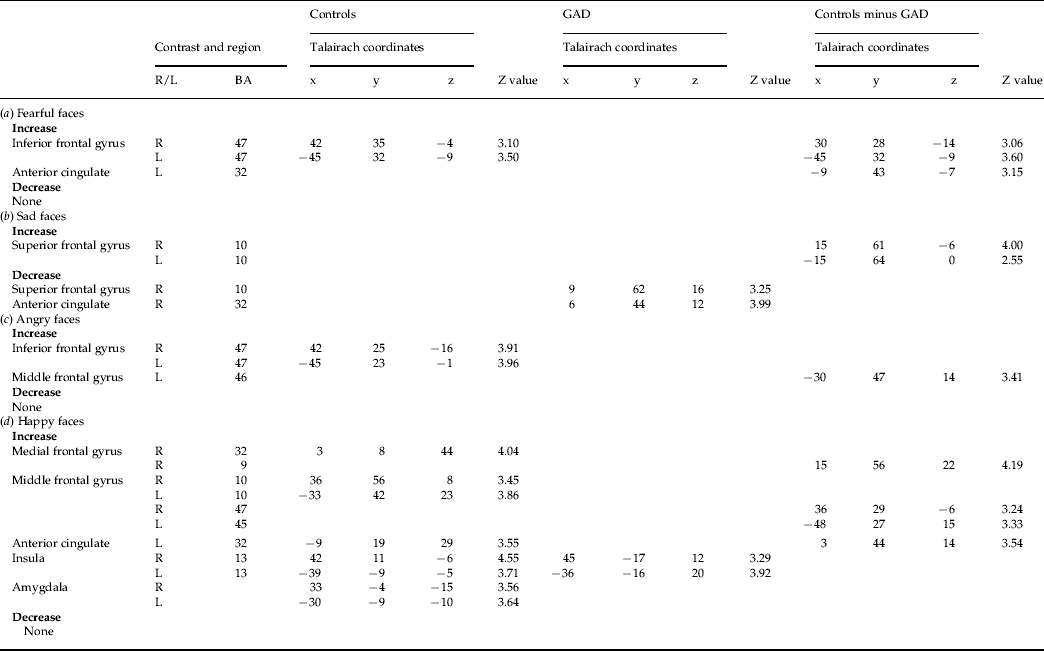
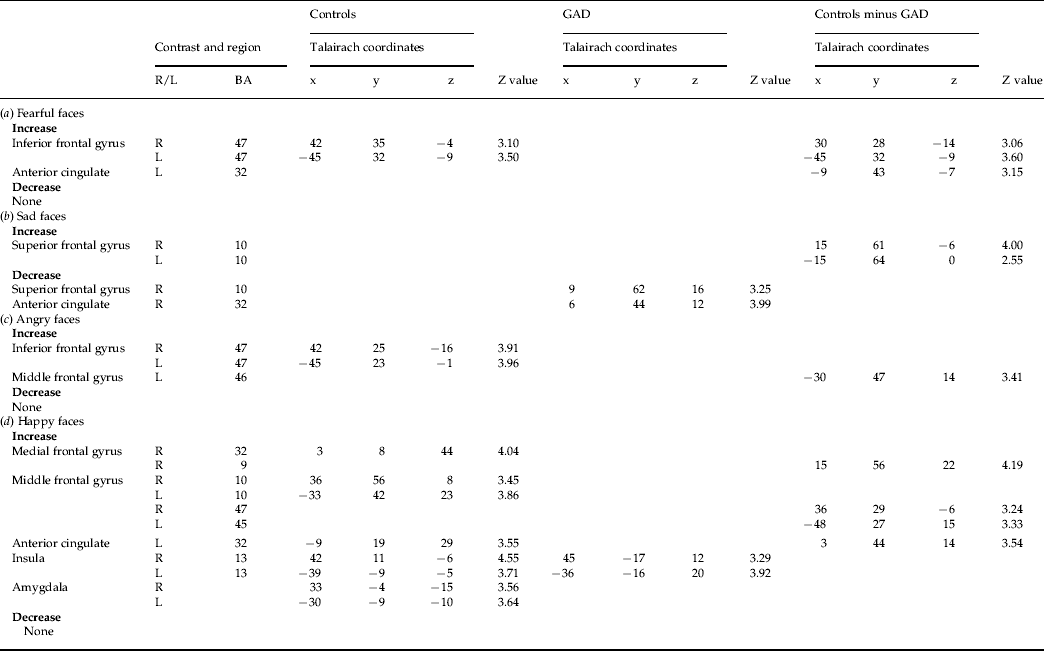
There were no significant differences in BOLD signal between control and GAD participants for disgusted and surprised facial expressions. The results for fearful, sad, angry and happy facial expressions are presented in Table 2. The contrasts between the groups were explored with and without the medicated GAD participants and no significant differences were found; therefore, all of the participants are presented together in the analyses below.
Functional magnetic resonance imaging results for facial expressions
GAD, Generalized anxiety disorder.
All presented at p<0.001 uncorrected; bilateral results presented for information.
Reaction time and the number of faces correctly identified as male or female were recorded for each emotion in the implicit faces task. There were no significant differences between control and GAD participants (1166 ms v. 1157 ms, p>0.1; ~97% v. ~98%, p>0.1).
Fearful faces
Control participants showed bilateral increases in BOLD signal in the VLPFC (BA 47) to fearful faces, while GAD participants showed no significant alteration in BOLD signal. Between-groups comparison showed significant attenuation in the left VLPFC (BA 47) in GAD participants compared with controls (as shown in Fig. 2 a).
Functional magnetic resonance imaging results for facial expressions: (a) fearful; (b) sad; (c) angry; (d) happy. Control minus generalized anxiety disorder participants.

Sad faces
Control participants showed no changes in BOLD signal associated with sad faces, whereas GAD participants showed attenuation in the right ACC (BA 32). Between-groups comparison showed attenuation in the right medial orbitofrontal cortex (OFC) (BA 10) in GAD participants relative to controls (as shown in Fig. 2 b).
Angry faces
Control participants showed bilateral increases in BOLD signal in the VLPFC (BA 47) to angry faces (as shown in Fig. 2 c), whereas GAD participants showed no alteration in BOLD signal. Between-groups comparison showed attenuation in the left middle frontal gyrus (BA 46) in GAD participants relative to controls.
Happy faces
Control participants showed an increased BOLD signal in the bilateral medial and middle prefrontal cortex (BA 10), left ACC (BA 24/32), bilateral amygdala, right insula and right parahippocampal gyrus to happy faces. GAD participants showed increased BOLD signal in the insula. The comparison between groups showed a reduced BOLD response for the GAD participants in the VLPFC (BA 45/47), right medial frontal gyrus (BA 9) and left ACC (BA 32) when compared with the BOLD response in control participants (as shown in Fig. 2 d).
PSWQ correlational analyses
The left VLPFC (BA 47) BOLD signal during angry faces was correlated with GAD participants' PSWQ scores, r=0.70.
BDI correlational analyses
The right amygdala and left VLPFC (BA 47) BOLD signals for angry facial expressions were correlated with GAD participants' BDI scores, r=0.69 and r=0.75, respectively. Both the left and right VLPFC (BA 47) BOLD signal for fearful faces were correlated with GAD participants' scores, r=0.76 and r=0.64, respectively. The right superior prefrontal cortex (BA 10) BOLD signal for sad faces was correlated with GAD participants' scores, r=0.71.
Discussion
In the behavioural task, GAD participants recognized significantly fewer sad facial expressions than control participants but otherwise did not differ in their ability to identify emotions. The main finding in the fMRI task was hypo-activation in regions of the prefrontal cortex in GAD participants across emotional expressions, but especially to happy facial expressions.
There have been relatively few studies of the ability to recognize emotional expressions in adults with anxiety disorders. Participants with social anxiety disorder were found to have decreased sensitivity to negative emotional expressions in one study (Montagne et al. Reference Montagne, Schutters, Westenberg, van Honk, Kessels and de Haan2006) but not another (Philippot & Douilliez, Reference Philippot and Douilliez2005). Our study found decreased sensitivity to sad faces but no biases towards expressions that may be related to a potential environmental threat (e.g. fear, anger, disgust). The reason for a selectively impaired recognition of a sad facial expression is not clear. Emotional dysregulation has been proposed in people with GAD, with GAD patients reporting more difficulty in identifying their own emotions and a poorer understanding of emotional experience (Mennin et al. Reference Mennin, Heimberg, Turk and Fresco2002; Turk et al. Reference Turk, Heimberg, Luterek, Mennin and Fresco2005). It could be that GAD participants, while able to identify risk relevant facial expressions at a similar accuracy level to control participants, had more trouble identifying a negative expression that was not risk relevant.
In contrast with the results of the behavioural task, the main finding in the fMRI task was prefrontal hypo-activation in female GAD participants across emotional expressions and especially to happy expressions. The findings are in the opposite direction to the study hypotheses, but are in line with an increasing body of evidence suggesting that the ventrolateral and medial prefrontal cortex and the ACC have altered function in patients with mood and anxiety disorders (Ochsner et al. Reference Ochsner, Ray, Cooper, Robertson, Chopra, Gabrieli and Gross2004; Rogers et al. Reference Rogers, Kasai, Koji, Fukuda, Iwanami, Nakagome, Fukuda and Kato2004; Paulesu et al. Reference Paulesu, Sambugaro, Torti, Danelli, Ferri, Scialfa, Sberna, Ruggiero, Bottini and Sassaroli2010). The prefrontal cortex and ACC show an increased BOLD signal in response to uncertainty, anxiety and aversive information in controls (Chua et al. Reference Chua, Krams, Toni, Passingham and Dolan1999; Critchley et al. Reference Critchley, Mathias and Dolan2001; Nitschke et al. Reference Nitschke, Sarinopoulos, Mackiewicz, Schaefer and Davidson2006; Paulesu et al. Reference Paulesu, Sambugaro, Torti, Danelli, Ferri, Scialfa, Sberna, Ruggiero, Bottini and Sassaroli2010). However, BOLD signal attenuation in the medial prefrontal cortex and ACC have been found in patients with post-traumatic stress disorder and panic disorder, and in anxious people responding to threat-related information (Fischer et al. Reference Fischer, Andersson, Furmark and Fredrikson1998; Bremner et al. Reference Bremner, Staib, Kaloupek, Southwick, Soufer and Charney1999). This pattern of brain activity has recently been termed ‘anxiety-related hypo-responsivity’ (Bishop, Reference Bishop2008) and it has been suggested that attenuation may mediate the ability to reinterpret threat (Ray et al. Reference Ray, Ochsner, Cooper, Robertson, Gabrieli and Gross2005). Altered BOLD signals in the ventrolateral and medial prefrontal cortex and the ACC in the present study may suggest that GADs recruit these areas of the brain abnormally when dealing with biologically relevant stimuli in general, as the differences between the groups are most apparent for happy faces, which are not threat related.
When differences in BOLD activation between control and GAD participants were explored, the direction of the BOLD signals indicated that control participants had an increase in the VLPFC signal for happy and fearful faces, whereas GAD participants had attenuation in these areas. The fact that the BOLD signals were moving in opposite directions in the two groups is the reason that this brain area is significantly (p unc<0.001) different in the contrasts.
We observed attenuation in the BOLD signal in the ACC (BA 32) to fearful and happy facial expressions in GAD patients. The ACC is important to the regulation of affective states (Phillips et al. Reference Phillips, Drevets, Rauch and Lane2003) and, as noted previously, there is evidence for emotional dysregulation in GAD patients, who report heightened intensity of emotion but poorer understanding of emotions and a negative reaction to emotional experience (Mennin et al. Reference Mennin, Heimberg, Turk and Fresco2005). The ACC has been associated with worry, with one study finding an increased ACC BOLD signal in GAD participants during both worry and resting states (Paulesu et al. Reference Paulesu, Sambugaro, Torti, Danelli, Ferri, Scialfa, Sberna, Ruggiero, Bottini and Sassaroli2010). A functional connectivity study with regions of interest has shown that GAD patients have decreased amygdala connectivity to the cingulate (Etkin et al. Reference Etkin, Prater, Schatzberg, Menon and Greicius2009) and a second study found they struggle to engage the ACC in order to decrease amygdala activity (Etkin et al. Reference Etkin, Prater, Hoeft, Menon and Schatzberg2010). The results of the present study concur with the literature, indicating abnormal functioning in this region. However, other findings in the present study are not consistent with the literature. In particular, our study fails to replicate the finding of BOLD signal increase in the VLPFC to angry facial expressions (Monk et al. Reference Monk, Nelson, McClure, Mogg, Bradley, Leibenluft, Blair, Chen, Charney, Ernst and Pine2006; Blair et al. Reference Blair, Shaywitz, Smith, Rhodes, Geraci, Jones, McCaffrey, Vythilingam, Finger and Mondillo2008).
In this study amygdala response was not observed for negative emotions and did not differ between patients and controls. We did not find a BOLD signal increase in the amygdala during presentation of fearful faces in either group, which is somewhat at odds with previous literature (Adolphs et al. Reference Adolphs, Tranel, Damasio and Damasio1995; Whalen et al. Reference Whalen, Shin, McInerney, Fischer, Wright and Rauch2001). Time modulation showed that this discrepancy with previous literature was not due to habituation over time. However, when aversive emotions (anger, disgust, fear) were combined across the two groups, there was a BOLD signal increase in the amygdala bilaterally, which survived small volume correction for the left amygdala (P FWE<0.05). This may suggest that power is an issue when examining individual emotions in our study. A pattern of frontal hypo-responsivity and amygdala hyper-responsivity during attention to threat-related stimuli has been reported in previous studies (Bishop et al. Reference Bishop, Duncan, Brett and Lawrence2004; Bishop, Reference Bishop2008). However, in the present study group differences in amygdala BOLD signal were not observed, even when negative emotions were combined. Whalen et al. (Reference Whalen, Johnstone, Somerville, Nitschke, Polis, Alexander, Davidson and Kalin2008) also failed to observe amygdala abnormalities in GAD patients. It may be that specific threat-related stimuli are required to elicit abnormal amygdala response in patients with GAD.
Another issue that may have impact upon the findings is that research has shown that neutral faces can be perceived as negative by participants (Lee et al. Reference Lee, Kang, Park, Kim and An2008b). GAD participants, in particular, have been shown to respond to neutral stimuli as if it were negative (Nitschke et al. Reference Nitschke, Sarinopoulos, Oathes, Johnstone, Whalen, Davidson and Kalin2009). Therefore, the fact that an increased BOLD signal in the amygdala was not found in this study may be due to the lack of a truly neutral baseline from which to measure participant BOLD signals.
The correlational analyses suggest that some of the main fMRI findings are correlated with symptoms of depression as measured by the BDI. While none of the participants had a current diagnosis of MDD, it is clear that subclinical levels of depression played a role in the results, making it difficult to untangle the elements of the results that were due to generalized anxiety and the elements that were due to depressive symptomatology.
Results from the behavioural and the imaging task differ, with the behavioural task only showing differences in the face emotion processing of sad faces and the fMRI data showing significant differences in the neural processing of fearful, sad, angry and happy facial expressions. This could be due to the differences in explicit versus implicit emotional processing, with different circuits of activation shown during the different types of processing (Scheuerecker et al. Reference Scheuerecker, Frodl, Koutsouleris, Zetzsche, Wiesmann, Kleemann, Bruckmann, Schmitt, Moller and Meisenzahl2007). However, it may also indicate a greater sensitivity of fMRI to detect subtle abnormalities in face emotion processing.
Limitations
Half of the GAD participants had suffered from MDD in the past and over half were suffering from a secondary anxiety disorder, illustrating the difficulty in studying ‘pure’ anxiety disorders and knowing which elements might contribute to the findings. The correlation between the BDI and GAD participants' fMRI results make it especially difficult to argue that the findings are a reflection of abnormalities found solely as a result of GAD symptoms. The small sample size of the study meant it was not possible to explore clinical subgroups or differentiate between those with ‘pure’ GAD and those with co-morbidities.
The small size and limited power of the study, and the use of neutral faces rather than a baseline measure, may explain the lack of amygdala activation to fearful faces. Nevertheless, we were able to show significant alterations in other brain areas that have previously been implicated in emotional processing, such as the ventrolateral and medial prefrontal cortex and ACC.
As this was an exploratory study, it was limited by the fact that each emotion was studied separately and the analyses did not control for multiple comparisons. Another major limitation is that the study included only female participants and therefore the findings cannot be generalized to males with GAD.
Conclusion
When GAD participants viewed emotional expressions in an implicit face emotion task they showed an attenuated BOLD signal in regions of the prefrontal cortex and ACC that are important in emotional processing. This was in spite of a generally normal ability to identify the emotions in an explicit face recognition task, where their attention was directed towards the emotion. Alterations in the prefrontal cortex and ACC BOLD signal could potentially lead to an abnormal interpretation of social and emotional events when processing incidental emotional stimuli as opposed to explicit stimuli. BOLD signal correlations with depression scores make it difficult to determine which symptoms were driving abnormal BOLD responses and whether current levels of depression, while subclinical, contributed to the differences found between GAD and control participants. Further studies examining the link between altered processing of emotional stimuli and the cognitive and clinical features of GAD are required.
Acknowledgements
Research was supported by the Medical Research Council. It was carried out as part of a PhD funded by the Overseas Research Student Award committee and a University of Manchester student scholarship. We also wish to acknowledge the Wellcome Trust Clinical Research Facility in Manchester.
Declaration of Interest
None.