Introduction
The golden orb-weaver genus Nephila Leach, Reference Leach1815 is renowned for its enormous orb webs constructed with distinctive gold-colored silk, for its extreme sexual size dimorphism (females are gigantic compared to the males), and for being a conspicuous inhabitant of tropical forests (Kuntner et al., Reference Kuntner, Arnedo, Trontelj, Lokovšek and Agnarsson2013). Some two dozen species are recognized in the genus, together with several subspecies (World Spider Catalog, 2018). Golden orb weavers inhabit tropical and subtropical regions throughout the world, and the enormous, permanent webs of the females serve as microecosystems for a variety of kleptoparasites and other cohabitants (Vollrath, Reference Vollrath1987; Tso and Severinghaus, Reference Tso and Severinghaus1998; Agnarsson, Reference Agnarsson2003, Reference Agnarsson2010; Harvey et al., Reference Harvey, Austin and Adams2007).
Nephila and related genera (presently including Clitaetra Simon, Reference Simon1889, Herennia Thorell, Reference Thorell1877, Nephilengys Koch, Reference Koch1872, and Nephilingis Kuntner in Kuntner et al., Reference Kuntner, Arnedo, Trontelj, Lokovšek and Agnarsson2013) were placed in the family Araneidae Clerck, Reference Clerck1757 by Simon (Reference Simon1894), together with other orb weavers, and close to the tetragnathines (Kuntner et al., Reference Kuntner, Coddington and Hormiga2008). They remained in Araneidae until Levi (Reference Levi1986), with doubt, and then Coddington (Reference Coddington1990) transferred the nephilines and tetragnathines into the family Tetragnathidae Menge, Reference Menge1866. The nephiline genera were raised to family status (Nephilidae Simon, Reference Simon1894) in the work of Kuntner (Reference Kuntner2006), where they remained (but closer to araneids than tetragnathids, e.g., Pan et al., Reference Pan, Zhou, Song and Qiu2004; Álvarez-Padilla and Hormiga, Reference Álvarez-Padilla and Hormiga2011; Su et al., Reference Su, Chang, Smith, Zhu, Kuntner and Tso2011) until Dimitrov et al. (Reference Dimitrov, Benavides, Arnedo, Giribet, Griswold, Scharff and Hormiga2017) returned these genera to the family Araneidae as subfamily Nephilinae, a result also supported by Wheeler et al. (Reference Wheeler, Coddington, Crowley, Dimitrov and Goloboff2017).
Despite the large size of the females, most fossil nephilines described are males in amber, mainly because of the need of adult males to wander from their webs to seek out the sedentary females. The youngest fossil nepheline described is Minutunguis silvestris Wunderlich, Reference Wunderlich2011, a male in Quaternary Madagascan copal. Miocene Dominican amber contains five species of Nephila, all males, described by Wunderlich (Reference Wunderlich1982, Reference Wunderlich1986), and Wunderlich (Reference Wunderlich2004) described nine male nephilines from Eocene Baltic and Bitterfeld amber, which he referred to three new genera: Eonephila Wunderlich, Reference Wunderlich2004, Luxurionephila Wunderlich, Reference Wunderlich2004, and Palaeonephila Wunderlich, Reference Wunderlich2004. The only female nephiline known hitherto from the Cenozoic Era is Nephila pennatipes Scudder, Reference Scudder1885, from Eocene beds at Florissant, Colorado. This species most closely resembles the one described here in size and geological age. Mesozoic nephilines include the males Cretaraneus vilaltae Selden, Reference Selden1990 from the Early Cretaceous of Spain, Geratonephila burmanica (Poinar in Poinar and Buckley, Reference Poinar and Buckley2012) from mid-Cretaceous Burmese amber, C. liaoningensis Cheng, Meng, and Wang in Cheng et al., Reference Cheng, Meng, Wang and Gao2008 from the Early Cretaceous of China, and C. martensnetoi Mesquita, Reference Mesquita1996 from the Early Cretaceous of Brazil. However, the age of Geratonephila was disputed by Wunderlich (Reference Wunderlich2015), who synonymized the genus with Nephila. From his long experience of working with Burmese amber, during which time he had never seen a nephiline in the deposit, Wunderlich (Reference Wunderlich2015) considered that Geratonephila was more likely from the Dominican Republic, of Miocene age, in which deposit the modern genus is quite common; he suggested it might belong to Nephila tenuis Wunderlich, Reference Wunderlich1986. Similarly, the two spiders from the Early Cretaceous of China and Brazil are most likely not nephilines but were placed in the genus Cretaraneus because of their Cretaceous age.
The only female Cretaceous nephilines known are several large, undescribed specimens from the Early Cretaceous Crato Formation of Brazil, one of which was figured by Dunlop and Penney (Reference Dunlop and Penney2012, fig. 93). A giant female spider from the mid-Jurassic Daohugou Fossil-Lagerstätte of China was originally described as Nephila jurassica Selden, Shih, and Ren, Reference Selden, Shih and Ren2011. However, shortly after its description, a giant male was discovered in the same beds, which was considered to be conspecific with N. jurassica; the species was placed in the new genus Mongolarachne Selden, Shih, and Ren, Reference Selden, Shih and Ren2013 and removed from Nephilinae. Kuntner et al. (Reference Kuntner, Arnedo, Trontelj, Lokovšek and Agnarsson2013) had already determined, using molecular dating methods, that N. jurassica was unlikely to be a nephiline, but possibly a stem orbicularian, where Mongolarachne was placed by Selden, Shih, and Ren (Reference Selden, Shih and Ren2013). Dimitrov et al. (Reference Dimitrov, Benavides, Arnedo, Giribet, Griswold, Scharff and Hormiga2017) remained unconvinced of the conspecificity of the male and female of Mongolarachne, but their analysis nevertheless recovered a younger origin for the genus Nephila.
In this paper, we describe a new fossil as a possibly juvenile female Nephila, from the early Eocene Palana Formation of the Gurha opencast lignite mine, western Rajasthan, India. The only fossil spiders known from India are from the Cambay amber, which is approximately coeval with the Palana Formation. Rust et al. (Reference Rust2010) listed four families (Mimetidae, Pholcidae, Thomisidae, and Uloboridae) in Cambay amber. Of these, the mimetid was described in more detail (but not named, being a juvenile) as the oldest known member of the Mimetidae Simon, Reference Simon1881 by Penney et al. (2012). The fossil described here is therefore the first nonamber fossil spider known from India and provides additional data to the known distribution of fossil nephilines.
Geologic setting
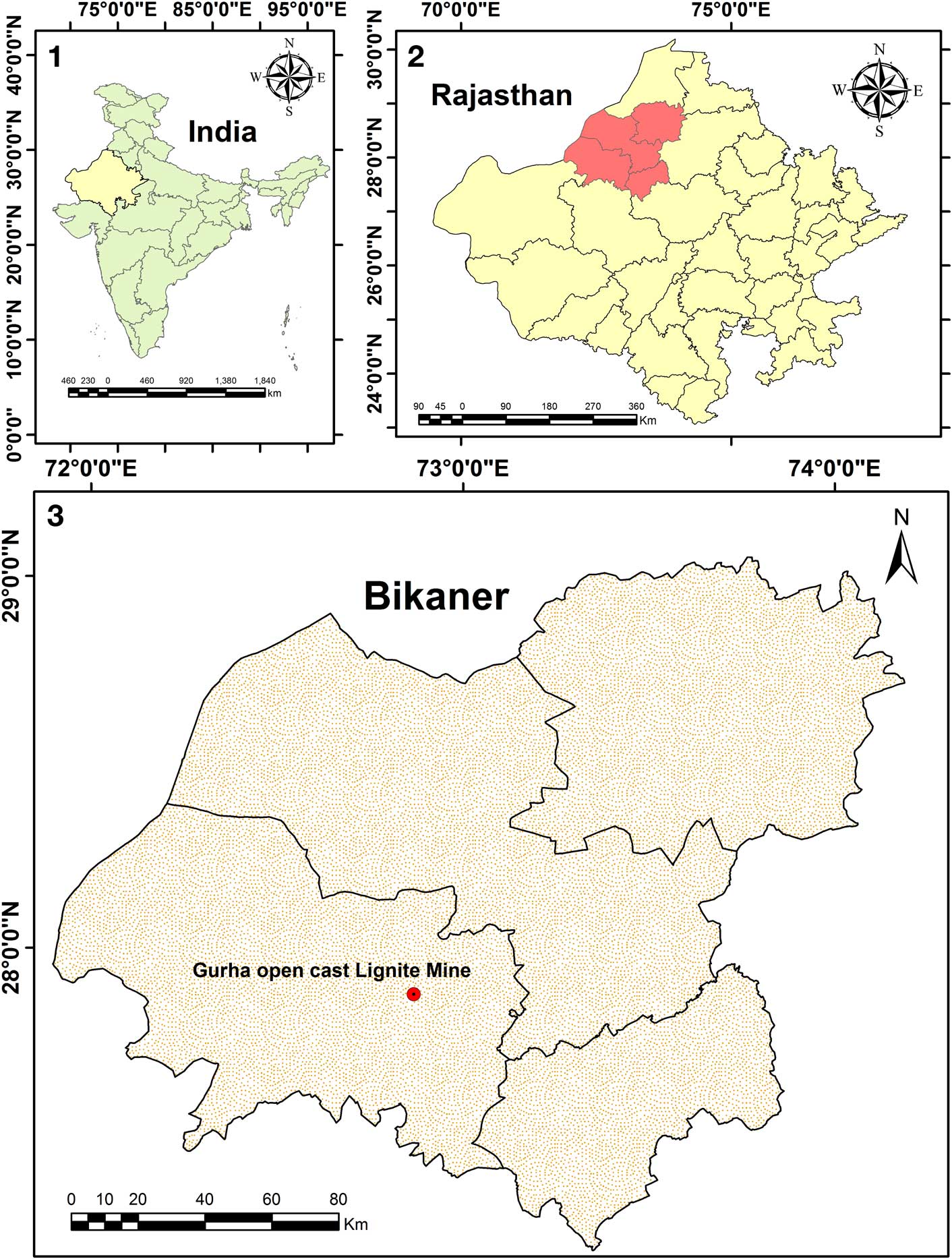
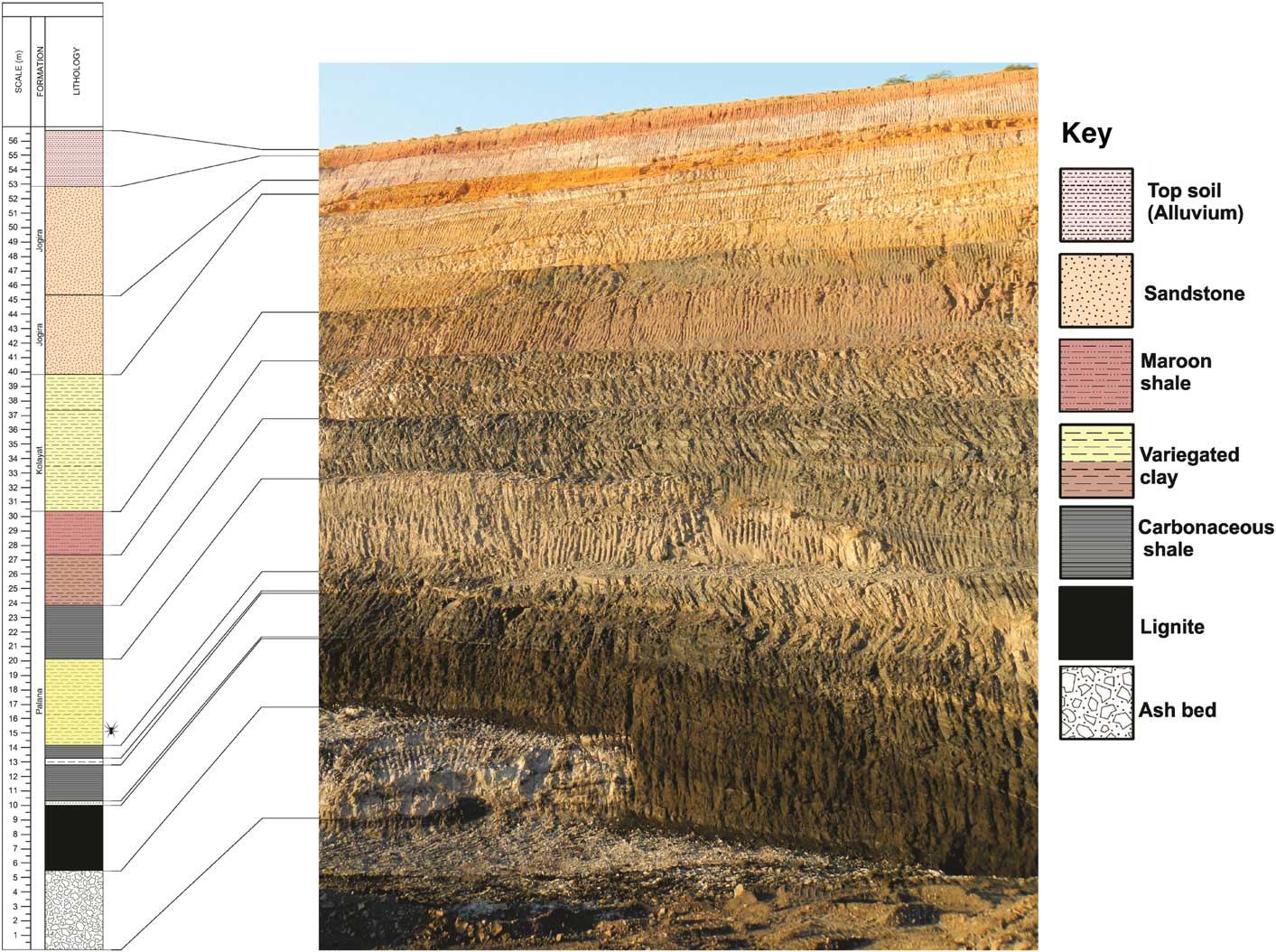
The Gurha opencast lignite mine is situated about 70 km southwest of Bikaner (72.52269°E, 27.5229°N) (Fig. 1). The general geology of the subsurface Gurha lignite mine (Fig. 2) consists of a basement pebbly ash bed, a whitish-gray ash bed that is not in bedded form and also associated with lignite, followed by the Palana Formation, which consists of lignite (4.5 m) at the base, carbonaceous shale (3.80 m) intercalated with a thin siliceous clay nodular bed, a fine laminated pale-yellowish-gray shale associated with a thin band of dirty maroon sandstone (12.00 cm), variegated clay (6.00 m), carbonaceous shale, (3.70 m), variegated shale (3.50 m), and maroon shale (3.00 m), respectively. The thicknesses of these beds are variable in the opencast lignite mine, including lignite. The Palana Formation is overlain by the Kolayat Formation, which consists of variegated clays or fuller’s earths (9.50 m), which is overlain by dirty yellow ferruginous sandstone with lenses of clay and sandy shale (5.50 m) and gritty sandstone and lime kankar (7.50 m) of the Jogira Formation, and the top is Recent alluvium and soil (3.88 m). The sedimentological and paleontological data suggest that the Palana Formation was deposited in a fluvio-lacustrine environment with influence of volcanism at the base. The Palana Formation is richly fossiliferous with plant leaves, rare fishes, and invertebrates. The characteristic pollen assemblages, Sastripollenites trilobatus (Venkatachala and Kar, Reference Venkatachala and Kar1969), Ratariacolporites plicatus (Kar, Reference Kar1985), Clavaperiporites jacobii (Ramanujam, Reference Ramanujam1966), C. densus (Thanikaimoni et al., 1984), Triangulorites bellus (Kar, Reference Kar1985), Dermatobrevicolporites exaltus (Kar, Reference Kar1985), and Kielmeyerapollenites eocenicus (Sah and Kar, Reference Sah and Kar1974), reported from the Palana Formation indicate an early Eocene (Ypresian) age (Shukla et al., Reference Shukla, Mehrotra, Spicer, Spicer and Kumar2014). A similar pollen assemblage is also known from the early Eocene Naredi Formation of the Kutch Basin (Kar and Saxena, Reference Kar and Saxena1981; Kar, Reference Kar1985) and the Cambay Formation of the Cambay Basin (Kumar, Reference Kumar1996; Rao et al., Reference Rao, Sahni, Rana and Verma2013); a late Paleocene–early Eocene age was reported for the lignites and associated sediments of Rajasthan in general (Kar and Sharma, Reference Kar and Sharma2001).
Location map of the Gurha opencast lignite mine, near Bikaner, western Rajasthan, India: (1) map of India showing location of Rajasthan; (2) map of Rajasthan, showing location of Bikaner district; (3) map of Bikaner district showing location of the Gurha opencast lignite mine.

Stratigraphy and lithologies exposed in the Gurha opencast lignite mine, near Bikaner, western Rajasthan, India. Horizon bearing the spider specimen in the variegated clays of the Palana Formation marked on the section, about 15 m from the base.

Materials and methods
The specimen was recovered by hand picking from the thin, laminated, pale gray shale bed of the Palana Formation exposed in the Gurha opencast lignite mine (Figs. 1, 2), Bikaner District, Rajasthan. The Palana Formation has yielded abundant plant remains and rare fish fossils (work in progress). The specimen was studied using a Leica MZ-6 microscope, and photographs were taken using a Nikon D5500 DSLR camera and Olympus digital micropad 777. Photographs were manipulated in Affinity Photo (affinity.serif.com), and drawings were made from the photographs using Autodesk Graphic (graphic.com) on an Apple MacBook Pro computer. All measurements are in millimeters and were made from the drawings using the tools in Graphic. Measurements of paired organs are means of left and right of the specimen.
Repository and institutional abbreviation
The specimen is deposited in the Department of Geology, HNB Garhwal University Srinagar Uttarakhand, India.
Systematic paleontology
Abbreviations
Roman numerals I, II, III, IV = walking leg numbers; ch = chelicera; cx = coxa; fe = femur; L = length; lb = labium; mt = metatarsus; op = opisthosoma; pa = patella; Pd = pedipalp; ta = tarsus; ti = tibia; tr = trochanter; W = width.
Class Arachnida Lamarck, Reference Lamarck1801
Order Araneae Clerck, Reference Clerck1757
Family Araneidae Clerck, Reference Clerck1757
Subfamily Nephilinae Simon, Reference Simon1894
Genus Nephila Leach, Reference Leach1815
Type species.—Aranea pilipes Fabricius, Reference Fabricius1793.
Remarks
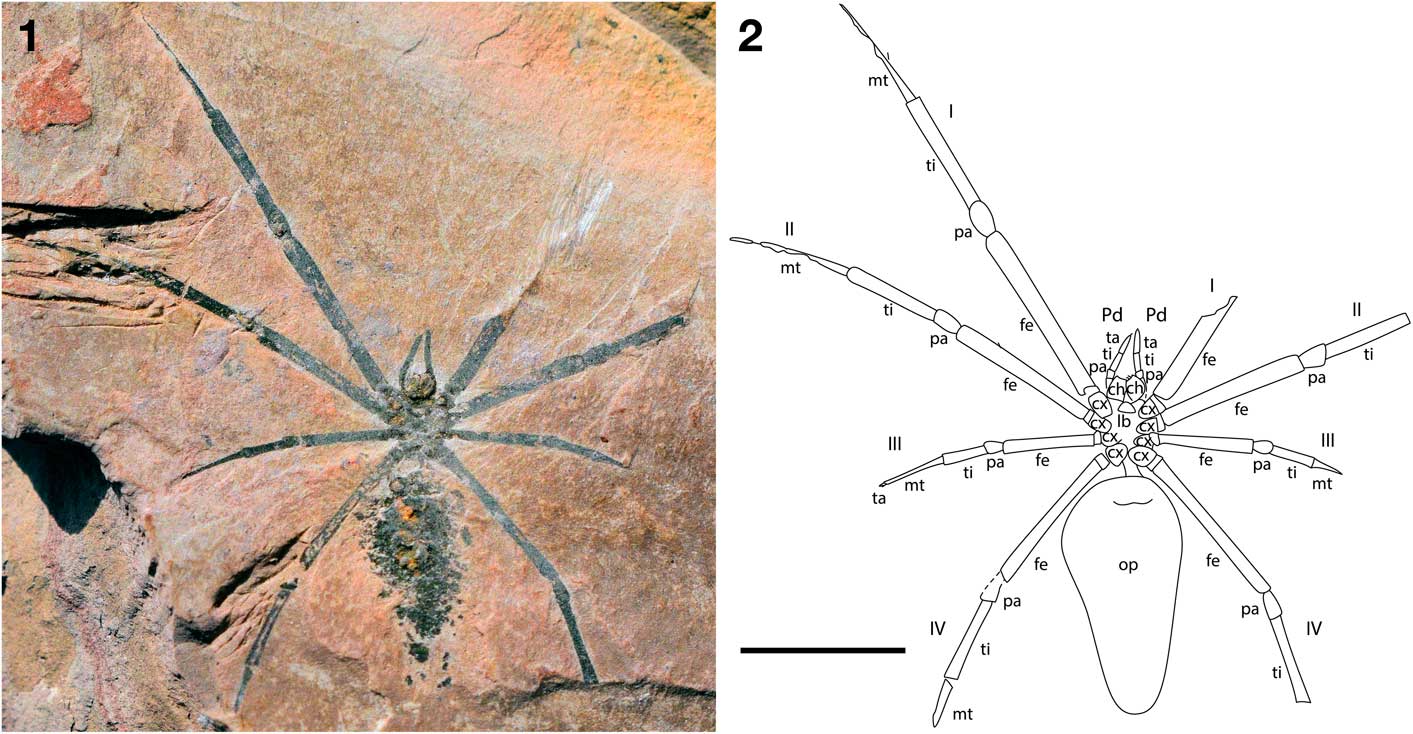
The specimen described here is identified as a possible Nephila on the basis of its relatively large size, the elongate, pyriform shape of the opisthosoma, the long, slender legs with legs I, II, and IV being extremely long while leg III is relatively shorter (nearly half the length of the other legs), and the shape of the sternum and labium (Figs. 2, 3; compare with Murphy and Roberts, Reference Murphy and Roberts2015, pl. 116). The slightly thickened proximal and distal ends of the tibiae, especially of legs III and IV (Fig. 3) are typical of Nephila; compare, for example, Figure 3.1 with the ventral view of N. pilipes in Thakur and Tembe (Reference Thakur and Tembe1956, pl. I, fig. 2, as N. maculata). Its small size suggests that it is an immature, and the shape of the opisthosoma together with the lack of swelling of the distal pedipalp podomeres suggest it is a female (see Discussion).
Nephila? from the early Eocene (Ypresian) Palana Formation, Gurha opencast lignite mine, near Bikaner, western Rajasthan, India: (1) photograph of whole specimen (GU/SP/B-101), ventral aspect; (2) explanatory drawing. I, II, III, IV = walking leg numbers; ch = chelicera; cx = coxa; fe = femur; lb = labium; mt = metatarsus; op = opisthosoma; pa = patella; Pd = pedipalp; ta = tarsus; ti = tibia. Scale bar = 5 mm.

Nephila? sp.
Description
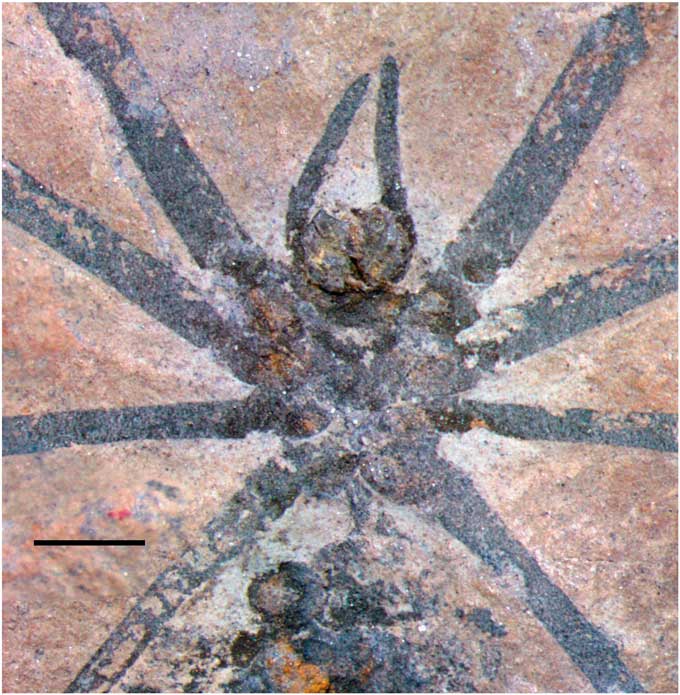
Immature female (Figs. 3, 4). Body length (including ch) 10.25. Labium subtriangular in outline, with rounded anterior border, wider than long (L 0.32 mm, W 0.53 mm, ratio 0.61); sternum subtriangular, widest at anterior border, longer than wide (L ~1.0 mm, W ~0.8 mm). Chelicera subequant in outline, L 0.81. Pedipalps slender, short, with tarsal claw; podomere lengths: pa 0.25, ti 0.57, ta 0.72. Legs long, slender, smooth, lacking tufts of setae (gaiters) on tibiae; leg I longest, legs II and IV approximately equal in length, leg III short (leg formula I, IV, II, III). Long podomeres, particularly tibiae of legs III, IV, slightly thickened at proximal and distal ends. Podomere lengths: Leg I cx 0.69, tr 0.18, fe 5.63, pa 1.07, ti 3.60, mt 3.69, total fe–ti 10.29; Leg II cx 0.67, tr 0.24, fe 4.57, pa 0.84, ti 2.82, mt 3.67, total fe–ti 8.23; Leg III cx 0.59, tr 0.23, fe 2.82, pa 0.59, ti 1.29, mt 1.94, total fe–ti 4.70; Leg IV cx 0.71, tr 0.25, fe 4.77, pa 0.90, ti 2.71, total fe–ti 8.38. Opisthosoma nearly twice as long as wide (L 7.17 mm, W 3.65 mm, ratio 1.96), elongate pyriform in outline, greatest width one-third of length from anterior border, connected to prosoma by narrow pedicel.
Close-up of ventral prosoma of Nephila? (GU/SP/B-101) from the early Eocene (Ypresian) Palana Formation, Gurha opencast lignite mine, near Bikaner, western Rajasthan, India, showing ventral structures of prosoma; for explanatory drawing, see Figure 3.2. Scale bar = 1 mm.

Material
Immature female, GU/SP/B-101 (part only), only known specimen, deposited in the Department of Geology, HNB Garhwal University Srinagar Uttarakhand, India, from the early Eocene Palana Formation, Gurha lignite mine, Bikaner, Rajasthan, India.
Remarks
This specimen differs from most other members of the genus in lacking gaiters on the tibiae in the immature female (which this specimen is presumed to be).
Discussion
Phylogenetic relationships
“When I see a bird that walks like a duck and swims like a duck and quacks like a duck, I call that bird a duck” (quote attributed to James Whitcomb Riley, Indiana poet, 1849–1916). However, what if that supposed duck lacks the synapomorphies of a duck? The analogy is important because the specimen described here shows the general habitus of a Nephila but lacks the synapomorphies of that genus, such as sexual dimorphism and web structure (e.g., Scharff and Coddington, Reference Scharff and Coddington1997; Harvey et al., Reference Harvey, Austin and Adams2007), which are not identifiable in a fossil. While the elongate abdomen is characteristic of Nephila, a similar abdomen shape occurs in some other araneids and tetragnathids. However, the chelicerae of tetragnathids are large, and their legs are very long and thin. One characteristic of Nephila (also seen in the specimen described here) that differs from other araneids is the length of the legs: not only is leg III short compared to the others, but also leg IV is as long as leg II. In addition, the metatarsus is longer than the tibia and patella together (e.g., Banks, Reference Banks1907).
Few setae or spines are visible on the specimen, yet it is most likely that, were they present, tufts of setae on the tibiae (gaiters) would be visible. Normally, spiders preserved in fluvio-lacustrine environments are well preserved, and spines, setae, and even trichobothria are usually visible in the fossils (e.g., Selden et al., Reference Selden, Shih and Ren2013). Tibial tufts are present in most Nephila juveniles (e.g., in all Australasian species except N. pilipes; Harvey et al., Reference Harvey, Austin and Adams2007) and are retained into adulthood in the females of a few species (Thakur and Tembe, Reference Thakur and Tembe1956; Robinson and Robinson, Reference Robinson and Robinson1973). So the absence of tibial tufts in the fossil is somewhat unusual but not conclusive evidence of it being either an adult or a juvenile.
With its body length of 10.25 mm, were it mature, the fossil would be the smallest Nephila known. The contemporaneous Nephila pennatipes from the Eocene of Florissant, Colorado, measures 14 mm in body length (Scudder, Reference Scudder1885), which is also small for a Nephila. N. pennatipes bears tibial gaiters, and it could be a juvenile or adult female. The smallest living Nephila is N. pakistaniensis Ghafoor and Beg, Reference Ghafoor and Beg2002, whose females range from 10.25 to 13.00 mm (mean 10.81, n = 5), which is similar in size to the Eocene species, but other extant Nephila are considerably larger (Kuntner and Coddington, Reference Kuntner and Coddington2009, fig. 1). N. pakistaniensis has not been restudied since its first description. The drawings of the body and the internal and external views of the epigyne are clearly copies of figs. 195–197 of Tikader (Reference Tikader1982) of the 20 mm long N. clavata; the male palp looks quite unlike a Nephila palp (there is no long conductor), so N. pakistaniensis requires reevaluation. The small size of the fossil, together with the labium being wider than long (it is normally longer than wide, or at least as long as wide; see Murphy and Roberts, Reference Murphy and Roberts2015, pl. 116), would suggest the specimen is immature and lacks tibial gaiters. It is most likely a female because male nephilines are much smaller than the females, and some swelling of the distal pedipalp podomores would be expected even in a juvenile male.
Paleoecology
The early Eocene is known for a marked global warming (Zachos et al., Reference Zachos, Pagani, Sloan, Thomas and Billups2001, Reference Zachos, Wara, Bohaty, Delaney, Petrizzo, Brill, Bralower and Premoli-Silva2003), known as the Paleocene–Eocene Thermal Maximum (Higgins and Schrag, Reference Higgins and Schrag2006), and at that time the Indian subcontinent was located near the equator (< 10°N) (Shukla et al., Reference Shukla, Mehrotra, Spicer, Spicer and Kumar2014). Studies on the flora of Gurha lignite mine indicate a mean annual temperature of ~24°C and a mean annual temperature range of ~10°C. The cold month mean temperature of ~18°C was tropical by today’s climate standards but cooler than experienced today at 9°N in southern India at sea level. Similarly, the Gurha mean annual temperature is cooler than that of today (~27°C), and the modern mean annual range of temperature (2.8°C) is smaller (Shukla et al., Reference Shukla, Mehrotra, Spicer, Spicer and Kumar2014). Paleobotanical evidence points toward a near-coastal tropical flora of evergreen trees subject to frequent wildfires under a strongly seasonal precipitation (monsoon) regime (Kumar et al., Reference Kumar, Spicer, Spicer, Shukla, Mehrotra and Monga2016; Spicer et al., Reference Spicer, Yang, Herman, Kodrul and Aleksandrova2017). The analysis of Spicer et al. (Reference Spicer, Yang, Herman, Kodrul and Aleksandrova2017) showed that, at the time of deposition of the Gurha mine sediments, this part of the Indian continent was subject to a seasonal climate more akin to the present-day Intertropical Convergence Zone–influenced Indonesia-Australia Monsoon, rather than the Himalaya-influenced South Asia Monsoon experienced in the region today.
Nephila is found today in tropical and subtropical (occasionally temperate) climates (Su et al., Reference Su, Chang, Smith, Zhu, Kuntner and Tso2011). The presence of a nephiline in the Palana Formation concurs with a subtropical climate. In comparison with the habits of modern Nephila, the fossil presumably wove orb webs to catch the insects living in the forest. Undescribed fossils of large insect wings have been recovered from the same horizon, and insects are known from amber in the Cambay Basin (Rust et al., Reference Rust2010).
Biogeography
Amber in the nearby Cambay Basin indicates the presence of Dipterocarpaceae at this time, a family of moist tropical forest trees with its current center of biodiversity in Borneo and once thought to have reached India in the Miocene from there. However, the Cambay amber, together with other fossil evidence, indicates a more likely origin for the family in Africa, with the Indian continent transporting the forests to Asia, followed by their subsequent later Cenozoic radiation (Ghazoul, Reference Ghazoul2016). The insects in Cambay amber show affinities with the much better-known Eocene Baltic amber, with some Recent taxa from Australasia, and with Miocene neotropical ambers (Mexico and Dominican Republic) (Rust et al., Reference Rust2010). The few spiders known from Cambay amber have yet to be formally described, but belong to widespread families (Rust et al., Reference Rust2010).
Su et al. (Reference Su, Chang, Smith, Zhu, Kuntner and Tso2011) studied the phylogeography of Nephila and concluded that the subtropical/temperate clades of the genus were more derived than the tropical ones and that the ancestral range of Nephila was Asia or Africa. However, Su et al. (Reference Su, Chang, Smith, Zhu, Kuntner and Tso2011) used an earliest date of 20 Ma (Miocene) for the oldest fossil Nephila, based on Wunderlich’s species from Dominican amber, yet N. pennatipes provides an Eocene age of ~35 Ma for an American Nephila. The most recent analyses of Su et al. (Reference Su, Chang, Smith, Zhu, Kuntner and Tso2011) and Kuntner et al. (Reference Kuntner, Arnedo, Trontelj, Lokovšek and Agnarsson2013) retrieved a basal Nephila group consisting of the type species N. pilipes, found in Asia, and the African N. constricta. Indeed, Kuntner et al. (Reference Kuntner, Arnedo, Trontelj, Lokovšek and Agnarsson2013) found this small clade to be sister to a group containing not just all other Nephila species but also Nephilingis and Clitaetra. These authors dated the origin of this clade to around 50 to 60 Ma, a time when India was separated from both Africa and Asia, half-way across the Indian ocean. The discovery of a fossil nephiline on the Indian continent adds to the known distribution of fossils of the subfamily. Whether the nephiline was transported on India over its entire journey from Africa (which began in the Cretaceous), or whether it arrived on the Indian continent from Africa, perhaps by ballooning (Su et al., Reference Su, Chang, Smith, Zhu, Kuntner and Tso2011), during its travels, is not known.
Acknowledgments
We thank C. Chowdhury, G. Stayanarayana (former and present general manager), V. Acharya, geologist, and mining staff of the Gurha East lignite mine Bikaner, Rajasthan, for permission to visit the mine and for providing necessary facilities during the field investigation. It is a pleasure for us to express our sincere gratitude to A. Rawat, A. K. Chowdhary, and S. Mishra, researchers, HNB Garhwal University Srinagar, Uttarakhand, for their help. We also thank the reviewers for their time in providing useful comments.