While Inglehart and Norris's work focuses on aggregate cross-national patterns of value “modernization,” we test the application of gender modernization theory to immigrant assimilation, specifically to the cross-generational assimilation of Latinos in the United States. Our study examines ways in which Latino gender attitude patterns might be influenced by migration from traditional industrial Latin American countries to the more egalitarian postindustrial United States. We test whether first-generation Latino immigrants arrive with gender equality attitudes consistent with the traditional gender gap. Then, we examine whether these attitudes become more egalitarian with subsequent generations as the result of assimilation toward a more modern (or “American”) gender gap.
The study unfolds in the following manner: First, we outline the theoretical framework engaging comparative politics research on gender modernization, immigrant assimilation, and American political behavior studies that address gendered and racialized dimensions of public opinion. Next, we articulate the hypotheses that serve to test the applicability of gender modernization theory on U.S. Latino attitudinal assimilation. Then, we present our empirical analysis of two survey data sets. The World Values Survey allows comparative assessments of gender equality opinions and gender gaps in the United States and Mexico. The 2006 Latino National Survey allows us to analyze Latino gender equality opinions across six generational cohorts. The results consistently demonstrate that Latinos and Latinas share liberal values across a range of gender equality topics. Generation and gender occasionally produce statistically significant differences, but actual opinion divergence is quite small; to the extent that opinions vary, it is only in degrees of support for egalitarian gender roles. National origin, gender, and generation do not produce attitudinal cleavages that theory and conventional wisdom predict.
GENDER EQUALITY AND THE MODERN GENDER GAP
The phenomenon in which women are generally found to have more egalitarian political attitudes and behaviors—or the modern gender gap—has largely been addressed as a tendency of advanced industrial democracies. In American politics, the modern gender gap is a well-established pattern that scholars and media have recognized for several decades (Box Steffensmeier, de Boef, and Lin Reference Box Steffensmeier, de Boef and Lin2004; Norrander Reference Norrander1999; Schlesinger and Heldman Reference Schlesinger and Heldman2001; Verba, Burns, and Schlozman Reference Verba, Burns and Schlozman1997). Because women stand to benefit more directly from gender equality than men, it is rational that, on average, women will exhibit more egalitarian views about gender equality issues. Contrary to Inglehart and Norris's prediction of a traditional versus modern gender gap, studies show that the American gender gap fluctuates because women's egalitarian preferences generally hold stable, while men demonstrate more variation on these issues over time.Footnote 1 American women were significantly more supportive of gender equality issues relative to men between 1940 and 1960. Those differences diminished in the mid-to-late 1970s as men became more supportive of gender equality, pointing to growing agreement about gender norms (Bennett and Bennett Reference Bennett, Bennett and Duke1999; Bolzendahl and Myers Reference Bolzendahl and Myers2004; Erskine Reference Erskine1971; Simon and Landis Reference Simon and Landis1989; Wolbrecht Reference Wolbrecht2000). Despite apparent convergence, longitudinal studies show a contemporary and widening gap on gender attitudes when generational cohort is taken into account (Brewster and Padavic Reference Brewster and Padavic2000; Jennings Reference Jennings2006). These contemporary findings in the United States reflect divergence in the level of support between men and women on gender equality issues and demonstrate a postmovement gendered trend in which men are more conservative than women in part because their attitudes are liberalized more slowly relative to women.
A limitation of gender gap research, in both cross-national and case-specific studies, is that it rarely accounts for group variation. Instead, the focus remains primarily on sex differences. Intersectional scholars argue that the well-recognized American gender gaps and associated attitudes reflect preferences and behaviors of white respondents in large-N surveys, posing significant limitations for application to other racial and ethnic populations of interest (Garcia Bedolla, Monforti, and Pantoja Reference Garcia Bedolla, Monforti and Pantoja2006; Lien Reference Lien1998). Evaluating opinions between the sexes across racial groups, Lien (Reference Lien1998) concludes that the gender gap remains largest between white men and women through the 1990s, and that gender is less predictive of Latino and Asian political attitudes.
Montoya's Reference Montoya1996 study is one of the few to examine gender gaps in Latino politics. The author finds that Latinas prefer significantly more modern gender roles relative to their male counterparts on a variety of gender equality issues. Garcia Bedolla, Monforti, and Pantoja (2006) highlight the importance of Latino in-group diversity, showing that the Latino gender gap is conditioned by national origin group. For example, Cuban women are more egalitarian than Cuban men, whereas Mexican, Puerto Rican, and Cuban origin groups significantly differ from one another. Building on these works, our study makes a unique contribution by investigating whether generational assimilation influences Latino gender role attitudes, and whether the scope and direction of gender gaps vary by generational cohort.
LATINO-SPECIFIC CONSIDERATIONS
Gendered Migration and Assimilation
Traditional assimilation theory suggests that ethnic group attitudes and behaviors should adjust with each generation to approximate more closely the host country's preferences and norms (Gans Reference Gans1992; Gordon Reference Gordon1964). Complementary modernization theories contend that economic gains over generational cohorts will develop and modernize immigrant group attitudes on cultural issues, especially gender equality concerns (Inglehart and Norris Reference Inglehart and Norris2003). Modernization theory is akin to assimilation theory insomuch as both posit specific directional expectations for variation by generational cohort. Theoretically, this suggests that Latino immigrants, especially the most recent arrivals to the United States, should have markedly conservative attitudes regarding gender equality and become more liberal with each subsequent generation.
New experiences, contexts, and economic circumstances should modernize less progressive attitudes in a liberal direction to reflect contemporary American dispositions on gender equality. First-generation Latina immigrants are especially influenced by American social norms that emphasize notions about choices and legal rights, even within the family (Parrado and Flippen Reference Parrado and Flippen2005). The set of occupational and educational opportunities available to women and their children further informs views on gender roles and equality (Hirsch Reference Hirsch1999; Pedraza Reference Pedraza1991). Latino male immigrants also develop more egalitarian opinions as a function of their experience with these more liberal social norms in public and private contexts (DeBiaggi Reference DeBiaggi2002).
Scholars have pointed out that immigration is a gendered phenomenon (Hondagneu-Sotelo Reference Hondagneu-Sotelo2003; Pessar and Mahler Reference Pessar and Mahler2003). Half of all Latino immigrants in the United States are women, and Latina immigrants become naturalized citizens at higher rates than do their male counterparts (Gonzales Reference Gonzales2008; Immigration Policy Center 2010). While the numbers of Latino and Latina immigrants are the same, the manner in which they arrive differs. Traditionally, Mexican and Central American men emigrated to the United States alone, and their wives and children followed after the men had established a standard of security. This trend shifted in the last decade, with many more women arriving on their own or with family. Once in the United States, 54% of Latina immigrants work outside of the home. More than 87% are employed in gender-stratified occupations in agriculture, food service, housekeeping, and domestic care jobs (Gonzales Reference Gonzales2008). In this respect, immigration (especially Mexican and Central American) has been an inherently gendered phenomenon.
Generational and National Origin Diversity
Latinos comprise 15% of the American population, making them the largest minority group since 2003. Younger median age (Latinos 27, whites 41) and a tendency toward larger families (Latinas average 2.3 children, white women 1.8) indicate that the growth trajectory will continue regardless of immigration rates for decades to come (U.S. Census Bureau 2009 and 2010). While Latinos share many commonalities, factors such as language ability, national origin, immigrant generation, citizenship status, and regional concentration yield distinctive political and socioeconomic trends. Contrary to popular media frames presenting Latinos as a largely illegal presence in this country, 62% of Latinos residing in the United States are American citizens by birth.Footnote 2 Indeed, millions of Latinos are three or more generations removed from the immigrant experience and have few ties to a country other than the United States. Family arrangements further contribute to Latino assimilation. By 2008, 26% of Latinos and Latinas had non-Latino spouses, pointing to further in-group diversity that occurs over generations (Pew Hispanic Center 2010). There is additional evidence of Latino generational assimilation on indicators including income, homeownership, educational attainment, English language acquisition, and political engagement (de la Garza Reference de la Garza2004). U.S. born and foreign-born Latinos differ significantly in political attitudes and behaviors (Garcia Reference Garcia2003), but few studies consider the evolution of these distinctions across generational cohorts.Footnote 3
The economic boom in the last decade drew new waves of Mexican, Central American, and Dominican immigrants to new destinations in the Southeast, Midwest, and Northeast. By contrast, there have been no recent large waves of Cuban or Puerto Rican migration. Unique homeland political history and migration patterns can produce marked differences between groups. Garcia Bedolla (Reference Garcia Bedolla2009) contends that national and period-specific contexts that encourage people to leave their homelands, coupled with the American sociopolitical environment they enter, can shape political attitudes and behaviors for generations. It is reasonable to expect, then, that immigration experiences specific to national origin groups differentiate Latino social and political attitudes.
A specific contemporary example that may link national origin to political attitudes relates to violence and unrest in Mexico—30,000 murdered between 2008 and 2011—that has produced a new strand of immigration to the United States dubbed the “Mexodus” by journalists on both sides of the border (Borunda Reference Borunda2010; Martinez Reference Martinez2010). This wave includes an estimated 400,000 middle-class Mexicans (the group normally least likely to leave) seeking refuge in the United States between 2008 and 2010. Latinas and Latinos may be uniquely politicized by the hostile American political discourse they encounter upon arrival that scapegoats Latinas. For example, immigration hardliners, including some elected officials and not just fringe media elements, describe Latina fertility as a national security threat, whereby masses of pregnant Mexican women illegally cross the border to give birth to “anchor babies” (Holding Reference Holding2011). The increasingly antagonistic climate may serve to unify Latino gender attitudes and political views.
Opportunities differ among the various generational cohorts. For example, the first generation is most likely to be constrained by limited language and socioeconomic resources. It is also true that immigration itself is gendered for different reasons, but it is unclear whether gendered migration has an enduring impact on gender attitudes. The comparative literature on modern versus traditional gender gaps, American political behavior studies on gender attitudes, and Latino politics research combine to provide theoretical leverage for investigating compelling questions about U.S. Latinos.
If gender modernization applies to immigration and assimilation, then we should expect:
H1:
First-generation Latino immigrants will hold the most traditional (conservative) gender equality opinions relative to other cohorts.
H2:
First-generation Latina immigrants will have more traditional gender attitudes than Latino men, demonstrating a traditional gender gap.
If Latino immigrants are assimilating, or modernizing, toward American majority attitudes, then:
H3:
Gender equality attitudes should become more egalitarian across generations for both men and women.
H4:
Latina attitudes will liberalize at a faster rate so as to create a “modern” gender gap in the later, most assimilated, generations.
COMPARING THE GAP IN AMERICAN AND MEXICAN GENDER EQUALITY ATTITUDES
Since 1980, more than half of all immigration to the United States originated in Latin America and Asia (Gibson and Lennon Reference Gibson and Lennon1999). By 2009, Latin America accounted for 53% of immigration, with Mexicans comprising 30% of all immigrants to this country (Grieco and Trevelyan Reference Grieco and Trevelyan2010). In the United States, concerns persist that immigrants, particularly Latino immigrants, do not possess or develop values similar to or compatible with national norms and identity (Huntington Reference Huntington2004). Attitudes about women's role in society are important markers of political culture and, as mentioned at the outset, conventional wisdom holds that Latin American attitudes regarding women and gender equality are more conservative relative to those in the United States. Thus, it is appropriate to begin by establishing the extent to which Mexican and American national norms on gender equality differ.
Relying on the same source employed in the Inglehart and Norris comparative gender attitudes research, we draw from three waves of the World Values Survey (WVS) for our analysis of U.S. and Mexican public opinion on gender roles. On the whole, Latin American countries are rated as more egalitarian than developing countries with respect to attitudes on gender equality. Still, Latin American nations consistently rank lower than the United States on these same dimensions of public opinion. Mexico, in particular, ranks significantly lower than the United States on this scale.Footnote 4
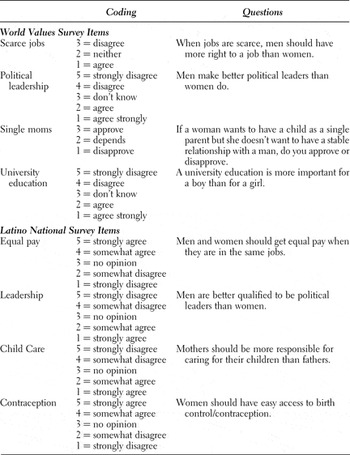
In their 2003 study, Inglehart and Norris created a gender equality scale using responses from five items on the 1990–2001 WVS. Respondents were asked to agree or disagree with the following statements: 1) “When jobs are scarce, men should have more right to a job than women.” 2) “If a woman wants to have a child as a single parent but she doesn't want to have a stable relationship with a man, do your approve or disapprove?” 3) “Men make better political leaders than women.” 4) “A university education is more important for a boy than for a girl.” 5) “It is necessary for a woman to have children to be fulfilled.”
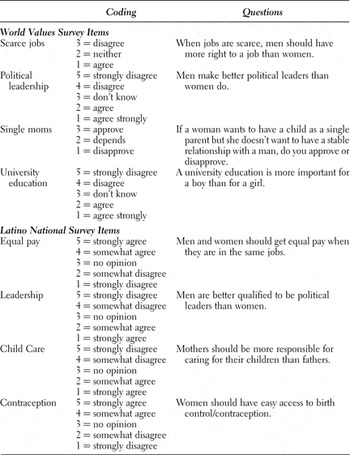
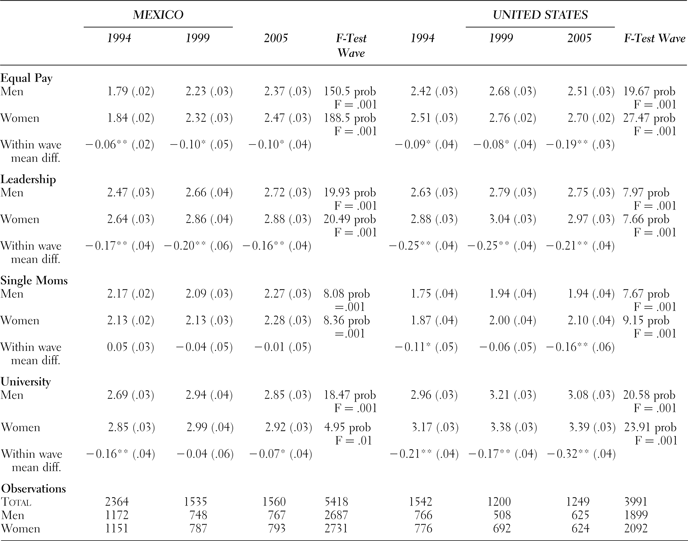
We evaluate the same battery of questions in the 1995–6 and 2005–6 WVS, excluding the fifth item, as it did not appear on the 2005 instrument. The measures offer theoretical leverage as they capture gender equality attitudes in four different venues: educational (university), personal (single mothers), political (women in leadership roles), and economic (jobs). Using this approach, we can observe how opinions about gender roles vary according to different aspects of personal and public life, and make assessments about equality attitudes more broadly than an overtly set of gendered topics (e.g., abortion or maternity leave policies) might allow. Specific wording and coding for these items are located in Appendix A. We compare responses from men and women in the United States and Mexico to assess the extent to which gender differentiates opinions about gender equality.
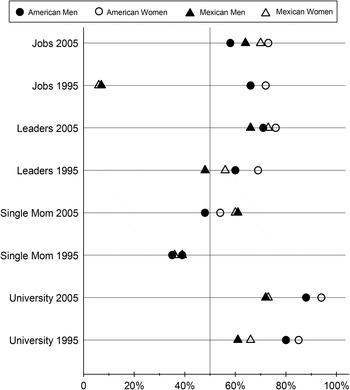
Figure 1 illustrates American and Mexican support for gender equality in response to the four aforementioned items on the 1995 and 2005 WVS. Further analysis detailing statistical and substantive differences between the sexes and countries is reported in Appendix B. The shapes in Figure 1 distinguish the groups of interest: American men, American women, Mexican men, and Mexican women. By plotting the percentage of liberal responses, the graph shows the extent to which each group voiced the strongest possible support for gender equality. For example, the first line on the graph shows that in 2005, more than 70% of Mexican women and 73% of American women disagreed with the statement “When jobs are scarce, men should have more right to a job than women,” while 64% of Mexican men and 58% of American men disagreed.
Gender equality attitudes in Mexico and the United States. Shapes plot percent liberal responses from American and Mexican men and women. Source: World Values Survey (1994–2006).
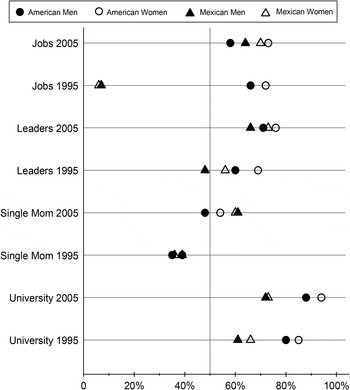
The simple plot design makes it easy to see how much distance exists between groups across issues and years, both between and within countries. Modernization expectations related to gender group and country hold across issues in the 1995 responses: American women and men consistently hold more egalitarian opinions relative to their Mexican counterparts.Footnote 5 American women are most liberal, followed by American men—though single motherhood is clearly an exception to this otherwise steady pattern. Mexican women, though more conservative than Americans, are more liberal than Mexican men. In 1995, the largest gap occurs between Mexican men and American women; this is graphically evident where the solid triangle (Mexican men) consistently falls at the lowest value and the hollow circle (American women) is at the highest value.
At the same time, it is also true that most Mexicans and Americans find commonality on some dimensions of these issues. On educational access, employment, and political leadership (in 2005), all groups fall well above the 50% line, indicating substantial support for gender equality. In 1995, single motherhood is the lone issue area in which Mexican and American attitudes closely approximate each other (hence, the clustering and overlapping shapes on the line). It is interesting to note that 39% of Mexican men and American women approve of women opting to have children without a spouse or male partner. Mexican women approve at a rate of 36% and American men about the same, at 35%. Note that the modern gender gap commonly occurs among Mexicans and Americans; women hold more liberal opinions than men, even when they are on the same side of an issue or in relatively close agreement. The one exception is the difference of opinions on single motherhood in Mexico, for which men are more egalitarian.
By 2005, national differences had decreased, and all groups demonstrate more support for gender equality. The liberalizing trends are evident by observing the data points consistently shifting in the egalitarian direction between 1995 and 2005. With the exception of single parenthood, American women remain the most liberal group across issues; well over 50% support all measures of gender equality. It is interesting that on the issues of jobs and political leadership, Mexican and American women hold opinions more similar to each other, rather than to their countrymen. In fact, Mexican women's attitudes changed at a more rapid rate than Mexican and American men during this period. Again, Mexicans barely hold onto a traditional gender gap in reference to single parenthood (more liberal men); Mexican men are marginally more supportive of single mothers than are women in the country. More than half of American women (54%) also came to support this position by 2005. American men (48%) are the only group to fall below 50% on any issue in 2005. In 2005, Americans continue to demonstrate modern gendered differences, with women more egalitarian than men on all issues examined here.
These trends provide an important, and rarely explored, context for conducting a U.S. Latino gender gap analysis. In contrast to assumptions regarding the cultural distance between Mexico and the United States, gender equality attitudes in the two countries have converged in recent years. It may be the case that foreign-born Latinos in the United States today arrived with the egalitarian attitudes observed in the WVS Mexican data, proving to be more similar to Americans than a decade ago. The results also point to a modernizing assimilation trend in Mexico, where women became more liberal at a faster rate than did men over time. On average, though, gender gaps between Mexican men and women are smaller than those between American men and women.
U.S. LATINO GENDER EQUALITY ATTITUDES ACROSS GENDER AND GENERATIONAL COHORTS
While the previous section focused on attitudinal comparisons across borders, this section focuses on tracking differences across generations. We conduct a series of empirical tests that examine the impact of generational assimilation, the theoretically attributed cause for attitudinal change, on Latino gender equality attitudes. The Inglehart and Norris Gender Equality Scale classifies all Latin American countries as less developed than the United States. Thus, applying modernity theory to the Latin American immigrant experience in the United States implies that assimilation will shift opinions in the same, linear direction for all U.S. Latinos.
The 2006 Latino National Survey (LNS) provides data for our analysis (Fraga et al. Reference Fraga, Garcia, Hero, Jones-Correa, Martinez-Ebers and Segura2006). The scope and depth of the LNS sample allows us to investigate assimilation effects in unprecedented fashion. The 8,634 respondents are a nationally representative sample of the Latino population (margin of error ± 1.05%). The survey was drawn from a random sample of 11 million self-identified Latino households in the United States. Telephone interviews were conducted in English and Spanish (and sometimes both) between November 2005 and August 2006. Our study capitalizes on the unique demographic detail and issue-specific content available in these data.
Measures: Gender Equality Attitudes, Generational Cohort, and Social Characteristics
Our interest in egalitarian attitudes about gender are measured using four LNS survey items: 1) Men and women should get equal pay when they are in the same jobs (equal pay); 2) men are better qualified to be political leaders than women (leadership); 3) mothers should be more responsible for caring for their children than fathers (child care); and 4) women should have easy access to birth control/contraception (contraception). Response values for each item are on a scale that ranges from zero (strongly disagree) to five (strongly agree); higher values indicate greater support for equal gender roles.Footnote 6
The LNS offers extensive information on family lineage, enabling researchers to identify six distinctive immigrant generational cohorts. First, respondents identify their country of birth. Foreign-born respondents provide their age at immigration. And all respondents are asked about national origin for both parents and four grandparents. Six distinctive immigrant generational cohorts are derived based on actual family generations in the United States and two additional categories that immigration scholars have identified as unique segments on the immigration assimilation continuum (Portes Reference Portes1996; Ramakrishnan Reference Ramakrishnan2004). The first generation is foreign born and arrived in the United States after age 10. The 1.5 generation is also foreign born, but arrived in the United States by age 10. Second-generation Latinos are U.S. born and have two foreign-born parents. The 2.5 generation consists of those with one U.S.-born and one foreign-born parent. Third-generation Latinos have two U.S.-born parents. Finally, the fourth generation has U.S.-born grandparents. These categories capture how far removed individuals are from the immigrant experience and signal degrees of American assimilation.
It is a truism in social science research that socioeconomic factors influence attitudinal and behavioral outcomes; gender equality attitudes are no exception. Both comparative and American political-behavior scholars agree that individual traits and socioeconomic indicators (such as income, age, gender, religion, marital status, parenthood, race, and ethnicity) mitigate gender equality attitudes relative to virtually any other explanatory factors of interest (Burns, Schlozman, and Verba Reference Burns, Schlozman and Verba2001; Inglehart and Norris Reference Inglehart and Norris2003). Burns, Schlozman, and Verba (Reference Burns, Schlozman and Verba2001) argue that these factors are indicative of resources, experiences, and contexts. Inglehart and Norris (Reference Inglehart and Norris2003, 43) point out that the strongest support for gender equality in their research comes from those younger, better educated, less religious, and female. With respect to Latinos, we know that education, national origin, gender, and religion influence and differentiate group attitudes, immigration experiences, political opinions, and participation (Garcia Reference Garcia2003).
Accordingly, we include demographic indicators in the multivariate analysis. Several of these attributes are measured as dichotomous variables: Female, Puerto Rican, Cuban, Dominican, Central and South American, homeownership, marital status, and parenthood are measured where 0 indicates “no” and 1 indicates “yes.”Footnote 7 Education is an eight-point scale that ranges from no formal education (zero) to postgraduate education (eight). Age is a continuous variable capturing all respondent ages from 18 to 97. Employment has three values coded zero for unemployed, one for part-time employment, and two for full-time employment. Religiosity is measured using a five-point scale indicating how often individuals attend church services.
To provide a nuanced and rigorous examination of U.S. Latino gender attitudes, we perform two types of analysis. First, difference of means and analysis of variance tests establish the presence and magnitude of gender gaps on four issues within and across generational cohorts. Subsequent multivariate analysis using ordered logistic regression considers the extent to which gender and generational cohort account for differences in egalitarian gender attitudes, controlling for socioeconomic and individual traits. We weight the data to reflect the composition of the national Latino population.
GENDER GAPS IN LATINO EQUALITY ATTITUDES: MODERN, TRADITIONAL, OR NONEXISTENT?
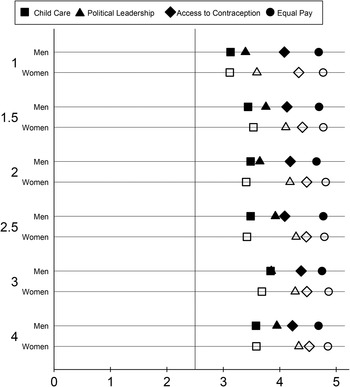
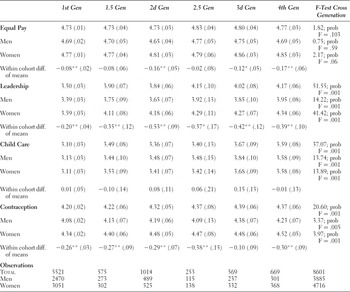
Does the gender gap among Latinos reflect modern or traditional theoretical interpretations? To answer this fundamental question, Figure 2 illustrates mean opinions on four measures of gender equality (equal pay, child-care responsibilities, political leadership, and access to contraception) by generational cohort and gender group. (Detailed tables in Appendix C report corresponding data illustrated in this figure.)
Comparing U.S. Latino support for gender equality by generational cohort. Shapes plot mean levels of support on four gender equality measures. Mean opinion on four equality measures are illustrated on two lines, highlighting within-generational cohort gender differences. Five is the maximum value for all indicators. Hollow shapes indicate women; solid shapes indicate men. Source: Fraga et al., Latino National Survey (LNS) 2006.
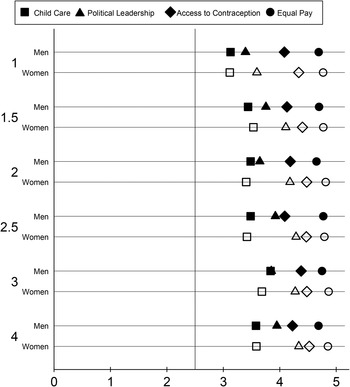
Each shape illustrates an issue, and shading indicates gender group: hollow shapes represent women's preferences, and solid shapes represent men's opinions. The first line on the graph shows average first-generation men's opinion on four issues. The second line shows first-generation Latina opinion on these same issues. The shapes and their location on the graph indicate that first-generation men and women hold nearly identical opinions on all four gender issues; the shapes align almost perfectly on the two lines. Just as interesting is the fact that Latinos and Latinas place these issues in the same rank order, where support for gender equality is highest on equal pay, followed by birth control access, then political leadership, and finally child-care duties. The data also highlight that the vast majority of responses on all issues fall between 4 and 5, indicating very strong support from all cohorts. Also apparent in the illustration is the pattern showing that Latinos and Latinas are not divided about gender equality on issues included here. The solid line marking the midway point on the graph marks the point where responses differ from supportive to unsupportive. For Latinos, opinion differences are not oppositional; rather, they are degrees of support for gender equality on several issue areas.
First-Generation Distinction
Our first hypothesis posits that first-generation Latinos will have the most traditional gender attitudes (or least egalitarian) relative to all other generational cohorts. In terms of actual values, this is indeed the case. Appendix C reports mean values for plotted data and corresponding significance tests. Looking at all respondents across generations, first-generation Latinos have the lowest mean responses on issues of equal pay, women in political leadership, child-rearing responsibility, and access to birth control. It is sometimes difficult to see these differences on the figure because these distinctions are very small, less than a half-point difference in all but one instance. Still, the most liberal attitudes are found in the most assimilated generations, which supports the third hypothesis regarding increasing egalitarianism over time in the United States. In most cases (with the exception of equal pay), average opinions are most egalitarian in the 2.5 and later generational cohorts; this holds for men and women alike.
Significance tests reported in Appendix C show that even slight differences between men and women are statistically significant; men are more conservative than women in the first generation on three out of the four issues, with child care as the only exception. This result contradicts the second hypothesis predicting that traditional gender gaps would endure. Within-sex differences across cohorts are also relatively small in substance, but do produce statistically different patterns. For example, the most recent wave of Latina immigrants holds less liberal opinions about women as political leaders compared to Latinas in all other generations. On other issues, a slight Latina generation gap exists between the first generation and the more assimilated third and fourth generations on attitudes about child-care responsibility. For men, assimilation differences are more consistent where the largest differences occur between the first and most assimilated generations. New male immigrants are more conservative than later generations on all issues; yet these are marginal differences, as all groups express egalitarian gender attitudes.
The findings here tell us that first-generation Latinos and Latinas do, indeed, hold more traditional views about gender equality across issue domains, and women are more liberal than men. To the extent that one would characterize these small opinion differences as a gap, they are primarily of the modern variety.
Gender–Generation Gaps
Theoretical expectations about the gender-gap dynamic predicted that traditional differences would occur in the first generation and then move toward a more modern gender gap with each subsequent generation. Actual trends do not support this expectation because gaps for all generational cohorts follow a modern gender gap on three of four issues, including equal pay, political leadership, and access to contraception. Latinas are more egalitarian than men on these matters within all generational cohorts. Further, generational cohorts where gaps are largest and smallest are inconsistent across issues. In the case of equal pay, for example, the gender gap is largest among the most assimilated Latinos in the fourth generation, and smallest in the less assimilated 2.5 cohort. In another example, on the matter of access to birth control, it is the third generation where both men and women agree most, but the prior 2.5 generation where the differences are most pronounced.
Our fourth hypothesis expects women's attitudes to liberalize at a faster rate than men so as to create the modern gender gap. It is appropriate to compare opinions of the least and most assimilated cohorts to address this question. Gaps should follow traditional form in the first generation (men more liberal than women) and modern in the fourth generation (women more liberal than men). We find, instead, that opinions do not necessarily differ as a function of gender and assimilation. Only one issue—women in leadership—shows the largest gender gap occurring among the least assimilated women and the most assimilated men. On the other hand, the least assimilated men have strong cross-generational differences (gender–generation gap) with the most assimilated fourth-generation Latina cohort on contraception and women in political leadership issues.
The final empirical test examines the effects that gender, generation, and the combination of the two have on equality attitudes. To this point, we have only examined variation (or lack thereof) within and across sex and generation groups. We have not established whether variation (small though it may be) can be attributed to these demographic differences. Ordered logistic regression analysis demonstrates whether gender, generation, and the interactions of the two, exert a significant impact on attitudes pertaining to gender equality, above and beyond the effects associated with country of origin, education, homeownership, age, religiosity, marital status, and parenthood.Footnote 8
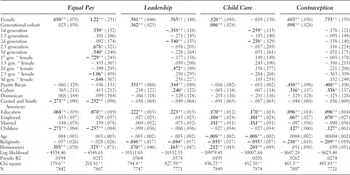
Table 1 presents two models to test variation on each of the four gender equality issues: equal pay, child care, leadership, and contraception. The first model tests the impact of gender and generation along with the competing demographic explanatory factors discussed earlier. The second model includes an interaction term for gender and generational cohorts along with the identical set of covariates in the first model. Table 1 indicates a consistency in our findings; women and more assimilated generational cohorts are significantly more likely to exhibit stronger gender equality preferences. In all models, women are significantly more supportive of gender equality. Education is the only additional variable that consistently has a significant impact on opinions across issues. Perhaps not surprisingly, more education yields more support for gender equality. Generational cohort proves influential on leadership and child care, as well as on support for contraception access. In each case, assimilated generations are more liberal in their attitudes. The models incorporating interaction effects yield mixed results for the interaction terms of interest. The most consequential outcome is that gender and generation remain independently influential factors on equality opinions, even when incorporating the interaction between them.
Gender, generation, and interaction effects on U.S. Latino attitudes: Ordered logistic regression coefficients (and standard errors)
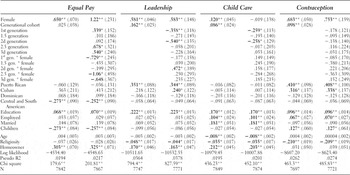
Notes: Cell entries are ordered logit coefficients and standard errors for each gender attitudes model. Reference categories: male, 4th generation, 4th generation female, and Mexican.
Significance: *p < =.05, **p < =.01.
Source: Fraga et al., Latino National Survey (LNS) 2006.
The inclusion of demographic variables serves to highlight important patterns for analysis. When a variable like national origin, religiosity, or income is significant, the relationship holds in both models; it is never the case that the interaction of gender and generation diminish other demographic effects. Despite the centrality of national-origin differences in Latino life and academic research, there is no indication that national origin influences gender equality opinions in any systematic manner. Rather, religiosity and income significantly affect attitudes in nearly all instances. More religious Latinos are significantly less liberal on child care, birth control, and leadership, consistent with the Inglehart and Norris finding. Alternatively, Latinos with more financial resources are significantly more likely to hold egalitarian opinions on equal pay, child care, and leadership. Latinos with children are less likely to support equal pay, but more prone to support contraception access. Latinos who are married and employed are more likely to favor shared child-care responsibilities, but older Latinos are less supportive.
ASSESSING ASSIMILATION THEORY AND LATINOS: OUTCOMES AND FUTURE TRAJECTORY
The current anti-immigrant and anti-Latino climate in the United States is fueled by beliefs about cultural distance and incompatibilities, making a study of these perceived differences both academically and politically salient. In many ways, the conventional literatures on gender modernization and gendered migration serve to support, rather than contest, some of these widely held beliefs. The empirical ambition of this study was to test the applicability of such theories in order to understand patterns of Latino gender equality attitudes. We tested the very premise that Latino gender opinions are divided by gender. To the extent that such differences exist, we sought to identify factors driving the variation. The results show that the gender gap in Mexico is in the modern direction, which is similar to the gap in the United States. Overall, U.S. and Mexican gender equality attitudes have converged in a liberal direction over time. Consequently, more recent immigrants seem to arrive in the United States with egalitarian gender values relatively similar to those in the American society. Thus, differences between Mexican-origin Latino immigrants might not be that different from those of the U.S. majority populations.
We also found that within and across six generational cohorts, Latinos in all stages of assimilation and in gender groups generally hold liberal opinions on a variety of gender equality issues. To the extent that opinions varied, substantive differences were quite small; thus, gender and generation had a very limited impact on gender role opinions in multivariate analysis. Religiosity, income, and education proved just as robust predictors in many instances, while national origin had no effect. But overall patterns in similarities should not be dismissed as nonfindings. Rather, shared egalitarian gender attitudes across generation and gender groups illustrate a weakness in assimilation theory. Neither gender nor generation produces oppositional attitudes between groups of Latinos and Latinas, which challenges popularly held stereotypes about less assimilated populations, and Latino men in particular. Where significant (if not substantive) differences do occur, they are essentially split between the most recent wave of Latino immigrants and the rest of the population. This study on Latino gender and generational differences arrives at the conclusion that the similarities are, themselves, a puzzle to be explored, as they challenge established theoretical interpretations in American and comparative politics regarding modernity, assimilation, and gender attitudes.
The findings pose interesting new questions that can advance theoretical and substantive contributions made here. The first, and perhaps the most obvious, question that arises from this study is whether the cohesiveness evidenced here maps onto Latino political behavior. This study does not speak to the salience and impact of gender equality attitudes on Latino political participation, candidate evaluations, or civic interest. Also beyond the scope of this research is whether issue areas themselves may elicit gendered responses. For example, economic equality questions may not trigger gendered responses, but opinions about personal decisions related to motherhood may reveal differences within sex group and across generations. A study focused on adjudicating between dimensions of difference would include several measures for each of the four areas of inquiry (education, personal, political, and economic) in order to reveal sharper contrasts or proximate relationships. Finally, the extent to which Latinos share gender attitudes with other racial and ethnic groups in the United States presents another related research opportunity with pressing relevance, given demographic shifts occurring in the American population.
Together, the findings in this study underscore a related, important point: The intersection of ethnicity and gender can yield theoretically unexpected and conventionally counterintuitive results. Increasing racial and ethnic diversity in the American population and electorate should prompt a growing share of scholars to consider how political phenomena develop and occur within intersectional spaces.
Survey Items and Coding
Mean Mexican and American Opinion on Equality by Gender Groups
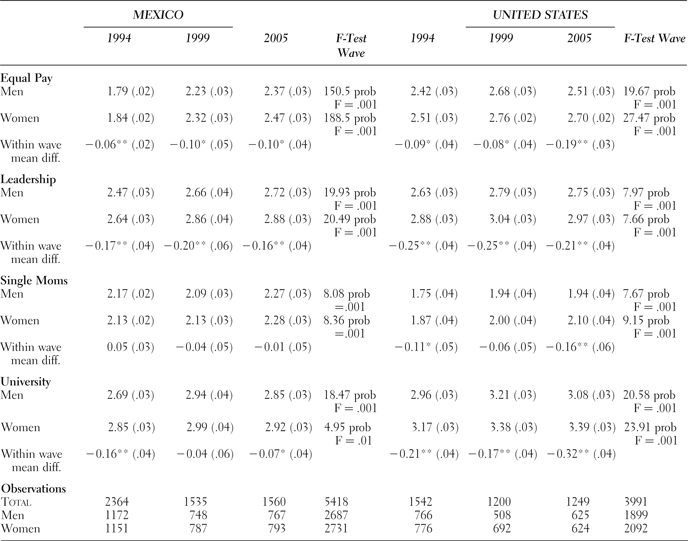
Notes: Cell entries are mean responses with standard errors in parentheses. Value ranges 1 = most conservative, higher values more liberal. Jobs and Moms maximum value = 3; Leadership and Education maximum value = 5.
*p < = .05, **p < = .01
Source: World Values Survey (1994–99; 1999–2004; 2005–07).
U.S. Latino Mean Opinions on Gender Equality by Gender and Generation
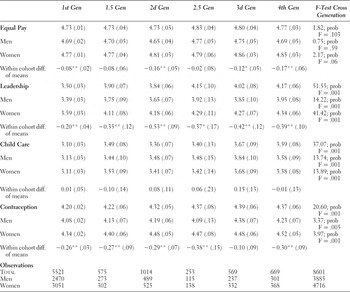
Notes: Cell entries are mean responses for gender equality questions and standard errors in parentheses.
*p < =.05, **p < =.01
Source: Fraga et al., Latino National Survey (LNS), 2006.