Introduction
Various techniques have been used to assess species abundance of seeds and vegetative propagules in soil seed banks. For example, some studies have physically extracted all seeds and other diaspores from samples (e.g. Andersson et al., Reference Andersson, Nilsson and Johansson2000; Tabacchi et al., Reference Tabacchi, Planty-Tabacchi, Roques and Nadal2005), whereas others have investigated only viable propagules. If viable seeds are of interest, viability may be tested using tetrazolium chloride (e.g. MacKay, Reference MacKay and Roberts1972). Alternatively, an emergence method can be used, and the resulting seedlings identified and counted. In the majority of soil seed bank studies summarized in a database for north-west Europe (Thompson et al., Reference Thompson, Bakker and Bekker1997), soil samples were collected from naturally vegetated sites, and seeds were allowed to germinate in a glasshouse or out-of-doors without extraction of seeds or sample reduction. Boedeltje et al. (Reference Boedeltje, ter Heerdt and Bakker2002) reviewed the germination media and environmental conditions under which riparian and aquatic seedling emergence in soil samples has been studied. If environmental conditions are controlled, they are commonly representative of moist, free-draining conditions (e.g. Keddy and Reznicek, Reference Keddy and Reznicek1982; Leck and Simpson, Reference Leck and Simpson1995; Goodson et al., Reference Goodson, Gurnell, Angold and Morrissey2003; Leck and Schutz, 2005), but different hydrological regimes have been compared in some studies (e.g. Van der Valk and Davis, Reference Van der Valk and Davis1978; Abernethy and Willby, Reference Abernethy and Willby1999; Baldwin et al., Reference Baldwin, Egnotovich and Clarke2001; Haukos and Smith, Reference Haukos and Smith2001; Boedeltje et al., Reference Boedeltje, ter Heerdt and Bakker2002).
Our broader research programme focuses on the species abundance of viable propagules dispersed along river corridors and deposited seasonally on the river bed, bank faces and bank-tops/floodplain in relation to the species composition of the standing vegetation, the soil propagule bank, and the inundation regime and hydraulic complexity of flows within the river. In particular, we are interested in the fate of propagules of species that thrive in three types of hydrological habitat (in-channel aquatic, waterlogged/wetland and free-draining) and, in addition, whether species that thrive in these conditions tend to be preferentially deposited within these hydrological environments. To identify viable propagules associated with these three habitats, we undertook emergence studies using three different treatments: submerged, waterlogged and moist but free-draining, hereafter called ‘Submerged’, ‘Waterlogged’ and ‘Drained’, respectively. These different emergence methods were chosen because we were interested in all viable propagules, and because the different methods gave representations of (1) the moist but not waterlogged conditions that prevail for the majority of the time on river banks and (2) the waterlogged and (3) submerged conditions that occur in specific situations or, periodically, across extensive riparian areas during flooding.
Thus, the focus of this paper is the variability in species abundance estimates obtained by Drained, Waterlogged and Submerged treatments and their implications for investigating propagule dispersal processes along river channels and their margins. In particular, we test the following four null hypotheses:
- Hypothesis 1:
Different emergence methods applied to the same samples result in similar germination success.
- Hypothesis 2:
Different emergence methods applied to the same samples identify similar numbers of aquatic, wetland and terrestrial species.
- Hypothesis 3:
Different emergence methods applied to the same samples identify the same species.
- Hypothesis 4:
Different emergence methods applied to the same group of samples generate species abundance data from which similar environmental gradients can be inferred when the data sets are subjected to ordination analysis
Materials and methods
Study reaches
The research was conducted along three lengths (reaches) of two UK rivers – the River Tern, Shropshire and the River Frome, Dorset. These rivers form the focus of the UK Natural Environment Research Council's, LOCAR (Lowland Catchment Research) Thematic programme to which the present research contributed. Two reaches (Frome1, 145 m long, and Frome2, 195 m long) were located 2 km apart in the headwaters of the River Frome and were underlain by chalk bedrock. They allowed comparison of results across reaches with similar environmental characteristics. The third (115 m long) was located in the headwaters of the River Tern, approximately 250 km distance from the first two study reaches, and it was underlain by sandstone bedrock, providing a strong environmental contrast to Frome1 and Frome2. The river channels in all three reaches were between 5.5 and 11.9 m wide and had well-vegetated margins that were fringed by riparian trees with a dense, largely ungrazed, herbaceous ground cover.
Field methods
Soil propagule bank samples were collected during May 2003, and a different method was used to sample river bank and river bed sediment. Soil cores were obtained directly from two zones of the river bank, the top of the bank (‘Top’ - T) and the central area of the bank face (‘Mid’ - M), using a 5 cm deep × 6 cm diameter corer, with five replicate cores taken at each location and bulked together. In total, 16 bulked samples were obtained from different locations along the bank top, and 16 bulked samples were obtained from the bank faces along each of the study reaches. For these ‘terrestrial’ samples, May is probably the time period after which most field germination has already taken place, so the method primarily sampled the persistent seed bank.
Sediment cores were also obtained from 16 locations on the river bed of each reach (‘Channel’ – C), using an Aston Sampler with a 26-cm diameter sampling area. The river bed enclosed by the sampler was vigorously manually disturbed to a depth of 5 cm, and the resultant samples of bed sediment were collected in a 100 μm mesh net. The sampler was placed at 16 different locations on the river bed of each study reach, and two replicate Aston cores were obtained at close proximity to each other. The small mesh size allowed the full range of seed sizes (typically >212 μm; Thompson et al., Reference Thompson, Bakker and Bekker1997) to be collected from the river bed. In some locations, dense compacted gravel and silts limited sampling depth, while an extension to the top of the sampler allowed sampling in locations with water up to a maximum of 1 m depth. Each sampling location was marked by installing a marker post on the nearest bank top, the precise horizontal distance from the post to the sampling location was measured, and the location was also fixed by a detailed topographic survey. This permitted repeat sampling of bed surface sediments, thus sampling identical bed microhabitats, at the same river bed locations for the remainder of the study.
Following the initial propagule bank sample collection, the sequential deposition of propagules on the river banks and bed was monitored along the three reaches between June 2003 and October 2004 over four 4-monthly periods: period 1, June 2003 to September 2003; period 2, October 2003 to January 2004; period 3, February 2004 to May 2004; and period 4, June 2004 to October 2004. Two different methods were used for sampling the river banks and the river bed. The propagules deposited along bank ‘Top’ and ‘Mid’ areas were sampled using 18 paired artificial turf (Astroturf) mats (an extra two pairs per reach in comparison with the propagule bank samples in case of mat loss). Each mat was 36 × 24 cm, with 1.5 cm length bristles at a density of 8 bristles per cm2. The mats were distributed widely along each reach to provide good spatial sampling of deposited material. However, the near-vertical, frequently undercut, unstable banks at Frome2 prevented sampling widely across the bank face. Instead, ‘Mid’ mats were all installed at the downstream end of the reach on a depositional bench that graded gently from river to floodplain level.
At the end of each sampling period, the mat pairs were retrieved, placed in sealed plastic bags for storage and new mat pairs were installed in the same locations. At the same time, the 16 ‘Channel’ sampling sites in each reach were carefully re-located, and superficial sediment that had accumulated on the bed since the previous collections was sampled using the Aston sampler.
The reason for choosing these 4-month sampling periods was that our larger research programme aimed to assess the influence of seasonal growth of in-channel and emergent vegetation on flow hydraulics (e.g. Gurnell and Midgley, Reference Gurnell and Midgley1994) and, thus, on the retention and redistribution of hydrochorous propagules and finer sediment particles (Gurnell et al., Reference Gurnell, van Oosterhout, de Vlieger and Goodson2006, 2007).
Laboratory methods
The aggregated propagule bank cores from the river banks and river bed (Propagule bank: ‘Top’, ‘Mid’ and ‘Channel’ locations) and the sequentially deposited material collected over 4-month periods from the river bank and channel areas (Period 1 to Period 4 – ‘Top,’ ‘Mid’ and ‘Channel’) were stored at 4°C for the short time (a maximum of 2 weeks) until they were processed.
The aggregated ‘Top’ and ‘Mid’ propagule bank core samples were hand-mixed before being condensed by wet-sieving through a 212 μm mesh sieve, which is sufficiently small to retain the smallest seeds (e.g. Juncus spp.; Thompson et al., Reference Thompson, Bakker and Bekker1997). The ‘Channel’ samples were also sieved to remove excess fine silts and clays wherever appropriate. All samples were split and subjected to the three separate emergence trials. In the case of the paired mats, one mat was used in the Drained trial, and sediment was removed from the second mat and split between the Submerged and Waterlogged trials.
For the Drained emergence method, core samples and river bed sediment samples were spread to an even depth (always less than 1 cm) in a tray previously filled with 3–4 cm sterile soil (John Innes #2). The mat samples were punctured and placed in seedling trays previously filled with water-soaked vermiculite, with further vermiculite added around the edges of each mat to ensure that moisture could pass up and across the mat from below. Mats with little deposited sediment were augmented with additional sterile soil to prevent desiccation and maintain water percolation across the entire mat. The propagule bank, channel and mat samples were arranged randomly in the greenhouse at controlled temperatures between 15–22°C and 16 h daylight, and watered twice daily using an automated pipe-feed system. As seeds germinated, the seedlings were identified to species and then removed or, where further growth was needed for identification purposes, grown in separate pots to prevent overcrowding. Each of the five separate Drained germination trials continued for 10 weeks.
Waterlogged and Submerged emergence trials were performed at the Experimental Water Facility (EWF) at CEH Monks Wood (Cambridgeshire, UK). Because of space limitations and the large size of this facility, it is located outdoors, and so the trials differed not only in their hydrology, but also in ambient light and temperature conditions. As a result, the trials were extended for at least 22 weeks to maximize the opportunity for germination (in every case, part of the trial period was too cold to permit germination). The facility has 32 tanks open to the atmosphere, each 2 m long and 1 m wide with a maximum water depth of 0.5 m. The tanks are linked in groups of eight to a water-circulation system with water supplied from a header tank to maintain the required water levels. Each tank is fitted with an overflow that drains into the circulation system. The height of the overflow can be varied to produce different water levels within each tank.
Each sample for the EWF germination trials was subdivided into two parts, which were placed into separate 25 cm diameter, 5 cm deep dishes, previously part-filled with sterile soil-based compost (John Innes #2). The sample material was spread on top of the compost, and a small amount of compost sprinkled thinly over the surface to reduce propagule movement once the samples were submerged. The two dishes were then subjected to Waterlogged and Submerged treatments. In the Waterlogged treatment, the water level was maintained flush with the dish tops, whereas in the Submerged treatment, the water level was maintained 10 cm above the top of the dishes. Dishes were placed randomly within the tanks and monitored for germination.
In the majority of cases, it was possible to identify seedlings to species, but occasionally they could be identified only to genus or family level. However, in some of the trials, identification was hampered by early death of seedlings that could not be determined at such an early stage. Based on information in Stace (Reference Stace1999), Hubbard (Reference Hubbard1992) and Rose (Reference Rose1981), each identified species was allocated to a group according to its general habitat requirements: aquatic, wetland and terrestrial.
Data analysis
All emergence data were expressed as propagules per m2 sampling area. Descriptive statistics and one-way analysis of variance (ANOVA) were used to compare the germination success of the three emergence treatments, to compare species richness of the seedlings germinated using each treatment, and to compare densities of species germinated using the three emergence techniques. Because of their skewed frequency distributions, all of the estimates of the number of propagules per m2 were log-transformed prior to statistical analysis. Where ANOVA revealed a significant difference in the observations obtained from the three treatments, Tukey post-hoc tests were used to identify the treatments that yielded statistically significantly different results. ANOVA was undertaken using Minitab, Version 14 (www.minitab.com).
Detrended correspondence analysis (DCA; Hill and Gauch, Reference Hill and Gauch1980) was applied to the average species abundance data for ‘Top’, ‘Mid’ and ‘Channel’ samples for the seed bank and each of the four depositional period data sets from each of the three study reaches. The aim was to investigate the degree to which similar indirect environmental gradients could be inferred from data sets generated by the different emergence methods when subjected to the same ordination technique. DCA was accomplished using detrending-by-segments, and there was no downweighting or removal of species or samples from the analyses. DCA was undertaken using CANOCO for Windows, Version 4.5 (Ter Braak and Smilauer, Reference Ter Braak and Smilauer2002).
Results
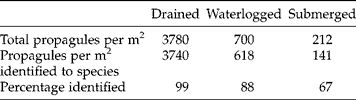
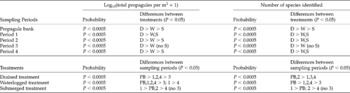
A total of 157,700 seedlings germinated during the trials. Overall, the Drained treatment had a far higher germination success than the Waterlogged treatment, and the Waterlogged treatment generated more seedlings than the Submerged treatment (Table 1, Fig. 1A). In all cases, the Drained treatment yielded a significantly higher density of seedlings than the other two treatments (P < 0.05, Table 2). For the propagule bank samples and the samples from periods 2 and 4, the Waterlogged treatment yielded a significantly higher density of seedlings than the Submerged treatment (P < 0.05, Table 2). Whereas 99% of seedlings were identified to species in the Drained treatment, only 88% and 67% were identified in the Waterlogged and Submerged treatments, respectively, as a result of early seedling mortality before the species could be identified (Table 1). The contrasts in identification success between the treatments persisted across the different sets of samples (Fig. 1B). Samples from depositional period 3 (February to May 2004 representing the ‘spring’ season) yielded significantly lower densities of seedlings for all treatments than any of the other sets of samples, while no seedlings were found in the Submerged treatment from this period (Table 2, Fig. 1A).
Differential germination success of riparian zone species from the River Frome (Dorset, UK) and the River Tern (Shropshire, UK) in drained, waterlogged and submerged treatments
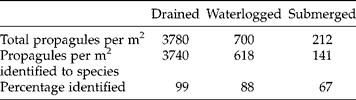
Differences between treatments and sets of samples in (A) the number of seedlings per m2 and (B) the proportion of the seedlings identified in the Drained, Waterlogged and Submerged emergence trials.

Differences in the number of seedlings and species germinated from each set of samples in the Drained, Waterlogged and Submerged treatments, assessed using one-way analysis of variance

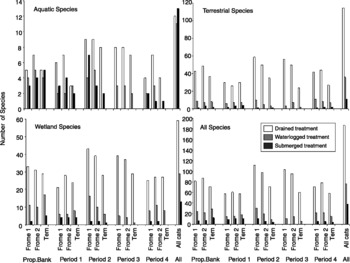
A total of 195 species was identified in the emergence trials: 186, 76 and 37 in the Drained, Waterlogged and Submerged trials, respectively. When the species richness of all samples within the propagule bank and the four depositional sample sets were subjected to one-way ANOVA, the results were significant (P < 0.0005) in all cases. Tukey post-hoc tests showed that the Drained treatment persistently identified a significantly larger number of species than the other two treatments (P < 0.05). When the species were subdivided into hydrological groups, the Drained treatment yielded the largest number of species in each group, apart from the aquatic species group where all treatments yielded a similar number of species. In the Drained trials, 115 terrestrial, 59 wetland and 12 aquatic species were identified in comparison with 36 terrestrial, 29 wetland and 11 aquatic species in the Waterlogged trials and 11 terrestrial, 13 wetland and 13 aquatic species in the Submerged trials. Only three species (Betula pendula, Geranium robertianum and Plantago lanceolata) uniquely germinated in the Waterlogged treatment; all were terrestrial species with an extremely small number of propagules. In contrast, two aquatic species (Potamogeton crispus and Potamogeton pusillus) germinated only in the Submerged treatment, and a further two aquatic (Charophyta spp., Zannichellia palustris) and one wetland (Cirsium palustre) species were found in both the Waterlogged and Submerged, but not the Drained treatments. Two aquatic species (Cladophora spp. and Juncus bulbosus) were found widely and uniquely within the Drained trials. The number of identified species within individual samples varied with the emergence treatment (Fig. 2, Table 2). Samples from the propagule bank and period 2 yielded significantly more species than the other data sets in the Drained treatments, and samples from the propagule bank also yielded significantly more species than the other data sets in the Waterlogged treatments, whereas samples from period 1 yielded significantly more species than the other data sets in the Submerged treatments. Period 3 samples yielded fewer species than other data sets across all treatments. The complete list of species and the trials in which they were identified are listed in the Appendix.
Number of aquatic, wetland and terrestrial species identified from Drained, Waterlogged and Submerged emergence trials.

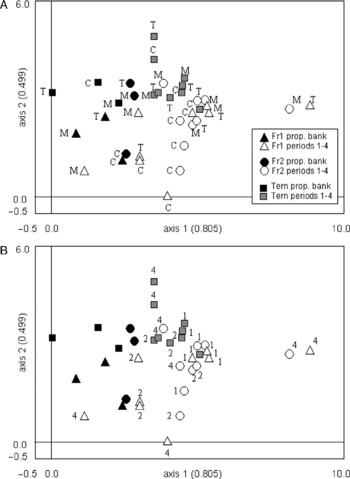
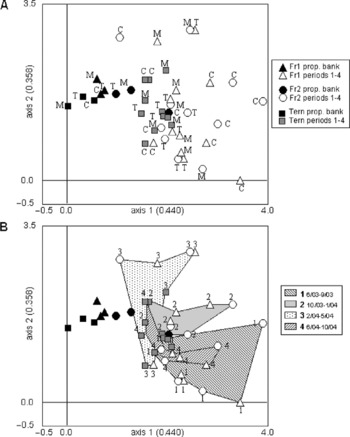
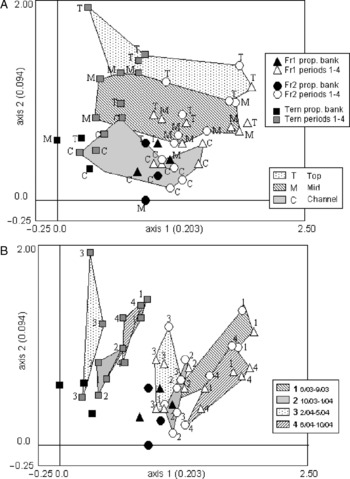
The three ordinations (Figs 3, 4 and 5) yield decreasing eigenvalues and axis lengths as the analyses focus on the Submerged, Waterlogged and Drained treatments. In the Submerged treatment (Fig. 3), axis 1 separates the propagule bank from the depositional samples, and axis 2 shows some separation between samples from the Tern and the Frome reaches. There is no clear separation between sampling positions (T, M, C) or sampling periods (1, 2, 3, 4), although it is noticeable that samples from position C and sampling period 1 occupy a more compact area of the biplot than samples from other positions and periods. In the Waterlogged treatment (Fig. 4), axis 1 again separates the propagule bank samples from the depositional samples. The Tern depositional samples occupy a more compact, but not a distinct, area of the biplot in comparison with those from the Frome. Axis 2 discriminates seasonal changes in the species composition of the samples, with samples obtained during the summer (periods 1 and 4) having predominantly lower scores on axis 2. On the other hand, samples obtained during late autumn and winter (period 3) have predominantly higher scores on axis 2, and those obtained during spring (period 2) have intermediate scores. The strongest contrasts in the seasonal plotting positions of the sample scores are found in samples from the Frome sites. In the Drained treatment (Fig. 5), axis 1 completely separates samples from the Tern and Frome sites, and also shows a distinct seasonal shift in the plotting position of depositional samples within these sites from spring (period 3), through late autumn and winter (period 2) to summer (periods 1 and 4). Axis 2 describes a gradient from propagule bank and channel depositional samples through bank face depositional samples to bank top depositional samples.
Sample scatter plots in relation to the first two axes of a detrended correspondence analysis (DCA). DCA was applied to the average species abundance found using Submerged trials in propagule bank samples and depositional samples obtained during periods 1–4 from bank tops (T), bank faces (M) and channel bed (C) of the three study reaches (eigenvalues are in parentheses next to the axis labels). (A) Samples labelled according to sampling position (T, M, C). (B) Samples labelled according to sampling period (1, 2, 4 – no seedlings were identified from period 3 samples).

Sample scatter plots in relation to the first two axes of a detrended correspondence analysis (DCA). DCA was applied to the average species abundance found using Waterlogged trials in propagule bank samples and depositional samples obtained during periods 1–4 from bank tops (T), bank faces (M) and channel bed (C) of the three study reaches (eigenvalues are in parentheses next to the axis labels). (A) Samples labelled according to sampling position (T, M, C). (B) Samples labelled according to sampling period (1, 2, 3, 4). The shaded polygons reflect the outer limits of the depositional samples only.

Sample scatter plots in relation to the first two axes of a detrended correspondence analysis (DCA). DCA was applied to the average species abundance found using Drained trials in propagule bank samples and depositional samples obtained during periods 1–4 from bank tops (T), bank faces (M) and channel bed (C) of the three study reaches (eigenvalues are in parentheses next to the axis labels). (A) Samples labelled according to sampling position (T, M, C). (B) Samples labelled according to sampling period (1, 2, 3, 4). The shaded polygons reflect the outer limits of the depositional samples only.

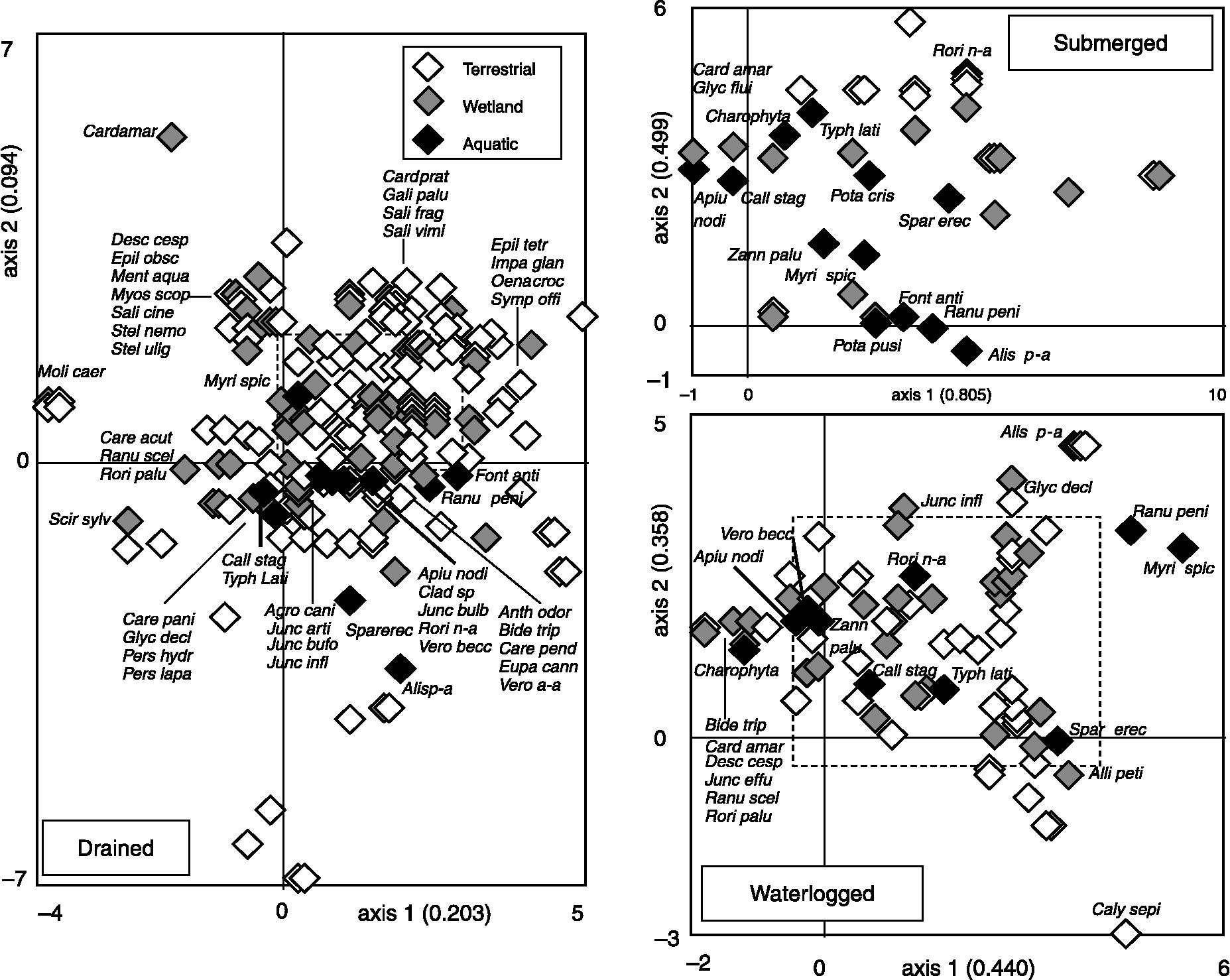
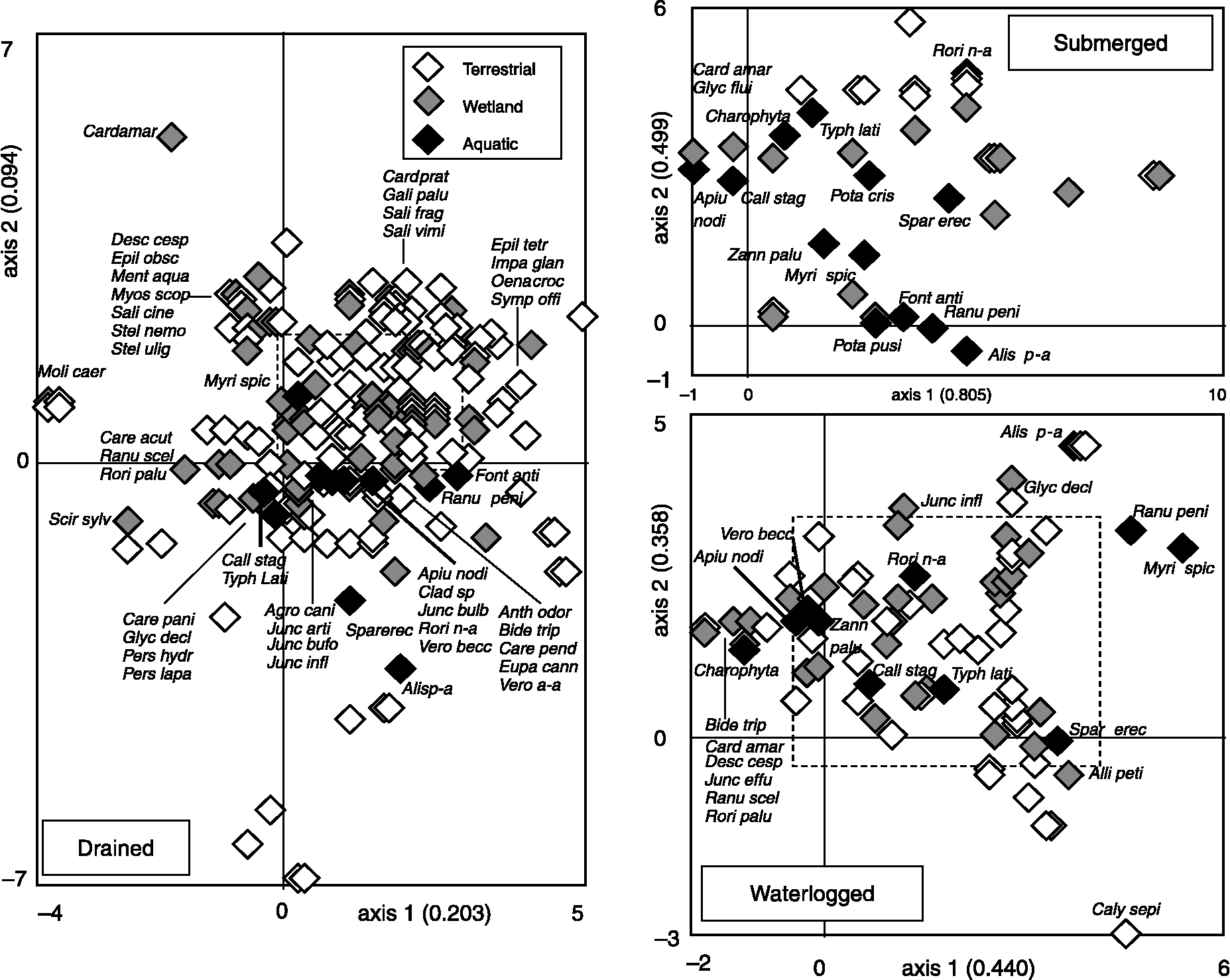
Figure 6 displays plots of species scores resulting from the same ordinations as Figs 3–5. In the Submerged treatment, the positive area of the plot is equivalent to the plotting area of the samples (Fig. 3), and displays predominantly aquatic and wetland species. However, the plots for the Waterlogged and Drained treatments extend well beyond the plotting positions for the samples (represented by the dashed boxes), and display a range of terrestrial as well as wetland and aquatic species. A particularly notable feature of the Drained plot is that virtually all of the aquatic species have negative scores on axis 2.
Species scatter plots in relation to the first two axes of detrended correspondence analyses (DCA) applied to the average species abundance found using Submerged, Waterlogged and Drained trials. DCA was applied to propagule bank and depositional samples obtained during periods 1–4 from bank tops, bank faces and channel bed of the three study reaches. Eigenvalues in parentheses are next to the axis labels. All aquatic species are labelled. Wetland species are labelled when they plot beyond the range of the sample plotting positions – for Submerged, this applies to species on the negative part of the horizontal axis; for Waterlogged and Drained, this applies to the area outside of the dashed boxes. See Appendix for full names.
Discussion and conclusions
The results obtained from the three emergence trials support rejection of all of the null hypotheses proposed at the beginning of this paper.
Hypothesis 1: Different emergence methods applied to the same samples result in similar germination success
Significantly more seedlings germinated in the Drained than the Waterlogged trial, and significantly more seedlings germinated in the Waterlogged than the Submerged trial (Tables 1 and 2). These contrasts persisted across all of the individual sets of samples (propagule bank, and periods 1–4) apart from period 1, where there was no significant difference between the Waterlogged and Submerged treatments. Although the differences between the Drained and the other two treatments in the present study may be exaggerated by the indoor-controlled conditions, in comparison with the outdoor-uncontrolled climatic conditions experienced by the samples, similar differences have been found in other studies (see below). Moreover, the contrast in germination success between the two outdoor treatments is marked, with a consistently low germination success achieved in the Submerged treatments.
Hypothesis 2: Different emergence methods applied to the same samples identify similar numbers of aquatic, wetland and terrestrial species
There was enormous variation in the number of species identified by the three emergence methods (see Appendix). Overall, the Drained trials identified 186 species in comparison within 76 in the Waterlogged and 37 in the Submerged trials. For terrestrial species, the contrast was even greater with 115, 36 and 11 species, in Drained, Waterlogged and Submerged trials, respectively. The contrast in the number of species identified by the three emergence methods was maintained for wetland species, with 59, 29 and 13 species identified, respectively. Similar numbers of aquatic species (12, 11, and 13) were identified by the three emergence methods. These results were similar to other studies that have compared hydrological treatments (see below).
Hypothesis 3: Different emergence methods applied to the same samples identify the same species
The Drained trials identified many more species than the Waterlogged trials, and the Waterlogged trials identified many more species than the Submerged trials. Only six species (Betula pendula, Charophyta spp., Cirsium palustre, Geranium robertianum, Plantago lanceolata, Zannichellia palustris), which were not identified in the Drained trials, were identified in the Waterlogged trials, and only five species (Charophyta, Cirsium palustre, Potamogeton crispus, Potamogeton pusillus, Zannichellia palustris) identified in the Submerged trials were not identified in the Drained trials. The Submerged trials added only two species (Potamogeton crispus and Potamogeton pusillus) to those already identified by the Drained and Waterlogged trials. With the exception of Zannichellia palustris in the Submerged treatment, none of these species were found at an abundance of greater than 5 seedlings m− 2 in either the Waterlogged or Submerged trials.
Hypothesis 4: Different emergence methods applied to the same group of samples generate species abundance data from which similar environmental gradients can be inferred when the data sets are subjected to ordination analysis
Within the data sets obtained for the propagule bank and the four depositional data sets, application of DCA to the average species abundance information for the sampled hydrological habitats (T, M, C) generated results from which underlying environmental gradients could be inferred. These results differed greatly between the three emergence methods.
The aim of the present paper is to illustrate that differences in inferred environmental gradients may result from analysis of the results of different emergence trials, rather than to explore the detailed processes underlying such differences. Nevertheless, a brief assessment of the nature and possible controls on these differences will provide an indication of the potential usefulness of the three emergence methods in process studies. The analysis of the Drained data set generated lower eigenvalues and shorter axis lengths than the Waterlogged and Submerged data sets, indicating considerable variability within, as well as between, groups of samples. Nevertheless, the arrangement of the samples and species with respect to the first two DCA axes indicated clear gradients in their floristic composition (Figs 5 and 6). In particular, axis 1 defined a gradient in species from the acidic to neutral sandstone environment of the Tern, to the more alkaline, chalk environment of the Frome. Within each of these environments, a seasonal separation in the depositional samples from spring (February–May), through winter (October–January) to summer (June–September) was observed, probably reflecting variations in the timing of propagule release and the longevity of propagules of the species collected in the depositional samples. Axis 2 described a clear elevational gradient in depositional samples obtained from the channel, the bank face and the bank tops. This probably reflects a gradient in the balance between hydrochory and other dispersal mechanisms, and also in the flow/inundation regime and buoyancy characteristics of hydrochorous propagules deposited at particular locations during different seasons. All propagule bank samples plot close to the channel depositional samples (C), showing slight separation towards lower scores on axis 1, but a very similar range in scores on axis 2. This probably indicates that the channel depositional samples (C) have a higher proportion of long-lived propagules than the bank face (M) and bank top (T) depositional samples, which would typify the propagule bank samples. In contrast, DCA applied to data from the Waterlogged treatment clearly distinguishes only between the propagule bank and the depositional samples, with some limited separation between the Tern and Frome depositional samples along axis 1, and also a seasonal gradient within the depositional samples with respect to axis 2 (Fig. 4). However, analysis of data from the Submerged treatment separates the propagule bank from the depositional samples in relation to axis 1 and a weak separation between depositional samples drawn from the Frome and Tern in relation to axis 2 (Fig. 3). Thus, although the eigenvalues and axis lengths of the Waterlogged and Submerged DCAs are larger than for the Drained DCA, suggesting clearer changes in the distributions of species abundance along the DCA axes, the interpreted gradients are more restricted, forming only a subset of those found in the Drained data set. In summary, the Drained treatment, which allowed virtually the full complement of species present in the samples to germinate, revealed significant (and expected) differences between sites, seasons and sample types. In contrast, the Waterlogged and (especially) Submerged treatments, by imposing increasingly severe constraints on the ability of species to germinate, presented an increasingly homogeneous view of the samples.
From a practical perspective, the Waterlogged and particularly the Submerged trials added little to the information obtained by the Drained treatment. In our study, the Waterlogged and Submerged treatments have permitted the identification of a few additional species compared to the Drained treatment, but these additional species have generally only been represented by a small number of seedlings. Because of logistical constraints of storing and processing such a large number of samples, emergence may have been inhibited by some aspects of our methodology, other than simply by hydrology. Although all sample sets (propagule bank and depositional samples 1, 2, 3, 4) received the same treatment prior to entering the emergence trials, which included up to 2 weeks' storage at 4°C, a longer period of cool storage might have resulted in the emergence of additional species and larger numbers of seedlings. Moreover, although we tried to compensate for differences in ambient light and temperature between the greenhouse and outdoor trials by extending the germination period of the latter, differences in our results may be partly attributable to these contrasting light and temperature conditions, as well as the contrasts in hydrological regime.
Despite these possible constraints on our research, the results are similar to emergence comparisons in other propagule bank studies, which have demonstrated that markedly fewer species and propagules germinate under flooded and/or under waterlogged treatments than under moist drained treatments (e.g. Abernethy and Willby, Reference Abernethy and Willby1999; Baldwin et al., Reference Baldwin, Egnotovich and Clarke2001; Boedeltje et al., Reference Boedeltje, ter Heerdt and Bakker2002; Capon and Brock, Reference Capon and Brock2006). They are also in accord with the experimental manipulations of the germination environment of macrophyte seeds undertaken by Leck (Reference Leck1996). Because our study has also used depositional samples, it has shown that the contrasts in emergence results also apply to seasonal, depositional samples obtained from river bank and river bed sites. Overall, the trials have demonstrated that the strong environmental sieves (Van der Valk, Reference Van der Valk1981) imposed by the Waterlogged and, particularly, Submerged trials restricted the emergence of numerous terrestrial and wetland species and even a few aquatic species that were successfully identified using the Drained approach.
More importantly for our larger research programme, the species abundance data obtained from our Submerged and Waterlogged trials have supported the presence of some of the environmental gradients that can also be inferred from the Drained treatment. The results of the Drained treatment provide the core information for investigating linkages between propagule dispersal and storage, the growing vegetation and river processes within river corridors, which will be elaborated in detail in future publications.
Acknowledgements
Many thanks to Carol Baskin (Editorial Board Member) and the referees for their helpful and constructive comments on our manuscript. This research was funded by research grant NER/T/S/2001/00 930 from the UK Natural Environment Research Council as part of the LOCAR programme. We are also very grateful to many landowners for granting us permission to work on their land and for making us so welcome: Mr and Mrs Cook, Mr Druce, Mr Holmes, Ms Quick, Mr Smith and Mr Welch on the River Frome; and Mr Furnible, Mr and Mrs Fisher, Dr Shaw on the River Tern.