Introduction
Dextro-transposition of the great arteries with intact ventricular septum is a cyanotic congenital heart defect characterised by ventriculoarterial discordance. It accounts for 5–7% of all CHDs and has an incidence of 1 in 3,000–5,000 live births.Reference Hoffman and Kaplan1,Reference Martins and Castela2 In dextro-transposition of the great arteries with intact ventricular septum, the aorta originates from the right ventricle and the pulmonary artery from the left, which leads to parallel systemic and pulmonary circulation.Reference Villafañe, Lantin-Hermoso and Bhatt3 Without mixing between circuits, it is incompatible with life; survival depends on structures like the patent foramen ovale, patent ductus arteriosus, or atrial septal defect. Early diagnosis is critical, as 90% of untreated cases die in the first year due to hypoxaemia and heart failure.Reference Parker, Zuhdi, Kouatli and Baslaim4 However, in resource-limited settings, late diagnosis beyond the neonatal period is observed, and this complicates management due to regression of the left ventricle.Reference Kang, de Leval and Elliott5
The first surgical choice for dextro-transposition of the great arteries with intact ventricular septum is the arterial switch operation performed within the first 2–3 weeks of life, allowing the left ventricle to sustain systemic circulation.Reference Wernovsky, Mayer and Jonas6 In late-diagnosed cases (beyond 4–8 weeks), arterial switch operation risks high left ventricular failure rates, often requiring ECMO (up to 36% usage, 27% mortality).Reference Duan, Sun, Dong, Du and Yan7 Left ventricular retraining precedes arterial switch operation in these cases. Traditionally, this involves pulmonary artery banding with a systemic-to-pulmonary shunt (e.g., modified Blalock-Taussig), increasing left ventricular afterload and preload for hypertrophy.Reference Jonas, Giglia and Sanders8 However, it risks acute overload, left ventricular dysfunction, pulmonary overcirculation, and infection.Reference Cevik, Karaci and Polat9,Reference Watanabe, Mainwaring, Carrillo, Lui, Reddy and Hanley10 Alternatives like pulmonary artery banding alone or with ductal stenting may insufficiently load the left ventricle.Reference Bishnoi, Patel and Agrawal11
Pulmonary artery banding with bidirectional Glenn anastomosis (BDG) provides balanced retraining by elevating afterload without excessive preload, achieving gradual left ventricular adaptation while maintaining stable oxygenation.Reference Cevik, Karaci and Polat9,Reference Schulz, Kelm and Weixler12 It reduces early morbidity compared to shunt methods by avoiding thrombosis and overcirculation, but delays arterial switch operation (10–12 months) and requires monitoring for excessive hypertrophy.Reference Mainwaring, Patrick and Arunamata13 Literature on late interventions is limited, with variable outcomes and no consensus on strategies.Reference Tan, Datuk Ja’apar and Sallehuddin14,Reference Yıldız, Ozturk, Onan, Tanıdır, Ergul and Guzeltas15
Given these gaps, we evaluated the safety and efficacy of two-stage arterial switch operation using BDG + pulmonary artery banding in late-diagnosed-transposition of the great arteries with intact ventricular septum, analysing preoperative, operative, and follow-up data to inform haemodynamic outcomes, retraining timelines, and long-term complications in this high-risk cohort.
Material and methods
Ethical approval
This study was approved by the Non-Interventional Research Ethics Committee of Istanbul Atlas University (Decision No: 09/40; Date: October 20, 2025).
Study design, setting, and population
This was a single-centre, retrospective cohort study conducted at the Pediatric Cardiology and Cardiovascular Surgery Departments of Atlas University Medical Faculty Hospital, Istanbul, Turkey. None of the procedures were prospectively planned as part of the study, and all analyses were based on existing medical records.
We evaluated outcomes of two-stage arterial switch operation in 24 paediatric patients with late-diagnosed transposition of the great arteries with intact ventricular septum managed between 2020 and 2025. Only patients aged at least 2 months at initial presentation were included, given echocardiographic confirmation of transposition of the great arteries with intact ventricular septum, a left ventricular mass index below 35 g/m2 Reference Watanabe, Mainwaring, Carrillo, Lui, Reddy and Hanley10,Reference Lacour-Gayet, Piot and Zoghbi16 and predominantly “banana-shaped” left ventricular geometry indicative of inadequacy for primary arterial switch operation.Reference Daoud, Nuri, Miette and Pomè17 Patients with minor associated anomalies were included if these did not alter the primary management strategy. There were three (12.5%) such cases that had haemodynamically insignificant small muscular ventricular septal defects. Exclusion criteria included patients with complex transposition of the great arteries (e.g., significant ventricular septal defect, left ventricular outflow tract obstruction, or other major cardiac defects requiring alternative surgical approaches), those who underwent primary arterial switch operation or atrial switch procedures, and cases with incomplete medical records or follow-up data.
The cohort was divided into two subgroups based on the presence or absence of prior palliative intervention in order to evaluate whether earlier stabilisation strategies influenced perioperative characteristics and outcomes of the subsequent two-stage arterial switch operation approach.
Collection of data
Data were collected retrospectively through a review of electronic and paper-based medical records, including preoperative assessments, operative reports, postoperativeICU notes, and follow-up clinic evaluations. A multidisciplinary team of paediatric cardiologists, cardiovascular surgeons, and radiologists assessed all data comprehensively to ensure accuracy and completeness. Patient demographics, including age, sex, weight, and oxygen saturation at presentation, were extracted from initial admission records. Socioeconomic background was collected. Preoperative interventions, such as balloon atrial septostomy or septectomy, were documented based on procedural notes and imaging reports.
Echocardiographic data were obtained from serial examinations performed using standardised protocols on a GE Vivid S5 machine, with measurements conducted by paediatric specialists with extensive experience in echocardiographic operation and interpretation. We calculated left ventricular mass index (using the Devereux formula: left ventricular mass = 0.8 × 1.04 × [(Left Ventricular Internal Diameter at end-Diastole + Posterior Wall Thickness at end-Diastole + Septal Wall Thickness at end-Diastole)3 – (Left Ventricular Internal Diameter at end-Diastole)3] + 0.6 g, indexed to body surface area),Reference Devereux, Alonso and Lutas18 left ventricular geometry (classified as “banana-shaped” for flattened, crescent-like morphology; “oval” for intermediate; or “normal” for rounded, concentric appearance). Reference Kang, de Leval and Elliott5 Other measurements included posterior left ventricular wall thickness in diastole and pulmonary artery band gradients (measured via continuous-wave Doppler across the band site). Preoperative left ventricular mass index values below 35 g/m2, combined with banana-shaped geometry in 75% of cases, were used as thresholds to indicate the need for left ventricular retraining, consistent with available recommendations.Reference Watanabe, Mainwaring, Carrillo, Lui, Reddy and Hanley10,Reference Lacour-Gayet, Piot and Zoghbi16
Pre-arterial switch operation angiography was selectively performed in patients with suspected coronary artery anomalies, borderline left ventricular preparedness on echocardiography, or to confirm haemodynamic adequacy for arterial switch operation, including systemic-level left ventricular pressure, pulmonary artery pressures, and pulmonary artery anatomy. In the majority of patients, echocardiographic assessment was sufficient for surgical decision-making without catheterisation. Catheterisation was specifically indicated in cases with borderline pulmonary artery band gradient (52–55 mmHg) requiring invasive verification of left ventricular pressure adaptation, or in patients with significantly advanced age at presentation (e.g., 3 years or older), where confirmation of left ventricular preparedness was deemed necessary to strengthen preoperative risk evaluation. Cardiac catheterisation angiographic and haemodynamic data were reviewed in select patients receiving catheterisation (4.17% pre-first stage, 17.39% pre-second stage), focusing on left ventricular pressure (target: > two-thirds of systemic pressure for retraining adequacy), right ventricular pressure, aortic pressure (typically 90/50 mmHg with a mean of 55–67 mmHg in 1–2-year-olds), main pulmonary artery pressure (targeted ≤20 mmHg post-pulmonary artery banding), and McGoon ratio (≥1.8 considered adequate for pulmonary artery suitability).Reference Abbaszadeh, Askari-Moghadam and Moradian19 Haemodynamic criteria for second-stage arterial switch operation readiness included left ventricular pressure equal to or exceeding systemic pressure, left ventricular mass index ≥35–40 g/m2, pulmonary artery band gradient of 60–80 mmHg, and McGoon ratio ≥1.8.Reference Daoud, Nuri, Miette and Pomè17,Reference Boutin, Jonas, Sanders, Wernovsky, Mone and Colan20 Operative details for the first stage were obtained from surgical logs, with intentional loose banding to achieve distal pulmonary artery pressures of 25–30 mmHg. This facilitated effective Glenn function and maintained oxygen saturations around 85% while allowing gradual left ventricular adaptation over approximately 15 months.Reference Cevik, Karaci and Polat9,Reference Tan, Datuk Ja’apar and Sallehuddin14 This approach was chosen for its haemodynamic advantages over shunt + pulmonary artery banding, as described previously.Reference Cevik, Karaci and Polat9,Reference Mainwaring, Patrick and Arunamata13 The degree of pulmonary artery banding was not fixed by predefined dimensions but was tailored intra-operatively based on real-time haemodynamic assessment. Band tightness was adjusted to achieve distal pulmonary artery pressures of approximately 25–30 mmHg, while maintaining stable systemic blood pressure and oxygen saturation, ensuring effective Glenn function and gradual left ventricular retraining. Following completion of the bidirectional Glenn anastomosis, upper vena cava–right atrial (SVC–RA) continuity was reconstructed using standard surgical techniques to ensure unobstructed systemic venous return. Particular attention was paid to avoid kinking or stenosis at the anastomotic site, and satisfactory flow was confirmed intra-operatively.
Postoperative data were as follows: duration of ICU stay, mechanical ventilation time, inotrope support duration, complications (e.g., infections, transient left ventricular dysfunction requiring ECMO), and total hospital stay. Follow-up assessments included clinical status [New York Heart Association (NYHA) class], echocardiographic findings (e.g., left ventricular ejection fraction, neo-aortic and neo-pulmonary valve regurgitation, pulmonary gradients), and reinterventions. Coronary anomalies (e.g. left circumflex from right sinus) were documented from preoperative imaging or operative findings. All measurements adhered to American Society of Echocardiography guidelines for paediatric echocardiography.Reference Lai, Geva and Shirali21
Sample size and statistics
No formal power analysis was conducted due to the retrospective nature and limited sample size inherent to this rare condition; all eligible cases treated during the study period were examined. Statistics were conducted using IBM SPSS version 27.0 (IBM Corp., Armonk, NY, USA), with the classical two-tailed p-value threshold of ≤0.05 for significance. Distributions of continuous data were assessed via histogram and Q-Q plots. Descriptive statistics were presented using median (25th percentile – 75th percentile) due to the non-normality of distribution, while frequency (percentage) was used for categorical variables. Continuous variables were analysed using the Mann–Whitney U test, and categorical variables were analysed using chi-squared tests or Fisher’s exact—including the Fisher-Freeman-Halton extension.
Results
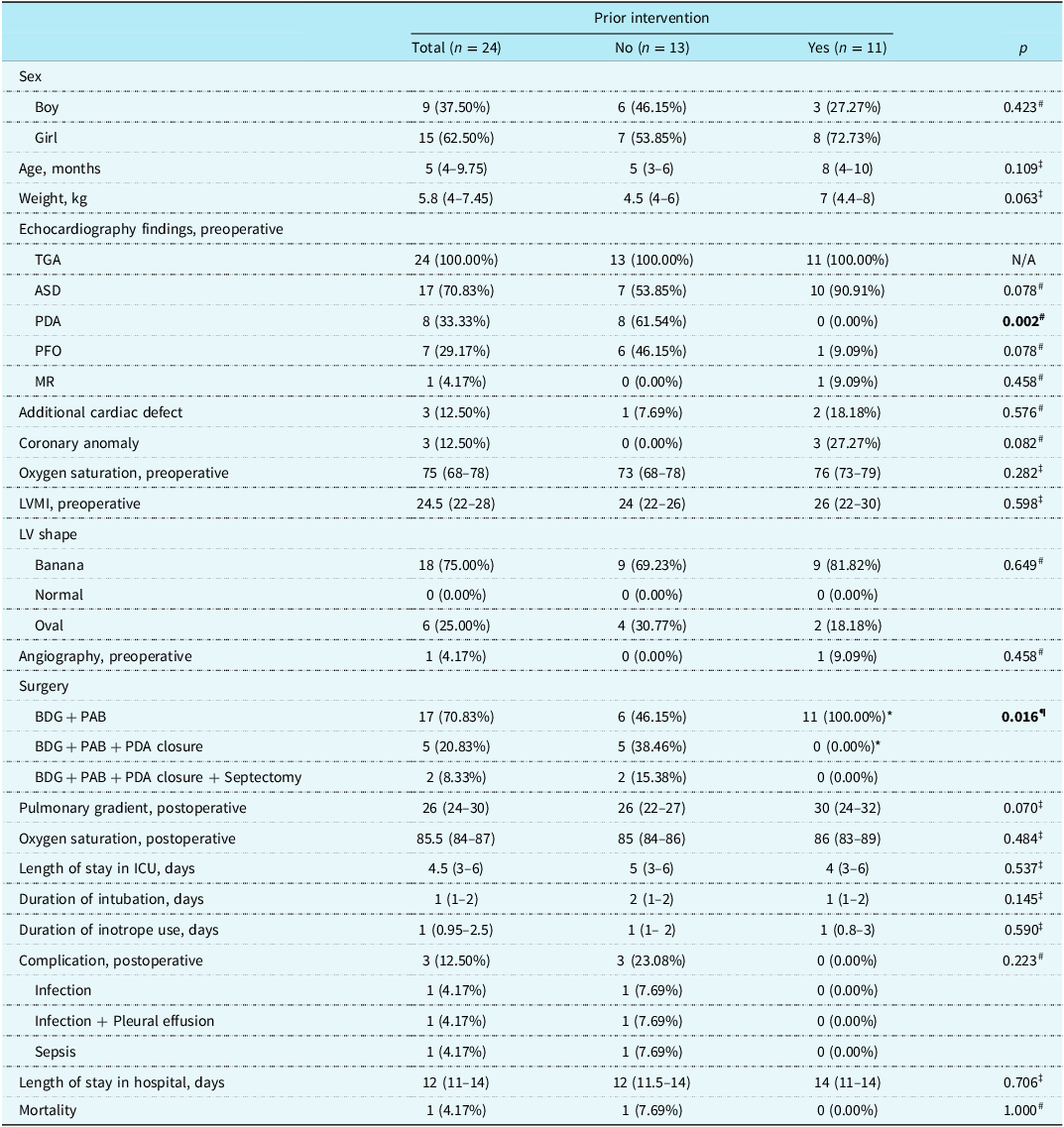
A total of 24 patients with late-diagnosed transposition of the great arteries with intact ventricular septum were included in the study. All patients were found to have originated from socioeconomically disadvantaged regions with limited healthcare access, and this was the primary reason for delayed referral in all subjects. The cohort consisted of 9 boys (37.50%) and 15 girls (62.50%). The median age at the first operation was 5 months (IQR: 4–9.75; range: 3–10), with a median weight of 5.8 kg (4–7.45 kg) and preoperative oxygen saturation of 75% (68–78). Echocardiographic findings confirmed transposition of the great arteries in all cases (100.00%), with associated atrial septal defect in 17 (70.83%), patent ductus arteriosus in 8 (33.33%), and patent foramen ovale in 7 (29.17%). One case had mild mitral regurgitation (4.17%). The median preoperative left ventricular mass index was 24.5 g/m2 (2–28), with banana-shaped left ventricular geometry in 18 (75.00%) and oval in 6 (25.00%) (Table 1).
Summary of preoperative and postoperative characteristics for first operation with regard to prior intervention

Descriptive statistics are presented using median (25th percentile–75th percentile) for continuous variables due to non-normality of distribution and frequency (percentage) for categorical variables.
‡Mann Whitney U test, # Fisher’s exact test, ¶Fisher-Freeman-Halton test, *Statistically significant category for the variables with three or more categories. Statistically significant p values are shown in bold. N/A Non-applicable.
Abbreviations: ASD = atrial septal defect; BDG = bidirectional Glenn anastomosis; ICU = intensive care unit; LV = left ventricle; LVMI = left ventricular mass index; MR = mitral regurgitation; PAB = pulmonary artery banding; PDA = patent ductus arteriosus; PFO = patent foramen ovale; TGA = transposition of the great arteries.
Haemodynamically insignificant muscular ventricular septal defects were present in 3 (12.50%), and left circumflex arising from the right sinus with the right coronary artery in 3 (12.50%). Cardiac catheterisation was performed in one case (4.17%), revealing left ventricular pressure of 40 mmHg, right ventricular pressure of 70 mmHg, aortic pressure of 75/35 mmHg (mean 50 mmHg), main pulmonary artery pressure of 38/20 mmHg (mean 24 mmHg), and McGoon ratio of 1.8. Prior interventions were noted in 11 patients (45.83%), including balloon atrial septostomy in 8 (33.33%) and septectomy in 3 (12.50%), performed at a median age of 2 months (1–4 months). Patients without prior intervention (n = 13, 54.17%) were younger (median 5 months vs. 8 months) (p = 0.109). Patent ductus arteriosus was significantly more common in the no-prior group (61.54% vs 0%, p = 0.002). The first-stage surgery varied: BDG + pulmonary artery banding in 17 (70.83%), BDG + pulmonary artery banding + patent ductus arteriosus closure in 5 (20.83%), and BDG + pulmonary artery banding + patent ductus arteriosus closure + septectomy in 2 (8.33%). Surgery types differed significantly by prior intervention (p = 0.016), with all prior-intervention patients receiving BDG + pulmonary artery banding. Complications occurred in 3 (12.50%), all in the no-prior group (infection in 1, infection + pleural effusion in 1, sepsis in 1; p = 0.223). Median hospital stay was 12 days (11–14, p = 0.706). One mortality (4.17%) occurred in the no-prior group due to sepsis (p = 1.000) (Table 1).
The mean postoperative left ventricular ejection fraction was 68%. Twenty-one patients (91.30%) demonstrated left ventricular ejection fraction within normal limits during early postoperative follow-up. In two patients (8.70%, both in the prior intervention group), early postoperative left ventricular ejection fraction was reduced (26–30%), necessitating temporary ECMO support for 4.5 and 5 days, respectively; both patients showed gradual improvement with recovery of left ventricular ejection fraction to approximately 60% following ECMO weaning (p = 0.217).
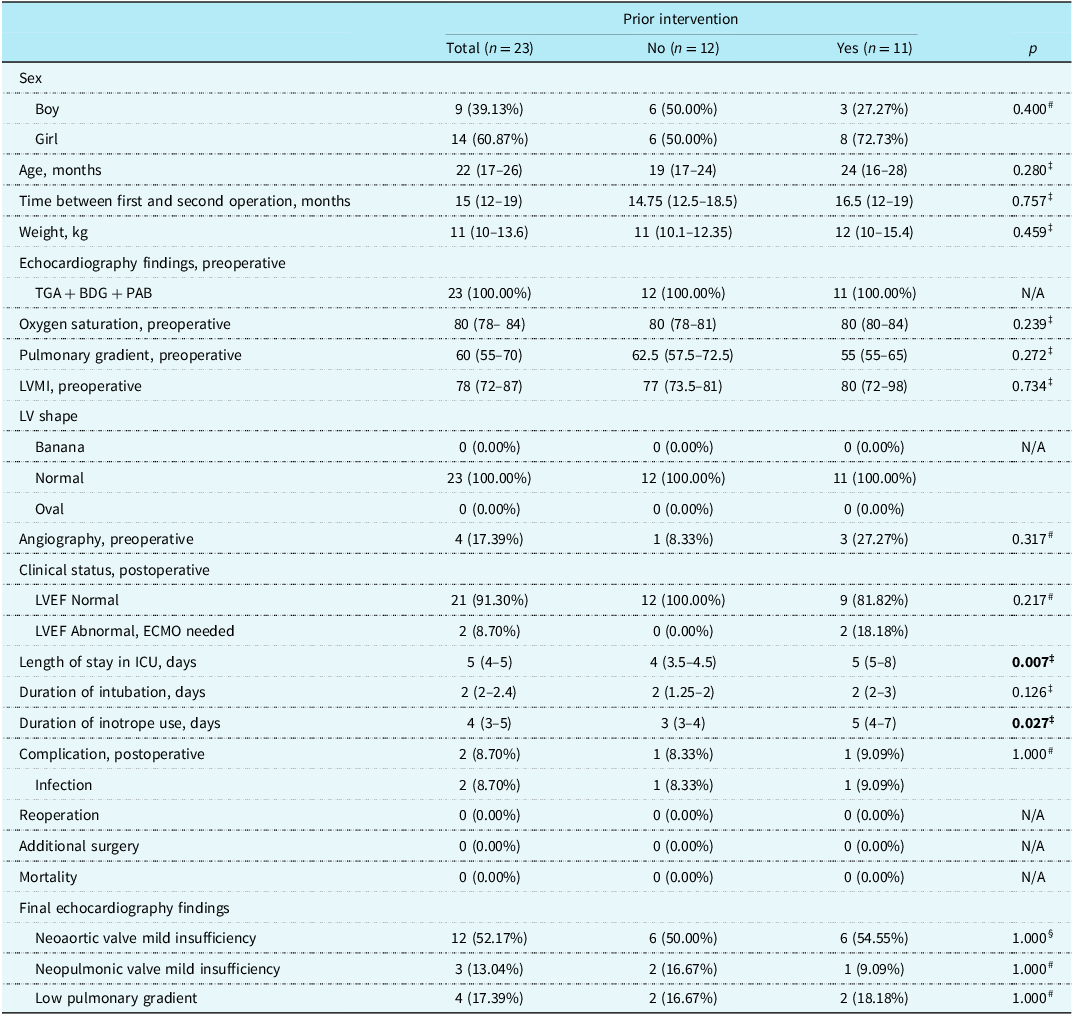
Twenty-three patients proceeded to the second-stage arterial switch operation (excluding one mortality). The cohort included 9 boys (39.13%) and 14 girls (60.87%). The median age was 22 months (17–26). The median interval between operations was 15 months (12–19), and the median weight was 11 kg (10–13.6). Preoperative oxygen saturation was a median 80% (78–84%). Echocardiography confirmed transposition of the great arteries + BDG + pulmonary artery banding in all (100.00%). Median pulmonary gradient was 60 mmHg (55–70), left ventricular mass index 78 g/m2 (72–87), and left ventricular shape was normal in all (100.00%). Angiography in 4 (17.39%) showed left ventricular pressure median 95 mmHg (70–120), right ventricular pressure 65 mmHg (50–85), aortic pressure 90/45 mmHg (mean 57 mmHg), main pulmonary artery pressure 20.75/15 mmHg (mean 16.5 mmHg), and McGoon ratio >1.8 (range: 1.8->2). Median ICU stay was 5 days (4–5 days), longer in the prior group (median 5 days vs 4 days, p = 0.007). Inotrope use was median 4 days (3–5, p = 0.027, longer in prior). There were no reoperations, additional surgeries, or mortality (Table 2).
Summary of characteristics for second operation with regard to prior intervention

Descriptive statistics are presented using median (25th percentile–75th percentile) for continuous variables due to non-normality of distribution and frequency (percentage) for categorical variables.
‡Mann Whitney U test, #Fisher’s exact test, §Chi-square test. Statistically significant p values are shown in bold. N/A Non-applicable.
Abbreviations: ASO = arterial switch operation; BDG = bidirectional Glenn anastomosis; ECMO = extracorporeal membrane oxygenation; ICU = intensive care unit; LV = left ventricle; LVEF = left ventricular ejection fraction; LVMI = left ventricular mass index; PAB = pulmonary artery banding; TGA = transposition of the great arteries.
Discussion
The management of late-diagnosed transposition of the great arteries with intact ventricular septum remains a challenge in paediatric cardiology and surgery, particularly in regions with socioeconomic limitations and delayed neonatal healthcare access. In our series of 24 patients, the BDG + pulmonary artery banding strategy enabled successful two-stage arterial switch operation in 96% of cases with only 8.7% requiring temporary ECMO and no late mortality, demonstrating its safety and efficacy in achieving adequate left ventricular retraining even in severely deconditioned ventricles from resource-limited settings. Without treatment, mortality can reach 90% in the first year due to persistent hypoxaemia and multiorgan failure.Reference Kang, de Leval and Elliott5 While timely arterial switch operation yields excellent outcomes in specialised centres,Reference Wernovsky, Mayer and Jonas6,Reference Rakha, Batouty, ElDerie and Hussein22 , delayed diagnosis beyond 2–4 months leads to left ventricular deconditioning, rendering primary arterial switch operation high-risk with reported mortality of 20–30% and frequent ECMO requirement.Reference Cevik, Karaci and Polat9,Reference Tan, Datuk Ja’apar and Sallehuddin14 Two-stage protocols address this by retraining the left ventricle, and BDG + pulmonary artery banding offers a physiologically balanced approach by increasing afterload without excessive preload, thus minimising complications associated with shunt-based methods. Our findings from a socioeconomically disadvantaged cohort add substantial evidence supporting this strategy in high-risk, late-diagnosed patients. Although shorter interstage intervals following left ventricular retraining have been proposed to minimise annular mismatch and potentially reduce early neo-aortic regurgitation, the optimal timing of arterial switch operation after BDG + pulmonary artery banding remains undefined. In our practice, progression to arterial switch operation was guided by functional and structural markers of left ventricular readiness rather than time alone. Therefore, the relatively longer interstage duration observed in this study reflects a strategy of ensuring stable and complete ventricular adaptation rather than delayed intervention.
Preoperatively, our patients demonstrated severe left ventricular regression, reflected by a median left ventricular mass index of 24.5 g/m2 and banana-shaped left ventricular geometry in 75% of cases, which is extremely low considering the safe value (35 g/m2) for primary arterial switch operation.Reference Lacour-Gayet, Piot and Zoghbi16 The first-stage operation (BDG + pulmonary artery banding) resulted in significant improvement in oxygen saturation (from 75% to 85.5%) while maintaining moderate pulmonary gradients (median 26 mmHg). Postoperative recovery was quick in the great majority of patients, with a median ICU stay of 4.5 days without extensive needs for mechanical ventilation or inotropic support. Complications were rare, albeit one patient (4.17%) died due to sepsis. These results align with the series by Cevik et al., Reference Cevik, Karaci and Polat9 who reported no mortality and comparable ICU stays and infection rates in a similar cohort. Our findings support the utility of BDG + pulmonary artery banding as a safe option to facilitate a stable haemodynamic environment that achieves left ventricular adaptation.
Following a median retraining duration of 15 months, left ventricular mass index increased markedly to 78 g/m2, and left ventricular geometry normalised in all patients. Angiographic data showed systemic-level left ventricular pressure (≥90 mmHg) and McGoon ratios ≥1.8, indicating adequate pulmonary arterial development. Subsequent arterial switch operation was completed successfully in 23 patients with no mortality. Two patients (8.7%) required temporary ECMO for transient left ventricular dysfunction, both of whom recovered. At a median follow-up of 2.5 years, all patients remained in NYHA class I, with mild neo-aortic regurgitation in 52.17% and mild neo-pulmonary regurgitation in 13.04%, which are frequencies that agree with long-term outcomes in prior studies.Reference Duan, Sun, Dong, Du and Yan7,Reference Cevik, Karaci and Polat9,Reference Watanabe, Mainwaring, Carrillo, Lui, Reddy and Hanley10,Reference Schulz, Kelm and Weixler12,Reference Tan, Datuk Ja’apar and Sallehuddin14,Reference Yıldız, Ozturk, Onan, Tanıdır, Ergul and Guzeltas15,Reference Daoud, Nuri, Miette and Pomè17 The absence of reoperation or late ventricular dysfunction is a critical finding that demonstrates the reliability of this gradual retraining method.
Comparative literature further supports our findings. Schulz et al. Reference Schulz, Kelm and Weixler12 observed left ventricular mass increases from 21 to 38.5 g/m2 after combined pressure–volume retraining in congenitally corrected transposition of the great arteries, while Duan et al. Reference Duan, Sun, Dong, Du and Yan7 reported higher morbidity and longer ICU stays using shunt + pulmonary artery banding. Similarly, Watanabe et al. Reference Watanabe, Mainwaring, Carrillo, Lui, Reddy and Hanley10 reported a 42% mortality rate in late primary arterial switch operation without retraining, whereas Yıldız et al. Reference Yıldız, Ozturk, Onan, Tanıdır, Ergul and Guzeltas15 achieved 0% mortality but required ECMO in 25% of cases. These data collectively demonstrate that abrupt loading strategies are needlessly risky compared with the gradual adaptation achieved with BDG + pulmonary artery banding.
To further elaborate on the results of pulmonary artery banding combined with Blalock-Taussig shunt versus pulmonary artery banding with BDG in late-diagnosed transposition of the great arteries with intact ventricular septum, both methods enable effective left ventricular retraining, but pulmonary artery banding + Blalock-Taussig shunt is associated with shorter durations (mean 98 days) at the cost of higher early morbidity, including prolonged ICU stays (significantly higher than BDG), extended inotropic support, and increased risks of complications such as pulmonary overcirculation, infection, and thrombosis.Reference Cevik, Karaci and Polat9,Reference Schulz, Kelm and Weixler12 In contrast, pulmonary artery banding + BDG promotes gradual left ventricular adaptation over longer periods (mean 117 days), resulting in fewer postoperative complications, shorter hospital stays, and stable oxygenation without excessive preload, while achieving comparable left ventricular mass increases (from ∼25 g/m2 to ∼68 g/m2) and successful arterial switch operation with low ECMO needs.Reference Cevik, Karaci and Polat9,Reference Schulz, Kelm and Weixler12 In a retrospective cohort of 47 patients, the BDG group demonstrated reduced overall morbidity compared to the Blalock-Taussig shunt, supporting its role as a safer alternative for high-risk, late-presenting cases (Reference Cevik, Karaci and Polat9).
The physiological rationale behind BDG + pulmonary artery banding is its ability to stimulate adaptive hypertrophy while maintaining balanced haemodynamics. Pulmonary artery banding increases left ventricular wall stress within tolerable limits, activating mechanosensitive signalling cascades such as integrin-linked kinases, titin kinase domains, and the calcineurin–NFAT and ERK1/2 pathways, leading to concentric hypertrophy and enhanced contractile capacity.Reference Schulz, Kelm and Weixler12,Reference Rakha, Batouty, ElDerie and Hussein22,Reference Jensen23 Meanwhile, BDG decompresses the right ventricle by diverting superior vena cava flow directly to the pulmonary arteries, reducing systemic venous return and preventing volume overload.Reference Cevik, Karaci and Polat9,Reference Yıldız, Ozturk, Onan, Tanıdır, Ergul and Guzeltas15 This avoids the excessive preload and turbulent flow characteristic of shunt-based methods, which can provoke pulmonary overcirculation and vascular remodelling.Reference Kang, de Leval and Elliott5,Reference Lacour-Gayet, Piot and Zoghbi16 Potential complications related to BDG, including superior vena cava (SVC) syndrome and SVC dilation or aneurysm formation due to competitive flow between the Glenn circulation and the antegrade LVOT–pulmonary artery pathway, have been reported in the literature.Reference Chen, Tulloh, Caputo, Stoica, Kia and Parry24,Reference Panduranga, Thomas, Al-Maskari and Al-Farqani25 In our cohort, careful modulation of pulmonary artery banding and maintenance of controlled antegrade flow likely minimised excessive SVC pressure, and no clinical signs of SVC syndrome or SVC aneurysm were observed during follow-up. Maintaining distal pulmonary pressures at 25–30 mmHg ensures gradual left ventricular retraining, resembling the natural transition from fetal circulation.Reference Wernovsky, Mayer and Jonas6,Reference Nakazawa, Oyama and Imai26 Controlled afterload prevents maladaptive signalling through p38-MAPK and JNK pathways, which are associated with apoptosis and fibrosis in overstressed myocardium.Reference Castaneda, Norwood, Jonas, Colon, Sanders and Lang27,Reference Gatzoulis, Walters, McLaughlin, Merchant, Webb and Liu28 The resulting left ventricular remodelling favours pro-survival Akt–mTOR signalling and angiogenesis, supported by VEGF upregulation,Reference Schwartz, Gauvreau, del Nido, Mayer and Colan29,Reference Chatterjee, Miller, Cribbs and Law30 thereby explaining the excellent postoperative left ventricular performance and minimal ECMO requirement observed in our cohort.
Additionally, the balanced haemodynamics produced by BDG + pulmonary artery banding help mitigate the consequences of chronic hypoxaemia. By maintaining oxygen saturations around 85%, the protocol minimises HIF-1α-mediated fibrosis and oxidative stress injury.Reference Gatzoulis, Walters, McLaughlin, Merchant, Webb and Liu28,Reference Losay, Touchot and Serraf31 The low incidence of postoperative ventricular dysfunction may thus reflect the preconditioning benefits of moderate hypoxaemia and controlled mechanical stress, which enhance ischaemia–reperfusion tolerance through induction of heat shock proteins and anti-apoptotic Bcl-2 pathways.Reference Chatterjee, Miller, Cribbs and Law30,Reference Lopez, Colan and Frommelt32 Mild neo-aortic regurgitation observed in our patients likely results from sinotubular junction mismatch, which is a well-established outcome of arterial switch operation, with higher frequencies reported in the literature.Reference Lang, Badano and Mor-Avi33,Reference Marino, Lipkin and Newburger34 Coronary anomalies identified in 13% of patients were also successfully managed, made possible in part by the low-pressure BDG environment that reduces ischaemic risk relative to high-flow shunt systems.Reference Jensen23,Reference Li and Ma35
BDG + pulmonary artery banding represents a particularly suitable approach for low-resource or socioeconomically disadvantaged populations where delayed diagnosis is common. The technique leverages the inherent regenerative potential of the paediatric myocardium, which retains robust stem cell activity and proliferative capacity.Reference Mainwaring, Patrick and Arunamata13,Reference Nakazawa, Oyama and Imai26 Our experience suggests that late-diagnosed patients can achieve functional recovery if retraining is performed under controlled afterload conditions. Therefore, it may be feasible to suggest that current age-based exclusion criteria may be outdated, particularly since individualised assessment based on left ventricular compliance and geometry appears to be a superior approach. The absence of overtraining or diastolic dysfunction in our series indicates that the procedure provides a self-adjusting mechanism that maintains adaptive stress within physiologic limits.Reference Wernovsky, Mayer and Jonas6,Reference Cevik, Karaci and Polat9,Reference Yıldız, Ozturk, Onan, Tanıdır, Ergul and Guzeltas15,Reference Nakazawa, Oyama and Imai26 Rapid retraining methods are known to predispose patients to arrhythmia and failure.Reference Boutin, Jonas, Sanders, Wernovsky, Mone and Colan20,Reference Sivakumar, Francis, Krishnan and Shahani36 The low postoperative pulmonary gradients in our patients further demonstrate balanced circulation that does not cause hypoplasia or stenosis—which can develop in shunt-based interventions.Reference Cevik, Karaci and Polat9,Reference Bishnoi, Patel and Agrawal11 Temporary ECMO use in two cases likely reflected the impact of baseline hypoxaemia, which was reversible, especially since both patients ultimately reached normal ejection fraction values.Reference Schulz, Kelm and Weixler12,Reference Lacour-Gayet, Piot and Zoghbi16
Despite these encouraging results, certain limitations must be considered. The sample size is small (n = 24) and reduces statistical power, but this reflects the rarity of late-diagnosed transposition of the great arteries with intact ventricular septum. The single-centre retrospective design and relatively small sample size limit the generalisability of our findings and preclude definitive conclusions. Follow-up duration (1–4 years) may not be sufficient to assess longer-term complications such as aortic root dilation or arrhythmia.Reference Lang, Badano and Mor-Avi33,Reference Marino, Lipkin and Newburger34 Furthermore, echocardiography may underestimate subtle fibrosis or vascular anomalies, while angiographic or cardiac MRI are superior in this regard. Socioeconomic factors, including malnutrition and delayed somatic growth, were not systematically assessed but may have influenced left ventricular hypertrophy.Reference Jensen23 The lack of molecular or histologic assessment limits our ability to directly confirm the likely pathophysiologic mechanisms described in this studyReference Kang, de Leval and Elliott5,Reference Lacour-Gayet, Piot and Zoghbi16 Regular follow-up during the prolonged retraining period may be challenging in resource-limited settings due to restricted healthcare access, potentially increasing loss to follow-up risk. Detailed quantitative measurements of atrial septal defect size were not consistently available due to the retrospective nature of the study and therefore could not be systematically analysed. Another limitation of this study is the absence of a direct comparative cohort using a modified Blalock-Taussig shunt with pulmonary artery banding, which prevents institutional outcome comparison with this alternative retraining strategy. Future multicentre prospective studies incorporating biomarkers such as NT-proBNP and microRNAs (e.g., miR-208a) may improve predictive accuracy and long-term monitoring.Reference Rakha, Batouty, ElDerie and Hussein22,Reference Lopez, Colan and Frommelt32
Conclusion
The two-stage arterial switch operation using BDG + pulmonary artery banding is a safe and effective strategy for late- diagnosed dextro-transposition of the great arteries with intact ventricular septum with advanced left ventricular regression. This approach allows gradual left ventricular retraining, reduces perioperative morbidity, and provides very good survival and midterm functional outcomes. For healthcare systems facing delayed diagnosis and limited resources, BDG + pulmonary artery banding represents a valuable strategy that can preserve the benefits of arterial switch operation while avoiding the risks associated with abrupt haemodynamic loading. The importance of administering controlled and gradual ventricular stress while improving oxygenation is crucial to the success of this intervention. Given the rarity of late-diagnosed dextro-transposition of the great arteries with intact ventricular septum, multicentre collaborations are needed to design prospective studies that can optimise retraining strategies and enhance long-term management of these patients.