1. Introduction
There is nothing new about neologisms. Lexicons of early Jewish and Christian literature are filled with hapax legomena and rare words that call for explanations into their etymology and attestation. The word δίψυχος κτλ. (‘double-minded’) is but one example highlighting the issues surrounding the identification of a neologism and its subsequent use. Past studies have sought to identify the first occurrence of δίψυχος through a process of intertextuality and literary dependency. After interacting with these approaches, I suggest that the consideration of lexical formation and the process of compounding in Koine Greek offer a more realistic and less tentative approach than previous scholarship has allowed.
The διψυχ- word group has garnered interest, in part, from its sparse but only attestation in early Christian literature. δίψυχος appears twice in the Epistle of James (the only attestation in the New Testament corpus), with a handful of occurrences in the Apostolic Fathers:Footnote 1
Jas 1.8 ‘He is a double-minded man [ἀνὴρ δίψυχος], unstable in all his ways’
Jas 4.8b ‘Cleanse your hands, you sinners, and purify your hearts, you double-minded [δίψυχοι]’
1 Clem. 11.2 ‘For when she [Lot's wife] left with him but then changed her mind and fell out of harmony, she was turned into a pillar of salt until this day – so that everyone may know that those who are of two minds [οἱ δίψυχοι] and who doubt the power of God enter into judgment and become a visible sign for all generations’
1 Clem. 23.2–3 ‘And so, we should not be of two minds [μὴ διψυχῶμεν], nor should we entertain wild notions about his superior and glorious gifts. May this Scripture be far from us that says, “How miserable are those who are of two minds [οἱ δίψυχοι], who doubt in their soul …”’
2 Clem. 11.2 ‘For the word of prophecy also says, “How miserable are those who are of two minds [οἱ δίψυχοι], who doubt in their hearts …”’
2 Clem. 11.5 ‘So my brothers, we should not be of two minds [μὴ διψυχῶμεν] but should remain hopeful, that we may receive the reward’
2 Clem. 19.2b ‘Because we are of two minds [τὴν διψυχίαν] and disbelieving in our hearts, we do not realize that we are doing evil; and we are darkened in our understanding through vain desires’
Did. 4.4 ‘Do not be of two minds [οὐ διψυχήσεις], whether this should happen or not’
Barn. 19.5 ‘Do not be of two minds [οὐ μὴ διψυχήσῃς], whether this should happen or not’
Hermas Fifty-five occurrences of the lemma. δίψυχος = Herm. Vis. 3.4.3; 4.2.6; 5.2.1; Mand. 9.5–6; 10.2.6; 11.1–2, 4, 13; 12.4.2; Sim. 1.3; 8.7.1–2; 9.18.3; 9.21.1–3; διψυχία = Herm. Vis. 2.2.4; 3.7.1; 3.10.9; 3.11.2; Mand. 9.1, 7, 10–12; 10.1.1–2; 10.2.2, 4; διψυχέω = Herm. Vis. 2.2.7; 3.2.2; 3.3.4; 4.1.4, 7; 4.2.4; Mand. 9.1, 6–8; Sim. 6.2.2; 8.8.3, 5; 8.9.4; 8.10.2; 8.11.3.
The infrequency of the word, as well as its first appearance in early Christian literature, has led some to argue that δίψυχος is in fact a Christian neologism.Footnote 2 Of course, the question of who coined the term inevitably leads to the divisive issue of who wrote what first. Theoretically, it has been surmised that if one can demonstrate literary dependence (and crucially, the direction of borrowing) between the δίψυχος texts, it may be possible to establish both the origins of the neologism and a viable terminus ad quem for its first attestation. Tracing the history of the lexeme is thus bound up with a complex process of intertexuality. I begin then with the Epistle of James, a work notorious for its contentious issues of date and authorship.Footnote 3 If the origins of δίψυχος can be traced to James, then the epistle must be dated prior to the next earliest text containing the lexeme. Hence a terminus ad quem could be secured to at least the mid-nineties, or whatever date is assigned to 1 Clement, who, ostensibly, would be the first to borrow δίψυχος from James.Footnote 4
2. James and δίψυχος
Stanley E. Porter has advocated such an intertexual method for dating James. The strength of his conclusions (which I will critique below) rests on his ability to demonstrate (1) a literary dependency between James and the Apostolic Fathers, and (2) the direction of borrowing. While verbal and conceptual parallels (point 1) can be weighed on their individual merits, the bulk of Porter's argument depends upon point 2. Excluding appeal to the dating of the works (which is contested), how can one prove who borrowed from whom?
Porter navigates the issue by arguing that James uses δίψυχος in two related but distinct ways. In Jas 1.8, δίψυχος is used ‘with reference to those who may be divided in their belief about God's faithfulness to answer a prayer for wisdom’.Footnote 5 The referent of δίψυχος is clearly a believer, ‘exhorted not to be of two minds’.Footnote 6 The context of 4.8, however, is decidedly different. δίψυχος refers here ‘to those who have succumbed to the wiles of the tempter and are divided in their allegiance and hence seen and addressed as sinners’.Footnote 7 In contrast to 1.8, where the (hypothetical) person addressed is a Christian, ‘the double-minded person [of 4.8] is described as a sinner, ambivalent in whether closer to God or to the devil’.Footnote 8
Porter contends that the specificity with which James uses δίψυχος is lost with other (later) writers:
Later writers are frequently less precise in the sense they give the word, often apparently conflating these two uses, as reflected in verbal and conceptual parallels. This may well indicate not that they and James share a common source, but that they are drawing upon James and often assuming, expanding or elucidating his usage.Footnote 9
Along with Porter's claim that δίψυχος usage moved from distinction to conflation is the insight by Chris C. Stevens concerning the directional frequency of attestation. Since James uses the word twice, and it appears six times in 1 and 2 Clement, and fifty-five in the Shepherd of Hermas, it is reasonable to surmise that ‘usage went from low to high’, rather than vice versa.Footnote 10 Stevens substantiates this seemingly natural assumption by exploring whether ‘the position of power and authority held by the authors [James, Clement, Hermas, etc.] … is suggestive for the direction of influence’:Footnote 11
Assuming the scenario [that James borrowed from 1 Clement and Hermas], it would be advantageous for a late pseudonymous James to bolster her/his/their position of authority by capitalizing on a major theme in a popular document like Hermas rather than downplay it. However, the use of δίψυχος in James is far less than Hermas or 1 Clement. Conversely, if one accepts an early date and circulation for James, then it is understandable why Hermas and 1 Clement capitalize on the theological point from James. They increase the use of δίψυχος to build on the authoritative status of the Epistle of James.Footnote 12
There are, however, a number of issues with both Porter's and Stevens’ analyses. While the eponym of the epistle is undoubtedly intended as a marker of authority,Footnote 13 it is not at all clear that the issue of ‘authority’ is the main driver of the literary relationship between Hermas and James.Footnote 14 Indeed, Stevens’ point seems to hang all too tentatively on the difference between an author's use of a ‘popular’ and an ‘authoritative’ document.Footnote 15
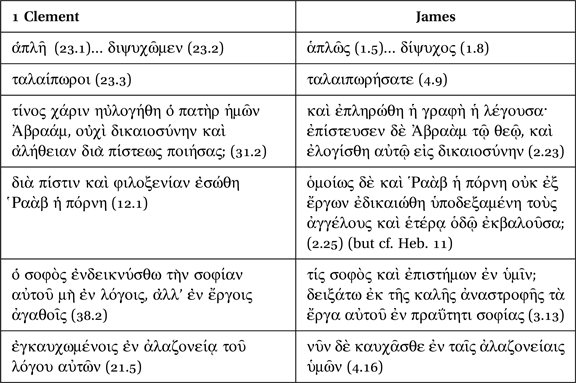
Likewise, on examination Porter's thesis is found wanting. First, the literary relationship between James and 1 Clement is questionable.Footnote 16 While Donald Hagner's survey of the New Testament in 1 Clement argued in conclusion for ‘the probability (although not very considerable) of literary dependence’ with James, he concedes that ‘there is little substantial enough to assert [this]’.Footnote 17 A number of verbal parallels have been noted (see Table 1).Footnote 18 These parallels are interesting, but not enough to establish literary dependency, as most agree.Footnote 19 In Andrew F. Gregory's more recent survey of Clement's use of the New Testament, James is not even discussed.Footnote 20 He cites the conclusions of the Oxford Committee, who ‘found no evidence for classifying higher than “d” [= “uncertain”] any potential allusion to [any] non-Pauline letters’.Footnote 21 The relationship posited between James and 1 Clement, or James and the Didache for that matter, is a logical necessity for the thesis that δίψυχος is a Jamesian neologism, but a necessity that finds little evidential support.Footnote 22
Commonly Purported Parallels between 1 Clement and James

Second, the purported conflation of James’ two distinct senses of δίψυχος also does not bear up to scrutiny. While the ambiguity of Did. 4.4 may ‘come very close to a conceptual conflation of the two senses found in James’,Footnote 23 this is by no means the case for many of the references in Hermas. In fact, studies that have focused particularly on the διψυχ- word group in Hermas have noted the nuanced and contextually distinct uses of the word.Footnote 24 Jeremiah Mutie has demonstrated that Hermas uses δίψυχος with quite distinct referents.Footnote 25 First, as in Jas 1.8, δίψυχος can be used of believers (Herm. Vis. 4.1–9), including church leaders (Vis. 2.2.6), and no less of Hermas himself.Footnote 26 Similitude 6.1–2 reads:
While I was sitting in my house and giving glory to the Lord for all the things I had seen, and reflecting that his commandments are good … I was telling myself, ‘I will be fortunate if I proceed in these commandments; for whoever proceeds in them is fortunate.’ While I was telling myself these things, I suddenly saw him sitting next to me saying, ‘Why are you of two minds about the commandments I have given you? [τί διψυχεῖς περὶ τῶν ἐντολῶν ὧν σοι ἐνετειλάμην;] … do not be at all of two minds [ὅλως μὴ διψυχήσῃς], but clothe yourself with faith of the Lord …’ (Herm. Sim. 6.1–2; cf. Mand. 9.1, 5).
Here, Hermas expresses his desire to observe the commandment. Even though his desire is ‘expressed positively in the future tense … the sense of the statement is conditional’, and thus is taken as a ‘statement of doubt’ by the Shepherd (6.2).Footnote 27
Second, there are also clear references to the apostate as double-minded:Footnote 28
But the other stones that you saw cast far from the tower and falling on the path and rolling from the path onto the rough terrain, these are the ones who have believed, but have left their true path because they are of two minds [τῆς διψυχίας]. (Herm. Vis. 3.7.1)
The referent is not a weak Christian, or a Christian caught in sin, but a person who has ‘finally’ or ‘completely’ (εἰς τέλος) rebelled against God (3.7.2).Footnote 29 Rather than a conflation, this is in fact a stronger distinction than we find in James, since in Jas 4.8 the δίψυχοι are exhorted to purify their hearts, while for the διψυχία of Vision 3 it is said that ‘it no more entered into their hearts to repent by reason of the lusts of their wantonness and of the wickednesses which they wrought’ (καὶ οὐκέτι αὐτοῖς ἀνέβη ἐπὶ τὴν καρδίαν τοῦ μετανοῆσαι διὰ τὰς ἐπιθυμίας τῆς ἀσελγείας αὐτῶν καὶ τῶν πονηριῶν ὧν ἠργάσαντο, 3.7.2).Footnote 30 Thus, it seems that the use of δίψυχος in Hermas is just as distinct as it is in James. The literary relationship between Hermas’ and James’ use of δίψυχος cannot be understood as the former's conflated use of the latter.Footnote 31
3. Eldad and Modad and διψυχος
An alternative explanation for the background of δίψυχος traces the term's origins to the pseudepigraphon Eldad and Modad,Footnote 32 of which we have only one extant line, preserved in Hermas: ‘“The Lord is near to those who return”, as it is written in the book of Eldad and Modad’ (ἐγγὺς κύριος τοῖς ἐπιστρεφομένοις, ὡς γέγραπται ἐν τῷ Ἐλδὰδ καὶ Μωδάτ) (Herm. Vis. 2.3.4). The suggestion was first made by J. B. Lightfoot,Footnote 33 and subsequently developed by Oscar J. F. Seitz,Footnote 34 Dale C. AllisonFootnote 35 and Richard Bauckham.Footnote 36
The hypothesis is based on examining the complex web of relations between James, 1 Clement, 2 Clement and Hermas. All four documents cite non-extant ‘scripture’ (Jas 4.5 ἡ γραφή; 1 Clem. 23.3 ἡ γραφὴ αὕτη; 2 Clem. 11.2 ὁ προφητικὸς λόγος; Herm. Vis. 2.3.4 ὡς γέγραπται), Hermas identifying his source as Ἐλδὰδ καὶ Μωδάτ. That the fragmentary pseudepigraphon stands behind all four works is strengthened by a number of considerations:
(1) The unknown ‘scripture’ of Jas 4.5 and Hermas share a number of verbal and conceptual parallels, two of which (Herm. Mand. 3.1; Sim. 5.6.5) contain the rare verb κατοικίζω (‘cause to dwell’), which only occurs in Hermas and Jas 4.5 in Christian literature before Justin.Footnote 37 The unknown ‘scripture’ in James also contains conceptual parallels to Num 11.26–30, the biblical text that references Eldad and Modad. The passage in Numbers 11 concerns the issue of jealousy and a divinely bestowed spirit; Jas 4.5 likewise mentions both φθόνος and πνεῦμα.Footnote 38 Furthermore, where Herm. Vis. 2.3.4 reads, ‘The Lord is near to those who return’ (ἐγγὺς κύριος τοῖς ἐπιστρεφομένοις), Jas 4.8a reads, ‘Draw near to God and he will draw near to you’ (ἐγγίσατε τῷ θεῷ καὶ ἐγγιεῖ ὑμῖν), another striking parallel considering the immediate context of δίψυχοι in 4.8b.Footnote 39
(2) The use of δίψυχος vis-à-vis non-biblical citations is another point of connection between James, Hermas and 1 and 2 Clement. In James, δίψυχος appears in close proximity (Jas 4.8) to his unknown citation in 4.5 (which seems linked to Herm. Vis. 2.3.4, cf. previous point).Footnote 40 δίψυχοι also appears in the unknown citation of 1 Clem. 23.3 and 2 Clem. 11.2, a citation seemingly reproduced independently by both authors.Footnote 41
(3) The citation in 1 and 2 Clement reads ταλαίπωροί εἰσιν οἱ δίψυχοι, οἱ διστάζοντες τῇ καρδίᾳͅFootnote 42 (‘How miserable are those of two minds, who doubt in their hearts …’). Hermas and James likewise link δίψυχος with ταλαίπωρος (Herm. Vis. 3.7.1; Sim. 1.2–3; Jas 4.9), with διστάζω (Herm. Mand. 9.2, 4–6; Jas 1.6 = διακρίνω) and with καρδία (Herm. Mand. 9.2, 4–5; 10.2–3; Vis. 3.10.9; 4.2.5–6; Jas 4.8).Footnote 43 Allison presses the conclusion: ‘Surely all this more than hints at dependence upon a common text.’Footnote 44
(4) The citations in Herm. Vis. 2.3.4, 1 Clem. 23.3 and 2 Clem. 11.2 function as refutations within an eschatological context.Footnote 45 Later rabbinic thought developed traditions about Eldad and Modad from Num 11.26–30 that were also eschatological in nature (e.g. references to ‘Gog and Magog’: Tg. Ps.-J. Num 11.26; Tg. Neof. 1 Num 11.26).Footnote 46
Allison and Bauckham conclude that Eldad and Modad was a Hebrew pseudepigraphon, although a Greek translation of the work was current in the first century.Footnote 47 Thus the case is made that δίψυχος κτλ. was coined by the author(s) of Eldad and Modad, a work prior to the Epistle of James and the Apostolic Fathers.
4. Origins of δίψυχος: An Etymological ApproachFootnote 48
While Allison's and Bauckham's proposed origin of δίψυχος has greater explanatory value than Porter's, both attempts fail to fully account for the data. If δίψυχος is identified as a neologism in Eldad and Modad on the basis of the literary relationships posited between the pseudepigraphon and James, 1 Clement, 2 Clement and Hermas, what then of the literary relationship to the Didache and Barnabas?Footnote 49 As Matthew Jackson-McCabe points out in his review of the edited volume Matthew, James, and the Didache: Three Related Documents in their Jewish and Christian Settings, it is not very clear what support there is ‘that James comes from the same “milieu” as … the Didache’.Footnote 50 A number of contributors are reluctant to assign James to the same milieu as the Didache,Footnote 51 and any shared thematic similarities are not strong enough to suggest dependency.Footnote 52 No one has yet been bold enough to identify Eldad and Modad as the ‘Two Ways’ source behind the Didache and Barnabas. Neither is there a level of agreement between Hermas and the Didache to suggest literary dependency.Footnote 53 Allison and Bauckham do not discuss the use of δίψυχος in the Didache or Barnabas, presumably due to the difficulty (inability?) to posit any kind of literary relationship between all five of the works considered so far.Footnote 54
Given the scarcity of texts containing δίψυχος κτλ., and the inability to convincingly establish literary relationships among all the few texts we do have that attest the lexeme, I am sceptical that we can locate the precise origins of the neologism. However, even if a single source cannot be identified, we can probably speak with a greater degree of certainty concerning the linguistic environment in which δίψυχος first arose and the process of its formation. I argue that the linguistic milieu of the Koine period was such that a compound word such as δίψυχος could very easily have come into being. It is precisely this lack of difficulty that prevents us from explaining the word's appearance with recourse to a particular text (reconstructed or otherwise). This contention is built upon three considerations: (1) the conceptual background to δίψυχος; (2) the generative nature of Koine Greek; and (3) compounding as a translational device.
4.1 A Semitic Conceptual Background
Back in 1944, Seitz suggested that δίψυχος is connected with the Hebrew idiom לב ולב (‘double heart’; cf. Ps 12.3; 1 Chron 12.33), a phrase the Septuagint reproduced with difficulty.Footnote 55 Evidence for the connection was slender, but the discovery of the Dead Sea Scrolls further substantiated his claim (1QH 12, 4.14; 4Q542 1 i, 19).Footnote 56 In general, there is strong evidence for the concept of a ‘double heart’, an idea that was developing in a number of ways within Jewish thought.Footnote 57 The Greek text of Sirach warns of approaching the Lord ἐν καρδίᾳ δισσῇ (LXX 1.28).Footnote 58 In context, Sirach speaks of desiring wisdom (ἐπιθυμήσας σοφίαν) by keeping the commandments; by contrast, the double-hearted are closely associated with hypocrisy and wrong speech, and a deceitful heart is one engaged in self-exultation, notably all themes that appear in James:Footnote 59
If you desire wisdom, keep the commandments, and the Lord will furnish her abundantly to you. For wisdom and education are the fear of the Lord, and his delight is fidelity and gentleness. Do not disobey the fear of the Lord, and do not approach him with a double heart [μὴ προσέλθῃς αὐτῷ ἐν καρδίᾳ δισσῇ]. Do not be a hypocrite [μὴ ὑποκριθῇς] in the mouths of humankind, and with your lips pay heed. Do not exalt yourself [μὴ ἐξύψου σεαυτόν], lest you fall and bring dishonor to your soul, and the Lord will reveal your secrets, and in the midst of a gathering he will overthrow you, because you did not approach in the fear of the Lord and your heart was full of deceit [ἡ καρδία σου πλήρης δόλου]. (Sir 1.26–30 nets)Footnote 60
Duality in connection with evil is present throughout Sirach: ‘Woe to timid hearts and to slack hands and to a sinner when he treads on two paths’ (οὐαὶ καρδίαις δειλαῖς καὶ χερσὶν παρειμέναις καὶ ἁμαρτωλῷ ἐπιβαίνοντι ἐπὶ δύο τρίβους, Sir 2.12); ‘all lawlessness is like a two-edged sword’ (ὡς ῥομφαία δίστομος πᾶσα ἀνομία, 21.3); while a ‘gracious tongue’ (γλῶσσα εὔλαλος) multiplies friends (6.5), those who become ‘an enemy instead of a friend’ are a ‘double-tongued sinner’ (ὁ ἁμαρτωλὸς ὁ δίγλωσσος, 6.1).Footnote 61
Other works use a variety of expressions for ‘division’ or ‘double-ness’ of heart (1 En. 91.4 leb kāle’ leb (Ethiopic) ‘double heart’; Mek. on Exod 14.3 לבו חלוק ‘his heart was divided’; T. Dan 4.7 and T. Ash. 2.2–3, 5, 7; 3.1–2; 4.1 διπρόσωποι, ‘two-faced’), which stand in contradistinction to a ‘single heart’, לב אחד (cf. 2 Chron 30.12; Jer 32.39; Ezek 11.19; 4Q183 1 ii, 4; 4Q215a 1 ii, 8; cf. ‘single-faced-ness’, μονοπρόσωποι, in T. Ash. 4.1; 6.1).Footnote 62 According to Loren T. Stuckenbruck, the double-heart idiom most likely originated as a state of being that contrasted the exhortation of the Shema in Deut 6.5: ‘You shall love the Lord your God with your whole heart [MT: לבב; LXX: καρδίας], and with all your soul [MT: נפשׁ; LXX: ψυχή], and with all your strength.’Footnote 63 Unlike the later rabbinic developments of the yetzer hara (evil inclination) (e.g. m. Ber 9.5; Midr. Prov 12.20), the double-heart idiom of the Second Temple Period is the disposition of the wicked alone.Footnote 64
4.2 The Generative Nature of Koine Greek
Second, it is important to keep in mind the relative frequency with which we find neologisms within the Septuagint and New Testament corpora. Robert Browning writes that Koine Greek vocabulary was rather ‘open-ended, in that new derivatives and compounds were freely formed as the occasion required’.Footnote 65 Indeed, ‘the combination of two or more elements in a compound formation (“composition”) was a common means of creating new vocabulary’.Footnote 66 This kind of formation is known as ‘derivational affixation’, by which a new lexeme is created (or ‘derived’) from a base.Footnote 67 In our case, ψυχή is the base, to which a contracted form of δίς is affixed.Footnote 68 It should also be noted that a number of inflectional affixes are attested, of which the nominal forms have been reanalysed from the feminine ψυχή to the masculine δίψυχος (Jas 1.8) and δίψυχοι (Jas 4.8). We cannot be sure which inflectional form came first, δίψυχος or διψυχία, though one might surmise that the original feminine form of the base would be carried over initially.Footnote 69 The inflected verbal forms (διψυχεῖς, διψυχήσεις, ἐδιψύχησας, ἐδιψύχησαν, διψυχήσῃς, διψυχῶμεν, διψυχήσωσιν, διψυχήσητε, διψυχήσαντες, διψυχοῦντες, διψυχήσασι, διψυχῆσαι) are likely to be a later development.Footnote 70 These derivational and inflectional affixations represent a common linguistic strategy for the formation of neologisms. Thus a new lexical base such as δίψυχ- is but one example among many of the generative nature of Koine.
4.3 Compounding in Translation
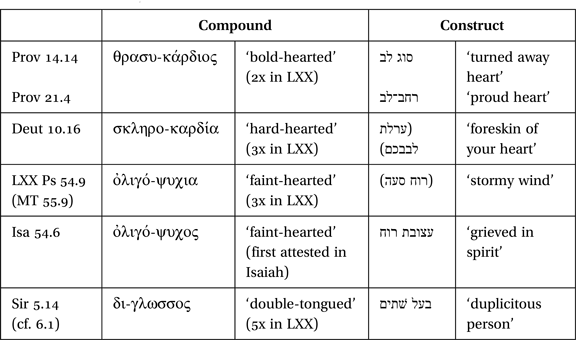
Third, there is the process of compounding itself. Philip Durkin explains, ‘In etymological research we also often need to establish as much as we can about the patterns of compounding found in a particular language in a particular historical period.’Footnote 71 Knowledge of Koine Greek compounding processes becomes even more important when we consider the hypothesised Semitic background to the term (לב ולב). Emmanuel Tov has shown how Septuagint translators often employed a single Greek compound word to translate two or more Hebrew words.Footnote 72 Whereas one might employ a Greek compound word to translate one Hebrew word ‘in order to express a composite idea’, the translation of two Hebrew words with a single compound may have resulted from the fact that the compound word ‘easily suggested itself as an equivalent for a combination of two (or three) Hebrew words’.Footnote 73 A search of the Septuagint Greek corpus reveals that the constituents of δι-ψυχος (and καρδία – the more common translation of לב) have very generative tendencies, producing compounds (including neologisms and hapax legomena) that translate two Hebrew words. Some examples are given in Table 2. The δι- and διχ- prefixes are also attested in hapax legomena which translate one Hebrew word that expresses ‘a composite idea’ (see Table 3).Footnote 74
Greek Compounds That Translate Two Hebrew Words

δι- and διχ- Prefixes That Translate Conceptually Composite Hebrew Words

In summary, provided that (a) the Hebrew idiom לב ולב is the conceptual background to δίψυχος, and given that (b) compound neologisms were common and (c) often translated two (or more) Hebrew words, (d) of which δι-, -ψυχος and -καρδία were generative constituents, it is not hard to imagine how δίψυχος could have arisen within the Greek-speaking Jewish-Christian milieu of the first century. Whether we can trace its origins to a single text is, in my opinion, unlikely, given the scarcity of textual attestations.Footnote 75
4.4 Other δίς-Compounds and Prototype Theory
One final point that Allison and Bauckham do not consider is the attestation of a number of near-synonyms to δίψυχος. An interesting line is found within a fragment of Parmenides:
πρώτης γάρ σ’ ἀφ’ ὁδοῦ ταύτης διζήσιος <εἴργω>, αὐτὰρ ἔπειτ’ ἀπὸ τῆς, ἣν δὴ βροτοὶ εἰδότες οὐδὲν πλάττονται, δίκρανοι· ἀμηχανίη γὰρ ἐν αὐτῶν στήθεσιν ἰθύνει πλακτὸν νόον· οἱ δὲ φοροῦνται κωφοὶ ὁμῶς τυφλοί τε, τεθηπότες.
For I forbid you of this first way of inquiry, the one on which mortals, knowing nothing, wander two-headed, for despair guides the wandering thought within their breasts, and they are carried along dazed, like the deaf and the blind (fr. 6.3–7).Footnote 76
Men are δίκρανοι, ‘two-headed’, trying to hold the incompatible concepts of ‘being’ and ‘non-being’ together, a product of men's ‘wandering intellect’ (πλακτὸς νόος).Footnote 77 Parmenides’ δίκρανοι have nothing to do with the δίψυχος of James and the Apostolic Fathers – which is precisely my point. Here, at least, Parmenides has used a δίς-compound to connote a certain negative bifurcation of his fellow philosophers.Footnote 78
The compound διπλοκαρδία is attested only in the Two Ways sections of the Didache (5.1) and Barnabas (20.1).Footnote 79 Both works also attest δίγνωμων,Footnote 80 which is placed in conjunction with δίγλωσσος (Did. 2.4; Barn. 19.7). In an extensive catalogue of vices, Philo lists δίγλωσσος with διχόνους (Sacr. 32).Footnote 81 διχόνους, itself a rare term, is paired with δολερούς (‘deceitful’) in Philo, Prob. 154, and the ‘foolish man’ (ὁ ἄφρων) is reckoned διχόνους and ἐπαμφοτεριστής (‘doubter’; cf. Sacr. 70) in QG 1, 2.12. While διπρόσωπος seems to connote the ‘dual aspect’ of a situation (T. Ash. 2.2–3), in at least T. Dan 4.9 and T. Ash. 3.2, 4.1 it appears to operate within a similar sphere of meaning as a number of the lexemes cited above do.
Using the generative δίς-affix, at various times, and in various contexts, new lexemes have been derived from various known bases (κάρα, καρδία, πνεῦμα, γινώσκω, νοῦς, γλῶσσα, πρόσωπον).Footnote 82 This is not to say that all are true synonyms with each other. It seems reasonable to expect that the Didachist had a rationale for using δίγνωμων (2.4) or διψυχήσεις (4.4) or διπλοκαρδία (5.1) in the places that he did. No doubt nuances existed that are now untraceable from our current historical distance. But, in light of the rather tenuous historical record for these terms, this is surely to be expected. At best, we can appreciate how a number of similar lexical bases (face, head, mind, heart, soul) underwent a similar compounding process (δίς-affixation)Footnote 83 to confer a similar negative or adversarial sense within each text's different discursive contexts.
The semantic relationship of these various lexemes may be analysed in terms of ‘prototype theory’. As Michael Clarke explains, the task of lexical semantics is to explain how each lexeme (the signifier) points back to ‘whatever concept was represented by it’ (the signified), thereby ‘explaining in each case the associative logic which allowed the ancient speech-community to link each referent to that concept whenever the word was used’.Footnote 84 In prototype theory,
the lexical semantics of a given word is separated onto two levels. The underlying concept is termed the prototype, and the word's referents exemplify what the speech-community recognized as instantiations of the prototype. (Note that ‘proto-’ here refers not to priority in time but to primacy in the structural configuration.)Footnote 85
Clarke illustrates this with the Greek word τρέφω. The lexeme can be associated with a number of seemingly unassociated phenomena: ice, scurf, cheese, an embryo, the body. Assigning semantic primacy to any one of these particular instantiations of τρέφω would run the risk of unintelligibility for the other instantiations.Footnote 86 A better approach would be to construct a single prototypical semantic basis that functions as the ‘motivating concept’, an underlying idea that explains the logic of each specific semantic instantiation.Footnote 87 In the case of τρέφω, the prototypical form can be characterised as ‘the action of achieving fulness through thickening or coagulation’.Footnote 88 Some instantiations are more basic to the underlying concept (focal), while others are less so (peripheral), but all can be seen as developing the prototype in some logical (yet divergent) way.Footnote 89
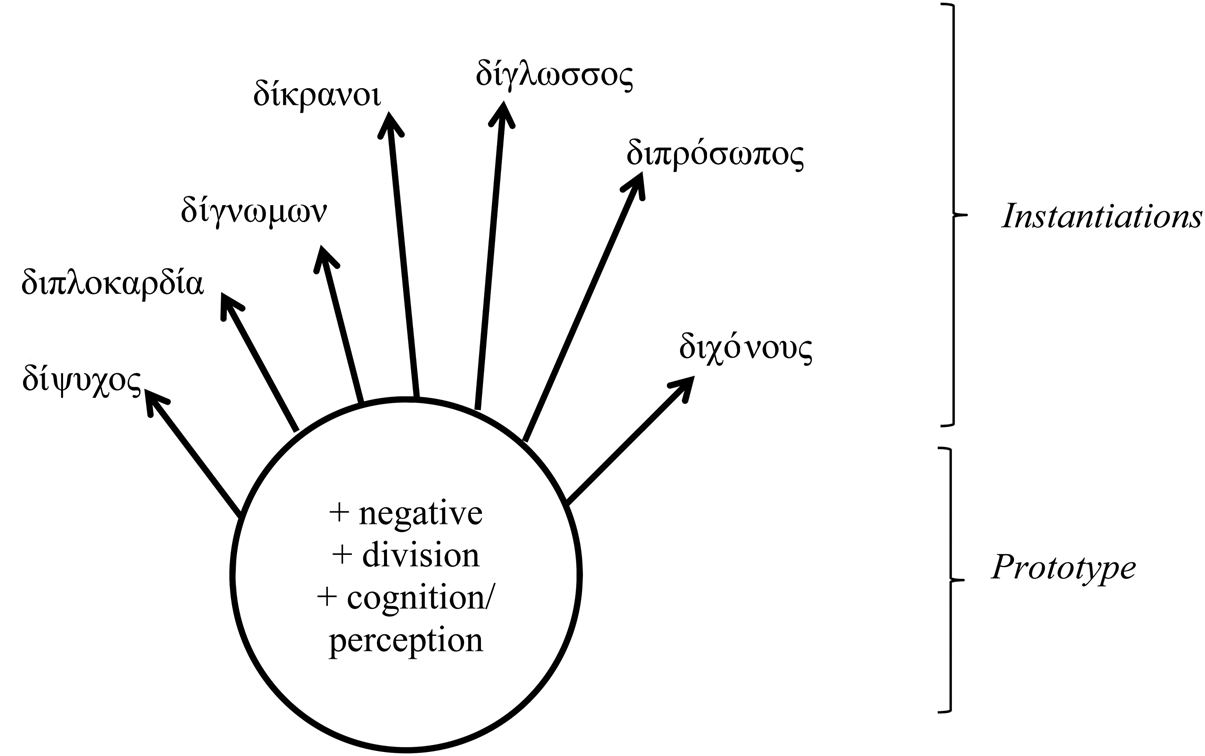
This prototype model could be adapted to explain the various δίς-affixations (δίκρανοι, διπρόσωπος, δίψυχος, δίγνωμων, δίγλωσσος; or διπλοῦς- and δίχα-affixation, in the case of διπλοκαρδία and διχόνους) as different lexical instantiations of a single semantic prototype. In contrast to Clarke's model, where the same lexeme connoted different (though prototypically related) meanings, what we find here is a number of different base lexemes, through a process of affixation, connoting similar meanings. The likelihood of different base lexemes converging on one instantiated meaning is increased when we consider the general similarity among the various terms. All are in some way related to either a cognitive or perceptual faculty of a person, either focally (καρδία, νοῦς) or peripherally (κάρα ‘head’, and by physical extension γλῶσσα, πρόσωπον).Footnote 90 These bases undergo a process of affixation/compounding to connote a similar negative conception of division or bifurcation, be it doing both good and evil (T. Ash. 2.1–8), holding contradictory philosophies (Parmenides, fr. 6.5) or being divided in belief concerning God's ability to answer prayer (Jas 1.8). This information is schematically represented in Fig. 1.
Prototype Semantics of ‘double-mindedness’

With reference to the prototype theory of lexical semantics, we are able to model how different lexical bases underwent a similar affixation process to arrive at seemingly equivalent semantic instantiations.
5. Conclusion: The Historiography of δίψυχος
The desire to trace a word's origins to a specific text is natural enough, yet in this case, the fragmentary and piecemeal attestation of the lexeme should gently guide us towards a humble agnosticism, rather than presume that the precise origins lie somewhere within the extant literature. Durkin is (unfortunately) right that ‘when we are considering the remoter linguistic past, we often have little or no information about the relative frequency of particular words’, and thus differences ‘of meaning, or register, or stylistic level’ are often ‘now unrecoverable’.Footnote 91 Given the infrequency of the later use of δίψυχος and its near-synonyms,Footnote 92 it seems that none of these lexemes became institutionalised, and thus the coining or use of one word did not pre-emptively block the formation of a near synonym.Footnote 93 And while we may still seek to exegetically parse out the differences in nuance between δίψυχος and διπλοκαρδία, or δίγνωμων and διχόνους, we should not be surprised or unsettled that ‘we very often encounter words which appear to be full synonyms in the historical record’,Footnote 94 especially given the patchy attestation of the terms.
Previous scholarship has sought to identify the origins of the neologism δίψυχος through a process of intertextuality and literary dependency. Porter's contention that James is the source of the use of δίψυχος in the Apostolic Fathers is not supported by the extant evidence, and thus the use of the lexeme can prove neither the anteriority of James nor the Jamesian origins of the neologism.Footnote 95 There is no doubt that Allison and Bauckham have offered the most convincing arguments for an intertexual approach based on the available evidence. Yet it is precisely this basis that is so tenuous. The scarcity of evidence is such that the term's chance discovery in some yet unpublished papyrus fragment would throw wide open the whole intertextual enterprise, in which the same old questions of literary dependency would be rehashed once again. Instead, I have advocated a turn away from intertextual methodology towards the study of etymology. While considerations of translation compounding and prototype theory cannot tell us who coined δίψυχος, it may help us to realise why that is the wrong question to ask, and that the question of how, not who, presents itself as a more productive avenue of inquiry.