Introduction
Soybean is the second most important crop after corn in South Dakota, with acreage of 2.3 million hectares and generating close to $2.2 billion in revenue (USDA-NASS 2018). However, its production in South Dakota is threatened by the soybean cyst nematode (SCN) (Allen et al. Reference Allen, Bradley, Sisson, Byamukama, Chilvers, Coker, Collins, Damicone, Dorrance, Dufault, Esker, Faske, Giesler, Grybauskas, Hershman, Hollier, Isakeit, Jardine, Kelley, Kemerait, Kleczewski, Koenning, Kurle, Malvick, Markell, Mehl, Mueller, Mueller, Mulrooney, Nelson, Newman, Osborne, Overstreet, Padgett, Phipps, Price, Sikora, Smith, Spurlock, Tande, Tenuta, Wise and Wrather2017; Niblack et al. Reference Niblack, Lambert and Tylka2006). SCN has been reported in 31 counties of South Dakota (Acharya Reference Acharya2015; Tylka and Marett Reference Tylka and Marett2017), and this pest is continuously spreading to other areas in the state. The estimated soybean yield loss due to SCN in South Dakota alone is 120 million kg annually (www.sdsoybean.org) and is expected to increase if efforts to minimize its spread are unsuccessful.
Soybean cyst nematode is a soilborne, obligatory, sedentary, endoparasitic nematode that parasitizes soybean roots (Niblack et al. Reference Niblack, Lambert and Tylka2006). Not only does feeding of SCN on soybean roots reduce nutrients for the plant, but wounds created by juveniles can be entry routes for other pathogens such as Fusarium virguliforme (Workneh et al. Reference Workneh, Yang and Tylka1999). SCN belongs to phylum Nematoda, order Tylenchida, and family Heteroderidae. The genus Heterodera comprises cyst-forming nematodes that are characterized by their ability to form cysts (thick-walled female body that that is filled with eggs) that provide overwintering protection for eggs (Davis and Tylka, Reference Davis and Tylka2000).
The SCN life cycle comprises three main stages: egg, juvenile, and adult. The egg goes through different phases of embryogenesis and molting, resulting in the formation of the first-stage juvenile (J1) inside the egg (Niblack Reference Niblack2005). The J1s molt into a second-stage juvenile (J2), which is the infecting stage. The J2s are attracted to the roots by root exudates and enter the host’s roots with the aid of a stylet (penetrating organ), finally migrating toward the vascular system of the plant. The juvenile destroys cortical and epidermal cells to form a metabolic sink often referred to as a syncytium (Davis et al. Reference Davis, Baum and Hussey2004). Juveniles feed from the syncytium and become sedentary, undergoing further molt into the third-stage juvenile (J3), where the sexual differentiation occurs. J3 males undergo metamorphosis, regaining their vermiform shape, whereas J3 females continue to feed and eventually change into a lemon-shaped cyst. SCN takes around 3 to 4 wk to complete its life cycle, but the duration is influenced by several environmental and genetic factors (Riggs and Wrather Reference Riggs and Wrather1992).
Use of SCN-resistant soybean cultivars and crop rotations with non-host crops are commonly practiced techniques for SCN management (Mitchum Reference Mitchum2016; Niblack and Chen Reference Niblack, Chen, Schmitt, Wrather and Riggs2004). However, the majority of host resistance used in SCN management was derived from one source (PI88788), and several reports indicate adapted SCN populations that can reproduce well on this resistance source (Gardner et al. Reference Gardner, Heinz, Wang and Mitchum2017; Howland et al. Reference Howland, Monnig, Mathesius, Nathan and Mitchum2018; Tylka and Mullaney Reference Tylka and Mullaney2018; Zheng and Chen Reference Zheng and Chen2011). Another challenge associated with use of host resistance is that some of the farmers are not adopting SCN-resistant varieties because they have not tested their soils to determine presence of SCN. SCN does not cause obvious aboveground symptoms when the SCN population density is low, though by this time yield loss is already occurring (Wang et al. Reference Wang, Niblack, Tremain, Wiebold, Tylka, Marett, Noel, Myers and Schmidt2003).
Weed SCN hosts further complicate SCN management because of continued SCN development in the soil in the absence of soybean (Creech et al. Reference Creech, Johnson, Faghihi, Ferris and Westphal2005; Johnson et al. Reference Johnson, Creech and Mock2008; Nice and Johnson Reference Nice and Johnson2005; Poromarto et al. Reference Poromarto, Nelson, Jain and Gramig2015; Thomas et al. Reference Thomas, Schroeder and Murray2005). Winter annual weeds emerge during fall, overwinter as seedlings, and then complete their life cycle in the spring (Mock et al. Reference Mock, Creech, Johnson, Faghihi, Ferris, Westphal and Bradley2007; Werle et al. Reference Werle, Bernards, Arkebauer and Lindquist2014). Previous studies have shown that there has been a surge in the winter annual weeds in different states that is probably due to factors such as increased conservation tillage practices, herbicide usage for weed management, and warmer winters in northern US regions (Johnson et al. Reference Johnson, Creech and Mock2008; Krausz et al. Reference Krausz, Young and Matthews2003; Thomas et al. Reference Thomas, Derksen, Blackshaw, Van Acker, Légère, Watson and Turnbull2004).
SCN reproducing on the alternative weed hosts may also influence the HG type (Heterodera glycines type) as a result of selection pressure favoring development of a particular SCN HG type (Niblack Reference Niblack2005). HG type is a modified classification system of SCN by considering the relative reproduction of SCN on seven soybean differential lines as compared to the standard susceptible check (Niblack et al. Reference Niblack, Arelli, Noel, Opperman, Orf, Schmitt, Shannon and Tylka2002; Wang et al. Reference Wang, Zhu, Wang, Luo, Song, Zhu, Wang, Chen, Chen and Duan2013). An SCN population is determined to be virulent to the specific differential line if the relative number of cysts developed on this line is ≥ 10% of the number of cysts that developed on a susceptible line. Acharya et al. (Reference Acharya, Tande and Byamukama2017) reported diverse HG types in South Dakota counties, and this can be attributed in part to weed hosts in soybean fields. It is therefore important to identify weeds that are hosts for SCN in South Dakota so as to inform SCN management approaches.
Some commonly found weed hosts of SCN documented in several soybean-producing US states of Indiana, Ohio, Illinois, North Dakota, Iowa, and Missouri include burclover (Medicago polymorpha L.), alsike clover (Trifolium hybridum L.), crimson clover (Trifolium incarnatum L.), common chickweed (Stellaria media L. Vill.), mouse-ear chickweed (Cerastium fontanum Baumg.), common mullein (Verbascum thapsus L.), field pennycress or henbit (Lamium amplexicaule L.), and purple deadnettle (Chen Reference Chen2012; Giesler and Wilson Reference Giesler and Wilson2011; Mock et al. Reference Mock, Creech, Johnson, Faghihi, Ferris, Westphal and Bradley2007; Poromarto et al. Reference Poromarto, Nelson, Jain and Gramig2015; Tylka Reference Tylka2012; Werle et al. Reference Werle, Giesler, Bernards and Lindquist2015). However, identification of SCN weed host species is complicated because of the genetic variability of HG types, localized environment, and selection pressure associated with different agronomic practices (Riggs and Schmitt Reference Riggs and Schmitt1988). The considerable temperature dependence of SCN growth and development influences their success on winter annual weeds (Creech et al. Reference Creech, Webb, Young, Bond, Harrison, Ferris, Faghihi, Westphal and Johnson2007).
Despite the importance of weeds as alternative hosts to SCN, no information is available on weeds that are SCN hosts in South Dakota. South Dakota has diverse cropping systems including no-tillage or minimum tillage, which influences the weed species present, some of which may be hosts of SCN. Moreover, only a few research studies on weeds as SCN hosts have included field-based information. Creech and Johnson (Reference Creech and Johnson2006) reported on abundance of broadleaf winter weeds in fields infested with SCN in Indiana but did not report on the SCN reproduction on these weed hosts. Mock et al. (Reference Mock, Creech, Ferris, Faghihi, Wesphal, Santini and Johnson2012) studied the influence of winter annual weed management and crop rotation on SCN. However, individual weed support of SCN reproduction was not reported in their study. Although Creech et al. (Reference Creech, Johnson, Faghihi, Ferris and Westphal2005) reported SCN reproduction on weed hosts based on field conditions, they investigated only two weed hosts. Moreover, weed diversity and abundance in the above study locations are different from South Dakota, which is located in the northern plains.
Most of the reports on SCN weed hosts done in several states had contrasting reports of plant species determined to be SCN hosts that were mainly due to different biotypes of the weed species tested (Poromarto et al. Reference Poromarto, Nelson, Jain and Gramig2015). Hence, it is important not only to identify state-specific weed hosts due to agronomic and abiotic differences among states, but also to test host status under field and greenhouse conditions. Therefore, the objective of this study was to determine weeds that host SCN based on field conditions supplemented with further greenhouse testing.
Materials and Methods
Weed Sample Collection
Previously confirmed SCN-positive fields (Acharya Reference Acharya2015) in 13 different soybean-growing South Dakota counties were identified arbitrarily. Weed samples were collected from 48 fields selected at random in the fall of 2016 from September to November (11 fields) and in the spring of 2017 in late April and May (37 fields). Sampling in the fall targeted weeds that emerge after soybean harvest, whereas the spring sampling targeted weeds that emerge before soybean planting. Temperature ranges for September to November and for April through May for eastern South Dakota in 2016 and 2017 were within the 30-yr averages of −7 C to 26°C for September through November and 0°C to 23°C for April and May (NWS 2018). For each field, whole weed samples were collected from locations likely to have SCN within the field including field entrances and low-lying areas. For each weed sample, the whole weed with its soil ball from a depth of 30 cm was obtained. At least two samples for each weed species were collected in each field. Samples were placed in plastic bags and stored in a cooler (4 C) until SCN extraction (within a week). Additionally, soil samples of approximately 2 to 3 kg were collected from every sampled field in a zig-zag pattern to confirm the presence of SCN through a standardized soil-washing extraction procedure as described below.
SCN Extraction
SCN cysts and eggs were extracted from 100 cm3 of the representative soil sample following the extraction procedures by Faghihi and Ferris (Reference Faghihi and Ferris2000). SCN extraction was done within a week of sampling for weed samples and within a month for the soil samples. Of 48 fields positive for SCN, 45 were used for further weed SCN hosts analysis. The root ball of the weed samples was placed in a bucket filled with water and left to soak for 48 h to facilitate removal of soil from the roots. Roots were cut into small pieces (length 1 to 2 cm) and macerated in a blender with 100 ml water at 12,000 rev/min for 1 min (EPPO 2013). The resulting suspension was passed through two sieves with a 250-μm sieve above a 25-μm sieve at the bottom. The suspension from the 25-μm sieve was collected in a 50-ml beaker, and a 1-ml aliquot was transferred to a counting slide and analyzed for the presence of juveniles using a dissecting microscope (Faghihi and Ferris Reference Faghihi and Ferris2000). Juveniles of SCN were identified based on morphology (Hunt and Lane, Reference Hunt and Lane2008) and enumerated.
Greenhouse Assay to Confirm Weeds as SCN Hosts
The greenhouse experiment examined the cyst development in weed species that tested positive for SCN as described above. The weed species included field pennycress, purple deadnettle, white clover, common mallow, Venice mallow (Hibiscus trionum L.), purple poppy mallow [Callirhoe involucrata (Torr. & A. Gray) A. Gray], horseweed (Erigeron canadensis L.), shepherd’s purse, common cocklebur, Canada thistle, small-flowered bittercress (Cardamine parviflora L.), and leafy spurge (Euphorbia esula L.). Weed seeds of these species (except small-flowered bittercress) were pre-germinated at room temperature (25°C) in a Petri dish with a moist filter paper. Pre-germinated seeds of each weed species and susceptible soybean cultivar Williams 82 as the susceptible check were transplanted into individual cone-tainers (3.8 cm diam and 21 cm height; Stuewe and Sons Inc., Tangent, OR) filled with sterilized clay–sand mixture (1 part clay to 2 parts sand). Each cone-tainer was planted with a single pre-germinated seedling. Each cone-tainer was inoculated 3 cm below the soil surface by pipetting a 1-ml aliquot of water containing 2,000 SCN eggs (HG type 0) per milliliter into the soil 3 d after transplanting. HG type 0 was used because it is the most predominant HG type in South Dakota (Acharya et al. Reference Acharya, Tande and Byamukama2016). The cone-tainers were placed in a 7.6-L bucket filled with sand and placed in a water bath maintained at 27 C to 28 C (ideal temperature for SCN reproduction; Palmateer et al. Reference Palmateer, Schmitt, Stetina and Russin2000). Each bucket contained one replicate of each weed species and a susceptible check.
The hatching rate of HG type 0 eggs was 50% within 10 d. The weed species with the susceptible soybean check were arranged in a completely randomized design with eight replicates, and the whole experiment was repeated once.
After 40 d post-inoculation, the cone-tainers were removed from the bucket and soaked in water for 20 min. The plants were then uprooted. The 40-d duration was chosen to provide enough time for life cycle completion on weed species under greenhouse conditions. A strong stream of water was applied on the roots to dislodge cysts, which were collected on a 210-μm sieve nested under a 710-μm sieve. The total number of cysts that developed on the root were counted and used to calculate the female index (FI):
 $${{\rm{FI = }}{{{\rm{Average \ number \ of \ cysts \ found \ on \ the \ weed \ species}}} \over {{\rm{Average \ number \ of \ cysts \ found \ on \ the \ susceptible \ check}}}} \times 100}$$
FI is the relative measure of SCN reproduction on a plant species as compared to a standard susceptible soybean check and is a preferred measure to determine the reproduction capacity of SCN on a given species (Niblack et al. Reference Niblack, Arelli, Noel, Opperman, Orf, Schmitt, Shannon and Tylka2002).
Data Collection and Summary
The weed field prevalence was determined as frequency obtained by dividing the number of fields found with the weed species by the total fields scouted. The average number of SCN eggs found in a county was determined by dividing the sum total of eggs in the soil samples by the number of soil samples obtained in a county. Average number of SCN juveniles in weed roots was obtained by dividing the sum of the juveniles extracted from weed roots by the number of root samples used for extraction for each weed species. Number of cysts that developed on each weed species and respective FI for each weed species were averaged across replications and runs. Because data collected were frequencies and no treatments were imposed, no statistical tests were necessary and discussion of the data was done by comparing percentages.
Results and Discussion
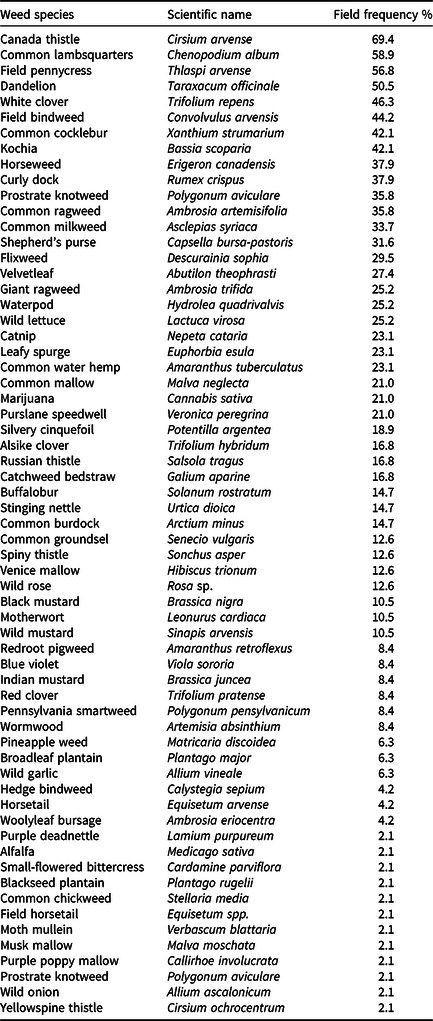
Of 670 whole weed samples collected from the fields during fall 2016 and spring 2017, Canada thistle was the most abundant, with a distribution frequency of 69% (33 of 48 fields sampled) (Table 1). Other commonly found weeds included common lambsquarters (Chenopodium album L.) (59%), field pennycress (56%), dandelion [Taraxacum officinale (L.) Weber ex F.H. Wigg.] (50%), white clover (46%), field bindweed (Convolvulus arvensis L.) (44%), common cocklebur (42%), and kochia [Bassia scoparia (L.) A.J. Scott] (42%) (Table 1). Weeds such as alfalfa (Medicago sativa L.), small-flowered bittercress, black-seeded plantain (Plantago rugelii Decne), common chickweed, field horsetail (Equisetum spp.), moth mullein (Verbascum blattaria L.), musk mallow (Malva moschata L.), purple poppy mallow, prostrate knotweed (Polygonum aviculare L.), wild onion (Allium ascalonicum L.), and yellow spine thistle (Cirsium ochrocentrum A. Gray) were collected in <3% of the fields sampled.
Collection frequency (%) of weed species obtained from the field survey (n = 48) to determine weed hosts for soybean cyst nematode in South Dakota during the fall of 2016 and spring of 2017.

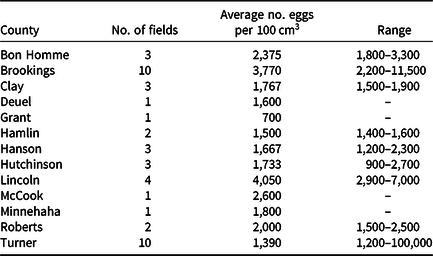
SCN was not detected in bulk soil samples collected in 3 of the 48 fields, and weed roots from these fields were not tested for SCN. SCN populations from the 45 SCN-positive fields ranged from 700 to 100,000 eggs per 100-cm3 soil sample, suggesting highly variable SCN populations in the infected fields in South Dakota (Table 2). In general, SCN population within and across locations is influenced by several biotic, abiotic, and agronomic factors. Some of the abiotic factors affecting SCN are soil temperature, soil characteristics, soil moisture content, salt content, pH, and metal ions. Biotic factors include presence of microorganisms, plant exudates, and weeds. Agronomic factors such as tillage, soil nutrients, nematicide seed treatments, and cropping history also affect SCN level (Gavassoni et al. Reference Gavassoni, Tylka and Munkvold2007; Workneh et al. Reference Workneh, Yang and Tylka1999).
Average number of soybean cyst nematodes obtained from the sampled counties of South Dakota.a

a Expressed as average number of eggs per 100 cm3 of soil sampled.
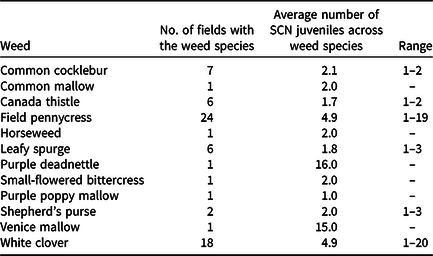
Among all the weed species, a comparatively higher number of SCN juveniles (>15) were obtained from purple deadnettle, Venice mallow, white clover, and field pennycress (Table 3). Fewer juveniles (1 to 3) were found from common cocklebur, common mallow, horseweed, small-flowered bittercress, shepherd’s purse, Canada thistle, leafy spurge, and purple poppy mallow (Table 3). There was no correlation between soil SCN population density and number of juveniles found in weed species. Similarly, time of sampling did not influence the weed species or juvenile densities found in roots (data not shown). Juveniles determined from field weed species were relatively fewer (1 to 20) compared to SCN egg counts, which ranged from 700 to 4,050 eggs per 100 cm3 of soil. The lack of correlation between juveniles in weed species roots and egg count in the soil samples within the same field might be due to SCN weed host preferences and high SCN variability within the field. High SCN within-field variability can be caused by several factors such as field landscape, soil type, tillage practices, and soil moisture (Gavassoni et al. Reference Gavassoni, Tylka and Munkvold2007; Perez-Hernandez and Giesler Reference Pérez-Hernández and Giesler2017; Workneh et al. Reference Workneh, Yang and Tylka1999). Although the HG type for each individual sampled field was not determined in this study, a previous study reported HG type 0 to be the predominant HG type in South Dakota (Acharya et al. Reference Acharya, Tande and Byamukama2016); therefore, HG type may have had minimum impact on the probability to detect a weed as a host for SCN under field conditions in this study.
Number of soybean cyst nematode (SCN) juveniles found in various weed species collected from 48 previously confirmed SCN fields in South Dakota.

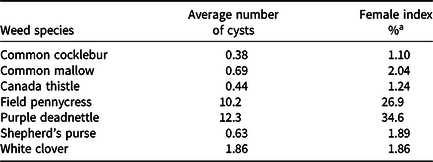
Purple deadnettle and field pennycress had the highest FIs of 34.6% and 26.9%, respectively, among the weeds tested as hosts in the greenhouse. FIs were lower for common mallow (FI = 2.04), shepherd’s purse (FI = 1.89), Canada thistle (FI = 1.24), white clover (FI = 1.86), and common cocklebur (FI = 1.10) (Table 4). Horseweed, Venice mallow, and leafy spurge did not support cyst development in the greenhouse, although roots from these species collected from the field were found with SCN juveniles.
Total number of soybean cyst nematode females (cysts) formed and their respective female index for weed samples in a greenhouse confirmation experiment.a

a Female index was obtained by dividing the number of cysts in a weed species divided by the cysts in the susceptible check × 100. Data were pooled across the two greenhouse runs.
This study identified and confirmed weed species that are hosts for SCN in South Dakota. Among the 63 commonly found weed species sampled and tested, 12 weed species were found with juveniles in the roots. Of these 12 weeds, 7 (field pennycress, purple deadnettle, common mallow, shepherd’s purse, white clover, common cocklebur, and Canada thistle) supported SCN cyst development in the greenhouse. Except common mallow, all the other weed hosts determined from this study had been previously identified as SCN weed hosts in other states. The number of cysts that formed on these roots was 70% to 99% lower than a susceptible soybean variety. These data suggest that the majority of the weeds tested above are poor hosts, and only a small portion of juveniles can complete their life cycle on these weed species. The few weeds that supported completion of SCN life cycle, however, may serve as a bridge for SCN in fields when not planted to soybean.
Canada thistle, common cocklebur, shepherd’s purse, white clover, and common mallow supported low SCN cyst development (FI < 5%) and therefore can be categorized as poor hosts for SCN. Our results are in agreement with a few previous reports but also differ from some of these reports. For instance, Poromarto et al. (Reference Poromarto, Nelson, Jain and Gramig2015) also found Canada thistle and common cocklebur to be a poor host for SCN; however, Wong and Tylka (Reference Wong and Tylka1994) and Venkatesh et al. (Reference Venkatesh, Harrison and Riedel2000) found these weeds not to be SCN hosts. Similarly, shepherd’s purse was found to be a poor host of SCN in this study, as was also reported by Venkatesh et al. (Reference Venkatesh, Harrison and Riedel2000) and Johnson et al. (Reference Johnson, Creech and Mock2008). However, Poromarto et al. (Reference Poromarto, Nelson, Jain and Gramig2015) reported shepherd’s purse as a non-host species. Additionally, white clover was found to be a poor host of SCN in our study, in agreement with findings by Donald et al. (Reference Donald, Hayes and Walker2007) and Warner et al. (Reference Warner, Sylvester and Bird2017). However, no SCN cysts were found on this weed in the greenhouse study by Poromarto et al. (Reference Poromarto, Nelson, Jain and Gramig2015). The difference in classification of SCN weed hosts in different studies might be attributable to differences in SCN HG types as well as weed biotypes used in these studies.
The weed species that supported cyst development in this study can be categorized in the host range types as determined by Riggs (Reference Riggs1987). Interestingly, Canada thistle, cocklebur, shepherd’s purse, white clover, and common mallow did not support cyst development in all the replicates in the greenhouse, suggesting again that these weed species are poor SCN hosts (Poromarto et al. Reference Poromarto, Nelson, Jain and Gramig2015). Weeds such as purple poppy mallow, horseweed, Venice mallow, and leafy spurge did not support cyst development under the greenhouse conditions. This result can be explained by the observation that certain weed species only allow penetration and juvenile development but do not allow completion of the cyst development as reported by Riggs (Reference Riggs1987). Such weed species might play an important role as a trap crop, where juveniles can penetrate but cannot form cysts. Field pennycress and purple deadnettle supported development of several cysts; therefore, these two weeds can be categorized as good SCN hosts in South Dakota.
Weed species compete with soybean for water and nutrients and may allow continued development of SCN inoculum in the field by serving as alternative weed hosts (Bernards and Sandell Reference Bernards and Sandell2011; Nice and Johnson Reference Nice and Johnson2005). Results from this study suggest that field pennycress and purple deadnettle are important SCN weed hosts from the SCN management point of view, as they can support significant SCN reproduction in the field and the greenhouse. However, the abundance of field pennycress in the soybean fields in South Dakota elevates its importance as a major alternative SCN weed host. Moreover, increasing interest of researchers in studying field pennycress as a potential cover crop or oilseed crop, and as integration to a corn–soybean rotation system further implicates its importance as a SCN weed host (Bishop and Nelson Reference Bishop and Nelson2019). These research findings suggest that weed species that are SCN hosts should be proactively controlled in fields that are positive for SCN to limit the spread and continued accumulation in the soil in the absence of soybean.
Acknowledgments
We thank the South Dakota Soybean Research and Promotional Council for funding this project. This work was also partially supported by the USDA National Institute of Food and Agriculture Hatch grant SD00H662-18. We thank Richard Geppert for his assistance in collecting weed and soil samples from different counties of South Dakota. We also appreciate assistance from Connie Tande, Krishna Acharya, Paul Okello, and Rawnaq Choudhury for their valuable suggestions in the different aspects of this project. No conflicts of interest have been declared.