We live in a 21st century world that is continuously affected by emergency situations which are often associated with highly serious consequences to local and regional health. An increase has been observed in the rate of non-communicable diseases. Among recent examples, we can refer to devastating storms and floods in USA, Australia, and Pakistan; earthquakes in Haiti, Japan, and New Zealand; and conflicts in Syria.Reference Murray, Vos and Lozano1 Non-communicable diseases (NCDs) such as cardiovascular disease, diabetes, cancer, and chronic lung disease are a major threat to global public health.2-4 As the main cause of death and disability in 65.5% of mortality and about 50% of disability-adjusted living worldwide.Reference Murray, Vos and Lozano1,Reference Lozano, Naghavi and Foreman5,Reference Nugent and Feigl6 In other words, 26.6 million deaths worldwide from NCDs in 1990, and its increase to 34.5 million in 2010.Reference Lozano, Naghavi and Foreman5,Reference Bloom, Cafiero and Jané-Llopis7 The World Health Organization estimates that the annual death toll from non-communicable diseases has risen from 38 million in 2012 to 55 million in 2030.8-Reference After11 Global economic burden of NCDs, as estimated in 2010, was 6.3 trillion US dollars with an increase to 13 trillion US dollars in 2030.Reference Habib and Saha12 Populations of the nations throughout the world are generally getting older and this factor has led to a significant appearance regarding the effects of NCDs. Disasters can damage the basic infrastructure of public health, as well as the necessary social protection systems for vulnerable populations. In addition to these difficult conditions, disasters affect people with NCDs, including loss of medicines, interruption of regular medical treatment, and damage to hospitals.13-Reference Jhung, Shehab and Rohr-Allegrini15 Disasters like earthquakes, hurricanes, and volcanic eruptions can cause the destruction of different body systems in various ways. Patients with chronic illnesses such as cardiovascular patients, diabetes, respiratory conditions, and patients with cancers are some of the most vulnerable groups in such disastrous situations and are faced with various problems after the occurrence of natural or technological disasters.Reference Gorji, Jafari, Heidari and Seifi16
Recent studies have shown that respiratory disease is the major cause of diseases and casualties resulting from disasters; and that respiratory damage is known to be the main cause of death in various kinds of disasters where a large amount of harmful suspended particles are released in the air.Reference Bandyopadhyay and Paul17
In the Sichuan earthquake, 77% of hospitalized patients were reported with at least 1 NCD. Hypertension (47%) and diabetes (24%) made up the majority of burden.Reference Chan, Man and Lam18 Hurricane Katrina was an experience in which it was observed that during health crises, patients with non-communicable diseases are in need of promoted crisis preparedness and response programs.Reference Bell, Abir, Choi, Cooke and Iwashyna19 This leads to indirect mortality and high complications, about 70%-90%, which is primarily due to the exacerbation of life-threatening conditions and chronic diseases.Reference Ryan, Green, Franklin and Burkle20 Due to the large-scale disasters, non-communicable diseases are expected to cause significant health problems. Therefore, with the development of anti-hazard measures such as earthquake-resistant construction, early warning can directly reduce the mortality of patients with non-communicable diseases as well as decrease the rate of injuries caused by hazards. In unexpected disasters, preparedness to care for a vulnerable population is far more important than for healthy people.Reference Bierman and Clancy21-Reference Fernandez, Byard, Lin, Benson and Barbera23 After disasters, inadequate care, resources, and lack of continuity of care for chronic diseases such as cardiovascular diseases, asthma, diabetes, and renal diseases lead to increased symptom exacerbation that result in increased morbidity and mortality among these populations.Reference Chan and Kim24 However, non-communicable diseases have received little attention from human-rights organizations in the acute phases of crisis and emergencies. There is, therefore, a need to refocus disaster systems for the 21st Century.Reference Murray, Vos and Lozano1
A significant gap exists in understanding NCDs in emergency settings as few studies provide estimates of NCD burden in displaced populations or the effect of emergencies on access to care.Reference Kloner, Leor, Poole and Perritt25,Reference Bethel, Foreman and Burke26
Although these issues are of importance, there has been little discussion on already existing chronic diseases that become exacerbated following natural crisis.Reference Owens and Martsolf27 Guidelines for the acute phase of disasters are mainly focused on communicable diseases such as diarrhea and measles; and according to the author’s investigations and review of literature, there are very limited research articles on NCDs management at the time of disasters.Reference Demaio, Jamieson, Horn, de Courten and Tellier28
Emergency non-communicable disease management calls for standard techniques and appropriate relief services.Reference Slama, Kim and Roglic29 Considering the above discussion, examining and clarifying the status of studies related to NCD patients in disasters may be effective in planning to reduce damages, as well as increase supply for their needs during disasters. Due to the constant increase in the incidence of disasters and the increase in the number of people suffering from non-communicable diseases, there is an urgent need to expand preparedness and response to people with chronic diseases in disasters. Therefore, with the importance of this topic and the lack of comprehensive review of literature, the purpose of this study is to provide a systematic review of the conditions and status of patients with non-communicable diseases before, during and after disasters. Also, considering that the World Health Organization identifies 4 major types of non-communicable diseases as cardiovascular disease, cancer, chronic respiratory disease, and diabetes, this study systematically reviews these 4 diseases in disasters.
Methods
Research Plan and Registration
This systematic review has been submitted to the International Prospective Register of Systematic Reviews (http://www.crd.york.ac.uk/PROSPERO) (Registration Number: CRD 42020164032). The review methods were guided by the PRISMA statement on systematic reviews, and the steps involved are shown in a PRISMA flow diagram (Figure 1).
Screening chart of the extracted studies in the systematic search in data banks for establishing the status of patients with non-communicable diseases in disasters.

Eligibility Criteria
Inclusion Criteria
An article was included in this review if all of the following were applicable:
1) Articles on non-communicable diseases prior to, during, and after disasters
2) Relevant articles published in accredited scientific and research journals
3) The abstract and text was written in English
4) Studies described condition of patients with NCDs at the time of the disasters. (Including before, during and after disasters)
5) Studies described disaster preparedness for patients with chronic diseases
6) Studies described management of chronic diseases in disasters
7) Studies described impact of disasters in patients with NCDs
Exclusion Criteria
An article was excluded from this review if any of the following was applicable:
1) Studies with inaccessible abstracts
2) Articles that exclusively discuss about patients with non-communicable diseases in situations other than disasters
3) Articles lacking required quality to be included in the study
4) Studies that described only infectious disease or injuries
It should be noted that the quality of the articles were evaluated using valid checklists to evaluate and critique scientific articles.
Quality Assessment
The researchers evaluated the quality of the selected articles based on valid checklists by type of study. Quality assessment of the observational studies, such as cohort and cross-sectional articles, were carried out by strengthening the reporting of observational studies in epidemiology check list (STROBE). Based on this checklist, studies obtain a score ranking from 0 to 34. In this review, studies were classified into 3 groups according to their obtained score as weak quality, ranking from 0 to 11; moderate quality, ranking from 12 to 22; and high quality, ranking from 23 to 34. Quality assessment of the experimental studies was carried out by Transparent Reporting of Evaluations with Non-randomized Designs (TREND). Based on this checklist, studies obtain a score ranking from 0 to 59. In this review, studies were classified into 3 groups according to their obtained score as weak quality, ranking from 0 to 21; moderate quality, ranking from 22 to 41; and high quality, ranking from 42 to 59. Quality assessment of the qualitative studies was carried out by Critical Appraisal Skills Program (CASP). Based on this checklist, studies obtain a score ranking from 0 to 10. In this review, studies were classified into 2 groups according to their obtained score as weak quality, ranking from 0 to 5; and high quality, ranking from 6 to 10. Quality assessment of the systematic review and meta-analyses studies was carried out by Preferred Reporting Items for Systematic Review and Meta-Analyses checklist (PRISMA). There are 27 items in this checklist. Each paper is reviewed in terms of these 27 items and marked either as implemented or not-implemented. If an item is not observed in a paper, it will be rated 0, and if the subject item is mentioned in the paper, it will be rated 1. When items are not as distinct, the unclear parts will be repeated several times until a precise interpretation is ultimately reached and a valid evaluation of the study is made.
Information Sources
Databases Used to Search for Sources
We reviewed articles electronically and through the following data banks: Scopus (Elsevier, Amsterdam, Netherlands), ISI Web of Science (Thomson Reuters, New York, NY), PubMed (National Library of Medicine, Bethesda, MD), Clinical Key (Elsevier, Amsterdam, Netherlands), Ovid Medline (New York, NY), Ovid EMBASE (Elsevier, Amsterdam, Netherlands), CINAHL (EBSCO, Ipswich, MA), EBSCO (EBSCO, Ipswich, MA), Cochrane library (Cochrane Database of Systematic Reviews; Cochrane Central Register of Controlled Trials), PsyCINFO (American Psychological Association, Washington, DC) including articles from 1997 to 2019. In addition to these databases, we used websites of organizations such as: CDC, WHO, World Bank, Department of Homeland Security, and Federal Emergency Management (FEMA). We also used disaster and chronic disease related published books.
Literature Search Strategy
The search was limited to the English language and was made for articles related to the topic using the following search terms: “non-communicable diseases and disasters,” “non-communicable diseases or chronic illness,” “disaster or crisis” on all databases.
The key words used in the search strategy were prevalence of chronic diseases, types of disasters, frequency of disasters, impact of disasters, management of chronic diseases in disasters, disaster preparedness for individuals with chronic diseases, health practitioners and chronic diseases in a disaster, disasters and chronic diseases, health outcomes for chronic disease individuals after a disaster, and management of chronic diseases in a disaster.
The variations included were based on World Health Organization (WHO) NCD terms and included cancer (malignant tumors or neoplasms); cardiovascular disease: coronary heart disease, cerebrovascular disease, peripheral arterial disease, rheumatic heart disease, congenital heart disease, deep vein thrombosis or pulmonary embolism; chronic respiratory diseases: asthma, chronic obstructive pulmonary disease (COPD), occupational lung diseases, lung disease or pulmonary hypertension; diabetes (of which there are no variations as this term is specific for a condition where the pancreas does not produce enough insulin or when the body cannot effectively use the insulin it produces).
The search was made on the international databases including PubMed, Scopus, EMBASE, CINAHL, EBSCO, and Clinical Key in the title /abstract field, as well as on the Web of Science in the topic field from 1997 to 2019. We selected relevant articles according to the inclusion and exclusion criteria in order of the title, abstract, and text. The gray literature was not actively searched because they usually do not portray the whole picture of the results and when fully published the results may change substantially. Also, we chose key terms and developed a search strategy based on the National Library of Medicine’s Medical Subjects Headings (MeSH).
Study Selection
WHO states that NCDs are not passed through person-to-person contacts. In addition to the 4 main types of NCDs (cardiovascular diseases, cancers, chronic respiratory diseases, and diabetes). In the present study, we considered 4 non-communicable diseases. And considering the chronic nature of the disease, we also included all natural and manmade disasters in the study.
This phase of the study was conducted in 3 sections. First, duplicate studies were deleted. Second, the title and abstract of the remaining papers were independently investigated by 2 members of the research working group based on the inclusion and exclusion criteria. When disagreement occurred, the opinion of a third reviewer was sought. Finally, the screened studies were selected based on the full text and independently by the researchers. Also, the reference lists of included studies were searched again for additional relevant articles.
Data Extraction
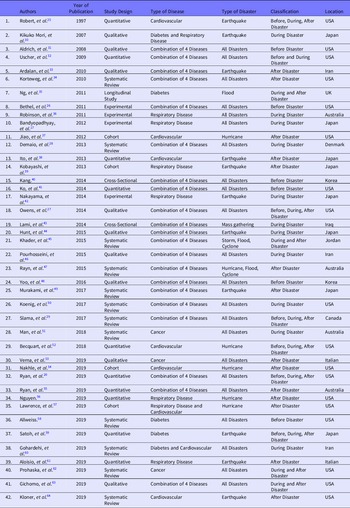
Data was extracted by researchers separately from a researcher-made checklist. This checklist included the title of the article, authors, the year of publication, study design, the type of non-communicable disease, the type of disaster, the stage of disaster (before, during, or after), and the country.
Data Collection
In our primary search, 453 studies were gathered. Of these, 5 were identified in 2 or more databases. Removal of the duplicate entries of the same articles left 448 unique studies. Examination of the abstracts identified 350 studies that did not fit the inclusion criteria described in the next paragraph. The remaining 98 studies were read in full and a further 56 studies were excluded with reasons for each exclusion recorded. This left 42 studies which were then included in the qualitative synthesis (Figure 1).
Results
Initially 453 potentially relevant articles were identified. After re-assessment of the titles, 5 articles were excluded due to repetition and 448 articles included in the screening process. Following a title and abstract review, 350 articles were excluded based on the exclusion criteria and 98 articles were selected for full text review. After the full text review, 56 articles were excluded based on the exclusion criteria. Finally, a total of 42 papers were included in our systematic review. The process of selecting studies in the PRISMA flowchart is described in Figure 1.
Of the 42 articles, most of the included studies described the conditions of patients with NCDs after disasters: 14 (13.3%), during disasters: 11 (26.2%), before disasters: 6 (14.3%), within all stages of disasters; before, during and after: 6 (14.3%), during and after disasters: 4 (9.5%), as well as before and during disasters: 1 (2.4%).
Most of the included studies were conducted in the USA (43%, n = 18) and Japan (19%, n = 8). The basic features of included studies are presented in Table 1.
Articles used in establishing the status of patients with non-communicable diseases in disaster

Considering NCDs as the target disease of this study, the majority of studies included have investigated a combination of 4 diseases: cardiovascular disease, respiratory disease, diabetes and cancer (50%, n = 21). Followed by cardiovascular disease (16.5%, n = 7), chronic respiratory disease (14.3%, n = 6), diabetes and cancer (7.2%, n = 3).
Of the 42 articles, 18 (43%) focused specifically on all disasters, 11 (26.1%) on earthquakes, 5 (12%) on hurricanes, 3 (7%) on natural with man-made disasters, 2 (4.7%) on hurricanes with flood, 1 (2.4%) on flood, 1 (2.4%) on disasters with mass gatherings, and 1 (2.4%) on only mass gatherings.
Most of the studies were systematic review articles (28.6%, n = 12). The rest consisted of quantitative articles (23.8%, n = 10), qualitative articles (21.4%, n = 9), cohort and experimental articles (9.5%, n = 4), cross sectional articles (4.8%, n = 2) and a longitudinal study (2.4%, n = 1).
A review of the articles showed that during and after disasters, the health outcomes of people with NCDs are significantly unfavorable compared to the general public. There is insufficient information on the management of chronic diseases, the quality of care, and resource identification during and after disasters.
Before Disasters
According to the results of studies in this research, for patients with NCDs in disasters, due to the vulnerability of these patients and their special needs, there should be planning and coordination among public health professionals to serve these patients.Reference Aldrich and Benson31
Effective pre-disaster strategies include having expertise in the division of tasks, training vulnerable people, ensuring that patients are prepared for emergencies at the community level, developing communication and collaboration between public health agencies, and serving patients.Reference Aldrich and Benson31
It is necessary to provide an emergency program in the city for patients with NCDs and to identify these people before disasters in order to provide timely services to patients in emergencies.
Preparation and management of NCDs in disasters, including the full preparation of disaster equipment such as water, flashlights, medicine for 3 days, food and radio, having an emergency evacuation plan through practical maneuvers is essential.Reference Kang40,Reference Ko, Strine and Allweiss65
A very important problem for these patients during disasters is the disruption of medical care, shelter and transportation. Therefore, planning for disasters, management, preparation, and the active cooperation of the government before disasters are essential. It is also important for the patient to be aware of their needs before the disaster.Reference Yoo, Lee and Tullmann48
During Disasters
For patients with NCDs, a lack of treatment, management, and care for even a short period can result in severe exacerbation of symptoms and death. Preparedness during disaster on evacuation programs, sheltering patients, relief and rescue, health care resources for vulnerable people with NCDs, preventing frostbite, preventing stress, getting proper diet, access to breathing masks, and dust minimizing focus.Reference Mori, Ugai and Nonami30,Reference Uscher-Pines, Hausman, Powell, DeMara, Heake and Hagen32
During disasters, patients with NCDs need to be aware of the evacuation routes in order to make decisions in emergency situation.Reference Uscher-Pines, Hausman, Powell, DeMara, Heake and Hagen32
Attention to medicine needs, including insulin, is important for patients with diabetes.Reference Ng, Atkin, Rigby, Walton and Kilpatrick35 During disasters, rescue workers must be fully prepared for public health and eliminated needs of these patients.Reference Koenig and Schultz50 Specialist consultation, for example lung consult, is required for patients with chronic respiratory disease in response to disasters.Reference Robinson, Alatas, Robertson and Steer36 One of the problems when disasters occur is the readiness for electricity and the provision of support generators for at least 24 hours for these patients, especially in patients who need ventilators and respiratory equipment. Therefore, replacement for emergency electricity can solve serious conditions for these patients during disasters.Reference Nakayama, Tanaka and Uematsu42
Other issues that are may arise during disasters in patients with NCDs include human resource management, access to patient’s medical records, resource and equipment management, nutrition management, environmental health monitoring, mental health control of patients, inter-organizational synchronization, as well as technology and communication management.Reference Pourhosseini, Ardalan and Mehrolhassani46,Reference Gohardehi, Seyedin and Moslehi60
Studies have shown that the most important stressors for these patients are financial and insurance problems, overcrowding, and the search for food, shelter, and medicine. Lack of proper diet, lack of medication, damage to infrastructure, damage to communication systems, damage to medical records, destruction of hospitals and radiotherapy centers are the most important causes of exacerbation of disease symptoms during disasters.Reference Lami, Jewad, Hassan, Kadhim and Alharis43,Reference Man, Lack, Wyatt and Murray51,Reference Becquart, Naumova, Singh and Chui52
The risk of care and treatment disorder of patients with cardiovascular disease, respiratory disease, diabetes, and cancer can persist for weeks to years after disasters.Reference Loehn, Pou and Nuss66-Reference Evans70
After Disaster
In this study, people with NCDs were identified as vulnerable populations. Therefore, evaluating their health needs after disasters is important.
After disasters, the clinical effects of respiratory diseases, cardiovascular diseases, diabetes, and cancer in patients had a negative effect, such as a sudden increase in blood pressure that occurred 2 weeks after the Japan earthquake due to emotional and psychological stress.Reference Ito, Date and Ogawa38
After disasters, there is an increase in the admission of patients with NCDs for care and treatment.Reference Kobayashi, Hanagama and Yamanda39 The results of our study showed the most important issue after disasters is the interruption of treatment and controlling systems for patients with NCDs. Disruption in regular treatments are the most common problems, followed by decreased monitoring capacity.Reference Murakami, Sasaki, Pascapurnama and Egawa49
Another important issue after disasters in these patients is the attention to mental health.Reference Yoo, Lee and Tullmann48 Following Hurricane Katrina, an increase in patient’s admission with Myocardial Infarction, coronary artery disease, and a prevalence of psychological and behavioral risk factors was observed that was 5 times higher than before the hurricane.Reference Nakhle, Ayoub, Subedi, Panhwar, Sangani and Razavi54 It is important to identify patients’ special needs and provide services to help them develop resilience during disasters.Reference Verna, Cortellini, Giusti, Ficorella and Porzio53
Different tools, for example the Disaster AWARE, can be used to prioritize the needs of cardiovascular, respiratory, diabetes, and cancer patients after disasters.Reference Ryan, Green, Franklin and Burkle71 The most important of these needs after disasters include continuous access to medications and medical services, management of symptoms, attention to stress and anxiety, and sleep disorders.Reference Ryan, Franklin, Burkle, Smith, Aitken and Leggat55
The key impacts of self-care success in patients with NCDs after disasters help to plan and adopt strategies to reduce complications of disease, as well as reduce the post-disaster demand for emergency medical care.Reference Ryan, Franklin, Burkle, Smith, Aitken and Leggat55 One of the main reasons for not following the post-disasters treatment program in these patients is financial barriers, so monitoring and planning health education and health policies in this regard is essential.Reference Kang40
In disasters such as floods and storms, toxins and carcinogen pose a threat to cancer patients. These toxins can be present in water, soil, and air for months, so after disasters, another important issue is to clean up environmental pollution.Reference Prohaska and Peters62 Focus on reduction, preparing, responding, and recovering from disasters should be considered 6 to 12 months later.
Health care workers should be aware that after disasters, rapid response to care and treatment for patients with NCDs should be provided. They should be aware of the symptoms and complications of the disease as well as be able to identify it in a timely manner.Reference Ryan, Franklin and Burkle47,Reference Prohaska and Peters62,Reference Kloner64
Discussion
As far as we know, the present study is the first systematic review related to the status of patients with NCDs before, during, and after disasters. We searched for articles published during a 22-year period, from 1997 to 2019.
Our study was designed to assess the condition of patients with cardiovascular disease, respiratory disease, diabetes, and cancer; and also to ascertain the necessary preparation for them before, during and after disasters. In general, cardiovascular disease, respiratory disease, diabetes, and cancer are considered as common NCDs that impact huge economic and social burden on different communities.
During the occurrence of disasters, the main focus of responsible organization is usually on organizing settlements and preventing communicable diseases in survivors. Therefore, NCDs such as cardiovascular, respiratory, diabetes and cancer diseases are often overlooked. During and after disasters, patients with NCDs are more likely than others to be affected by problems due to lack of access to medication, loss of medical records, lack of access to proper nutrition, lack of access to medical services, and mobility impairment due to destruction of the main routes of access to medical centers.
Therefore, the necessary preparation for these patients should be planned in all stages before, during, and after the disasters. There is also a need to expand traditional perspectives on disasters by promoting public health in patients with NCDs.Reference Murakami, Sasaki, Pascapurnama and Egawa49,Reference Koido, Kondo, Ichihara, Kohayagawa and Henmi72 Improving disaster preparedness and training programs in these patients before disasters, facilitating timely care during disaster, rapid response when disconnecting communication networks, storing of food and medicine, the need for laboratory diagnostic tests, training health care workers on how to deal with these patients in disasters, training patients to prepare before disasters, assessment of patients’ laboratory tests during and after disasters, cooperation and inter-organizational coordination, rapid reconstruction of medical centers, attention to patients’ mental health issues, elimination of ineffective strategies in chronic patient management in disasters, strengthen public health and control risk factors, and integrating NCDs into primary health care are essential.
Developing medical center preparation programs to provide services to patients is another important step for these patients.
Having the necessary facilities and equipment at home for some patients and training them, before the disaster, to prepare oxygen therapy equipment and oxygen cylinders in respiratory patients who face power outages during disasters.
Limitations
This research focused on 4 diseases only: cardiovascular, respiratory, cancer, and diabetes. This approach was selected in order to ensure consistency with the 4 major disease groupings for NCDs by the World Health Organization. However, other NCDs may be impacted more significantly by a disaster.
Conclusion
This systematic review showed the status of cardiovascular, respiratory, diabetes and cancer patients before, during, and after disasters and their vulnerability. Discontinuation of medications and treatments, lack of awareness in patients and health care workers, impaired timely provision of medical services to patients, impaired transportation, and lack of access to proper nutrition have been found to result in the exacerbation of disease’ complications.
Therefore, the integration of NCDs in policies and standards in emergencies, the management of NCDs in emergencies in scientific and academic educations, and the provision of resilience in patients are very important because NCDs impose a great burden on treatment systems of the community.
Acknowledgements
This article is extracted from a PhD thesis on Health in Emergency and Disaster, with COI: IR.UMSU.REC.1398.228, Urmia University of Medical Sciences, by the Research Center for Social Factors Effective on Health. We extend our special thanks to supervisors and advisors who collaborated in this research.
Author Contributions
Elham Ghazanchaeiwas was involved in the design of the research study, data collection, data analysis, and interpretation of the paper data. Davoud Khorasani Zavareh contributed to study design, data validation, data analysis and interpretation, article editing, and article revision. Iraj Mohebbi contributed to the study design and also to finalizing the article. Javad Aghazadeh-Attari was involved in the study design. All authors were involved in the manuscript writing and approval of the final paper.
Conflicts of Interest
The authors declare that there is no conflict of interest.