INTRODUCTION
When anti-cancer treatments are no longer useful, patients are usually referred to various health professionals for end-of-life (EoL) care such as primary care physicians, or oncology, and palliative care specialists. This transition carries a significant risk of resulting in fragmented care. The role of the palliative care specialist in oncology is evolving: a recent study has shown a clear benefit when these professionals are involved early in the management of cancer patients (Temel et al., Reference Temel, Greer and Muzikansky2010). However, the optimal integration model of oncological and palliative care is an important research area still not fully investigated. A position statement from ASCO in 1998 said: “the role of the oncologist and the care team is not simply to treat cancer, but to provide comprehensive palliative and anticancer throughout the course of an illness … The principal physician responsible for the management for patients with cancer is the oncologist … (who) provides care through the course of therapy, recovery or recurrence of cancer and death.” Among the elements that determine a high professional standard for EoL care there is the “trustworthy assurance that there will be no abandonment by the physician” (ASCO Task Force on Cancer Care at EoL, 1998). A study suggested that patients worry about physician abandonment when death approaches (Back et al., Reference Back, Young and McCown2009). They placed great value in the availability of their physician when causal therapy was no longer available and were concerned that the physician they trusted was out of the picture when they entered the most difficult phase of the illness trajectory. Bruera and Hui in Reference Bruera and Hui2010 identified three conceptual models of delivering palliative care to cancer patients: the “solo” practice model, the “congress” practice model and the integrated care model. While these authors favor the integrated model, the “solo” practice model in which the oncologist takes care also of the supportive/palliative care needs may be preferred in some circumstances (Bruera & Hui, Reference Bruera and Hui2010). How the level of engagement of the oncologist in EoL care impacts on the satisfaction of patient and caregivers is a poorly scrutinized area in oncology (Han & Rayson, Reference Han and Rayson2010). In this explorative study, we evaluated the feasibility and the acceptance of a model of care in which the oncologist is the responsible physician throughout the entire disease trajectory.
METHODS
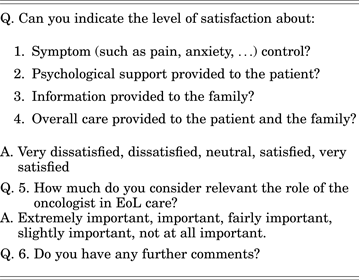
The Oncology Units of the Hospitals of Fermo and San Benedetto del Tronto (Marche Region, Central Italy) were reorganized to ensure continuity of care of cancer patients. Five out of the nine oncologists working in these units received specific training in palliative care. One oncology unit offered continuity of care at the patient's home, while the other also offered the possibility of inpatient hospice treatment. Oncologists were involved in EoL care until patient's death. Patients assisted at home or at an inpatient hospice that died in the year 2011 were selected for the study. The family member we interviewed was the principal caregiver or the next of kin when this was not possible. A semi-structured telephone interview was conducted by a psychologist or a social worker at least one month after death. We evaluated satisfaction in relation to various aspects including: symptoms control, communication with health care professionals, psychological support, and overall quality of care. A specific question addressed the value of continuity of the therapeutic relationship with the oncologist (Table 1). At the end of the interview, an open-ended question asked for additional comments and suggestions for improvement. Results were measured using a five-point Likert scale ranging from very dissatisfied to very satisfied and converted to a 0-to-100 scale (Press, Reference Press2006). As control group we utilized data from our previous work in which 50 caregivers were interviewed after patients' death, but this continuity of care model was not still adopted (Bascioni et al., Reference Bascioni, Esperide and Iacopini2010).
Questions used to investigate the level of satisfaction about EoL care

RESULTS
Relatives of 65 patients were contacted. Fifty-five accepted the interview (27 spouses, 22 sons, five in-laws, and one parent); 50/55 was the leader caregiver. Forty-one were relatives of patients followed at home, while 14 were relatives of patients followed at an inpatient hospice. The duration of EoL care ranged from one to 24 weeks (median 3 weeks). Satisfaction mean scores were: symptoms control 76/100, communication 85/100, psychological support 82/100, and overall quality of care 84/100. A specific question on the role of the oncologist in EoL care produced a score of 82/100, with no negative or neutral responses recorded for this item. A common perception among caregivers was the appreciation of the oncologist's commitment until patient's death in addition to the technical quality of the intervention. The open-ended question allowed family members to comment further about their thoughts on the clinical care received by their relative. Some of the comments were: “we feel fortunate to have the same doctor throughout the disease, who would have had the strength to explain everything all over again?”; “knowing that the doctor knows all the history was a great help for us, we didn't feel abandoned as they know how to treat this disease”; “it is important to have that feeling of familiarity and of being known by the doctor”; “I feel relieved by the fact that these doctors are people you can count on until the end.” The overall satisfaction score was higher than in our previous study in which a continuity of care model was not adopted, with a score improvement from 55 to 84/100 (p < 0.001).
DISCUSSION
The literature data on patient and caregiver preferences about what kind of physician should be the primary provider during EoL care are not conclusive. Some cancer patients appear to feel abandoned by their oncologist especially when a long term relationship has been developed (Back et al., Reference Back, Young and McCown2009). The oncologist's preferences about EoL care seem to cluster in two categories: (1) those who describe themselves as having primarily a “biomedical” role report a more distant relationship with the patient as well as a sense of failure about EoL care; (2) those who view their role as encompassing both “biomedical” and “psychosocial” aspects of medicine report a closer relationship with the patient and consider EoL care as a rewarding experience (Jackson et al., Reference Jackson, Mack and Matsuyama2008; von Gunten, Reference von Gunten2008). Assessment of the quality of EoL care presents unique challenges related to difficulties in administering questionnaires to subjects that are very ill, and ethical concerns have been raised about whether near EoL patients should be asked to participate in research studies. In addition, there are conflicting results about the accuracy of proxy responses in this setting. Some authors suggest that it is important to evaluate the family members' experience not as a proxy response but as an outcome itself as this strategy acknowledges that the family is the “unit of care” in palliative care. This kind of evaluation does not per se replace patients' experience but seem to have a value in its own (Steinhauser, Reference Steinhauser2005), as valuable information can be obtained from bereaved family members through follow-back surveys of their experience (Teno, Reference Teno2005). In this explorative study, we tested the feasibility of the “solo” practice model that considers the oncology team as the provider of both oncological and palliative care. Various possible drawbacks were suggested with respect to the implementation of this model. First, the growing complexity of oncology and supportive/palliative care makes it more difficult for the oncologist to keep up with all areas of patient care. Second, time constraints may reduce the time the oncologist can devote to a demanding area such as EoL care, with possible risks of burnout related to this high emotional burden. However, the most favorable aspect of this model is related to the continuity of care without transfer of responsibility to different physicians in the most difficult phase of the patient illness trajectory (Bruera & Hui, Reference Bruera and Hui2010). A strengthening of the therapeutic alliance between patient and physician, who remains engaged and “present” until the final moments, is one of the most important predictors of quality of life at the EoL (Zhang et al., Reference Zhang, Nilsson and Prigerson2012).
The current study has some notable limitations. The study was performed in two non-academic medium-volume cancer units in Italy, which to some extent the average of medical care delivered to cancer patients in Italy, while the health care system can be different from those of other countries, particularly the United States. The interview format was very simple as a truly validated instrument of quality of care evaluation at EoL in Italian was not available when the study was performed. Of note, the implementation of this “solo” model of cancer patient care requires educational programs aimed at optimizing the oncologist's specific skills in palliative care.
In conclusion, our study suggests that an active role of the oncologist in EoL care of cancer patients was considered an important issue by family caregivers and resulted in improved satisfaction scores about quality of care. The respondents highly value the continuity of the patient-oncologist relationship until death, thus suggesting that this model may be preferable to other models in which responsibility of care is transferred to different professionals over time.
We believe that it is essential to maintain a continuous relationship between patient and oncologist during EoL care, and that conversion of small-medium size oncology units to ensure this type of care should be encouraged. Further investigation is warranted to evaluate the potential applicability of this model of EoL care in other health care contexts.