According to the FAO of the UN, food insecurity is defined as the lack of regular access to sufficient, safe and nutritious food required for normal growth, development and an active and healthy life(1). In 2023, it was estimated that 28·9 % of the global population – approximately 2·33 billion people – experienced moderate or severe levels of food insecurity and lacked regular access to adequate food(2). A large-scale systematic review demonstrated that individuals experiencing food insecurity tend to have lower fruit and vegetable intake and poorer diet quality(Reference Shi, Davies and Allman-Farinelli3). Another study reported that each unit increase in the food insecurity score was associated with an 11 % decrease in the likelihood of being a high fruit and vegetable consumer(Reference Turnbull, Homer and Ensaff4). Several studies have shown that individuals facing food insecurity consume fewer healthy sources of protein and fruits and vegetables, while consuming more energy-dense foods(Reference Farahbakhsh, Hanbazaza and Ball5–Reference Naja, Itani and Kharroubi8). These factors collectively suggest that adherence to healthy dietary patterns may be lower among individuals experiencing food insecurity.
Food insecurity may affect not only dietary habits but also eating behaviours. Indeed, individuals experiencing food insecurity may adopt an eating pattern referred to as the ‘feast-famine’ cycle. In this cycle, individuals consciously restrict their food intake when resources are limited and tend to overeat once food becomes available(Reference Hazzard, Loth and Hooper9,Reference Zickgraf, Hazzard and O’Connor10) . Such cyclical eating behaviours can impair an individual’s ability to accurately perceive and respond to hunger and satiety cues. Therefore, this pattern closely aligns with the theoretical foundations of intuitive eating, which emphasise the importance of internal regulatory signals in guiding eating behaviour. Intuitive eating posits that dietary restraint may contribute to behaviours related to eating disorders, such as overeating, and encourages individuals to eat in response to their body’s natural cues(Reference Van Dyke and Drinkwater11). Emphasising eating based on hunger and fullness signals, intuitive eating discourages dieting unless it is medically necessary(Reference Lucherini Angeletti, Spinelli and Cassioli12). In addition to its role in preventing eating disorders, intuitive eating has been associated with greater fruit and vegetable intake and healthier dietary patterns(Reference Christoph, Hazzard and Järvelä-Reijonen13,Reference Burnette, Hazzard and Larson14) . However, a systematic review reported that intuitive eating interventions may not significantly influence dietary intake or quality(Reference Grider, Douglas and Raynor15).
According to the 2024 Global Hunger Index report, Türkiye is categorised as having a ‘low’ level of hunger, with a score below 5(16). However, the Global Food Security Index report of 2022 ranked Türkiye 49th among 113 countries(17). Small-scale studies conducted in various age groups and regions across Türkiye have reported that the prevalence of food insecurity ranges between 21 and 69 %(Reference Aytekin Sahin and Mengi Celik18–Reference Selcuk, Atan and Arslan20). Due to its geopolitical position – being close to regions experiencing political instability and civil wars(Reference Zarei21,Reference Öztürk, Gür, Jongerden and Sutter22) – as well as income inequality(Reference Destek, Sinha and Sarkodie23) and food inflation(Reference Işık and Özbuğday24), Türkiye faces a significant risk of food insecurity. Therefore, regular monitoring and evaluation of food insecurity in Türkiye is essential.
In the literature, one study has been identified that investigated the relationship between food insecurity and intuitive eating, reporting a negative association between the two(Reference Jackson, Sano and Parker25). Intuitive eating may contribute to the maintenance of healthy dietary patterns. However, considering that intuitive eating skills may be weakened among individuals experiencing food insecurity, this could also influence adherence to the Mediterranean diet. The Mediterranean diet emphasises nutrient-dense, minimally processed foods rich in vegetables, fruits, legumes, whole grains, nuts and olive oil, along with moderate intake of fish, poultry and fermented dairy products, which collectively support cardiovascular health, metabolic regulation and reduced chronic inflammation(Reference Romagnolo and Selmin26). Accordingly, this study aimed to examine the mediating role of intuitive eating in the relationship between food insecurity and adherence to the Mediterranean diet. In line with this objective, the following hypotheses have been developed:
H1: There is a negative relationship between food insecurity and intuitive eating.
H2: There is a negative relationship between food insecurity and adherence to the Mediterranean diet.
H3: Intuitive eating mediates the relationship between food insecurity and adherence to the Mediterranean diet.
Method
Participants
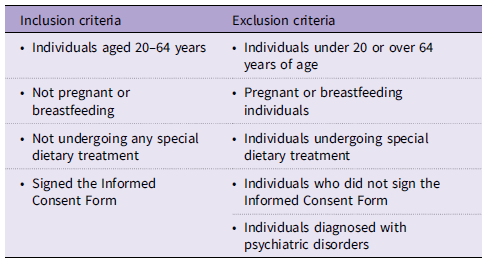
This cross-sectional and correlational study was conducted with adult individuals aged 20–64 residing in Niğde, Türkiye. Data were collected between January and March 2025. In determining the sample size for the study, relevant literature(Reference Burnette, Hazzard and Larson14,Reference Tabatabai, Holland and Curtis27) was reviewed, and using G * Power software, a minimum of 700 participants was calculated to be necessary based on an α level (α) of 0·05, a power (1 − β) of 0·80 and the specified effect size. All participants were assessed by the researchers based on predefined inclusion criteria, and those who met the criteria were recruited for the study on a voluntary basis through face-to-face interviews. The inclusion criteria for participation are presented in Table 1.
Inclusion and exclusion criteria for participation

A total of 1113 individuals were reached for this study, which employed a convenience sampling method. However, seventy-four participants were excluded from the study for various reasons (incomplete responses to the survey form (n 43), age over 64 (n 31). As a result, 1039 adult individuals constituted the study sample. Ethical approval for the study was obtained from the Niğde Ömer Halisdemir University Ethics Committee (Date: 01·11·2024 No: 22504254-2024/19-23). In accordance with the principles of the 2013 Helsinki Declaration, informed consent was obtained from all participants.
Study design
The questionnaire administered to the participants included sections on general information, dietary habits, the Household Food Access Scale (short form), the Mediterranean Diet Adherence Screener (MEDAS) and the Intuitive Eating Scale-2 (IES-2). The general information section of the survey collected data on participants’ socio-demographic characteristics such as gender, age and occupation, as well as other lifestyle habits. Participants’ dietary habits were assessed based on the frequency of fruit, vegetable (raw and cooked) and meat consumption. To determine consumption frequency, participants were asked, ‘How often do you consume fruit?’ and responses were categorised into five groups: none (1), 1–2 times per week (2), 3–4 times per week (3), 5–6 times per week (4) and daily (5). Similarly, participants were asked ‘How often do you consume vegetables (cooked or raw)?’ and ‘How often do you consume meat?’ using the same response categories.
Household Food Security Survey Module – Short Form
The Household Food Security Survey Module – Short Form (HFSSM-SF) was used to assess food insecurity in participants. The Turkish validation of this scale was carried out by Emiral et al. (Reference Emiral, Önsüz and Metintaş28). This scale consists of six items and is of the Likert-type. Based on the total score obtained from the scale, participants were classified as ‘high food security’ (0 points), ‘marginal food security’ (1 point), ‘low food security’ (2–4 points) or ‘very low food security’ (5–6 points). Food insecurity is defined as the total number of individuals with low or very low food security(Reference Bickel, Nord and Price29). The Cronbach’s alpha coefficient of the Turkish version of the scale was determined to be 0·90. In this study, Cronbach’s alpha coefficient was determined as 0·79.
Mediterranean Diet Adherence Screener
The MEDAS, developed by Martinez-Gonzalez et al. (Reference Martínez-González, Corella and Salas-Salvadó30) and validated in Turkish by Özkan Pehlivanoğlu et al. (Reference Özkan Pehlivanoğlu, Balcıoğlu and Ünlüoğlu31), was used to assess participants’ adherence to the Mediterranean diet. This scale consists of fourteen items, and for each question, participants receive a score of 1 or 0 based on their consumption frequency, with the scores being summed. A total score of 7 or higher indicates high adherence to the Mediterranean diet. The scale’s Cronbach’s α coefficient was reported as 0·83(Reference Özkan Pehlivanoğlu, Balcıoğlu and Ünlüoğlu31); in the present study, it was calculated as 0·69.
The Intuitive Eating Scale-2
The IES-2, developed by Tylka and Kroon Van Diest(Reference Tylka and Kroon Van Diest32) and validated in Turkish by Baş et al. (Reference Bas, Karaca and Saglam33), was used to determine the level of intuitive eating in individuals. This scale consists of twenty-three items and uses a five-point Likert scale. The scale includes four subscales: ‘unconditional permission to eat’ (UPE) (questions 1, 2, 3, 4, 5 and 6), ‘eating for physical rather than emotional reasons’ (EPR) (questions 7, 8, 9, 10, 11, 12, 13 and 14), ‘eating based on hunger and fullness cues’ (questions 15, 16, 17, 18, 19 and 20) and ‘body-food choice congruence’ (B-FCC) (questions 21, 22 and 23). Responses are rated as follows: ‘strongly disagree’ 1 point, ‘disagree’ 2 points, ‘neutral’ 3 points, ‘agree’ 4 points and ‘strongly agree’ 5 points. Items 1, 2, 4, 5, 9, 10 and 11 are reverse scored. When calculating the total score and subscale scores, the item score is averaged by dividing the sum of the scores by the number of items. As the total score increases, the level of intuitive eating also increases. In the Turkish version of the scale, the Cronbach’s alpha coefficient was 0·97 for the UPE subscale, 0·95 for the EPR subscale, 0·92 for the reliance on hunger and satiety cues (RHSC) subscale and 0·86 for the B-FCC subscale. The α coefficient for the overall IES-2 was found to be 0·82. In this study, the Cronbach’s alpha coefficients for the IES-2 subscales ranged from 0·71 to 0·79. The coefficient for the overall scale was calculated as 0·74.
Statistical analysis
The data obtained from the study were analysed using the Statistical Package for the Social Sciences (SPSS) version 23.0. Additionally, Hayes’(Reference Hayes34) Process macro was utilised to test mediating effects. The normality of the variables in the data set was assessed using the Kolmogorov–Smirnov/Shapiro–Wilk tests. Descriptive data were presented using frequency-percentage tables. In the evaluation of categorical variables, the Pearson χ 2 test was used when the expected frequency was greater than 0·20, and Fisher’s exact test was applied when the expected frequency was less than 0·20. For variables that showed a normal distribution, mean and sd were used, while for variables that did not show a normal distribution, median, minimum and maximum values were presented. Pearson correlation analysis was conducted to assess the relationship between two continuous variables that showed a normal distribution. In interpreting the correlation coefficients, Cohen’s(Reference Cohen35) guidelines were followed: r = 0·10 indicates a small effect size, r = 0·30 a medium effect size and r = 0·50 a large effect size. In the mediation analysis to determine the effect of food insecurity on diet quality and the mediating role of ‘intuitive eating’ and its subscales, including ‘UPE’, ‘EPR’, ‘RHSC’ and ‘B-FCC’, the bootstrap results based on 5000 iterations were considered. In this analysis, the total score of intuitive eating and its subscales were analysed separately, with age as a covariate to control for potential confounding effects. The statistical significance of the mediation effects of intuitive eating and its subscales was assessed based on whether the bootstrap CI included zero. In this study, the reliability analyses of the scales used were determined by examining the internal consistency coefficient (Cronbach’s α value). In reliability measurements, values below 0·50 are considered ‘low’, values between 0·50 and 0·80 are considered ‘moderate’ and values above 0·80 are considered ‘high’ reliability(Reference Salvucci, Walter and Conley36). The findings were evaluated at a 95 % CI and a significance level of 0·05.
Results
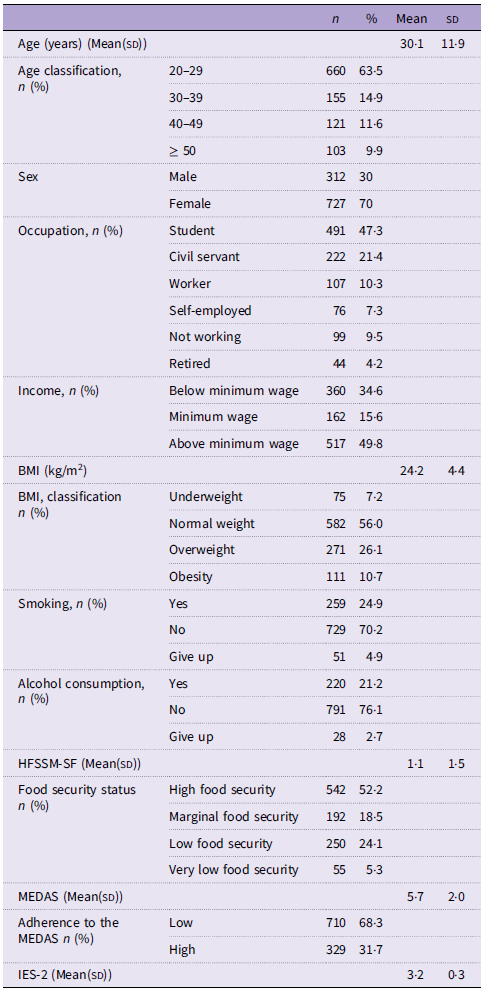
The general characteristics of the participants were presented in Table 2. The participants’ age range was predominantly between 20 and 29 years, representing 63·5 % of the sample (mean age 30·1 (sd 11·9) years). Additionally, 70 % of the participants were female, and 47·3 % were students. Those with an income above the minimum wage constituted 49·8 % of the sample. A majority of the participants (56 %) had a normal body weight, with a mean BMI of 24·2 (sd 4·4) kg/m2. Furthermore, most participants did not consume cigarettes (70·2 %) or alcoholic beverages (76·1 %). Regarding food security, 52·2 % of the participants had high food security, 18·5 % had marginal food security, 24·1 % had low food security and 5·3 % had very low food security. Nearly one-third (31·7 %) of the sample group exhibited high adherence to the Mediterranean diet. The mean HFSSM-SF score was 1·1 (sd 1·5), the MEDAS score was 5·7 (sd 2·0) and the IES-2 score was 3·2 (sd 0·3).
General characteristics of participants (numbers and percentages; mean values and standard deviations)

HFSSM-SF, Household Food Security Survey Module – Short Form; MEDAS, Mediterranean Diet Adherence Screener; IES-2, Intuitive Eating Scale-2.
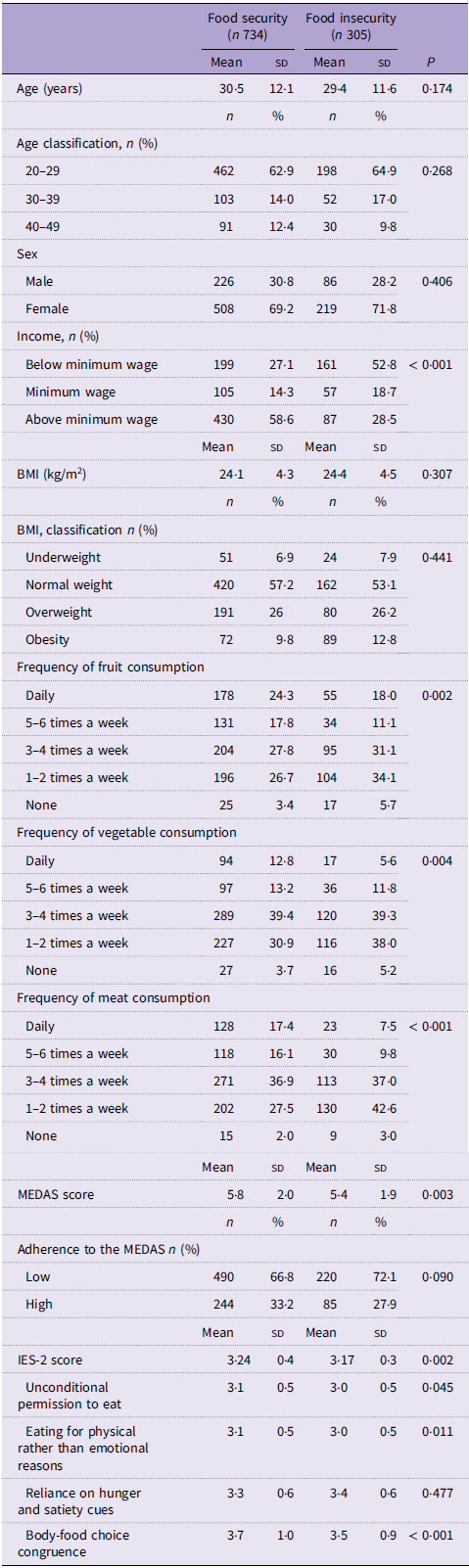
In Table 3, general information about participants’ food security status, dietary habits, adherence to the Mediterranean diet and intuitive eating status is presented. Statistically significant differences were observed in income status, dietary habits in income status, dietary habits, MEDAS score, IES-2 score and subscales such as UPE, EPR and B-FCC scores based on food security status (P < 0·05). Among those with food insecurity, a higher frequency was found for individuals with incomes below the minimum wage and those who consume fruits, vegetables and meat 1–2 times a week (P < 0·05). It was found that the MEDAS score, IES-2 score and subscales of UPE, EPR and B-FCC scores were lower in individuals with food insecurity (P < 0·05).
General characteristics, dietary habits, Mediterranean diet adherence and intuitive eating across food security status (numbers and percentages; mean values and standard deviations)

MEDAS, Mediterranean Diet Adherence Screener; IES-2, Intuitive Eating Scale-2. The χ 2 test was used for categorical variables, and independent sample t tests were used for continuous variables.
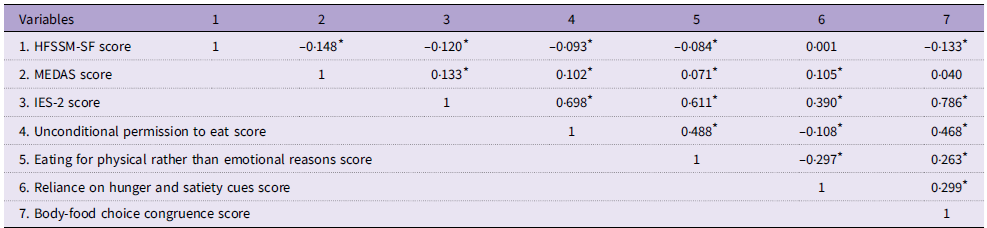
The relationship between HFSSM-SF, MEDAS and IES-2 scores is presented in Table 4. It was found that the HFSSM-SF score has a significant negative correlation with the MEDAS score (–0·148, P < 0·05), IES-2 score (–0·120, P < 0·05) and subscales of UPE (–0·093, P < 0·05), EPR (–0·084, P < 0·05) and B-FCC (–0·133, P < 0·05).
The relationship between HFSSM-SF, MEDAS, IES-2 scores and its subscales

HFSSM-SF, Household Food Security Survey Module-Short Form; MEDAS, Mediterranean Diet Adherence Screener; IES-2, Intuitive Eating Scale-2. Pearson correlation was used.
* Significant at P-value < 0·05.
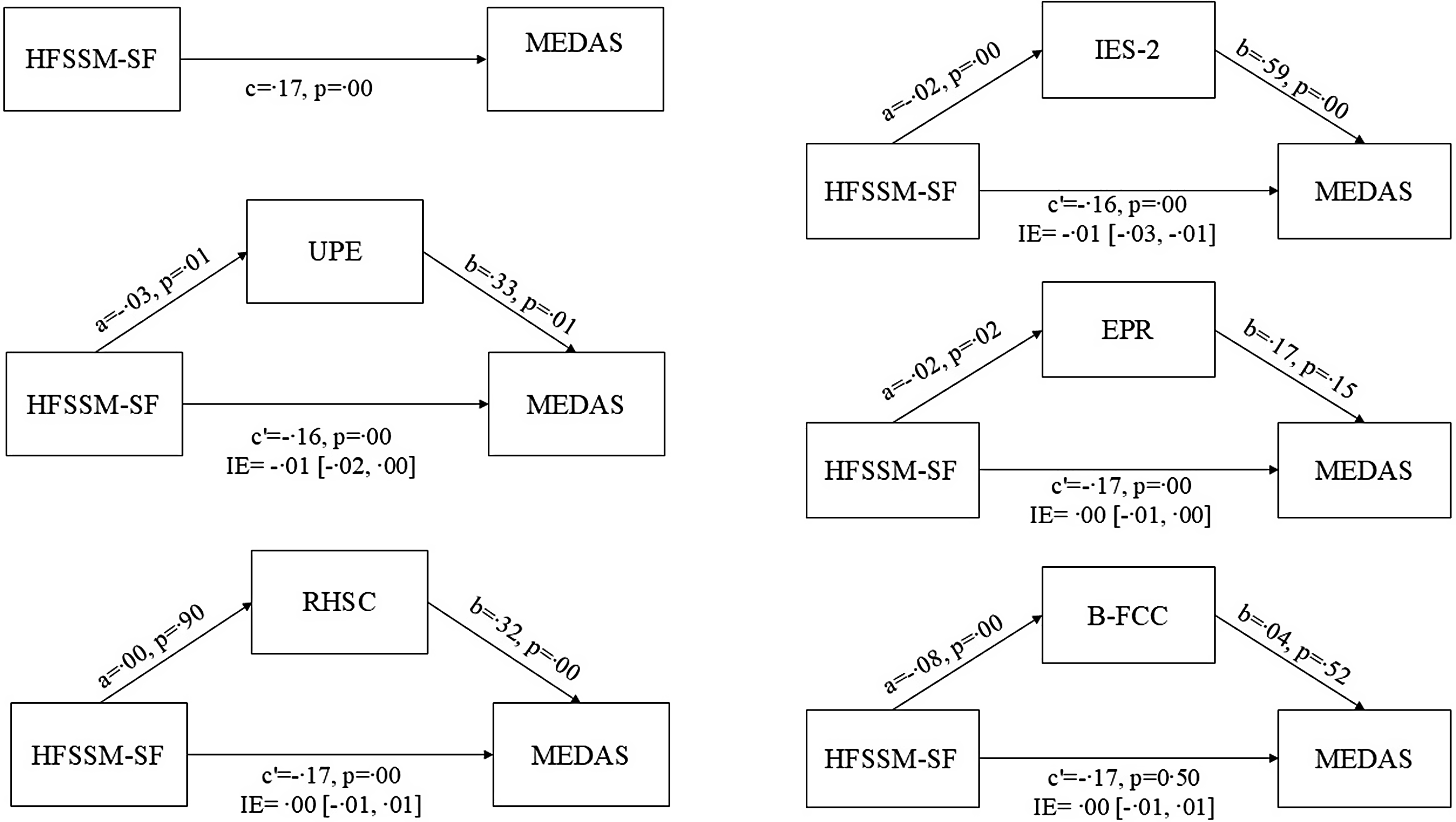
Figure 1 examines the mediating roles of intuitive eating and its subscales in the relationship between food insecurity and adherence to the Mediterranean diet. The analyses showed that intuitive eating plays a small but statistically significant mediating role in this relationship. Food insecurity was directly and negatively associated with adherence to the Mediterranean diet, and this relationship remained significant even after including the intuitive eating variable in the model. In separate analyses at the subscale level, only the ‘UPE’ subscale was found to have a significant mediating effect. The mediating effects of the other subscales, namely, ‘EPR’, ‘RHSC’ and ‘B-FCC’, were not statistically significant.
The mediation models of the relationship between food insecurity and adherence to the Mediterranean diet, considering intuitive eating and its subscales as mediators. The models are adjusted for age. Results are presented as unstandardised regression coefficients with P-values. IE = indirect effect (lower and upper bounds of the 95 % CI for indirect effect). HFSSM-SF, Household Food Security Survey Module – Short Form; MEDAS, Mediterranean Diet Adherence Screener; IES-2, Intuitive Eating Scale-2; UPE, unconditional permission to eat; EPR, eating for physical rather than emotional reasons; RHSC, reliance on hunger and satiety cues; B-FCC, body-food choice congruence.

Discussion
As far as is known, this study is the first to examine the mediating role of intuitive eating in the relationship between food insecurity and adherence to the Mediterranean diet. The results of the study revealed that food insecurity is negatively associated with adherence to the Mediterranean diet and that intuitive eating partially mediates this relationship.
In this study conducted with 1039 individuals, the fact that 63·5 % of the participants were in the 20–29 age range and 70 % were female indicates a young and female-dominated sample. Additionally, the fact that 47·3 % of the participants were students and 34·6 % had an income below the minimum wage is an important factor in assessing the dietary habits and food insecurity status of this group. The results of the study revealed that 29·4 % of the individuals were food insecure (with low and very low food security). Yüksek et al. (Reference Yüksel, Güzelalp and Albayrak37) stated that food insecurity is inevitable for families of four living on the minimum wage in Türkiye, as the minimum wage is below the hunger threshold. In their study, they found that 47·9 % of minimum wage earners experienced food insecurity. According to FAO (2023) data, the global prevalence of moderate or severe food insecurity, which particularly affects women and individuals in rural areas, is reported to be 29·6 % (2·4 billion people)(38). This finding indicates that food insecurity is a significant issue both globally and within Turkish society.
Food insecurity is associated with chronic diseases such as diabetes, hypertension, CHD and depression, and it also leads to a range of issues, including mental health problems and an increased risk of mortality(Reference Ilkay and Özkan39). In one study, it was found that individuals with obesity aged 18–35 with food insecurity had a 12 % higher risk of binge eating disorder and bulimia nervosa compared with obese individuals without food insecurity(Reference Gardizy, Lindenfeldar and Paul40). A study conducted on adults revealed that food insecurity increases the risk of anxiety by 1·7 times(Reference Hazzard, Barry and Leung41). Furthermore, individuals experiencing food insecurity often resort to inexpensive, energy-dense foods that are low in essential nutrients due to limited financial resources. Such dietary patterns have been robustly associated with higher obesity rates and related chronic diseases, including type 2 diabetes and CVD(Reference Darmon and Drewnowski42,Reference Franklin, Jones and Love43) . In addition, the association of food insecurity with obesity, through the triggering of low diet quality and increased consumption of energy-dense foods, is referred to in the literature as the food insecurity–obesity paradox(Reference Carvajal-Aldaz, Cucalon and Ordonez44).
Although no relationship was found between participants’ BMI values and food insecurity in this study, it was determined that individuals with food insecurity had lower MEDAS scores and consumed fewer fruits, vegetables and meats. Notably, nearly 70 % of the participants were found to have low adherence to the Mediterranean diet. The Mediterranean diet is a healthy eating model rich in plant-based foods such as fruits and vegetables, whole grains, legumes, nuts and olives, with moderate to high consumption of fish and seafood; moderate consumption of dairy products, eggs, poultry and wine; and low consumption of red meat. In a study conducted with university students in Türkiye, it was found that students experiencing food insecurity had low adherence to the Mediterranean diet and higher levels of depression, anxiety and stress(Reference Esin and Ayyıldız45). Another study conducted in Portugal found that food insecurity was associated with low adherence to the Mediterranean diet(Reference Gregório, Rodrigues and Graça46). In one study in the literature, it was reported that food insecurity was not associated with diet quality(Reference Rizk, Haddad and Sacre47). In this study, although a weak relationship (r = –0·148) was found between food insecurity and the MEDAS score, even such small relationships can be significant from a public health perspective. Since food insecurity is a widespread issue in Türkiye, even minor changes in dietary quality can lead to adverse health outcomes in the long term. Therefore, our findings suggest that interventions aimed at preventing food insecurity may positively influence nutritional behaviours.
Intuitive eating is an approach that advocates for individuals to eat in accordance with their body signals. This approach encourages healthy eating based on the body’s needs and promotes a more balanced diet independent of external dietary restrictions(Reference Gast, Nielson and Hunt48). In a review study published on this topic, although some studies found a positive and significant relationship between intuitive eating and diet quality, it was reported that there are conflicting results regarding the relationship between intuitive eating and diet components(Reference Aydoğdu and Akbulut49). The literature suggests that individuals with food security tend to have higher intuitive eating scores, while food insecurity is associated with lower scores(Reference Burnette, Hazzard and Larson14,Reference Rezeppa and Forney50) . Additionally, it has been stated that students experiencing food insecurity have negative effects on intuitive eating, highlighting the importance of food security for the effectiveness of intuitive eating interventions(Reference Burnette, Hazzard and Larson14,Reference Jackson, Sano and Parker25) . Consistent with the literature, this study demonstrated that individuals experiencing food insecurity had significantly lower IES-2 scores, as well as lower scores on subscales such as UPE, EPR and B-FCC. Moreover, as food insecurity increased – as indicated by higher HFSSM-SF scores – overall intuitive eating scores and relevant subscale scores declined.
The results of the mediation analysis conducted in this study revealed that intuitive eating partially mediates the relationship between food insecurity and adherence to the Mediterranean diet. This finding indicates that, in addition to food insecurity directly negatively affecting adherence to the Mediterranean diet, it also exerts an indirect effect by weakening intuitive eating skills. One possible explanation for this inverse relationship is that individuals experiencing food insecurity often face irregular eating patterns due to limited food availability and financial constraints. These external pressures may force individuals to prioritise quantity over quality or eat when food is available rather than when hunger arises, which disrupts their ability to recognise and respond to internal hunger and satiety cues. As a result, intuitive eating behaviours may be compromised even when physiological signals are present. Therefore, educational programmes and awareness campaigns aimed at promoting intuitive eating could play a potential role in mitigating the negative effects of food insecurity. However, addressing this issue requires more comprehensive policies aimed at improving food systems and socioeconomic conditions.
This study has several limitations. First, the cross-sectional design of the study prevents the establishment of causal relationships between the variables. The fact that a significant portion of the participants were women and young adults limits the generalisability of the findings to the broader population. Another limitation is the absence of dietary intake records from the participants. In addition, it is worth noting that the B-FCC subscale, which evaluates individuals’ tendencies to choose nutritious foods, consists of only three items. This limited number may reduce statistical power and potentially affect the significance of mediation analyses. Finally, the use of convenience sampling in this study may limit the extent to which the sample represents the general population of Niğde and could restrict the generalisability of the findings. This limitation should be carefully considered when interpreting the results. Future studies should examine the relationships between intuitive eating, adherence to the Mediterranean diet and food insecurity in the context of individuals’ nutritional status and eating habits.
Conclusion
This study, which is among the pioneering works examining the relationship between food insecurity, adherence to the Mediterranean diet and intuitive eating, found that intuitive eating partially mediates the relationship between food insecurity and adherence to the Mediterranean diet. While food insecurity is directly negatively related to adherence to the Mediterranean diet, it also reduces adherence by weakening intuitive eating skills. These results suggest that food insecurity may hinder the adoption of healthy eating habits both psychologically and behaviourally.
Considering the negative consequences of food insecurity on individuals’ physical and mental health, comprehensive policies and interventions are needed to prevent and mitigate its effects. Strengthening social support mechanisms, particularly for individuals in high-risk groups such as those with low incomes and students, is of great importance in increasing access to healthy and balanced food. Food assistance programmes, subsidies and educational programmes promoting healthy eating habits are among the key strategies that could alleviate the effects of food insecurity. Awareness-raising educational programmes and psychosocial support services should be provided to help individuals experiencing food insecurity maintain healthy eating habits.
Acknowledgments
We thank the adults who participated in the study.
The authors reported that there is no funding associated with the work featured in this article.
C. M. I.: conceptualisation; data curation; formal analysis; investigation; methodology; roles/writing – original draft and writing – review and editing. E. C.: investigation; roles/writing – original draft and writing – review and editing. F. I.: formal analysis; writing – review and editing.
No conflict of interest was declared by the authors.
Ethical approval for the study was obtained from the Niğde Ömer Halisdemir University Ethics Committee (Date: 01·11·2024 No: 22504254-2024/19-23).