




No CrossRef data available.
Bureaucratic Capacity, Delegation, and Political Reform
Published online by Cambridge University Press: 01 August 2004
Abstract
We analyze a model of delegation and policymaking in polities where bureaucratic capacity is low. Our analysis suggests that low bureaucratic capacity diminishes incentives for bureaucrats to comply with legislation, making it more difficult for politicians to induce bureaucrats to take actions that politicians desire. Consequently, when bureaucratic capacity is low, standard principles in the theoretical literature on delegation no longer hold. We also use the model to examine the issue of political reform in polities with low bureaucratic capacity. The model indicates that politicians in such polities will be trapped in a situation whereby they have little incentive to undertake reforms of either the bureaucracy or other institutions (such as courts) that are crucial for successful policymaking.
Information
- Type
- ARTICLES
- Information
- Copyright
- © 2004 by the American Political Science Association
The central tension motivating contemporary theories of delegation from politicians to bureaucrats lies in the potential conflict between the value of bureaucratic expertise, on one hand, and the desire for political control, on the other. This tension is well-known, and has been debated at least since Weber's classic work on bureaucracy. Modern bureaucracies are staffed with individuals who, by virtue of “rational” bureaucratic organization, are highly skilled policy experts who in principle should be able to help less knowledgeable politicians achieve their goals. However, the very skills and expertise that bureaucrats enjoy create the possibility that bureaucrats will usurp the rightful role of politicians in policymaking processes. Because the way this tension is resolved determines the ultimate compatibility of democracy and bureaucracy, existing theories of delegation typically focus on understanding how and to what extent politicians can resolve it.1
Influential works include informal arguments by McCubbins, Noll, and Weingast (1987), the formal model in Bawn 1995, and the formal model and empirical tests in Epstein and O'Halloran 1999. See Huber and Shipan 2002, chap. 2, for a recent review of the literature.
In many contexts, particularly developing democracies, bureaucracy does not fit the “Weberian” characteristics that are assumed in the existing delegation literature. The bureaucracies may be staffed with individuals who lack the personal capacity to execute orders effectively. The organizational structure may lead to breakdowns within bureaucratic hierarchies, making it difficult for senior administrators to control their subordinates. Departments and ministries may lack basic budgets and resources to undertake implementation actions. They may suffer from incentives for corruption. For a variety of reasons, then, it may be very difficult for bureaucracies to implement policies effectively, even when leaders within the bureaucracy have sufficient expertise to understand which policies will yield desired outcomes. The problem for politicians in such contexts is not how to create appropriate incentives for high-powered bureaucrats. Instead, the problem is how to make policy when bureaucracy is known to lack capacity.
We develop a model of delegation that can help understand policymaking processes when bureaucratic capacity is lacking. A central feature of our approach is to distinguish the problem of information (knowledge about the consequences of different actions) from the problem of capacity (the ability to accomplish intended actions). The information problem has dominated the existing delegation literature, whereas the capacity issue has been essentially ignored. We argue that the problems of information and capacity are conceptually distinct. Senior bureaucrats, for example, may have policy expertise but, because of the problems described in the previous paragraph, be unable to execute reliably the policies they intend. By disentangling the effects of expertise and capacity on delegation, we can achieve important insights into policymaking in situations where bureaucratic capacity is low.
Specifically, we use the model of delegation to low-capacity bureaucracies to explore three substantive issues. First, we examine how low bureaucratic capacity diminishes the ability of politicians to achieve their policy goals. Our main argument is that although low bureaucratic capacity reduces the general quality of bureaucratic outcomes though a straightforward efficiency loss, it also changes policymaking in a less obvious way. In particular, it diminishes incentives for bureaucrats to comply with legislative statutes. Put differently, bad bureaucracies are not only inefficient (i.e., less successful at implementing the policies they intend), but also harder to control because their incompetence diminishes their incentives to implement the policies politicians describe in legislation. For this reason, politicians can often induce more desirable actions from highly competent “enemy” bureaucrats (i.e., bureaucrats with policy preferences that differ from the politician's) than from less competent “friendly” ones (who share the politician's policy preferences). Importantly, however, politicians need some level of policy expertise to take advantage of bureaucratic competence. Without it, competent bureaucrats can often work successfully to achieve outcomes that politicians oppose.
Second, we use the model to understand how delegation strategies in situations of low bureaucratic capacity differ from delegation strategies that have been described in previous research on high-capacity bureaucracies. Our model suggests that when bureaucratic capacity is low, well-established principles in the existing literature no longer hold. In models that assume high-capacity bureaucrats, for example, politicians typically delegate more discretion to bureaucrats when the bureaucrats are ideological allies and when ex post monitoring possibilities are most effective. We find the opposite in low capacity systems. Thus, predictions about discretion in legislative statutes may not apply in political systems where bureaucratic capacity is low.
Finally, we use the model to understand incentives for political reform in polities with low bureaucratic capacity. We argue that politicians in such polities are trapped in a situation where they have little incentive to reform not only the bureaucracy, but other institutions as well. The incentives of politicians to reform low-capacity bureaucracies increase as politicians gain more policy expertise, for instance, but the incentives of politicians to gain policy expertise are smallest when bureaucratic capacity is low. Similarly, incentives to reform low-capacity bureaucrats increase when enforcement of statutes—which is often done by courts—becomes more effective, but incentives to create effective enforcement are diminished by low-bureaucratic capacity. In addition to these problems, we also find that the incentives of politicians to “politicize” the bureaucracy are largest when bureaucratic capacity is low and that, when bureaucrats are “politicized,” incentives to reform bureaucracy are lowest.
THE MODEL
The model we describe in this section focuses on a specific notion of bureaucratic capacity that is related to the ability of senior members of a bureaucracy to implement desired actions. We are motivated, in particular, by previous descriptions of inefficiency and incompetence in policy implementation in developing countries. Geddes (1994, 17), for example, points out that in the early 1970s, leaders in Chile's bureaucracy clearly had the knowledge and expertise for successful nationalization of Chilean copper mines, but general mismanagement, prompted by political incentives to treat important political positions as patronage plums, led to very poor performance of these mines. Geddes (1990) similarly describes a very incompetent bureaucracy in the 1930s in Brazil, when the government could not even locate the documents that were necessary to determine how much money Brazil owed foreign lenders. Other scholars describe specific factors that influence basic bureaucratic capacity, such as merit-based pay and promotion (e.g., Evans and Rauch 1999), public-sector salaries that are sufficiently high to attract skilled individuals into public service (e.g., Besley and McLaren 1993), the nature of social networks among bureaucrats (e.g., Carpenter 2001), insulation of agency budgets from excessive political influence (e.g., Geddes 1994), and training programs (e.g., McCourt and Sola 1999).
Importantly, low bureaucratic capacity can exist even when high-level bureaucrats know what they would like to accomplish. A senior administrator in a department of education, for example, may have a clear idea of which curriculum for students will yield the best test scores, but implementation of this curriculum may be difficult and uneven given variation in the quality of school principals and teachers. Or it may be the case that a senior bureaucrat charged with administering a pension system can establish a clear set of rules about eligibility and payments. But this bureaucrat may be unable to enforce adequately the application of these rules, as subordinates may favor particular individuals over others, refuse pensions where they are deserved, or provide them to individuals who are ineligible. Or a senior bureaucrat may be assisted by international development agencies regarding how to build a water project but be unable to motivate subordinates to get the job done right. We want to focus, then, on problems that senior bureaucrats often face when attempting to have their subordinates implement policy and, therefore, to separate this problem of “capacity” in implementation from the problem of “expertise.”
Our approach to modeling policymaking in the presence of capacity and expertise problems is as follows. The model has two players, a Politician who writes laws and a Bureaucrat who implements them.a
We use in our model a female politician and male bureaucrat to avoid confusion in the use of pronouns.
The game begins with the Politician adopting a statute that establishes the domain of implementation actions that the Bureaucrat can take while complying with the law. The Politician may lack expertise (i.e., be uncertain about which specific policies best serve her interests). Following the adoption of the statute, the Bureaucrat, who has policy expertise, attempts to implement policy. The Bureaucrat's success at executing the desired action depends on the Bureaucrat's capacity. In the final stage, if the Bureaucrat's action does not comply with the statute, he is caught and punished with some probability. We interpret this probability as the effectiveness of oversight and of judicial enforcement. This general structure is therefore similar to the model developed by Huber and Shipan (2002). A central difference is that the model here adopts assumptions about bureaucratic capacity that follow Chang, Lewis, and McCarty (2000).
To model bureaucratic capacity in the sense described above, we assume that if the Bureaucrat attempts action a, then the realization of this action is a−ω, where ω is a random variable with a probability density function f(ω)=(Ω−|ω|)/Ω2 on the interval [−Ω, Ω]. Therefore, ω is distributed symmetrically around a mean of zero with a variance σ2ω=(Ω2/6).2
For our results, only the unimodality and symmetry of ω is crucial. The density of ω is that of the sum or difference of two uniform random variables with zero mean.
Our assumption about policy expertise follows the standard approach in the literature. Politicians often understand what policy outcomes they want to achieve—such as an efficient pension system or a reliable supply of clean water—but may be uncertain about which specific policy will achieve this objective. A pension system might be accomplished through private contributions to insurance schemes or payments from general revenues, for example, and water supply might be assured by digging wells or making dams. In our analysis, we wish to treat the Politician's degree of policy uncertainty as a variable. Specifically, we assume that if some policy a−ω is implemented, the ultimate policy outcome is a−ω−ε, where ε∼U[−E, E] with variance σ2ε=(E2/3). Each player j's preferred policy action is therefore xj+ε. In this paper, we assume that the Bureaucrat knows ε, capturing the fact that in most political systems, senior-level bureaucrats have more resources for obtaining policy expertise than politicians. An important avenue for future research would be to examine cases where expertise in the bureaucracy is also variable.3
Bendor and Meirowitz (2004) provide a model where levels of expertise vary across bureaucracies, but each is assumed to implement its intended policy choice perfectly.
The smaller is E, the lower the Bureaucrat's expertise advantage over the Politician. At the extreme, where E=0, both the Politician and the Bureaucrat know the consequences of adopting any specific policy. We manipulate the value of E to examine two issues. The first concerns how the Politician's level of policy uncertainty (the value of E) influences policymaking processes. The second concerns political development: How does bureaucratic capacity influence politicians' incentives to create institutions that help them to develop expertise (e.g., that make E smaller), and how does the level of expertise affect incentives to improve bureaucratic capacity?
It is important to bear in mind that the ultimate outcome from any action attempted by the Bureaucrat is a function of capacity (ω) and the policy shock (ε). Thus, the final outcome from the action, a, attempted by the Bureaucrat is a−ω−ε.
As noted, the game begins when the Politician adopts a law. This law specifies the upper and lower bound on policies that the Bureaucrat can implement while remaining compliant with the law. Formally, this law is
. Because we assume that xP < xB, the Politician will set
as low as possible because the Bureaucrat never has an incentive to take actions that are lower than what an informed legislature would have wanted. To simplify the analysis, we therefore assume that
and focus our analysis on the location of
. Following the adoption of the law, the Bureaucrat attempts to implement a, the realization of this action is a−ω, and the policy outcome is a−ω−ε.
A central feature of our model is the assumption that the policy that the Bureaucrat implements (i.e., a−ω) may or may not comply with the statute (i.e., it may or may not be the case that
). We assume that if the policy is noncompliant (i.e.,
), then with some probability, γ, the Bureaucrat is caught in noncompliance and pays a penalty, δ. Our model does not assume, then, that the Bureaucrat must comply with the law. The Bureaucrat may try to do so, but fail, because of a large implementation error. Or he may not even try, instead attempting an action that is known to be out of compliance with the statute. The parameters γ and δ therefore capture the effectiveness of the political system, particularly the courts, at uncovering and punishing actions by the Bureaucrat that do not comply with statutes.
It is useful to note that the punishment of bureaucrats for noncompliance is based on the realization of the Bureaucrat's attempted action, a−ω, rather than on the policy outcome itself, a−ω−ε. We assume that it is never possible to observe a, the Bureaucrat's intended action. We also assume that the Bureaucrat cannot be punished if the realization of his action complies with the statute
. It may be the case that
. However, the Bureaucrat cannot be punished for this state of the world if he actually complied with what the statute says.
Politicians, for example, may want to contain health-care costs. A law may state that global budgeting procedures should be adopted for individual hospitals to achieve this goal. It may be that senior bureaucrats instruct their team to develop these budgeting systems. If in fact some bureaucrats do not implement the required budgeting systems for their hospitals, this would be a situation where the policy is not compliant with the statute (and
. In this case, if caught in noncompliance, the bureaucrats could be punished. By contrast, it may be the case that all of the budgeting procedures were put in place
, but the end result did not save money, as was expected. In this second case,
, yet the bureaucrat should not be punished for doing what the law prescribed. This possibility that faithful execution of the law leads to bad outcomes represents one of the risks to an uninformed legislator (one who is uncertain about the value of ε) of placing policy constraints on the Bureaucrat—that is, the Politician may force the Bureaucrat to take actions that, given the actual value of ε, are bad from both the Bureaucrat's and the Politician's perspective.
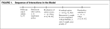
Figure 1 summarizes the model. In the next section, we examine how bureaucratic capacity influences the Bureaucrat's implementation strategy.

BUREAUCRATIC CAPACITY AND POLICY IMPLEMENTATION
In the model, one reason the Politician is harmed by a low capacity Bureaucrat is because of a straightforward efficiency loss. This efficiency loss is simply σ2ω=Ω2/6, which is increasing in Ω. In this section, by examining the Bureaucrat's best response to any statute, we show that bureaucratic capacity has two distinct effects on policymaking in addition to this efficiency effect. On one hand, the best action the Bureaucrat can be induced to take improves for the Politician as bureaucratic capacity increases. In fact, the Politician can often induce a better action from a high-capacity “enemy” Bureaucrat (with an ideal point far from the Politician's) than from a low-capacity “friendly” Bureaucrat (with an ideal point close to the Politician's). On the other hand, a high-capacity Bureaucrat's action is more responsive to his information about the policy environment.4
Bendor and Meirowitz (2004) make a similar point in a model with variable expertise.
The Bureaucrat reacts to a statute by attempting an action, a. He knows that the realization of this effort is a−ω but does not know the value of ω (only that ω∈[−Ω, Ω]). In choosing the optimal a, then, the Bureaucrat must weigh the (potential) costs and benefits of moving a toward his ideal point. Such moves can lead to the benefit of better policy outcomes, but at the cost of possibly being punished for noncompliance.
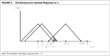
Figure 2 illustrates the Bureaucrat's decision problem given a statute,
, and given an arbitrary level of capacity, Ω, which has a probability density function f(ω). In Figure 2 we assume that the Bureaucrat knows that ε=0. The figure depicts three different actions—a1, a2, and a3—along with the distributions of realizations of these actions, which are denoted by the triangles centered above each action. The attempted action
would ensure compliance with the statute for any possible ω because even if ω=−Ω, the realization of the Bureaucrat's action complies with
. By contrast, by attempting action a2=xB, the Bureaucrat completely ignores the statute by attempting the action at his ideal point. This will often lead to a better policy outcome for the Bureaucrat, but it will also lead to substantial noncompliance. In this example, whenever
, the realization of the Bureaucrat's action will be noncompliant, and if caught in noncompliance (which occurs with probability γ), the Bureaucrat pays a punishment penalty, δ. The probability that the realization of the action at a2 is noncompliant is represented by the area under the triangle centered above a2 that is to the right of
.

Obviously, as the Bureaucrat moves his attempted action from a1 to a2 he obtains a better policy outcome but he increases the probability that the realization of his action will not comply with the statute, and that he is caught and punished. In equilibrium, the Bureaucrat's optimal attempted action equates the marginal policy benefit of moving the action toward his ideal point with the marginal cost associated with being caught in noncompliance with the law, point a3 in Figure 2, for example. It is useful to note that the optimal action will at times result in noncompliance for some realizations of ω.
Note that for some locations of
, the Bureaucrat's optimal response will always be to attempt to implement his most preferred policy. If
, for example, such as
in Figure 2, then the Bureaucrat can attempt his most preferred action without ever risking noncompliance. If
is sufficiently far to the left of xB (relative to the cost of noncompliance, i.e.,
,5
Note that this boundary point implies that the cost of punishment for noncompliance is sufficiently small because we assume in this paper that δγ<Ω2 (see discussion below).
, the Bureaucrat will attempt an action at his ideal point. We can therefore see that as the bureaucratic capacity improves (Ω declines), the range of statutes that result in a=xB+ε increases (i.e., the interval [xB+ε−Ω, xB+ε+Ω] shrinks).
Although a high-capacity Bureaucrat will respond to a wider range of “extreme” statutes by attempting an action at his ideal point, a higher-capacity bureaucrat is also easier to “control” with nonextreme statutes. That is, when
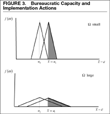
, a higher-capacity Bureaucrat can be induced to take actions that are closer to the Politician's preferred policy than can a low-capacity Bureaucrat. The reason can be seen in Figure 3, which depicts two different levels of bureaucratic capacity, a higher-capacity Bureaucrat in the top plot and a lower-capacity Bureaucrat in the bottom plot.

Given the
depicted in Figure 3, consider the consequences for the Bureaucrat of moving his attempted action from a1 to a2. For both levels of capacity, if the Bureaucrat attempts an action at
, the probability of noncompliance is one-half. For the higher-capacity Bureaucrat depicted in the top plot, attempting an action a2 guarantees full compliance with the statute (i.e., because
for all realizations of ω,
. By contrast, for the low-capacity Bureaucrat depicted in the bottom plot, adopting a2 reduces the risk of noncompliance by much less (i.e., for many realizations of ω,
. Thus, the expected benefit for the low-capacity Bureaucrat of attempting greater compliance with the statute (by moving from a1 to a2) is much less than this expected benefit for the higher-capacity Bureaucrat. The policy loss (when noncompliance does not occur or is not detected) of moving from a1 to a2 is the same for the high-capacity and the low-capacity Bureaucrat, but the low-capacity Bureaucrat is less willing to pay this cost because he reduces the risk of noncompliance much less than does the high-capacity Bureaucrat. Thus, all else equal, the lower-capacity Bureaucrat is harder for the Politician to control. Because the results of the low-capacity Bureaucrat's actions are less sensitive to his efforts, he has less to lose from risking additional noncompliance and thus, for a given statute, will attempt actions that are closer to his preferred policy than will the high-capacity Bureaucrat.
To establish formally the precise location of the Bureaucrat's optimal action, recall that we assume xP<xB,
, and we multiply the quadratic policy utility by one-half. With these assumptions, the Bureaucrat's expected utility of attempting to implement the policy a in response to statute
is given by

The first term in this expression is the expected utility over the range of ω for which a leads to a compliant policy by the Bureaucrat. The second term in this expression is the expected utility over the range of ω's that lead to noncompliant policies. Evaluating the integrals reveals that the expected utility for the Bureaucrat from an action, a, is
, where F(ω) is the cumulative distribution function for ω. Thus, the Bureaucrat's optimal implementation strategy a* solves the first-order condition
.
The first-order condition has a very intuitive interpretation. It says that in equilibrium the marginal utility of increasing the intended action toward xB, xB−a*+ε must equal the marginal increase in the likelihood of punishment
times the penalty δ. Below we refer to xB−a*+ε as the marginal policy benefit and
as the marginal compliance cost of action a. Thus, the key feature that determines how much the Bureaucrat is willing to choose actions far from his ideal point is
, the value of the density of ω at
.
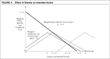
Figure 4 plots the marginal policy benefit curve and the marginal compliance costs for three values of
as a function of a. The marginal benefit line is the thick downward-sloping line. The marginal policy benefit is independent of the location of
and declines as the Bureaucrat's action approaches the Bureaucrat's most preferred action, xB+ε. The marginal cost curves depend on the location of
and are depicted in Figure 4 by the three triangles centered at
,
, and
. Outside these triangles the marginal cost is zero. If
were too high or too low, the marginal costs would be zero at the Bureaucrat's ideal intended action, xB+ε. This would lead the Bureaucrat to choose his ideal action. For nonextreme statutes, the Bureaucrat's best response lies at the intersection of the marginal benefit curve with the relevant marginal cost curve. Given
, for example, the optimal action is a*1. For any a<a*1, the marginal policy benefits of increasing the policy action (toward the Bureaucrat's most preferred) exceed the marginal compliance costs, and for any a>a*1, the reduction in compliance costs of moving the action away from the Bureaucrat's most preferred action exceed the policy losses.

We can see from Figure 4 that the effect of changes in
on the Bureaucrat's best response depends on whether the apex of the “compliance cost” triangle is to the left or right of the policy benefit line (i.e., to the left or right of
in Figure 4). For
,
. In this range, increases in
increase the marginal compliance costs of any
, inducing the Bureaucrat to move a* toward the Politician's ideal point. At
, however, this effect reverses. For
,
, and increases in
decrease the marginal compliance cost of any
, inducing the Bureaucrat to adjust his action closer to his ideal point.
We focus in this paper on the case where Ω2>γδ. This simplifies the analysis by ensuring that the marginal benefit and cost lines intersect only once and guarantees second-order conditions for a maximum hold at that solution. Substantively, this implies that we are focusing\vphantom{
} on cases where the variance in the implementation errors is relatively large compared to the Bureaucrat's expected costs of noncompliance. This restriction is reasonable given our focus on democracies where bureaucratic capacity is limited and the probability of the courts rigorously enforcing statutes is relatively small.
Proposition 1 specifies the best-response function for the Bureaucrat.
Proposition 1. When Ω2>γδ, the following intended actions by the Bureaucrat are optimal given
:
(i) If
, a*=xB+ε.
(ii) If
,
.
(iii) If
,
.
(iv) If
, a*=xB+ε.
Proof. See the Appendix.
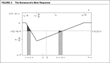
An example of the best-response function of the Bureaucrat to any
is given in Figure 5. The horizontal axis at the top of the figure depicts
, along with the key points in the Bureaucrat's best response as described by Proposition 1. The horizontal axis at the bottom of the figure depicts
, which determines the Bureaucrat's best response in Proposition 1. The vertical axis depicts the Bureaucrats best response, minus the policy shock (i.e., it depicts
.

There are several points to note about the best response. First, as we noted above, extreme statutes induce the Bureaucrat to attempt to implement its most preferred policy a*−ε=xB. This is because the marginal compliance cost is zero for sufficiently high or sufficiently low
.6
For large
, a*−ε=xB is always compliant so the Bureaucrat will choose it. For low
, a*−ε=xB is never compliant and marginal concessions have no impact on compliance, so the Bureaucrat is willing to choose it.
or when
. Thus, the range of statutes for which the Bureaucrat tries to implement his own preferences increases as the Bureaucrat's capacity increases.
Second, the Politician can induce any action a*−ε∈[xB−(δγ/Ω), xB] by adopting intermediate values of
. For
, the Bureaucrat's equilibrium action moves farther from his ideal point as discretion increases (with the specific value of the best response given by part ii of Proposition 1). The Politician obtains a better action by giving more discretion because
when
. As noted in the discussion of Figure 4, when
, the effect of expanding discretion is to increase the marginal compliance cost, which leads the Bureaucrat to make greater concessions from his ideal policy. For
, the Bureaucrat's equilibrium action moves closer to his ideal point as
increases (with the specific value of the best response given by part iii of Proposition 1). The Politician obtains a better action by giving less discretion because
when
. Thus, the effect of increasing discretion lowers the marginal compliance cost, leading the Bureaucrat to move his action away from the Politician's ideal point.
The Bureaucrat's best response, a*−ε, is thus a piecewise, linear function and V-shaped for
. At the bottom point, or lowest inducible policy outcome,
and this leads to a probability of noncompliance equal to 0.5. The Politician, then, can induce any action in the interval a*−ε∈[xB−(δγ/Ω), xB]. If the Politician is relatively distant from the Bureaucrat, or if the Bureaucrat has low capacity (i.e., if xP<xB−(δγ/Ω)+ε), then the best action that the Politician can induce is a*−ε=xB−(δγ/Ω). Because we wish to focus in this paper on cases where Bureaucratic capacity is low, we will concentrate only on cases where the Politician cannot induce his most preferred action (i.e., where xB>(δγ/Ω)).
Third, the Bureaucrat's V-shaped best response is asymmetric, with a steeper downward slope in the first interval than the upward slope in the second interval. This asymmetry can also be seen in Figure 4, where although
and
produce the same action,
is much closer to
than is
. To understand why the Bureaucrat's action is more responsive to changes in
for low values of
than for high values, note that the effect on a* of a change in
can be decomposed into two components. The first-order effect is that increasing
changes the marginal compliance costs, giving the Bureaucrat an incentive to adjust its action. The second-order effect is that the change in the action itself changes the marginal policy benefits and compliance costs, leading to an additional adjustment in a*.7
More technically inclined readers will recognize this intuition as that underlying the implicit function theorem.
is larger, leading to policy choices that are more responsive to the statutes.
If
, the marginal compliance cost is decreasing in a and increasing in
. The first-order effect of increasing
is therefore a decrease in a*. The second-order effect is that the decrease in a* also increases marginal compliance costs further decreasing a*. Because both effects work in the same direction, the intended action is very responsive to
when
. For
, the marginal compliance cost is increasing in a and decreasing in
. Thus, the first-order effect of increasing
is an increase in a*, whereas the second-order effect is increased compliance costs, which depresses a*. Since the first- and second-order effects move in opposite directions, the Bureaucrat is less responsive to changes in the statute.8
This asymmetry in the response function does not depend on our specification of the distribution of ω. It is true for any distribution function that is symmetric and unimodal at zero.
As Proposition 1 and Figure 5 make clear, as the Bureaucrat's ideal point moves away from the Politician's, so too does the best action that the Politician can obtain. Consistent with many theories of delegation, then, when we ignore the impact of bureaucratic capacity, the Politician in our model always prefers a Bureaucrat with an ideal point closer to the Politician's to one with an ideal point farther away. But if we take bureaucratic capacity into account, the Politician may not prefer a Bureaucrat who has preferences similar to the Politician's. Note that the best action the Politician can induce, a*−ε=xB−(δγ/Ω), moves closer to the Politician's ideal point as bureaucratic capacity improves (Ω gets smaller). Thus, when our assumption that xB>(δγ/Ω) is satisfied, in comparing any two Bureaucrats, there is always a level of bureaucratic capacity that will make the Politician prefer the “less friendly” one to the “more friendly” one (in terms of preferences) because the high-capacity Bureaucrat is easier to control.
THE POLITICIAN'S OPTIMAL DELEGATION STRATEGY
We now consider the Politician's optimal statute. First, assume that the Politician has complete policy expertise, corresponding to the case where E=0. From Proposition 1, the best action the Politician can induce is a*−ε=xB−(δγ/Ω), which occurs when
. The more difficult case occurs when the Politician does not know ε (which occurs when E>0). The Politician's goal is to set
so that the Agent's expected response is as close as possible to xB−(δγ/Ω), but policy uncertainty precludes the Politician from doing this effectively.
Return to Figure 5 for an example of how the Politician solves the problem. The Politician wishes to position
so as to maximize his utility over the range of possible ε. If the Politician chooses
, for example, then
, as depicted by the two dashed vertical lines. The expected utility for the Politician from
is represented by the area that is bounded by the dashed lines on each side, the horizontal axis on the bottom, and the best response function on the top. The Politician wants to choose
to minimize this area (and, of course, would maximize her utility if the best response was a flat horizontal line at
.
We can see that
cannot be an equilibrium statute for the Politician. By moving from
to
, for example, the Politician eliminates the outcomes in the shaded area at the left in the diagram and adds the outcomes in the shaded area at the right in the diagram. Because the shaded area at the left is larger than the shaded area at the right (and the Politician wants to minimize the area under the best-response function), the Politician does better adopting
than adopting
.
In equilibrium, the Politician will choose
such that if the Politician moves
in either direction, the expected utility of the policy losses created on the right side of the V in the Bureaucrat's best response is exactly equal to that of the expected losses on the left side of this V. This occurs only when
, as with
in Figure 5.
Note that if the policy uncertainty is so large that E>Ω, there is no unique optimal statute for the Politician. In such cases of extreme uncertainty, the Politician's decision problem in designing her statute is trivial because all she can do is center
so as to ensure that the interval [xB−Ω, xB+Ω] is spanned by
. For this reason, in what follows, we focus on the case where Ω>E, an assumption that is also consistent with our focus on polities with low-capacity bureaucrats.
This intuition about the optimal statute is formalized in Proposition 2, which also states the Politician's expected utility from this statute.
Proposition 2. If
, then

and

Proof. See the Appendix.
The results described in Proposition 2 can be used to explore two substantive issues. On one hand, since the Proposition describes
, it can be used to examine delegation incentives when bureaucratic capacity is low. We explore this issue in the remainder of this section. On the other hand, since it describes the Politician's expected utility from optimal behavior, the Proposition can be used to examine the payoff to the Politician of particular types of political reform, such as improved ex post enforcement (which occurs when δγ increases). We explore this issue in the next section.
The contemporary literature on bureaucratic policymaking has developed a number of standard predictions about delegation to highly competent bureaucracies, as follows.
The uncertainty principle: Politicians should delegate more policymaking autonomy to bureaucrats when politicians are more uncertain about which policy will yield the best outcome.
The ally principle: Politicians should delegate more policymaking autonomy to bureaucrats when politicians and bureaucrats share similar policy preferences.
The monitoring principle: Politicians should delegate more policymaking autonomy to bureaucrats when politicians have more opportunities for ex post monitoring and sanctions.
Our model suggests that neither the ally nor the monitoring principle should hold in polities with low-capacity bureaucrats. Note that an increase in
implies greater policymaking discretion for the Bureaucrat in our model. Direct inspection of
in Proposition 2 shows that the uncertainty principle holds in our model (i.e.,
is increasing in E). However, neither the ally principle nor the monitoring principle holds since
is increasing xB and decreasing in γδ.
The reason the allied principle fails is straightforward. As we have demonstrated, low-capacity bureaucrats are make fewer concessions toward the ideal point of the Politician because the impact of their policy choice on the probability of compliance is low. Thus, low capacity is especially harmful to the Politician when the Bureaucrat has divergent preferences. So how does the Politician mitigate the harm and make the Bureaucrat more responsive? One way is to increase
. This leads to a higher marginal impact of policy choice on compliance for low values of ε and a lower impact for high values. However, as we know from Figure 5, this leads to a sharper increase in concessions for lower values of ε than the decrease in concessions for higher values of ε. Because politicians with divergent preferences value this net increase in concessions the most, they are the most willing to grant additional discretion to bureaucrats.
The mechanism that leads to a violation of the monitoring principle is similar. As ex post enforcement improves, the Bureaucrat will make more concessions to the Politician's preferences due to the increased cost of noncompliance. In particular, these increased concessions are larger for low values of ε than for high values. By reducing discretion, the Politician can transfer some of the gains for low-ε to high-ε states of the world. Thus, effective ex post enforcement creates opportunities for the Politician to use policy details in statutes to induce greater responsiveness by a low-capacity Bureaucrat. This turns the standard monitoring principle from studies of high-capacity bureaucrats on its head. With high-capacity bureaucracies, policy details and ex post enforcement are substitutes for each other, but with low-capacity bureaucracies, they are complements.
Given these findings, our empirical predictions about delegation in developing systems are quite different from those of the advanced democracies for whom the bulk of the empirical knowledge about delegation has originated. Our model clearly suggests that findings consistent with the ally and monitoring principals are contingent on a high bureaucratic capacity and that these principles should be applied to developing systems with a great degree of caution.
POLITICAL REFORM IN POLITIES WITH LOW-CAPACITY BUREAUCRACIES
Proposition 2 states that the Politician's expected utility from adopting
is

We can use the equation to examine how bureaucratic capacity influences the Politician's willingness to pay for different types of institutional reforms. In the Appendix, we define these propositions formally and provide proofs. In what follows, we state the Propositions informally and discuss their intuitions.
Our first proposition concerns the interaction of policy expertise and bureaucratic capacity.
Proposition 3. When bureaucratic capacity is low,
- the Politician's benefit from increasing bureaucratic capacity increases as policy expertise increases, and
- the Politician's benefit from increasing policy expertise decreases as bureaucratic capacity declines.
Proof. See the Appendix for a formal statement of the proposition and its proof.
When politicians are relatively expert (E low), they can optimally choose statutes that capture large concessions from the bureaucrat for most values of ε. For example, in the extreme case of E=0, they can induce the best possible action of a*−ε=xB−(γδ/Ω). Because these concessions get larger as capacity improves, highly informed politicians have strong incentives to increase capacity.
On the other hand, consider the incentives to acquire information when capacity is low. As we have shown, low-capacity bureaucrats tend to bias policy toward their ideal point and the expected policy outcome a*−ε tends to be less responsive to ε. This change in responsive of the expected policy outcome to the policy shock means that politicians are unable to generate substantially more concessions by learning ε. Thus, in systems with low-capacity bureaucrats, politicians are least likely to want to develop policy expertise.
Next consider reforms related to enforcement. In our model, this enforcement, which is typically done by courts but may also be done by politicians themselves, is represented by δγ, the probability that bureaucratic actions that do not comply with a statute are discovered, multiplied by the punishment cost for noncompliance. A country with a judiciary that rigorously enforces statutes will have a large value of δγ. We want to understand how reforms of bureaucracy are related to the quality of the judiciary and how incentives to create strong judiciaries are influenced by bureaucratic capacity. Our main result is summarized in Proposition 4.
Proposition 4. When bureaucratic capacity is low,
- the Politician's benefit from increasing bureaucratic capacity increases as enforcement becomes more effective, and
- the Politician's benefit from increasing the effectiveness of enforcement decreases as bureaucratic capacity declines.
Proof. See the Appendix for a formal statement of the proposition and its proof.
We have noted that the actions of a high-capacity Bureaucrat are more sensitive to the location of statutes. The Politician can therefore best take advantage of a high-capacity Bureaucrat when strong ex post enforcement intensifies the relationship between actions and punishment. But the Politician has the least to gain from improving ex post enforcement when bureaucratic capacity is low. One way to see this is to recall that the best policy the Politician can ever induce the Bureaucrat to take is given by xB−(δγ/Ω). Thus, the Politician can push policy toward its ideal point by improving enforcement (increasing δγ) or by increasing bureaucratic capacity (decreasing Ω). But as the equation makes clear, the benefit of improving enforcement will decline as Ω increases, and the benefit of improving bureaucratic capacity will decline as δγ decreases.
Finally, consider how bureaucratic capacity influences incentives to “politicize” the bureaucracy. Our model speaks to this issue in the following respect. The preferences of bureaucrats are largely determined by the rules and structures that politicians adopt. If the rules and procedures give politicians great latitude to appoint, promote, and dismiss bureaucrats, then we might expect bureaucrats to have preferences that are relatively close to the politicians'. By contrast, if bureaucratic hiring and promotion are largely governed by neutral rules and procedures of administrative law, then we might expect bureaucrats to have preferences that are more divergent from the politicians (at least in comparison to bureaucrats who are chosen by a more politicized process). We can therefore ask how bureaucratic capacity influences the value of having a “politicized” bureaucracy—that is, of having a Bureaucrat with preferences aligned with the Politician.
Our main result is summarized in Proposition 5.
Proposition 5. When bureaucratic capacity is low,
- the Politician's benefit from decreasing policy divergence with the Bureaucrat increases as bureaucratic capacity declines, and
- the Politician's benefit from increasing bureaucratic capacity declines as policy divergence with the Bureaucrat decreases.
Proof. See the Appendix for a formal statement of the proposition and its proof.
Proposition 5 describes another trap that is created by low bureaucratic capacity. When bureaucratic capacity is low, the benefit to the Politician of an “allied” bureaucrat (with policy preferences similar to the Politician's) is greatest. This is because low-capacity bureaucrats bias policy choices so heavily toward their own ideal points. Thus, one way to eliminate those losses of political control is to try to politicize the bureaucracy by moving it to the Politician's ideal point.
But consider how this logic affects the decision of a politician to reform the capacity of an allied bureaucracy. Since a low-capacity ally produces policies close to the Politician's ideal point, there is significantly less reason to engage in capacity enhancing reforms. The Politician's benefit from reforming the bureaucracy (decreasing Ω) declines when xB is close to xP.
CONCLUSION
In any polity governed by the rule of law, bureaucratic behavior during policy implementation is conditioned by the bureaucrats' fear that they could be punished if caught taking actions that the law forbids (or not taking actions that the law requires). This fear is central to a politician's ability to use laws to successfully delegate policymaking authority to bureaucrats. Without it, bureaucrats could ignore the policy goals of politicians, thereby severing any democratic link between citizens and the policymaking process.
Factors that influence bureaucrats' concern about the consequences of noncompliance with legislation therefore have a significant influence on delegation and policymaking. Our analysis identifies one such factor—low bureaucratic capacity—that has received little attention in formal studies of delegation. Our model indicates that low bureaucratic capacity diminishes the ability of politicians to influence the actions of bureaucrats. As bureaucratic capacity declines, bureaucrats recognize that their ability to take actions that comply with legislation also declines, diminishing their incentive to try to do so. Politicians, then, are less able to use legislation to influence bureaucratic actions when bureaucratic capacity is low.
We argue that this diminished ability of politicians to control bureaucrats with low capacity has a significant impact on how we understand delegation and political reform in developing democracies. Our analysis suggests, for example, that when bureaucratic capacity is low, well-established principles in the existing delegation literature no longer operate. In particular, the “monitoring principle” is turned on its head, as is the “ally principle.”
With respect to political reform, we argue that polities with low bureaucratic capacity are caught in a trap. Although politicians always benefit from reforming low-capacity bureaucracies, they will be most willing to pay for such reforms when politicians themselves have technical expertise, and when ex post enforcement is effective. But politicians will be least willing to improve their technical expertise or ex post enforcement when bureaucratic capacity is low. In addition, when bureaucratic capacity is low, politicians have the greatest incentives to politicize the bureaucracy, and this politicization diminishes incentives to improve bureaucratic capacity.
The existence of this trap suggests that “comprehensiveness” is crucial to successful political reform. In studies of political development, scholars often underline the importance of reforming courts to enhance enforcement, or reforming bureaucracies to enhance capacity, or reforming legislatures or executives to enhance technical expertise. Although each of these reforms is valuable, what prior research neglects is the relationship of such reforms to each other. Politicians will have little incentive to enhance bureaucratic capacity if they lack the technical expertise necessary to influence bureaucrats to implement policies that politicians desire or if ex post enforcement is too ineffective to condition bureaucratic behavior. Politicians will have little incentive to improve their own technical expertise if they are delegating to low-capacity bureaucrats who ignore statutory details or if lax enforcement makes the content of statutes largely irrelevant. And politicians will have little incentive to improve enforcement by the judiciary if low bureaucratic capacity diminishes the incentives of bureaucrats to comply with the law in the first place. The benefits of reform in any one area, such as the bureaucracy, then, depend crucially on reforms in other areas, such as the courts.
This argument suggests an avenue for empirical study of political reform in polities with low bureaucratic capacity. Our model suggests that reforms will be most successful when they are comprehensive, with simultaneous efforts focusing on bureaucracies, courts, and politicians themselves. Although such comprehensiveness is a tall order, our argument suggests the contrary as well—reforms that are not comprehensive are likely to fail. Efforts to improve bureaucratic capacity in polities with ineffective enforcement by judiciaries, for example, are likely to flounder and unravel. This need for comprehensiveness, we suspect, may help explain the substantial difficulties polities face as they attempt to develop politically.
Because there has been little effort to model policymaking in polities with low bureaucratic capacity, there is clearly a need to develop additional theoretical models that can further explore the issues raised here. Bureaucratic capacity can be conceptualized in a number of ways, and our analysis focuses narrowly on only one of the possibilities. A particularly interesting issue to introduce would be policy uncertainty by bureaucrats themselves. In addition, our policymaking model is “institution-free,” and it would be useful to consider how the constitutional setting, such as the separation of legislative and executive power, influences delegation to low-capacity bureaucrats. And we have obviously offered a rather reduced-form specification of the factors within bureaucracies that create low capacity. Modeling these factors within bureaucracies explicitly should have a central place in future studies. The further development of such models should significantly improve our understanding of challenges faced in governing those polities that are in the process of political development.
APPENDIX
Proposition 1. The following intended actions by the Bureaucrat are optimal given
:
(v) If
, a*=xB+ε.
(vi) If
.
(vii) If
.
(viii) If
,a*=xB+ε.
Proof. The Bureaucrat's expected utility is

where F(ω) is the cumulative distribution function for ω. Thus, the Bureaucrat's optimal implementation strategy a* solves the first-order condition

Due to the absolute values operator, there are two relevant cases depending on the relationship between a and
.
Case 1.
. In this case the first-order condition becomes
, which implies that
. We can verify that
when
. Because it is dominated strategy for the Bureaucrat to choose an action higher than her ideal action, we must also verify that a*[les ]xB+ε. This is guaranteed by
or
.
Case 2.
. In this case, the first-order condition becomes
, so that
. Similarly to above, we must establish that
. This inequality will hold when
. It can be verified that a*<xB+ε if and only if
.
Proposition 2. If
,
and

Proof. Note that the expected policy outcomes given a choice of
is

From the results of Proposition 1, we can compute
:

Note that because we assume that Ω>(δγ/xB), it must be the case that
so that

Now we claim that since Ω>E,
. Suppose that
or
. We can show that the distribution of utilities generated by these choices is stochastically dominated by a distribution generated by some other choice of
. First, consider
. This generates a utility of −x2B−σ2ω for
and
for
. Now we compare this distribution of utilities to that of
. Note that
. Thus, because ε is distributed uniformly, the distribution of outcomes for
under
is the same as for
under
. However, for
under
,
, which is strictly better than the −x2B−σ2ω for the same width interval under
. Thus, the distribution of utilities under
stochastically dominates the distribution under
. We can show that any
is similarly dominated.
Now consider the Politician's optimization problem, which is to choose
to maximize

The first-order condition is

Note that if
, then
for all ε∈[−E, E], which guarantees that the first-order condition is always negative. Thus, we know that the optimal policy satisfies
. By a similar argument, we can show that optimality also requires
. Combining these conditions with our first claim, the optimal
must satisfy both
and
. Therefore, the first-order condition can be written

Integrating both terms we can rewrite this condition
. Because both squared terms are positive, the only solution is
.
9The second-order condition is
(Ω2+γδ)], which is negative because
and Ω2>γδ.
from

which leads to
. It is easy to check that
satisfies both
and
because Ω2>γδ. Finally, given
, we can compute the politician's expected utility at the optimum as

Proofs of Propositions 3–5. Each of Propositions 3–5 relates to the interaction of Ω with one other substantive variable in our model. Proving the propositions therefore involves (a) examining the first-order partial derivatives of EUP with respect to Ω and with respect to the substantive variable of interest and (b) demonstrating that the cross-partial derivative of these two variables has the correct sign (given the signs of the first order partials). In Proposition 3, for example, we claim that (i) the benefits to the Politician of increasing bureaucratic capacity increase as policy expertise increases, and (ii) the marginal benefits to the Politician of increasing policy expertise decrease as bureaucratic capacity declines. As we show below, (∂EUP/∂Ω)<0. Thus, to show that the benefit to the Politician of increasing bureaucratic capacity increases as policy expertise increases, we need to show that (∂2EUP/∂E∂Ω)>0. By a similar logic, given that (∂EUP/∂E)<0, we again need to establish that (∂2EUP/∂E∂Ω)>0. For Propositions 3–5, we simply establish a sufficient condition on the size of Ω to ensure that the various partial derivatives have the correct sign. In so doing, each of the three propositions takes advantage of Lemma 1.
Lemma 1. For
, (∂EUP/∂Ω)<0.
Proof. From proposition 2,

Note that the first term is clearly negative because Ω>E. The sum of the second and third terms term is negative as long as E(γδ)2(4E−3Ω)<Ω6. Because Ω>E, the left-hand side of this inequality can be no larger than Ω2(γδ)2. Because Ω2>γδ, the inequality holds and the partial derivative is negative.
Proposition 3
Informal Statement
When bureaucratic capacity is low,
- the benefit to the Politician of increasing bureaucratic capacity increases as policy expertise increases, and
- the benefit to the Politician of increasing policy expertise decreases as bureaucratic capacity declines.
Formal Statement
If
, (∂EUP/∂E)<0 and (∂2EUP/∂E∂Ω)>0.
Proof. As noted above, given Lemma 1, both parts of the proposition are true if, for sufficiently low bureaucratic capacity, (∂EUP/∂E)<0 and (∂2EUP/∂E∂Ω)>0. Let
. If Ω [ges ] Ω*, then the Politician's utilities are given by Proposition 2. Thus,

and

Proposition 4
Informal Statement
When bureaucratic capacity is low,
- the benefit of increasing bureaucratic capacity increases as enforcement becomes more effective, and
- the benefit of increasing effectiveness of enforcement decreases as bureaucratic capacity declines.
Formal Statement
For
, ∂EUP/∂(δγ)>0 and ∂2EUP/∂(δγ)∂Ω<0, where
is defined implicitly by
.
Proof. Given Lemma 1, both parts of the proposition are true if, for sufficiently low bureaucratic capacity, ∂EUP/∂(δγ)<0 and ∂2EUP/∂(δγ)∂Ω<0. Note that
because (xBΩ/γδ)>1. Because Γ(E) ≡ −(γδ/3xB)<0 and Γ′>0,
. Therefore, if
, then
so the politician's expected utility is given by Proposition 2. Therefore, the marginal benefit of γδ is then ∂EUP/∂(δγ)=[((2Ω−E)/2Ω2)(xB−(γδ/Ω))(γδE/2Ω3)−(1/3)(E2γδ/Ω4)]. For Ω [ges ] E and Ω>(δγ/xB), this marginal utility must be positive. These conditions are also implied by
.
The cross partial of Ω and γδ is ∂2EUP/∂(δγ)∂Ω=(1/Ω3)[(E−Ω)(xB−(γδ/Ω))+γδ+[(4E−6Ω)/3Ω2]γδE]. This cross partial is negative if Ω−E−(γδ/xB)(2+(4E2/3Ω2)−(3E/Ω)) ≡ Γ(Ω)>0. By definition of
and the fact that Γ′>0, this implies that the cross partial will be negative as long as
.
Proposition 5
Informal Statement
When bureaucratic capacity is low,
- the Politician's benefit from decreasing policy divergence with the Bureaucrat increases as bureaucratic capacity declines, and
- the Politician's benefit from increasing bureaucratic capacity declines as policy divergence with the Bureaucrat decreases.
Formal Statement
If
, (∂EUP/∂xB)<0 and (∂2EUP/∂xB∂Ω)<0.
Proof. Given Lemma 1, to prove both parts of the proposition we need to show that (∂EUP/∂xB)<0 and (∂2EUP/∂xB∂Ω)<0. If
, then the conditions for Proposition 2 hold, implying that (∂EUP/∂xB)=−(xB−(γδ/Ω))−E(γδ/2Ω2)<0 and (∂2EUP/∂xB∂Ω)=−(γδ/Ω2)+E(γδ/Ω3)<0 because E<Ω.
We would like to thank John Carey, David Epstein, David Lewis, and Eric Schickler for comments on early versions of the manuscript. We are also grateful for feedback from participants in seminars at UC—Berkeley and the University of Michigan and from participants in conferences on the Macropolitics of Congress and Brazilian Political Institutions in Comparative Perspective. Huber is grateful to Princeton's University's Center for the Study of Democratic Politics, where he was a visiting fellow during work on this project.
References
Bawn Kathleen.
1995
“Political Control versus Expertise: Congressional Choice About Administration Procedures.”
American Political Science Review
89
(1):
62–
73.Google Scholar
Bendor Jonathan, and
Adam Meirowitz.
2004
“Spatial Models of Delegation.”
American Political Science Review.
98
(2):
293–
310.Google Scholar
Besley Timothy, and
John McLaren.
1993
“Taxes and Bribery: The Role of Wage Incentives.”
Economic Journal
103:
119–
41.Google Scholar
Carpenter Daniel.
2001
The Forging of Bureaucratic Capacity: Reputations, Networks, and Policy Innovation in Executive Agencies, 1862–1928.
Princeton, NJ:
Princeton University Press.
Chang Kelly,
David E. Lewis, and
Nolan McCarty.
2000
“The Tenure of Political Appointees.”
Paper presented at the 2000
American Political Science Association,
Washington, DC.
Epstein David, and
Sharyn O'Halloran.
1999
Delegating Powers.
New York:
Cambridge University Press.
Evans Peter, and
James Rauch.
1999
“Bureaucracy and Growth: A Cross-National Analysis of the Effects of ‘Weberian’ State Structures on Economic Growth.”
American Sociological Review
64:
748–
65.Google Scholar
Geddes Barbara.
1990
“Building ‘State’ Autonomy in Brazil, 1930– 64.”
Comparative Politics
22
(2):
217–
35.Google Scholar
Geddes Barbara.
1994
Politician's Dilemma: Building State Capacity in Latin America.
Berkeley:
University of California Press.
Huber John D., and
Charles Shipan.
2002
Deliberate Discretion? Institutional Foundations of Bureaucratic Autonomy.
New York:
Cambridge University Press.
McCourt Willy, and
Nazar Sola.
1999
“Using Training to Promote Civil Service Reform: A Tanzanian Local Government Case Study.”
Public Administration and Development
19:
63–
75.Google Scholar
McCubbins Mathew D.,
Roger G. Noll, and
Barry R. Weingast.
1987
“Administrative Procedures as Instruments of Political Control.”
Journal of Law, Economics, and Organization
3
(2):
243–
77.Google Scholar
 You have Access
- 228
- Cited by
Comments
No Comments have been published for this article.