

1. INTRODUCTION
Mortgages – that is, loans secured by immovable real estate such as land and buildings – enable people to purchase real estate and to make investments fixed in real estate liquid. These attractive benefits notwithstanding, not all societies have succeeded in establishing well-functioning mortgage markets. Hernando de Soto has pointed out that if a developing economy lacks a system through which ownership of and encumbrances on real estate can be registered, local people will be prevented from accessing mortgage markets beyond the confines of their personal social networks, as they will be unable to provide potential lenders with credible information about a particular piece of real estate.Footnote 1 This constrains economic development and impinges on the well-being of the people. De Soto's interpretation is attractive and has inspired further research but it has also been much criticised.Footnote 2 In this paper we contribute a further perspective to the debate by examining, from a historical perspective, whether the registration of ownership and encumbrances provided a simple and complete solution to the challenge of developing mortgage markets.
To address the issues raised by de Soto we chose to analyse mortgage markets between 1300 and 1800 in the Low Countries (more specifically the provinces Brabant, Flanders and Holland), where there was well-organised registration of who owned which building or parcel of land, and England, where such registration was poorly organised.Footnote 3 English legal authorities and other observers in the seventeenth century were amazed by Holland's booming economy and they widely debated how such success might be emulated in their own country. A recurring theme in their writings was how England would reap great benefits from copying the way the Dutch organised their (financial) institutions. These commentators thought, for instance, that the way in which the Dutch registered real estate transactions facilitated a larger mortgage market.Footnote 4 In the province of Holland (changes in) ownership and encumbrances, such as mortgages, of real estate were recorded in registers kept by the public authorities of the town or village where the real estate was situated. Registration was compulsory and consulting the registers was easy and cheap. It was alleged that in England many profitable opportunities were foregone because the lack of a similar registration system made the process of mortgaging real estate much more complicated.Footnote 5 In 1668 the merchant and politician Josiah Child argued, for instance, that by ‘keeping up Publick Registers of all Lands and Houses, Sould or Mortgaged […] many chargable Law-Suits are prevented [i.e. in the Netherlands], and the securities of Lands and Houses rendred indeed, such as we commonly call them, Real Securities’.Footnote 6 In a similar vein the engineer Andrew Yarranton stressed that the Dutch had ‘fitted themselves with a Publick Register of all their Lands and Houses, whereby it is made Ready Money at all times […]’.Footnote 7
What the observers in seventeenth-century England probably did not realise, however, was that the registration system in Holland had taken a considerable time to evolve and mature, having probably been inspired by systems developed in Brabant, Flanders or elsewhere in northwest Europe. While the earlier systems functioned quite well, they differed significantly from one location to another depending on the strength of the legacy of their medieval institutional structures. The relative lack of such a legacy in Holland enabled its public authorities to establish a fairly effective and uniform system of registers. The strong medieval legacy in England, on the other hand, meant that any system of registers set up was neither uniform nor effective. And, as will be addressed in more detail later, royal attempts at reform were often stymied by those with vested interests in fee revenues who clung to their old registration privileges. The English system that had emerged during the medieval era was much less effective than that in Holland, necessitating specialised and costly legal specialists such as scriveners and attorneys to sift through several registers to establish who owned a particular piece of real estate. While these specialists could collect valuable information, they could not fully rule out the possibility that a vendor did not actually own a piece of real estate, or that it came with encumbrances such as mortgages. Mortgage-backed borrowing therefore only grew in those parts of England where registration systems improved over the course of the eighteenth century. By comparing the evolution of registration systems in the Low Countries with those in England, we argue that it was seldom simple to establish a registration system: considerable periods of time were involved and the systems that eventually emerged were not necessarily effective or efficient.
Registers did not provide a complete solution for those wishing to mortgage real estate either. De Soto failed to address two crucial elements to a successful mortgage transaction: namely mortgage law and the role of financial go-betweens or intermediaries. We will argue that in England pre-industrial mortgage law was much stricter and less favourable to borrowers than it was in the Low Countries and as a consequence most Englishmen only sought a mortgage as a last resort. In addition, even where mortgage law was more conducive to business, those seeking mortgages and those supplying them still had to locate each other. We will therefore also review how this was accomplished and what role the various registration systems played in bringing the various parties together.
Our historical case studies of England and the Low Countries demonstrate that local circumstances determined both whether registration was established and how effective it was. Improving the effectiveness of existing institutions was a long-term process that could easily be delayed by those with vested interests in maintaining the previous arrangements. For a well-functioning mortgage market to emerge, issues such as mortgage law and the role of financial intermediaries also had to be addressed.
2. CONFUSION IN ENGLAND
Seventeenth-century observers such as Child and Yarranton were not the first to propose changes to the English system of registration. The government had actually tried to reduce disorder in the country's contractual law more than a century before in 1535, by reforming, through a Statute of Enrolments, the way in which freeholders could dispose of their land. Previously, the latter had traditionally sold land through private contracts and ‘fines’, a type of fictitious lawsuit heard before royal justices,Footnote 8 but this system made it difficult to establish ownership of – and encumbrances on – a particular piece of real estate at a later date. This was problematic because, according to Christopher Brooks, parcels of land ‘completely free of some kind of encumbrance, or complication, in terms of rights and tenures seem to have been few and far between’.Footnote 9 The Statute of Enrolments sought to remedy these shortcomings by stipulating that all land transactions should henceforth be registered.Footnote 10
The legislation ensuing from the Statute of Enrolments had the key problem that it failed to override the arrangements which had been put in place in medieval times. People could register at one of Westminster's royal courts – Chancery, the Court of Exchequer, the King's Bench, or the Court of Common Pleas – or with the Keeper of the Rolls in the county where the land being sold was located. However, corporations, such as boroughs, and palatine counties that already had their own court of record were exempted by the Statute of Enrolments.Footnote 11 Thus, instead of improving matters, the Statute failed to implement a clear and effective system of land registration in England, while such systems were nearing completion in parts of the Low Countries. In England transactions involving land could be registered in a variety of courts, so ownership and encumbrances remained hard to establish. During the early eighteenth century it was observed that the Statute of 1535 ‘hath been found by Experience to be of little or no use’, particularly as clerks had not been enjoined to store their registers with care and no specific location had been appointed for the drawing-up and safe storage of the documents.Footnote 12
In the absence of an effective registration system, information concerning ownership and encumbrances became a valuable asset. In England some scriveners, laymen who wrote legal documents, specialised in retrieving this information from the records of the various courts.Footnote 13 As discussed below, when mortgage law became more complex, an attorney, who would have received more legal training than a scrivener, took over from the latter. The attorney would have had a more intimate knowledge of the law and the changes that were made to it, putting him in a better position to draft and register deeds that would hold up in court.Footnote 14 Scriveners and attorneys thus helped to untangle a vendor's legal position but this increased transaction costs and still could not fully rule out the possibility that the vendor did not actually own a parcel of land, or that the land came with encumbrances. It is therefore not surprising that concerned parties in England looked abroad for alternative, effective systems allowing the ownership of – and encumbrances on – real estate to be registered.
Several reasons explain why the English took inspiration from the Dutch Republic. As a near neighbour with a booming economy and developed financial institutions the Republic must certainly have made an attractive model,Footnote 15 particularly as, unlike most other parts of pre-industrial Europe, it had a well-functioning system for the registering of real estate transactions and encumbrances.Footnote 16 It is not surprising that the simplicity of the registration system in the Republic, where there were no overlapping jurisdictions, amazed English observers such as Yarranton: transactions in Groningen, he had to explain to his English audience, were only registered in Groningen. If living in Amsterdam, but interested in buying some land in Groningen, one only had to send a letter to the latter to establish information about ownership and encumbrances on the plot one was interested in.Footnote 17 The following sections discuss the registration system in Holland which so fascinated the English and explore how it was used by both lenders and borrowers active in the mortgage market.
3. THE EVOLUTION OF REGISTRATION IN HOLLAND
Holland's sale registration system developed during the middle ages but was not fully established until 1542. The physical characteristics of the Dutch landscape, and the way the land was taken into occupation, played a central role in this process. Inland Holland was marshy and uninhabitable until the land reclamations organised by the ruling counts between the tenth and fourteenth centuries. Faced by a largely untouched wilderness, the counts offered personal freedom, the right to own land, and the right of self-government to anyone willing to reclaim and settle it. In return, settlers had to acknowledge the count as their lord and pay him taxes. Thus, although medieval social structures did exist in the older settlements along the coast and rivers, they played a relatively unimportant role in most of Holland, and gradually any remaining feudal layers were removed from society. Certainly by 1500, and probably much earlier, most of Holland consisted of urban and rural jurisdictions governed by their inhabitants. Each town and village functioned as an independent public body, each with its own law court.Footnote 18
Public law courts in Holland consisted of a sheriff, who organised court days, and representatives of the local community, called ‘aldermen’ or ‘neighbours’, acted as judges. These courts became established as the most important authority for the ratification of transfers involving real estate, as they verified whether each transaction complied with the law, which could either be in writing or customary law. Once the verification had been undertaken the court officials would conclude the transaction by sealing or signing the contract of sale.Footnote 19 The earliest evidence of the presence of such courts comes from Holland's major towns: Delft (where the court was first mentioned in 1260), Dordrecht (1269), Leiden (1293) and Haarlem (1295).Footnote 20 The law courts occupied a central position in conflict resolution because anyone disputing ownership of a parcel of land, a lease contract or a mortgage had to file a complaint with them. The origins of this practice lie in the thirteenth century, but Count William V strengthened the position of the courts in 1351 when he forbade noblemen and clerics from settling disputes.Footnote 21 It was possible to appeal over the sentences by public law courts. This could be done at regional courts of appeal, which were organised by bailiffs, and where regional nobles acted as judges. However, these would only pass judgement on a dispute related to real estate if a litigant appealed against the judgment of a local law court.Footnote 22 However, as the local courts preferred, and indeed gave priority to, contracts they had ratified themselves over those ratified by other authorities, parties drawing up contracts gradually stopped consulting other authorities altogether. Although local ratification was only made mandatory by Charles V in 1529, by that date voluntary ratification by local law courts had long been common in Holland.Footnote 23
The sale registration system was fully established in 1542 when the recording in a register by the local authority of a summary of each ratified contract of sale of a piece of real estate was also made mandatory.Footnote 24 Preserved registers from Dordrecht (from as early as 1405), Gouda (1465) and Haarlem (1471) show that law courts had started to register such transactions well before the 1542 legislation was put in place.Footnote 25 A 1475 bylaw from the small town of Schiedam indicates that mortgages were recorded in a register there too, but as soon as the mortgage was paid off, the entry was crossed out.Footnote 26 A system of registration of sales of land also developed in Holland's rural areas, starting up first in the south of the province. An early register, dating from around 1470, survives for Ouderkerk aan den IJssel and the bailiff in the region of Land van Putten ordered village law courts to register land transactions on penalty of a fine in 1479: annuities or renten, larger long-term loans which were secured on real estate, were to be registered every seven years, and any unregistered annuities would cease to be legally enforceable.Footnote 27 Over the course of the sixteenth century evidence mounts that registration was being practised in rural villages, and by the 1560s, on the eve of the Dutch Revolt it is clear that registration had become common in such areas.
Eventually, the number of transactions in Holland's urban areas reached a threshold, which meant that administrative improvements were necessary. The government of Haarlem, for instance, introduced separate registers for sales of real estate, annuities, and debts that had a ship or ships as collateral. Around the mid-sixteenth century the town had six different registers documenting transactions of real estate and various types of credit.Footnote 28 The authorities attempted to make the use of registers easier by constructing indices to them. Leiden's government, for example, instructed its secretaries to ‘use their time, once in a while, to create indices for the books and registers they kept’.Footnote 29
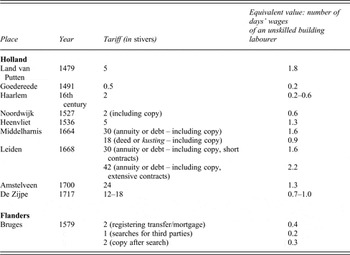
The province's representative body, the States of Holland, ensured that the registration of transactions was inexpensive for the parties involved, decreeing in 1580 that all transactions related to real estate which had occurred since 1572, and for which no proper registers were yet available, should be registered for one groat, a sum worth less than one day's wage for an unskilled labourer.Footnote 30 A similar tariff is encountered in a 1562 edict to the secretaries of the town of Haarlem which declared that: ‘to prevent all fraud they should keep a register of all sealed ratifications, in order to be able to look these up at any time. They should receive for registration one stiver on top of the usual earnings’.Footnote 31Table 1 shows that tariffs for registration varied across space and time, but that they were generally low. In the fifteenth and sixteenth centuries the charge was usually less than one guilder and in the seventeenth and eighteenth centuries usually less than two guilders, a fraction of the sums that regularly changed hands in the real estate markets.Footnote 32
Tariffs for the registration transactions related to real estate in Holland (1479–1717) and Flanders 1579

Sources: Land van Putten: M. S. Pols, ‘Oudste rechten van het Land van Putten’, Verslagen en Mededeelingen van de vereniging tot uitgave der bronnen van het Oude Vaderlandsche Recht 1 (1885), 122–61, here 158–9; Goedereede: M. S. Pols ed., ‘De rechten der stad Goedereede’, Verslagen en Mededeelingen van de vereniging tot uitgave der bronnen van het Oude Vaderlandsche Recht 2 (1886), 288–357, here 310; Haarlem: J. G. C. Joosting ed., ‘Haarlemsche dingtalen’, Verslagen en Mededeelingen van de vereniging tot uitgave der bronnen van het Oude Vaderlandsche Recht 2 (1886), 620–39, here 634–5; Noordwijk: Regionaal Archief Leiden, Gemeente Noordwijk (entry number 900), inv. nr. 115; Heenvliet: M. S. Pols ed., ‘De keuren van Heenvliet van 1536’, Verslagen en Mededeelingen van de vereniging tot uitgave der bronnen van het Oude Vaderlandsche Recht 1 (1882), 210–23, here 221; Middelharnis: Lijste van't salaris voor balliu, schout, leenmannen, schepenen, secretaris ende boode van Middelharnisse (Delft, 1664); Leiden: F. van Mieris ed., Handvesten, privilegiën, octroyen, rechten en vryheden… (Leiden, 1759), 239–48; Amstelveen: Reglement, waar na den officier, secretaris en andere bedienden in de heerlykheid van Amsterveen, haar in't stuk van hare vacatien en salarissen voortaan zullen hebben te reguleeren (Amsterdam, 1700), 21; De Zijpe: Octroyen, privilegiën ende keuren: mitsgaders de ordonnantie van de weeskamer en vierschaar van Oude-Zijpe en Hase-polder (Alkmaar, 1717); Bruges: L. Gilliodts-van Severen, Coutumes des pays et comté de Flandre. Quartier de Bruges, Tome second: Coutumes de la ville de Bruges (Bruxelles, 1875), 426–32; equivalent value in wages: L. Noordegraaf, Hollands welvaren? Levensstandaard in Holland, 1450–1650 (Bergen, 1985), 73; J. de Vries and A. van der Woude, The first modern economy: success, failure, and perserverance of the Dutch economy, 1500–1815 (Cambridge, 1997), 610–11; E. Scholliers, ‘Lonen te Brugge en in het Brugse Vrije (XVe–XVIIe eeuw)’, in C. Verlinden, ed., Dokumenten voor de geschiedenis van prijzen en lonen in Vlaanderen en Brabant II (Bruges, 1959–1973), 87–160.
4. REGISTRATION AND MORTGAGE MARKETS IN HOLLAND
By the sixteenth century, as we have seen, a comprehensive registration system was in place in Holland. Public courts used the extensive registers for reference, as did private individuals, who had to pay a small fee for the privilege.Footnote 33 In Amsterdam in 1644 registers were accessible to ‘anyone with a certain interest [in a piece of real estate, who] would be granted access to the aforementioned register under supervision of the secretary’.Footnote 34 It is clear from sources dating from 1700 for the village of Amstelveen that access to the registers amounted to a public service. The village secretary would receive 1 guilder 4 stivers, equivalent to 1.2 days’ wages for an unskilled labourer, ‘for opening the registers and looking up any annuities’ or other types of mortgage and for making a copy of the relevant entry.Footnote 35 The secretary would also receive ‘for opening and looking up in the registers for any encumbrances 6 stivers’ or 0.3 of a day's wage for an unskilled labourer.Footnote 36
As it was mandatory for any transfers of real estate, or for any loans secured on real estate, to be registered, ownership and encumbrances could easily be established. Letters sent by Jacoba Catharina van Schoonhoven, a rich widow living in The Hague, to her financial advisor in Rotterdam during the 1760s, show that lenders seriously considered the information that they, directly or indirectly, obtained from the registers. In one letter Van Schoonhoven wrote that she had been assured that she would be the first to be given a mortgage on a specific piece of real estate. In another letter she informed her advisor that a house offered as collateral by a potential borrower had already been encumbered with other mortgages.Footnote 37 Whether she had obtained this information from the borrower or after consultation of the registers is not clear, but other examples suggest that the registers must have been consulted regularly. In a proxy deed, signed by a notary in Amsterdam, for instance, Simon van Hoegaarden and his wife Johanna van der Borst authorised broker Arnout de l'Hommel to record a loan before Amsterdam's aldermen. They had borrowed 4,500 guilders and were offering a piece of real estate located in the Kalverstraat as collateral. It is clear, however, that they not only expected l'Hommel to record the loan details, but also to consult the registers in order to prove to their lender that no prior encumbrances existed. The borrowers ‘agreed the registers to be consulted at their costs on behalf of the said Mr. Professor Röell [the lender], to increase his security, to verify whether the house and its land had been encumbered’.Footnote 38
Similar examples are also available for less prominent parts of the Dutch Republic. In 1778, Joris Lammers, a merchant from the town of Culemborg in the centre of the Republic, authorised the secretary of nearby Beusichem and Zoelmond through a notarial deed to make enquiries about a parcel of land on the island of Texel, in the far north of the country. The secretary was to contact his counterpart on the polder of Hoornenburg, or whoever had the relevant information, to verify whether a particular part of the polder was indeed owned by one Huybert van Ee, who had offered it for sale. Lammers was particularly concerned that the relevant piece of land had been mortgaged for a sum worth 80,000 guilders. According to the vendor this sum had already been repaid, but Lammers wanted to be sure that the repayment had indeed been recorded in the register or ‘protocolle’ by the authorities. He therefore asked for a ‘copy or extract authentique’ of the transactions to be delivered.Footnote 39 Such deeds were always called upon to provide an up-to-date assessment of encumbrances.
The fact that textbooks designed for notaries contained examples of standard forms to be filled in when conducting searches of the registers provides further confirmation of how regularly lenders and borrowers asked to consult the registers. Jacob Schoolhouder's textbook for notaries, Oeffenschool voor de notarissen (1727), provides a good example of this. The author, an experienced notary, explained to future notaries where to obtain information about real estate in a certain locality, how to contact the secretary, and what kind of certification to ask for.Footnote 40 According to Schoolhouder the secretary should certify that he had ‘[…] consulted and searched through [the] local register and [had] not found, nor [did not] know, that this parcel of land (or house and yard) […] belonging to […] has been encumbered with any dues or mortgages on behalf of a certain individual’.Footnote 41
The registration system in Holland was thus easy to use, effective and efficient. In both urban areas and in the countryside, local law courts had the sole authority to ratify real estate transactions. The registers they compiled facilitated the mortgage market in two ways. First, potential lenders could consult the registers to collect crucial information about the ownership of a particular piece of real estate, such as whether the individual seeking a loan would be its sole owner. The lender did not always have to seek this information, as during the process of ratifying the sale, the public courts would also verify whether the vendor or the mortgagor was the rightful and sole owner. Second, when real estate was used as collateral for a loan, public courts would also verify whether it was of sufficient value to secure the debt by establishing its net value, by subtracting the worth of preferential claims and existing encumbrances from the worth of the real estate concerned.Footnote 42 The available evidence suggests that the registers were consulted frequently.
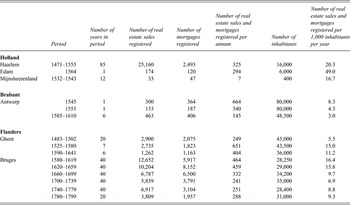
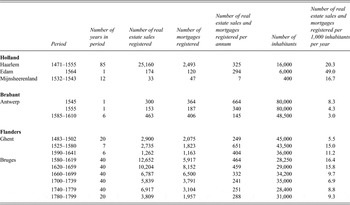
All of this allowed the market in mortgages to spread beyond the confines imposed when lenders and borrowers relied on their private networks of contacts. By the sixteenth century urban public courts usually recorded several hundreds of transactions per annum and kept records concerning the ownership of many thousands of pieces of real estate, in addition to details of any mortgages put on the latter. Such records were kept not only in cities such as Haarlem, but also in small towns and even in villages. This becomes evident when we examine Table 2, providing the number of land sales and mortgages per annum for several towns in Holland, as well as the small town Edam, where on average 294 sales of land and mortgages were registered per year, and the village Mijnsheerenland, where this figure was seven. To put these figures in perspective, Table 2 also gives the number of real estate sales and mortgages registered per 1,000 inhabitants per year, demonstrating widespread use of such registers in towns and villages.
Number of transactions registered in selected towns and villages in Holland, Brabant and Flanders: fifteenth to eighteenth centuries
Sources: Haarlem: C. J. Zuijderduijn, ‘Conjunctuur in laatmiddeleeuws Haarlem: Schepenregisters als bron voor de ontwikkeling van een Hollandse stad’, Holland Historisch Tijdschrift 40 (2008), 3–17; Edam: J. L. van Zanden, J. Zuijderduijn and T. de Moor, ‘Small is beautiful: the efficiency of credit markets in sixteenth-century Holland’, European Review of Economic History 16 (2012), 3–23; Mijnsheerenland: L. Helms van Eis ed., ‘Register ende protocol van eijgen- ende rentbrieve van Moerkercken, ingaende anno XVc XXXII ende eindigende metten jare 1552’, Ons voorgeslacht 37 (1982), 97–123, and Ons voorgeslacht 40 (1985), 143–55, 349–70; Antwerp: H. Soly, ‘De schepenregisters als bron voor de conjunctuurgeschiedenis van Zuid- en Noordnederlandse steden in het Ancien Régime. Een concreet voorbeeld: de Antwerpse immobiliënmarkt in de 16de eeuw’, Tijdschrift voor Geschiedenis 87 (1974), 521–44; L. Meulenaere, ‘De verhandeling van onroerende goederen te Antwerpen, 1585–1595’ (unpublished M.A. thesis, University of Ghent, 1973); J. Jaspers, ‘De verhandeling van onroerende goederen te Antwerpen (1600–1610)’ (unpublished M.A. thesis, University of Ghent, 1973); Ghent: M. Boone, M. Dumon and B. Reusens, Immobiliënmarkt, fiscaliteit en sociale ongelijkheid te Gent 1483–1503 (Kortrijk, 1981); J. Dambruyne, Mensen en centen: het 16de-eeuwse Gent in demografisch en economisch perspectief (Ghent, 2001), 130, 156; J. Dambruyne, ‘De Gentse immobiliënmarkt en de economische trend, 1590–1640’, Bijdragen en mededelingen betreffende de geschiedenis der Nederlanden 104 (1989), 157–83; Bruges: H. Deneweth, ‘Huizen en mensen: wonen, verbouwen, investeren en lenen in drie Brugse wijken van de late middeleeuwen tot de negentiende eeuw’ (unpublished Ph.D. thesis, Free University of Brussels, 2008).
5. MEDIEVAL LEGACIES IN FLANDERS AND BRABANT
To understand the difficulties inherent in the creation of public registers we will now turn to consider Flanders and Brabant where such registers emerged earlier than in Holland. These regions did not develop one comprehensive registration system, however, because their ancient social and legal structures proved resilient to change. They did, however, develop different registration systems that functioned well at the local or regional level and served similar general purposes everywhere: accurate registration of ownership and encumbrances.
The registration practices which developed in Flanders and Brabant differed from those in Holland in two respects. First, the earlier economic development and urbanisation experienced by these two provinces led to their law courts being established before those in Holland. Before the twelfth century, written contracts were limited to the imperial and papal courts and were not common in urban contexts in the southern Netherlands. Contracts were predominantly oral and as such were usually confirmed in the presence of qualified witnesses such as members of the clergy or the urban patriciate, including the aldermen. The latter gradually gained in importance because they acquired greater competences in respect to criminal and civil justice and voluntary jurisdiction. Early traces of their activities can be observed in Nivelles (in documents from 1075), Bruges (1094), Ypres (1111), Liège (1113), Louvain (1131), Antwerp (c.1146), Ghent (1147), Brussels (1155) and Lille (1177).Footnote 43
As a result of commercial growth in the twelfth century, testimonial proof that was presented verbally lost ground to written contracts. Private individuals applied to aldermen's courts, feudal courts and ecclesiastical courts to have their contracts drawn up and ratified. Early private contracts passed before the aldermen were found in Ghent (from 1147), Tournai (1160), Ypres (1206), Bruges (1211), Brussels (1234) and Antwerp (1239).Footnote 44 During the first half of the thirteenth century aldermen's courts became the dominant courts as far as the ratification of contracts related to real estate in both urban and rural areas was concerned. If no court was available locally people travelled to the nearest town to have their contract ratified. From the fourteenth century onwards, for reasons of safety and control, each court preserved duplicate copies of the contracts it had processed in specially designated chests, a practice which can be traced back to the German Empire, where, in thirteenth-century Cologne, the city government stored copies of contracts in a wooden box.Footnote 45 The German tradition of registering private contracts in Grundbücher and Erdbücher (land registers) may also have inspired the aldermen of Flanders and Brabant to introduce registers where all contracts related to real estate could be registered chronologically.Footnote 46
Second, registration practices in Flanders and Brabant were less uniform than in Holland because they developed gradually and in a less coordinated manner. Despite the fact that the medieval county of Flanders was originally part of the kingdom of France and the duchy of Brabant belonged to the German Empire, they had each copied the best legal and administrative practices from each other before the Burgundian unification of the later middle ages, as the early existence of aldermen's registers with chronological entries of all ratified contracts attests. Still, local registration systems within the two provinces may have differed from each other because they had to be integrated into the existing feudal or urban institutional contexts. Two examples will clarify this. The first example relates to the city of Ghent in the county of Flanders which witnessed early urbanisation within a feudal context. As settlements developed in the domain of the Count of Flanders, and in those of other landlords, private individuals gradually received the right to construct their houses on land which the Count or the landlord owned, as long as they paid a ground rent (landcijns) for the use of the land occupied. New mortgages were only possible on the surplus value of the house over the value of the land. In case of insolvency of the house owner, the original landowner or his descendants would always maintain priority claims over additional creditors. Since Jan van Namen proclaimed in 1302 that existing ground rents could not be adjusted to real land prices anymore, they gradually evolved into minor encumbrances compared with the sharply rising housing prices. In the city of Ghent the ground rent remained important and played a key role in the way the registration of real estate transactions was organised until the end of the early modern period. Although real estate transfers and mortgage contracts were originally drawn up and ratified by the town's aldermen, landowners in Ghent wanted to be aware of sales and mortgages involving the houses built on their land, since their ground rent had priority over all mortgages. Therefore, a system developed in which sales and mortgages were registered by each landlord.Footnote 47 Ghent's customary law, the local medieval rules and practices that evolved into a coherent legal system, was first published in 1563 and confirmed that any knowledge on ownership and mortgages held by a landlord superseded any knowledge held by the aldermen. As such, the latter performed a less important role in the registration of contracts relating to real estate than their colleagues in other cities did. As a consequence of this and because of the rise of notaries during the sixteenth century, more and more individuals preferred their family notaries for drawing up formal contracts instead of the aldermen and in 1679 the magistrate abolished the aldermen's registers altogether. Knowledge of ownership and existing mortgages thus became private information within this setting, but the necessary details could at least be found within the landlords’ registers and for a small fee extracts could be provided ‘for those involved’.Footnote 48 The system in Ghent was transparent in that any sales contracts were contained in the registers compiled by each landlord. In addition, tax registers which surveyed all properties within the city also provided details of housing values within the town, including a reference to the landlord responsible for the land on which each building stood.Footnote 49
The second example relates to the city of Bruges, also situated in the county of Flanders, where the urban authorities also established a central registration system. There were two main differences from the system in Ghent, however. First, when Bruges expanded into the domains of different landlords during the thirteenth century, the town authorities decided to buy up these lands and bring them under the jurisdiction of the urban area.Footnote 50 Only the feudal court of the Bourg of Bruges and the ecclesiastical court of the Proosse retained authority over some minor enclaves (less than 5 per cent of the total land area) until the end of the eighteenth century. Both institutions had their own customary law and systems of ratification and registration.Footnote 51 Second, when Bruges developed into a major international commercial centre, the distinction between ‘house’ and ‘land’, as it existed in Ghent, was removed and in 1302 the ground rent evolved into a simple encumbrance on each house. Although landowners retained their priority claims in case of insolvency of the house owner, house ownership was deemed more important for registration than land ownership. This facilitated the development of a central registration system for the whole of the town, rather than one fragmented between landlords. Although there was some disjuncture between the city and the two remaining jurisdictions, the town's central registers, which ran from 1580 to 1800, recorded all real estate on a house-by-house basis. Entries for the houses and land situated in the enclaves were cross-referenced to the registers of the other jurisdictions. It was easy to consult the different registers covering Bruges as all three administrations were housed around the same square in the city. Like their counterparts in Holland the system of registers in Bruges was effective as the registers were kept well and could be searched easily.
The main incentive for people to register their real estate transfers was to secure ownership. Only at the end of the middle ages, when financial instruments and services had become more diverse and mortgage loans could be repaid more quickly, did urban administrations open additional registers in order to track the encumbrances on each piece of real estate. At the end of the fifteenth century, Bruges had tried to establish a separate registration system for annuities on a street-level basis, but this system failed to flourish, probably because it had no direct link to the registration of ownership. The registers van de zestendelen, which functioned from 1580 to 1800, were more successful. This registration system was organised on plot level and contained summaries of contracts, including both transfers and mortgages, for each building or piece of land. Only those contracts that had been passed before the urban clerks and ratified by the aldermen could be registered. Notaries therefore never became as important in Bruges as they did in Ghent and the aldermen ratified all contracts related to real estate until the end of the eighteenth century in Bruges.Footnote 52 Antwerp in Brabant, which emerged as the new commercial gateway to Europe during the sixteenth century, developed a similar system based on the Wyckboeken in its charter of 1582. To prevent fraud related to an underestimation of mortgages, all individuals were held responsible for the correct citation of annuities and other forms of mortgage debt when registering their sales contracts in Antwerp. Those who failed to provide the correct information were prosecuted in the criminal court. Town secretaries were responsible for verifying ownership and existing encumbrances before they ratified new sales contracts and mortgages. Extracts from the registers were provided for a small fee. Bruges and Antwerp, the two main commercial cities in Flanders and Brabant, each with an active financial market, thus developed registration systems that clearly inspired the later system operating in Holland. A key difference, however, was that customary law limited access to the registers in the southern Netherlands to parties who were directly involved in any transaction relating to real estate.Footnote 53
Although registration systems differed within and between cities, each of them seems to have been effective at the local level. It is difficult to establish, however, how often lenders asked for information concerning ownership or encumbrances, although there is sufficient evidence to suggest that this was common practice. Hubert Nélis cites a certificate issued by the aldermen of Nivelles as early as 1209 which proved that the ownership of a piece of land in Lathuit had been inherited.Footnote 54 Both seventeenth- and eighteenth-century handbooks for notaries and guidelines for urban administrators mention the drawing up of certificates of ownership (attestaties) as one of the practices that notaries and clerks had to undertake: they give advice on how to look up the necessary information and deliver a written, signed certificate. The offices of the urban administrations were open to the public on specific days and at particular hours so that parties directly involved in a transaction could be provided with whatever information they were seeking.Footnote 55 In addition, preserved correspondence demonstrates that there was also intense communication between clerks and notaries working in different villages and cities, trying to link demand and supply for mortgage loans and seeking information on ownership and encumbrances on behalf of their clients.Footnote 56
A comprehensive system of ownership registration and the continuous monitoring of encumbrances were necessary to ensure that loans were secure and to allow mortgage markets to expand. Contrary to de Soto's arguments, however, the cases of medieval Flanders and Brabant demonstrate that because different jurisdictions overlapped it was far from easy to develop these basic elements, even on the local level. Furthermore, even though Holland, with its less complex institutional setting, succeeded in transplanting previous ‘best practices’ more or less intact, it then took decades to perfect them further. Thus, while observers in seventeenth-century England were optimistic about the results of copying institutions from Holland, success was far from guaranteed.
6. REFORMING REGISTRATION IN ENGLAND
The first effective register in England, in the West Riding of Yorkshire, was not established until 1703. The preamble to the Act of Parliament that established it argued the need for a register in terms similar to those of Child and Yarranton: ‘Whereas the West Riding of the County of York is the principal Place in the North for the Cloth Manufacture and most of the Traders therein are Freeholders and have frequent Occasions to borrow Money upon their Estates for managing their said Trade but for want of a Register [they] find it difficult to give Security to the Satisfaction of the Money-Lenders (although the Security they offer be really good) by Means whereof the said Trade is very much obstructed and many Families ruined […].’Footnote 57
Notwithstanding these arguments proposals for an Act of Parliament had been unsuccessful in 1701 and 1702 and in 1703 the Clerks of Enrolment of the Court of Chancery opposed the setting up of a register in the West Riding. Although the Clerks of Enrolment did not carry their argument, similar interest groups elsewhere had greater success, managing to protect their privileges and obstructing the introduction of new registers, as demonstrated by the failure of applications for local registers by the counties of Berkshire, the East Riding of Yorkshire, Huntingdon, Middlesex, Surrey and Wiltshire. Only the East Riding of Yorkshire, Middlesex and the North Riding of Yorkshire subsequently managed to make successful applications, in 1707, 1708 and 1735, respectively. In Berkshire and Surrey opposition to the bill came from boroughs that already had their own Court of Record. The cities of London and York were not included in the Acts covering Middlesex and Yorkshire, as they too already had the necessary courts. In addition, more than a dozen bills calling for a national register failed to pass through the House of Commons.Footnote 58
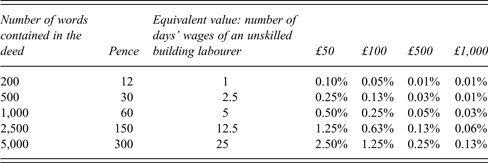
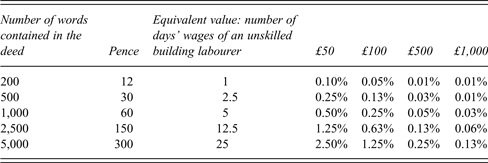
While vested interests thus hindered the introduction of more effective registers, the Act applying to the West Riding shows how the shortcomings of existing registers could be remedied. The West Riding's new register was to be kept in a public office in Wakefield, as this was ‘the nearest Market Town to the Centre or Middle of the said West Riding’, and the office had to be open between 9 am and noon and 2 and 5 pm on all days except Sundays and holidays. These stipulations show that the national government was concerned with the ease with which the register could be accessed. The fees for registering a deed were also specified in the Act: for a deed of up to 200 words 1 shilling was to be charged and each additional 100 words would cost 6 pence. As the relationship between the length of a deed and the value of the underlying transaction is unknown, Table 3 reconstructs the relative costs of registering a set of deeds with hypothetical lengths and values. Registering a deed of 2,500 words cost 150 pence or 12.5 days’ wages of an unskilled labourer. In relative terms this weighed more heavily on an underlying transaction of £100 (0.63%) than it did on an underlying transaction of £500 (0.13%). As longer deeds were probably associated with higher underlying values, however, the relative costs of registering a deed can be thought quite modest.Footnote 59
Relative costs of registering a deed of hypothetical length and underlying value in the West Riding of Yorkshire, England, as set in 1703 (expressed as a percentage of the underlying transaction's value)
Source: Based on 2 & 3 Anne, c. 4 (1703); D. Woodward, Men at work: labourers and building craftsmen in the towns of northern England, 1450–1750 (Cambridge, 1995), 275.
Searches of the registers could be made for 1 shilling – a building worker's wage for a day's work – and copies of deeds could be ordered on payment of the same rates as applied when making an entry in the register.Footnote 60 Searches should have been relatively easy as the register was supposed to contain an alphabetical index of place names with cross-references to the number of the deed and the names of the parties involved. In reality, however, the indices were not always properly compiled. Since any transaction which was agreed upon after 29 September 1704 but not recorded in the register was to be considered both fraudulent and void, people had an incentive to ensure that they recorded all relevant West Riding transactions in its register. Failure to register was consequently low and this greatly enhanced the register's usefulness as a tool to prove ownership and the presence of encumbrances such as mortgages.Footnote 61
7. MORTGAGE LAW
Whereas well-functioning registration systems were an important and necessary condition to allow a well-functioning mortgage market to develop, they were not, on their own, a sufficient condition. Both lenders and borrowers also had to find the mortgage laws sufficiently favourable to make it worth their while actually engaging in transactions. In this respect further major differences existed between England and the Low Countries: while mortgage law in the Low Countries protected the interests of both lenders and borrowers, this was not the case in England. As long as they did not default on their mortgage (re)payments, borrowers in the Low Countries not only retained full use of their real estate but also remained in full ownership of it.Footnote 62 In England, however, one way of securing a loan was to convey the real estate to the lender upon the signing of a mortgage. Although such contracts included a promise of re-conveyance once the loan was repaid, ownership remained with the lender upon any default, no matter how small. Owners of real estate therefore preferred to raise their capital through more expensive leases, which resembled mortgages as tenants made large lease payments or fines up front.Footnote 63 Robert Allen has consequently argued that mortgage law was a ‘major impediment’ to more productive agriculture in England.Footnote 64
While mortgage law was, at first sight, less strict in the Low Countries, registered mortgages did leave the lender in a strong position if a borrower defaulted on his (re)payments. In theory the entry in the register obviated the need for any legal proceedings and allowed the mortgaged real estate to be auctioned publicly to recover the money lost. In practice the public courts usually mediated between a defaulting borrower and the lender, negotiating an instalment plan which would allow the former time to repay his debts, while acknowledging the claim of the latter. If it came to an auction, a lender could participate, although he would not necessarily be the highest bidder and become the owner of the real estate used as loan collateral. Instead, the proceeds from the auction, minus any transaction costs, were used to compensate all registered lenders in the order in which the mortgages had been registered. The borrower then received what remained, but faced claims on his ‘person and goods’ if this amount was insufficient to repay all the lenders. Thus while mortgage law in the Low Countries could be flexible, it was also strict towards defaulting borrowers, making it more conducive for use in a wider market.Footnote 65
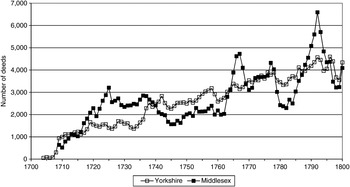
Lawmakers did become aware of the negative characteristics of English mortgage law and started to change it from the late sixteenth century onwards. The right of redemption that developed during the first half of the seventeenth century, for instance, enabled a defaulter to reclaim his real estate after he had repaid the principal, any interest and costs. This strengthened the position of borrowers when they could not honour agreements to the letter and made them more willing to mortgage their real estate. Changes in foreclosure procedures brought them more in line with those in the Low Countries and further enhanced the position of borrowers who were to receive the surplus, if any, yielded by a forced sale.Footnote 66 These institutional changes, and England's economic development, resulted in the mortgaging of real estate becoming increasingly popular during the latter half of the seventeenth century. Whereas only about 2.5 per cent of the value of real estate was mortgaged around 1660, by the 1690s this had increased to about 8 per cent. By the early twentieth century over 27 per cent of real estate was mortgaged.Footnote 67Figure 1 shows that where registers were established registration quickly became popular and the number of registered deeds continued to increase during the eighteenth century.Footnote 68 One reason for this must undoubtedly have been the fact that as information about ownership and encumbrances became more secure, borrowing became cheaper. Even in 1830 it was claimed, for instance, that interest rates in Yorkshire were one-fourth to one-half of a percentage point lower than in Lincolnshire because of Yorkshire's registers.Footnote 69 While it is difficult to distinguish the importance of institutional changes from increased demand for mortgages, it is hard to imagine that England would have enjoyed the economic growth it experienced without the changes in registration and mortgage laws.Footnote 70
Number of deeds entered annually in the registers established in Yorkshire and Middlesex, England, 1700–1800. Source: F. Sheppard, V. Belcher and P. Cottrell, ‘The Middlesex and Yorkshire deeds registries and the study of building fluctuations’, London Journal 5 (1979), 176–217, here 209–12.

8. FINANCIAL INTERMEDIARIES
Although effective registers and a mortgage law that was attractive to both lenders and borrowers were important for stimulating the development of mortgage markets, they could not guarantee successful transactions. While some borrowers may have been familiar to wealth holders willing to lend them money, others would have depended on intermediaries to introduce them to lenders. The historical evidence for England and the Low Countries corroborates the fact that intermediaries did indeed provide a valuable service to at least some of the individuals wishing to enter the mortgage market.
As writers and legal specialists, English scriveners and attorneys were ideally situated to function as intermediaries within the mortgage market.Footnote 71 Attorneys, for instance, were not only involved in litigation but also functioned as estate stewards and trustees and they served on the boards of institutions and companies. The information that they thus acquired about which of their clients had financial surpluses and whether they were prepared to offer loans allowed them to point borrowers towards suitable lenders. The literature has documented these types of activities in regions such as Lincolnshire, but most is known about Lancashire and Yorkshire.Footnote 72 Letters to and from attorneys in these counties demonstrate how their business operated. One client was informed, for example, that before a potential lender could be contacted he, the client, had to specify the size of the loan he sought and provide as much detail as possible about the collateral he could offer. If an attorney could not always succeed in indentifying a suitable potential lender from amongst his own clients, however, there were several mechanisms whereby he might find an alternative. First, attorneys corresponded with each other, seeking or suggesting a lender for a borrower, or vice versa. Opportunities could also be discussed when they attended various court meetings. Second, some attorneys in Lancashire and Yorkshire corresponded with bankers and attorneys in London. Such relationships were convenient not only for gaining access to courts in the capital and to the Stock Exchange, but also to the country's largest pool of potential lenders. Third, if no match could be identified through these legal and economic networks, the attorneys were able to resort to advertisements in newspapers as a means of contacting members of the general public who might be in a position to provide the necessary finance.
In the Low Countries notaries functioned as intermediaries on the mortgage market. Like scriveners and attorneys in England, notaries obtained information about local wealth holders as they wrote all kinds of financial and finance-related documents. It would, therefore, not be unlikely for a borrower seeking someone to provide a mortgage to approach a notary to act as an intermediary. Cash-strapped buyers of real estate, who would have just recorded their purchase with the notary, were a special group of borrowers because the party selling real estate did not demand immediate payment, giving the buyer several weeks in which to get his finance together. In late-medieval Holland a period of six to eight weeks was usual and in early modern Amsterdam a six-week period was common. This gave the buyers, or the notaries, sufficient time to locate a lender.Footnote 73 Jacoba Catharina van Schoonhoven could thus write to her financial advisor stating that she had been asked to supply ‘a mortgage on a house which the cloth merchant La Faille has purchased for seventeen thousand guilders’.Footnote 74 Since any mortgage negotiated had to be recorded in the local register, and not in the deeds drawn up by the notary, it is unfortunately hard to document how often notaries acted as intermediaries in the northern Netherlands. Van Schoonhoven's correspondence suggests, however, that they often acted in this capacity.Footnote 75 The same holds true for notaries in Ghent, who conducted much active correspondence in order to locate both lenders and borrowers.Footnote 76
Through their commercial and financial dealings brokers on financial and goods markets, just like notaries, were able to acquire information about potential lenders. As in the case of notaries, however, it is difficult to quantify brokers’ activities, but qualitative evidence once again supports the belief that they acted as intermediaries. In Amsterdam, for instance, tariff lists specified the rates that brokers could charge for brokering a mortgage.Footnote 77 In documents detailing the loans that were recorded before Amsterdam's aldermen during the eighteenth century, brokers also regularly appeared as proxies for borrowers.Footnote 78 The notarial deeds that authorised a broker to act as a proxy did not make his role explicit, but it must have been that of intermediary in the negotiation of a loan because otherwise a borrower could just as well have authorised the notary or his clerk to undertake the task. It is likely, therefore, that registering loans before the aldermen was part of brokers’ intermediary services.Footnote 79
We have argued above that during the pre-industrial period part of the mortgage market in England and the Low Countries depended on financial intermediaries and that the registration system in place influenced who could function in such a capacity. In England, information could only be retrieved from the registers by legal specialists, and it was they who could subsequently branch out as financial intermediaries. In the Low Countries, there was no link between those who could search the registers and those who could bring borrowers and lenders together. As a register could be consulted easily for a small fee, specialised searchers were not required to retrieve the information they contained.Footnote 80 So while legal specialists, such as notaries, could act as intermediaries, many others, such as brokers, could also bring lenders together with borrowers.Footnote 81 Whether the evolution of an effective registration system influenced intermediaries’ possibilities for developing economies of scale or reduced their opportunities for rent-seeking (i.e. the ability to charge excessive fees), however, still needs further research. It therefore remains unclear whether the registration system in England or those in the Low Countries performed better when it came to locating the finance for a mortgage.
9. CONCLUSION
This paper sought to contribute to the debate, initiated by de Soto, over the relationship between registration of ownership of and encumbrances on real estate and the development of mortgage markets, by examining whether registration really offers a simple and complete explanation for the rise of well-functioning mortgage markets. Our case studies from the Low Countries confirm that good registration was available in what were arguably the most advanced mortgage markets of the pre-industrial period. Registers enabled borrowers to present credible information to lenders about the ownership of real estate and the encumbrances attached to it. This allowed real estate owners and those purchasing real estate to acquire funding from beyond their personal social and business networks.
Setting up a system of registers was, however, a far from simple task as there were no ready-to-use blueprints. Our case studies have shown that it took various urban and regional rulers several centuries to fine-tune their local registration systems, a process which was strongly influenced by the local legacy of medieval real estate ownership. These medieval roots, and the vested interests that they had created, exerted a long-term influence on the financial and economic possibilities of each region. The English case perhaps illustrates this best, but also shows that in England it was eventually possible to change institutions that were deemed to be hampering economic development.
While the registration of ownership and encumbrances was necessary for the emergence of larger mortgage markets, it was not the only prerequisite. Our case studies show that inappropriate mortgage laws could impede the development of a wide-scale mortgage market. Only when conditions in the law were sufficiently attractive to both lenders and borrowers did they enter the market. Even when good registers were present and the mortgage laws were favourable, lenders and borrowers could still fail to identify each other, however. Intermediaries could overcome such information asymmetries, but their ability to function successfully depended on the workings of the registration system in the region in which they operated.
We would argue, therefore, that although de Soto championed the role of registers, they were insufficient on their own to account for the flourishing of broad mortgage markets. The establishment of a registration system was a complex process with long-term consequences and this should serve as a warning for present-day policymakers, encouraging them to adapt any future registration systems to the exact needs of the financial markets that they are designed to support.
ACKNOWLEDGEMENTS
The authors would like to thank William Baer, seminar participants at both the University of Antwerp and the University of Cambridge, and the editors and anonymous referees for valuable comments and suggestions.