Introduction
Deficits in social functioning are common and prominent in schizophrenia spectrum disorders, and they often serve as predictors of outcome.Reference Brissos, Molodynski, Dias and Figueira 1 Impairment in social functioning in schizophrenia is best defined by social isolation and withdrawal, both aspects playing very important roles in the clinical profile of the disorder. Interpersonal functioning in schizophrenia remains essentially unexplored and awaits systematic investigation.Reference Hooley 2 Targeting, therefore, proximal domains of social functioning has lately become front-line treatment for the illness.Reference Roberts and Velligan 3 Social cognition is a broad, multifaceted construct that refers to the mental processes that underlie interpersonal functioning and offers great conceptual proximity to social functioning.Reference Adolphs 4 , Reference Couture, Penn and Roberts 5 Social cognition is one of the 7 domains of the National Institute of Mental Health (NIMH)-sponsored Measurement and Treatment Research to Improve Cognition in Schizophrenia (MATRICS) battery, which involves 5 areas: theory of mind (ToM), emotion processing, social perception, social knowledge, and social attribution.Reference Green, Nuechterlein and Gold 6 , Reference Green, Penn and Bentall 7 Empirical evidence has shown that social cognition is significantly impaired in individuals with schizophrenia, and is a better predictor of poor functional outcomes than symptoms and neurocognitive deficits.Reference Bora, Yucel and Pantelis 8 , Reference Lam, Raine and Lee 9
Mentalization
Bateman and FoganyReference Bateman and Fonagy 10 defined mentalization as the capacity to conceive conscious and unconscious mental states in oneself and others. It is the person’s ability to think about and reflect on personal experiences—to formulate interpretations about their own and others’ behavior. Mentalization is a multidimensional construct that incorporates 3 dimensions: implicit and explicit mode of functioning, self/other-oriented mentalization, and cognitive/affective mentalization.Reference Fonagy, Bateman and Bateman 11 Mentalization deficits have been established in schizophreniaReference Fretland, Andersson, Sundet, Andreassen, Melle and Vaskinn 12 as well as in other psychiatric and neurologic disorders, such as autism spectrum disorders,Reference O’Nions, Sebastian, McCrory, Chantiluke, Happé and Viding 13 mood disorders,Reference Hoertnagl and Hofer 14 frontotemporal dementia,Reference Henry, Phillips and von Hippel 15 and severe traumatic brain injury.Reference Robinson, Fountain-Zaragoza and Dennis 16
Theory of Mind (ToM)
ToM is often used interchangeably with the term mentalization, but offers greater explanatory value as it provides the basis of the mentalization process. The term ToM refers to the cognitive ability to attribute mental states to self and others, as well as understanding the link between mental states and action.Reference Premack and Woodruff 17 ToM and emotion perception are considered to be the most important processes for social behavior. Although there is a conceptual overlap between the two constructs, emotion perception is a low-level perceptual process that precedes ToM, whereas the latter requires higher-level processing.Reference Mitchell and Phillips 18 This impressive human ability has an important social function: it allows us to navigate the personal and social world by explaining past behavior, and anticipating and predicting future actions. This review focuses on research findings related to the construct of ToM and critically presents current methods of ToM assessment and treatment, both pharmacological and psychosocial, using data retrieved from MEDLINE/PubMed, the Cochrane Database of Systematic Reviews, and the ClinicalTrials.gov databases.
Processes of ToM
Implicit and explicit ToM
Dual process theorists claim that there are 2 kinds of social mentalizing that work independently of one another and are served by exclusive neural networks: implicit (ie, fast and automatic) and explicit (ie, slow and controlled) ToM.Reference Strack and Deutsch 19 This claim is not, however, supported by empirical findings. A meta-analysis of 200 studies suggested that implicit and explicit ToM share the same early timing and the same core brain areas.Reference Van Overwalle 20 In addition, implicit processes may provide a quick default judgment to an assessment, which may later be either accepted or rejected by explicit reasoning.Reference Evans 21 Schneider et al Reference Schneider, Nott and Dux 22 found that implicit mentalizing occurs in an uncontrollable and unintentional manner. Furthermore, implicit ToM appears to rely heavily on visual attention, and patients with schizophrenia are less likely to focus on the faces of others. ToM deficits in schizophrenia could, thus, be explained at least partly by impaired attention toward gaze orientation.Reference Roux, Forgeot d’Arc, Passerieux and Ramus 23
Self and other referential processing
Perspective taking is the ability to see the world from another person’s point of view. As such, it relies heavily on ToM abilities in order to understand other peoples’ mental states, which may be different from one’s own. It requires an implicit understanding of the behavior of others, while the person is still able to maintain a coherent sense of self to allow for self–other discrimination.Reference Ebisch and Gallese 24 Deficits in perspective taking have long been considered central to both autism and schizophrenia.Reference Abu-Akel, Wood, Hansen and Apperly 25 In schizophrenia, the disrupted sense of self–other discrimination may result from malfunction of multisensory integration at the level of the ventral premotor cortex, which prevents a person from being able to control or switch between neural representations attributed to the self and to other people.Reference Sowden and Shah 26
Affective and cognitive ToM
Shamay-Tsoory et al Reference Shamay-Tsoory, Shur, Barcai-Goodman, Medlovich, Harari and Levkovitz 27 proposed the existence of cognitive and affective aspects of ToM. The cognitive construct involves inferring the mental states of other people, and the effectiveness of the actions controlled by this aspect are correlated to the functioning of cognitive abilities. On the other hand, the affective aspect involves the recognition of emotions based on facial expressions and movements. There seems to be an overlapping relationship between the affective process of ToM and emotion perception.Reference Schlaffke, Lissek and Lenz 28 Findings from neuroimaging studies have shown some common identified regions, such as the medial prefrontal cortex and the temporal lobe areas. The main differences between them emerge from the perceptual, cognitive, and emotional demands of each process, where emotion perception is regarded as a low-level perceptual process necessary to decode affective cues, while ToM is usually seen as a higher-level cognitive process involving mental state deduction.Reference Bodden, Kübler and Knake 29 Cognitive ToM appears to involve the precuneus and cuneus, as well as regions in the temporal lobes bilaterally, whereas affective ToM involves the prefrontal cortical area and smaller regions in the posterior cingulate cortex and the basal ganglia.Reference Leisman, Braun-Benjamin and Melillo 30 The involvement of the basal ganglia in affective ToM could provide a motor control component that is known to influence reward learning and cognitive and reason functioning.Reference Gopnik 31 , Reference Forbes, Poore and Barbey 32
Theories of ToM
The theories to account for the development of ToM are grouped into 3 major categories: theory-theory, simulation theory, and modularity theory.
Theory-theory
The term “theory-theory” postulates that knowledge about the mind derives from a kind of theory by which people try to predict and explain behavior in terms of its causation by beliefs, intentions, emotions, and traits of character.Reference Forbes, Cameron and Grafman 33 In line with the theory-theory, conceptual change occurs during development, and that should be reflected in the brain. However, conceptual change at a neural level is difficult to examine. During infancy and early childhood, mentalizing takes an implicit form, such that information processing is spontaneous, automatic, and inaccessible to control and consciousness, whereas from late childhood onward, processing requires awareness, introspection, and control.Reference Evans 21 Based on the notion that implicit and explicit mentalizing are 2 distinct cognitive processes, some studies have found that the amygdala and the orbitofrontal cortex are linked to implicit social processes, and that the dorsolateral prefrontal cortex plays an important role in explicit social processes.Reference Siegel, Donner and Engel 34 , Reference Ma, Vandekerckhove, Van Overwalle, Seurinck and Fias 35 Nevertheless, a growing body of evidence has shown that there is a neural interaction between these social cognitive processes, and that this interaction has been associated with more effective cognitive performances.Reference Mahy, Voigt, Ballhausen, Schnitzspahn, Ellis and Kliegel 36 In addition, the neural interactions involved during social cognitive processes are moderated by several genetic polymorphisms, such as those in brain-derived neurotrophic factor (BDNF), catechol-O-methyltransferase (COMT), and serotonin transporter genes.Reference Siegel, Donner and Engel 34 A recent trend emerging from imaging studies is a common mentalizing neural network that is more prone to the content of a certain inference rather than the nature of the inference (ie, implicit or explicit).Reference Uddin, Molnar-Szakacs, Zaidel and Iacoboni 37
Simulation theory (ST)
Increasing attention has been given to an alternative account of mentalizing known as simulation theory (ST). It describes the ability to take the perspective of another person. ST relies on direct access to the individual’s psychological states in order to make mental state attributions. ST suggests that people first inhibit their own perspectives to be able to infer about other peoples’ perspectives. The problem may arise when self-inhibition fails and the simulated states are excessively influenced by egocentric tendencies. Deficits in perspective taking have long been considered central to schizophrenia.Reference Abu-Akel, Wood, Hansen and Apperly 25 According to ST, certain neural systems are responsible for imaginative processes during childhood, and these become more efficient during development.Reference Mahy, Voigt, Ballhausen, Schnitzspahn, Ellis and Kliegel 36 Empirical data from studies utilizing different neuroimaging techniques have shown 2 major neural systems that are involved in mentalizing: the cortical midline structures and the mirror neuron system.Reference Uddin, Molnar-Szakacs, Zaidel and Iacoboni 37 The mirror neuron system has been suggested as a deficient system underlying impairment of ToM in schizophrenia.Reference Mehta, Thirthalli, Basavaraju, Gangadhar and Pascual-Leone 38 Nevertheless, others have argued that a more abstract neural mentalizing network may be necessary to efficiently process inner states.Reference Suttrup, Keysers and Thioux 39
Modularity theory
Modularity theory postulates that ToM development is driven by an innate neural mechanism dedicated to mental state reasoning. Although experience may be important in triggering this mechanism, it cannot revise the mechanism’s basic nature.Reference Leslie, Friedman and German 40 A particular brain region or a brain network would need to be consistently activated whenever individuals engage in mental state reasoning throughout their lifespan. More specifically, certain brain regions, such as the medial prefrontal cortex, the bilateral middle temporal gyrus, and the bilateral temporoparietal junction, respond selectively to ToM input.Reference van Veluw and Chance 41 , Reference Schurz, Radua, Aichhorn, Richlan and Perner 42 The absence of robust neuroimaging evidence, however, does not allow for fully distinguishing between theories of ToM, and therefore further research is needed to investigate how ToM develops in the brain.Reference Mahy, Voigt, Ballhausen, Schnitzspahn, Ellis and Kliegel 36
Other Theories of ToM
Executive functions
It has been argued that information about mental states is processed entirely by executive functions (ie, higher-order cognitive processes, such as planning, shifting, and coordination of actions), and therefore, operation of implicit ToM is controlled by executive resources.Reference Hardy-Bayle, Passerieux, Claudel, Olivier and Chevalier 43 Bailey and HenryReference Bailey and Henry 44 examined the hypothesis that in order to take the perspective of another person, the self-perspective must first be inhibited, and as such, executive function failures may contribute to the ToM difficulties that have been observed in schizophrenia. The authors found that schizophrenia patients displayed impairment in ToM; however, this was not related to self-perspective inhibition but to another form of perspective taking.
Inflammation
Alterations in peripheral cytokines have been shown to play a role in the pathophysiology of schizophrenia, and therefore, inflammation could be held responsible for the impairment in social cognition processes.Reference Möller, Swanepoel and Harvey 45 The effects of acute peripheral inflammation on ToM abilities has been investigated in a double-blind, randomized, crossover functional magnetic resonance imaging (fMRI) study with healthy participants who were either injected with bacterial lipopolysaccharide or saline.Reference Kullmann, Grigoleit and Wolf 46 Findings showed that ToM performance was not worsened by acute inflammatory response, but it was linked to increased activation in relevant ToM brain regions. Similarly, Moieni et al Reference Moieni, Irwin, Jevtic, Breen and Eisenberger 47 examined whether exposure to an experimental inflammatory challenge (ie, inflammatory-induced conditions via endotoxin) led to changes in ToM. Healthy participants were randomly assigned to receive either endotoxin or placebo, and then they complete the Reading the Mind in the Eyes test at baseline and at the peak of inflammatory response for the endotoxin group. Findings showed that the endotoxin group performed lower in ToM task compared to controls, indicating that inflammation can lead to impairment in inferring mental states.
Method of Assessment
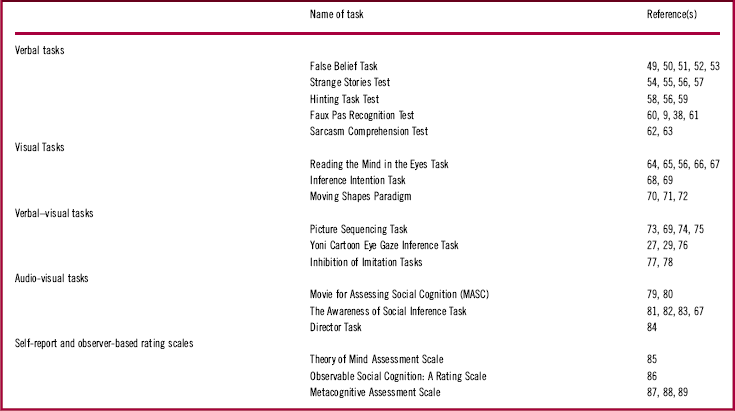
Given the significance of ToM to social functioning, it is important that valid and reliable measures are utilized in clinical research. However, current measures often display methodological problems with lack of established psychometric properties.Reference Bora, Yucel and Pantelis 8 In addition, several ToM tasks have been criticized for their low ecological validity.Reference Couture and Penn 48 Finally, many aspects and/or components should be taken into account when measuring ToM (.., implicit/explicit form of reasoning, cognitive/affective process, self or others’ mental states), as they may not be relevant in all clinical conditions or experimental purposes. See Table 1 for a list of methods of assessment for ToM.
Methods of assessment of theory of mind

Theory of Mind in Schizophrenia
Many studies that tried to evaluate the role of social cognition and mentalization in schizophrenia have focused on investigating ToM. The impaired ability of schizophrenia patients to evaluate and predict other people’s mental states and/or their own is a well-established deficit in schizophrenia that might explain some aspects of the patients’ social dysfunction and poor social outcomes.Reference Sprong, Schothorst, Vos, Hox and Van Engeland 90 The question arises: can mentalizing deficits in schizophrenia be considered a trait associated with the illness, or are they a state dependent on symptomatic exacerbation? Although some data support the notion that ToM deficits are heightened in acute phases of the illness, several lines of research have yielded evidence suggesting that the deficit is a trait.
State approach
Deficits in ToM (failure to monitor our own and other peoples’ mental states and behaviors) may contribute to the positive and negative symptoms as well as social dysfunction in schizophrenia. For instance, schizophrenia patients, instead of taking beliefs as subjective representations of reality, often equate their representations with reality and may therefore experience difficulty at distinguishing between subjectivity and objectivity. They thus maintain false beliefs in the form of delusional convictions. Furthermore, failing to detect other people’s social signals and intentions may lead to a breakdown of communication and eventually social isolation. Patients with psychotic symptoms may be aware of other people’s mental states, but as they fail to use contextual information, they may be unable to make correct inferences about what these mental states are. They may, however, still be capable of compensating for their impaired ToM by using intelligence when not under pressure.Reference Pickup and Frith 91 Moreover, patients with prominent negative symptoms exhibit the most impaired ToM, as they lack the capacity to represent mental states. Finally, patients whose symptoms are in remission and patients with passivity symptoms are predicted to have normal mentalizing abilities. Recent findings from patients with schizophrenia and matched controls showed that alterations in social interaction in patients with schizophrenia are related to oscillatory brain activity, suggesting maladjustment of expectation when patients face social and nonsocial agents.Reference Billeke, Armijo and Castillo 92 Such alterations are related to psychotic symptoms and could guide further therapies for improving social functioning in patients with schizophrenia.
The relationship between clinical symptoms and ToM deficits was evaluated in patients with schizophrenia or schizoaffective disorder, and showed that overmentalizing was weakly associated with positive symptoms but disorganised symptoms were related to undermentalizing.Reference Fretland, Andersson, Sundet, Andreassen, Melle and Vaskinn 12 Another study showed that negative symptoms in schizophrenia were associated with lack of ToM, whereas positive symptoms were associated with “overmentalizing.”Reference Montag, Dziobek and Richter 80 Moreover, a study in first episode psychosis (FEP) patients reported that metacognitive impairments of FEP were significantly correlated with greater negative symptoms and poorer functioning.Reference Macbeth, Gumley and Schwannauer 93 Lincoln et al Reference Lincoln, Mehl, Kesting and Rief 94 examined the hypothesis that social cognitive processes, including ToM, are involved in the formation and maintenance of negative symptoms in schizophrenia, and showed that impairment in ToM abilities was significantly associated with negative symptoms even after controlling for neurocognition and depression, but only in patients with lower self-esteem. These findings provide further support to the concept that the level of perceived criticism from family members can predict both the presence and the severity of negative symptoms.
Moreover, ToM ability in FEP patients was significantly related to the presence of positive symptoms but not alexithymia and empathy, and neurocognitive deficits appeared to have a moderate effect on ToM performance.Reference Koelkebeck, Pedersen, Suslow, Kueppers, Arolt and Ohrmann 95 Another studyReference Mizrahi, Korostil, Starkstein, Zipursky and Kapur 96 examined ToM ability and its relationship to symptoms in patients with psychosis, and found that schizophrenia patients exhibited impairment in ToM that was significantly associated with prominent negative but not with positive symptoms. Furthermore, the association between clinical symptoms and ToM abilities was examined in patients with schizophrenia, patients with affective disorder, and healthy controls.Reference Marjoram, Gardner, Burns, Miller, Lawrie and Johnstone 97 Individuals with high levels of delusions and hallucinations performed significantly worse on ToM tasks, regardless of diagnosis, implying that ToM impairment is not exclusive to schizophrenia.
Trait approach
The trait approach suggests that ToM deficits exist prior to the onset of schizophrenia, and therefore the extent of ToM impairment depends on the level of abnormal development of ToM. Empirical evidence derived from comparison studies, studies of individuals with high risk of developing schizophrenia, family members of schizophrenia patients, and patients with FEP suggests that ToM is a trait of schizophrenia.
Comparison studies
The relationship between ToM, symptoms, and neurocognitive deficits was investigated in recent-onset, stabilized, schizophrenia patients compared to matched, healthy controls at baseline and after 6 months.Reference Ventura, Ered and Gretchen-Doorly 98 Schizophrenia patients scored significantly lower in ToM, and impairment in mentalizing was evident and stable in remitted patients as well. Moreover, ToM was significantly correlated with neurocognition, negative symptoms, and role functioning. The authors suggested that ToM possibly influences negative symptoms, which in turn impacts role functioning. Ioannidi et al Reference Ioannidi, Konstantakopoulos and Ploumpidis 99 compared the level of ToM capacity in schizophrenia vs euthymic bipolar disorder patients. Schizophrenia patients exhibited impairment in both affective and cognitive ToM, but bipolar patients showed a specific deficit only in the cognitive domain of ToM. When the association of positive symptoms and ToM abilities was examined, patients with nonremitted schizophrenia were shown to perform significantly worse than patients with remitted schizophrenia and healthy controls.Reference Wang, Roberts, Xu, Cao, Yan and Jiang 52 It was, therefore, suggested that deficits in ToM might be state-dependent. In addition, schizophrenia patients were more impaired in social cognition tasks, whereas bipolar patients showed greater deficits in neurocognitive performance.Reference Lee, Altshuler, Glahn, Miklowitz, Ochsner and Green 100 These results suggested that these two cognitive domains might play different roles in schizophrenia and bipolar disorder. Interestingly, ToM impairments in schizophrenia patients may be also detected during the remission phase of the disease.Reference Herold, Tényi, Lénárd and Trixler 101
Clinical high-risk (CHR) individuals
Data from individuals at CHR for psychosis and healthy controls showed that individuals at CHR exhibited significant impairments in all domains of social cognition compared with healthy controls.Reference Lee, Hong, Shin and Kwon 102 Moreover, in higher order theory of mind tasks, performance of CHR individuals did not seem to differ from the worse performance of patients with schizophrenia.Reference Stanford, Messinger, Malaspina and Corcoran 103
Familial high risk
Several studies have examined deficits in ToM as potential biomarkers of vulnerability to psychosis in unaffected relatives. Moreover, the social consequences of ToM deficits in schizophrenia patients are thought to create further vulnerability for individuals at familial high risk. Cella et al Reference Cella, Hamid, Butt and Wykes 104 examined deficits in several aspects of social cognition including ToM in healthy siblings of schizophrenia patients, and found that siblings performed significantly worse in ToM tasks as well as in executive function, speed of processing, and IQ tests compared to healthy individuals, suggesting that ToM may be associated with a genetic vulnerability for schizophrenia. Similarly, Ho et al Reference Ho, Lui and Hung 76 found more impaired ToM in patients with FEP and unaffected siblings compared to healthy controls.Reference Castelli, Happé, Frith and Frith 70 Imaging studies found that individuals at familial high risk demonstrated less neural activity in bilateral temporoparietal junction than controls, and the degree of deficit was related to day-to-day social functioning.Reference Dodell-Feder, DeLisi and Hooker 105 Montag et al Reference Montag, Neuhaus and Lehmann 106 examined ToM ability in unaffected first-degree relatives of schizophrenia patients vs healthy controls and found subtle impairment in the cognitive but not the affective aspects of ToM in the relatives’ group.
The extent to which deficits in ToM are shared by unaffected first-degree relatives and the nature of this relationship was explored in schizophrenia patients, unaffected first-degree relatives, and healthy subjects who underwent several tasks of social cognition including ToM measurements.Reference de Achával, Costanzo and Villarreal 107 Results revealed that schizophrenia patients and first-degree relatives showed similar impairment in mentalizing, but nonidentical patterns of social cognition processing, as relatives showed deficits in emotion processing, but patients with schizophrenia did not. Cassetta and GoghariReference Cassetta and Goghari 82 examined ToM ability in terms of sarcasm comprehension in schizophrenia patients, their first-degree relatives and controls and reported that schizophrenia patients demonstrated impairments in sarcasm comprehension but relatives and controls had intact comprehension.
First episode psychosis (FEP)
The differences in social cognition, including ToM and metacognitive abilities, were investigated in FEP patients, patients with prolonged psychosis, patients with substance use disorder, and healthy controls.Reference Vohs, Lysaker and Francis 108 Data analysis revealed that both psychotic groups performed similarly and worse in social cognition tasks when compared to controls. Metacognitive capabilities were, however, more impaired in FEP compared to prolonged psychosis. Bora and PantelisReference Bora and Pantelis 109 conducted a meta-analysis to investigate ToM as a vulnerability marker of schizophrenia. Data on ToM performance from individuals with FEP, individuals at ultra-high risk of psychosis (UHR), and unaffected relatives were compared to healthy controls. Analysis showed that ToM was substantially impaired in FEP, with a smaller effect size in UHR and unaffected relatives.
Schizotypy
Schizotypy is multidimensional trait organization that reflects psychosis-like symptoms and individual psychosis-proneness. One study recruited college students who undertook a comic strips functional imaging task to examine ToM and empathy.Reference Wang, Liu and Li 110 Results showed that negative schizotypy was related to impairment in ToM as demonstrated by brain activity in regions typically involved in social cognition, such as the middle temporal gyrus and the medial prefrontal gyrus. Another study evaluated ToM abilities in 3 psychometrically identified schizotypes: only positive schizotypy (eg, perceptual distortions), negative schizotypy (eg, social anhedonia), and both positive and negative.Reference Pflum, Gooding and White 111 Results revealed that individuals with elevated positive schizotypy scores experience more difficulty inferring the meaning of others’ mental states than negative schizotypy.
The Relationship Between the Neural Network of ToM and Schizophrenia
The neural basis of ToM in healthy adults is well documented and mainly involves disruption of neural activity in the medial prefrontal cortex (MPFC) and the right and left temporoparietal junctions (RTPJ/LTPJ).Reference Molenberghs, Johnson, Henry and Mattingley 112 Imaging studies have also identified the MPFC and the TPJ as prominent sites of abnormality in schizophrenia.Reference Pomarol-Clotet, Canales-Rodríguez and Salvador 113 , Reference Jimenez, Lee and Wynn 114 Such findings suggest an overlap in neural networks between ToM and schizophrenia. Indeed, when Dodell-Feder et al Reference Dodell-Feder, Tully, Lincoln and Hooker 115 examined, using fMRI, the neural basis of ToM in relation to social functioning and anhedonia in 20 individuals with schizophrenia and schizoaffective disorder and compared them to 18 healthy controls, they found that schizophrenia patients exhibited reduced neural activity in the MPFC in relation to matched controls. Reduction of neural activity in MPFC was associated with impairment in social functioning and social cognitive ability. Similarly, Lee et al Reference Lee, Quintana, Nori and Green 51 examined the neural network of 14 patients with schizophrenia and 14 matched healthy controls using fMRI during a ToM task, and found significantly less activation in the bilateral TPJ and right medial prefrontal cortex in individuals with schizophrenia compared to controls.
Relationship Between Neurocognitive Deficits and Mentalization in Schizophrenia
Cognitive deficits have been considered to be a core symptom of schizophrenia.Reference Berry, Bucci, Kinderman, Emsley and Corcoran 53 Neurocognition refers to the processes of linking and appraising information, and includes cognitive domains such as speed of processing, working memory, attention, memory, and executive functions. The relationship between ToM, neurocognitive deficits, negative symptoms, and functional outcome was investigated in FEP and healthy controls over 6 months.Reference Ventura, Ered and Gretchen-Doorly 98 ToM was assessed with a Social Animations Task, in which the participants’ descriptions of scenes depicting abstract visual stimuli “interacting” in 3 conditions (ToM, goal-directed, and random) were rated for degree of intentionality attributed to the figures and for appropriateness. Results showed that FEP had lower scores than controls for both intentionality and appropriateness during ToM assessment. Moreover, ToM was significantly correlated with neurocognition and negative symptoms.
In addition, the relationship between ToM, executive functions, and negative attributions was assessed in schizophrenia patients with acute paranoia and remission compared with controls.Reference Berry, Bucci, Kinderman, Emsley and Corcoran 53 The authors found that patients following remission still exhibited greater levels of maladaptive attributional styles for negative events and poorer ToM performance than controls. Mehta et al Reference Mehta, Thirthalli, Kumar, Kumar and Gangadhar 116 examined the relationship of ToM and social functioning and the role of symptoms. Data from schizophrenia patients showed that second-order ToM (ie, thinking about thinking) was significantly related to functional status, and that the relationship seemed to be mediated by the presence of negative symptoms. Koelkebeck et al Reference Koelkebeck, Pedersen, Suslow, Kueppers, Arolt and Ohrmann 95 investigated ToM abilities in FEP vs healthy controls in relation to neuropsychological deficits. Patients showed significant impairment in ToM—a relationship that held true even after controlling for neuropsychological functioning and verbal IQ. Another study examined the relationship between ToM, neurocognitive deficits, IQ, and symptoms in FEP and healthy controls, and showed that neurocognitive deficits and symptoms explained a minor proportion of the variance in the patient group, and IQ was relevant to ToM only when the cognitive demands of the task were complex.Reference Bliksted, Fagerlund, Weed, Frith and Videbech 117 Metacognitive ability is viewed as a higher-order, more complex, and critical operation of ToM.
Genetic Considerations
The neural network supporting ToM has been well studied. What remains unclear is which neurotransmitter systems contribute to the reduction of ToM ability in schizophrenia. The dopamine mesocortical system that innervates the prefrontal cortex is a good candidate. Alfimova et al Reference Alfimova, Golimbet and Korovaĭtseva 118 examined the possible relationship between ToM abilities with COMT and DRD2 gene polymorphisms in 209 schizophrenia patients and 172 healthy individuals, and found an association between ToM performance and COMT Val158Met polymorphism. Walter et al Reference Walter, Schnell and Erk 119 examined the hypothesis that activation of the ToM network is altered in healthy risk allele carriers of the single-nucleotide polymorphism rs1344706 in the gene ZNF804A that has been recently discovered to be a risk variant for psychosis. The risk carriers displayed neural activity in the medial prefrontal cortex and left temporoparietal cortex—both areas known to be associated with ToM processes. In addition, the association between the glutamatergic regulatory gene risk variant DAOA Arg30Lys and brain structure in people with schizophrenia and healthy controls was examined and revealed reduced cortical thickness in areas crucial for ToM functioning, namely the middle temporal, inferior parietal, and lateral occipital lobes, in schizophrenia patients only.Reference Schultz, Nenadic and Koch 120 So far, research evidence suggest that ToM should be considered in future genetic studies in schizophrenia. However, the heritability of ToM functioning has not been sufficiently established, and more work is needed to confirm its status as a reliable endophenotype for schizophrenia research.Reference Martin, Robinson, Dzafic, Reutens and Mowry 121
Treatment
The NIMH MATRICS identified social cognition as one of the key targets for the development of new treatment interventions in schizophrenia and other psychoses.Reference Green, Nuechterlein and Gold 6 , Reference Green, Penn and Bentall 7
Pharmacological treatment
Pharmacological treatment research on social cognition of schizophrenia is limited. There are 2 main treatment strategies: (1) the use of antipsychotic medication to reduce symptoms and facilitate the patient’s engagement in cognitive rehabilitation and (2) specific medication targeted at the social cognitive mechanisms related to the psychotherapeutic rehabilitation.
Antipsychotic drugs
Can standard pharmacotherapy repair social cognition and the dysfunctional social brain? Mizrahi et al Reference Mizrahi, Korostil, Starkstein, Zipursky and Kapur 96 conducted a study with drug-free patients who received risperidone or olanzapine for a period of 6 weeks, and found that both positive symptoms and ToM improved with medication, particularly during the first 2 weeks of antipsychotic treatment, suggesting that antipsychotic treatment may be sufficient to improve ToM ability in FEP. Another study examined the impact of both typical and atypical antipsychotics on ToM, and showed that patients medicated with typical antipsychotics or risperidone performed worse in ToM tasks than patients receiving olanzapine and clozapine.Reference Savina and Beninger 122 However, there was no significant difference in ToM performance between patients on olanzapine, clozapine, and healthy controls. Inconsistencies in study design, drug doses, and sample sizes produce inconclusive results regarding the influence of antipsychotics on ToM and other social cognitive aspects, and empirical evidence so far does not favor the use of antipsychotic medication for improving social cognition in schizophrenia.
Oxytocin (OT)
Recent evidence suggests that administration of OT targets complex social-cognitive circuitry and, therefore, may have clinical implications for the treatment of psychiatric disorders such as schizophrenia.Reference Wigton, Radua and Allen 123 Interestingly, evidence suggests that OT may provide a useful biomarker for exploring mechanisms of change in social functioning in schizophrenia.Reference Gumley, Braehler and Macbeth 124 Current evidence on the role of OT in schizophrenia and its efficacy in improving mentalizing remains inconsistent but promising.
A randomized, placebo-controlled trial examined the efficacy of intranasal OT treatment and showed OT to diminish ToM deficits.Reference Pedersen, Gibson and Rau 125 Using the MATRICS Consensus Cognitive Battery (MCCB), Frost et al examined whether endogenous peripheral OT levels would predict social cognition in schizophrenia patients and healthy controls. The 2 groups did not differ in plasma OT levels; however, schizophrenia patients demonstrated greater impairment in all 7 MCCB domains, including speed of processing, working memory, verbal learning, visual learning, reasoning and problem solving, and social cognition.Reference Frost, Keller and Buchanan 126 The efficacy of OT nasal spray treatment combined with social cognition training (SCT) was evaluated for its potential to improve ToM, clinical symptoms, and social functioning in early psychosis schizophrenia-spectrum illness, and was found to significantly improve negative symptoms of the disease.Reference Cacciotti-Saija, Langdon and Ward 127 A randomized, double-blind, placebo-controlled, cross-over study examined the effects of OT in several aspects of social cognition, including ToM, in schizophrenia patients vs healthy controls. The study reported that administration of intranasal OT significantly improved controlled (ability to comprehend emotions, thoughts, or intentions over longer time periods) but not automatic (rapid interpretation of emotional cues from the voice, face, and body) social cognition. Furthermore, healthy participants did not seem to benefit from OT administration.Reference Woolley, Chuang and Lam 128
Psychological interventions
There are 2 types of interventions: (1) targeted interventions that seek to stimulate only 1 specific domain of social cognition and (2) broad-based interventions that incorporate multiple domains of social cognition.
Targeted interventions
Targeted interventions include Emotion and ToM Imitation Training (ETIT)Reference Mazza, Lucci and Pacitti 129 and mentalization-based therapy (MBT).Reference Fonagy and Bateman 130 ETIT is a 12-week group-based intervention program involving observation of photos, paintings, figures, comic strips, and imitation of facial expression of emotions. MBT, which was initially developed for borderline personality disorder, is a psychodynamic psychotherapy intervention founded on the assumption that impaired mentalization is influenced by early attachment disruptions between the patient and the caregiver(s). Dismissing and disorganized forms of attachment have been associated with symptom development in schizophrenia, and insecure attachment has been linked with the development of maladaptive coping strategies in the recovery from psychosis.Reference Harder 131 , Reference Korver-Nieberg, Berry, Meijer and de Haan 132 MBT is a manualized, evidence-based treatment where active questioning about a patient’s mental state and a “not-knowing” stance on behalf of the therapist are essential for the development of a collaborative mentalizing process. The MBT therapeutic approach may lead to improved clinical outcomes; however, future research is needed to further validate this intervention.
Broad-based interventions
Broad-based interventions include social cognition and interaction training (SCIT), integrated psychological therapy (IPT), social cognitive skills training (SCST), integrated neurocognitive therapy (INT), cognitive enhancement therapy (CET), and metacognitive training for schizophrenia (MTC).
SCIT
SCIT is a manual, group-based program that addresses a wide range of sociocognitive deficits in schizophrenia including ToM.Reference Combs, Adams, Penn, Roberts, Tiegreen and Stem 133 SCIT consists of 20 hour-long sessions of training that address emotion perception and social cognitive bias, such as “jumping to conclusions.” A clinical trial showed that SCIT improved both social function and negative symptoms in schizophrenia patients.Reference Roberts, Combs and Willoughby 134 Another trial showed improvement in social cognition abilities in schizophrenia patients after eight weeks of SCIT.Reference Taylor, Cella, Csipke, Heriot-Maitland, Gibbs and Wykes 135 A third trial reported improvement in ToM in bipolar or schizoaffective disorder patients after an 18-week SCIT program. It is, however, unknown whether the effects of SCIT will persist over time due to the absence of follow-up assessment.Reference Lahera, Benito and Montes 136 Delivery of SCIT is proved to be feasible and well received.
IPT
IPT is a cognitive behavioral therapy program for groups of 5–8 schizophrenia patients.Reference Brenner, Hodel, Roder and Corrigan 137 The IPT manual is based on the notion that cognitive deficits have a profound effect on social perception and social competence in schizophrenia. IPT is organized into 5 subprograms that target basic impairments in neurocognition and social cognition, and involves training in problem solving and interpersonal skills. A meta-analysis found that schizophrenia patients who underwent IPT showed significant improvement in social cognitive skills and functioning, as well as neurocognition and negative symptoms when compared to patients under different intervention programs or on standard care.Reference Roder, Mueller and Schmidt 138
SCST
SCST is a group-based intervention with 12 sessions that incorporates several skill-building strategies, such as breaking down complex social cognitive processes into their component skills. It targets 4 main domains: ToM, emotional processing, social perception, and attributional style.Reference Horan, Kern and Shokat-Fadai 139 Training includes analysis of complex videos, discussion of relevant material from participants’ lives, and role-play exercises to practice obtaining additional information in socially ambiguous situations. One study administered SCST, computerized neurocognitive remediation, standard skills training, or a hybrid of SCST and neurocognitive remediation to a randomized group of schizophrenia patients, and found that SCST was more efficient in treating deficits in facial affect recognition than ToM or other domains of social cognition when compared with control groups.Reference Horan, Kern and Tripp 140
INT
INT is a broad-based, group remediation approach that consists of a total of 30 biweekly sessions, based on the MATRICS initiative, and includes 6 neurocognitive domains (speed of processing, attention, verbal and visual learning and memory, working memory, reasoning and problem solving) and 5 social cognitive domains, including emotion perception, social perception, ToM, social schema, and attribution style.Reference Roder, Mueller and Schmidt 141 The authors evaluated the efficacy of the program in 169 schizophrenia outpatients who were compared with a control group that received treatment as usual. Results retrieved after therapy and at 1-year follow-up showed that the INT group showed better outcomes than the control group.
CET
CET is a developmental approach that integrates remediation in neurocognition and social cognition using multiple methods, including 60 hours of computer-assisted exercises (attention, memory, and problem solving; PSSCogRehab program) conducted in pairs.Reference Hogarty and Greenwald 142 It also includes 45 group-based, weekly training sessions in social cognitive skills (perspective-taking, social perception, managing emotions, and social context appraisal) that are taught and practiced in vivo via psychoeducation, role-playing, and experimental and homework exercises. CET is unique in that it is the only cognitive remediation approach that comprehensively addresses both neurocognition and social cognition. It aims to reinforce appraisal of social cues and interprets the perspectives or emotions of others, which both pertain to ToM. CET presents a significant advance in cognitive remediation for schizophrenia, as its approach extends beyond the traditional neurocognitive training offered in cognitive remediation interventions. In a sample of patients with schizophrenia and substance use, patients treated with CET for 18 months showed significant improvements in social cognition and social adjustment, as well as reduction in substance use.Reference Eack, Hogarty and Greenwald 143
Metacognitive training for schizophrenia (MTC)
Metacognition can be simply defined as thinking about thinking. It consists of 2 processes: metacognitive knowledge and metacognitive regulation. Metacognition involves introspecting about one’s own behavior, whereas ToM involves the perception of own and others’ behaviour. Metacognition requires more complex verbal and linguistic operations, while ToM ability is associated with the representation and clear identification of self and others.Reference Buck, Warman, Huddy and Lysaker 144 It is unclear whether ToM and metacognition are 2 independent mechanisms with distinctive seta of abilities that relate to different outcomes, or whether they share a common architecture that allows them to follow similar developmental paths and deliver similar inputs. Metacognitive training is based on the theoretical foundations of the cognitive-behavioral model of schizophrenia that targets cognitive (eg, jumping to conclusions) and problem solving (eg, poor memory recollection) errors and biases in schizophrenia, which in turn assist in the development of false beliefs to the point of delusions.Reference Peters and Garety 145 Since many of the cognitive biases observed in schizophrenia fall beyond conscious reflection, an intervention with metacognitive training may bring patients some awareness of all these biases to the patients. MCT is offered in a group format, which consists of 8 modules that cover the following 6 areas (jumping to conclusions bias, attributional biases, bias against disconfirmatory evidence, social cognition, over-confidence in errors, and depressive cognition).Reference Moritz, Veckenstedt, Bohn, Köther and Woodward 146 A narrative review examined the efficacy of MCT in reducing delusions in schizophrenia from 16 trials and found that MCT is effective in addressing both symptoms and cognitive biases.Reference Moritz, Andreou and Schneider 147 Like ToM, metacognitive abilities have been associated with poor functioning, even when neurocognitive deficits and symptoms are controlled for.
Ussorio et al Reference Ussorio, Giusti and Wittekind 148 examined the effectiveness and the feasibility of a 4-month MCT training program to treat symptoms of the early phases of psychosis.Reference Alfimova, Golimbet and Korovaĭtseva 118 Data showed that there was significant improvement in positive symptoms, cognitive abilities, metacognitive functions, ToM abilities, and social perception. Another study examined whether metacognitive impairment can distinguish individuals with schizophrenia from others experiencing significant life adversity but without psychosis using the Metacognitive Assessment Scale Abbreviated (MAS-A).Reference Lysaker, Vohs and Hamm 149 Results showed that the MAS-A total score correctly classified 93% of the schizophrenia group, and as such the authors suggested that the abilities to synthesize thoughts about oneself and others into larger representations are a unique feature of schizophrenia. Indeed, when metacognitive abilities of individuals with schizophrenia were compared to those of patients with bipolar disorder (BD), domains of metacognition such as self-reflection and understanding of others’ minds, were uniquely related to schizophrenia but not to bipolar disorder.Reference Tas, Brown, Aydemir, Brüne and Lysaker 150
Conclusions
Support for intervention at the level of theory of mind derives from recent empirical evidence. Research findings suggest that ToM seems to be a distinct construct, but related to neurocognitive deficits and clinical symptoms of schizophrenia. It possibly acts as a mediator in the relationship between symptoms, neurocognitive deficits, and functional outcome. Furthermore, impairment in ToM has been well documented across the psychosis spectrum, including individuals clinically at high risk or genetic risk for schizophrenia, individuals with schizotypy, first episode psychosis patients, and chronic schizophrenia patients. Such evidence suggests that ToM might be a prominent feature of psychotic disorders, associating psychotic symptoms with social cognitive deficits. Advances in cognitive and affective neurosciences seem to lead to the development of more advanced behavioral methods to assess the relationship between cognitive functions, symptoms, and social cognition based on their underlying neural mechanisms. Development of assessment tools that better examine the neural circuitry of such relationships may lead to the development of novel and improved pharmacotherapies for schizophrenia and other idiopathic psychotic disorders.
Disclosures
The authors do not have anything to disclose.