In April 2014, a ferry accident occurred on the western seacoast of Korea. The Sewol ferry, bound for Jeju Island, left port at 9:00 PM on April 15, 2014, with 476 passengers (325 of whom were students at Danwon High School, located in the city of Ansan). This passenger ferry line was commonly used by elementary, middle, and high school students for field trips to Jeju Island. At 8:16 AM on April 16, the Sewol ferry issued a 119 distress call near Jindo Island of South Jeolla Province. While the ship sank rapidly, passengers who were in compartments that were not submerged quickly jumped ship and were, for the most part, safely rescued. These initial survivors were transported via helicopter and boat to the nearest base camp. The Central Disaster Task Force Team of the government had set up base camp in Jindo, approximately 420 km away (about a 5-hour bus ride) from Ansan.
A few hours after the sinking occurred, the media began to report that no further survivors, including students, were being rescued from the scene. This led to nationwide mourning, as the country watched the events unfold on live television. Many of the passengers were young students, accentuating the tragedy among both the survivors and the families of the victims, as children and adolescents are easily susceptible to depression, anxiety, and post-traumatic stress disorder.Reference Kronenberg, Hansel and Brennan 1 , Reference Osofsky, Osofsky and Weems 2 The government and the parents of the survivors requested that the students be provided care at an appropriate medical facility, and as most of the survivors and victims were high school students whose hometown was located in Ansan City (population of approximately 800,000), Korea University Ansan Hospital (KUAH) was the logical choice. It is the only tertiary teaching hospital and thus had the responsibility to participate in the survey and medical care of the rescued students and the families of the victims.
We want to share our experience as a regional base hospital remote from the field and discuss what preparations must be made for future disaster events.
NARRATIVE
After the sinking occurred, the rescued students underwent primary evaluations by medical staff who were on standby at the base camp. The media at this time was broadcasting the fact that although those who had survived had no major injuries, no further survivors were being rescued, and the ship was nearly completely submerged.
KUAH was first contacted by Ansan City Hall officials at around 11 AM, with an inquiry as to how many Sewol-related patients could be admitted. A meeting of the key hospital faculty and staff members ensued to ascertain the current treatment and admission capabilities. During this time, many parents and family members of the students aboard the Sewol were en route to the base camp in Jido. It was at the base camp that government officials and parents came to the final agreement that survivors should be moved to Ansan, at approximately 3 PM. Because of the high casualty rate, the high media profile, and the fact that most of the survivors were students, the government decided that the surviving passengers required special care and should therefore be transported to KUAH. Large charter buses were chosen as the method of transportation because (1) the patients were largely stable and not in serious condition and (2) there were over 200 persons to transport, including surviving students, family members, and supervising government officials.
At around 3 PM, when the decision was made to move to KUAH, a disaster alert was issued throughout the hospital and a rapid response team was assembled. Amid unconfirmed rumors and inaccurate information regarding the state of the patients, the response teams initially prepared for a mass casualty situation. As reliable information began to come through official channels, it became clear that most of the patients were not in serious condition and would mostly require psychiatric care. The final assembled team consisted of staff from the departments of pediatrics, psychiatry, pulmonology, orthopedics, general surgery, and emergency medicine, along with administrative, nursing, and pharmacy support staff.
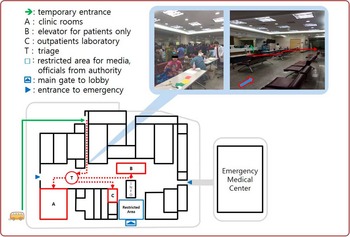
In receiving the Sewol patients, 2 priorities were set. First, it was considered critical to arrange for the more than 200 people to enter the hospital in a safe and orderly manner, while protecting them from unnecessary and potentially psychologically harmful exposure to the media and public. Second, it was also crucial to set up a patient intake process that would lead the newly arriving patients en masse quickly and efficiently through registration, triage, evaluation, and admission.
The simulation of the intake process was completed at 7 PM. The allocated resources included (1) approximately 150 response team members, (2) the isolated first-floor lobby space, (3) a dedicated ward, and 4) an elevator allocated exclusively to the Sewol patients (Figure 1).
Schematic View of the First Floor of the Korea University Ansan Hospital.

The first patients arrived at 7:28 PM by ambulance, and some family members of the victims went directly to the emergency room. This caused some confusion in the emergency room (ER), as early separate arrivals had not been planned for, and Sewol-related patients had to be identified. To make matters worse, these patients arrived at peak overcrowding hours of the ER.
The first bus arrived at 10:28 PM, through a private entrance, as practiced during the simulation. Patients were triaged by board-certified emergency physicians using color-coded tags, and those who required imaging studies were escorted to and from radiology by a hospital security guard. After the initial imaging studies were complete, faculty members from other departments (eg, orthopedics, general surgery) evaluated and admitted patients. Ambulatory patients who did not need imaging studies were evaluated by psychiatrists and pediatricians and then admitted.
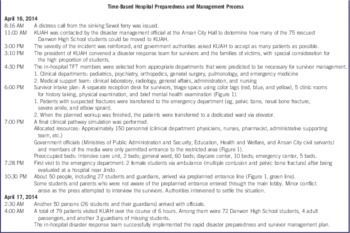
The buses arrived at 1- to 2-hour intervals, shuttling about 40 persons per bus. The last patients were seen at around 4 AM. The rapid response team completed the patient intake with no major obstacles or mistakes. Figure 1 and Table 1 show the schematic view of the first-floor lobby and detailed timeline, respectively.
Timeline After the EventFootnote a

a Abbreviations: KUAH, Korea University Ansan Hospital; TFT, Task Force Team.
DISCUSSION
The Sewol ferry disaster is an ongoing event that has yet to see a definite end, and it is even now difficult to concisely define the scale and impact of the accident. One of the most distinctive points is that a large, homogeneous group of adolescents suffered an unexpected and tremendous sense of loss. This experience of dealing with young student survivors and the families of these victims made it very clear that disaster preparedness and the role of the base hospital are key components of proper disaster management.
One of the most positive outcomes of this event was that these fragile adolescents were not exposed to the media or the public (Figure 1). In addition, early psychiatric intervention and psychological support were performed via interdisciplinary collaboration. Sufficient preparation and the early allocation of a dedicated ward were major reasons behind the safe completion of patient intake without gross errors or mistakes. However, we acknowledge weak points in our response that need to be improved and corrected. Among the areas that require improvement were the lack of a network system between hospitals for appropriate distribution of patient load and the need for a separate, dedicated space for disaster management within the base hospital.
Development of Appropriate Manuals for Diverse Disasters
As a tertiary university teaching hospital, KUAH did have a disaster preparedness manual, but in retrospect it was inefficient and impractical. In the face of the Sewol disaster patient load, it was nearly impossible to follow the directions outlined in the preexisting manual. Furthermore, because the city of Ansan is surrounded by an industrial complex, there is a higher likelihood of future disasters involving chemical exposure and explosions. Such types of predictable disasters should be investigated, and appropriate manuals should be developed for possible future incidences.
Practical Evacuation and Distribution Plan in a Local Community
In disaster events with large volumes of patients, appropriate triage and distribution of victims to proper facilities are key elements to an effective management algorithm.Reference Halpern, Goldberg and Keng 3 , Reference Garner, Lee and Harrison 4 There was a window of approximately 7 hours from the time patient transfer was decided at 3:00 PM until patients began to arrive at 10:00 PM. Securing 70 beds, however, was a difficult task. Fortunately, as KUAH had recently undergone expansion remodeling, it was possible to quickly admit such a high volume of patients under short notice. Although it was deemed appropriate to admit these patients, especially in light of the fact that KUAH was the only hospital in the area capable of administering psychiatric care, it would have been appropriate to distribute the patients among hospitals in the region had there been a mixture of critically injured patients among those transferred from the disaster site. An efficient interhospital transfer network with a central command center that could facilitate patient allocation will undoubtedly be necessary in the future.
Pre-Arrival Notification and Registration for Efficiency
The bus ride from the base camp of the government officials to the KUAH took about 5 hours. This time could have been spent more efficiently in pre-registering patients before their arrival at the receiving hospital. Communication between the bus and the receiving hospital staff only consisted of the bus location and estimated time of arrival. Valuable time could have been saved, and unnecessary delay and confusion avoided, had the passengers of the bus been pre-sorted by students, guardian, and parents during transportation. This is an area that must be included in future training drills.
Dedicated Human Resources and Space for Mass Casualty Disasters
Disaster events that produce large numbers of patients require dedicated human resources and space within the hospital. Although not every hospital may need to prepare for such an event, tertiary-level general hospitals require effective management protocols to be fully prepared to fulfill their duty within their respective communities. Patients from the Sewol accident arrived after 10 PM, which allowed the dedicated use of the entire first-floor lobby. Had these patients arrived during the day, it would have been difficult to find the necessary space and resources. A base hospital should be able to fulfill this role full-time at all hours, day or night.
Leadership and Communication
Unlike its neighbor Japan, which is prone to earthquakes and is therefore much more prepared for disasters, Korea was largely inexperienced and ill-prepared for a disaster on the scope and scale of the Sewol ferry disaster. Although the official government investigated report has not yet been released, the Sewol ferry incident can be described as a complex manmade disaster with many contributing factors, such as the delayed rescue effort; the lapses in moral judgment of the captain and crew, which resulted in weak initial evacuation efforts; and a poor real-time understanding of the situation by the government. This contrasts sharply with the tsunami and subsequent nuclear fallout in 2011 in Japan, where government measures were carried out in a timely, appropriate manner.Reference Shultz, Forbes and Wald 5 The Sewol incident served as an impetus to drive organizational change within the government to strive for disaster preparedness.
In the face of disaster events, it is difficult for a single organization to manage the situation alone, and close cooperation is therefore required among the many organizations involved. To maximize efficiency, a centralized form of leadership is necessary. The role of such a centralized command center would be to allocate responsibilities and tasks according to a predeveloped manual, depending on the type of disaster. The development of such protocols would require regular and coordinated training and education on the part of local public health responders (eg, police, fire department, municipal health centers, and major hospitals in a community).
The issue of effective interagency and interorganizational communication must also be addressed. The central government, fire and police departments, schools, civilian associations, and media alike all provided conflicting, confusing, and at times inaccurate information that hindered the efforts of the rapid response team at KUAH. In the future, as Korea is extremely well networked in terms of social media (eg, Facebook, Twitter, KakaoTalk, Naver), the use of such communication channels during disaster events could prove to be effective. The right amount of information at the right time, with vertical and horizontal inter- and intra-organizational controls, can prove to be crucial in the efficient use of limited resources.
CONCLUSION
To effectively manage a disaster, there are specific roles that must be played by both the central government and local communities. The role of base hospitals within the community is to be well-trained for disasters. Such preparedness will contribute to not only the management of the incident itself, but also the long-term recovery of the community at large. It is therefore critical to evaluate the type and likelihood of disasters within the community and develop contingency plans that include training and educating the appropriate personnel.