The heritage profession values the historic built environment as a fixed asset. There is both a materiality and geography to how we interpret and valorize particular places. Those of us trained in, and charged with, the conservation of immovable cultural property fundamentally seek to counteract the destruction of properties deemed significant through designation, regulation, management, and advocacy. The pervasive perception that loss is always negative hinders the field’s capacity to deal fluently with destruction and thus complicates both theory and practice in relation to reconstruction.
In an era when war, acts of terror, and the potentially catastrophic effects of climate change loom large in the public consciousness, the conservation community must confront loss of the historic built environment at great scales and with profound urgency. Overconsumption in how we construct and operate buildings, largely by the global North, has resulted in inefficient resource and land use and contributed significantly to climate change.Footnote 1 Based on current data, coastal settlements will be increasingly at risk from sea-level rise and storm surges, compelling relocation.Footnote 2 Given the conditions created by this exploitation of resources and shifting climate, elements of the built environment face obsolescence.Footnote 3 It is not simply that buildings are in harm’s way, rather we—particularly those in the global North—have developed the built environment in ways that directly contribute to the climate crisis, and we must make demonstrable changes to existing practices. The inevitable nature of this new reality requires a broader range of adaptive approaches, including destruction, managed retreat, and more, obliging the heritage field to reconsider its attitudes about the physical, place-based fabric.
Growing evidence also demonstrates the role of architectural design and urban planning—from zoning to heritage designation—in perpetuating social exclusion and inequality.Footnote 4 There is thus a mounting obligation on the part of the heritage community to consider why and how we conserve in relation to broader economic, environmental, and social outcomes over time. These environmental and social equity concerns raise issues about the potential value of destruction and the opportunities it affords for reconstructing memory and the historical narrative through the built environment in more just and sustainable ways. This article borrows loosely from Joseph Schumpeter’s economic concept of creative destruction to explore the ways in which both innovation and new lenses on history and memory may be borne of change, loss, and obsolescence. Beyond its application to economic theory and systems, the term “creative destruction” has been applied to the loss of heritage in service to urban development and renewalFootnote 5 and rural reinvestmentFootnote 6 as well as to disruptive development driven by global sustainability concerns.Footnote 7 At its core, it proffers that progress and invention, and, at times, revolution, come at the cost of superseded technologies and infrastructures.
The intention of this article is neither to justify nor challenge the tenets of creative destruction but, rather, to use it as a trope for exploring the social, political, and economic dimensions of destruction in the built environment. Drawing largely from scholarship beyond the heritage field, this exploration does not delve into the theoretical debates about authenticity and physical reconstruction that are well represented in the heritage canon. Rather, it is premised on a recognition of heritage being fundamentally a social reconstruction of built assets, a process that is not politically neutral.Footnote 8 The stories told through the built historic environment can both empower and marginalize publics, and conservation can pose both benefits and risks. Such an examination is intended to challenge and inform concepts and practices of destruction and reconstruction within the heritage enterprise, thereby enhancing fluency with loss and exploring its connections to spatial justice.
Building upon discussions at the International Council on Monuments and Sites’s (ICOMOS) University Forum Workshop on Authenticity and Reconstructions, which was held in Paris on 13–15 March 2017, this conceptual article explores ideas through discourse analysis and case illustrations. While drawn from the North American context, the examples used to investigate the dynamics of destruction and reconstruction, and the perspectives of the heritage community, have global resonance. They echo environmental, economic, and social tensions faced by nations and communities the world over. On the environmental front, this includes the rise in urbanization and the demand for cities to accommodate growth and sustainable modernization as well as the need to enhance the resilience and adaptability of the built environment in the face of sea-level rise and climate change. The socioeconomic dynamics of rising nationalism and populism and the intolerance that often accompanies it also constitute a critical point of global concern, particularly in a postcolonial era in which we seek greater freedom and equality for oppressed and underrepresented peoples and grapple with the challenges of restorative justice in the built environment. These issues are not specific to North America; they span geopolitical boundaries. The heritage enterprise alone is not responsible for these problems nor is it positioned to unilaterally solve them. However, as stewards of spatial history, the heritage field is compelled to consider its agency in both remediating these conditions and contributing to their perpetuation.
The article is divided into five parts. The first part examines some fundamental ideas regarding capital in the built environment and the economic value of destruction. The second and third parts explore the negative social consequences of destruction and the historical influence cum perspective of the heritage enterprise. The fourth part posits potentially positive values and opportunities engendered through destruction, and the final part reimagines how approaches to reconstruction by the heritage field may contribute to more socially just and sustainable futures.
CREATIVE DESTRUCTION, CAPITAL, AND THE BUILT ENVIRONMENT
Austrian economist Joseph Schumpeter coined the term creative destruction in the mid-twentieth century, and it has become a fundamental tenet of free market economics and neoliberalism. Schumpeter described capitalism as the “perennial gale of creative destruction,” meaning that loss and ruin are fundamental to industrial progress and innovation.Footnote 9 Obsolescence necessitates adaptation, and those societies that more freely allow for creative destruction, he argued, tend to be more resilient and prosperous. But while creative destruction can produce positive benefits in terms of growth, wealth creation, and improved standards of living, it can also incur social inequities, the loss of livelihoods, the superseding of technologies, and the devaluing of fixed assets and infrastructure. Attempts to mitigate these negative consequences, for example, by trying to protect certain types of industries or jobs, has historically led to decline by impeding the force of progress.Footnote 10
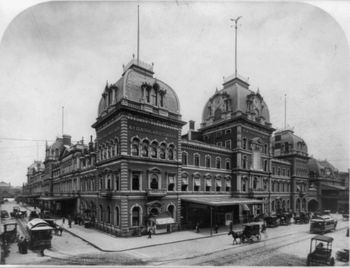
While the concept of creative destruction is most often associated with industry, its application to, and effects on, the built environment are significant. The transportation industry alone—through technological advances in railroads, to shifts in waterway shipping, to the advent of the automobile era—has profoundly shaped urban landscapes, especially in the United States. As an illustration, consider Grand Central Terminal, the rail station that has graced Manhattan’s Eastside since the dawn of the twentieth century and served as a seminal legal battleground for landmarks legislation in the city. The terminal site was formerly occupied by Grand Central Depot, a Victorian structure built by Cornelius Vanderbilt in 1871, and was expanded under the moniker of Grand Central Station in 1898, before plans for the current terminal were launched in 1903 (see Figure 1).
Grand Central Depot, circa 1896, was expanded and later demolished to make way for Grand Central Terminal (courtesy of the Library of Congress Prints and Photographs Division Washington, DC, and in the public domain).

As Theodore Steinberg recounts in Slide Mountain, the advent of electrified trains revolutionized rail transportation and, specifically, Grand Central, as the obsolescence of the steam locomotive allowed for a shift underground.Footnote 11 Freed from the constraints of coal-fired engines, trains could begin to travel long distances in tunnels without the dangers of noxious fumes. Stations no longer required large swaths of nearby land to serve rail yards, and passengers could embark and debark from closed platforms. In 1903, a design process for a new Grand Central began, calling for the construction of a vast network of below grade tunnels in addition to the new terminal itself.
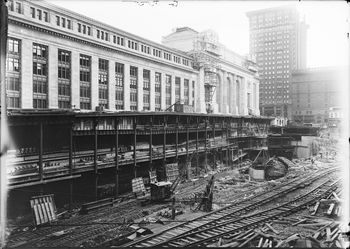
Significant demolition to stage and implement the project was still required (see Figure 2). As noted in a 1907 New York Times article, construction of the terminal meant the destruction of the former station, plus all of the buildings between Fiftieth and Forty-fifth Streets and Park and Lexington Avenues, including 86 houses and several churches and public buildings. But the demolition was positioned as the bargain price of progress and a trade-off in the modernization process:
Grand Central Terminal under construction after 1905 (courtesy of the Library of Congress Prints and Photographs Division, Washington, DC, and in the public domain).

The churches, warehouses, and dwellings destroyed in the metropolis every year to make way for larger structures cost fully $12,000,000. … This seems like a heavy sacrifice for even a great city like New York to make to progress. As a matter of fact the loss is insignificant when compared with the tremendous gain. The $12,000,000 worth of demolished structures are replaced with buildings worth $100,000,000. It is as if a 6-foot man could add to his stature and in a single year grow to be 48 feet tall—as high as the average city dwelling.Footnote 12
With the vast rail yards no longer necessary, the land above the tunnels became leasable space that financed the undertaking. Divorcing ownership of the land from the ownership of buildings, this large-scale redevelopment created value, quite literally, out of the air. By essentially commodifying air rights, the project valorized the three-dimensional potential of architecture rather than the two-dimensional qualities of the land on which it was built—more than a decade before New York City’s first zoning code was established. Referred to as “Terminal City,” the redevelopment of the leased land created a hub of commercial properties surrounding and supporting the station. This act of destruction and redevelopment displaced hundreds of residents and destroyed dozens of properties. It likewise produced today’s Grand Central Terminal, the Waldorf-Astoria, the Shelton Hotel, and the New York Central Building, all of which have been designated as New York City landmarks in recognition of their public benefit to the city and, thus, are highly protected from demolition.Footnote 13 While this history is rife with inequities, it nonetheless serves as a poignant reminder of the way in which both destruction and conservation intervene in an ever-evolving built environment in profound ways, as one does not exist without the other.
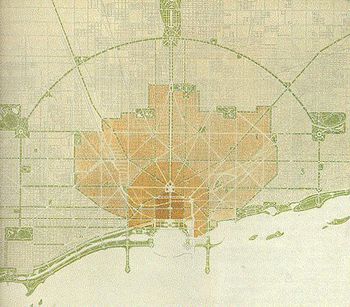
Similarly, as Joshua Salzmann recounts, the obsolescence of the port industry in Chicago paved the way for major changes on its waterfront through Daniel Burnham’s 1909 Chicago Plan, which reconceptualized the city as a rationally ordered and beautified landscape, influencing a new era of urban planning throughout the country (see Figure 3). No longer viable as the hub of an industrial corridor due to technological advances in shipping, Chicago’s river became “an urban amenity to be admired by the increasing numbers of shoppers, tourists, and white-collar workers who filled the Loop each day.”Footnote 14 This creative destruction set the stage for the development of many of the city’s iconic skyscrapers, including the Wrigley Building and the Chicago Tribune Tower. In what ways does this challenge the field’s aversion to destruction and suggest that there may be positive aspects to loss?
Daniel Burnham’s 1909 plan redeveloped central Chicago and its waterfront (in the public domain).

THE SOCIAL CONSEQUENCES OF DESTRUCTION
In each of the above cases, urban regimes of power saw the economic value of significant change to the built environment as outweighing the costs and consequences of demolition. And without this creative destruction, many important landmarks—now characterizing the historic urban landscape as protected resources—would not exist. But such change still comes at a price. As Alessandro Busà notes, the ongoing re-creation of the built environment reflects the dynamics of growth and the need for capital to find new ways of reproducing itself. But in doing so, it can cause “a relentless disruption of existing communities, social ties, and cultural identities.”Footnote 15
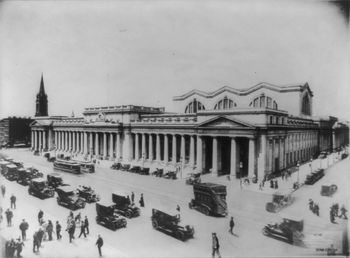
At the same time that Grand Central Terminal was rising in the east of Manhattan, McKim, Mead, and White’s Pennsylvania Station was rising in the west (see Figure 4). With the capacity for electrified trains to cross the Hudson River by tunnel, plans for the new station were announced in 1903. The Pennsylvania Railroad company purchased a large swath of land in West Midtown to stage the construction of the tunnel and the terminus. The destruction of the built infrastructure was understood as being necessary for modernization, but the displacement of residents and commercial enterprises was an additional sacrifice with projected long-term effects:
Pennsylvania Station, circa 1920, was demolished in 1963 (courtesy of the Library of Congress Prints and Photographs Division, Washington, DC, and in the public domain).

Every time Manhattan Island throws a bridge to Brooklyn or digs a tunnel to Jersey it must get rid of a portion of its own population. … Four hundred buildings occupying the ground between Seventh and Ninth avenues and Thirtieth and Thirty-third streets are to be razed to the ground. … A population mounting into the hundreds of thousands will eventually be driven out of its accustomed neighborhoods by these improvements and the development that will follow. … Like Venice itself in the old days, the city is reaching out upon the mainland and planting there the population it cannot house at its heart.Footnote 16
Completed in 1910 to great acclaim, Pennsylvania Station occupied four city blocks. That same year, the US Census calculated the island of Manhattan’s population at 2,331,542, constituting half the people of New York City. In the most recent US Census of 2010, Manhattan had a population of 1,585,873, more than 30 percent fewer residents than a century earlier and less than 20 percent of New York City’s 2010 overall population of 8,175,133. The revolutionizing of the rail industry alone did not cause this shift; it stems from complex dynamics related to urban disinvestment, suburbanization, building codes and zoning to protect public health and safety, and more. Nonetheless, the construction of Pennsylvania Station portended significant population displacement in the New York metropolitan area. It serves as a poignant illustration of the way in which capital flows through the built environment with profound community effects, positive and negative. Half a century later, the destruction of the very same Pennsylvania Station represented a new response to the social impacts of destruction when it became the cause célèbre for the modern preservation movement:
Until the first blow fell no one was convinced that Penn Station really would be demolished or that New York would permit this monumental act of vandalism against one of the largest and finest landmarks of its age of Roman elegance. … Any city gets what it admires, will pay for, and, ultimately, deserves. … And we will probably be judged not by the monuments we build but by those we have destroyed.Footnote 17
Often cited as the birth moment of the US preservation enterprise, urban preservation in New York City and the country, in actuality, long predated the well-known battle for Pennsylvania Station. There was an awareness about historic structures and their importance as a counterpoint to progress in New York City’s changing urban landscape for decades; preservation was a partner in the city’s ongoing evolution and redevelopment. As Randall Mason argues, preservation was understood as an integral element of the urban modernization project writ large since at least the nineteenth century.Footnote 18 The public and professional dialogue regarding the significance of old buildings and their protection evolved by the mid-twentieth century, and a new tension emerged. The conflict between preservation and economic growth became common rhetoric in many US cities:
[T]here are times when one wonders whether New York’s bulldozers are not going to knock down everything in sight. … The destruction arises from a basic land policy that has come to prevail in New York…This approach has, of course, led to much of the progress and economic growth that make New York such an imposing city. But there are dangers at the end of the path. For any policy that treats a city and its space solely in economic terms may ultimately destroy the entire values of urban life.Footnote 19
While preservation-minded citizens saw profit-driven real estate development as a primary culprit in the loss of historic fabric, they also viewed state-driven programs, such as urban renewal and highway building, as equally complicit. Federally funded redevelopment of large areas of United States cities—to produce more efficient roads, alleviate poverty, and improve housing conditions—fostered new forms of creative destruction in the name of the public good:Footnote 20 “To some preservationists the … very superhighways that may enable tourists to see more American history than ever before are being laid out with little regard for the preservation of bits of Americana that may lie in the way.”Footnote 21 At the time of its publication, Jane Jacobs’s The Death and Life of Great American Cities epitomized the growing rift between the preservationists and the urban planners of the time. Jacobs sought to protect neighborhoods; she viewed this as a socioeconomic imperative to preserve communities—communities of people—of which buildings were a critical element.Footnote 22 While preservationists embraced similar goals, they framed their interests as an aesthetic imperative that prioritized protection of the traditional urban landscape of the city. This aesthetics rationale underpins much of the municipal legislation in US municipalities, based on the notion that form or design can improve the human condition.Footnote 23 It fundamentally comports with modernist ideas of social order through control of the built environment, wedding history and memory to urban form and fabric in a profound way.
But Jacobs was railing against the modernist paradigm, laying bare the pitfalls of this approach and its consequences on communities—people and places. Her critique sparked a new awareness in the planning field that helped to move it into a new era. However, as urban planning was questioning its tenets, preservation was codifying its approach through new legislation—namely, the New York Landmarks Law of 1965 and the National Historic Preservation Act of 1966.Footnote 24 At this moment when the entire enterprise of urban planning was under scrutiny for its negative impacts on people and places, preservation was seen as a David against the Goliath. Neighborhoods fighting urban renewal and federal intervention found an effective ally and germane rhetoric in the preservation movement’s mission of saving old buildings:
A nation can be a victim of amnesia. It can lose the memories of what it was, and thereby lose the sense of what it is or wants to be. It can say it is being “progressive” when it rips up the tissues which visibly bind one strand of its history to the next. It can say it is only getting rid of “junk” in order to make room for the modern. What it often does instead, once it has lost the graphic source of its memories, is to break the perpetual partnership that makes for orderly growth in the life of a society.Footnote 25
THE POWER OF HERITAGE
A new policy toolbox developed in the second half of the twentieth century in support of the heritage cause. Under the power of legislation in many municipalities, buildings could be protected from demolition through designation and thus removed from the pressure of market forces. The “public good” of large-scale demolition by the state was also put in check through procedural reviews that gave voice to local communities in the face of federally funded redevelopment. This power cultivated a public policy rationale for heritage conservation that hinged on the maintenance of original form and fabric. It codified a position of loss aversion that championed physical protection—rather than demolition, replacement, or alternate—as not only the preferred option but also the better option for society.Footnote 26 Yet despite more than half a century of implementing this power and associated toolbox, the tension between progress and preservation persists today: “Our city is molting. … Here, colossal towers are merely placeholders, temporary arrangements of future debris. New York lives by a philosophy of creative destruction. The only thing permanent about real estate is a measured patch of earth and the column of air above it. The rest is disposable.”Footnote 27
Following on the idea that the built environment serves as a conduit of histories and narratives of the past, the heritage perspective proffers that maintaining structures in the landscape can retain the possibility of telling untold stories. If the fabric persists, the stories may survive or have the chance to be told through spatial means. Demolition implies that some alternative past may be lost or undiscovered, yet retention of a structure suggests that some alternative future may not be realized, as in the previous cases of Grand Central and Chicago. To reconcile this tension of privileging the past versus privileging the future, heritage rhetoric often centers on how conservation—as a more conservative act—affords generations to come more options. By ensuring the persistence of particular resources within the built environment, the present generation claims to give the next generation greater choice over whether to keep—or not—the resources they inherit. The process of designation nonetheless changes the role and value of certain resources within the built environment. By preventing destruction, it shifts market dynamics and the use of space. Within a framework of spatial economics, heritage protection might be characterized as a social reinvestment in physical capital that complicates the cycles of creative destruction.Footnote 28
As Robert Beauregard notes, “the built environment … is a source of capital accumulation, a place of consumption and reproduction, and a terrain of profound struggle.”Footnote 29 Building on Henri Lefebvre’s idea of space as both a social product and a means of production,Footnote 30 urban space has been increasingly redefined through consumption-driven economic development practices.Footnote 31 The “naturalization” of neoliberalism within the political economy has led to the redistribution of wealth and the dismantling of institutions, creating new forms of hegemony in the control of space.Footnote 32
Heritage conservation has become a tool for such change in the built environment. Having evolved beyond a set of assets to be preserved and protected by government for the public good, heritage is a socially constructed “resource” to be utilized as a means of regeneration and competitive advantage in neoliberal economies.Footnote 33 Conservation seeks to prevent the loss of certain places deemed significant. It thus aims to keep the forces of creative destruction at its back, or to run downwind of Schumpeter’s gale, by reinventing them for public consumption as heritage.Footnote 34 So while designation in effect attempts to alleviate the pressure of market forces on heritage, it simultaneously contributes to the social construction of heritage as a commodity and industry. In seeking to preserve a sense of place, the heritage enterprise is also controlling space. Thus, the commodification of heritage as a public asset calls into question issues of power and hegemony in the decisions about what to save and what to destroy within the built environment.
The preservationists of the Jane Jacobs era cast their struggle against the intra-generational inequities created by a hegemonic class of urban planning experts and powerbrokers. They questioned the pain and gain rationales of creative destruction—that progress comes at a cost—and sought to mitigate the negative aspects by averting loss of physical fabric and form. In doing so, they forged institutions and a policy infrastructure to curate the historic built environment. This curatorial, and fundamentally hegemonic, power is significant. As T. C. Chang and Shirlena Huang argue, if heritage is intended as a reification of collective memory in the built environment, we must acknowledge the impossibility of these resources representing all narratives: “Heritage is confined to what a society deems useful for its survival. Selective recall and interpretation of history is thus essential.”Footnote 35 But who decides whose memories survive? In what ways are these selective narratives contributing to the exclusionary and unjust aspects of the built environment and our spatial experience?
THE SOCIAL VALUE OF DESTRUCTION
The built environment can serve as a conduit for inequality, and the persistence of certain elements over time can perpetuate and exacerbate injustice by reflecting the cumulative buildup of investment and planning decisions inherited from previous eras.”Footnote 36 The aforementioned history of urban renewal had disproportionate impacts on vulnerable communities, in part due to deep-rooted issues of racial and socioeconomic bias that influenced decision-making about land use and investment. The physicality and longevity of the built environment, and the way in which it influences social-spatial relationships, preclude a simple reinterpretation of the past to include more narratives. As David Crouch and Gavin Parker note, “landscape, its sites and its representations of history, is practiced; not only observed, read or understood.”Footnote 37 But realizing restorative and spatial justice within the built environment, historic or not, is challenging, and destruction serves as an important, though contested, tool toward that end.
Many municipalities in the United States are confronting the entrenched legacy of federal investment in highways that decimated urban neighborhoods and marginalized communities of color more than a half a century ago. In 2017, Congress for the New Urbanism published its fifth Freeways without Futures report, calling for the removal of urban renewal-era highways in order to improve “health, equity, opportunity, and connectivity” within cities.Footnote 38 After the removal of the Park East elevated highway in Milwaukee, Wisconsin, land values in its footprint nearly doubled and helped to attract new business to the city.Footnote 39 The demolition of the Embarcadero Freeway in San Francisco after a 1989 earthquake transformed the city’s waterfront and spurred rehabilitation of the historic area. Rochester, New York, is infilling a portion of its 60-year-old sunken highway to create new housing and pedestrian space as well as to foster economic vitality.Footnote 40
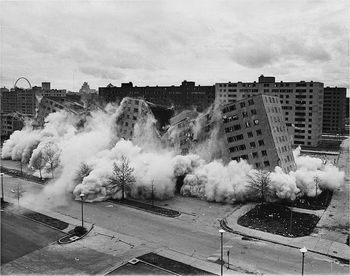
Similarly, federally funded public housing projects of the urban renewal era draw attention to the role of the built environment in perpetuating social exclusion. The iconic Pruitt-Igoe complex in St Louis, Missouri, was designed by architect Minoru Yamasaki in the mid-1950s. Within a decade, it was riddled with violence as well as building failures. Demolished in the 1970s, the implosion of one of its towers was widely televised (see Figure 5).Footnote 41 The case of Pruitt-Igoe serves as a stark illustration of destruction’s power to challenge the complicity of architectural design and construction in social inequity.Footnote 42 While not the only potential approach, nor a solution to the problem writ large, understanding destruction as one of a range of tools to confront entrenched histories of spatial inequity and social injustice in the landscape lends important lessons to the heritage enterprise. Much of the work of conservation is premised on the notion that heritage is critical to individual and collective identity. Recognizing that the field can both challenge and promote hegemonic narratives in the way it shapes meaning in the built environment may afford greater fluency in the language and potential power of loss.
Demolition of the Pruitt-Igoe public housing complex in 1972 (courtesy of the United States Department of Housing and Urban Development and in the public domain).

The potential value of destruction in promoting justice and reconciliation in some cases is demonstrated poignantly in that of Canada’s former residential schools, which operated from the 1880s to the 1990s. Established to help assimilate First Nations children into the dominant Canadian culture, residents were removed from their families and communities and stripped of their cultural identity. Many suffered horrific abuses, and thousands died in residence.Footnote 43 An unknown number of the 139 school buildings still stand; some have been torn down, others adaptively reused or simply abandoned. In the case of St Michael’s Indian Residential School in Alert Bay, British Columbia, destruction was a ceremonial act of reconciliation: “[L]ike so many former residential schools, its presence reminded survivors of their stolen culture, language and identity, their broken familial bonds and, in some cases, the physical or sexual abuse they endured. … For many residential school survivors, demolishing these buildings is about hope for the future.”Footnote 44
Such demolition can also be understood as an ideological form of creative destruction. Removing the school from the landscape refutes a pre-existing order and empowers First Nations communities to reclaim their past and reshape their future. Yet many, especially those within the heritage profession, argue that the structures serve as tangible evidence of their story and an experiential reminder of past atrocities to generations to come. Emphasis is placed on what might be lost due to the absence of the original fabric, and there is a limited toolbox for exploring what alternative pasts and futures might be precluded—and what further injustice perpetuated—by its material persistence in the landscape.
Simply acknowledging and interpreting past wrongs does not create spatial justice. Citing Jonathan Freidman, Crouch and Parker argue: “History is frequently situated, idealised and practiced in terms of space … from the perspective of interest groups and marginalized political groups what better than to (re)appropriate space and artefacts that have been implicated in accounts of (radical) actions and then to reconstruct these competing histories, these imagined counter-memories?”Footnote 45 In confronting how to honor the residential school history, the Assembly of First Nations commissioned Aboriginal artists to create markers, purposefully departing from Western concepts of heritage recognition. The dynamic markers are offered to the communities from where children were taken rather than being placed at the sites of schools.Footnote 46 This shift transfers spatial power, and, with it, narrative authority, from the institutions that perpetrated these offenses to the First Nations peoples.
The contemporary debate in the United States surrounding Confederate monuments serves as an additional illustration of the value of destruction (or at least removal) in challenging and reconstructing historical narratives. The recent violence in Charlottesville, Virginia, drew international attention to a long simmering debate about the presence of monuments in public spaces that idealize figures who defended slavery and fought for the South in the US Civil War. In many instances, these monuments were purposeful installations in the landscape, intended to reaffirm notions of white supremacy and disenfranchise African-Americans. As Dell Upton argues, “[t]his is not ultimately a conflict over monuments. It is a conflict over the values that we wish to endorse in the contemporary public realm.”Footnote 47 Viewed by some as heritage resources and by others as blatant symbols of oppression, cities across the country have borne witness to deliberations, vandalism, protests, and counter-protests surrounding these monuments. Even some cities without Confederate statuary, such as New York, have initiated reviews of monuments in public spaces to determine which monuments may represent bias toward people of color, women, and other marginalized groups.
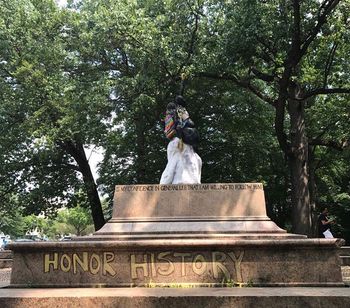
In Baltimore, Maryland, in 2015, activist Owen Silverman Andrews convinced artist Pablo Machioli to design a counter-statue to protest a monument celebrating the Confederate generals Robert E. Lee and Stonewall Jackson. Madre Luz depicted a pregnant Black woman with an upheld fist that survived next to the monument for one day before city authorities impounded it and fined the artist. In the wake of the tragedy in Charlottesville in 2017, the mayor of Baltimore called for the removal of all Confederate statuary in the city. Activists returned with Madre Luz, this time placing her upon the empty pedestal where Lee and Jackson had stood (see Figure 6).Footnote 48 Though a temporary installation, Madre Luz helped to spur collective efforts by local government and not-for-profit organizations, which allowed “residents to discuss and process the removal of the monuments and their history, and to brainstorm what should stand in their place.”Footnote 49
Madre Luz, protest art by artist Pablo Macioli, placed atop the pedestal of the deposed Jackson and Lee Monument in Baltimore, 2017 (courtesy S. K. Dunn, Wikimedia Commons).

These examples suggest that averting loss may have profound consequences in terms of representations of power in landscapes. While often a default position of the heritage profession, the desire to physically preserve curated elements of the built environment cannot be segregated from the spatial meaning they engender in a broader social context. No matter how much historical narratives are challenged or reinterpreted in prose, physical encounters bear repeated witness to particular ideas and experiences that can perpetuate injustice. There are long legacies of destruction within the built environment that have negated or made invisible the histories of marginalized populations, communities of color, and Indigenous and enslaved peoples. At the same time, demolition or removal may contribute to processes of creative destruction that challenge hegemonic notions of what is or is not representative of collective memory and what is or is not heritage.
REDEFINING RECONSTRUCTION
In the context of heritage conservation, the discourse surrounding reconstruction has largely centered on physical re-creation and associated issues of authenticity. Concern about whether the lack (as in digital replicas) or loss of original material constitutes a false representation pervades, as do debates about whether reconstruction negates certain moments in a site’s historical evolution. These are valid considerations if reconstruction is simply about replacing something that was lost or recreating what physically existed before. What if the dialectic surrounding heritage and reconstruction were also about consciously staking claims to spatial power, reimagining and redistributing historical narratives and memory, and fostering adaptive resilience within the built environment? Land is a finite resource, and the prevalence—or lack thereof—of certain narratives within the landscape incurs inherently political trade-offs. The tangible “footprint” of certain histories—where they are located, their proportional distribution, and the extent of their spatial occupation—influences how we see ourselves in both the past and the future. Along with conservation, rehabilitation, restoration, and adaptive reuse, both destruction and reconstruction may serve as purposeful heritage tools in elucidating underrepresented histories and redressing past injustice.
For example, one might argue that the reconstruction of slave quarters at Monticello emancipates underserved histories and empowers new actors and narratives in the built environment and landscape of American history. Monticello is the historic Virginia home of Thomas Jefferson, a prominent, and increasingly controversial, “founding father” of the United States and one of the world’s most renowned proponents of democracy. Part of a United Nations Educational, Scientific and Cultural Organization world heritage site, the plantation did not interpret its pronounced slave history for many decades, and limited vestiges of its original slave quarters survive. Archaeological investigations in the 1980s, along with Jefferson’s own documentation of the workings of his plantation, produced a better understanding of the form and function of said quarters, known as Mulberry Row.Footnote 50 In debates about whether to attempt reconstruction, many argued that the lack of original fabric and the degree of conjecture required to (re-)create these structures would constitute an inauthentic intervention. Others asserted that the physical absence of the slave legacy at the plantation was itself an inauthentic representation of history that perpetuated an inaccurate and unjust narrative. As the aforementioned quote by Sidney Hyman suggests, if “[a] nation can be a victim of amnesia. It can lose the memories of what it was, and thereby lose the sense of what it is or wants to be,” is that not what is at risk when we fail to provide physical encounters with such critical elements of our past? Augmented by exhibits and smart phone applications, newly constructed buildings now help to realize a spatial experience of Mulberry Row and tell the story of slave life at Monticello, giving this previously untold history both physical dimension and functional presence in the landscape.
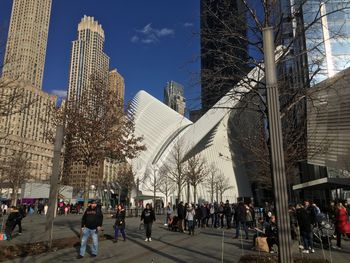
In lower Manhattan, terrorist destruction of the World Trade Center, which was also designed by Minoru Yamasaki, architect of the Pruitt-Igoe complex, was a global tragedy. In the fraught aftermath of 9/11, protracted negotiations debated the treatment of what had, quite instantly, become a site of universal significance in the heart of the world’s financial capital. The footprints of the Twin Towers were quickly recognized as sacred ground and became the architectural basis of the 9/11 Memorial, which commemorates those who lost their lives.Footnote 51 But the historical narrative created at Ground Zero was also one of resilience and fortitude in the face of disaster. The redevelopment of 14 acres of prime real estate in one of the most dynamic cities in the world included the redesign and rebuilding of the tallest skyscraper in Manhattan and reconceptualized New York’s Financial District. It created a new mass transit hub, an important twenty-first-century investment in public transit design, and enabled a reshaping of surrounding urban form and function, akin to what Grand Central inspired more than a century ago (see Figure 7). Like the transformation of San Francisco’s Embarcadero after a devastating earthquake, the forces of destruction afforded opportunities to reimagine an historic landscape through a newly envisioned future.
The Oculus, designed by Santiago Calatrava, serves as a transit hub on the site of the World Trade Center (courtesy Matt Rice, Wikimedia Commons).

Despite our efforts to conserve the fabric of heritage, we are consistently reminded of the provisional nature of the built environment. An anticipated 66 inches of sea-level rise by 2100 now threatens the San Francisco coast and has justified the inclusion of the Embarcadero on the National Trust for Historic Preservation’s 11 most endangered historic places. Climate change will increase both forced and planned relocation, especially in historic coastal communities. Given global trends in populism, nationalism, and partisan politics, intolerance and conflict will likely continue to contribute to population migration and displacement as well. Such conditions compel the heritage field to decenter the protection of original form and fabric and include destruction, reconstruction, and more in its toolbox in order to meet the needs of evolving built environments and communities. In anticipation of destruction and abandonment, and the need to reconstruct in new locations, it must be an active agent in developing innovative ways to guide adaptation and resilience through social-spatial relationships that empower new historical narratives and memories, not simply re-create those entrenched in the existing built environment.
Around the world, societies struggle to reconcile contemporary values with their own histories, histories often marked with periods of violence, slavery, fear of the other, the oppression of minorities, the subjugation of women, economic exclusion, the exploitation of resources, or other forms of injustice. While we may push back against these legacies, many of them are nonetheless engrained in our built environments. Each monument, site, and landscape we list, and prevent from destruction, runs the risk of perpetuating the biases of the past. Each instance of destruction represents an opportunity to actively reinterpret the past with new knowledge. Rather than seeking normative standards for when destruction or reconstruction is acceptable or not, the field has the opportunity to be self-reflective about its societal goals and for whom it acts. By more explicitly acknowledging both destruction and reconstruction as viable and innovative options within the heritage toolbox, we can expand the agency and restorative capacity of the heritage field in promoting more just and sustainable futures.
One might argue that the field has an opportunity to take more liberal advantage of the benefits of creative destruction. Doing so may allow the process of conservation to expose alternative histories, represent underserved narratives, empower new actors, and redefine spatial power dynamics within the built environment, as evidenced through the cases throughout this article. But this entails, to some extent, relinquishing hegemonic power within the heritage enterprise. The fabric-oriented aesthetic and historic values that have long underpinned the curation of the historic built environment and informed our understanding of authenticity must give way to, as proffered by Rodney Harrison during the ICOMOS workshop, a new kind of honesty that explains our actions (good and bad). If heritage protection is a reinvestment in physical capital that complicates the cycles of creative destruction, the field would be well served to reorient its attitudes toward loss and creative reconstruction, so as foster more inclusive and sustainable processes of social, economic, and environmental regeneration.