The family Cetomimidae (Cetomimiformes), sensu Paxton (Reference Paxton1989) and Nelson (Reference Nelson2006), represent a rare group of pelagic deep-sea fishes that are distributed in all great oceans. These fishes typically exhibit whale-shaped bodies, tiny eyes, huge horizontal mouths, cavernous lateral-line canals and a lack of pelvic fins and external scales (Paxton, Reference Paxton1989; Nelson, Reference Nelson2006; Johnson et al., Reference Johnson, Paxton, Sutton, Satoh, Sado, Nishida and Miya2009; Vieira et al., Reference Vieira, Christiansen, Christiansen and Gonçalves2012).
Since 1895, nine genera (Cetichthys Paxton, Reference Paxton1989; Cetomimus Goode & Bean, Reference Goode and Bean1895; Cetostoma Zugmayer, Reference Zugmayer1914; Danacetichthys Paxton, Reference Paxton1989; Ditropichthys Parr, Reference Parr1934; Gyrinomimus Parr, Reference Parr1934; Notocetichthys Balushkin, Fedorov & Paxton, Reference Balushkin, Fedorov and Paxton1989; Procetichthys Paxton, Reference Paxton1989; and Rhamphocetichthys Paxton, Reference Paxton1989) and about 20 species of cetomimids have been described (Paxton, Reference Paxton1989). However, to date, this family remains as one of the most poorly known fish groups with several undescribed forms and only about 700 known specimens (most females measure 26–408 mm in standard length (SL)) in scientific collections around the world (Paxton, Reference Paxton1989; Johnson et al., Reference Johnson, Paxton, Sutton, Satoh, Sado, Nishida and Miya2009; Vieira et al., Reference Vieira, Christiansen, Christiansen and Gonçalves2012; Froese & Pauly, Reference Froese and Pauly2014).
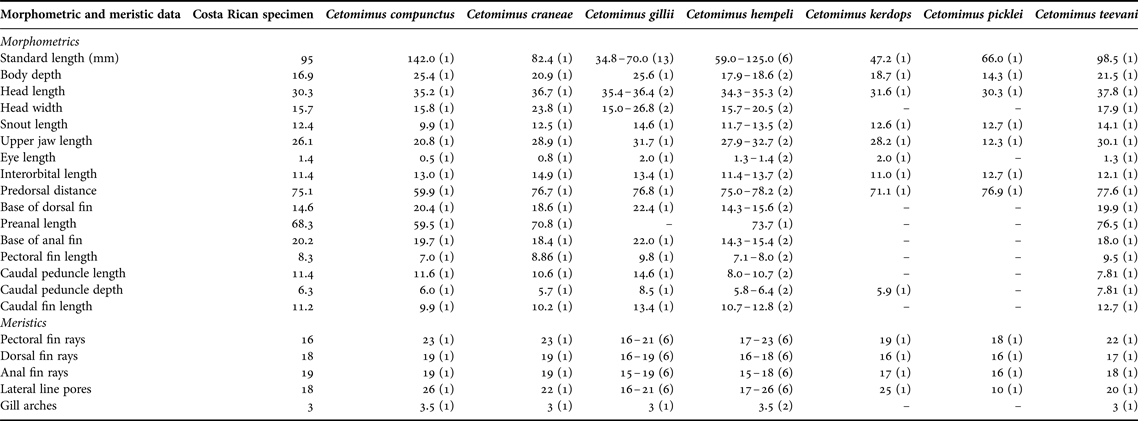
The genus Cetomimus, with seven valid species (Cetomimus compunctus Abe et al., Reference Abe, Marumo and Kawaguchi1965; Cetomimus craneae Harry, Reference Harry1952; Cetomimus gillii Goode & Bean, Reference Goode and Bean1895; Cetomimus hempeli Maul, Reference Maul1969; Cetomimus kerdops Parr, Reference Parr1934; Cetomimus pickle (Gilchrist, Reference Gilchrist1922); and Cetomimus teevani Harry, Reference Harry1952) and several undescribed forms, is the most diverse of the family (Paxton, Reference Paxton1989). As defined by Paxton (Reference Paxton1989), this genus has no single derived characters to distinguish it from the remaining cetomimids. Similar to all other genera (with the exception of Procetichthys), Cetomimus has small and short nasal organs, with zero or less than ten small lamellae (vs long nasal organs, filling both nostrils and with more than 30 large lamellae); similar to Cetichthys, Danacetichthys, Ditropichthys, Gyrinomimus, Notocetichthys and Rhamphocetichthys, Cetomimus has less than 26 dorsal and anal fin rays (vs 29–37 dorsal fin rays and 26–34 anal fin rays in Cetostoma); similar to Cetichthys, Danacetichthys, Ditropichthys, Gyrinomimus and Notocetichthys, Cetomimus does not have an elongated, beak-like snout (vs elongated and beak-like snout in Rhamphocetichthys); and similar to Gyrinomimus, Cetomimus has only three free gill arches (vs four free gill arches in Cetichthys, Danacetichthys, Ditropichthys and Notocetichthys). Finally, members of Cetomimus differ from Gyrinomimus, a genus with which they are the most closely related, only in the teeth (short, in distinct or indistinct diagonal rows vs elongated in distinct longitudinal rows in all but two species) and in the shape of the vomerine tooth patch (round or elliptical and dome shaped vs rectangular or laterally elongated and flat) (Paxton, Reference Paxton1989). Within the genus Cetomimus, characters such as the number and shape of lateral line pores and flaps, the number of dorsal and anal fin rays and vertebrae and the distribution and shape of the cavernous tissues, as recognized by Harry (Reference Harry1952), Maul (Reference Maul1969) and Paxton (Reference Paxton1989), become important in the species identification (Table 1).
Morphometric and meristic data of Cetomimus gillii from Costa Rica (UCR-Searcher 501) and comparative material; data from Goode & Bean (Reference Goode and Bean1895), Brauer (Reference Brauer1906), Parr (Reference Parr1934), Harry (Reference Harry1952), Abe et al. (Reference Abe, Marumo and Kawaguchi1965), Maul (Reference Maul1969) and Tolley et al. (Reference Tolley, Gartner and Lancraft1989). Morphometric data is expressed as percentages of standard length. Unavailable measurements are represented with an en-dash (–). Number of examined specimens is indicated in parentheses.

To date, more than 180 specimens of this genus have been collected from all of the three major oceans, however the vast majority have been collected in the Atlantic Ocean (Paxton, Reference Paxton1989; Tolley et al., Reference Tolley, Gartner and Lancraft1989; Froese & Pauly, Reference Froese and Pauly2014). To the author's best knowledge, with the exception of Cetomimus compunctus, all of the species belonging to Cetomimus are known in the Atlantic Ocean (Tolley et al., Reference Tolley, Gartner and Lancraft1989; Froese & Pauly, Reference Froese and Pauly2014). However, only two species (Cetomimus compunctus and Cetomimus gillii) and even fewer specimens have been collected in the Pacific Ocean to date (Abe et al., Reference Abe, Marumo and Kawaguchi1965; Tolley et al., Reference Tolley, Gartner and Lancraft1989; Froese & Pauly, Reference Froese and Pauly2014).
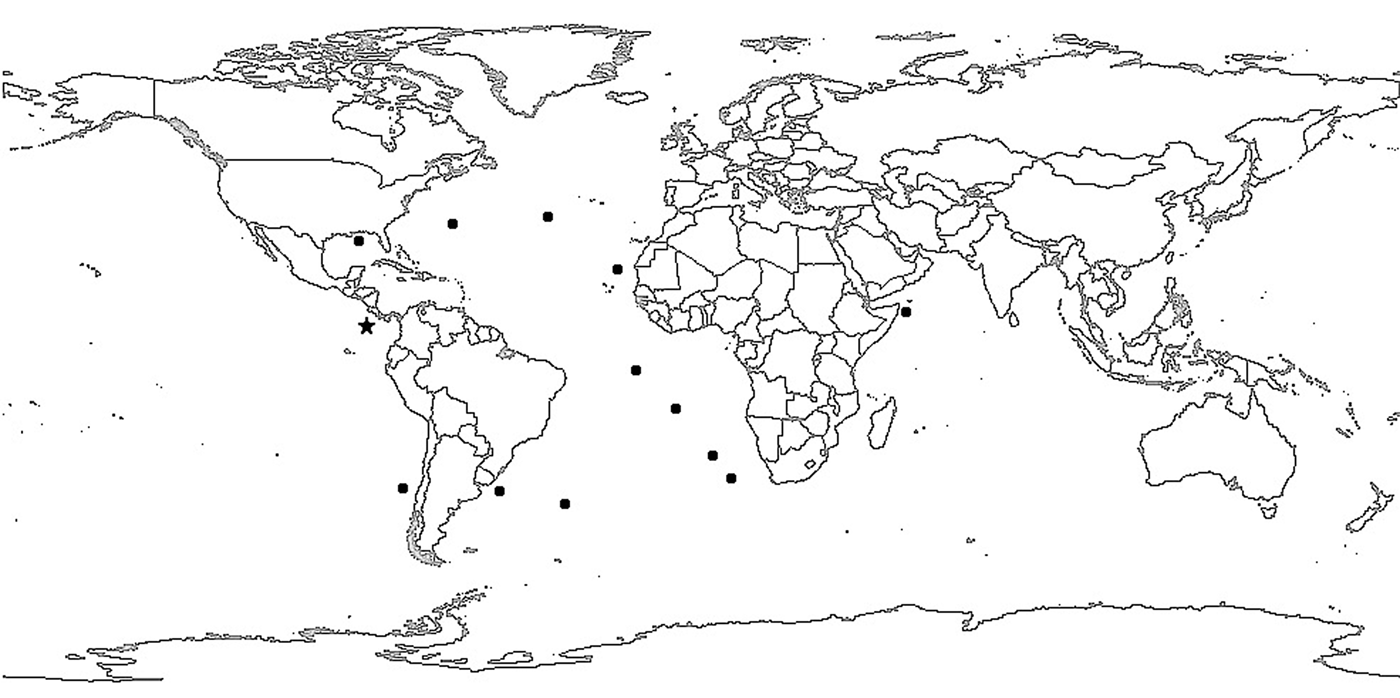
In 1972, during a cruise of the R/V Searcher (see Cortés, Reference Cortés, Wehrtmann and Cortés2009, for details), an adult whalefish (95.0 mm in SL; Figure 1) was captured from off the Pacific coast of Costa Rica (08°16′59.00″N 84°06′43.92″W; Figure 2) at a depth of about 950 m. This specimen was deposited at the fish collection of the Museo de Zoología of the Universidad de Costa Rica (UCR) with the following catalogue number: UCR-Searcher 501. Recently, this specimen was revised and identified as Cetomimus gillii. In this contribution, a new record and the first for this species in Costa Rican and Tropical Eastern Pacific waters, is formally reported; comparative morphometric data and distributional information are also proportioned and discussed.
Cetomimus gillii, 95.0 mm in SL, captured from off the Pacific coast of Costa Rica (08°16′59.00″N 84°06′43.92″W).
Distribution of Cetomimus gillii: star indicates the present record (UCR-Searcher 501), circles indicate previous literature and museum records. Adapted from http://www.fishbase.org.
The identification of the specimen was carried out on the basis of the following distinctive characters: (1) head distinctly broader than body, rounded when viewed dorsally; (2) posterior tips of lower jaw widely separated, not meeting posteriorly; (3) pectoral fin rays 16; (4) lateral-line pores 18, the posterior pores without distinct lappets; (5) dorsal fin rays 18; (6) anal fin rays 19; and (7) no cavernous tissue around the origin of the dorsal fin. All of these characters agree with the diagnosis of the species and match well the descriptions given by Brauer (Reference Brauer1906), Harry (Reference Harry1952), Maul (Reference Maul1969) and Tolley et al. (Reference Tolley, Gartner and Lancraft1989). Additional morphometric and meristic data from the examined specimen and comparative information from all valid species of the genus are summarized in Table 1.
Originally described from the Western Atlantic (Goode & Bean, Reference Goode and Bean1895), Cetomimus gillii has been documented in the Indian Ocean just south of the Gulf of Aden (Brauer, Reference Brauer1906; Tolley et al., Reference Tolley, Gartner and Lancraft1989), in the Western Central Pacific (Paxton, 1999; Froese & Pauly, Reference Froese and Pauly2014) and in the South-Eastern Pacific (Craddock & Mead, Reference Craddock and Mead1970; Pequeño, Reference Pequeño1989), see Figure 2, at depths between 750 and 2300 m (Paxton & Blake, Reference Paxton, Blake, Quero, Hureau, Karrer, Post and Saldanha1990; Froese & Pauly, Reference Froese and Pauly2014). The northernmost record of occurrence of this species in the Eastern Pacific Ocean was from off Chile (Craddock & Mead, Reference Craddock and Mead1970; Pequeño, Reference Pequeño1989). Given this, the specimen herein reported represents a north range extension of at least 4600 km of the known distribution of the species.
Taking into account the geographical distribution pattern of this species, it is notable that similar distributions are relatively common among other meso- and bathypelagic fishes. For example, of the meso- and bathypelagic bristlemouths, lightfishes and lanternfishes of the families Gonostomatidae, Phosichthyidae and Myctophidae, and of the bathypelagic anglerfishes of the families Ceratiidae and Melanocetidae, among others, the majority of species are widely distributed in the three major oceans, with the remaining species distributed in two oceans and only a few species with restricted ranges in a single ocean or water mass (Pietsch & Van Duzer, Reference Pietsch and Van Duzer1980; Pietsch, Reference Pietsch1986; Harold & Weitzman, Reference Harold, Weitzman, Stiassny, Parenti and Johnson1996; Harold, Reference Harold1998, Reference Harold and Carpenter2003a, Reference Harold and Carpenterb; Nelson, Reference Nelson2006; Froese & Pauly, Reference Froese and Pauly2014). In addition, other whalefishes occurring in the Eastern Pacific Ocean are also broadly distributed (e.g. Cetichthys parini Paxton, Reference Paxton1989; Cetostoma regani Zugmayer, Reference Zugmayer1914; Danacetichthys galathenus Paxton, Reference Paxton1989; Ditropichthys storeri (Goode & Bean, Reference Goode and Bean1895); Gyrinomimus bruuni Rofen, 1959; Gyrinomimus grahami Richardson & Garrick, 1964; Gyrinomimus myersi Parr, Reference Parr1934; and Rhamphocetichthys savagei Paxton, Reference Paxton1989) (Paxton, Reference Paxton1989; Froese & Pauly, Reference Froese and Pauly2014). These distributional patterns, in general terms, presumably reflect environmental stability and/or ecological uniformity (Marshall, Reference Marshall1980; Gartner et al., Reference Gartner, Hopkins, Baird and Milliken1987; Tolley et al., Reference Tolley, Gartner and Lancraft1989).
Finally, although the epipelagic fish fauna of the Pacific coast of Costa Rica and Central America have been examined in some detail (Bussing & López, Reference Bussing and López1994, Reference Bussing, López, Wehrtmann and Cortés2009, Reference Bussing and López2011), meso- and bathypelagic fishes are relatively poorly known due to the paucity of collections from depths of below 200 m (Bussing & López, Reference Bussing, López, Wehrtmann and Cortés2009). In recent years, an important number of deep-water fish species have been recorded for the first time in the region (see Bussing & López, Reference Bussing and López2011; Cortés et al., Reference Cortés, Sánchez-Jimenez, Rodriguez-Arrieta, Quirós-Barrantes, González and Blum2012; López-Garro et al., Reference López-Garro, Zanella, Golfín-Duarte and Pérez-Montero2012; Starr et al., Reference Starr, Green and Sala2012; Angulo, Reference Angulo2014a, Reference Angulob; and Angulo et al., Reference Angulo, López, Bussing and Murase2014). Most of these species, as in this case, are probably residents in this area that might have remained undetected due to their intrinsic rarity and/or difficulty of access to their specific habitats (Angulo, Reference Angulo2014b). The presence of these previously unrecorded species indicates that the Costa Rican and Central American marine ichthyofauna is considerably richer than expected and an estimation of number, composition and distribution of species is still far from being obtained (Angulo, Reference Angulo2014b).
ACKNOWLEDGEMENTS
The author is grateful to William A. Bussing (1933–2014), Myrna I. López, Ana Rosa Ramírez, the authorities of the Museo de Zoología, the Escuela de Biología and the Centro de Investigación en Ciencias del Mar y Limnología (CIMAR) of the UCR for encouragement and facilities; as well as to Zachary Stepanovich for the English revision of this paper.