Introduction
Bark beetles (Coleoptera: Curculionidae: Scolytinae) are among the most significant forest insect pests, infesting stressed or weakened trees while at lower population levels but able to attack and kill healthy trees during epidemics. The spruce beetle, Dendroctonus rufipennis (Kirby) (Coleoptera: Curculionidae), is a major destructive agent to spruce stands across North America (Wood Reference Wood1982a). Outbreaks of D. rufipennis can have major impacts on stand and landscape composition (Veblen et al. Reference Veblen, Hadley, Reid and Rebertus1991; Doak Reference Doak2004; Allen et al. Reference Allen, Wesser, Markon and Winterberger2006; Werner et al. Reference Werner, Holsten, Matsuoka and Burnside2006). An outbreak of this species began in 2003, causing considerable tree mortality in mature spruce stands in the Atlantic provinces of Canada, notably in Newfoundland and Nova Scotia. Silvicultural control options, including thinning, sanitation, and harvesting, are most effective if applied before outbreaks or during incipient outbreaks, for which an early warning tool to delineate areas at risk is critical.
Bark beetles typically use a combination of pheromones and host volatiles to colonise hosts and find mates (Wood Reference Wood1982b); thus, the use of traps baited with semiochemicals represents a potentially effective method for early detection, monitoring, and possible control of scolytid populations. A semiochemical method for detection and monitoring of D. rufipennis depends on the identification of the optimal attractant composition and concentration specific to this species. The pheromone components produced by, and attractive to, D. rufipennis have been identified as frontalin (Dyer Reference Dyer1973, Reference Dyer1975; Furniss et al. Reference Furniss, Baker and Holstetler1976; Gries et al. Reference Gries, Pierce, Lindgren and Borden1988), and in some locations, 3-methyl-2-cyclohexen-1-ol (seudenol), its analogue 1-methyl-2-cyclohexen-1-ol (MCOL), and/or 4-methylene-6,6-dimethylbicyclo[3.1.1]hept-2-ene (verbenene) (Vité et al. Reference Vité, Pitman, Fentiman and Kinze1972; Furniss et al. Reference Furniss, Baker and Holstetler1976; Gries et al. Reference Gries, Pierce, Lindgren and Borden1988, Reference Gries, Borden, Gries, Lafontaine, Dixon, Wieser and Whitehead1992; Borden et al. Reference Borden, Gries, Chong, Werner, Holsten and Wieser1996; Setter and Borden Reference Setter and Borden1999; Ross et al. Reference Ross, Daterman and Munson2005). The commercially available spruce beetle lure is currently either a two-component lure comprised of the female-produced pheromone, frontalin (as identified by Gries et al.(Reference Gries, Pierce, Lindgren and Borden1988)) and a kairomonal component, a host terpene (95%:5% (±)-α-pinene), or a three-component lure also containing MCOL. In southern British Columbia, this two-compound lure caught two to five times more D. rufipennis than unbaited traps (Poland and Borden Reference Poland and Borden1998). However, in interior Alaska, United States of America and south-central British Columbia, Canada, this combination failed to capture more beetles than an unbaited control (Borden et al. Reference Borden, Gries, Chong, Werner, Holsten and Wieser1996). In addition, this combination attracted very few beetles in Idaho, as compared with logs infested with females (Kline et al. Reference Kline, Schmitz, Rudinsky and Furniss1974). Finally, a preliminary field trapping experiment in 2005 determined that populations of D. rufipennis in the eastern-most part of its range (Newfoundland) were also not responsive to a lure combination of frontalin and 95%:5% (±)-α-pinene (based on observations of K.L.R), thus precipitating the current study.
Previous research has demonstrated considerable differences in pheromone blends among populations in different geographic regions for this and other scolytine species (Lanier et al. Reference Lanier, Birch, Schmitz and Furniss1972, Reference Lanier, Claesson, Stewart, Piston and Silverstein1980; Vité et al. Reference Vité, Islas, Renwick, Hughes and Kliefoth1974; Gries et al. Reference Gries, Borden, Gries, Lafontaine, Dixon, Wieser and Whitehead1992; Seybold et al. Reference Seybold, Ohtsuka and Wood1995; Borden et al. Reference Borden, Gries, Chong, Werner, Holsten and Wieser1996; Grosman et al. Reference Grosman, Salom, Ravlin and Young1997; Miller et al. Reference Miller, Gibson, Raffa, Seybold, Teale and Wood1997, Reference Miller, Raffa, Dalusky and Berisford2003; Setter and Borden Reference Setter and Borden1999; Erbilgin et al. Reference Erbilgin, Szele, Klepzig and Raffa2001, Reference Erbilgin, Mori, Sun, Stein, Owen and Merrill2007; Ross et al. Reference Ross, Daterman and Munson2005; Moreno et al. Reference Moreno, Macias, Sullivan and Clarke2008). In western North America, specifically Alaska, northwestern Alberta, southeastern British Columbia, Colorado, Wyoming, and Utah, a three-component lure of α-pinene, frontalin, and MCOL was typically reported as most attractive to D. rufipennis (Borden et al. Reference Borden, Gries, Chong, Werner, Holsten and Wieser1996; Ross et al. Reference Ross, Daterman and Munson2005; Hansen et al. Reference Hansen, Vandygriff, Cain and Wakarchuk2006), although with some inconsistencies in attraction to (+)-, (−)-, and (±)-MCOL among locations (Borden et al. Reference Borden, Gries, Chong, Werner, Holsten and Wieser1996). These studies used three ratios of α-pinene: 89%:11% (±), racemic, and 95%:5% (±), respectively. MCOL of any enantiomeric composition increased attraction to traps baited with frontalin when tested in northern British Columbia (Setter and Borden Reference Setter and Borden1999), in the absence of α-pinene. However, in another study in Alaska, seudenol attracted the most D. rufipennis in combination with an uninfested spruce log or α-pinene (Furniss et al. Reference Furniss, Baker and Holstetler1976). The pheromone composition of D. rufipennis has not been studied in the Great Lakes region of North America (Haberkern and Raffa Reference Haberkern and Raffa2003) and, to our knowledge, the pheromone composition has never been studied east of 100°W longitude.
Specific host volatiles have been demonstrated to be important for synergising responses to pheromones for bark and wood-boring beetle species (Wood Reference Wood1982b; Borden Reference Borden1989; Erbilgin and Raffa Reference Erbilgin and Raffa2000; Miller and Borden Reference Miller and Borden2000; Pureswaran and Borden Reference Pureswaran and Borden2005; Silk et al. Reference Silk, Sweeney, Wu, Price, Gutowski and Kettela2007; Borden et al. Reference Borden, Pureswaran and Lafontaine2008). For D. rufipennis, the preferred host species varies from western North America (primarily white, Engelmann, and Sitka spruce, Picea glauca (Moench) Voss, Picea engelmannii Parry ex Engelmann, and Picea sitchensis (Bongard) Carrière, respectively, and their hybrids) to eastern North America (primarily white spruce). Pureswaran and Borden (Reference Pureswaran and Borden2005) reported that D. rufipennis were significantly attracted to volatiles from spruce hosts (P. engelmannii × glauca) from interior British Columbia, although the beetles did not discriminate among differing host volatiles when a pheromone lure was included. In another study, Pureswaran et al. (Reference Pureswaran, Gries and Borden2004) reported no qualitative difference in terpene compounds among different species of conifers using gas-chromatographic mass spectrometric analysis (GC-MS), suggesting that beetles might use differences in ratios of compounds to discriminate among hosts. In addition, Dyer and Chapman (Reference Dyer and Chapman1971) reported that spruce logs infested with female D. rufipennis attracted almost nine times more beetles than traps baited with frontalin and α-pinene, suggesting the presence of additional pheromone or kairomone cues. Other previous research has demonstrated the ability of frontalin and/or seudenol to induce attacks on trap trees or logs (Dyer and Chapman Reference Dyer and Chapman1971; Dyer Reference Dyer1973, Reference Dyer1975), but not necessarily demonstrating increased trap captures; overall, this result suggests that the appropriate host volatiles are needed to synergise trap captures.
Our goal was to improve our understanding of the regional specificity in pheromone/kairomone blends of D. rufipennis and to develop an improved attractant lure for early detection and monitoring of this species in eastern North America. In the laboratory, our objectives were to: (1) investigate for additional male-produced or female-produced pheromone compounds; and (2) investigate foliage and bark volatiles from eastern host species. In the field, our objectives were to test the synergistic activity on trap captures of several pheromone and kairomone compounds when added to the female-produced pheromone, frontalin; this was accomplished by conducting a series of trapping experiments in the Atlantic provinces of Nova Scotia and Newfoundland, Canada.
Materials and methods
Insect and host tree specimens
Dendroctonus rufipennis adults used in laboratory studies were collected from infested white spruce trees located in three sites around Corner Brook, Newfoundland, Canada. Bark samples were removed and overwintering teneral adults were extracted from the bark in April 2006. In October 2006, pupae were collected from bark samples taken from recently infested trees and allowed to emerge, then separated by sex, held individually in gel capsules to prevent mating, and shipped to the Canadian Forest Service laboratory in Fredericton, New Brunswick, Canada. In addition, samples of phloem and foliage were obtained from healthy white spruce from two sites near Corner Brook, Newfoundland in April 2006 and were shipped in sealed glass jars to Fredericton for analysis.
Laboratory analysis
In April 2006, volatiles were collected in the laboratory by drawing air through activated charcoal, then through a glass chamber (2.8 cm diameter × 18 cm length) containing 10–15 male–female pairs of beetles along with host material. In October 2006, 15–20 unmated females and males were placed into two separate glass-pumping chambers with host material. Volatiles were collected for 72–96 h per replicate group. Volatiles from the groups (15–20 insects × 3 replicate groups) of mated and unmated males and females were collected using both Porapak® Q (SigmaAldrich, St. Louis, Missouri, United States of America) and solid-phase microextraction methodologies (Silk et al. Reference Silk, Sweeney, Wu, Price, Gutowski and Kettela2007; Lemay et al. Reference Lemay, Silk and Sweeney2010). Collected volatiles were then subjected to GC/electroantennographic (EAG) analysis (Silk et al. Reference Silk, Ryall, Mayo, Lemay, Grant and Crook2011), followed by GC/MS analysis to attempt to identify the antennally active compounds. Synthetic samples, volatiles, and extracts were analysed by GC-MS on a Hewlett-Packard 5890 GC and a Hewlett-Packard 5971 mass selective detector (Agilent Technologies, Santa Clara, California, United States of America) in the electron impact (EI, 70 eV) mode. The columns used for analysis were a Supelco SPB-5 (Agilent Technologies) capillary (30 m × 0.32 mm × 0.25 μm film) or, for chiral separations, a Supelco β-Dex 120 (Agilent Technologies) (30 m × 0.25 mm × 0.25 μm) cyclodextrin column in the splitless mode with helium as carrier gas. The injection port was at 250 °C and the oven temperature was programmed from 70 °C, held for one minute and then increased at 15 °C/minute to 220 °C and held for 30 minutes for use in either column. Similarly, GC-MS analyses were conducted on host volatiles from bark and foliage samples (Silk et al. Reference Silk, Sweeney, Wu, Price, Gutowski and Kettela2007).
Field trapping experiments
Different attractant blends were assessed in a series of four field bioassays from 2006 to 2009 using baited 12-unit multiple-funnel traps. Blends that showed increased trap captures were re-tested in subsequent years, with the addition and/or subtraction of various host kairomones. Trapping experiments were conducted in mature white spruce-dominated stands in Newfoundland and Nova Scotia. Trapping sites had a moderate population of D. rufipennis, as evidenced by the presence of recently infested trees (i.e., ∼10–15% of trees infested). Stands with epidemic populations (i.e., considerable tree mortality and high density of currently attacked trees) were not included. Treatment combinations were each tested with a randomised complete block design. Traps were deployed ∼2 m above ground using rope tied between two trees, ∼1.5–2.0 m from host trees and with a minimum of 30 m between traps. Collecting cups were half filled with plumbing antifreeze to kill and retain captured adults. In each year, traps were set up near the end of May at or before the onset of the flight period of adult beetles and sampled weekly or biweekly until the end of August or early September when beetle flight had ceased, as evidenced by no more beetles being caught in the traps. All scolytines were retained, and all D. rufipennis were counted.
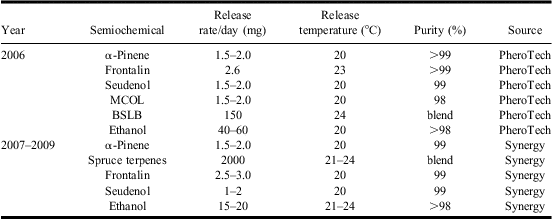
In experiment 1 (conducted in 2006), trapping was conducted at two sites near Corner Brook, Newfoundland. This experiment tested six different treatments: (1) the standard spruce beetle bait of frontalin + α-pinene (but with 75%:25% (±) α-pinene, see below); (2) frontalin + racemic seudenol + 75%:25% (±) α-pinene; (3) frontalin + 1-methyl-2-cyclohexen-1-ol (MCOL)+75%:25% (±) α-pinene; (4) frontalin + seudenol + MCOL + 75%:25% (±) α-pinene; (5) a spruce terpene blend + ethanol; and (6) blank control trap. All lures were provided by Pherotech Inc. (Delta, British Columbia, Canada) (Table 1). Treatment 1 was the two-component lure for D. rufipennis. However, based on laboratory analysis of host tree volatiles (see the ‘Results’ section), the α-pinene used was 75%:25% (±). Seudenol and (+)-MCOL were chosen because both are pheromone components known to synergise trap catches in other locations in western North America (Borden et al. Reference Borden, Gries, Chong, Werner, Holsten and Wieser1996; Setter and Borden, Reference Setter and Borden1999; Holsten et al. Reference Holsten, Shea and Borys2003; Ross et al. Reference Ross, Daterman and Munson2005) and because preliminary laboratory analysis showed the presence of seudenol in female-produced volatiles (see below). Finally, the spruce terpene blend (44% racemic α-pinene, 19% (−)-β-pinene, 10% (+)-3-carene, 18% (+)-limonene, and 9% α-terpinolene) used had been observed to capture high numbers of spruce beetle in Nova Scotia when being tested for brown spruce longhorn beetle, Tetropium fuscum (Fabricius) (Coleoptera: Cerambycidae) (BSLB) lure (Sweeney et al. Reference Sweeney, De Groot, Macdonald, Smith, Cocquempot and Kenis2004, Reference Sweeney, Gutowski, Price and de Groot2006). Three replicate blocks of the six treatments were established in each site.
Semiochemicals, with release rates, in synthetic lures from two sources used in trapping experiments from 2006 to 2009
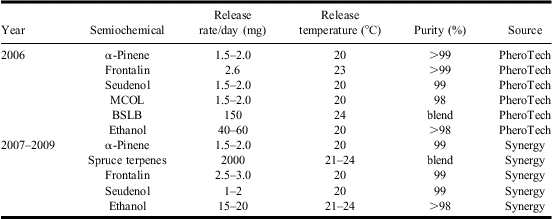
In experiment 2 (conducted in 2007), trapping was done at the same two sites in western Newfoundland and at two sites in Nova Scotia. This experiment tested five different treatments: (1) 75%:25% (±) α-pinene + frontalin + racemic seudenol (the best lure from 2006); (2) a high release spruce terpene blend (44% α-pinene [49.4:50.6 (+):(−)], 19% β-pinene, 18% limonene, 10% 3-carene, and 9% terpinolene, produced by Synergy Semiochemicals Inc., Burnaby, British Columbia, Canada) + frontalin + racemic seudenol; (3) frontalin + racemic seudenol without host terpenes; (4) 75%:25% (±) α-pinene alone; and (5) spruce terpene blend alone. All lures were provided by Synergy Semiochemicals Inc. (Table 1). The rationale for these treatments was that: treatment 1 caught the most beetles in 2006 and was thus considered to be our “standard” treatment to test against other combinations that may increase captures: treatment 2 substituted Synergy's spruce terpene blend for α-pinene as an alternate host kairomone: and treatments 3–5 tested pheromone or host kairomones separately to see if they caught similar numbers of beetles as they did in combination. All four of the host compounds in the spruce terpene blend have been shown to produce an antennal response in D. rufipennis (Pureswaran et al. Reference Pureswaran, Gries and Borden2004). Based on our laboratory analysis of host tree volatiles, the α-pinene used was again 75%:25% (±). Within each site, there were five replicate blocks of the five treatments, for a total of 25 traps per site.
In experiment 3 (conducted in 2008), trapping was done at two different sites in Nova Scotia. The experiment was designed to further elucidate the role of host volatiles in synergising trap captures when used alone or in combination with the pheromone components. Treatments were: (1) 75%:25% (±) α-pinene + ethanol + frontalin + seudenol; (2) spruce terpene blend + ethanol + frontalin + seudenol; (3) frontalin + seudenol; (4) spruce terpene blend + ethanol; and (5) 75%:25% (±) α-pinene + ethanol. All lures were provided by Synergy Semiochemicals Inc. (Table 1). Treatments were repeated in 2008 because of inconclusive results among sites in 2007 (see the ‘Results’ section), with ethanol as an additional host volatile because it had been shown to induce tree attacks by D. rufipennis (Moeck Reference Moeck1981) and was effective at capturing spruce beetles during a 2007 study in Nova Scotia on T. fuscum (Silk et al. Reference Silk, Sweeney, Wu, Price, Gutowski and Kettela2007). Within each site, there were five replicate blocks of the five treatments, for a total of 25 traps per site.
In experiment 4 (conducted in 2009), trapping was done at the same two sites in Nova Scotia where experiment 3 was conducted in 2008. Treatments were: (1) spruce terpene blend + ethanol + frontalin + seudenol; (2) spruce terpene blend + frontalin + seudenol; (3) frontalin + seudenol; (4) spruce terpene blend + ethanol; and (5) a blank control. All lures were provided by Synergy Semiochemicals Inc. (Table 1). The five treatments were selected to further test the role of spruce terpene blends, based on results from 2007 and 2008 suggesting terpenes are important synergists when used in combination with D. rufipennis pheromone components to increase trap capture. We also tested whether the addition of ethanol increased the synergy between the spruce terpenes and pheromone components. At each site, there were five replicates of the five treatments, for a total of 25 traps per site.
Statistical analysis
For 2006–2009, data from field trapping experiments were natural-log transformed (x + 1) to satisfy assumptions of normality and homogeneity of variances. Data were analysed separately by year with a two-way ANOVA with site and lure type as the two factors, followed by a Holm-Sidak pairwise multiple comparison (Zar Reference Zar1984). All data were analysed using the program SigmaStat V11.0 (San Jose, California, United States of America).
Results
Laboratory analysis
Gas-chromatographic/mass spectrometric analysis of host volatiles on the β-cyclodextrin column determined that the α-pinene emitted from eastern white spruce consisted of 75% (−) and 25% (+). Gas-chromatographic mass spectrometric analysis of volatiles from living beetles (both males and females) detected seudenol only in females, but did not MCOL from either sex. Frontalin was not detected in the volatile samples but was likely below our detection limits in this study, given the extremely low release rate of this compound (Gries et al. Reference Gries, Pierce, Lindgren and Borden1988). In the EAG trials, both male and female spruce beetles showed a small but consistent electrophysiological response to commercial seudenol (data not shown).
Field trapping experiments
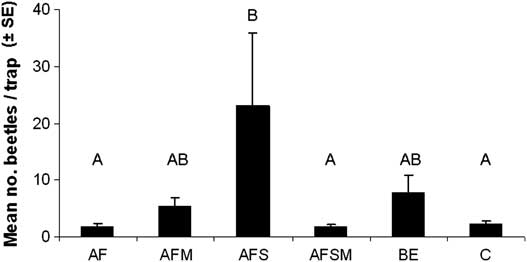
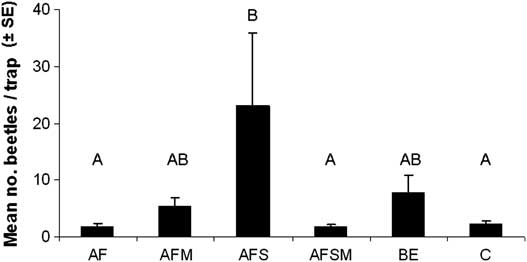
In experiment 1, a total of 2958 D. rufipennis were captured in all treatments over the course of the summer. A significantly higher number of beetles was captured in one site, as compared with the other location (∼80% versus 20% of beetles captured; F = 22.23, P < 0.001, df = 1,23). Despite the high variability, there was a significant difference in trap captures among the treatments (F = 5.77, P = 0.001, df = 6,27) with five to six times more D. rufipennis captured in the α-pinene + frontalin + seudenol treatment, as compared with other treatments (Fig. 1). The 75%:25% (±) α-pinene + frontalin treatment did not capture more D. rufipennis than the unbaited control, nor did the spruce terpene blend plus ethanol. In addition, MCOL reduced trap catches, as evidenced by the four-component lure (AFSM).
Mean number (+SE) of Dendroctonus rufipennis caught in 2006 in Newfoundland, Canada in multiple-funnel traps with six treatments. n = 3 traps per treatment at two locations. Different letters indicate significant differences among means in trap captures (P < 0.005). AF, α-pinene + frontalin; AFM, α-pinene + frontalin + MCOL; AFS, α-pinene + frontalin + seudenol; AFSM, α-pinene + frontalin + seudenol + MCOL; BE, brown spruce longhorn beetle + ethanol lure; C, control trap.
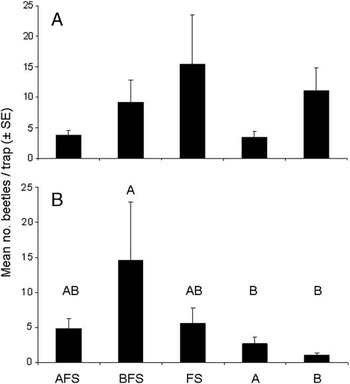
In experiment 2, a total of 2752 D. rufipennis were captured in all treatments over the course of the summer of 2007 in Newfoundland. There were no significant differences in trap capture among treatments (F = 1.62, P = 0.17) or between sites (F = 1.86, P = 0.17) (Fig. 2a). However, although low numbers of D. rufipennis were captured in Nova Scotia in 2007 (only 316 in total), there was a significant difference in mean trap captures among the treatments (F = 4.52, P = 0.004, df = 4,40). The three-component lure (spruce terpenes + frontalin + seudenol) caught the highest numbers of D. rufipennis (Fig. 2b), compared with the host volatiles alone. More beetles were captured in one site than in the second site (F = 32.78, P < 0.001, df = 1,40) (Fig. 2b), but there was no site × treatment interaction (P = 0.12).
Mean number (+SE) of Dendroctonus rufipennis caught in 2007: (A) in Newfoundland, Canada and (B) in Nova Scotia, Canada using multiple-funnel traps baited with one of five treatments. n = 5 traps per treatment. Different letters indicate significant differences among means in trap captures (P < 0.05). AFS, α-pinene + frontalin + seudenol; BFS, BSLB spruce terpene blend + frontalin + seudenol; FS, frontalin + seudenol; A, α-pinene; B, BSLB spruce terpene blend.

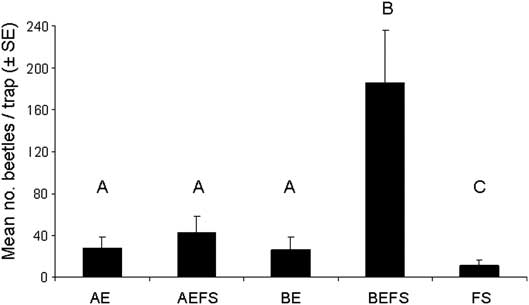
In experiment 3 (2008), a total of 3515 D. rufipennis were captured at the two sites in Nova Scotia. There was a significant difference in trap captures among treatments (F = 9.75, P < 0.001, df = 4,40). Again, the combination of the pheromone and host volatiles synergised trap captures. The pheromone-host volatile treatment of spruce terpenes + ethanol + frontalin + seudenol, caught four to five times the number of beetles caught by host volatiles alone or pheromones alone (frontalin + seudenol) (Fig. 3). In addition, the four-component lure incorporating the spruce terpene blend caught four to five times more D. rufipennis than the four-component lure with 75%:25% (±) α-pinene. Trap captures were significantly different among the two sites (3099 versus 416 beetles) (F = 24.09, P < 0.001, df = 1,40); however, there was no interaction among treatment and site (P = 0.43).
Mean number (±SE) of Dendroctonus rufipennis per trap caught in Nova Scotia, Canada during 2008. Traps were baited with one of five treatments. n = 10 traps per treatment. Different letters indicate significant differences among means in trap captures (P < 0.05). AE, α-pinene and ethanol; AEFS, α-pinene, ethanol, frontalin and seudenol; BSLB, BSLB terpene blend and ethanol; BEFS, BSLB, ethanol, frontalin and seudenol; FS, frontalin and seudenol.
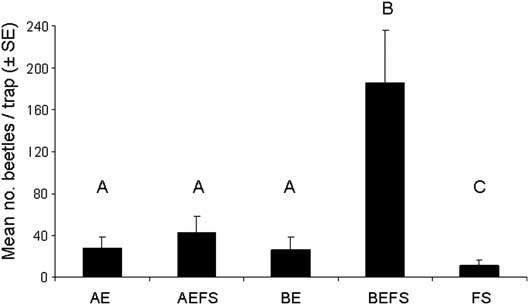
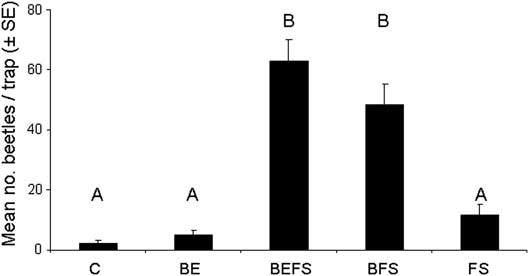
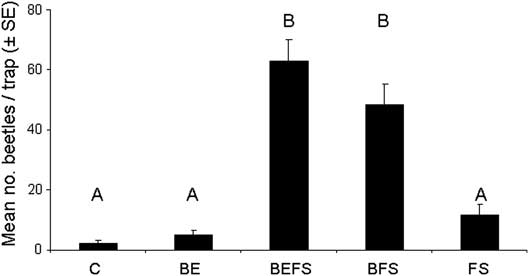
In experiment 4 (2009), beetle counts were lower than in 2008, with a total catch of only 1261 adults. As in 2008, the combination of the pheromone and host volatiles appeared to synergise trap captures (F = 31.84, P < 0.001, df = 4,40) (Fig. 4); the greatest mean captures were in traps baited with either the four- or three-component lure (spruce terpene + ethanol + frontalin + seudenol and spruce terpene + frontalin + seudenol, respectively), with five to seven times the trap captures as compared with the control, or the spruce terpenes or pheromone components alone (Fig. 4). The addition of ethanol did not appear to increase trap captures versus the three-component lure.
Mean number (±SE) of Dendroctonus rufipennis per trap caught in Nova Scotia, Canada during 2009. Traps were baited with one of five treatments (unbaited control). n = 5 traps per treatment per site (two sites). Different letters indicate significant differences among means in trap captures (P < 0.05). BE, spruce terpene blend and ethanol; BEFS, spruce terpene blend, ethanol, frontalin and seudenol; BFS, spruce terpene blend, frontalin and seudenol; FS, frontalin and seudenol.
Discussion
From our results, frontalin, seudenol, and a spruce terpene blend appear to be key components of a lure for D. rufipennis in eastern Canada, catching the highest number of beetles in several field trials. Frontalin and seudenol alone or spruce terpene blend and ethanol alone typically had among the lowest trap catches, but when the lures were combined they caught more D. rufipennis than any other lure combination, supporting the findings that host volatiles may synergise attraction to pheromones (see Silk et al. Reference Silk, Sweeney, Wu, Price, Gutowski and Kettela2007). Seudenol was found in female-produced volatiles and increased trap captures, indicative of its importance in the pheromone blend of eastern populations. This supports previous studies, which demonstrated the production of seudenol by D. rufipennis (Vité et al. Reference Vité, Pitman, Fentiman and Kinze1972; Borden et al. Reference Borden, Gries, Chong, Werner, Holsten and Wieser1996) and its ability to increase trap catches of D. rufipennis (Furniss et al. Reference Furniss, Baker and Holstetler1976). The Douglas-fir beetle, Dendroctonus pseudotsugae Hopkins, was also reported to be attracted to frontalin and seudenol, in addition to ethanol (Ross and Daterman Reference Ross and Daterman1995). However, ethanol did not appear to increase captures of D. rufipennis in our current study. MCOL was not detected in female-produced volatiles and did not increase trap captures, in contrast to previous studies in western North America (Borden et al. Reference Borden, Gries, Chong, Werner, Holsten and Wieser1996; Setter and Borden Reference Setter and Borden1999; Ross et al. Reference Ross, Daterman and Munson2005; Hansen et al. Reference Hansen, Vandygriff, Cain and Wakarchuk2006). Ours is the first study to be conducted on populations of D. rufipennis in eastern North America. Our results support the differential lure response among geographic locations reported by previous studies on D. rufipennis and support the conclusion of Borden et al. (Reference Borden, Gries, Chong, Werner, Holsten and Wieser1996) that semiochemical lures for this wide-ranging bark beetle species likely are regionally specific.
Geographic variation in the D. rufipennis pheromone blend has previously been demonstrated across western North America. However, this variation cannot readily be attributed to the genetic population structure determined for this wide-ranging species (Maroja et al. Reference Maroja, Bogdanowicz, Wallin, Raffa and Harrison2007). Based on microsatellite analysis by Maroja et al. (Reference Maroja, Bogdanowicz, Wallin, Raffa and Harrison2007), populations of D. rufipennis in eastern Canada contain two haplotype groups (Northern I and II), which occur across the northern range of D. rufipennis from Newfoundland to Alaska, in conjunction with the distribution of white spruce. However, populations in Alaska used MCOL as an additional pheromone component (Borden et al. Reference Borden, Gries, Chong, Werner, Holsten and Wieser1996; Holsten et al. Reference Holsten, Shea and Borys2003), in contrast to the results of our study. The pheromone blend reported for populations within the third haplotype region, which distinguishes populations in British Columbia and the midwestern United States of America, also typically includes the additional component, MCOL (Setter and Borden Reference Setter and Borden1999; Ross et al. Reference Ross, Daterman and Munson2005). Thus, other factors varying over the large geographic range of this species are involved in determining the precise pheromone blend used by various populations, requiring further investigation.
Our proposed lure combination of a spruce terpene blend, frontalin, and seudenol provides a substantial improvement in trap captures in eastern Canada as compared with the two-component commercially available lure for spruce beetles. However, trap captures often appeared low, compared with the local populations present at the experimental sites. These results suggest that additional key pheromone or kairomonal component may still be lacking from the optimal lure combination for eastern populations of the spruce beetle. Release rates of various compounds are likely also important; although release rate was not tested per se in the current study, higher release rates of spruce terpene blends appeared to be more effective at catching beetles than lower release rates of either the blend or a single host compound and appeared more effective at synergising trap captures when combined with pheromones. Systematic studies of varying release rates and ratios of the various compounds are recommended.
Our results have improved our understanding of the chemical ecology of D. rufipennis across its broad geographic range, with the identification of a pheromone-host volatile lure combination that significantly increases trap captures as compared with the two-component commercially available lure that failed to elicit attraction by adult spruce beetles in eastern Canada. Based on our results, we currently recommend the use of a three-component lure comprised of spruce terpene blend + frontalin + seudenol, for detecting and monitoring spruce beetle populations in eastern North America. However, our low and often highly variable trap captures suggest that further research is needed into the pheromone production and preferred host volatile composition in D. rufipennis at different geographic locations, including clarifying the role of seudenol as a possible pheromone component. Different release rates and ratios of the various components have previously influenced captures of other scolytines (Miller and Borden Reference Miller and Borden2000; Erbilgin et al. Reference Erbilgin, Powell and Raffa2003), and should be considered in future research into the chemical ecology of D. rufipennis. Overall, our results highlight the need to study the same insect across different geographical regions to develop an optimal semiochemical-based trapping methodology for early detection and monitoring.
Acknowledgements
Funding was received from Spray Efficacy Research Group (SERG)-International (Ontario, New Brunswick, Nova Scotia, and the United States Department of Agriculture Forest Service) and the Canadian Forest Service. In-kind support was provided by the province of Newfoundland and Labrador. For excellent technical assistance the authors thank Glen Forbes, Andrea Sharpe, Andrea Skinner, Paige Marchant, Kit Folkes, Joseph Mosseler, Alex Veitinghof, Elise D'Arcy, Catherine Desjardins, Shallen Calbury, Sara Carmichael, Emily Lavigne, and Adrian Ives Thurston. They also acknowledge the management support of Ed Hurley and Ed Kettela at Canadian Forest Service (CFS)/Atlantic Forestry Centre and of Bruce Pike at CFS/Corner Brook.