INTRODUCTION
A dominant feature of Irish dairy farming is its low-cost grass-based milk production. Although this has benefits at farm level in terms of a low-cost source of feed (Finneran et al. Reference Finneran, Crosson, O'Kiely, Shalloo, Forristal and Wallace2010), it creates challenges at processor level due to the fluctuating levels and composition of raw materials in this type of system. Grass growth is seasonal; therefore milk production in Ireland is seasonal. As a result, dairy processors in Ireland have developed and adapted processing facilities, production systems and marketing strategies to meet the needs of a seasonal milk production system. However, with the advent of Common Agricultural Policy (CAP) reform and the removal of milk quotas, the seasonality of the Irish dairy industry is being challenged as a costly industry feature with claims that greater industry returns would be yielded by less seasonal milk supply (Prospectus 2003).
Milk price volatility has become an integral part of the dairy industry due to the removal of EU support and the opening up of world dairy markets, and the volatility appears to be here to stay (Rabobank, unpublished). Producers and processors need to insulate themselves against this volatility to ensure the long-term sustainability of their respective businesses. Contrary to this reductionist measure is the removal of EU milk quota by 2015 (CAP Health Check 2008), which means for the first time since 1984 milk production in the EU will no longer be constrained. For Irish dairy farmers, this presents a real opportunity to expand. Expanding the peak season milk supply requires major investment in processing facilities that will be under-utilized for parts of the year. Expanding the milk supply in early spring, late autumn and winter will increase farm costs due to increased requirements for non-pasture feed. Examining the value of alternative strategies for the expansion of the Irish dairy industry (seasonally or less seasonally), in order to increase returns to processors and farmers alike without incurring risks due to price volatility, is essential.
Farm system models that incorporate the seasonality of milk production are used regularly to help inform changes to the production system and to develop strategies. McCall et al. (Reference McCall, Clark, Stachurski, Penno, Bryant and Ridler1999) developed a linear programming model to determine the optimum feeding strategies for dairy farms in the Northeast USA and New Zealand. Cabrera et al. (Reference Cabrera, Breuer, Hildebrand and Letson2005) developed an optimization farm system's model for Florida to minimize nitrogen leaching while increasing farm profit. Processing sector models have been utilized world-wide to help with the decision-making process. Papadatos et al. (Reference Papadatos, Berger, Pratt and Barbano2002) developed a nonlinear optimization model that accounted for the seasonal variation of milk composition and prices of dairy products. Benseman (Reference Benseman1986) developed a linear programming seasonal processing sector model to simulate production planning in New Zealand. That model accounted for the seasonal variation in milk volumes, composition of milk, transport costs, processing capacities, processing costs, product yields and product market prices. Nicholson & Fiddaman (Reference Nicholson, Fiddaman, Eberlein, Diker, Langer and Rowe2003) developed a seasonal processing model for the USA to understand the sources of milk price volatility in the dairy industry and to determine the effect of government policies on milk price volatility. Caine & Stonehouse (Reference Caine and Stonehouse1983) used linear programming models to analyse the impact of changes to the seasonality of milk shipments on farm profits in Canada. The analysis found that profit-maximizing scenarios were associated with even greater levels of seasonality and policy incentives would be required to induce uniform milk shipment patterns. Sun et al. (Reference Sun, Kaiser and Forker1995) examined the impact of seasonal milk price incentive schemes, low price paid at the peak and high price paid when production was low, on seasonal milk production in the USA and found the seasonality of milk production could be lowered significantly by implementing seasonal milk pricing differentials. The available literature highlights the many applications of systems modelling and how widely they are used to inform decision-making internationally.
The objective of the current paper was to examine the effect of changing the seasonal supply profile (spring only) to a less seasonal supply profile (0·5 spring and 0·5 autumn) on overall industry profitability (farmers and processors).
MATERIALS AND METHODS
Overview of the key components of the analysis
Two milk supply profiles were examined in the current analysis, a seasonal and a less seasonal milk supply profile. The impact of both supply profiles on farm and processor returns were examined using Irish data. The farm and processor data were combined for both supply profiles to examine the impact on overall industry returns.
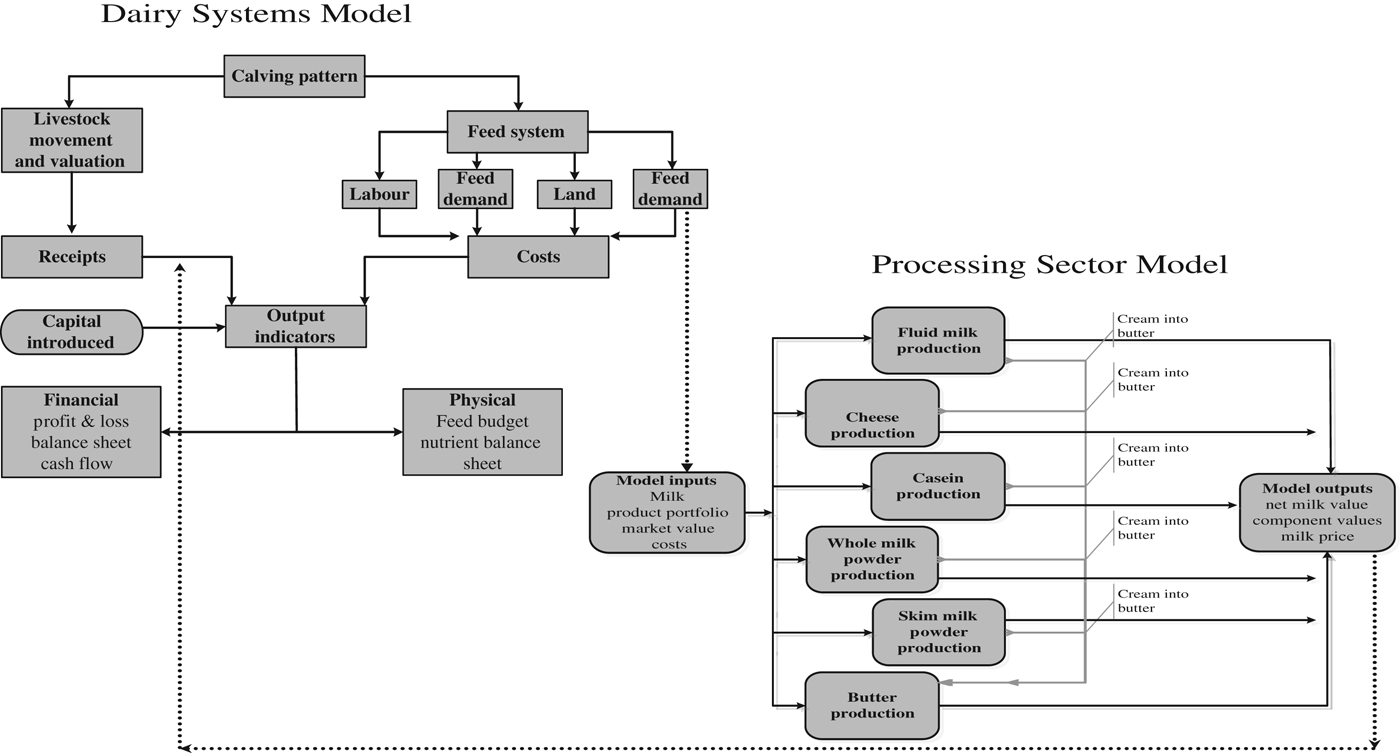
Two models, the Moorepark Dairy Systems Model (MDSM) (Shalloo et al. Reference Shalloo, Dillon, Rath and Wallace2004) and the Moorepark Processing Sector Model (MPSM) (Geary et al. Reference Geary, Lopez-Villalobos, Garrick and Shalloo2010), were used in the current analysis. The MDSM simulates dairy systems inside the farm gate, whereas the MPSM simulates processing activities from milk collection at the farm gate to selling and distribution of intermediate and final dairy products. In this analysis both models were run simultaneously as an interacting system:
• Two calving patterns, either spring calving only (seasonal) or split 0·5 spring and 0·5 autumn calving (less seasonal), were incorporated into the MDSM.
• The supply profiles produced by the MDSM were applied to the Irish national milk pool to calculate the monthly volumes of milk produced and processed. These quantities and the fat, protein and lactose compositions were inputs for the MPSM.
• The MPSM calculated (i) the volumes of products produced per month based on the volume and composition of milk received, (ii) the processing costs, (iii) market returns, (iv) net milk value (NMV; total revenue – total costs), (v) milk price per litre and (vi) value per kg of fat and protein per month of year for both calving patterns.
• The values per kg of fat and protein calculated in the MPSM per month of year for both calving patterns were incorporated into the MDSM so that net farm profit could be calculated from the perspective of a typical 40 ha farm. This net farm profit accounted for the impact of milk supply profile on processor milk price through the calculated values per kg of fat and protein, which were incorporated into the MDSM.
• Net farm profit, expressed as margin per litre, was then multiplied by the litres of milk in the national milk pool of 5189·9 million litres (Central Statistics Office; CSO 2011) to estimate the net industry returns for both supply profiles.
• The net industry returns, the returns at processor level, farm level and milk price paid were compared for both the seasonal and less seasonal milk supply profiles.
Moorepark Dairy Systems Model
The MDSM (Shalloo et al. Reference Shalloo, Dillon, Rath and Wallace2004) is a stochastic budgetary simulation model of an Irish dairy farm (Fig. 1). It allows investigation of the effects of varying biological, technical and physical processes on farm profitability. The model integrates animal inventory and its valuation, along with milk production, feed requirements, and land and labour utilization to provide an economic analysis of the production system. The default parameters of the MDSM were obtained from the results of experiments conducted in Moorepark (Dillon et al. Reference Dillon, Crosse, Stakelum and Flynn1995; Ryan Reference Ryan1998; Horan et al. Reference Horan, Dillon, Faverdin, Delaby, Buckley and Rath2005; McCarthy et al. Reference McCarthy, Horan, Dillon, O'Connor, Rath and Shalloo2007; O'Donovan & Delaby Reference O'Donovan and Delaby2008). The model was run holding land area constant at 40 ha based on the average farm size in Ireland (O'Donnell et al. Reference O'Donnell, Shalloo, Butler and Horan2008). The MDSM assumes that all male calves were sold and replacement heifers were reared on farm from birth. Feed energy requirements were calculated in the MDSM based on the net energy required for milk production, maintenance, pregnancy and body weight change (Jarrige Reference Jarrige1989). Variable costs (fertilizer, contractor charges, medical and veterinary fees, artificial insemination, silage and reseeding), fixed costs (machinery maintenance and operating costs, farm maintenance, car, telephone, electricity and insurance) and market prices (calf, cull cow and milk) in the MDSM were based on updated prices from a Teagasc (2008) report and the CSO (2011). The MDSM accounts for full labour expenses, where one labour unit costs €22 855 per year (1848 h). While the MDSM model is stochastic, no stochastic variables were included in the current analysis.
Schematic representation of MDSM and MPSM.

The outputs of the MDSM include financial indicators (cash flow, profit and loss and balance sheet) and physical outputs (feed budget, nutrient balance sheet and physical ratios). Total farm receipts account for milk and livestock receipts. Total farm costs include variable and fixed costs as well as depreciation.
Calving patterns and milk supply profile assumptions
Two calving patterns were assumed in the MDSM. Using these calving patterns, the MDSM estimated the milk supply profile and the composition of milk for the year.
Seasonal
The February milk supply profile represented seasonal supply with a mean calving date of 15 February, which comprised 0·15 of cows calved in January, 0·70 calved in February and 0·15 calved in March. The seasonal milk supply profile currently being operated in Ireland is based on a mean calving date of mid-March; however, the recent analysis by Geary et al. (Reference Geary, Lopez-Villalobos, Garrick and Shalloo2012) demonstrated that a mean calving date of mid-February is more optimal for the Irish dairy industry.
Less seasonal
The less seasonal supply profile was representative of a split spring and autumn calving period with 0·50 of the herd calving in each period. This calving pattern lowered the peak compared with the seasonal supply, with proportionately more milk produced at the shoulders of the season, effectively flattening the milk supply profile. The calving pattern consisted of 0·075 of the herd calving in January, 0·350 in February and 0·075 in March, while in the autumn 0·200 of cows calved in September, 0·250 in October and 0·050 in November. A 50 : 50 split calving pattern was chosen for this analysis because (1) at a practical level, shifting from one compact calving period to two compact calving periods was deemed more likely than a shift to constant year-round calving and (2) Irish-specific research has been conducted previously comparing spring calving only and a split spring/autumn calving system (Ryan Reference Ryan1998; O'Brien & Gleeson Reference O'Brien and Gleeson2006).
Seasonal and less seasonal assumptions
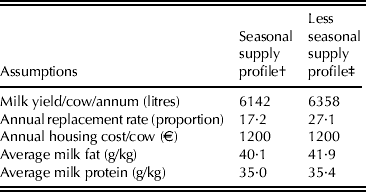
Ryan (Reference Ryan1998) examined the impact of autumn calving only, 0·5 autumn and 0·5 spring calving, and spring calving only patterns on performance and grazing management on Irish dairy farms over a 2-year period. Data on the spring only (seasonal) and 0·5 autumn and 0·5 spring (less seasonal) calving patterns from Ryan (Reference Ryan1998) were used in the current analysis (Table 1). Housing construction costs were assumed to be equivalent for both supply profiles as no data were available on higher housing costs for the split calving system. This data were integrated into the MDSM, which resulted in differences in feed demand and fertility performance. The proportion of milk supplied per month of year and the relative fat, protein and lactose compositions for both supply profiles were generated using standard lactation curve records (Olori & Galesloot Reference Olori and Galesloot1999) and the data from Ryan (Reference Ryan1998). The milk supply profile throughout the year along with the fat, protein and lactose compositions of milk for both supply profiles from the MDSM were fed into the MPSM. The on-farm labour requirement in the current analysis was 18% higher for the less seasonal relative to the seasonal milk supply profile, based on the research carried out by O'Brien & Gleeson (Reference O'Brien and Gleeson2006), who compared spring calving herds with mixed spring and winter calving herds.
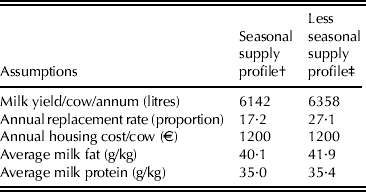
Additional Moorepark Dairy Systems Model assumptions
A 40 ha farm was assumed in the analysis for both supply profiles. Replacement heifer costs were estimated at €1451 (Kennedy et al. Reference Kennedy, Shalloo and Buckley2011). Cull cow value was estimated at €350 per cull cow, male calf price was assumed to be €102 per calf, concentrate costs were assumed to be €250 per tonne, the opportunity cost of land was estimated at €450 per hectare and the labour costs were €1905 per labour unit per month based on the current prices.
The MDSM estimated the net farm profit for a single dairy farm based on the assumptions outlined above. The net farm profit was calculated in the MDSM using the monthly fat and protein values calculated by the MPSM; therefore it accounted for processor returns as well as farm returns. The net farm profit was expressed as margin per litre and was multiplied by the national milk pool (5189·9 million litres; CSO 2011) to estimate the net industry returns for each of the supply profiles.
Moorepark Processing Sector Model
A milk processing sector model has been developed for the Irish dairy industry (Geary et al. Reference Geary, Lopez-Villalobos, Garrick and Shalloo2010) based on annual activities. The model presented in the current analysis expands the Geary et al. (Reference Geary, Lopez-Villalobos, Garrick and Shalloo2010) model to function on a monthly time step, with 12 independent sets of inputs and outputs (Geary et al. Reference Geary, Lopez-Villalobos, Garrick and Shalloo2012). As outlined in Geary et al. (Reference Geary, Lopez-Villalobos, Garrick and Shalloo2010), the approach uses a mass balance milk processing-sector model that accounts for all inputs, outputs and losses involved in dairy processing. The model is a mathematical representation of the conversion of milk into dairy products; Fig. 1 provides a schematic of the model. Within the model the production of cheese, casein, butter, whole milk powder (WMP), skimmed milk powder (SMP) and fluid milk is simulated, with the by-products (butter milk powder (BMP), whey powder and cream) all being further processed or sold. Liquid milk and other fresh dairy produce have been excluded from the current analysis because these products are generally not exported from Ireland.
The volume and composition of raw milk intake (output from the MDSM), product portfolio and its composition are included as model inputs that are used in the simulations. The quantities of products and by-products that can be produced from the available milk pool to meet product specifications are calculated. The return from raw milk is calculated (NMV) and the values per kg of fat, per kg of protein and carrier costs per litre are derived in the model.
The proportion of milk that is directed toward the production of each product is specified in the model. Some of the milk is separated into cream and skimmed milk based on the composition of: (a) the milk and (b) the final product to be manufactured. The volumes of whole milk, cream and skimmed milk from separation are reconstituted in differing proportions to meet final product specifications. Excess cream not used in the production process can be sold or used in butter manufacture with excess skimmed milk remaining from butter manufacture being used in the production of SMP. As this is a mass balance model, all components of the milk received are accounted for, whether they are utilized in product manufacture or lost in the production process. The compositions of the dairy products produced in the model are presented in Table 2 and remained constant throughout the year. The simulations of the dairy products produced in the model are described in detail in Geary et al. (Reference Geary, Lopez-Villalobos, Garrick and Shalloo2010, Reference Geary, Lopez-Villalobos, Garrick and Shalloo2012).
Composition of dairy products simulated in the MPSM

* WMP, Whole milk powder; SMP, Skimmed milk powder; BMP, Butter milk powder.
The model outputs include the volume of milk used in the production of each product, the volume of products produced, the total processing costs (TC), the total revenue (TR), the NMV (TR-TC), the milk price and the component values of milk as per Geary et al. (Reference Geary, Lopez-Villalobos, Garrick and Shalloo2010, Reference Geary, Lopez-Villalobos, Garrick and Shalloo2012).
Moorepark Processing Sector Model simulations
The MPSM analysis was run assuming that the national milk pool in Ireland of 5189·9 million litres of milk (CSO 2011) was being processed. This volume of milk was applied to both the seasonal and less seasonal milk supply profiles to apportion the volume of milk processed per month. Monthly cheese and casein processing capacity was constrained which impacted the product mix throughout the year. Based on this data, and the assumptions outlined below the model outputs were calculated and the component values of milk (value per kg of fat and per kg of protein) were incorporated into the MDSM in order to complete the financial analysis for the farming sector and the industry as a whole.
Moorepark Processing Sector Model assumptions
Market values
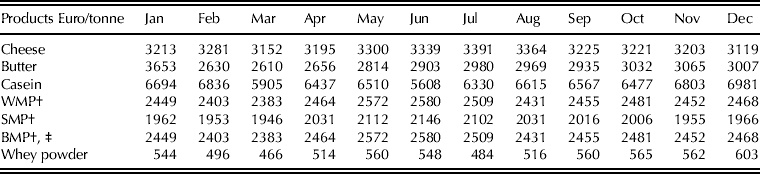
There is some seasonal variation around product market values. The market values assumed in the current analysis were taken from the Dutch official quotation system (Productschap Zuivel 2011) to capture this price variation. This is the quotation system referred to by the Irish Dairy Board in financial analyses. The monthly market prices were representative of a 3-year average from 2008 to 2010. The market values for butter, WMP, SMP and whey powder were representative of the market prices for the Netherlands. Market prices for cheese and casein were not quoted for the Netherlands therefore the market price for cheese was representative of the UK cheddar cheese market price (DairyCo 2011) and the market price for casein was representative of the US casein market price (CLAL 2011). As in Geary et al. (Reference Geary, Lopez-Villalobos, Garrick and Shalloo2010, Reference Geary, Lopez-Villalobos, Garrick and Shalloo2012) the market price for BMP was assumed to be equivalent to the market price for WMP. The product market values assumed for each of the 12 months in the current analysis are presented in Table 3.
Product market values assumed per tonne of dairy product in the MPSM*
* Assumed average market prices per month from 2008 to 2010 as per the Dutch official quotation (Productschap Zuivel 2011) for butter, WMP, SMP and whey powder. Cheese market prices were representative of the UK cheddar cheese market price (DairyCo 2011). Casein market prices were taken from the US casein market price (CLAL 2011).
† WMP, Whole milk powder; SMP, Skimmed milk powder; BMP, Butter milk powder.
‡ Assumed BMP market values equivalent to WMP market values.
Since the market values over the 3 years from 2008 to 2010 capture periods of price volatility, further analysis could be carried out capturing periods of greater price stability to determine the impact this would have on the study outcomes. Analysis by Geary et al. (Reference Geary, Lopez-Villalobos, Garrick and Shalloo2012) demonstrated that the MPSM is sensitive to changes in product market values. However, volatility is expected to be a key feature of milk price into the future.
Processing costs
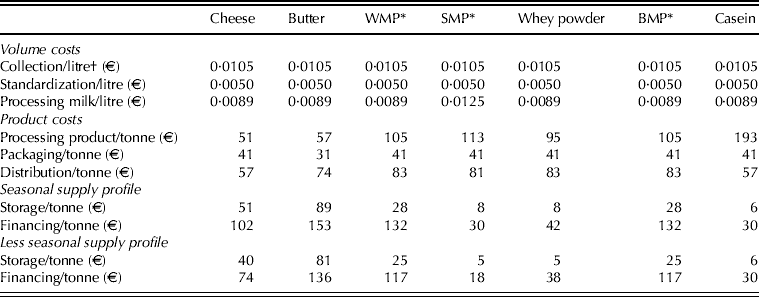
The processing costs and cost components published in Geary et al. (Reference Geary, Lopez-Villalobos, Garrick and Shalloo2010) were further validated via additional consultative processes with financial and managerial dairy processing personnel (Table 4) using the Delphi technique (Dalkey & Helmer Reference Dalkey and Helmer1963). The processing costs assumed in the current analysis were representative of the processing costs incurred by Irish dairy processors. The unit processing costs included in the current analysis were assumed to stay constant per month of year and were applied either to the volume of milk being processed (volume-related processing costs) or the volume of product produced (product-related processing costs).
Volume and product-related processing costs assumed in the MPSM
* WMP, Whole milk powder; SMP, Skimmed milk powder; BMP, Butter milk powder.
† Quinlan et al. (Reference Quinlan, Keane, O'Connor, Shalloo, Gosh and Murray2010).
Storage and finance costs were incurred in the current analysis when product in excess of demand was produced and so required storage; as a result capital was tied up while this product was stored and not sold, and this cost was captured via the financing costs. The demand for each product was calculated by summing the volume of product produced throughout the year and dividing this by 12 to give the monthly demand for each product. When the volume of product produced per month exceeded this demand, storage and financing costs were incurred but only on the volumes that exceeded demand. Storage and finance costs were higher in the seasonal milk supply profile due to the high peak in April and the greater number of months that excess product was stored. The maturation period for cheese was accounted for in both supply profile analyses.
The processing costs included in the current analysis are presented in Table 4.
Fixed costs
Fixed costs were included at a rate of 1·5 cents per litre, which was validated in the consultation process. This was applied to the total volume of milk being processed in the year for Ireland (5189·9 million litres) and the cost was spread evenly over the 12 months of the year. This cost incorporated rents and rates, depreciation, quality control, management, central research and development, marketing, administration and IT.
Capacity constraints
A cheese and casein processing capacity was incorporated into the MPSM model that was representative of the current capacity in Ireland to produce these products (Geary et al. Reference Geary, Lopez-Villalobos, Garrick and Shalloo2012). The processing capacity for cheese was 150 million litres of milk per month and for casein was 90 million litres of milk per month. Analysis by Geary et al. (Reference Geary, Lopez-Villalobos, Garrick and Shalloo2012) demonstrated how sensitive the MPSM model outcomes are to processing capacity constraints.
Investment costs
Owing to the higher peak with the seasonal milk supply profile, additional processing capacity was required. Using the national milk pool of 5189·9 million litres of milk processed throughout the year, the difference in volume between the seasonal and less seasonal supply profiles at peak (April) was 96·8 million litres. Additional capacity to process this volume of milk was taken into account in the seasonal analysis. The costs of building a 15 tonnes/h dryer, with a daily capacity of 3 000 000 litres and a 3 tonnes/h dryer, with a daily capacity of 550 000 litres, on a greenfield site in Ireland were estimated at €57·8 and €19·2 million, respectively (Teagasc, unpublished confidential report), €76·9 million in total. It was assumed that the value of this investment would depreciate over a 15-year period, with a depreciation cost of €5·1 million per annum. In addition, the annual interest charge on an investment of this scale was estimated at €3·8 million (based on an interest charge of 5%). The estimated charge required to increase processing capacity was €8·9 million annually. This annual investment cost was incorporated in the MPSM as a fixed cost in the seasonal supply profile analysis. Sensitivity analysis was carried out to estimate the impact on net industry returns if the investment costs presented here were doubled.
Product mix
The product mix in the current analysis changed per month. For each of the analyses the casein capacity was filled first, then the cheese capacity was filled and the remainder of the milk pool was apportioned to butter and SMP (0.76) and WMP (0.24). This ratio was calculated based on the Irish dairy product mix of 2008 (FAOSTAT 2009) in which 0·30 of milk was used to produce butter, 0·13 to produce SMP, 0·43 to produce cheese and 0·14 to produce WMP. Removing the 0·43 to cheese, after casein was produced, and recalculating the WMP, SMP and butter proportions to total 1·00 resulted in the ratios presented above. In the seasonal supply profile analysis, cheese and casein were not produced in the months of January and December due to the poor milk quality from spring calving herds in these months. This assumption was based on processor practice in Ireland (Guinee et al. Reference Guinee, Mulholland, Kelly and Callaghan2007). In the months of January and December when cheese and casein were not produced, the milk pool was apportioned 0·43, 0·43 and 0·14 to butter, SMP and WMP, respectively.
RESULTS
Physical outputs
Farm level
Volume and composition of milk
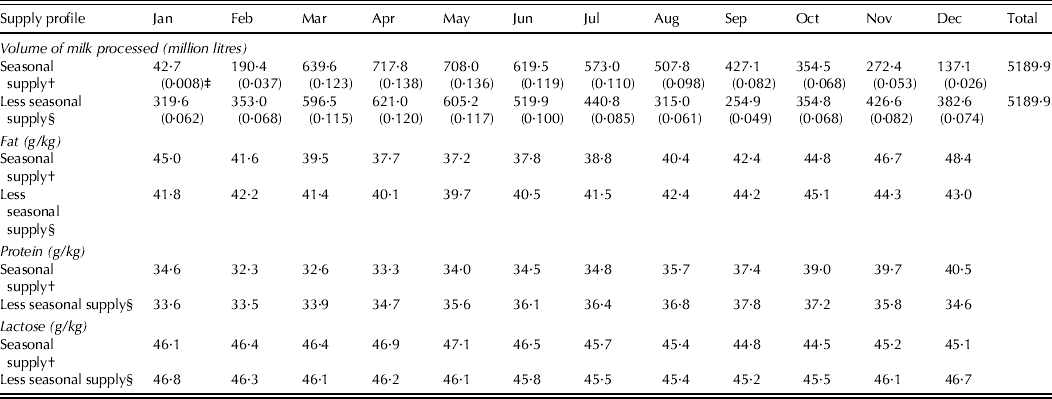
Based on a mean calving date of 15 February the seasonal milk supply profile estimated by the MDSM resulted in 13·8% of the annual milk pool being supplied in April, close to the current actual Irish national milk supply of 14·1% in May. The April fraction applied to the national milk pool of 5189·9 million litres gave a peak milk supply of 717·8 million litres (Table 5). The associated fat, protein and lactose composition of the seasonal milk supply in April was 37·7, 33·3 and 46·9 g/kg, respectively. The lowest volume of milk supplied in the seasonal supply profile was 0·008 or 42·7 million litres in January. The associated fat, protein and lactose composition was 45·0, 34·6 and 46·1 g/kg, respectively. Utilizing the 0·5 spring and 0·5 autumn calving pattern in the MDSM to achieve a less seasonal supply profile resulted in a peak milk supply in April of 0·12, with the lowest volume of milk supplied in September at 0·049 of the national milk pool, equivalent to 621·0 and 254·9 million litres, respectively (Table 5). The associated fat, protein and lactose composition of the less seasonal milk supply was 40·1, 34·7 and 46·2 g/kg, respectively, in April and 44·2, 37·8 and 45·2 g/kg, respectively, in September.
Milk supply profile, volume of milk produced and the associated fat, protein and lactose content of milk for the seasonal and less seasonal supply profiles, estimated using the MDSM*
* The volume of milk and the associated fat, protein and lactose composition in this table were generated using the MDSM and subsequently used as inputs in the MPSM.
† Spring calving only.
‡ Numbers in brackets represent the proportion of the milk pool supplied per month.
§ 0·5 spring and 0·5 autumn calving.
The volume of milk supplied and the associated fat, protein and lactose compositions of both supply profiles for the 12 months of the year are presented in Table 5. The monthly volumes and compositions of milk were incorporated into the MPSM.
Milk produced
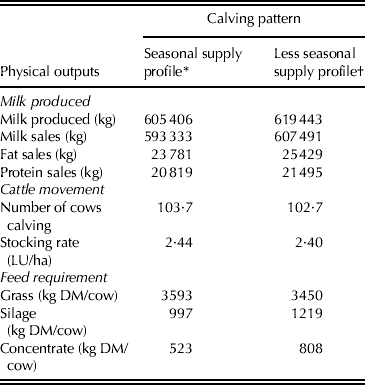
Using the seasonal milk supply profile in the MDSM, the total volume of milk produced throughout the year for a 40 ha farm was 605 406 kg, with total milk sales of 593 333 kg, fat sales of 23 781 kg and protein sales of 20 819 kg (Table 6). The total volume of milk produced throughout the year for the farm for the less seasonal supply profile was estimated at 619 443 kg, with total milk sales of 607 491 kg, fat sales of 25 429 kg and protein sales of 21 495 kg.
Moorepark Dairy Systems Model physical outcomes for a 40 ha farm
* Spring calving only.
† 0·5 spring and 0·5 autumn calving.
Livestock
The stocking rate was 2·44 cows per hectare using the seasonal milk supply profile and 2·40 cows per hectare using the less seasonal supply profile (Table 6). The number of cows calving was 104 for the seasonal supply profile and 103 for the less seasonal supply profile.
Feed requirements
With the seasonal supply profile, 3593 kg DM of grass, 997 kg DM of grass silage and 523 kg DM of concentrate were fed per cow (Table 6). Utilizing the less seasonal supply profile, less grass and more grass silage and concentrate were fed, specifically 3450 kg of grass, 1219 kg of silage and 808 kg of concentrate per cow.
Processor level
Milk utilization
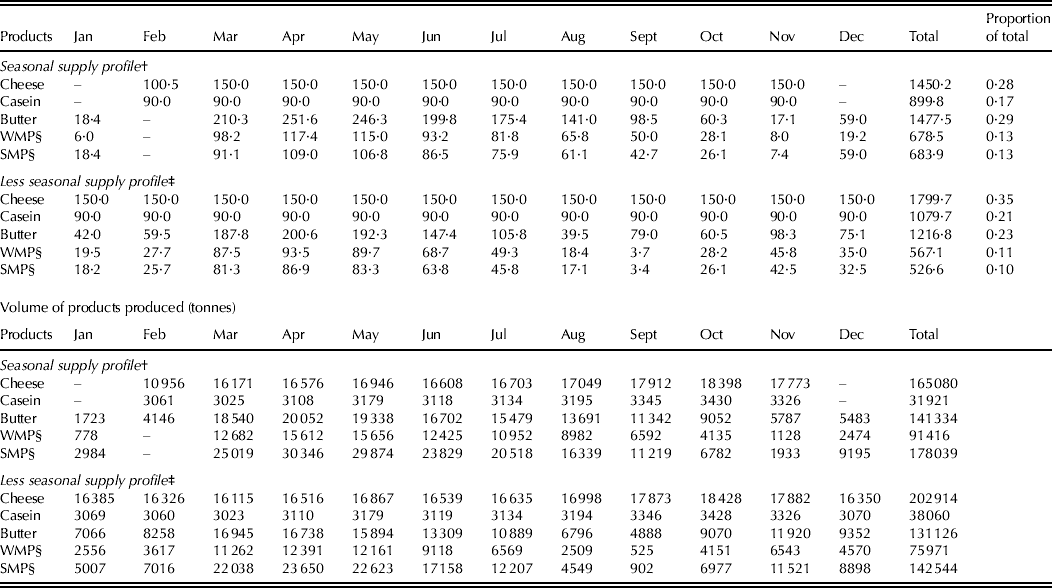
The volume of milk used in the production of cheese over the 12 months of the year was 1450·2 million litres using the seasonal milk supply profile and 1799·7 million litres using the less seasonal supply profile (Table 7). As a proportion of the total volume of milk used in the production of cheese over the year this represented 0·28 for the seasonal and 0·35 for the less seasonal supply profiles. The higher volume of milk to cheese with the less seasonal supply profile reflected that the cheese processing was at capacity for a longer period (the entire year) relative to only 9 months in the seasonal supply profile. The volume of milk used in casein production was 899·8 million litres using the seasonal supply profile and 1079·7 million litres using the less seasonal supply profile. The higher volume of milk used in casein production for the less seasonal supply profile again reflected that casein was produced over the 12 months of the year and the casein processing was at capacity in each of these 12 months. Owing to the higher volumes of milk used in the production of cheese and casein using the less seasonal supply profile, less milk was available for butter, WMP and SMP production with 0·23, 0·11 and 0·10 of the annual milk supply being used in the production of each product, respectively. Using the seasonal milk supply, 0·29, 0·13 and 0·13 of the annual milk supply was used in the production of butter, WMP and SMP, respectively.
Moorepark Processing Sector Model physical outcomes for the Irish milk processing sector: monthly volumes of milk used in the production of each product and volumes of products produced for the seasonal and less seasonal supply profiles assuming a capacity constraint*
* Capacity constraint=cheese processing capacity of 150 000 000 litres/month; casein processing capacity of 90 000 000 litres/month.
† Spring calving only.
‡ 0·5 spring and 0·5 autumn calving.
§ WMP=Whole milk powder, SMP=Skimmed milk powder.
Quantity of product produced
Using the seasonal milk supply profile over the 12 months of the year, production in tonnes were 165 080 cheese, 31 921 casein, 141 334 butter, 91 416 WMP and 178 039 SMP (Table 7). Using the less seasonal supply profile the tonnages were 202 914 cheese, 38 060 casein, 131 126 butter, 75 971 WMP and 142 544 SMP.
Financial outputs
Processor level
Net milk value
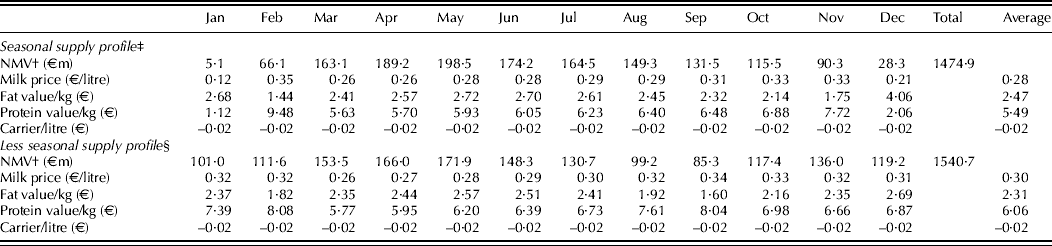
The seasonal supply profile and the less seasonal supply profile resulted in annual NMVs of €1474·9 and €1540·7 million, respectively, a gain of €65·8 million by moving from a seasonal to a less seasonal supply profile (Table 8). Utilizing the seasonal supply profile, January had the lowest monthly NMV of €5·1 million, reflecting the volume of milk being processed and the exclusion of high-value products (cheese and casein) from the product mix. Using the less seasonal supply profile, September had the lowest monthly NMV (€85·3 million) when milk supply was at its lowest.
Moorepark Processing Sector Model financial outcomes for the Irish milk processing sector: monthly net milk value, milk price and component values of milk for the seasonal and less seasonal supply profiles assuming a capacity constraint*
* Capacity constraint=cheese processing capacity of 150 000 000 litres/month; casein processing capacity of 90 000 000 litres/month.
† Net milk value.
‡ Spring calving only.
§ 0·5 spring and 0·5 autumn calving.
Milk price
The lowest milk price using the seasonal supply profile was generated in January at 12·0 cents per litre with the highest milk price being in February at 34·7 cents per litre (Table 8). The average milk price across the year for the seasonal supply profile was 28·4 cents per litre. Using the less seasonal supply profile the lowest milk price was generated in March at 25·7 cents per litre with the highest price in September at 33·5 cents per litre (Table 8). The average milk price across the year for the less seasonal supply profile was 29·7 cents per litre. The current analysis highlights that by moving from a seasonal to a less seasonal supply profile a gain in milk price of 1·3 cents per litre could be made.
Component values of milk
The average values per kg of fat and kg of protein for the seasonal supply profile were €2·47 and €5·49, respectively (Table 8). The highest value of fat relative to protein was generated in December when cheese and casein were excluded from the product mix. The highest protein values relative to fat were generated in February and November when the largest proportion of available milk was utilized in the production of cheese and casein. The less seasonal supply profile resulted in an average value per kg of fat of €2·31 and an average value per kg of protein of €6·06 (Table 8). The higher protein value with the less seasonal supply profile and the higher fat value with the seasonal supply profile reflected the different volumes of milk being used in the production of cheese and casein.
Farm level
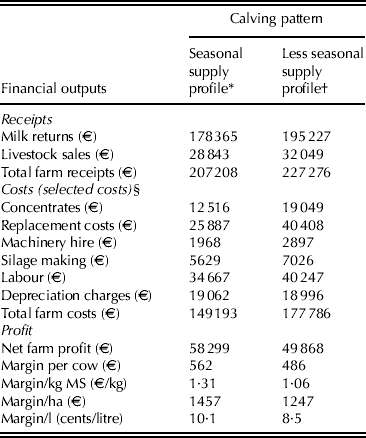
The value per kg of fat and protein for each month of the year for both supply profiles, as calculated in the MPSM, were incorporated into the MDSM to estimate the impact on farm profitability of changing the milk supply profile. The milk returns and livestock sales were higher for the less seasonal supply profile resulting in total farm receipts that were €20 068 higher for the less seasonal supply profile relative to the seasonal supply profile (Table 9). However, the total farm costs were €28 593 higher for the less seasonal supply profile than the seasonal supply profile. The main cost components contributing to this differential were concentrates (€6533), replacement costs (€14 521), machinery hire (€929), silage making (€1397) and labour (€5580). This resulted in the seasonal supply profile generating a net farm profit that was €8431 higher than the less seasonal supply profile (Table 9).
Moorepark Dairy Systems Model financial outcomes‡
* Spring calving only.
† 0·5 spring and 0·5 autumn calving.
‡ The farm financial outcomes account for the values per kg of fat and protein calculated by the processing sector model for each supply profile. Therefore, the farm system financial outcomes capture the farm and processor returns.
§ Selected costs presents the cost components that have the greatest differential between both supply profiles.
Net industry returns (farmer and processor)
Using the dairy farm margins per litre (which captures farm and processor returns) for each supply profile and scaling this up to national industry returns, by multiplying by the volume of milk produced and processed of 5189·9 million litres based on 2010 data, provided the net industry returns (farmer and processor). Multiplying the farm margin per litre by the volume of milk processed nationally (e.g. €0·101×5189·9 million litres) gave a net industry return of €524·2 million for the seasonal supply profile and €441·1 million for the less seasonal supply profile. This equated to a net industry gain of €83·1 million from operating a seasonal milk supply profile as opposed to a less-seasonal milk supply profile. The farm, processor and net industry returns are summarized in Table 10.
Summary of processing sector, farm sector and net industry returns for both the seasonal and less seasonal milk supply profiles

* Spring calving only.
† 0·5 spring and 0·5 autumn calving.
Doubling the investment costs to €17·8 million annually would reduce the gain of a seasonal milk supply profile relative to a less seasonal milk supply profile by €8·9 million to €74·1 million. Thus highlighting that the seasonal supply profile was still optimal relative to a less seasonal supply profile even with very high investment costs accounted for.
DISCUSSION
Within the processing sector a movement from a seasonal to a less seasonal supply profile would enable greater volumes of cheese and casein to be produced, thus generating higher returns relative to the seasonal supply profile, based on the underlining assumptions. Conversely, at farm level moving from a seasonal to a less seasonal milk supply profile would result in higher input costs and lower net farm profit. In the current analysis the net impact to the Irish dairy industry of moving from a seasonal to a less seasonal milk supply profile would be a reduction in returns of €83 million per annum.
Models and analysis
Farm and processing sector models have been developed and used worldwide to inform strategic decision making. Similar to the analysis presented here, Keane & Killen (Reference Keane and Killen1980) found earlier spring calving to be of net benefit relative to a more even supply pattern for the Irish dairy industry. Davis & Kirk (Reference Davis and Kirk1984) found that there would be an increase in costs at farm level nationally of £2·1 million with a gain in processor returns of £900 000, resulting in a net industry cost of £1·2 million by flattening the milk supply profile for Northern Ireland. Jalvingh et al. (Reference Jalvingh, Van Arendonk and Dijkhuizen1993) found the optimal calving pattern in the Netherlands, from the farm perspective was for calvings concentrated in the autumn period. The literature echoes the finding presented here, there can be conflicts between optimality for the farm and optimality for the processing sector. There is a net benefit of looking at a combination of traits rather than evaluating the farm and processing sectors independently.
The outputs estimated in the current analysis in terms of milk price (28·4 cents per litre) and the volume of product produced are closely aligned with the actual milk prices received between 2008 and 2010 (28·7 cents per litre; CSO 2011) and volumes of product produced over this time period. Therefore the modelled outcomes are realistic for the Irish dairy market.
Research has demonstrated that from a cost point of view (farm level) the less seasonal system will always struggle to be as profitable as the seasonal system, predominantly due to the low-cost grazing of the seasonal system (Finneran et al. Reference Finneran, Crosson, O'Kiely, Shalloo, Forristal and Wallace2010). However, if an increase in product returns (processing level) can offset the negative effect it would make the less seasonal milk production system equally or more profitable than the seasonal production system. In Ireland, over 0·80 of the milk produced is exported. Ireland's reliance on the production of long-term storable dairy produce is reflective of its proximity to the international dairy markets. While in theory the production and exportation of value added fresh dairy produce would seem possible for the Irish dairy industry to increase revenue, in practice fresh dairy produce is heavily discounted in local dairy markets thus putting fresh Irish dairy produce at a competitive disadvantage (AR, Irish Dairy Board).
Implications of a change to the milk supply profile
Farm level
Feed budget and grazing season length
One of the key strengths of the Irish dairy production system is its reliance on low-cost grazed grass. As a result, milk production in Ireland is seasonal with milk supply following seasonal grass growth. Moving from a seasonal milk supply profile to a less seasonal milk supply profile would result in less grazed pasture in the diet with out-of-season feed requirements being met through harvested forages (silage, maize, etc.) or purchased feed. Hennessy et al. (Reference Hennessy, O'Donovan, French and Laidlaw2006) found the dry matter digestibility of grass decreased from 20 November to 20 January, thus highlighting the difficulty of managing an autumn calving herd while maintaining pasture quality, milk yield and solids concentration.
Labour
Split-calving systems involve two calving seasons, two breeding seasons and milking throughout the year, which has substantial labour time and cost implications. O‘Brien & Gleeson (Reference O'Brien and Gleeson2006) found mixed production systems on Irish dairy farms had a significantly higher average daily labour input of 17·6 h/day relative to a spring system with an average of 14·8 h/day. As Irish dairy farms expand in a post-quota environment, the additional labour required to operate a large-scale farm with a 50 : 50 split-calving pattern could have considerable cost implications at the farm level.
Fertility
Ryan (Reference Ryan1998) found when examining a seasonal and less seasonal milk production system in Ireland that submission rates for service in the first 3 weeks of the breeding season was highest for spring calving cows at 0·90, relative to 0·69 for autumn and spring calving cows. The infertility rate was 0·19 for autumn and spring calving cows and 0·08 for spring calving cows. The main contributing problems associated with infertility in autumn calving systems are based on reduced expression of oestrus and ultimately submission rates among housed cows as found by Fitzgerald et al. (Reference Fitzgerald, Mee and O'Grady2004). Increased dairy cow replacement rate in the less seasonal system accounted for a significant component of the differences in profitability between both systems and suggest that there is a requirement for a greater emphasis on dairy cow fertility in the less seasonal system to achieve similar fertility performance.
Processor level
Investment
A seasonal milk supply profile is characterized by high peaks and lower capacity utilization. Ireland's capacity utilization at processor level operates at approximately 0·54 nationally, with significant year-to-year variation. As a result, seasonal supply profiles require a higher capital investment. However, as demonstrated in the current paper, even accounting for this capacity investment the seasonal milk supply profile was more profitable to the dairy industry relative to a less seasonal supply profile. Even when investment costs were doubled the seasonal calving system was still optimum.
Product portfolio
With a seasonal milk supply profile, late lactation milk may not be compatible with cheese and casein production due to the ‘processability’ (protein to fat ratio) of milk (Guinee et al. Reference Guinee, Mulholland, Kelly and Callaghan2007). However, with a mix of both early and late lactation milk with a less seasonal supply profile, year-round casein and cheese production is feasible. In the analysis presented here, this equated to proportionately more cheese and casein being produced. As mentioned earlier, there is scope for the Irish dairy industry to move from the production of commodity products to the production of short shelf life, fresh dairy produce if the markets are identified and if it is determined to be a profitable strategy.
Irish dairy processors need to determine the optimal product mix (maximize net profits to the industry as a whole) within the constraints of the system. The optimal product mix could change between months as the product market values change. Flexibility (in terms of processing capacities) should be built into the Irish dairy industry to respond to these market changes and therefore maximize returns.
Tools to modify the milk supply profile
Seasonal milk payment systems and incentive schemes
Seasonal milk payment systems are commonly used in the dairy industry to encourage a desirable milk supply profile. In New Zealand, seasonal milk payments were implemented in periods of short supply so as to encourage more milk to be supplied (Blackwell Reference Blackwell2001). Keane (Reference Keane1981) found that incentives spread over many months had little benefit in encouraging a shift in calving dates, whereas incentives confined to early spring gave a significant advantage to calving in January–February when compared with March–May.
The monthly values per kg of fat and protein and the monthly milk price estimated in the current analysis using the MPSM could be used to develop an incentive scheme to encourage the most profitable milk supply profile for the industry. McErlean (Reference McErlean1999) found that in the long run, a peak to trough seasonal price differential of 11 pence per litre would be required to produce an even pattern of milk supply in Northern Ireland. It is not clear if McErlean (Reference McErlean1999) examined whether this was the most profitable strategy for the Northern Ireland dairy industry as a whole.
CONCLUSIONS
Based on the assumptions in the current analysis the seasonal milk supply profiles are disadvantageous at processor level in terms of storage, financing and capacity utilization; however, at a net industry level (accounting for farm and processor returns) a seasonal supply profile is more profitable than a less seasonal supply profile. The Irish dairy industry is primed for expansion in a post-quota environment with potential for an estimated 50% increase in milk production. Based on the underlying assumptions within the analysis presented here, maintaining seasonal milk production while investing in additional processing facilities was found to be more profitable for the Irish dairy industry than a movement towards a less seasonal milk supply profile. However, increased dairy cow replacement rate in the less seasonal system accounted for a significant component of the differences in profitability between both systems and suggests that there is a requirement for a greater emphasis on dairy cow fertility in the less seasonal system to achieve similar fertility performance. Optimizing the product portfolio subject to market demands, processing capacities and market returns will help ensure the sustainability of the Irish dairy industry.