Introduction
Alzheimer's disease (AD) is the most common form of dementia, estimated to rise dramatically in the future (Wimo et al. Reference Wimo, Winbald, Aguero-Torres and von Strauss2003). Research has focused on early accurate diagnosis and intervention. The construct ‘amnestic mild cognitive impairment’ (aMCI; Peterson et al. Reference Petersen, Doody, Kurz, Morris, Rabins, Ritchie, Rossor, Thal and Winbald2001) has become increasingly popular to predict those who are most at risk for developing dementia. It is considered a transitional stage between normal ageing and the earliest clinical diagnosis of AD (Petersen, Reference Petersen2005; Petersen & O'Brien, Reference Petersen and O'Brien2006). Research on clinic-based samples has suggested that the conversion rate from aMCI to dementia is 10–15% per year (e.g. Petersen et al. Reference Petersen, Smith, Waring, Ivrnik and Kokmen1999; Storandt et al. Reference Storandt, Grant, Miller and Morris2006) compared with between 1% and 2% in a normal age-matched non-clinical sample.
While primary impairment in very early AD includes episodic memory function, many authors have reported that attention and executive functioning are also vulnerable at this stage (Parasuraman & Haxby, Reference Parasuraman and Haxby1993; Perry & Hodges, Reference Perry and Hodges1999). In particular, people with early AD exhibit marked difficulty dividing their attention between two concurrent tasks. By comparing performance of a synchronous dual task with that of identical task components done separately and consecutively, a deficit in dual performance can be attributed to failure of the central executive that coordinates the simultaneous operation of these components (Baddeley et al. Reference Baddeley, Logie, Bressi, Della Sala and Spinnler1986). One advantage of the dual task paradigm is that it avoids modality-specific interference between tasks: the tracking task is presented visually and a manual response is required; information for the digit span task is presented aurally with a verbal response (Nebes et al. Reference Nebes, Butters, Houck, Zmuda, Aizenstein, Pollock, Muslant and Reynolds2001). A further strength is that task demands can be fixed at individual ability levels, controlling for individual variation in performance in the component parts of the dual task. Therefore, each patient is his or her own control, adjusting for the generally poorer performance of AD patients in the baseline tasks (Logie et al. Reference Logie, Cocchini, Della Sala and Baddeley2004).
Research has suggested that failure of the ‘coordination’ function is characteristic of mild AD in a laboratory setting. Participants with mild AD appear to be impaired, irrespective of task demands, and this impairment has been found to worsen with illness progression (Baddeley et al. Reference Baddeley, Logie, Bressi, Della Sala and Spinnler1986, Reference Baddeley, Bressi, Della Sala, Logie and Spinnler1991; MacPherson et al. Reference MacPherson, Della Sala and Logie2004). Proponents of the dual task paradigm suggest such findings are in contrast to normal ageing, which they believe has a relatively minor effect on dual task performance (e.g. Baddeley et al. Reference Baddeley, Logie, Bressi, Della Sala and Spinnler1986; Hartley & Little, Reference Hartley and Little1999; Logie et al. Reference Logie, Cocchini, Della Sala and Baddeley2004; but see Crossley & Hiscock, Reference Crossley and Hiscock1992). The equipment used for this test is often an expensive computerized tracking device impractical for clinical settings (e.g. Baddeley et al. Reference Baddeley, Bressi, Della Sala, Logie and Spinnler1991; Logie et al. Reference Logie, Cocchini, Della Sala and Baddeley2004). Della Sala et al. (Reference Della Sala, Baddeley, Papagno, Spinnler, Graham, Holyoak and Boller1995) developed a modified pencil-and-paper version of the tracking component for the dual task. This has been reported to produce results comparable with the original instrument (Della Sala et al. Reference Della Sala, Baddeley, Papagno, Spinnler, Graham, Holyoak and Boller1995; Sebastian et al. Reference Sebastian, Menor and Elousa2006). To our knowledge the dual task paradigm has not been investigated with a sample defined according to recent aMCI criteria (Petersen et al. Reference Petersen, Smith, Waring, Ivrnik and Kokmen1999).
The aim of this study was therefore to assess dual task performance in aMCI to ascertain whether this measure can be useful in the early diagnosis of AD. As AD is associated with a specific impairment in the aspect of working memory that coordinates performance of two separate tasks, we predicted that the performance of people with aMCI and very early AD should be significantly lower than that of aged matched controls. Furthermore, the inclusion of a group of elderly patients with symptoms of depression would test the specificity of dual task impairments in AD. On the basis of the previous research, we predicted that the depressed group would show impairment in the dual task compared with controls.
Method
Participants
We examined 33 patients with aMCI, 10 early AD patients, 17 control out-patients with depressive symptoms and 21 healthy elderly controls, following a protocol approved by the local ethics of research committee. All participants also took part in a larger longitudinal study of neuropsychological markers in pre-clinical AD. The aMCI patients were recruited over a 2-year period (September 2003–September 2005) from tertiary referrals to the local neuropsychological assessment service for older adults and met criteria for aMCI (Petersen et al. Reference Petersen, Smith, Waring, Ivrnik and Kokmen1999). MCI patients had to give subjective reports of memory difficulty corroborated by an informant and exhibit objective memory impairments on neuropsychological tests of episodic memory. In terms of impairments on tests of episodic memory, 13 participants showed an impairment of more than 2 standard deviations (s.d.) below our control mean on two or more tests, a further four showed impairments of 1.5 to 2 s.d. on two or more tests, 12 participants were impaired at 1–1.5 s.d. below control means on two or more tests, and the final four participants performed more than 1 s.d. below controls on one episodic memory test. All aMCI patients underwent comprehensive neuropsychological and psychiatric evaluation and medical screening prior to study entry, as well as neuroimaging before or during the study period, if thought to be clinically indicated by the responsible specialist, i.e. in 24 of the 33 participants in this group. Exclusion criteria for the aMCI group were a diagnosis of dementia or other medical/neurological conditions which may account for memory loss, untreated depressive illness, significant or predominant cerebrovascular disease on neuroimaging, significant motor and/or visual problems or an age below 58 years. Mini Mental State Examination (MMSE) scores ranged from 24 to 30, with a mean of 28.3. The final aMCI group consisted of 15 males and 18 females with a mean age of 73.3 years (range 58–85 years).
For the healthy elderly control group (MMSE 28–30), we recruited spouses or carers of patients who had attended the service. Potential participants were excluded if there was a history of medical, psychiatric or neurological conditions (i.e. stroke or cerebrovascular disease, head injury, alcoholism, schizophrenia, etc) that could conceivably affect cognitive functioning. The healthy elderly control group was matched as closely as possible to the aMCI and early AD groups in terms of age and estimated pre-morbid intelligence quotient (IQ). The final elderly control group consisted of eight males and 13 females with had a mean age of 69.5 years (range 59–81 years).
Ten participants diagnosed with AD, in accordance with National Institute of Neurologic, Communicative Disorders and Stroke–AD and Related Disorders Association (NINCDS-ADRDA; McKhann et al. Reference McKhann, Drachman, Folstein, Katzmann, Price and Stadlan1984) and DSM-IV (APA, 1994) diagnostic criteria, took part in the current study. AD patients were recruited from tertiary referrals to our neuropsychology service or via referrals to the local old age psychiatry service. All early AD patients scored above 23/30 on the MMSE and above 65/100 on the more comprehensive Addenbrooke's cognitive examination (ACE; Mathuranath et al. Reference Mathuranath, Nestor, Berrios, Rakowicz and Hodges2000), indicating relatively mild disease. Patients had undergone relevant medical screening and neuroimaging, together with comprehensive psychiatric and neuropsychological evaluation as part of their initial diagnostic workup. The final early AD group consisted of three males and seven females with a mean age of 73.6 years (range 65–81 years).
Seventeen participants with depressive symptoms (MMSE 25–30) were recruited via local psychiatric out-patient clinics and day hospitals. In an attempt to match this patient group with the aMCI group in terms of illness severity, patients with milder forms of depression were included. Fifteen of the 17 participants were receiving treatment for their symptoms at the time of testing; all but two of these pharmaceutical in nature. As it has been suggested that type of depression does not influence the magnitude of cognitive deficits (Christensen et al. Reference Christensen, Griffiths, Mackinnon and Jacomb1997), participants with a variety of disorders were included. Eight patients had a history of major depression, two of bipolar disorder, two were suffering from anxiety disorders with depressive features, three were considered dysthymic and two were considered to be suffering with a subclinical level of depressive symptoms. Mean geriatric depression scale (30-item version) score for this group was 13.2 (range 0–27). We once again excluded patients with any medical, neurological or psychiatric condition with a known potential to affect cognitive function. The group consisted of three males and 14 females with a mean age of 73.3 years (range 65–84 years). Subjects gave informed written consent to the whole protocol which was approved by the Lothian Research Ethics Committee; the research was completed in accordance with the Helsinki Declaration.
Neuropsychological tests
All participants completed a variation on the modified dual task paradigm (Della Sala et al. Reference Della Sala, Baddeley, Papagno, Spinnler, Graham, Holyoak and Boller1995). This pencil-and-paper test of divided attention consists of two components (a digit span task and a visuospatial tracking task) that are each performed on their own before being performed concurrently. First, participants' digit span was determined. This involved repeating strings of digits read by an experimenter at a rate of approximately two per s. Initially, two-digit strings were presented and these increased one digit at a time if the participant correctly recited five of six examples of each length. When the participant failed to recite two or more strings of the same span, digit span for that person was considered to be the previous length. No time limit was imposed at this stage. Having determined the participants' individual digit span, participants had 90 s to recite as many digit strings, fixed at the individual participants' digit span, as possible (digit span – single). Responses were recorded as correct for each digit recited in the correct order.
Following this, participants completed the tracking task (Della Sala, Reference Della Sala1999). An A3-sized sheet with 319 empty circles linked by a meandering line was presented to the participant. The participant was instructed to trace a line though circles, following the line that was already there, without lifting the pen from the paper. Participants had 90 s for this trial, and the number of circles reached during this time was recorded (tracking – single). The final trial was the concurrent dual task. Here participants had 90 s to simultaneously perform both tasks: recite digit strings fixed at their digit span (digit span – dual) as well as carrying out a tracking task identical to the one used above (tracking – dual). In order to take into account the various strategies one may adopt in performing the two tasks simultaneously, an overall decrement score was calculated using the following formula:

where μ is the combined dual task score, Pm is the proportional loss in span performance between single (Xsingle) and dual task (Xdual) conditions, [(Xsingle – Xdual)/Xsingle] while Pt is the equivalent proportional loss in tracking score. Thus a score of 100 would represent no dual task decrement and lower scores reflect greater dual task decrements.
A number of further tests were administered as part of the longitudinal investigation of neuropsychological markers. These included measures of general cognitive ability, such as the ACE, the more widely known MMSE and the National Adult Reading Test, revised version (NART-R; Nelson & Willison, Reference Nelson and Willison1991). The NART-R was used to provide an estimate of the pre-morbid level of intellectual functioning. Episodic memory was assessed using the Hopkin's verbal list test, revised (HVLT-R; Brandt, Reference Brandt1991) and the paired associates learning test (PAL) from the Cambridge automated neuropsychological test battery (Swainson et al. Reference Swainson, Hodges, Galton, Semple, Michael, Dunn, Iddon, Robbins and Sahakian2001). Participants also completed the trail-making test (TMT) part A and B (Reitan, Reference Reitan1985), considered a measure of attention and executive functioning.
The HVLT-R requires participants to recall as many words as possible immediately following presentation of a 12-item word list. The word list is presented on three consecutive learning trials. The participant is also required to recall, and finally recognize, as many words from the list as he or she is able, following a delay of 30 min. The PAL is a computerized measure of visuospatial learning requiring participants to learn the locations of an increasing number (i.e. 1, 2, 3, 6 and then 8) of patterns (Swainson et al. Reference Swainson, Hodges, Galton, Semple, Michael, Dunn, Iddon, Robbins and Sahakian2001). The score of interest was the number of pattern-position errors at the six pattern level. The TMT A requires tracing a line linking numbers in ascending order, while for the TMT B participants have to connect numbers and letters alternatively in ascending order: the participant has to divide his/her attention back and forth between multiple lines of thought.
Each of these measures has been shown to be sensitive to very early AD (Chen et al. Reference Chen, Ratcliff, Belle, Cauley, DeKosky and Ganguli2000; Nathan et al. Reference Nathan, Wilkinson, Stammers and Low2001; Swainson et al. Reference Swainson, Hodges, Galton, Semple, Michael, Dunn, Iddon, Robbins and Sahakian2001; Hogervorst et al. Reference Hogervorst, Combrinck, Lapuerta, Rue, Swales and Budge2002; Blackwell et al. Reference Blackwell, Sahakian, Vesey, Semple, Robbins and Hodges2004; Stokholm et al. Reference Stokholm, Vogel, Gade and Waldemar2006). Neuropsychological assessments lasted approximately 90 min in total. The order of test administration was identical for all assessments.
Statistics
Data were analysed using SPSS 12.0 for Windows (SPSS Inc., Chicago, IL, USA). Demographic variables were analysed using univariate analysis of variance (ANOVA), and Tukey honestly significantly different pairwise comparisons were carried out on all significant analyses where possible. Where the assumption of homogeneity of variance was not met, this was adjusted for using Games–Howell post-hoc pairwise comparisons, given that the sample sizes were unequal in the current analysis. A univariate ANOVA was carried out on the overall decrement score (see above). Decrement scores broken down into tracking decrement and digit span decrement were also calculated and examined using ANOVAs. Two participants in the early AD group were incapable of completing the TMT B; in these cases a default ceiling score of 500 s to completion was applied.
Results
Participant characteristics
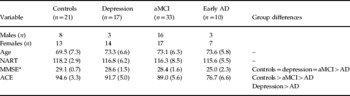
Demographic matching characteristics are presented in Table 1. There were no group differences in age [F(3, 77)=1.73] or estimated pre-morbid full-scale IQ [F(3, 75)=0.55]. The mean MMSE score for the early AD group was, as expected, significantly lower than that of the other groups [F(3, 77)=17.70, p<0.0001] (AD v. healthy controls, p=0.001; AD v. controls with depressive symptoms, p<0.005; AD v. controls, p<0.005). No other group differences in mean MMSE score were noted. As expected, the early AD patients had significantly lower mean ACE scores than did all other groups [F(3, 77)=29.30, p<0.0001] (post-hoc tests as above in all cases, p<0.0001). The ACE also discriminated between normal elderly control participants and aMCI patients, with the latter group obtaining a significantly lower mean ACE score (post hoc p=0.01).
Demographic data

aMCI, Amnestic mild cognitive impairment; AD, Alzheimer's disease; NART, National Adult Reading Test; MMSE, Mini Mental State Examination; ACE, Addenbrooke's cognitive examination.
Values are given as mean (standard deviation).
a Games–Howell multiple comparison carried out due to lack of homogeneity of variances.
Dual task performance
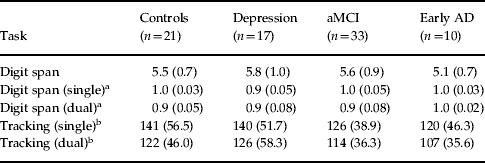
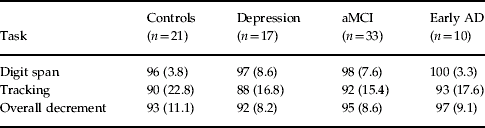
Group means and s.d.s for the digit span task and the tracking measures of the modified dual task paradigm are presented in Table 2. Mean percentage scores for performance on the concurrent tasks, the digit span tasks and the visuospatial tracking tasks for each of the four groups are presented in Table 3. On carrying out a one-way non-repeated ANOVA on the overall decrement score, no group difference was found [F(3, 77)=0.63]. Similarly, no significant group differences were found for any of the other component tasks or decrement scores.
Digit span and individual component measures of the dual task (span and tracking, performed separately and together)
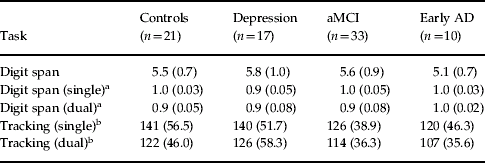
aMCI, Amnestic mild cognitive impairment; AD, Alzheimer's disease.
Values are given as mean (standard deviation).
a Proportion of digits recalled in the correct position (1=all correct).
b Number of circles joined in 90 s.
Percentage loss of performance in component tasks and overall decrement score during the dual taskFootnote a
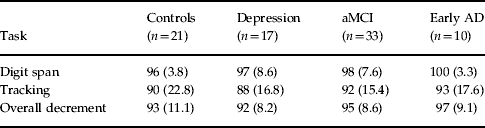
aMCI, Amnestic mild cognitive impairment; AD, Alzheimer's disease.
Values are given as mean (standard deviation).
a Percentage loss of performance scores were calculated as (1−[(Xsingle−Xdual)/Xsingle])×100 and the overall decrement score as μ=(1−[(Pm+Pt)/2])×100, as described in the Method section.
Other cognitive functions
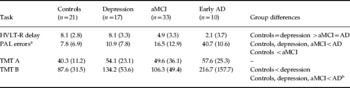
Group mean scores and s.d.s for the HVLT-R, the number of errors at the six pattern level of the PAL and the TMT B are presented in Table 4. On analysing the HVLT-R delayed recall data, there was a significant group effect [F(3, 77)=12.39, p<0.0001]. On closer analysis, the AD group recalled significantly fewer words than the healthy control (p<0.0001) and depression groups (p<0.0001). Similarly, the aMCI group performed more poorly than the healthy control (p<0.005) and depression groups (p<0.01). No significant difference was found between the AD and aMCI groups. The performance of the elderly control and depression groups on the HVLT-R delayed recall did not differ. However, the AD group made significantly more errors at the six pattern stage of the PAL compared with all other groups [F(3, 755)=22.82, p<0.0001] (post hoc tests comparing AD with other groups were in all cases p<0.0001). The aMCI group's error scores fell between those of the healthy control and AD groups, and significantly differed from both of these (aMCI v. healthy controls, p<0.05; aMCI v. AD, p<0.0001). A significant group effect was also found for the TMT B [F(3, 77)=8.62, p<0.0001]. In the post hoc analyses, only the control and depression groups differed in terms of TMT B scores (p<0.05); participants with depressive symptoms took significantly longer to complete the task. However, once time to completion on TMT part A (a measure of psychomotor speed) was statistically controlled for, a different pattern of group differences emerged [F(3, 76)=7.76, p<0.0001]. Specifically, it was found that the participants with AD took longer to complete the second task compared with all other groups (aMCI v. AD, p<0.0001; healthy controls v. AD, p<0.0001; controls with depressive symptoms v. AD, p<0.05). The group difference between the control and depressive symptom groups was no longer significant. No other group differences were uncovered.
Other cognitive domain measures

aMCI, Amnestic mild cognitive impairment; AD, Alzheimer's disease; HVLT-R, Hopkins verbal learning test, revised; PAL errors, six pattern stage errors from the paired associates learning test; TMT A, trail-making test part A; TMT B, trail-making test part B.
Values are given as mean (standard deviation).
a Games–Howell multiple comparison was used because of unequal variances.
b After removing effects of TMT A (see text).
Discussion
This study investigated the claim that the dual task paradigm can be used in the early diagnosis of dementia of the Alzheimer's type. We assessed the concurrent performance of a visuospatial tracing task and a digit span forward task in four diagnostic groups with aMCI (MMSE 24–30), early AD (MMSE 23–29), symptoms of depression (MMSE 25–30) and healthy elderly controls (MMSE 28–30). Our results show that aMCI is not associated with impaired dual task performance; those with aMCI had comparable performance to healthy older adults and older adults with depressive symptoms. Our early AD group was similarly unimpaired on the modified dual task paradigm relative to depressive and non-depressive elderly control groups and the presence of depressive symptoms appeared to have no effect on dual task performance. By contrast, and indeed by definition, episodic memory impairments were present in the aMCI and early AD groups. The early AD group also exhibited an impaired ability to divide their attention at pace, as indicated by part B of the TMT.
These results shed some light on previous findings. One line of research has suggested that dual task performance is vulnerable to the influence of AD, even early in the disease course (Baddeley et al. Reference Baddeley, Baddeley, Bucks and Wilcock2001; Logie et al. Reference Logie, Cocchini, Della Sala and Baddeley2004). However, such studies generally involve participants varying in severity from minimal to mild AD. When participants with AD are divided by severity using the MMSE, only the more severely ill patients (e.g. MMSE <24) are impaired on the dual task paradigm (Greene et al. Reference Greene, Hodges and Baddeley1995; Perry et al. Reference Perry, Watson and Hodges2000; Crossley et al. Reference Crossley, Hiscock and Foreman2004). This result is in agreement with the absence of impairment on the dual task measure observed in the current study in early AD. The combined findings suggest that dual task impairments are generally not observed early on in the AD process, with MMSE scores above 23/30.
Only one other study has investigated the dual task performance of a group of older adults with cognitive impairment without a diagnosis of dementia (Holtzer et al. Reference Holtzer, Burright and Donovick2004). Cognitively impaired adults, defined by a dementia rating scale (DRS) cut-off score of <124 (Mattis, Reference Mattis1988), performed two tasks in different modalities at the same time. Two combinations of tests were used: a visual cancellation task (where participants were required to cross out a specified stimulus type from a field of stimuli) combined with a digit span task, and the same visual cancellation task combined with a verbal fluency task. The researchers report that their cognitively impaired group exhibited a significantly larger dual task decrement than age-matched controls. However, the cognitively impaired group in the Holtzer et al. (Reference Holtzer, Burright and Donovick2004) study was identified solely on the basis of a DRS cut-off score falling at or below levels that are indicative of an underlying dementia. It is for this reason difficult to be certain of, or to compare, disease severity of this ‘minimally cognitively impaired’ group with other studies, which commonly use well-established clinical and research criteria to define patient groups. Furthermore, the cognitively impaired group in the Holtzer et al. (Reference Holtzer, Burright and Donovick2004) study were significantly less well educated than the control groups, while in the current study participant groups were well matched both in terms of age and estimated levels of pre-morbid intelligence.
Holtzer et al. (Reference Holtzer, Burright and Donovick2004) did not investigate the potential influence of depression on dual task performance. This is crucial where consideration is being given to the early and differential diagnostic value of a neuropsychological measure. Hasher & Zacks (Reference Hasher and Zacks1979) confirmed our result that people with depression show impaired attention during effortful processing tasks, for instance on measures of divided attention such as the TMT B (Nathan et al. Reference Nathan, Wilkinson, Stammers and Low2001; Mahurin et al. Reference Mahurin, Velligan, Hazleton, Davis, Eckert and Miller2006). Only one study has investigated the effect of depressive symptoms on Baddeley et al.'s (Reference Baddeley, Logie, Bressi, Della Sala and Spinnler1986) original dual task paradigm (Nebes et al. Reference Nebes, Butters, Houck, Zmuda, Aizenstein, Pollock, Muslant and Reynolds2001). This indicated that people with depression had a significantly greater decrement in computerized tracking performance and a composite decrement measure than non-depressed controls. No study to date has investigated the effects of clinically depressed mood on the modified version of the dual task paradigm to replicate or contradict our negative result (Della Sala et al. Reference Della Sala, Baddeley, Papagno, Spinnler, Graham, Holyoak and Boller1995).
A strength of the current investigation relates to the availability of additional neuropsychological data demonstrating the existence of significant episodic memory impairments in aMCI and early AD and additional impairment of speeded divided attention (as assessed by TMT B) in early AD. The TMT B assesses the ability to divide attention back and forth between multiple lines of thought (connecting numbers and letters, respectively), but differs from the dual task paradigm in that its different components are not drawn from separate modalities. Performance is thus more vulnerable to reduced processing capacity. Several previous studies have demonstrated that TMT B is impaired in the very early and even pre-clinical stages of AD (Lafleche & Albert, Reference Lafleche and Albert1995; Arnaiz et al. Reference Arnaiz, Blomberg, Fernaeus, Wahlund, Winbald and Almkvist2000; Perry et al. Reference Perry, Watson and Hodges2000; Nathan et al. Reference Nathan, Wilkinson, Stammers and Low2001; Crowell et al. Reference Crowell, Luis, Vanderploeg, Schinka and Mullan2002; Crossley et al. Reference Crossley, Hiscock and Foreman2004; Alladi et al. Reference Alladi, Arnold, Mitchell, Nestor and Hodges2006; Baudic et al. Reference Baudic, Barba, Thibaudet, Smagghe, Remy and Traykov2006; Stokholm et al. Reference Stokholm, Vogel, Gade and Waldemar2006), although its specificity for AD, as distinct from, for example, depression, has not been established.
The Holtzer et al. (Reference Holtzer, Burright and Donovick2004) study compared the dual task performance of minimally cognitively impaired participants only with their performance on tests comprising the single task conditions (i.e. visual cancellation, digit span and letter fluency). However, these tests are not, generally speaking, associated with impairments in very early and pre-clinical AD and it is therefore not surprising that they are insensitive to cognitive deficits in the minimally impaired group, as was the case in this study.
One important methodological feature may have influenced the current results: While those studies reporting general dual task impairment in early AD used both computerized and pencil-and-paper versions of the tracking task, only the modified version utilising the pencil-and-paper tracking task (Della Sala et al. Reference Della Sala, Baddeley, Papagno, Spinnler, Graham, Holyoak and Boller1995) has been used in studies that separated participants by symptom severity. Thus, while patients who are minimally affected do not show impairments on the modified version of the task, it remains possible that they would show impairments if the test were more taxing – for instance if the dual task paradigm included the original computerized version of the tracking task. This version of the task requires increased effort and attention, as participants are required to adjust to an external influence (i.e. the speed of the light dot on the screen) rather than working at a self-defined rate. It may therefore be sufficiently taxing to identify those who are not picked up by the more straightforward pencil-and-paper tracking task. However, the paper-and-pencil version (as opposed to the computerized task) is more likely to be adopted for widespread use in clinical and research practice, which underscores the relevance of our negative result.
A further methodological issue is the variability of dual task administration, which can lead to difficulties comparing findings across studies. We administered each of the three trials in blocks of 90 s, while some previous studies set the trial time at 120 s (e.g. Perry et al. Reference Perry, Watson and Hodges2000). Most dual task studies have utilized pencil-and-paper tracking tasks that required participants to cross out boxes on an A4-size sheet of paper to form a chain (e.g. Baddeley et al. Reference Baddeley, Della Sala, Papagno and Spinnler1997). The current task required participants to trace a line through linked empty circles on an A3-size sheet. While the initial dual task paradigm involved recording the number of completely correct digit strings (Baddeley et al. Reference Baddeley, Logie, Bressi, Della Sala and Spinnler1986), many subsequent studies, including the current investigation, have calculated the number of digits recalled in the correct order for this measure. The significance of such alterations to dual task administration requires further investigation.
A partial alternative explanation for our negative result is that a majority of individuals forming our aMCI group may fail to convert to AD in the future. If this proves to be the case, then the absence of dual task impairment would not be surprising. The issue will be resolved through the longitudinal follow-up of participants with aMCI, currently underway. However, the sound performance of our early AD group on the dual task measure makes it more likely that the negative result for our aMCI patients is due to lack of test sensitivity rather than absence of underlying AD pathology. The impaired performance of the early AD group on an alternative popular measure of speeded divided attention implies that the dual task measure lacks sensitivity to very early changes of an attentional/executive nature in AD.
In conclusion, people with early AD and aMCI did not display impaired performance on the modified version of the dual task paradigm at a time when episodic memory, and in the case of early AD, speeded divided attention, were significantly impaired. The likely explanation is that the dual task paradigm is insufficiently sensitive for use as an adjunctive cognitive tool in the early diagnosis of AD. Future longitudinal research is needed to investigate the use of dual task tests of varying demand in aMCI and very early AD participants in an effort to determine the potential influence of task demands and complexity on performance.
Acknowledgements
The authors are grateful to the Gordon Small Charitable Trust for financial support and to clinical colleagues for referring their patients.
Declaration of Interest
None.