1. Introduction
The Seventh Framework Programme for Research and Technological Development (FP7) was a funding programme of the European Union (EU) that ran from 2007 to 2013, with a few activities still ongoing. FP7’s Cooperation Programme fostered international collaborative research within Europe and with other partner countries and regions, therefore playing a pivotal role in intensifying cross-border research cooperation and developing a European research community.Reference Arnold 1 Over the years, international research cooperation has become a key issue of European research policies. Since 1983, when the European Commission (EC) launched the Science and Technology for Development Programme, European research policy towards international cooperation (INCO) has been continuously evolving to address global research challenges (such as climate change, health, and sustainable energy) and the competition from other industrialized countries (such as the United States and Japan) and the BRICS 2 countries. This is reflected in the importance ascribed to INCO in the subsequent framework programme.
The international cooperation perspective of the framework programme, particularly its global engagement and role in European integration, has not yet been studied. Thus, we lack knowledge about why the EU opened the European Research Area (ERA) 3 – Reference Prange-Gstöhl 5 to the rest of the world at a time of scarce resources and what is the added value of EU-level, rather than unilateral, intervention. The contribution of this paper is to discuss these issues. There have only been a few studiesReference Edler and James 6 on the emergence and development of FP7, and the existing literature focuses mainly on historical studies,Reference Krige and Guzzetti 7 the interplay between the EC and other stakeholders,Reference Peterson, Rhodes and Mazey 8 or the role of the EC in developing research policy.Reference Grande and Peschke 9 Generally, the studies tended to focus on the role of the EC and specific thematic programmes at the expense of discussing broader political and institutional factors.Reference Edler and James 6 , Reference Citi 10 , Reference Princen 11
The research questions that this paper addresses are as follows: why did the EU open the ERA to the world, what is the European added value (EAV) of international research intervening at the EU level, and how does international research cooperation contribute to European integration? These questions and the evidence provided in this paper may have important implications both for academic research – by deepening our understanding of integration – and for research policy and research organizations in Europe and worldwide, in particular for the countries participating in the INCO programme – by aiding them in designing more effective activities.
The paper contributes to the limited body of literature on FP7 and European research integration in two ways. First, based on a mixed methods approach to better grasp the complexity of INCO, the focus lies on the policies and instruments used to open European research to third countries, and on the mapping of the INCO activities with respect to their added-value contribution at the EU level. Second, the paper sets out to explore how the opening of the ERA to the world has contributed to European integration, and considers the programme’s effectiveness in relation to the EU member states, on the one hand, and the targeted third countries on the other.
The organization of the paper is as follows. The next section provides a discussion of the conceptual framework of the paper and our methodological approach. In Section 3, a case study is presented through a description of the policy rationale for INCO and the results of the activities carried out within INCO. Section 4 offers a discussion of the opening of the ERA to the world and the added value of INCO. The final section closes the paper with a Conclusion.
2. Conceptual Framework and Methodological Approach
From a theoretical point of view, this study aims to provide insights into the governance of the EU and the mobilization of member states and third countries, also in terms of European research integration and EAV. 12 This is done by elaborating on the concept of external governance and discussing the conditions under which it is effective in INCO. The concept of external governance is ‘both an attempt at conceptualizing important aspects of the EU’s international role and a step towards analysing forms of integration into the European system of rules that remain below the threshold of membership’ (Ref. Reference Lavenex and Schimmelfennig13, p. 792). External governance thus occurs when the institutional and legal boundaries are moved beyond the member states.Reference Smith 14 The concept was inspired by theories of international relations and comparative politics and it combines these with approaches focusing on the EU’s external relations.Reference Lavenex and Schimmelfennig 13 Applied to the EU’s external relations, the term ‘external governance’ implies institutionalized coordinated actions, a common system of rules and a horizontal coordination process with voluntary instruments. External governance thus promotes an institutional and structural approach and comprises open fora that can involve different stakeholders, also from the private sector.Reference Mayntz and Schuppert 15
EU external governance addresses complex interdependencies not only with neighbouring regions and countries but also with third countries in other regions, and varies depending on the region, country and intervening policy field. In the INCO context, it may be based on bilateral cooperation agreements (such as the BILAT programme) and on overall policy initiatives (such as the European Neighbourhood Policy (ENP), cooperation with the Mediterranean countries, 16 and the Eastern Partnership policy 17 ), or developed due to high mutual interdependence and third countries’ high interest in EU policies.
Focusing on the effectiveness of the EU external governance in INCO, three sets of factors are central: institutions, power, and domestic structures. According to the institutionalist approach, ‘the modes and effects of external governance are shaped by internal EU modes of governance and rules’ (Ref. Reference Lavenex and Schimmelfennig13, p. 792). The effectiveness of external governance is thus closely linked to the quality of the existing EU institutions, and external governance follows the way internal governance is exercised (cf. Refs Reference Abbott, Keohane, Moravcsik, Slaughter and Snidal18,Reference Lavenex, Lehmkuhl and Wichmann19). In this process, external governance is more effective when used in a hierarchical mode and as the legitimacy of EU internal rules increases.
The power-based approach attributes the modes and effects of external governance to the power and resources available to the EU in relation to third countries, as well as the EU’s interdependence with these countries, and also to the competing governance providers, such as the US and China. This implies that external governance is not dependent on the internal institutional structures but on external structures and interdependences. According to this perspective, ‘the modes and effectiveness of EU external governance vary with international structures of power and interdependence between the EU and third countries’ (Ref. Reference Lavenex and Schimmelfennig13, p. 804).
The structure approach focuses on the third countries’ domestic structures that may condition the modes and effectiveness of the EU’s external governance. Third countries are more likely to be receptive to external governance that resonates with their domestic institutional structures. Thus, the effectiveness of the external governance of the EU varies with its compatibility with third countries’ domestic institutions, traditions and practices.Reference Lavenex and Schimmelfennig 13 The three approaches (institutions, power, and domestic structures) may interact to explain the effectiveness of external governance.
2.1. International Cooperation as a Supranational Activity
An issue can become subject to external governance when responsibilities in a particular field are granted to the EU and the EU has the competence to act in relation to third countries.Reference Lavenex 20 This process incorporates two challenges: achieving attention from both the member states and third countries and convincing them that the EU is the right arena to handle international cooperation with sufficient capabilities to deal with the issue.Reference Princen 21 Thus, how international cooperation is framed is crucial for achieving the necessary attention and, consequently, for the effectiveness of the EU’s policy and governance.Reference Rochefort and Cobb 22
Focusing in particular on the underlying policy rationale of the INCO activities, the first challenge was to gain the attention of the member states and third countries and mobilize the relevant stakeholders. However, as mentioned above, gaining attention may not prove sufficient; stakeholders need to be convinced that the EU is the most relevant arena to handle the specific issue.Reference Princen 21 Achieving attention and convincing actors that the EU should take up the issue may be particularly challenging for those areas that are new to EU policy. Where competing arenas are present (in the case of INCO, these are national settings), the EU must demonstrate the added value of dealing with the issue at the European level. In the INCO case in particular, it is not immediately clear why supranational intervention is needed; thus, the EU has to build a convincing argument about the European scope of the issue to mobilize member states.
The framing of the issue is important in this process. Framing may be carried out either by using ‘big words’ or ‘small steps’.Reference Vanhoonacker and Pomorska 23 The first method refers to linking the issue to key values (ethics, protection of the environment, etc.), the identity of the EU (addressing political and socio-economic challenges) or stated priorities and commitments (ERA, EAV). The second strategy refers to a gradual build-up of interest through ‘small steps’ that often include pointing out technical aspects to support the proposed policy and start from general, non-controversial issues (such as common research interests) and gradually advance to more ambitious ones (formulating common research priorities, addressing global challenges).Reference Héritier and Héritier 24 – Reference Kelly 26
The second challenge for the EU in relation to INCO is to demonstrate credibility. The EU needs to show that the body that will deal with the issue (in this case, the Directorate-General for Research and a network of experts) has both the organizational capability and expertise. Simultaneously, credibility involves constructing an argument as to why the issue is European in scope (a process known as the ‘political construction of scale’Reference Delaney and Leitner 27 ), and thus providing an EU body (the EC) with the legitimacy to deal with it. One way of doing this is to link INCO to existing policies (i.e. ERA, EAV, and the policy of Europe in the global world) and/or to identify common ground (i.e. common research priorities or challenges to be addressed) to mobilize stakeholders in the member states and third countries. Another way is to define a “European model” – a set of principles in a specific area (such as producing clean energy and protecting the environment) – and identify common challenges to those principles (cf. Ref. Reference Smith14).
2.2. Methodology and Data Collection
Due to the complexity of the INCO programme, a study design based on a mixed-methods approach for social science research was developed.Reference Creswell 28 , Reference Bloch, Sørensen, Graversen, Schneider, Kalpazidou Schmidt, Aagaard and Mejlgaard 29 In this type of study, the results from one method are used to enhance, augment and clarify the results of another. A partially mixed design in which qualitative and quantitative phases were carried out independently was used, while mixing took place at the data analysis stage.Reference Leech and Onwuegbuzie 30 Particular focus was placed on the complementarity and supplementarity of the two approaches and on capturing the data and insights they generated.Reference Bloch, Sørensen, Graversen, Schneider, Kalpazidou Schmidt, Aagaard and Mejlgaard 29
The study was carried out based on the components of the considered elements of the INCO activities, as illustrated in Figure 1.
An illustration of the components of the INCO study.

Component 1 centred on the policy rationale of INCO and aimed to describe the logic of intervention at the European level. Component 2 described the FP7 intervention from a process perspective by factually establishing participation patterns and by looking at the reasons for participation. Component 3 focused on the direct achievements of the intervention. Component 4 centred on the wider achievements and impacts on European integration and the EAV.
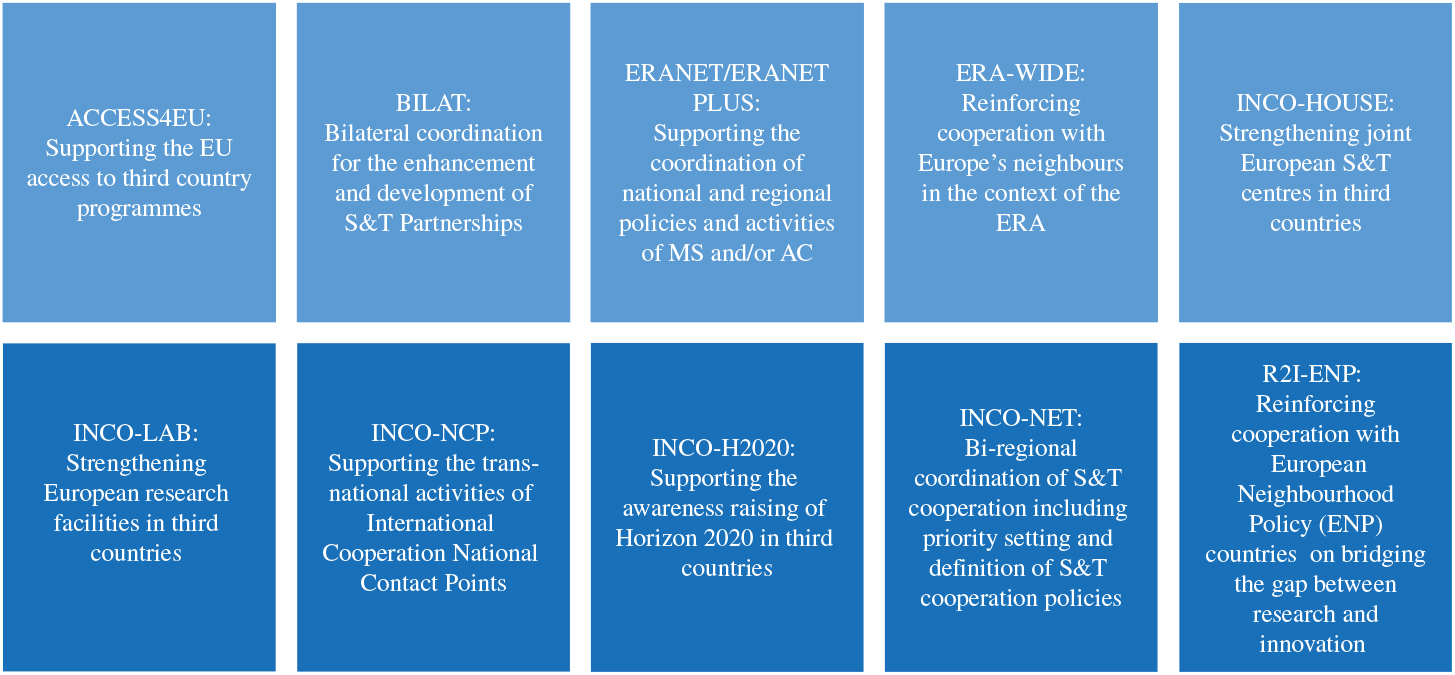
The study of the INCO activities was conducted in 2014 (January–November) and involved all ten activities/instruments of the INCO programme, as illustrated in Figure 2.
INCO instruments and policy targets.

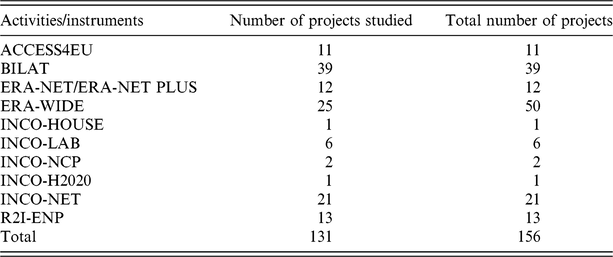
First, the INCO policy objectives, logic of intervention and strategy documents were studied, followed by an examination of 131 projects out of the 156 funded in FP7 (Table 1). Only projects where sufficient material for analysis was available were included in the study, i.e. projects in the starting phase of their implementation were excluded. Results were then analysed against the objectives set out in the respective calls and work programmes.
Total number of FP7-INCO projects by instrument and projects studied.

Data and information were collected from several sources – interviews, questionnaires and EC documents – to cross-reference and triangulate findings. Key stakeholders in Europe and worldwide were contacted and interviewed. Statistical analyses based on EC databases were carried out to record participation patterns and to map the INCO contribution to the ERA.
The first phase of data collection was based on official documents from the CIRCAB website (EC’s collaborative platform facilitating the distribution and management of documents) and other sources, such as design and programming documents, basic documents on INCO policies, relevant documents on the partner country/region) or national/regional strategy. The EC’s strategic documents and other policy programme documents issued by relevant EC Directorates-General (DGs) were also analysed. In parallel with the analysis of strategic documents, a systematic review of the projects was carried out to map the impact and added-value of INCO projects in the ERA perspective (examining the project-specific documents and data, grant agreements and reports).
The second phase of data collection involved interviews with selected key informants and stakeholders, and information gathered through participation in meetings related to INCO activities (including ongoing project meetings, workshops, events and conferences). The objective of the interviews was to gather information regarding the issues covered in the quantitative analysis, thus validating the results, but also to gain insights into key stakeholders’ views on the opening of European research to the world. The 80 individual interviews carried out thus gathered in-depth information on intervention and participation logic, the outcome and impact of activities on European integration and added-value perspective. The interviews lasted 30–90 minutes and highlighted the programme’s aims and strategies, the stakeholders’ view of activities in relation to the ERA, drivers for participation, cooperation and capacity-building dynamics, perceived impact and EAV. The interviews were carried out in the period of February–July 2014 and involved 30 project coordinators, 20 project partners, 18 EC officers and 12 EU delegates and national officers. Separate questionnaires were used for each stakeholder group. Interviews were carried out through face-to-face meetings, video or telephone interviews and email as per interviewees’ preferences. Semi-structured interview guides were used to conduct the individual interviews with the aim of improving the reliability of data by using open questions.
The third phase involved the collection of quantitative data. Relevant statistical data were extracted from the E-CORDA statistical database. Full extraction of the database was undertaken, covering all FP7 INCO calls, including programme calls, project-level funding and participant type. The total number of projects, targeted countries, EC financial contribution and other key variables for international cooperation were considered. The focus was on the participation level of the European member states and associated countries for the INCO activities and the targeted third countries or regions.
3. The Case of INCO in FP7
In this section, the case study is presented, as are the results of the mixed-methods analysis used to illustrate the logic of intervention and participation, as well as the integrative effects and added value of the INCO programme in the ERA perspective.
3.1. EU INCO Policy Approach
January 2000 marked an important turning point in European Science and Technology (S&T) policymaking with the publication of ‘Towards a European Research Area’. 3 This document contained the basis for a sweeping reform, the main objective of which was to strengthen the identity of European research by integrating research in Europe. The ERA was an ambitious effort to pool European S&T resources more effectively to mitigate the risk of loss of growth and competitiveness for European economies in an increasingly global economy. To improve the attraction of Europe for researchers from the rest of the world, the guiding principles of the ERA were put into practice in the Sixth Framework Programme for Research and Technological Development, FP6 (2002–2006) and later in FP7 (2007–2013). To address this evolving EU policy better, the international cooperation programme was developed through a series of policy orientations. In that way, the Communication on the international dimension of the ERA 31 has been a turning point, opening the ERA to the world by facilitating the participation of third countries in the framework programme and by developing an extensive international S&T cooperation programme. Accordingly, the EU encouraged the participation of third countries in its research programmes, and S&T agreements were signed with several third countries, including reciprocity clauses to provide access to each other’s funding.
The implementation of FP6 gave rise to international cooperation with all third countries (including the industrialized ones), not just with developing and Eastern European countries. However, a more significant change in the overall policy was apparent in FP7, with a broad opening and mainstreaming of international cooperation across all of FP7 and the programming of specific priorities for third countries and regions in different calls for proposals across the thematic work programmes. New funding instruments were employed to improve coordination with third country research activities, simultaneously with thematic and geographic targeting, with much clearer intervention logic as to the alignment with other European Community policies.Reference Arnold, Clark and Muscio 32
3.2. INCO Capacities Programme
The INCO Capacities programme derives from two key inter-linking drivers: the objective of creating the ERA, on the one hand, and the internationalization of FP7, on the other. Since the adoption of the 2020 vision for the ERA by the European Council on 2 December 2008, the EU and its member states launched partnership initiatives to enhance cooperation – one of these being international cooperation in S&T. 33 By 2012, the ERA vision had evolved into a unified research area open to the world, based on the internal market, with mobility for researchers and free flow of S&T knowledge to enable member states to strengthen their S&T bases and enhance their competitiveness and capacity to jointly address societal challenges. International cooperation in FP7 rested on several key objectives: integrating European research and innovation excellence into the global context; establishing strategic partnerships with international partner countries; enhancing access to global research; and focusing S&T on the specific problems of partner countries and problems of a global character. 34
The INCO Capacities programme focused on horizontal activities for supporting research collaboration with third countries. No funding for research activities was provided (FP7 was allocated a total budget of €53 billion, with €185 million designated for INCO activities); instead, the emphasis was on supporting research capacity and facilitating the access for European researchers to third countries. INCO Capacities adopted a differentiated policy approach, based on a general characterization of country groups as industrialized, emerging, developing, and neighbourhood countries. Emerging countries were granted similar opportunities and access as member states and, for that reason, were not required to contribute financially to participate in the programme. This was also the case for the developing countries. The neighbourhood countries, consisting of the Mediterranean 16 countries and the Eastern Partnership 17 region, retained similarly favourable financial status as recipients of funding and were ultimately the largest group of participants in the INCO programme. The industrialized countries 35 included a highly diverse group and were not eligible for funding.
Since 2008, a strategic approach to international research cooperation has been employed, with a focus on geographical and thematic dimensions. Strategic international research cooperation was framed in terms of three key policy objectives: (i) to strengthen the EU’s excellence and attractiveness in research and innovation and enhance its economic and industrial competitiveness; (ii) to address global societal challenges; and (iii) to support external policies. At the same time, the horizontal measures adopted were underpinned by three components of the Capacities programme. The first component comprised bi-regional S&T cooperation, bringing together policy makers, the scientific community, enterprises and civil society from the EU and third countries to identify priorities and define policy direction. The second component consisted of bilateral cooperation for the development of S&T partnerships to improve the dissemination of information on programmes and funding, thus promoting cooperation between Europe and specific third countries. Moreover, this component encompassed activities to identify and demonstrate mutual interests and benefits in S&T cooperation between the EU and specific third countries better, detect the prospects for cooperation in specific fields, and share best practices through joint forums and workshops. Finally, the third component comprised support for the coordination of national policies and activities of the EU member states and associated countries on international S&T cooperation. At the same time, the Strategic Forum for International S&T Cooperation (SFIC) was established by the member states with the task to develop a coherent approach to international cooperation, thus enhancing the ERA.
The Europe 2020 strategy, acknowledging the new policy context, set new priorities in the 2011 work programme on developing the economy based on knowledge and growth. The overall aim of the Capacities Programme was to develop research and innovation in Europe and, where possible, attain world leadership. The 2013 work programme reflected the link to Horizon 2020 (FP8) and the focus on areas with high EAV, based on cross-cutting themes calling for activities that could support other EU policies. The international dimension of the ERA was central to the latter work programme, aiming to establish economies of scale and critical mass through policy coherence and coordination.Reference Vullings, Arnold, Boekholt, Horvat, Mostert and Rijnders 36
3.3. INCO Participation Patterns and Mobilization of Stakeholders
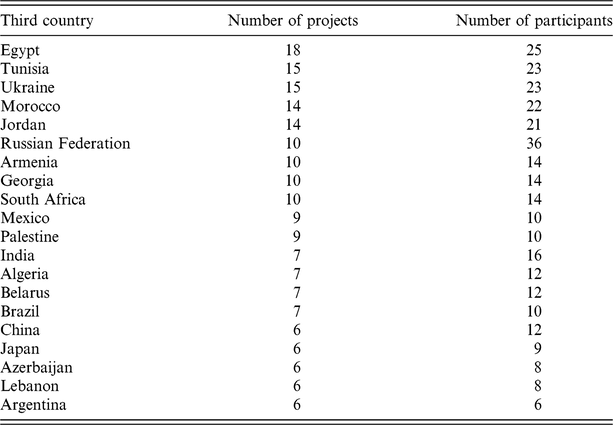
INCO programme interventions spanned many countries, reflecting the diversity of policy aims across activities, from the bilateral focus of BILAT, targeting countries that had signed S&T agreements with the EU with the specific aim of accessing scientific institutions in third countries (ACCESS4EU), and the strategic focus towards neighbouring and other countries (ERANET/ERANET+, ERAWIDE, R2I-ENP). Eighty-eight third countries participated in INCO activities. However, there have been differences in the participation rates of the third countries. The top nine countries (Egypt, Tunisia, Ukraine, Jordan, Morocco, Armenia, Georgia, the Russian Federation, and South Africa) had a higher participation rate both in terms of the number of projects and the number of participants (see Table 2).
The ‘top-20’ FP7-INCO participating third countries.

The INCO participation among EU member states reflected the pattern of FP7 participation rates: France, Germany, Italy, Spain, Greece, the UK and Austria were the top participants, with all other member states included to a lesser degree. Thirty-eight countries (EU member states, associate and candidate countries) participated in INCO activities throughout the period, with a global total of 126 taking part in the programme. While this picture illustrates the European research policy’s focus on increased internationalization, a more detailed examination of the distribution of participants and funding flows suggests a widening rather than deepening of engagement. INCO made great efforts to widen the ERA and make it more open to the world by engaging more and more countries (from 70 participating countries in 2010 to 126 in 2014), involving a broad range of third country stakeholders.
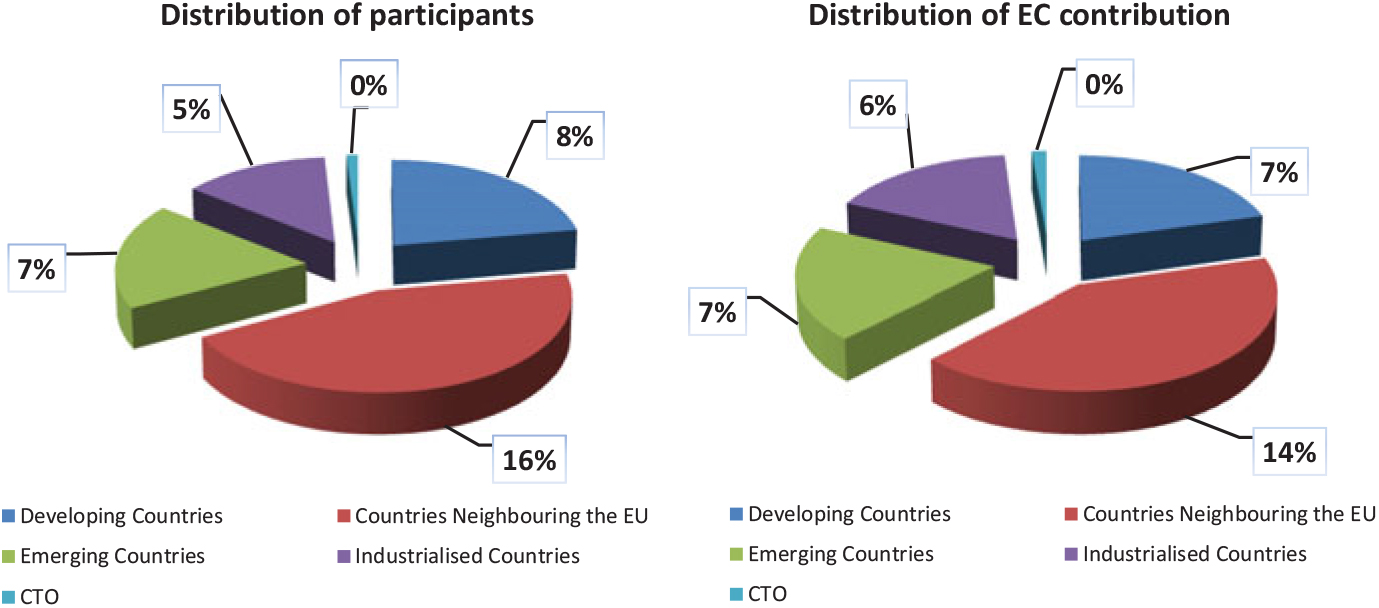
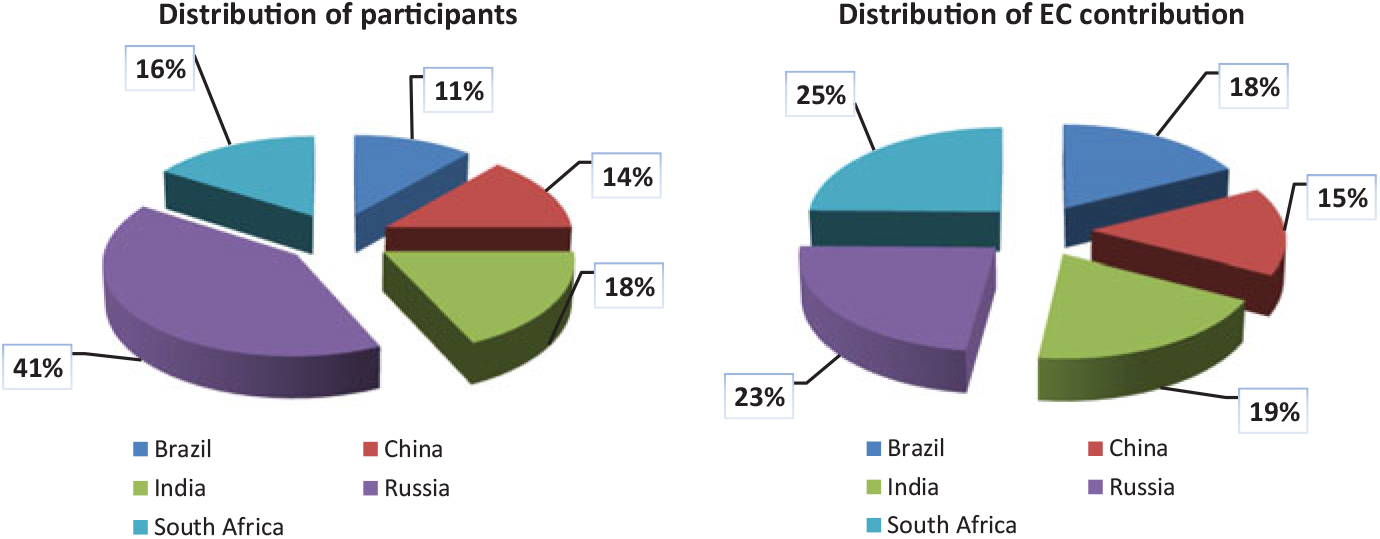
The number of participants from the developing countries group was just over 8% of total participants, receiving 7% of the EC contribution (Figure 3); neighbouring countries accounted for 16% of total participants and just over 14% of the EC contribution. The emerging countries group accounted for nearly 7% of both the total number of participants and of the EC contribution (Figure 4). The associated and candidate countries group accounted for a lower share of participants and of the EC contribution than either the developing or neighbouring countries groups. EU member states constituted 56% of total participants in the INCO projects and nearly 61% of the EC contribution.
Distribution of participants and EC contribution per third country group in FP7-INCO.

Distribution of participants and EC contribution per emerging country in FP7-INCO.

Looking at the EC financial distribution across the third countries group, the neighbouring countries attracted more than twice the amount allocated to other country groups. This reflected the wider policy priorities gaining ground within the EU during this period, in particular the strong focus on the ENP, directed at fostering political association and economic integration between the EU and each of the 16 neighbouring countries. Among the emerging countries, participants from Russia accounted for 40% of the distribution per emerging country, ahead of India (18%), South Africa (16%), China (14%) and Brazil (11%). The pattern of the financial distribution among emerging countries is, to a large extent, the result of the direction of the calls for proposals. The distribution is hence strategically triggered or at least strongly influenced by the EC strategy and reflects the addressed potential.
The profile of the participants varied across the INCO activities and, depending on the particular INCO activity, included ministries, research organizations, project groups, and private entities. INCO-NET projects, for example, typically had a high number of participants, including government ministries, public sector entities, research councils, funding bodies, science academies, and universities. The R2I-ENP activity, with an emphasis on innovation, included participants from universities, private enterprises, business associations, innovation funding agencies, and science parks. While the participant profile reflected the requirements of the individual activity, the results of the study revealed that those participants with some experience in international research cooperation were more willing to extend and deepen participation, but even for those participants with limited experience, the continued coordination and support actions of the kind provided through INCO remained crucial.
As mentioned above, INCO developed an international dimension to European research through a range of coordination and support actions rather than by direct funding of collaborative research projects. European participants were drawn towards these opportunities to get involved in third-country funding programmes and research systems. Participants from developing countries aimed to strengthen their national science, technology and innovation capabilities and to enhance their knowledge of the EU approach to research policy and management. For some of the individual member states, geopolitical objectives were a consideration, as INCO presented an opportunity to prioritize research collaboration with preferred partners and/or regions.
The INCO calls attracted a strong response from the international community, from the countries and regions targeted. Participants noted the ‘learning effect’ especially in relation to EC rules and procedures on project management, and a range of dissemination activities marked a significant contribution to knowledge sharing both regarding funding sources and potential future partnerships and research networks. Across the INCO activities, a critical mass of international research cooperation was established (1326 partners in total). The emphasis that many INCO activities placed on enhancing policy dialogue 37 was reflected in projects, particularly in regions such as Mediterranean countries where the EU aimed to establish a sustained political dialogue. The effect of INCO on networking, capacity building, and policy dialogue was highlighted by stakeholders in the interviews. Among the third countries with strong, multiple participation, the research networks that had emerged from INCO reflected an emerging research community that was aware of and highly informed about European research.
The efforts of the EC to open member states’ research systems were met with mixed responses. Certain national areas remained less susceptible to the EC’s policies. Certainly, the developmental path from basic research through to innovation and into the marketplace varies between countries, and the restricted industrial participation from some countries in INCO limited the opportunity to engage in innovation activities. The mobilization of stakeholders, and claims that the EU is the right arena for international cooperation, has hence been less effective in relation to the industrial sector. However, this result is not surprising but is in line with results that have been observed with FP7 as a whole, where the difficulty to mobilize industry is acknowledged.
4. Discussion
4.1. Opening the ERA to the World
Overall, the international cooperation activities helped project an image of the EU in third countries as a united alliance with a consistent strategy. Apart from promoting better relations with third countries, INCO mobilized supporters among member states and contributed to the further understanding and development of common research priorities within specific areas. Moreover, INCO provided an opportunity for developing good collaborative research practices as part of the opening of the ERA to the world. However, moving the issue to the EU level, gaining legitimacy to deal with it and mobilizing actors with different interests among the member states has not been a straightforward undertaking. For EU processes, as Edler and JamesReference Edler and James 6 point out, the choice of intervening arena is not restricted to the EU, particularly in cases where there are already established bilateral science cooperation schemes, as was often the case in international cooperation for most larger EU member states.
An issue can be expanded and moved from one arena to another to create greater support among stakeholders.Reference Stephenson 38 Closer synergies with other EU instruments, better links with other credible policies (such as external action activities or aid) and identification of common interests were used to yield more significant results. An important external action initiative used was the emerging science diplomacy which, as widely reported by the interviewees, helped bring down barriers and build trust between the EU and third countries, thus arousing further interest for the ERA. The EC anticipated that
science diplomacy will use international cooperation in research and innovation as an instrument of soft power and as a mechanism for improving relations with key countries and regions. Good international relations may, in turn, facilitate effective cooperation in research and innovation. (Ref. 39, p. 4)
While science diplomacy is increasingly important in contemporary international relations, 40 – Reference Turekian 45 the concept is a relatively recent addition to the EU research policy discourse. However, as pointed out by the interviewees, science diplomacy has been used to a limited degree in relation to INCO. Interviewees point out the lack of clarity regarding the strategic objectives of EU external relations and international research policy as the reasons for not being able to establish a better link. As an arena for linking science policy to other interests and formulating science policy as being closely related to other external action policies, science diplomacy has hence not been exploited to its full potential. The interviewees, in particular EU officers and delegates, clearly expressed the need for more coordinated efforts between INCO and science diplomacy activities, as third-country-based EU diplomats possess the required knowledge of the domestic institutions, structures and practices of these countries to facilitate the process. Thus, seen from an institutionalist perspective, the fact that the effects of external governance are shaped by internal modes and rules, has in this case constrained the outcome and impact of the INCO programme. At the same time, the lack of knowledge about and compatibility issues with third countries’ institutions and practices have hampered the programme’s effectiveness.Reference Lavenex and Schimmelfennig 13
As the results in Section 3.3 reveal, the INCO programme suffered from its broad geographical scope, which overall led to a dilution of resources, weakening the ability to mobilize key experts and stakeholders. Apart from a few exceptions (such as BILAT), the overall strategy of ‘one size fits all’ limited the effectiveness of the activities. The programme thus failed, to a sufficient degree, to take into consideration the power asymmetries and domestic structures and practices of the third countries, and to formulate strategies tailored to the targeted countries. Similarly, the scattergun approach of widespread promotion of FP7 in third countries, rather than focusing on the most promising research institutions, limited the effectiveness of the programme. In regional initiatives, practical and financial constraints often limited participation to one or two participants from each target country, thus making it difficult to achieve broad coverage (and thus to mobilize the most relevant expertise) within a specific country. The EC has developed practices that could orchestrate the ‘power of expertise’ by initiating discursive interactions with international institutions and stakeholders.Reference Richardson and Richardson 46 However, the weakness of the EC to arouse the interest of a wider range of participants (e.g. the industrial sector) among member states has limited the impact from an ERA perspective.
A key aim of INCO was to establish a dialogue for industrial innovation through a strong linkage with European innovation and competitiveness programmes. INCO activities had been seeking a way to integrate research and innovation, to enable cross-fertilization, and to support public–private strategic partnerships by promoting reciprocal cooperation opportunities of mutual interest, including co-financed actions. Nonetheless, only a few INCO projects developed an active partnering strategy and innovation activities. The limited industrial participation illustrates the difficulties of the EC to convince this group of stakeholders in the member states why the European level is the right arena for international research activities. This has been one of the less successful activities of the INCO programme despite its inclusive character and the provision of open fora to include stakeholders from the private sector.Reference Mayntz and Schuppert 15
A deeper coordination among the DGs (across thematic programmes) and between the DG for Research and Innovation and other DGs was perceived by the stakeholders as a lacking key factor for more effective international cooperation. BorrásReference Borrás 47 identifies three internal factors determining the power of the EC: the normative-ideological leverage, the process leverage and the coordination leverage. Bauer,Reference Bauer 48 on the other hand, opening the ‘black box’ of the EC, reveals the internal vertical differentiation between the DGs. In the case of INCO, the link between the different DGs in the process and coordination leverageReference Borrás 47 has been weak in a highly fragmented and heterogeneous administration.Reference Bauer 48 The division of authority between the different areas of the EC in internationalizing research policy has been blurred, which has compromised activity coordination. This is again in line with the findings of Lavenex and Schimmelfenning that ‘effectiveness of external governance is shaped by internal EU modes of governance and rules and that effectiveness increases with the legitimization of rules and/or the legitimacy of rules’ (Ref. Reference Lavenex and Schimmelfennig13, p. 803). Thus, the institutionalist approach to external governance provides a part of the explanation of how lacking internal governance and legitimization of rules impact on the effectiveness of external governance.
In addition, perhaps the most unwarranted shortcoming of the international cooperation activities was the seeming lack of a suitable strategy on how best to make use of the great amount of valuable knowledge garnered through the activities (in terms of third-country policies, research performers, stakeholders, common research interests among member states, etc.) to create broader attention to INCO and a stronger impact on the ERA. The wealth of information and experience could be leveraged by the EC to enhance strategy, gaining increased attention, mobilizing more participants within the EU, and attracting leading third-country institutions in joint activities with member states. Despite some efforts to develop a centralized repository for such information, which would improve the visibility of INCO, this was not achieved to an effective degree. Again, internal EU modes of governance have been mirrored in the effectiveness of external governance.
For the smaller third countries, for whom the main motivation for participation was to get better access to the EU research programmes, setting European research on their agenda was only partially achieved (despite the fact that INCO policies aimed to create an environment and mechanisms that allowed all partners, member states and third countries, to converge on a common thematic focus). Here, the domestic structures of third countries’ research systems – and the lack of knowledge about these structures, institutions and traditions – have conditioned the effectiveness of INCO activities (cf. Ref. Reference Lavenex and Schimmelfennig13). However, among the third countries with strong, multiple participation (mainly the neighbouring countries), a higher impact and a successful strategy with research communities that are to a much higher degree aware of European research and programmes have been observed. The latter might be explained by the high interdependence between the EU and the neighbouring countries on the one hand, and the fact that these countries have been more receptive to EU policies due to their better compatibility with European traditions and practices on the other.
4.2. European Added Value
It has been central to the EC to claim authority and convince stakeholders that sufficient capability to deal with international cooperation is in place. The EC, with its long-standing framework programmes for research, has a well-recognized competence in the area and has linked the issue of authority to this specific competence. However, claiming authority has been a challenge to the EC despite the use of manifold strategies, such as linking international cooperation to established policies (ERA, globalization strategy, external relations, etc.) and identifying common ground (common research priorities to address issues of global scale). By linking the issue to the ERA (in terms of common research priorities to achieve EAV) and addressing challenges that are global in their nature (i.e. climate change, energy, health, food security, etc.), the EC justifies intervention at the supranational level. Likewise, international cooperation is framed in economic terms and arguments of competition, promoting economic development and creating jobs in a globalized world, where strategic regions and countries are targeted, with the aim to achieve EAV.
However, the strategy failed to extend participation of member states beyond that already established; INCO participation shows similar patterns as the overall FP7 participation, led by larger member states with long-standing experience in bilateral international cooperation. Despite this, an important element of the European-level approach has been the increased efficiency and reduced duplication of efforts brought about by using such an arena. The supranational venue has been more positively received by third countries compared with individual (small) member states, especially in the case of dealings with the more advanced or larger economies in the world (US, Japan). In the case of smaller member states, INCO provided the possibility of participating in international cooperation, beyond the scope of limited national resources, by mobilizing support from national institutions. As regards larger member states, the more efficient use of resources, under the umbrella of the EU, made it possible to target a broader range of third countries than would have been the case in unilateral initiatives. The latter is in line with the results of other studies on EAV, which conclude that such value is realized when the scale of an action is such that it is difficult for individual member states to undertake the action at the national level.Reference Vullings, Arnold, Boekholt, Horvat, Mostert and Rijnders 36
The joint EU venue and mobilization of numerous member states served to deepen European integration and achieve added value by acting at the supranational level. Working together, European member states formulated common priorities, learned about their respective individual initiatives and national capacities and leveraged their collective experience, thus helping to expand the EAV. For both the EU and non-EU countries, INCO provided a larger pool of researchers and organizations than could be accessed individually. However, mobilization of supporters was more effective among participants with some experience of international research cooperation. They were more willing to deepen participation by moving their activities to the European arena. Policymakers and researchers in countries that have had active international cooperation, such as Germany and France, could access networks and leading researchers both within Europe and beyond more easily. In this respect, according to the interviewees, the intergovernmental entity SFIC offered an important supporting venue for establishing common strategic priorities and provided a basis for establishing consensus around strategic thematic priorities and geographic focus in INCO.
Studies highlight the potential benefits and economies of scale arising from EU-level research initiatives over national arena activities. An analysis of Science, Technology and Innovation (STI) agreements revealed a significantly more rigorous approach in agreements made by the EU compared with those signed by individual member states.Reference Fikkers and Horvat 49 Scholars point out that it is the interdependence of economic and societal factors that drives European integration and makes stakeholders aware that joint activities and institutions bring net benefits, as integrative actions in one area may trigger integrative actions in related areas.Reference Rosamond 50 – Reference Schimmelfennig, Rittberger and Richardson 51
Edler and James assert that ‘the addition of a new theme in the Framework Programme is an integrative step, whereby the Commission attains competences in a new policy area which were previously exclusively the domain of sovereign Member States’ (Ref. Reference Edler and James6, p. 1255). Here, the driving role of the EC in setting INCO on the agenda as transnational was expected to lead to integrative activities (cf. Refs. Reference Richardson52–Reference Radaelli53). A number of authors have pointed out the pro-active, driving policy role of the EC in this process.Reference Stephenson 38 , Reference Stephenson 54 – Reference Niemann, Schmitter, Wiener and Diez 55 Scholars have likewise pointed out the weakness of the EC in terms of lack of hierarchical power to deliver policy (in contrast to national governments).Reference Bauer 56 Nevertheless, by linking policy to normative leverage,Reference Borrás 47 the EC expands its influence sphere.Reference Edler, Biegelbauer and Borrás 4 Although the real power of the EC lies in policy drafting and not in policy implementation,Reference Bauer 48 the results of this study reveal that the EC could make more use of other EU bodies such as the European External Action Service (EEAS), which offers a global diplomatic network able to leverage support to INCO implementation through science diplomacy to augment EAV. As discussed above, the full potential of science diplomacy was not explored in INCO.
4.3. A Strategy of ‘Big Words’ and ‘Small Steps’
Overall, mobilizing support was exercised through horizontal venue initiatives involving, to some degree, other European bodies (SFIC, EEAS, DEVCO 57 ), and vertically through national bodies (ministries, research councils, research organizations, enterprises, etc.). The EC, as the initiator of the INCO activities, has been the driving force in gaining trust and arousing interest in European research among third countries. This was done through framing and reframing INCO policy and strategy, raising awareness about European research, enhancing access to global research and integrating European research into a global context. As mobilizing stakeholders across Europe is a prerequisite for INCO, the identification of common research priorities among the member states and third countries and the framing of activities in terms of common interest and justifying why the activities should be addressed at EU level have been crucial to the process.
Both ‘big words’ and ‘small-step’ approaches have been part of the strategy of drawing attention to INCO.Reference Vanhoonacker and Pomorska 23 Policy has been framed via the ‘big words’ approach, i.e. ‘Europe as a global actor’, ‘speaking with one voice’, ‘addressing global challenges’ and ‘collaborating with the best researchers in the world’ to reach set objectives. Solving global problems, enhancing the ERA, achieving EAV, attaining research excellence and attracting the best researchers to Europe – these reflect the ‘big words’ approach. The ‘small-step’ approach comprises more technical aspects and makes use of a variety of tangible instruments (conferences, workshops, mobilizing and training of experts, etc.) to stimulate wider interest in INCO. In sum, while the two approaches have been used simultaneously and extensively, the ‘big words’ approach has dominated the programme as the objectives of strengthening the ERA and addressing global societal challenges have required such an approach for the EU to demonstrate interdependence and thus promote international cooperation in FP7.
5. Conclusion
INCO has established the foundation to enhance the international position of the EU as a partner in global research. Several common research priorities among member states have been identified, hence deepening European integration while advancing the EU research agenda worldwide. The INCO activities gave the EU member states the opportunity to better prioritize and target their research collaboration. However, policy goals were too broad to deliver the expected effectiveness, and a more consistent strategy has therefore been called for by stakeholders. Likewise, the EC needs to better differentiate the activities and implementation process, depending on the country or the region, in order to move the issue more effectively from the national to the EU arena. Similarly, the framing of international cooperation needs to be targeted to the specific requirements of the different stakeholders. As seen, not all stakeholders (in particular industrial stakeholders) are convinced that the EU level is the right arena for international research cooperation activities.
While this paper considers one specific case, INCO in the FP7 Capacities programme, it could have wider significance for studies about European research policy as it provides insights into the understudied area of opening European research to the world and its impact on the ERA. Even though the study may not allow generalizations, it lays the ground for further research, calling for more case studies, which could deepen our understanding of international research cooperation and European research integration. Policymakers can use the evidence from this line of research to formulate improved agendas and better design and target activities both within the EU and globally, to achieve stronger long-lasting research cooperation outcome and effects.
Acknowledgements
The author is deeply grateful to Mary Farrell, Mireille Mourzelas and Brian Warrington for offering their time and knowledge to comment on earlier drafts of this paper.
About the Author
Evanthia Kalpazidou Schmidt is Associate Professor and Research Director at Aarhus University, Department of Political Science, the Danish Centre for Studies in Research and Research Policy. She specializes in science policy and governance, European policy evaluation, comparative higher education policy and is co-author of the International Handbook of Higher Education (Springer). She has been involved in several projects funded by the European Union and is the appointed Danish expert member of the European RTD Evaluation Network and the H2020 Advisory Group for Gender. She has been frequently engaged by the European Commission as an expert in the evaluations of FP6, FP7 and H2020 project proposals and has been advisor to research councils in a number of European countries.