The move from the family into independent employment was one of the key transitions in the lives of youths in early modern England. Usually it involved both geographical and economic change: whether entering agricultural work or a craft or trade, youths generally left home and lodged in their employer's household or nearby at the same time as they entered their employment.Footnote 1 Although it was common for children to engage in some level of productive labour from a young age, within and outside the household, becoming a farm servant or apprentice marked a profound break in a youth's legal, economic and social position in early modern England. Thereafter, they were subject to the authority of their employer, were normally no longer dependent on their family for food and lodging and were on the path to acquiring the skills and income that would allow them to establish an independent household of their own when the time came.Footnote 2
The age at which youths made this transition has a significant impact on how we interpret the function of service, the economic roles of youths in early modern England and the acquisition of human capital. For example, did the birth family or an external master supply youths with the majority of their education and socialisation? How important was the labour of children to their birth families? Would apprentices have worked for a long time before beginning their training? What skills might they possess or lack on entrance? Were they even fully grown or not? Our answers are unlikely to be stable over this period. There is increasing evidence that the English economy in the early modern period had a distinctive trajectory – marked by relatively high wages and substantial economic growth – that contributed significantly to subsequent industrialization. Changes in the age at which youths left home have implications for life-cycle work-time, consumption and wealth accumulation, and have the potential to profoundly change the age–skill profile of the labour force.Footnote 3 Finally, age has a particular relevance for historical interpretations of apprenticeship. Arguments about the social, economic and cultural position of apprentices have often implicitly turned on their age. Were apprentices children – perhaps vulnerable, exploited and isolated?Footnote 4 Or were apprentices adolescents, whether rebellious and independent cultural and political agitators or thoughtful agents in their own economic destiny?Footnote 5
Despite the importance of the move into service, there is surprisingly little information on the age at which youths entered independent work in early modern England. Richard Wall's discussions of the age of leaving home established the agenda, but it is difficult to generalize from Wall's findings because of the limited number of population listings available, and population listings only give a rough indication of the age at which departure occurred.Footnote 6 Beyond this, Anne Kussmaul used settlement examinations (carried out to examine if individuals might have a claim to poor relief in a parish) to show that entry into farm service occurred normally at thirteen or fourteen years old.Footnote 7 Finally, there are a few substantial studies of the age of apprenticeship, notably those by Steve Rappaport and K. D. M. Snell, which are discussed further below.Footnote 8
In this article, we present new evidence on the age at which apprenticeship began in early modern London, using a sample of 22,156 apprentices bound in the city into 78 different Livery Companies. London was England's largest city and its most important single site of training. Exactly what proportion of London's population consisted of apprentices has been a subject of debate, but that estimates of the proportion of adult males who had been apprentices range between 10 and 40 per cent confirms the importance of apprenticeship to the city.Footnote 9 By the late seventeenth century, around 6.5 per cent of all English teenage males would travel to London to enter an apprenticeship.Footnote 10 Entering an apprenticeship involved negotiating terms with a master, often including a fee, and being inspected, sworn and registered by both guild (Company) and city officials. Corporate apprenticeship – that part of service regulated by the London's Livery Companies – declined in volume over the later eighteenth century. But private apprenticeship as an institution of training and a way to manage the problem of pauper youths – who could be forcibly entered into an apprenticeship by parish poor-law officials as a way of removing them from the parish's charge – retained its significance.Footnote 11
Across Europe, for many youths who sought a future in a craft or trade, entry into an apprenticeship marked their transition from the family group into the wider labour market. Once an apprenticeship had been served, they would be able to work as a journeyman or establish their own career as a master.Footnote 12 The legal and social history of apprenticeship has been closely examined by successive generations of historians.Footnote 13 Information about the age at which apprentices began their terms of service, however, is surprisingly rare. It is clear that the age at which apprenticeship began varied widely across Europe, suggesting that its purposes also varied. A few examples illustrate the wide range of ages.Footnote 14 In French cities, apprenticeship began at age 12 in the sixteenth century and rose over the seventeenth century, with youths becoming journeymen in their mid to late teens.Footnote 15 By the eighteenth century, Parisian apprentices were bound (contracted) to a master at an average age of 15.2 years.Footnote 16 In seventeenth- and eighteenth-century Antwerp, apprentices were 15.6 years old when they began.Footnote 17 Around 1800, Hamburg carpenters' apprentices were 18 or 19 years old when they entered apprenticeships.Footnote 18 By contrast, in eighteenth-century Vienna, three-quarters of silk weavers' apprentices were between 13 and 15 when they started, while in Florence the Ospedale degli Innocenti put children into apprenticeship or service at 6 or 7 years old.Footnote 19
In London, apprenticeship regulations in the city should have affected the age at which service began. City ordinances prevented apprentices from becoming freemen (citizens) of the city of London before the age of 24.Footnote 20 Only freemen could establish independent businesses, take apprentices and join the city's Livery Companies. Combined with a minimum term of 7 years, this age restriction meant that where citizenship was their main objective, youths had fewer incentives to begin before they were 17.Footnote 21 However, the existing evidence we have on the age of apprenticeship in London suggests wide variations over time. The age of apprenticeship seems to have increased between the fourteenth and seventeenth centuries. Barbara Hanawalt suggests that in the early fourteenth century, most apprentices began at age 14, but that they were at least 16 and normally 18 in the fifteenth century.Footnote 22 More detailed data is scarce. Evidence gathered by Rappaport for 1,317 apprentices in the Carpenters' Company from 1572 to 1594 suggests that the average age of apprenticeship was 19.5 years. The variation in ages he observed was limited: 57 per cent were aged 18 to 20, but only 7 per cent were younger than 17, and only 4 per cent were older than 24.Footnote 23 As Rappaport notes, carpenters' apprentices may have been older than the norm: Vivien Brodsky-Elliott's analysis of marriage allegations from 1598 to 1619 found an average age of 18.9 years for 232 men apprenticed in 40 Livery Companies.Footnote 24
By the eighteenth century, Joan Lane argues that most youths entered apprenticeship at around 14 years old across England, while Snell's exploration of provincial apprenticeship found that the mean age of entry among those later examined under settlement regulations rose from 14.0 to 14.7 years between 1700–1760 and 1835–1860.Footnote 25 Apprentices who did not receive aid from their parish appear to have been older than pauper apprentices, who were bound at an average age of 12 in London between 1760 and 1840.Footnote 26 It should of course be noted that entering service outside the family did not necessarily mark the beginning of work. Jane Humphries and Sara Horrell's examination of the age at which children started work within the family in the early nineteenth century suggests that this could occur around the age of 10, while by 1851 census data suggests that 46 per cent of 13-year-old and 68 per cent of 14-year-old children were in employment.Footnote 27
1. Sources and Method
The volume and richness of information in London's Company records have long been recognized. Similarly, England's detailed parish registers contain almost unequalled information on the basic demographic experiences of its population. Here we use internal evidence to link a new and extensive sample of London's corporate apprentice registers to baptism records contained in the International Genealogical Index.
Our initial sample of apprentice indentures contains the records of 185,032 individuals bound in the city into 78 Companies between 1575 and 1810. It contains the main information included in the Company's records when their indenture was recorded: their name, their father's name, the place and county where their father lived, his occupation and whether he was alive or dead, their master's name and the date on which the indenture was recorded (enrolled) by the Company.Footnote 28
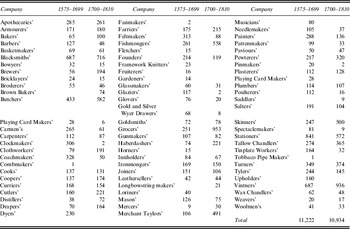
London Livery Companies and numbers of their apprentices in the linked sample for this study

Source: London Livery Company apprenticeship registers series, abstracted and indexed by Cliff Webb, 48 vols. (London, 1998–2009), and see text.
It is difficult to evaluate the accuracy of the answers given by potential apprentices and their sponsors, and they may well have sought to represent themselves in a positive light. However, there was no obvious reason for systematic misrepresentation by either apprentice or Company. The main problem with apprenticeship registers is the ambiguity and fluidity of the terms they use, rather than their accuracy, particularly when apprentices described themselves as the sons of gentlemen or yeomen.Footnote 29
The composition of Companies in our sample shifts as the surviving Company archives begin and end at different points. For fourteen important Companies whose data have not yet been fully digitized the sample contains apprentices from only two counties, Surrey and Bedfordshire.Footnote 30 This sub-sample makes up 12 per cent of our sample of London apprentices. Although not representative of all entrants to these Companies, the home counties were major suppliers of apprentices in this period, so the sub-samples offer a reasonable representation of a large segment of apprentices in these Companies at the very least.Footnote 31
In total, the sample we use here contains around half of all apprentices indentured in the city in the later seventeenth and eighteenth centuries.Footnote 32 The survival of Company records from the sixteenth and early seventeenth centuries is much more sporadic and our sample contains a smaller proportion, although in the absence of reliable overall totals for apprentices in the city in this period it is impossible to estimate the proportion.
Using automated queries, we matched this sample of apprentices with the parish records of youths' baptisms contained in the International Genealogical Index (IGI).Footnote 33 The IGI is not without problems. The information was largely entered by volunteers, not all of whom possessed a satisfactory level of skill in reading, interpreting and entering historical sources.Footnote 34 Because parish records survive for varying periods, the areas included change over time, adding a further confounding factor. Nonetheless, in the absence of an alternative, the IGI remains the preferred choice. Given the large sample size under consideration, the IGI is sufficiently accurate for our purposes. We do not expect any errors in the IGI to have biased our findings in one direction or another: there is no reason to believe that the linkage procedure we use identifies a sample of matched apprentices that are particularly young or old.
The linkage between the apprenticeship sample and the baptismal information in the IGI used several parameters. We accepted positive matches where the forename and surname of the apprentice and his father matched those of a child and his parent in a baptismal record from the same parish or town that the apprentice came from.Footnote 35 There is an inevitable risk of errors in any attempt at linkage. To reduce this, we excluded all cases where there was an obvious ambiguity, including cases from a location where there were multiple individuals listed in the baptismal registers who could have been the apprentice in question, and where two apprentices with the same name and a same-named father came from the same location in an overlapping period. For the small communities which contained most of England's population in this period and supplied the majority of apprentices to the city, the place name sets a relatively tight boundary on linkage error. For larger cities, and London in particular, linking on place names is weaker. For the metropolitan area, we limited our linkage to cases where apprentices indicated their parish of origin or an area of the city (such as Spitalfields or Holborn) that could be linked with a small number of parishes. However, even then the size and complexity of some parishes, particularly those just outside the old walls of the city, raise the probability of linkage errors.
The quality of linkage may also be affected by the reuse of names between generations. Thus, with a search that is not restricted by date, we could link apprentices to individuals who would have been of an advanced age when entering service.Footnote 36 The implication is that we may confuse parents with their children. That these links might be actual apprenticeships is confirmed by qualitative sources reporting indentures made with adults, although the actual meaning of such contracts was likely to have been quite different to those of the majority of youths who engaged in apprenticeships.Footnote 37 However, because we cannot sift the wheat from the chaff, our analysis excludes apprentices thought to be over 30 years old. For the same reason, we excluded those under 10 years of age. This reduces the risk of including false linkages and lowers the impact of outliers on our findings. We do know from other sources that some children aged 10 and under were bound as apprentices – William Clowes was bound as a compositor at the age of 10 in 1779, for example – but the numbers of apprentices we identified being bound at 10 or 11 are sufficiently small to suggest that the benefits of excluding potentially flawed links outweigh the costs.Footnote 38
The final sample of apprentices for whom we have identified dates of baptism contains 22,156 individuals. The sample follows closely the distribution of apprentices between the different Companies in our original dataset; the distribution of the sample between Companies is given in Table 1.Footnote 39 Because of the linkage difficulties just outlined, it is a less accurate mirror of the geographical distribution of apprentices. In particular, London apprentices are particularly under-represented (6 per cent of those with ages compared to 24 per cent of the full sample), and those from Surrey and Bedfordshire, for which we have additional samples, are over-represented.
Our calculation of the age at which apprentices were bound was based on the date of baptism and date of binding. This introduced further difficulties into our analysis. Most importantly, baptism is not birth – the event that actually concerns us here – and the time between birth and baptism was variable in the seventeenth and eighteenth centuries. English Church regulations required baptism by no later than the Sunday or Holy Day after the birth of a child, extended in 1662 to the second Sunday. However, studies of baptismal practices have shown that in practice baptism could be delayed for a significant time after birth. The likelihood of delay increased over the seventeenth and eighteenth centuries with the breakdown of the church courts and the rise of non-conformity. R. S. Schofield and B. M. Berry found that the time by which 75 per cent of infants had been baptised rose from 14 days after birth in the median parish between 1650 and 1700 to 38 days in 1771–1789 and 64 days in 1791–1812.Footnote 40 The problem may in fact have been worse in the seventeenth century than Schofield and Berry suggested.Footnote 41 Similarly, while apprentice indentures offer a greater precision about the timing of the formal contract, binding often followed an indefinite period of ‘trial’, which might vary from a few weeks to several months. In the late seventeenth century, we have found elsewhere that apprentices often appear to have joined their master permanently some time after their term of service had commenced.Footnote 42 This delay is hard to quantify, but may have been as long as a year in some cases. These sources of error need to be considered when reading the findings we present here. We do not know which records contain either type of error, or exactly how frequent either type of error may have been. Errors of a few months in either direction, however, are unlikely to invalidate the main trends and results highlighted below.
2. How old were apprentices when bound?
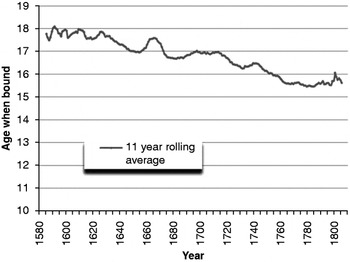
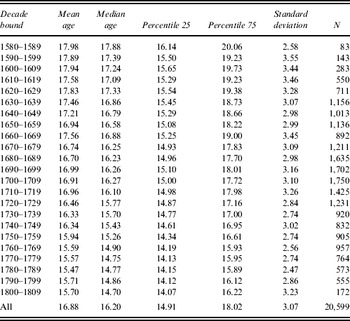
The ages of apprentices bound in London between 1580 and 1809 are presented in Table 2. The mean age of apprenticeship in the city during these two centuries was 16.88 years; the median was 16.2 years. There was, however, a decline over the period of more than two years. At the end of the sixteenth century, apprentices were on average verging on 18 years old when bound. By the start of the nineteenth century, they were around 15 and a half. The median age of apprenticeship fell even further, from 17.4 in the 1590s to 14.7 in the 1800s. This decline of 2 and a half years occurred relatively smoothly. As the 11-year rolling average shown in Figure 1 shows, there were a few fluctuations, particularly around the time of the plague of 1665, and some periods of stagnation. However, the trend remained stable throughout. By the end of the eighteenth century, London's apprentices were markedly younger than they had been two centuries earlier.
Ages of London apprentices, 1580–1800. (Source: London Livery Company apprenticeship registers series, abstracted and indexed by Cliff Webb, 48 vols. (London, 1998–2009), and see text.)


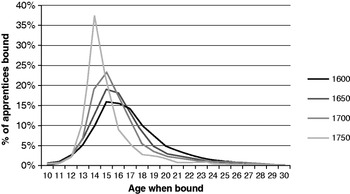
This decline in age was accompanied by a narrowing in the range of ages at which service in London began, particularly at the upper end of the age range. Figure 2 plots the proportion of apprentices bound, by year of age for the four half-centuries between 1600 and 1800. As it shows, the distribution of ages became narrower and steeper with every period, with a particularly sharp change from the first to the second half of the eighteenth century. This was not an effect of the outliers. The proportion of apprentices who were very young or very old remained constant: in both 1600–1649 and 1749–1799, 4 per cent of apprentices were aged 10 to 12 and 4 per cent were over 24. The real change was in the proportion of apprentices who were in their late teens and early twenties when bound. Whereas the 25th percentile fell by 1.4 years over the seventeenth and eighteenth centuries, the 75th percentile dropped by 3.1 years, from 19.2 years old in 1590s to 16.1 in the 1790s. Over the same period, the inter-quartile range narrowed from 3.7 years to 2.2 years.
Distribution of apprentices by age over time.

Our figures show that the different estimates of the age of apprenticeship found in the literature are in fact a reflection of a real and substantial change in the practice of service from the sixteenth to the nineteenth century. While we can reconcile Steve Rappaport and Brodsky-Elliott's accounts of 18- or 19-year-old apprentices in the sixteenth century with the much younger norm of around 14 discussed in work on the late eighteenth and nineteenth centuries, our figures do differ markedly from earlier estimates. Compared to Rappaport's data on the Carpenters' Company, our wider sample of apprentices were a year and a half younger: only 22 per cent of those bound in 1600–1649 were aged 18 to 20 in contrast to 57 per cent of carpenters' apprentices. As the data on carpenters dates from 1572 to 1594, some of this difference may be due to the ongoing downward trend. Nonetheless, it seems that the best evidence we have had to date on sixteenth-century apprentices was for an exceptionally old group, perhaps because of the physical demands of their work.Footnote 43
For the eighteenth century, the difference between our data and Snell's findings is also striking. The apprentices he studied were bound at a younger age than in London, with a mean age of 14.0 years in 1700–1760, 14.1 in 1761–1780 and 14.3 in 1781–1815. Surprisingly, where Snell observed a small rise in the mean age of apprentices over the eighteenth century, we see a decline.Footnote 44 Snell's evidence is for a rather different cohort of apprentices: he used settlement examinations, which presumably gave his data a bias towards the lower end of the social scale, and his evidence is largely drawn from rural parishes.Footnote 45 It is therefore possible that apprentices bound in the provinces, and perhaps from poorer backgrounds, were younger than those migrating to London. Understanding these differences will require further research.
London's apprentices were drawn from the entirety of England and Wales, with a few from even further afield. It is reasonable to expect that the distance an apprentice had to travel from his place of origin to London would have affected his age at the start of service, if only because older youths would have a greater ability to take care of themselves during the lengthy period of travel and in the city once their service had begun. By contrast, apprentices from in or around the capital could also have ongoing contact with and support from their family and friends; they might also have had a greater exposure to and understanding of London's economic opportunities, facilitating an earlier match into a trade.
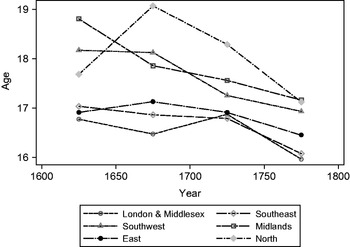
When we look at the way geography affected the age of apprenticeship we do find that distance did strongly affect age. Figure 3 shows the mean age of apprentices from six English geographical regions.Footnote 46 Those from furthest afield in the counties of Northern England were the oldest among their cohort. Apprentices from London and Middlesex were much younger: the difference between the two groups was almost two years in the first half of the seventeenth century, and still almost a year in the second half of the eighteenth. There are indications of convergence between the regions over time, possibly due to improvements in transport. The age difference between London-born and provincial recruits shrank from an average of 0.6 years in 1650–1699 to 0.1 years in 1750–1799. As the figure also shows, the distribution of ages by region was largely consistent across the time-period and all regions followed broadly similar trends. The ages of London's apprentices fell irrespective of their origin; apprentices did not get younger only because they became more local.
Ages of apprentices by region. (Source: As in Figure 1.)

London's apprentices came from widely different social and occupational backgrounds. The sons of gentlemen would have had a quite different position in the domestic economy of their family to those of labourers and small craftsmen, and one would reasonably expect this to affect the age at which they left home. Establishing the balance of the costs and benefits of retaining children within the family economy is, however, notoriously hard to establish. Much depends on the structure of the local economy. Where children could provide a useful domestic or external income, we might expect them to leave home later than elsewhere. But it is less obvious when and where this would apply in practice, particularly given the countervailing effect of the additional periods of formal education wealthier families might provide, and the possibility that where poor apprentices had to save in advance of apprenticeship, this might have taken them longer in areas of lower earnings. By the early nineteenth century, poverty appears to have driven children into work at an earlier age.Footnote 47 But was this the case for the social cohort who entered apprenticeship?
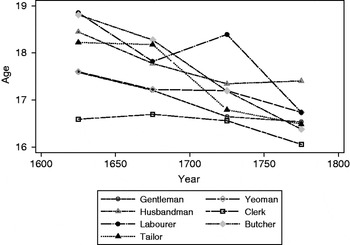
Figure 4 isolates the seven largest specific occupational groupings in our sample (including 7,479 apprentices) and covers a wide range of social and occupational groups. As Figure 4 shows, the age at which youths became apprentices did vary by family background, and these differences remained substantial throughout the period. Although there was some reordering of the ranking over time, overall, there was a tendency for the children of poorer families to be apprenticed at an older age than those from more prosperous backgrounds. This may reflect the relative importance of physical strength in the occupations they were being selected into, which we do not observe directly here. However, it also suggests the possibility that poor families were retaining children for longer in order to benefit from their labour. A possible implication of the decline in age of apprenticeship is that the relative value of these children's labour to their parental household declined over the period. Given that apprentices from all backgrounds became younger at a broadly similar rate over this period, it would also appear implausible that the fall in ages was driven by an undetected expansion in the numbers of younger pauper children entering apprenticeships.Footnote 48
Apprentices by status/occupation of father. (Source: As in Figure 1.)

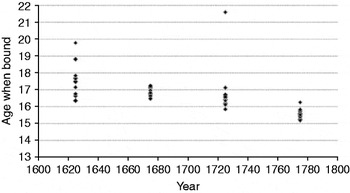
We might also expect that the age of binding in apprenticeship would vary widely across Livery Companies. Trades had different physical, intellectual and educational requirements, and this meant that some were likely to be better suited to younger or to older youths.Footnote 49 The physical demands of blacksmithing or carpentry could call for the greater strength of older teenagers, for example. Although London's Companies included individuals who practised a variety of different occupations beyond the trade they each notionally controlled, members did have a tendency to cluster in particular occupations or sectors. This was particularly true for some of the newer Companies, such as the Apothecaries' and Carmen's. However, as Figure 5 shows, there was relatively little divergence among the ages of apprentices in different Companies. As our sample includes a large number of Companies that often recruited only small numbers of apprentices in a particular period, the graph shows the spread of ages among the ten Companies in each period that recruited the most apprentices.Footnote 50 Most Companies' apprentices fell within a narrow range of ages. There were a few outliers – most obviously in 1700–1749, when the Carmen's Company – the guild of carters – recruited apprentices at an average age of 21.6, almost four and half years older than the next Company, perhaps reflecting the importance of physical strength in the carrying trade.Footnote 51 It is impossible to determine whether this lack of diversity in apprentices' ages indicates greater levels of occupational heterogeneity within London's Companies than is normally supposed or whether non-occupational factors were more important than occupation in determining the age of binding. Either way, geographical and social differences in apprentices' origins appear to have produced a wider range of ages than the differences in their corporate destinations.
Ages of apprentices by Company. Note that the table shows the distribution of mean ages for the ten Companies that recruited the largest number of apprentices in each half-century. The Companies included and the number of periods in which they appear were as follows: Blacksmiths', 4; Butchers', 4; Stationers', 4; Turners', 4; Vintners', 4; Fishmongers', 3; Coachmakers', 2; Grocers', 2; Skinners', 2; Tallow Chandlers', 2; Apothecaries', 1; Brewers', 1; Carmen's, 1; Clockmakers', 1; Dyers', 1; Merchant Taylors', 1; Painters', 1; Pewterers', 1; Tylers', 1. (Source: As in Figure 1.)

3. A regression analysis of apprentices' ages
The descriptive statistics discussed thus far give a useful impression of the ways in which the ages of London's apprentices varied by time, geography, family background and Livery Company. In this section, we extend the analysis a step further by estimating multivariate regressions explaining the age of binding as a function of these and other characteristics. These regressions yield partial correlation coefficients, which speak directly to the statistical and historical significance of alternative explanations for the age at which youths entered apprenticeship.
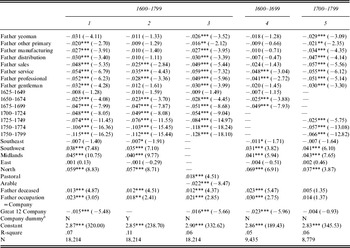
The results of these regressions are reported in Table 3. The estimation method used is ordinary least squares, and the dependent variable is the log of age (in years) of entry into apprenticeship. For certain variables, there are some minor differences from the categories used earlier. For example, to group occupations into meaningful blocks we adopted Wrigley's ‘Primary, Secondary, Tertiary’ (PST) coding scheme to allocate parental occupations to different sectors, and amended it to distinguish two of the largest particular groupings among parents: yeomen and gentlemen.Footnote 52
Regressions of characteristics of apprentices explaining their age at bindingFootnote a

a The regression estimation method is Ordinary Least Squares. The dependant variable is the natural logarithm of age at binding. T-statistics are in parentheses. Sons of fathers without an occupation were excluded from the sample. Apprentices identified as training with a relative are also excluded. ‘Pastoral’ counties are Devon, Dorset, Gloucestershire, Herefordshire, Somerset and Wiltshire. ‘Arable’ counties are Bedfordshire, Berkshire, Buckinghamshire, Cambridgeshire, Essex, Hertfordshire, Huntingdonshire, Leicestershire, Norfolk, Oxfordshire, Suffolk and Surrey. Coefficients significant at the 1, 5, and 10 per cent levels are marked ***, ** and *. ‘Father labourer’ is the omitted father occupation group; 1600–1624 is the omitted quarter-century; and London is the omitted place of origin.
b The ‘Great 12’ were the twelve most senior London Companies whose members monopolized senior city offices, such as that of alderman.
Source: As in Table 1.
We report the results of five models in Table 3. The first covers the full period and our main variables. The second adds Company dummies. The third explores regions by whether they were mainly pastoral or arable. The fourth and fifth separate the seventeenth and eighteenth centuries.
The baseline regression in column 1 largely confirms our earlier discussion. Time, region and family were all significant factors in affecting the age of apprenticeship. The fall in age over time, as shown by the sequence of quarter-century dummy variables, is strongly significant, and remained so after the inclusion of other characteristics potentially affecting when youths began their terms. The time dummies in Table 3 indicate that, after controlling for other determinants of age, the age of apprenticeship fell by 5 months between 1600–1624 and 1650–1674 and by 21 months between 1600–1624 and 1774–1799. These are significant and substantial declines, and only somewhat smaller than the changes reported in Table 2.
Apprentice and Company characteristics clearly influenced age of entry into apprenticeship, but the secular decline seen over two centuries was not driven by changes in who entered apprenticeship and who engaged in training. Variables for region of origin show that youths from distant parts of provincial England were considerably older than those from the capital (the excluded reference group) or the Southeast of England. Apprentices from the North of England were almost 12 months older on indenture than otherwise similar apprentices from London and Middlesex. Family background had a moderate effect on age of binding, with the sons of labourers (the reference group) being older than the sons of families in most other positions, perhaps because they needed more time to save sufficient funds to cover the costs of travel, entry fees and any premium they paid to their master. Youths with fathers in sales and service occupations tended to be 10 to 11 months younger than apprentices with labourer fathers. It is interesting to note that the range of marginal effects in both father's occupation and region of origin are similar. Leaving aside the sons of labourers, who account for only 3 per cent of our sample, variation between the remaining father's occupation groups is associated with less than 6 months of the average difference in age of apprenticeship. By contrast, over 20 per cent of apprentices came from the Midlands and the North, where entry was typically delayed by up to a year compared with those from London. Among the ‘middling sorts’ that dominated apprenticeship, there was considerably more variation in age associated with the region of origin than with parental background. The background effects are somewhat smaller when we include a fuIl set of dummy variables for each Company in which apprenticeships took place (column 2). This is also much as one would expect, as it is well known that Companies recruited from quite different social groups. In columns 4 and 5, we estimate the baseline model separately for each century. Interestingly, the effect of parental occupation on age is clearer in the eighteenth century than in the seventeenth.
There are three aspects to this analysis that have not been discussed earlier. In our third model (in column 3) we explore how age of apprenticeship varied for those coming from ‘pastoral’ or ‘arable’ regions. Snell found that agricultural servants in Eastern arable counties left home later than those from Western pastoral areas, while for entrants to apprenticeships the position was reversed.Footnote 53 Snell suggested that agricultural servants' ages were explained by the employers' demand for labour. It is not clear why the ages of those entering apprenticeships should have moved in counterpoint, but our similar finding that youths from ‘arable’ counties in the east of England began apprenticeships earlier than those in Western ‘pastoral’ ones suggests that systematic differences in youths' roles in the domestic economy in these regions did help determine the age at which they left home.Footnote 54
The second additional element is the effect of the death of a father on the age of apprenticeship. The harsh demographic realities of life in early modern England made it likely that many youths would have lost their father before reaching their mid-teens. In his study of Rye, Graham Mayhew found that most apprentices were orphans or young immigrants, and that when parents survived they normally kept their children with them until marriage.Footnote 55 Rappaport also posited that ‘pressure to begin apprenticeships early in life might have been considerable’ for orphans.Footnote 56 However, among our sample of London apprentices, the regression results indicate that a small, positive relationship existed between the age of apprenticeship and the death of the apprentice's father, after controlling for other characteristics that influenced age: those who had lost their father were bound at a slightly older age than those who had not. The difference is not large – about 2 to 3 months in the first three specifications if the typical apprentice was bound at age 16 – and there is an obvious circularity in the relationship, given that the probability of one's father dying increases with age. Nonetheless, it seems unlikely that many London apprentices had been pushed into service at an early age by the death of their father.
This conclusion is supported if we compare the proportions of apprentices whose father was deceased with the rates of mortality that might be expected for parents. Overall, only 25.4 per cent of London's apprentices in this period had lost their father when they started service; more of those from the London area were orphans (32.2 per cent) than from the provinces (24.1 per cent). These numbers may seem large, but in practice they fit reasonably closely with the probability of death for males of the age to be fathers. Between the ages of 30 (when a man could expect to have a child) and 45 (when this child might enter service), male mortality was around 25 per cent nationally in the mid-seventeenth century, while Landers found that in London in 1730–1749 it was 31.6 per cent.Footnote 57 Given this, it seems unlikely that paternal mortality was an important factor in the decision to send youths into apprenticeships in London. In this, we may be observing one of the differences between metropolitan apprenticeship and its provincial equivalent. Becoming an apprentice in London could take considerable financial and organizational effort to arrange. It was not an easy way to respond to the problem of looking after a child whose birth family had suddenly dissolved.
We also considered whether sons training in a Company close to their father's occupation left home to enter service at different ages. Unfortunately, it is not possible to match father's occupation to the occupation of the master with whom the apprentice was training, as we have Company but not occupation for the masters. Some fathers have an occupation (for example, blacksmith) that matches exactly with the name of one of the Companies, and we used this information to generate a rough indicator of common economic activity. This is likely to miss many unidentified matches between fathers and masters, particularly in Companies that encompassed a wide range of occupations. Despite these limitations, we did find a small positive link between occupational links and age of apprenticeship. This may be explained by masters' perceptions of the returns to training and employing apprentices with some pre-indenture experience. If boys without exposure to activities associated with the Company required a longer prior training period to achieve a given level of productivity, it may have been attractive to have them enter into indentures earlier, so that more of the training period took place at a younger age when learning was more rapid and the productivity associated with physical strength lower.
4. Conclusion
Our analysis has shown that the age at which apprentices entered service in London experienced a long and slow decline in the seventeenth and eighteenth centuries. Apprentices were also starting in a more tightly defined age-period, suggesting that the ‘suddenness with which children leave home’ that Wall noted as distinguishing modern from past communities was the end-point of a longer process in which children left home within a increasingly narrower range of ages.Footnote 58 This decline affected youths from all areas, all backgrounds, and all Livery Companies. Geography and background did still affect the age at which youths began apprenticeships: those from more distant areas were older, while youths from more prosperous backgrounds tended to be younger. Those whose fathers had died before the youths began service were somewhat older at entry than otherwise similar apprentices.
Earlier studies by Wall and by Horrell and Humphries have observed a fall in the age of leaving home in the eighteenth and early nineteenth centuries, which only reversed in the mid-nineteenth century.Footnote 59 Our findings suggest that this process began earlier than was previously thought. It is possible that the late sixteenth century saw a peak in the age of entry to service, as indicated by Hanawalt's estimates of the age of medieval apprenticeship. This would suggest that the age of entering service experienced long cycles in response to changes in real wages, the wage premium received by skilled workers and other economic and demographic factors.
The fall in the age of apprenticeship was part of a process of change in the institution of apprenticeship and its wider role. It implies that formal regulations and norms, and the corporate life-cycle that they defined, were becoming less important. The decision by apprentices and their families to begin terms earlier meant that they would have completed their terms around the age of 21 by 1800, rather than at 24 or older as in 1600, despite guild, city and national rules that set a minimum age of 24 for completion. This is strong evidence that many, if not most, apprentices had incentives to train beyond those associated with obtaining the citizenship of the city where they were trained. The fall in the age at which service started may also explain the apparent increase in the frequency of payment of premiums, as younger children were probably less productive.Footnote 60 Finally, that apprentices in our sample were more than three years older on average than pauper apprentices in London underlines the fundamental distinction between craft and pauper apprenticeship as stages in the life cycle of youths.
Age may also have affected apprentices' private and public experiences. Their public role within the London mob that regularly brought disorder to the city's streets would have changed subtly: a group of apprentices aged 14 or 15 gives a different impression to one in which all are 18 or older – apprentices became ‘boys’ rather than the ‘lusty fellowes’ Bartholomew Steer hoped would assist the 1596 Oxfordshire rising against enclosures.Footnote 61 London's mob must always have encompassed a wide age range, as John Walter has recently noted, but the intersection of assertive manliness and subordination within apprentices' participation in acts of public protest was played out against shifting levels of physical maturity.Footnote 62 As they became younger, apprentices may also have been more vulnerable to exploitation and abuse within the household and workplace. The apprentice increasingly became an ‘adolescent’. In modern terms – although not in early modern definitions of maturity – new apprentices moved from being adults to being children. If we take 21 as the age of adulthood, as has been suggested for this period, apprentices in the early seventeenth century would have been of ‘adult’ age for more than half of their term. In contrast, by the late eighteenth century, adulthood and completion coincided. If defined by status, apprenticeship might always have been adolescent labour, but if measured against cultural definitions of adulthood, it would appear that over the early modern period apprenticeship labour increasingly became adolescent labour.Footnote 63
The decline in the age of apprenticeship has several wider implications for our understanding of England's economy and society. First, to the extent that it was a product of the demand for labour in London's economy (and we cannot a priori exclude supply-side factors), it provides additional evidence for a long-run expansion in the English economy over the centuries before industrialization. Second, it is a further indication of the importance of the metropolis in shaping the life-cycle and life-course across England as a whole, as E. A. Wrigley famously observed.Footnote 64 London's long boom, most visible in the growth of trade and population, also made its migrants and adolescent workforce younger. Finally, it points to a previously unrecognized expansion in the supply of semi-skilled and skilled labour in the run-up to industrialization. London's youths were attaining their ‘final level’ of training at an earlier age by the end of the eighteenth century. Assuming that the proportion of young men in craft occupations was roughly constant, this fall in the age of entry into service would have expanded the relative supply of trained labour by almost 10 per cent over the two centuries to 1780.Footnote 65 This is a small, but not trivial, addition to de Vries' thesis that this period saw an industrious revolution.Footnote 66
The fall in the age of apprenticeship in London has implications for the structure of the household economy as well as the wider labour force. We cannot be sure that apprenticeship was a youth's first move beyond the family home; the question of the scale and extent of child labour within and beyond the household has been much debated.Footnote 67 However, to the extent that apprenticeship did mark leaving home, our findings suggest a substantial shift in the involvement and importance of children and adolescents in the family economy. If we take the age of 15 as the end of childhood, as is standard, for apprentices throughout this period nearly all their ‘child’ labour would have occurred while they remained resident in their family. Nonetheless, the increasingly early departure of youths suggests that children played a declining role in the family economy. By leaving at 15 rather than 18, youths were exiting the household at the point at which they were likely to become net producers.Footnote 68 It is hard to reconcile the decline in age with arguments that expanding proto-industrialization saw an increasing demand for the labour of children within households over this period, unless apprentices came from a wholly different social group, which does not seem likely on the evidence of their reported backgrounds.Footnote 69 That youths from poorer families left later suggests that their incomes remained more important to their families. That said, the fall in the age of apprenticeship may, however, have had the perverse effect of increasing levels of child labour. Horrell and Humphries found that the labour-force participation of younger children depended in part on the presence or absence of older children in the family. If this applies in earlier periods, then the earlier age of apprenticeship would have led to an increase in child labour within the household.Footnote 70 Finally, because starting younger meant apprentices would have completed their terms earlier, the fall in their age may help explain the similar decline in the age at which men married and established their own households, which occurred from the mid-seventeenth century.Footnote 71 The wide implications of the fall in the age of apprenticeship underline the interconnected nature of the structures of family and economy in early modern England.
ACKNOWLEDGEMENTS
We would particularly like to thank Philip Clarkson for his work programming the linkage scripts. We would also like to thank Tim Leunig, Peter Howlett, the anonymous referees and Philip Epstein for their comments on an earlier version of this article, and Tony Wrigley for the use of his PST codes.