Population density is often a critical factor in colonisation of trees by bark and wood-boring insects. Insect population density can affect success in attack of individual trees (e.g., via compromised tree resistance), rate of tree mortality, stand-level mortality, and survivorship and fecundity in the subsequent generation. There is evidence that at high densities wood borers are able to mitigate or overcome host tree resistance more easily or quickly (Hanks et al. Reference Hanks, Paine, Millar, Campbell and Schuch1999; MacQuarrie and Scharbach Reference MacQuarrie and Scharbach2015). Similarly, other studies observed that tree mortality was greater at sites with higher populations of wood borers (Fierke et al. Reference Fierke, Kelley and Stephen2007; Nahrung et al. Reference Nahrung, Smith, Wiegand, Lawson and Debuse2014). Bark beetles (Coleoptera: Curculionidae) rely on high population densities to successfully kill and colonise host trees (e.g., Raffa and Berryman Reference Raffa and Berryman1983), although at very high densities a trade-off between host colonisation and intraspecific competition exists (Lindgren and Raffa Reference Lindgren and Raffa2013). It follows that density-dependent changes in offspring survival and parent generation fitness can also occur (Anderbrant et al. Reference Anderbrant, Schlyter and Birgersson1985; Jactel and Lieutier Reference Jactel and Lieutier1987; Zhang et al. Reference Zhang, Byers and Schlyter1992).
Sirex noctilio Fabricius (Hymenoptera: Siricidae), the European woodwasp, typically colonises stressed or sub-dominant pines (Pinus Linnaeus; Pinaceae) throughout its native range and in parts of its introduced range (Madden Reference Madden and Berryman1988; Ayres et al. Reference Ayres, Pena, Lombardo and Lombardero2014). However, S. noctilio is known to attack and, in some instances, successfully colonises greater numbers of healthy, co-dominant trees at high population densities or during an outbreak (Morgan and Stewart Reference Morgan and Stewart1966; Madden Reference Madden1975; Haavik et al. Reference Haavik, Dodds, Ryan and Allison2016). In North America where S. noctilio is exotic, it colonises native pines and a co-evolved pine, Pinus sylvestris, especially suppressed individuals (Dodds et al. Reference Dodds, de Groot and Orwig2010; Haavik et al. Reference Haavik, Dodds, Ryan and Allison2016). Although established and spreading in North America, S. noctilio has yet to outbreak and kill healthy pines at economically important levels (Ayres et al. Reference Ayres, Pena, Lombardo and Lombardero2014; Haavik et al. Reference Haavik, Dodds and Allison2018), as it has done on other continents that it has invaded (Hurley et al. Reference Hurley, Slippers and Wingfield2007).
Female S. noctilio inject the combination of a toxic mucus and symbiotic Fungi, Amylostereum Boidin (Amylostereaceae), into the tree (during or instead of oviposition) that weakens pine resistance to colonising larvae (F1 cohort) (Morgan and Stewart Reference Morgan and Stewart1966; Coutts and Dolezal Reference Coutts and Dolezal1969). Typically, trees that are successfully colonised die, although several successive years of attack may be necessary to kill trees (Haavik et al. Reference Haavik, Dodds and Allison2018). The effect of density of the attacking S. noctilio population on occurrence and time to tree mortality has not been empirically tested.
Our objective was to determine whether density of the attacking population of S. noctilio affected P. sylvestris survival. Specifically, we caged high and low densities of S. noctilio on P. sylvestris trees and examined whether S. noctilio attack occurred by the presence of characteristic resin beading, and whether attack was successful, as indicated by emergence of a F1 cohort. Subsequent to attack, we assessed if and when P. sylvestris mortality occurred. We expected that a higher population density of attacking S. noctilio would result in certain rapid mortality of P. sylvestris.
The study site was a P. sylvestris stand (UTM Zone 16T, 692978 E, 5152387 N) near Sault Ste. Marie, Ontario, Canada. Trees were pole-sized (diameter at a breast height of 6–8 cm) and experiencing sub-optimal growing conditions, as evidenced by crown dieback, and exhibited no evidence of infestation by the native S. nigricornis. The study site was not within the area generally believed to be infested with S. noctilio in 2014. We selected 18 P. sylvestris for our study that were haphazardly scattered throughout the stand and stressed by environmental factors enough that they exhibited ≥ 75% crown dieback. We expected that these individuals would be suitable for S. noctilio colonisation.
We tested two levels of S. noctilio population density: high (15 mating pairs) versus low (two mating pairs). In early July 2014, we used an orchard ladder to fit each tree with one (low-density treatment) or three (high-density treatment) wire mesh screen (2 × 2 mm) cages near mid-bole. We secured cages (each 1 m long) to tree boles with heavy duty, plastic zip ties at each end. The cages were equipped with velcro closures, sewn directly onto the wire mesh. To prevent cages from collapsing in on themselves, we screwed three wooden struts (10–15 cm long, cut from 5 × 5 cm lumber) into tree boles, equidistant apart (e.g., at 0°, 120°, and 240°), near both ends of cages.
In late July through mid-August 2014, we introduced male–female S. noctilio pairs to cages as wasps became available, partially completing one replicate from each treatment group at a time. This simulated natural conditions by creating some asynchrony in attack consistent with four to six week flight phenology (Ryan et al. Reference Ryan, de Groot, Nott, Drabble, Ochoa and Davis2012). The first wave of attacking females could condition (weaken) trees before more were introduced to complete the requisite number of wasps for the treatment. These adult S. noctilio were obtained from 58 naturally infested pines (identified by resin beading), which we felled and removed from several sites throughout southern Ontario. In late June of 2014, we brought those infested pine logs to a field station near Barrie, Ontario, where we placed them into cardboard rearing tubes in a covered, outdoor shed. We collected S. noctilio that emerged from the logs five times per week and stored them at 4 °C until enough were available for a shipment (20 + wasps). We shipped the wasps to Sault Ste. Marie overnight in coolers with ice packs (one to two times per week). The number of replicates for this study was limited by availability of female S. noctilio, which were difficult to recover from a natural population that was low, because infested trees were difficult to locate, and sex ratios were often biased in favour of males (see Haavik et al. Reference Haavik, Dodds, Ryan and Allison2016, Table S1).
In September 2014, we determined whether trees were attacked by female S. noctilio by visual assessment of resin beading on tree boles inside the cages. Adult S. noctilio were not removed from the cages, and cages remained on trees throughout the duration of the study to prevent other insects from interfering with developing F1 S. noctilio. Only one tree (high-density treatment) was attacked by bark beetles during the study; it was also successfully colonised by S. noctilio. We assessed status of trees (alive versus dead) monthly from September 2014 to August 2015. In November 2015, we assessed and marked presence/absence of S. noctilio adult emergence holes inside each cage (F1, one-year generation time). Because no trees died in the winter of 2014/2015, we did not assess trees the following winter. We assessed trees monthly from May to August in 2016. In November 2016, we conducted a final assessment of tree mortality and S. noctilio adult emergence holes inside each cage (new holes = F1, two-year generation time).
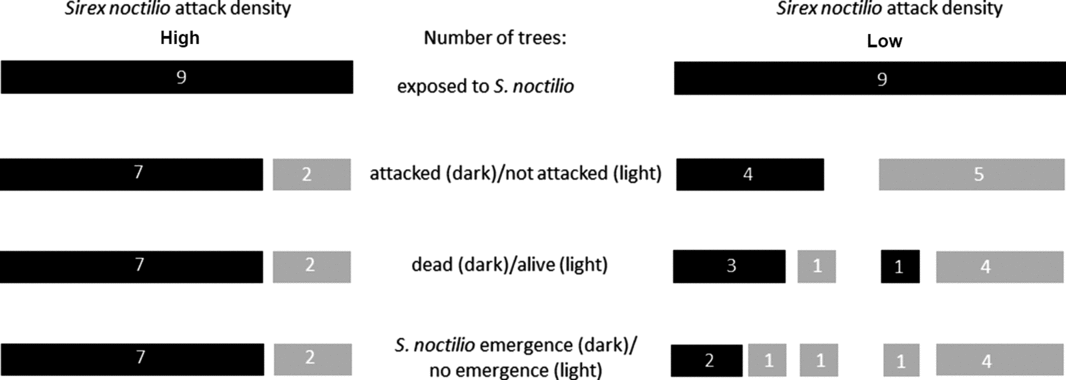
More trees were attacked and subsequently died when exposed to a high versus low density of S. noctilio. This is consistent with our a priori prediction at the outset of the study and observations that larger, more well-defended trees were attacked and killed most frequently at the peak of an outbreak (Madden Reference Madden1975). Specifically, 78% of trees in the high-density treatment were attacked and killed by S. noctilio; 44% of trees in the low-density treatment were attacked and 33% were killed by S. noctilio (Fig. 1). Attack failure was more likely to occur in the low-density treatment (Fig. 1). If attacked, most trees eventually died and produced a F1 cohort, regardless of S. noctilio density (seven of seven in the high-density trees and three of four in the low-density trees).
Diagram illustrating the status and fate of 18 Pinus sylvestris two years following exposure to two different densities of attacking Sirex noctilio.

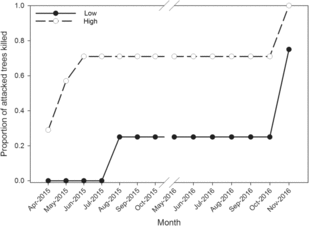
Our limited sample size prevents robust estimation of the frequency with which attack from a low-density S. noctilio population results in tree mortality. Observations indicate that the S. noctilio population is low in most Ontario pine forests, and trees were often attacked in several successive years before they died (Dodds et al. Reference Dodds, de Groot and Orwig2010; Haavik et al. Reference Haavik, Dodds and Allison2018). Consistent with that, trees attacked by a high density of S. noctilio died more rapidly than trees attacked by a low density of S. noctilio (Fig. 2). If attacked, most trees in the high-density treatment died the spring after attack; most in the low-density treatment died by the following fall, more than two years after attack (Fig. 2). A previous study in Ontario at sites with high S. noctilio populations found that pines naturally attacked by S. noctilio died between two weeks and seven months (the next spring) after attack (Ryan et al. Reference Ryan, de Groot, Smith and Turgeon2013), which was similar to observations from S. noctilio populations on other invaded continents (Madden Reference Madden and Berryman1988).
Cumulative proportion of trees that were attacked by Sirex noctilio that died by month, categorised by S. noctilio density (low = two mating pairs; high = 15 mating pairs). No trees in the study died prior to April 2015.

In the high-density treatment, tree death was synonymous with production of a S. noctilio F1 cohort. Trees that died within one year (2015) produced a F1 cohort with a one-year generation time; trees that died the following year (2016) produced a F1 cohort with a two-year generation time. Of the four trees that were attacked by S. noctilio in the low-density treatment, none produced a F1 cohort with a one-year generation time, although one died within one year of attack. Variable development time, between one and three years, occurs in S. noctilio populations on other continents, is thought to be related to temperature, and can affect population growth, interactions, and synchronicity with natural enemies, as well as life history characteristics (Corley and Villacide Reference Corley, Villacide, Slippers, de Groot and Wingfield2012). Our results suggest that attack density is an additional factor that may contribute to variation in development time in S. noctilio.
Patterns in the high-density treatment were clear: most trees were attacked by S. noctilio, and if so, they subsequently died and produced a F1 cohort with a generation time consistent with time of P. sylvestris mortality, usually within one year of attack. Patterns in the low-density treatment were less clear: nearly half of the trees were attacked, and of those only half died and produced F1 S. noctilio within two years. Though our results were limited and require further investigation, they support existing literature and observations that suggest insect population density affects the likelihood of successful host colonisation by wood-boring insects. This has implications for future invasions of S. noctilio and other wood-boring insects and provides further evidence that size of the founding population affects the likelihood of establishment of an insect in a new range (e.g., Beirne Reference Beirne1975; Grevstad Reference Grevstad1999).
Acknowledgements
Authors thank Sarah Drabble, Reg Nott, Roger Scharbach, Nick Boyonoski, Sarah Crispell, Katelyn Kotska, Chanel Fall, Cydney Mihell, Brett Marshall, and Shannon Escasa for field and laboratory assistance, Al Foley for access to the Ontario Tree Seed Facility, and two anonymous reviewers for helpful comments on the manuscript. This work was funded in part by Natural Resources Canada, The Ontario Ministry of Natural Resources, and the United States Department of Agriculture Forest Service-Forest Health Protection.