Introduction
The optimal method to intubate a patient with a difficult airway in a straightforward and expedient manner remains controversial. A difficult airway is defined by the American Society of Anesthesiologists as a clinical situation in which a conventionally trained anaesthesiologist has trouble with facemask ventilation, difficulty with tracheal intubation or both.Reference Apfelbaum, Hagberg, Caplan, Connis, Nickinovich and Benumof1 Because of variability in patients’ anatomy and pathology, no single technique or instrument at the disposal of a surgeon or anaesthesiologist has been proven to be a superior method for achieving airway stabilisation.Reference Frerk2,Reference Rose and Cohen3 It has been well documented in patients requiring emergency intubation that repeat intubation attempts can be associated with death or permanent brain damage.Reference Cook4 Patients with difficult tracheal intubation are at increased risk for significant oxygen desaturation events of less than 90 per cent and subsequent hypoxia.Reference Cook4
This study sought to assess the outcome of performing an immediate pre-operative multidisciplinary airway examination for intubation management in adult patients with a difficult airway.
Materials and methods
This study was approved by the University of Oklahoma Health Sciences Center Institutional Review Board. All subjects provided written informed consent if they were in a stable condition. The study was performed at the University of Oklahoma Health Sciences Center, which is a large tertiary academic medical centre with 35 anaesthesiologists and 10 ENT surgeons.
This single-institution, prospective study involved an intervention on a non-consecutive group of patients undergoing surgery who had a difficult but stable airway as determined by an anaesthesiologist or otolaryngologist. Difficult airway status was ascertained in collaboration with otolaryngologists and anaesthesiologists utilising the American Society of Anesthesiologists definition and prior patient records. Study enrolment and data collection occurred over a one-year period from June 2018 to July 2019. Selected patients were afflicted with head and neck airway pathology, including laryngeal and pharyngeal cancer, trismus, and other post-treatment sequelae, as well as conditions such as angioedema.
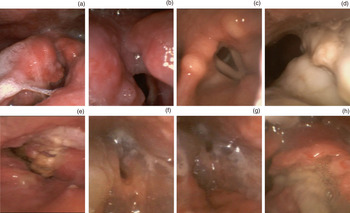
Twelve patients with a difficult airway underwent a pre-operative airway examination, immediately prior to surgery, using a flexible fibre-optic laryngoscope (Figure 1). Only patients who were stable were recruited into the study. Any patient in obvious respiratory distress who required an urgent airway procedure, such as an awake tracheostomy or other method of securing the airway, or were located outside of the operating theatre environment, was excluded.
Images collected from the pre-operative examination. (a & b) Patient 11 had a tumour stage T3 supraglottic squamous cell carcinoma and was transferred from an outside facility after two failed intubation attempts. A significant obstructive mass was evident during our pre-operative examination (a). Closer examination showed evidence of a patent airway (b). (c & d) Patient 5 images show a normal view of the larynx (c), but a superior base of tongue lesion (d) prohibited oropharyngeal intubation. (e) Patient 1 had a laryngeal mass obstructing safe passage of an endotracheal tube. (f & g) Patient 12 had severe angioedema and significant swelling of all oropharyngeal structures. (h) Patient 7 had a laryngeal mass and total disruption of the normal architecture.

The images and recordings obtained during this examination were reviewed together by an anaesthesiologist and otolaryngologist in the pre-operative holding area on a video monitor before entering the operating theatre. The definitive airway management plan was then documented on the airway evaluation template specifically created for this study (Appendix 1). We subsequently recorded whether the management strategy changed after examination.
Once the patient entered the operating theatre, we proceeded with the intubation strategy that had been planned by consensus. The total number of intubation attempts per case and the total time spent intubating the patient were recorded. When measuring the total time, the timer was started when an instrument was inserted into the oral cavity to perform laryngoscopy and stopped once the endotracheal tube was confirmed to be correctly placed within the airway. Other outcomes, including the lowest oxygen desaturation the patient experienced, and complications that arose during the intubation process such as bleeding and oedema, were noted.
The primary outcomes of this study were the effect that multidisciplinary examination had on intubation ‘first-pass success’ and/or change in initial intubation strategy. Secondary outcomes included: the total time spent intubating the patient, the success with initial intubation, the total number of attempts at intubation and the method(s) utilised for intubation. We also recorded complications that arose from all intubations performed or attempted (e.g. worsening oedema, bleeding, trauma, anoxia and death).
Results
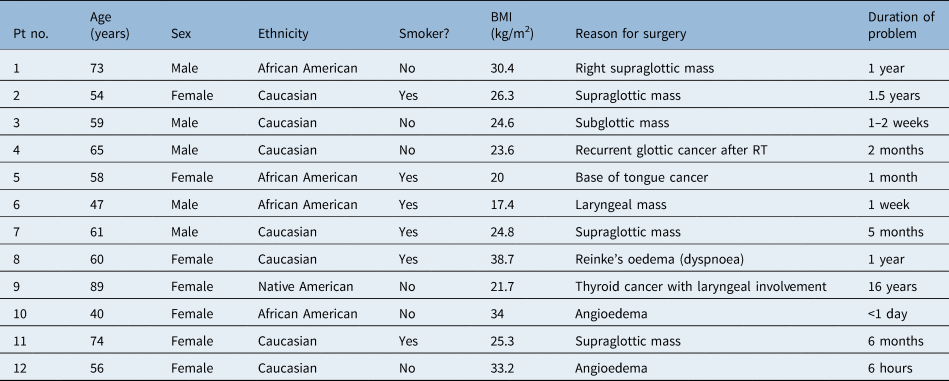
The epidemiological characteristics of the 12 consecutive patients who underwent the pre-operative examination are shown in Table 1. There were five male and seven female patients. The patients’ mean age was 61.3 years. The racial profile of the patients was predominantly African American and Caucasian. Fifty per cent of patients had a history of smoking. The mean body mass index was 26.44 kg/m2. Vocal fold function was abnormal in 42 per cent of the cases, with paralysis of either the right or left vocal fold being a common finding. Eight of the 12 patients had laryngeal head and neck cancer, 1 patient had base of tongue cancer, 2 patients had angioedema and 1 patient was affected by Reinke's oedema.
Epidemiological characteristics of patients who underwent pre-operative fibre-optic laryngoscopy examination

Pt no. = patient number; BMI = body mass index; RT = radiotherapy
All patients in this study were stable; thus, all patients were able to provide informed consent and undergo the fibre-optic examination. Active bleeding was absent in all cases.
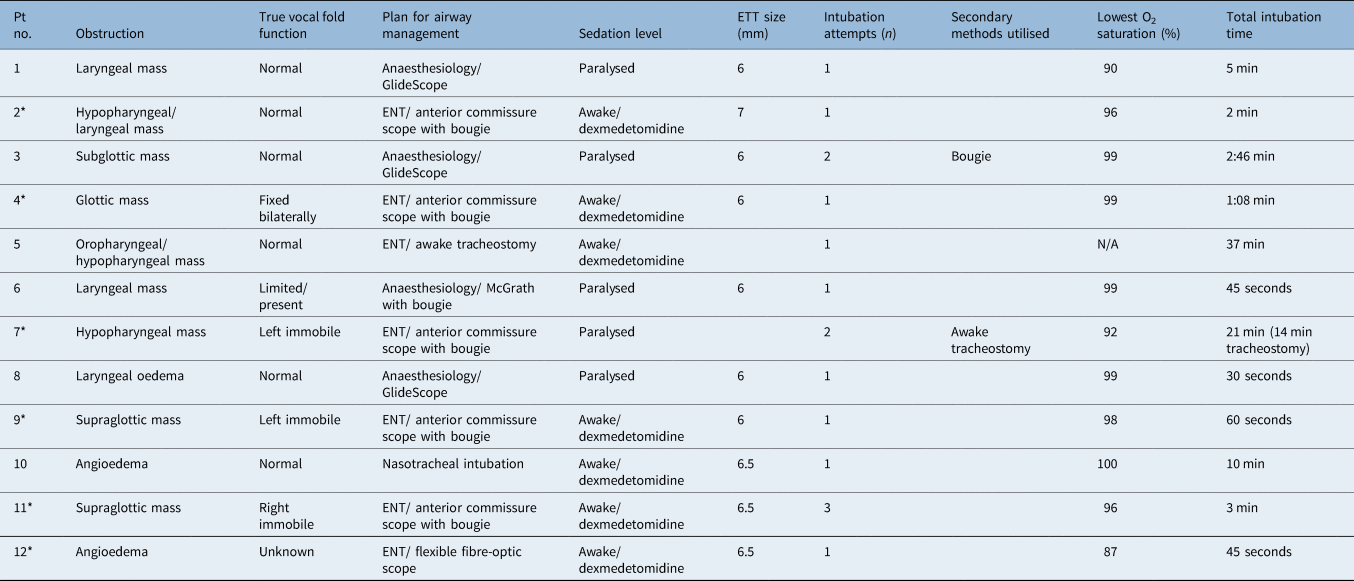
Table 2 details the results of the pre-operative examination. Seven out of 12 patients were intubated whilst awake, under conscious sedation using dexmedetomidine. The remaining five patients were paralysed with traditional muscular blockade. In 5 out of 12 cases, intubation was successfully performed with an anterior commissure scope and bougie. One patient required an awake tracheostomy. Another patient required nasotracheal intubation.
Pre-operative airway examination results

*Examination led to a change in the initial intubation strategy. Pt no. = patient number; ETT = endotracheal tube; O2 = oxygen; min = minutes; N/A = not available
Our examination led to a change in the initial intubation strategy for 6 of the 12 cases, as shown in Table 2. Nine of the 12 patients had first-pass success at intubation, with an average of 1.33 intubation attempts per case. The average time spent on intubation for all patients was 7 minutes and 5 seconds, measured from the time when an instrument was placed in the oral cavity until the time when the airway was secured. Three patients were successfully intubated using the GlideScope, with an average time of 2 minutes and 45 seconds. Four patients were successfully intubated with the anterior commissure scope and bougie technique, with an average time of 1 minute and 47 seconds. One patient was unable to be successfully intubated with this technique, and needed an awake tracheostomy to secure the airway, requiring a total of 21 minutes.
Discussion
To our knowledge, this is the first study to formally assess the utility of a fibre-optic laryngeal examination in difficult but stable airway patients in the immediate pre-operative setting. Many studies have addressed the incidence of complications associated with induction anaesthesia. Adverse outcomes associated with respiratory events constituted the largest class of injury in the American Society of Anesthesiology closed claims study.Reference Metzner, Posner, Lam and Domino5 That study found that management of difficult tracheal intubation was among the most significant contributors to preventable error.Reference Cook4,Reference Metzner, Posner, Lam and Domino5 In addition, difficult airway management in head and neck cases are associated with higher rates of death, brain damage and the need for an emergency surgical airway.Reference Katz6–Reference Iseli, Iseli, Golden, Jones, Boudreaux and Boyce8
Multiple intubation attempts can cause oedema and trauma that can disrupt identifiable anatomy, making further attempts at intubation more difficult. This could result in having to establish an unnecessary emergency surgical airway in order to secure stable ventilation. A study following patients intubated in an emergency room setting found that first-pass success was related to a much lower incidence of adverse events compared with two or more intubation attempts.Reference Sakles, Chiu, Mosier, Walker and Stolz9 Therefore, as long as the patient is maintaining appropriate oxygen saturation, time to intubation is not as important as achieving first-pass success.
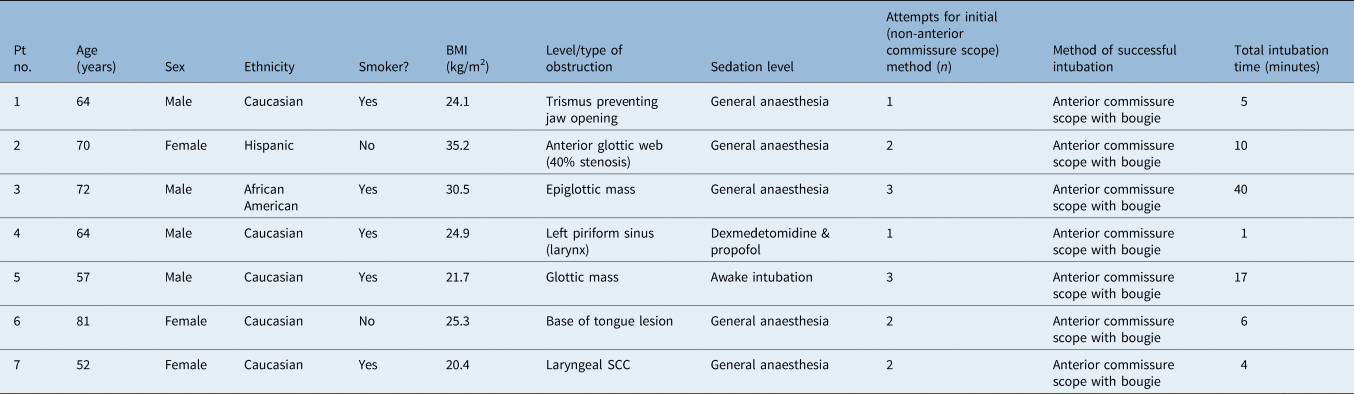
As part of this study, we additionally performed a retrospective review of surgeon-performed intubation at our own institution (University of Oklahoma Health Sciences Center) and identified seven cases for historical analysis. The inclusion of a control arm that does not undergo pre-operative airway examination would in our opinion be unethical and unsafe in this population. As shown in Table 3, five out of seven patients who underwent surgeon-performed intubation without a pre-operative airway examination required multiple (two or more) attempts before stable ventilation was obtained. Our records indicate that intubation took 17 minutes and as long as 40 minutes to achieve in cases 5 and 3, respectively, which represent the longest times recorded. The average time spent intubating these seven patients was 11 minutes and 51 seconds, with an average of two attempts at intubation per case.
Retrospective review of patients who underwent surgeon-performed intubation without pre-operative airway examination

Pt no. = patient number; BMI = body mass index; SCC = squamous cell carcinoma
This small study was conducted to improve airway management in patients with a difficult but stable airway. Specifically, a multidisciplinary pre-operative examination was performed by both anaesthesiologists and ENT surgeons, in order to develop a safe plan to intubate patients on the initial attempt. For any intervention regarding awake airway management, it is important to discuss the appropriate level of sedation required for each patient based on the location of the mass and the amount of airway obstruction present. In addition, it is crucial to have planned alternative methods for intubation if the initial strategy fails, whether this involves using different instrumentation or performing a tracheostomy.
After performing fibre-optic laryngoscopy and discussing the findings as a team, our examination led to a change in the initial intubation strategy in 6 of the 12 cases. In some of these cases, physicians were unable to identify structures such as the epiglottis and arytenoids, and a mutually agreed decision was made to change the primary team that would attempt intubation, to improve the likelihood of first-pass success. In all cases, the change of plans was retrospectively noted to involve a move from the traditional Macintosh or Miller blade to the anterior commissure scope and bougie.
In order to achieve successful intubation, it was imperative that the healthcare providers avoid trauma to friable masses and decrease the amount of bleeding or oedema, as documented in cases 2, 4, 9 and 12. These patients were successfully first-pass intubated by the ENT surgeon using the bougie and anterior commissure scope. Despite being considered a rescue device by many healthcare providers, an increasing number of studies have demonstrated the bougie's success in terms of first-pass intubation.Reference Driver, Prekker, Klein, Reardon, Miner and Fagerstrom10,Reference Driver, Dodd, Klein, Buckley, Robinson and McGill11 The bougie allows for precise access to an airway that may be affected by a supraglottic or glottic mass. In such cases, the bougie's smaller calibre creates an optimal path into the patient's airway and allows for easier placement of the endotracheal tube.
This strategy (using the bougie and anterior commissure scope) is also relevant for lesions that involve the base of tongue, vallecula and epiglottis, as seen with patient 5. This type of pathology makes traditional methods of intubation (Macintosh or Miller blade) unfavourable for first-pass success, as the tip of the blade will invariably cause trauma to the lesion and subsequent bleeding. Direct visualisation achieved during our fibre-optic airway examination brought these aspects to the attention of all healthcare providers present. In the case of patient 5, we entered the mouth on the contralateral side with the anterior commissure scope and succeeded with first-pass intubation without complication.
Other aetiological considerations that may necessitate a definitive airway management strategy prior to intubation include progressive oedema of the airway. In our pre-operative evaluation of these patients we documented oedema of all oropharyngeal structures, with patent airways barely identifiable on scope examination. In one case, it was decided to perform awake intubation orally, using a flexible fibre-optic scope, which was successful on the first attempt. In another case, awake nasotracheal intubation was performed, which was also successful on the first attempt. These examples highlight the importance of the pre-operative examination in allowing for rapid assessment and co-operative management.
Of the two patients who were not orally intubated, one underwent a planned tracheostomy. In the other case, patient 2, the plan was to attempt oral intubation with an anterior commissure scope and bougie, with a low threshold to convert to awake tracheostomy. After two unsuccessful intubation attempts, the decision was made to convert to tracheostomy, as planned. In this instance, having alternative methods for intubation in mind before proceeding to the operating theatre allowed for efficient conversion to tracheostomy and timely success at achieving airway stabilisation.
Overall, our intervention led to a change in intubation management in 6 out of 12 cases, with first-pass success at intubation achieved in 9 cases. We recorded an average of 1.33 intubation attempts per case, and the mean time to successful intubation was 7 minutes and 5 seconds.
This study describes a pragmatic approach to securing a difficult airway. However, there are inherent limitations to our study. All of the patients enrolled in this study were known a priori to have a difficult airway and thus there is potential for selection bias to influence our results. In addition, we did not utilise a prospective comparator group as a control to eliminate for potential confounders. Another limitation is the relatively small sample size. Despite these limitations, as an initial study, we believe these results provide a framework for a safe and effective method to evaluate patients with a difficult but stable airway prior to surgery and increase the likelihood of first-pass success at intubation.
• Pre-intubation multidisciplinary assessment using flexible videolaryngoscopy is important when evaluating a patient with a difficult but stable airway
• Pre-operative assessment of the airway in a team approach frequently leads to a change in the initial intubation strategy
• The primary goal of airway assessment is to achieve ‘first-pass’ success at intubation
• Using an anterior commissure laryngoscope with a bougie is a safe and reliable method to secure a difficult airway
Conclusion
We describe a pre-operative intervention for a difficult airway that improves patient safety by increasing the likelihood of first-pass success at intubation. This was accomplished via a multidisciplinary team approach, in which the difficult airway was evaluated using a flexible fibre-optic laryngoscope prior to any intubation attempt. After performing this examination, we found that the subsequent transition to the operating theatre optimised patient safety, interdisciplinary collaboration and healthcare provider confidence. This collaborative effort with both the anaesthesiologist and ENT surgeon created an environment that was beneficial to all healthcare providers involved, and it decreased the stress and anxiety normally associated with intubating a difficult airway. Most importantly, it enabled the safest possible outcome for the patient. Further studies with larger sample sizes are necessary to quantify the effectiveness of this intervention. We hope to implement this protocol as the standard of care for all patients with a difficult airway at our academic institution.
Competing interests
None declared
Appendix 1. Pre-operative airway examination form used to record findings