The bivalve ocean quahog, Arctica islandica, is slow growing and long-lived, which makes it vulnerable to over-exploitation (Thórarinsdóttir & Jacobson, Reference Thórarinsdóttir and Jacobson2005). The estimated maximum age is 374 years (Shöne et al., Reference Schöne, Fiebig, Pfeifer, Gless, Hickson, Johnson, Dreyer and Oschmann2005). The species has been of great commercial importance in eastern North America since 1976 (Chaisson & Rowell, Reference Chaisson and Rowell1985; Murawski & Serchuk, Reference Murawski, Serchuk and Caddy1989). In 1995 commercial ocean quahog fishery started in Iceland and at present a 2.5% harvest policy is in operation (Thórarinsdóttir & Jacobson, Reference Thórarinsdóttir and Jacobson2005).
The ocean quahog is a burrowing bivalve that lives in medium to fine grain sand habitats off the coasts of North America, Iceland and elsewhere along the northern European coast (Fogarty, Reference Fogarty1981; Thórarinsdóttir, Reference Thórarinsdóttir1997). This species can move up and down in the sediment but does not move horizontally after the larvae has settled and burrowed down into the sediment. Approximately 300,000 mt wet weight of ocean quahog are estimated to be distributed along the north-west, north and east coasts of Iceland at depths of 5–50 m (Thórarinsdóttir & Einarsson, 1996). The species is usually found in much deeper waters off Europe and North America.
When feeding, the ocean quahog is found just beneath the surface of the sediment where the siphon holes are clearly visible at the surface as two elliptical holes (inflow and outflow siphons) (Figure 1).
Underwater photograph of the seabed showing siphons of ocean quahogs. (Photograph: Stefán Á. Ragnarsson.)

The ocean quahog in European waters showed a pattern of intermittent burrowing with no obvious periodicity (Taylor, Reference Taylor1976). Burrowing activity in Iceland has, however, been related to season with maximum depth (14 cm) during winter (Thórarinsdóttir, unpublished data). Ocean quahogs are very resistant to oxygen deficiency and can survive hypoxic conditions for a longer period than most other bivalve species (Theede et al., Reference Theede, Ponat, Hiroki and Schlieper1969; Weigelt & Rumohr, Reference Weigelt and Rumohr1986). Burrowing behaviour may help them reduce predation risk by decreasing their accessibility (Zwarts & Wanink, Reference Zwarts and Wanink1989). Living in shallow water sediment makes ocean quahogs particularly vulnerable to storms off the coast of Iceland. Although ocean quahog burrow deeply during winter, big waves during heavy storms can dislodge and move them to relatively shallow waters with a hard bottom that are not suitable as habitat. Under these conditions, quahogs eventually die due to predation as they cannot escape down into the bottom. Such an event was observed in Lonafjördur, north-eastern Iceland after a heavy storm, blowing towards the shore.
The density of ocean quahogs in Lonafjördur, north-eastern Iceland, during 1994 was relatively high, about 3.1 kg m–2 and 34 individals m–2 (Thórarinsdóttir & Einarsson, Reference Thórarinsdóttir and Einarsson1996) and very little fishing has occurred in Lonafjordur since 1994. The Lonafjördur area has a hard bottom in shallow water with rocks and boulders from the low tide level down to 7–9 m depth. Dense sand, a typical ocean quahog habitat, predominates in the fjord from 9–30 m depth but most of the catches have been taken at around 20 m depth (Thórarinsdóttir & Einarsson, Reference Thórarinsdóttir and Einarsson1994).
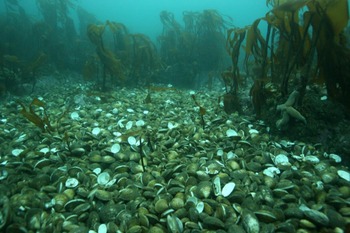
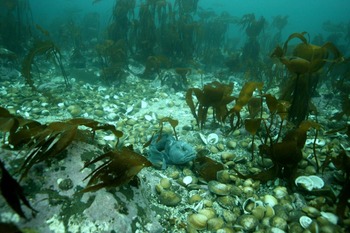
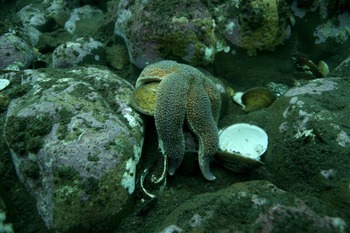
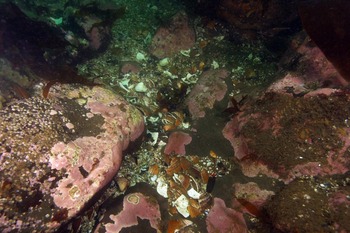
In April 2006 a heavy storm (winds > 20 m sec–1) from the north-west, resulted in large waves and strong currents in Lonafjördur (the Icelandic Meteorological Office). A few days after the storm, a diver found large quantities of ocean quahogs alive on the hard bottom at 8 m depth. These clams had been swept from their natural sandy habitat at depths of more than 9 m, up onto the hard bottom in shallower water (7–9 m) (Figure 2). Lying exposed, unable to escape, they were easy prey for fish such as wolffish (Figure 3) and invertebrate predators (Figure 4). In September 2007, the diver revisited the site and observed empty shells and shell fragments, but no living clams (Figure 5).
Massive numbers of ocean quahogs which were relocated to the shallow hard substratum following the storm in Lonafjördur in April 2006. (Photograph: Erlendur Bogason.)

Wolffish (Anarhichas lupus) predating on ocean quahog on hard substratum. (Photograph: Erlendur Bogason.)

Sea star (Asterias rubens) attacking ocean quahog on hard substratum. (Photograph: Erlendur Bogason.)

Occurrence of empty and broken shells of ocean quahog on a hard substratum in Lonafjördur in September 2007 at the same site as in Figure 1. (Photograph: Erlendur Bogason.)

Physical disturbance is an important environmental factor in structuring soft-bottom communities in the intertidal and storms can provide mortality for benthic organisms (Posey et al., Reference Posey, Lindberg, Alphin and Vose1996). The severity and duration of the disturbance can determine whether entire populations are destroyed or reduced in density. Most research on the influence of storm disturbance on infaunal benthic communities has concentrated on nearshore habitats and shallow waters. However, the results have varied, and differences have been observed in the effects of storms on benthic infauna (Boesch et al., Reference Boesch, Diax and Virnstein1976; Yeo & Risk, Reference Yeo and Risk1979; Barnett, Reference Barnett1981; Dobbs & Vozarik, Reference Dobbs and Vozarik1983; Dreyer et al., Reference Dreyer, Bailey-Brock and McCarthy2005). Posey et al. (Reference Posey, Lindberg, Alphin and Vose1996) described effects of storm on surface-dwelling taxa in an offshore benthic community but no effects on deeper burrowing guilds were observed.
To our knowledge, storm induced movements of a deep burrowing species like ocean quahogs from their natural sandy habitat to an unsuitable hard bottom environment with subsequent mass mortality has not been reported previously. Further investigations on the importance of physical disturbance on the movement and mortality of deep burrowing clams would be of great interest for long-term population monitoring.