I. INTRODUCTION
With the development of high-power InGaAs laser diode in the early 1990s, Yb3+-doped laser materials as promising materials for diode-pumped solid-state high-power lasers with wave lengths between 0.9 and 1.1 μm have been gained much attention.Reference Kolbas, Anderson, Laidig, Sin, Lo, Hsieh and Yang1–Reference Taira, Tulloch, Byer and Kobayashi3 Trivalent ytterbium has simple energy level scheme, i.e., the ground state 2F7/2 and excited state 2F5/2, which are separated by an energy gap of around 100,000 cm−1. In comparison with the other laser ions such as Nd3+ and Er3+, it has some advantages, such as low quantum defect, no excited state absorption, no upconversion, and a relatively long fluorescence lifetime. Otherwise, Yb3+ ion exhibits an intense and broad absorption and emission band. Previously, the synthesis and structure of double borate family with formula M3Re2(BO3)4 (M = Ca, Sr; Re = Y, Gd, and La) were reported.Reference Mill, Tkachuk, Ershova, Mironov and Nikitichev4–Reference Haumesser, Gaumé, Benitez, Viana, Ferrand, Aka and Vivien6 Recently, Nd3+-doped and Yb3+-doped Ca3Re2(BO3)4 crystal of growth and spectral properties were investigated.Reference Mill, Tkachuk, Belokoneva, Ershova and Mironov7–Reference Wei, Lin and Wang9 This paper reports the crystal structure of Yb3+:Sr3Y2(BO3)4 and spectroscopic characterization as well as its laser parameters.
II. EXPERIMENTS
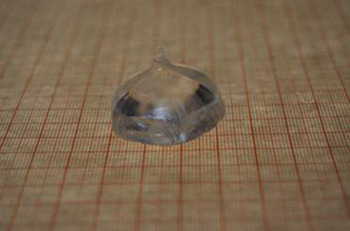
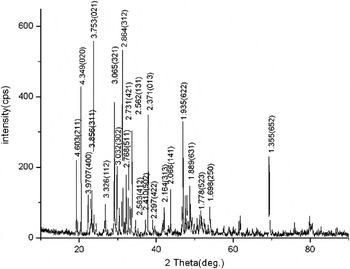
Yb3+:Sr3Y2(BO3)4 crystal was grown by the Czochralski method in a 2 kHz frequency furnace heating an iridium crucible in N2 atmosphere. The crystal growth was carried out along the crystallographic directions [010], with the pulling rate in the range 1∼2 mm/h and the rotation rate of 15∼25 rpm. As a result, Yb3+:Sr3Y2(BO3)4 crystal with dimension Φ12.5 × 20 mm2, free crack, and inclusion was obtained, as shown in Fig. 1. The x-ray powder diffraction (XRPD) method was used to determine the lattice structure and parameters of the as-grown Yb3+:Sr3Y2(BO3)4 crystal. The as-grown crystal of Yb3+:Sr3Y2(BO3)4 was ground into powder as a sample to be measured by the XRPD apparatus. The XRPD pattern of Yb3+:Sr3Y2(BO3)4 crystal is shown in Fig. 2, which was performed using a D–max-rA type diffractometer with a powder, using Cu Kα radiation (λ = 1.54056 Å) by using a graphite monochromator at room temperature. The x-ray diffraction (XRD) data for structure refinement were collected in the step scan mode with steps of 0.020 (2θ). The obtained d values, Miller index, and the corresponding intensities of the peaks are shown in Fig. 2. The crystallinity of the Yb3+:Sr3Y2(BO3)4 samples was investigated by x-ray rocking curve (XRC) analysis for the (020) peak using a multipurpose advanced thin film x-ray system with an extra high resolution Rigaku diffractometer (Tokyo, Japan), which was evaluated based on the full width at half maximum (FWHM) of the peak. A sample of Yb3+:Sr3Y2(BO3)4 crystal with dimensions 2.1 × 2 × 3 mm3 was cut from as-grown crystal for measurement of absorption and emission spectrum. The absorption spectrum was measured using a Perkin-Elmer UV–VIS–NIR (Lambda 35, Norwalk, CT) spectrophotometer at room temperature, which was measured in the range from 800 to 1100 nm. Photoluminescence spectrum was measured at room temperature using Edinburgh Analytical Instruments FLS 920 LifeSpec Ps spectrophotometer (Edinburgh, UK), which contained a Hamamatsu/R5509 photodetector (Hamamatsu, Japan).
The grown Yb3+-doped Sr3Y2(BO3)4 crystal.

The XRD pattern of Yb3+-doped Sr3Y2(BO3)4 crystal.

III. RESULTS AND DISCUSSION
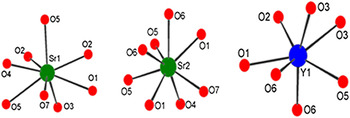
Yb3+:Sr3Y2(BO3)4 crystallizes in the orthorhombic biaxial crystal system. The values of the unit cell constants are a = 7.4062(3) Å, b = 16.0030(7) Å, c = 8.7130(4) Å, α = β = γ = 90°. The crystal belongs to Pnma space group. According to the structure analysis, there are three cationic sites: two eight-coordinated sites are occupied by Sr(1) and Sr(2) ions, whereas the third seven-coordinated site is occupied by Y ions. Figure 3 shows three polyhedron sites. There are two kinds of boron sites, B(1) and B(2, 3), with 3-fold coordination. Moreover, the shortest distance for Y–Y interaction is equal to 3.896 Å, and it is not long enough to limit the energy transfer between the active ions. Thus, the quenching effect in Yb3+:Sr3Y2(BO3)4 is expected. Taking into account the compatibility of charge and ionic radii, the Yb ions will enter Y site for substitution, especially on the condition of low doping concentrations (Yb3+ < 5 at.%).
Cationic sites in Sr3Y2(BO3)4.

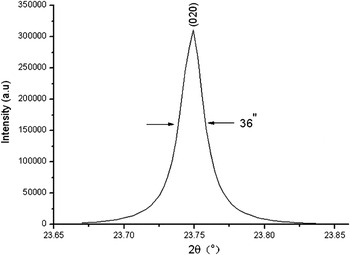
The crystalline quality of the Yb3+:Sr3Y2(BO3)4 single crystal can be characterized by the width of the XRD peak in the XRC measurement. Figure 4 shows the XRD rocking curve, which exhibits a FWHM at (020) peak is as low as 36 arcseconds, featuring a very symmetric diffraction peak. The result demonstrates excellent crystalline perfection of the grown crystal.
XRC for (020) reflection of Yb3+-doped Sr3Y2(BO3)4 crystal.

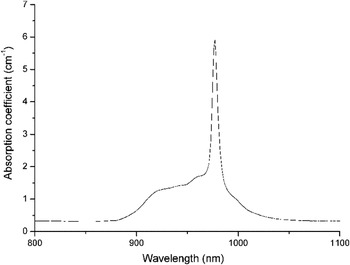
Figure 5 shows the absorption spectrum of Yb3+:Sr3Y2(BO3)4 crystal. There are three main absorption bands centered at 922, 960, and 977 nm. The strongest absorption band is centered at 977 nm. The absorption cross section of 2F7/2–2F5/2 transition is determined from the optical density, thickness, and the concentration of the sample. It is calculated by:

Absorption spectrum of Yb3+-doped Sr3Y2(BO3)4 crystal at room temperature.

where OD(λ) is the optical density at wave length λ, l is the thickness of Yb3+:Sr3Y2(BO3)4 crystal, N 0 is the concentration of Yb3+ in Yb3+:Sr3Y2(BO3)4 crystal, which was determined to be 2.72 × 1020 cm−3 by the inductively coupled plasma method. The absorption coefficient at wave length of 977 nm is 5.91 cm−1, so the absorption cross section at 977 nm is 2.17 × 10⁻²⁰ cm2. Its FWHM is 8 nm. It is larger than that of Yb:GdCOB (2.6 nm)Reference Jiang, Wang, Zhang, Hu, Teng, Zhang and Wang10 and Yb:BOYS (6 nm).Reference Haumesser, Gaumé, Viana and Vivien11 This characteristic is significant in the case of diode pump because this means the laser output power is less sensitive to the drift of the diode pump wave length caused by changes in temperature.
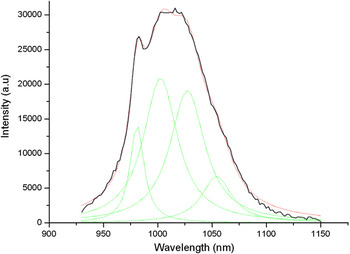
Figure 6 shows the fluorescence spectrum of Yb3+:Sr3Y2(BO3)4 crystal excited with at 977 nm laser radiation. To illustrate the fluorescence bands, the fluorescence curve of Yb3+:Sr3Y2(BO3)4 crystal is decomposed by Lorentzian multipeak fits, which correspond to the emission from the 2F5/2 excited state manifold to the sublevels of the 2F7/2 ground state manifolds. A broad emission band corresponding to 2F5/2 → 2F7/2 transition was observed in 900–1150 nm region with peaks at 981, 1003, 1027, and 1054 nm. The overall splitting of 2F7/2 manifold is 747 cm−1, which is larger than that of Yb:GdCOB (448.3 cm−1) and Yb:YCOB (501.3 cm−1).Reference Jiang, Wang, Zhang, Hu, Teng, Zhang and Wang10, Reference Jiang, Wang, Zhang, Hu, Phil and James12 Such large energy splitting will be available to lower laser thermal effect and reduce reabsorption losses. The spectra of Yb3+:Sr3Y2(BO3)4 crystal are similar to absorption and emission ones obtained for Yb-doped glassy matrices. This is probably due to a particularly strong multisite character, as the host offer one Y site and two different strontium sites, which are also likely to be substituted with Yb3+ ions to some extent. Thus, the laser-active Yb3+ absorption and emission bands are broadened.
Fluorescence spectrum of Yb3+-doped Sr3Y2(BO3)4 crystal at room temperature (the dotted lines are Lorentz fitting line).

High-power directly diode-pumped femtosecond (fs) lasers are one of the hottest and most challenging current research fields. Ytterbium-doped crystals that typically have broad emission bands around 1 μm have been recognized as very attractive gain media for diode-pumped fs oscillation and amplification. Many Yb-doped materials have been already demonstrated as competitive laser gain media in the fs regime.Reference Mougel, Dardenne, Aka, Kahn-Harari and Vivien13–Reference Berger, Greco and Schroeder20 Among these new materials, Yb-doped glasses exhibit very broad and smooth emission spectra that permit possible generation of ultrashort pulses, but poor thermal conductivity and low stress fracture limit their applications in high-power laser systems. Yb3+:Sr3Y2(BO3)4 crystal exhibit a large fundamental manifold splitting up to 747 cm−1, and a broad emission bandwidth in the range 1006–1100 nm with a FWHM of 40 nm. Broad gain bandwidth of the crystal has stimulated its applications for generation of ultrashort pulses in mode-locked regime.
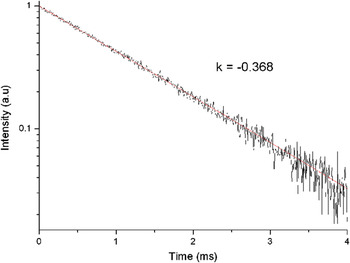
Fluorescence decay curve of the 2F5/2 multiplet of Yb3+:Sr3Y2(BO3)4 crystal displayed in Fig. 7 was measured for an excitation at 977 nm and emission at 1027 nm. The decay curve shows a single exponential behavior and the fluorescence lifetime could be obtained from the slope of the fitting line k, i.e., τf = −(1/2.303 k). By linear fitting, the slope of the fitting lines is −0.368 and the fitted lifetime is about 1.18 ms. The long lifetime will allow for an enhance level of energy storage and be favorable to obtain a high inversion of the electronic population under diode pumping.
Room temperature fluorescence decay curve of Yb3+-doped Sr3Y2(BO3)4 crystal.

The parameter characterizing the potential laser performance of laser crystal is emission cross section, which can be calculated by either the reciprocity method or the F–L method. Since the reciprocity method relies on very weak absorption to predict emission at long wave lengths, its accuracy is inherently limited in this region. The emission cross section depended on the emission spectra line shape, so F–L method is much more accurate especially at longer wave length. The dependency between the emission cross sections and considered fluorescence spectra is described as:

where c is the speed of light in vacuum, I(λ) is the relative emission intensity, n is the crystal refractive index, which was measured roughly as 1.74 using the RHG-181 refractive index instrument (Fuzhou, China). τr is the radiative lifetime, which is estimated from the reciprocity prediction. The peak stimulated emission cross section and bandwidth predicted by the reciprocity method were used to estimate the radiative lifetime of the Yb3+ (2F5/2) manifold, as calculated for the 2F5/2 → 2F7/2 transition by the following formula:

where n is the refractive index of the medium, c is the speed of light in vacuum, and the integral is taken the whole transition centered around  . J and J′ are the total momentum of 2F7/2 manifold and 2F5/2 manifold, respectively. We obtain a value of 1.04 ms for radiative lifetime τr, which is close to the 10 at.% sample fluorescence lifetime of 1.18 ms. The room temperature fluorescence lifetime estimate is reasonably consistent with the radiative lifetime inferred from the absorption data. Therefore, the radiative quantum efficiency is approximate to 1. The maximum emission cross section σe is 1.13 × 10⁻²⁰ cm2 at 1027 nm.
Several important laser parameters, which can be derived from the absorption cross section, emission cross section, and lifetime, assess the performance of a quasi-three-level laser medium. The βmin represents the minimal fraction of Yb3+ ions in the excited state to achieve population inversion at the extraction wave length (λext). So the quality βmin is important for quasi-three-level system such as Yb3+. It is given by:

The pump saturation intensity I psat, which is a measure of the ease with which the ytterbium ion population must be bleached to overcome the ground state absorption, can be given by:
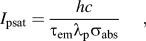
where τem is the fluorescence lifetime, λp is the pump wave length, σabs is absorption cross section at the pump wave length λp.
I min is another laser parameter, which is the minimum absorption pump intensity to reach the threshold at the extraction wave length. It is utilized as a figure of merit. It also indicates the relative usefulness of Yb3+-doped media. It can be obtained from the above parameters as follows:

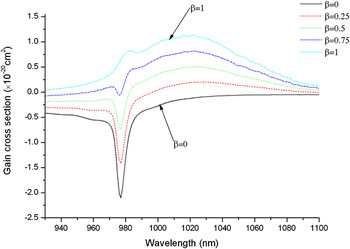
Based on the absorption and emission cross section, the gain cross section σg of the Yb:Sr3Y2(BO3)4 crystal can be obtained by:

where σa and σe are the absorption and emission cross section at the laser wave length, respectively. So the gain cross section spectra are derived for several population inversion rates β, see Fig. 8. It should also be noticed from this figure that σg is positive in a wide range of wave lengths. This fact clearly indicates that the possibility of obtaining tunable laser action is about 40 nm (from 1020 to at least 1060 nm). This tunability range is comparable to the one obtained in Yb:LSB crystals.Reference Romero, Johannsen, Mond, Petermann, Huber and Heumann21
The gain cross section of Yb3+-doped Sr3Y2(BO3)4 crystal.

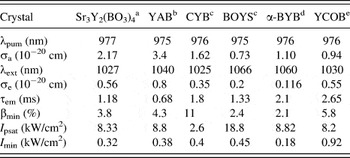
The laser parameters of Yb:Sr3Y2(BO3)4 and other crystals are listed in Table I. Owing to special electric structure of ytterbium, the spectroscopic properties and laser characteristics of ytterbium are host dependent. As compared with the other Yb3+-doped borates, the absorption cross section of Yb3+:Sr3Y2(BO3)4 crystal is larger than that of the other borate crystals except YAB crystal. At the same time, its emission cross section is similar to that of Yb3+-doped YCOB crystals. The important lasing parameter I min is 0.32 kW/cm2, which is lower than that of the other borate crystals except α-BYB crystal. It signifies that Yb3+:Sr3Y2(BO3)4 crystal has lower laser threshold. Thus, the studied Yb3+:Sr3Y2(BO3)4 crystal is very promising materials for active elements of solid-state laser operating in a microrange.
Spectroscopic parameters of Yb3+-doped Sr3Y2(BO3)4 and other Yb3+-doped crystals.

IV. CONCLUSIONS
A transparency Yb3+:Sr3Y2(BO3)4 crystal with dimensions up to Φ12.5 × 20 mm2 has been grown by the Czochralski method. Yb3+:Sr3Y2(BO3)4 crystallizes in the orthorhombic biaxial crystal system, in which there are two types of cationic sites occupied by Sr and Y ions, respectively. The FWHM at (020) peak in the XRC measurement is 36 arcseconds, which indicates excellent crystalline perfection of the grown crystal. The absorption and the luminescence spectra of Yb3+:Sr3Y2(BO3)4 crystal are investigated in the vicinity of 1 μm. The spectral characteristics of Yb3+:Sr3Y2(BO3)4 crystal are compared with the respective characteristics of the known crystals. These results show that Yb3+:Sr3Y2(BO3)4 crystal is of considerable interest as a active medium of diode-pumped fs solid-state lasers operated in the 1 μm wavelength regime.