Introduction
The term emotional labor was first introduced by Hochschild (Reference Hochschild1983) to describe occupations in which individuals face high emotional demands, that is, those aspects of the job that require sustained emotional effort. This is the case, for instance, of service workers, social workers, health professionals, and teachers. Since Hochschild's (Reference Hochschild1983) seminal research, several studies have focused on understanding the emotional labor process (e.g., Beal, Trougakos, Weiss, & Green, Reference Beal, Trougakos, Weiss and Green2006; Bechtoldt, Rohrmann, De Pater, & Beersma, Reference Bechtoldt, Rohrmann, De Pater and Beersma2011; Diefendorff, Gabriel, Nolan, & Yang, Reference Diefendorff, Gabriel, Nolan and Yang2019; Gabriel, Daniels, Diefendorff, & Greguras, Reference Gabriel, Daniels, Diefendorff and Greguras2015; Morris & Feldman, Reference Morris and Feldman1997), to the extent of showing that it plays a key role in explaining individuals' effectiveness and well-being in the workplace (for a review, see Grandey & Melloy, Reference Grandey and Melloy2017; Humphrey, Ashforth, & Diefendorff, Reference Humphrey, Ashforth and Diefendorff2015).
Despite the fact that scholarly and practical interest in emotional labor has increased dramatically in recent years, research on this line of inquiry has produced inconclusive results (Chi, Grandey, Diamond, & Krimmel, Reference Chi, Grandey, Diamond and Krimmel2011; Seery & Corrigall, Reference Seery and Corrigall2009). Thus, on the one hand, most studies have demonstrated that emotional labor is generally related to negative outcomes, including emotional exhaustion or depersonalization (e.g., Nguyen & Stinglhamber, Reference Nguyen and Stinglhamber2018; Pugh, Groth, & Hennig-Thurau, Reference Pugh, Groth and Hennig-Thurau2011; Yagil & Medler-Liraz, Reference Yagil and Medler-Liraz2017), as individuals are likely to experience emotional dissonance (Bakker & Heuven, Reference Bakker and Heuven2006; Kenworthy, Fay, Frame, & Petree, Reference Kenworthy, Fay, Frame and Petree2014). Yet, on the other hand, recent research has shown that emotional labor may also have beneficial effects, including, for instance, job satisfaction or commitment (e.g., Aw, Ilies, & De Pater, Reference Aw, Ilies and De Pater2019; Isenbarger & Zembylas, Reference Isenbarger and Zembylas2006; Shuler & Sypher, Reference Shuler and Sypher2000), as individuals may experience a deep sense of personal accomplishment (Brotheridge & Grandey, Reference Brotheridge and Grandey2002) and feelings of authenticity (Brotheridge & Lee, Reference Brotheridge and Lee2002).
Since employees may have very different experiences in the workplace based on their personal characteristics (Judge, Weiss, Kammeyer-Mueller, & Hulin, Reference Judge, Weiss, Kammeyer-Mueller and Hulin2017), it is possible that some of the inconsistencies noted in the emotional labor literature may be, in fact, explained by individual differences (Grandey & Melloy, Reference Grandey and Melloy2017; Humphrey, Ashforth, & Diefendorff, Reference Humphrey, Ashforth and Diefendorff2015). However, only a few studies have analyzed the role of, for instance, the big five personality traits (e.g., Chi et al., Reference Chi, Grandey, Diamond and Krimmel2011; Kiffin-Petersen, Jordan, & Soutar, Reference Kiffin-Petersen, Jordan and Soutar2011) and dispositional affectivity (e.g., Gabriel et al., Reference Gabriel, Daniels, Diefendorff and Greguras2015; Kammeyer-Mueller et al., Reference Kammeyer-Mueller, Rubenstein, Long, Odio, Buckman, Zhang and Halvorsen-Ganepola2013) in such dynamics. These scholarly efforts, although valuable, are insufficient to account for the effects of individual differences, such as personality traits, on the mechanisms through which individuals perceive and experience emotional labor (Dahling & Johnson, Reference Dahling, Johnson, Grandey, Diefendorff and Rupp2013).
Thus, this paper bridges this gap between the previous studies to further explore the effects of personality traits in the emotional labor process by examining the role of core self-evaluations (CSEs), that is to say, a personality trait that reflects individuals' beliefs regarding their worthiness, competence, and capabilities (see Chang, Ferris, Johnson, Rosen, & Tan, Reference Chang, Ferris, Johnson, Rosen and Tan2012 for a review), in the mechanisms through which employees perceive and react to emotional labor. More specifically, this study examines for the first time the effects of CSEs on the relationships among emotional demands, emotional dissonance, and depersonalization. In this context, it is worth noting that emotional dissonance refers to a form of role conflict in which individuals feel forced to display emotions that are inconsistent with their true feelings (Bakker & Heuven, Reference Bakker and Heuven2006). In addition, depersonalization means much more than simply being exhausted to reflect a negative affective state in which the employee experiences a persistent and extreme state of fatigue and tries to prevent further losses of personal resources by detaching themselves emotionally and viewing others as impersonal objects rather than people (Schmidt & Diestel, Reference Schmidt and Diestel2014). This leads individuals to adopt a distant, dehumanized, cynical, and indifferent attitude toward work in general and toward the users of their service in particular (Maslach & Leiter, Reference Maslach and Leiter2016).
Although the big five personality traits and the dispositional affectivity taxonomy certainly have their merits (for a brief discussion of this topic, see Judge, Heller, & Klinger, Reference Judge, Heller and Klinger2008), the current paper argues that the CSE model also has much to offer to the emotional labor literature. In this regard, CSEs represent a higher-order trait that reflects four personality traits that are well established in psychology research (i.e., self-esteem, generalized self-efficacy, internal locus of control, and emotional stability). Therefore, from a conceptual standpoint, CSEs may serve as an integrative individual-difference variable for explaining emotional labor processes under a single theoretical framework (see Kammeyer-Mueller, Judge, & Scott, Reference Kammeyer-Mueller, Judge and Scott2009). Moreover, since CSEs represent a latent, higher-order personality trait, it is possible that this model will contribute to better understand the complex dynamics underlying individuals' perceptions and experiences toward emotional labor beyond other individual personality measures. In fact, numerous studies have shown that CSEs are able to explain unique variance in numerous affective states and job attitudes beyond other personality taxonomies, such as the big five personality traits and dispositional affectivity (e.g., Judge, Heller, & Klinger, Reference Judge, Heller and Klinger2008; Rode, Judge, & Sun, Reference Rode, Judge and Sun2012). Furthermore, from a methodological viewpoint, since CSEs can be assessed by using a short, direct measure (the Core Self-Evaluations Scale, CSES; see Judge, Erez, Bono, & Thoresen, Reference Judge, Erez, Bono and Thoresen2003), this model may also allow researchers to measure personality traits in an easy, precise, and cost-effective manner (see Rode, Judge, & Sun, Reference Rode, Judge and Sun2012).
This study also contributes to the organizational literature by shedding light on the importance of individual differences in explaining employees' differential experiences and reactions to emotional labor. In doing so, it extends the job demands-resources (JD-R) theory (Bakker & Demerouti, Reference Bakker, Demerouti, Cooper and Chen2014) by providing evidence of the role of personal resources in the way individuals perceive and react to job-related emotional demands, and moves forward from previous research in at least three ways. First, since studies on the role of CSEs in the context of emotional labor have only examined their effects on the emotion-regulation strategies used by individuals when dealing with emotionally demanding situations (such as, surface acting, deep acting, and naturally-felt emotions; e.g., Beal et al., Reference Beal, Trougakos, Weiss and Green2006; Nguyen & Stinglhamber, Reference Nguyen and Stinglhamber2018), this study addresses emotional labor in terms of the emotional requirements of the job (Lewig & Dollard, Reference Lewig and Dollard2003; Morris & Feldman, Reference Morris and Feldman1997; also see Grandey & Gabriel, Reference Grandey and Gabriel2015). Second, the current research focuses on depersonalization as a potential affective reaction to emotional labor, while existing studies have mostly analyzed its effects on emotional exhaustion (e.g., Gabriel et al., Reference Gabriel, Daniels, Diefendorff and Greguras2015; Pugh, Groth, & Hennig-Thurau, Reference Pugh, Groth and Hennig-Thurau2011; Yagil & Medler-Liraz, Reference Yagil and Medler-Liraz2017). Finally, most studies on emotional labor have predominantly focused on service workers who are exposed to short and routinized customer interactions, such as call center agents, hotel clerks, or sales assistants (see Bechtoldt et al., Reference Bechtoldt, Rohrmann, De Pater and Beersma2011). However, the emotional labor process may be even more complex in highly demanding occupations, in which individuals are required not only to manage their emotions successfully, but also to invest high levels of cognitive energy when performing tasks that are complex in nature (see Pujol-Cols & Lazzaro-Salazar, Reference Pujol-Cols and Lazzaro-Salazar2018). In light of this, the current study further contributes to advancing our knowledge in the field by investigating the emotional labor process in a sample of teachers who worked in primary, secondary, and higher education institutions in Argentina.
Literature review and hypothesis development
The emotional labor process
The term emotional labor refers to the deliberate process of managing the feeling and expression of one's emotions as part of a work role (Hochschild, Reference Hochschild1983). As it involves the expression of particular emotions during interpersonal interactions (Ashforth & Humphrey, Reference Ashforth and Humphrey1993), it is usually associated with those occupations involving frequent interactions with customers or users (Morris & Feldman, Reference Morris and Feldman1996). Individuals under such conditions are expected to adjust their feelings and emotional displays to conform to a set of emotional rules while on the job, which reflect various organizational or social expectations that set appropriate ways of feeling and displaying emotions in a given social setting (Hochschild, Reference Hochschild1983). In summary, emotional occupations are characterized by: (a) involvement in frequent interactions with the public, (b) employees' management of their emotions, and (c) the monitoring and enforcement of emotional display by the managerial team (see Grandey & Melloy, Reference Grandey and Melloy2017).
Research on emotional labor has typically been conducted from three main perspectives (for a review, see Grandey & Gabriel, Reference Grandey and Gabriel2015). Early studies have mostly examined emotional labor in terms of emotion performance, that is, by focusing on the observable, facial, or vocal expressions displayed by employees when performing their work roles (e.g., smiling and eye contact). Other studies have turned their attention to the repertoire of emotional-regulation strategies used by individuals to manage their emotions in the workplace. Finally, a third set of studies has conceptualized emotional labor in terms of emotional requirements, that is, by focusing on the demands for emotional displays imposed on the individual by the job. The current study adopts this last approach.
Regarding the effects of emotional demands or emotional requirements, this study follows a JD-R perspective (Bakker & Demerouti, Reference Bakker, Demerouti, Cooper and Chen2014). This theory proposes that employees' states and attitudes can be explained by the interactions between two broad categories of job-related factors. On the one hand, job demands reflect those physical, social, or organizational aspects of the job that require a sustained physical, cognitive, and/or emotional effort by the individual and are thus associated with certain physiological and/or psychological costs. Although job demands may not always be detrimental, they may become job stressors when individuals feel forced to invest significant levels of energy and other resources in meeting those demands without having sufficient opportunities for recovery. Conversely, job resources represent those physical, psychological, social, and organizational factors that are functional in reaching goals and stimulating both personal and professional growth. According to the JD-R theory, job demands are usually related to negative states and health outcomes, whereas job resources tend to enhance job involvement and engagement through motivational processes (Bakker & Demerouti, Reference Bakker, Demerouti, Cooper and Chen2014).
Following the principles of the JD-R theory (Bakker & Demerouti, Reference Bakker, Demerouti, Cooper and Chen2014), job demands tend to negatively affect individuals' well-being through health impairment processes. From this perspective, the processes involved in regulating one's emotions to conform to emotional rules are highly demanding and are, thus, associated with several physiological and psychological costs. Then, the sustained and chronic exposure to these emotional demands is expected to cause exhaustion and strain, as it may lead to a persistent depletion of energy, which may, therefore, drain individuals' physical and psychological resources (Kenworthy et al., Reference Kenworthy, Fay, Frame and Petree2014). Individuals who are exposed to such levels of chronic, occupational distress are, in turn, more likely to suffer from depersonalization (Maslach & Leiter, Reference Maslach and Leiter2016).
Even when the effects of emotional demands on depersonalization have been scarcely studied, especially when compared to other dimensions of burnout (such as emotional exhaustion) or even to other affective outcomes (such as job satisfaction; see Aronsson, Theorell, Grape, Hammarström, Hogstedt, & Marteinsdottir, Reference Aronsson, Theorell, Grape, Hammarström, Hogstedt, Marteinsdottir and Hall2017; Kenworthy et al., Reference Kenworthy, Fay, Frame and Petree2014), based on the rationale presented so far this study proposes that those individuals who perceive emotional situations at work as highly demanding will be more likely to experience depersonalization. In other words:
Hypothesis 1 (H1):
Emotional demands will be positively related to depersonalization.
According to Hochschild (Reference Hochschild1983), for social actors to face emotional demands, regulate their emotions and, therefore, avoid becoming emotional deviants, they have at least three strategies at their disposal. In this regard, surface acting involves the suppression of true feelings and the display of inauthentic emotions that are consistent with social or organizational requirements (e.g., a clerk at a store might have no choice but to smile at a customer that they find annoying or irritant). Deep acting involves a proactive change in one's feelings to elicit an authentic emotional display that is consistent with social or organizational expectations (e.g., a teacher interested in building a sense of excitement in a group of students may show a cheerful and enthusiastic demeanor). Finally, individuals might also express naturally felt emotions that are consistent with organizational or social expectations.
To explain the effects of emotional demands and, in particular, surface acting on individuals' well-being, scholars have mostly turned to the concept of emotional dissonance, a form of role conflict in which individuals feel forced to display emotions that are inconsistent with their true feelings (Morris and Feldman, Reference Morris and Feldman1996). From this perspective, sustained exposure to emotional demands is likely to cause emotional dissonance, which is expected to not only lead to feelings of duplicity and to a state of alienation (Abraham, Reference Abraham1999) but also be experienced as a threat to the true identity of the individual (Jansz & Timmers, Reference Jansz and Timmers2002). As discussed in Bechtoldt et al. (Reference Bechtoldt, Rohrmann, De Pater and Beersma2011), these processes, in turn, are likely to lead to negative outcomes since: (a) expressing fake emotions is highly demanding (also see Karatepe & Aleshinloye, Reference Karatepe and Aleshinloye2009), (b) suppressing negative emotions increases physiological distress (also see Rohrmann, Hennig, & Netter, Reference Rohrmann, Hennig and Netter2002), and (c) experiencing inconsistencies between felt and expressed emotions is unpleasant, as individuals strive to behave authentically (also see Van Dijk & Brown, Reference Van Dijk and Brown2006).
At this stage, it should be noted that the detrimental effects of emotional dissonance on employees' affective states, job attitudes, and health outcomes have been empirically demonstrated in previous research. To provide an example, Heuven and Bakker (Reference Heuven and Bakker2003) showed that the incongruence between actual feelings and positive emotional displays predicted burnout complaints in a sample of cabin attendants. In a similar vein, Bakker and Heuven (Reference Bakker and Heuven2006) demonstrated that the relationship between emotional demands and burnout symptoms was mediated by feelings of emotional dissonance in a sample of police officers. More recently, Diestel, Rivkin, and Schmidt (Reference Diestel, Rivkin and Schmidt2015) reported a negative relationship between day-specific emotional dissonance and various day-specific indicators of well-being, such as ego depletion, need for recovery, and work engagement, in two diary studies involving employees from different occupational and organizational contexts. In spite of these valuable scholarly efforts, however, this field remains under-researched as only a few studies have empirically examined the relationships among emotional demands, emotional dissonance, and depersonalization.
In light of this, drawing on the theoretical and empirical evidence presented so far, this paper argues that the sustained exposure to high levels of emotional demands is likely to cause depersonalization by increasing emotional dissonance. Thus, this study proposes that those individuals who are exposed to high emotional demands will be more prone to experiencing a state of physiological and/or psychological distress due to possible incongruences between felt and displayed feelings. Moreover, this study also argues that individuals in such conditions will be likely to experience emotional dissonance as a highly exhausting, unpleasant, overwhelming, and struggling process (Van Dijk & Brown, Reference Van Dijk and Brown2006), which, if persistent over time, may cause depersonalization (Maslach & Leiter, Reference Maslach and Leiter2016). Thus, based on the rationale discussed so far, this study hypothesizes that:
Hypothesis 2 (H2):
Emotional dissonance will mediate the relationship between emotional demands and depersonalization.
The role of core self-evaluations in emotional labor
The J-DR theory proposes that the processes underlying the effects of job-related factors, including emotional demands, may be affected by individual differences, such as employees' personal resources (Bakker & Demerouti, Reference Bakker, Demerouti, Cooper and Chen2014). In this context, personal resources refer to a set of positive self-evaluations that are related to resilience and reflect individuals' sense of ability to control and influence the environment successfully (Hobfoll, Johnson, Ennis, & Jackson, Reference Hobfoll, Johnson, Ennis and Jackson2003). Similarly, self-verification theory (Swann, Stein-Seroussi, & Giesler, Reference Swann, Stein-Seroussi and Giesler1992) argues that employees' perceptions of job-related factors, such as emotional demands, may mediate the relationship between their personal resources and their states and job attitudes. In this sense, individuals with higher personal resources, such as more positive personality traits, may perceive and react to the attributes of their job in a more favorable way.
Although, as shown in the previous section, numerous studies have demonstrated that emotional labor tends to lead to negative outcomes (e.g., depersonalization) since individuals are likely to experience emotional dissonance, some other studies have shown that emotional labor might also have beneficial effects (e.g., Isenbarger & Zembylas, Reference Isenbarger and Zembylas2006). Indeed, many employees, even those in occupations that are believed to be difficult or unpleasant, may experience positive states, such as job satisfaction or commitment, when performing emotional work roles (Humphrey, Ashforth, & Diefendorff, Reference Humphrey, Ashforth and Diefendorff2015). In fact, as explained by Humphrey, Ashforth, and Diefendorff (Reference Humphrey, Ashforth and Diefendorff2015), ‘many people seek jobs that have high emotional labor demands, and for some of these positions […], people are willing to go through lengthy and expensive educational programs in order to obtain them’ (p. 750).
Chi et al. (Reference Chi, Grandey, Diamond and Krimmel2011) posited that one reason for the inconsistencies noted in the emotional labor literature (as mentioned above) is the insufficient consideration of individual differences. In fact, despite the growing scholarly and practical interest in this research stream, to date, only a few studies have examined the role of individual differences, such as personality traits, in employees' perceptions and reactions to emotional labor. To provide an example, Kiffin-Petersen, Jordan, and Soutar (Reference Kiffin-Petersen, Jordan and Soutar2011) reported that individuals higher in neuroticism were more likely to use surface acting when managing their emotions at work, which was subsequently found to be positively related to emotional exhaustion. In a similar vein, Kammeyer-Mueller et al.'s (Reference Kammeyer-Mueller, Rubenstein, Long, Odio, Buckman, Zhang and Halvorsen-Ganepola2013) meta-analysis showed that the positive and negative affectivity construct was also important for understanding the patterns of effects of emotional labor on individuals' attitudes and outcomes.
Beyond the influence of the big five personality traits and positive/negative affectivity, this study proposes that a relatively newer construct, named core self-evaluations (CSEs), a personality trait that represents a set of fundamental and unconscious conclusions that individuals have regarding their worthiness, competence, control, and capabilities (Judge et al., Reference Judge, Erez, Bono and Thoresen2003), may also contribute to explaining the mechanisms underlying the effects of emotional labor. Although most research on CSEs has focused on job satisfaction (for a review, see Chang et al., Reference Chang, Ferris, Johnson, Rosen and Tan2012), few studies have also explored their effects on depersonalization. For instance, Peng et al. (Reference Peng, Li, Zhang, Tian, Miao, Xiao and Zhang2016) showed that CSEs may reduce depersonalization by enhancing individuals' affective states, such as their organizational commitment and job satisfaction. Similarly, Li, Guan, Chang, and Zhang (Reference Li, Guan, Chang and Zhang2014) demonstrated that CSEs may affect depersonalization by conditioning the coping strategies used by employees when facing stressful situations in the workplace.
Drawing on the evidence presented so far, the current study proposes that:
Hypothesis 3 (H3):
Core self-evaluations (CSEs) will be negatively related to depersonalization.
In addition to the direct effects of CSEs, this paper argues that this higher-order personality trait may also exert a significant indirect effect on depersonalization by affecting individuals' perceptions and reactions to emotional labor. In this sense, this paper proposes that those individuals with less positive CSEs will perceive their jobs as more emotionally demanding, which may lead to experiences of emotional dissonance and, as a result, depersonalization. Although no previous research has simultaneously examined the relationships proposed in this paper, previous literature has suggested at least three mechanisms why the link between CSEs and depersonalization is likely to be mediated by the emotional labor process.
First, since those individuals with more positive CSEs tend to have a clearer career identity and to seek out jobs that are consistent with their personality traits (Hirschi, Reference Hirschi2011), they may simply enjoy the emotional aspects of their job rather than experience them as ‘demands to be faced’ (Pujol-Cols & Lazzaro-Salazar, Reference Pujol-Cols and Lazzaro-Salazar2018). Second, these individuals are also more prone to experiencing work engagement (Tims & Akkermans, Reference Tims and Akkermans2017) and, as a result, to get so absorbed in their work role that they simply internalize certain performance-related behaviors, such as dealing with emotionally demanding situations, until the point these become natural or instinctive (Kammeyer-Mueller et al., Reference Kammeyer-Mueller, Rubenstein, Long, Odio, Buckman, Zhang and Halvorsen-Ganepola2013). Finally, these individuals are more likely to make greater efforts to change their true emotions to conform to emotional demands (Beal et al., Reference Beal, Trougakos, Weiss and Green2006; Kammeyer-Mueller et al., Reference Kammeyer-Mueller, Rubenstein, Long, Odio, Buckman, Zhang and Halvorsen-Ganepola2013; Kiffin-Petersen, Jordan, & Soutar, Reference Kiffin-Petersen, Jordan and Soutar2011). As a result, employees with such positive personality traits are less likely to focus on the most negative, emotional aspects of the job, and to perceive them as stressful (Kammeyer-Mueller, Judge, & Scott, Reference Kammeyer-Mueller, Judge and Scott2009).
By perceiving the emotional situations they encounter as less demanding and by engaging in deep acting rather than in surface acting more often, individuals with such positive CSEs may be in a better position to deal with the most challenging emotional demands of their job, thus being less likely to experience emotional dissonance and, as a result, depersonalization. As a result, drawing on the evidence presented in this section, this study hypothesizes that:
Hypothesis 4 (H4):
The emotional labor process (i.e., perceptions of emotional demands and feelings of emotional dissonance) will mediate the relationship between CSEs and depersonalization.
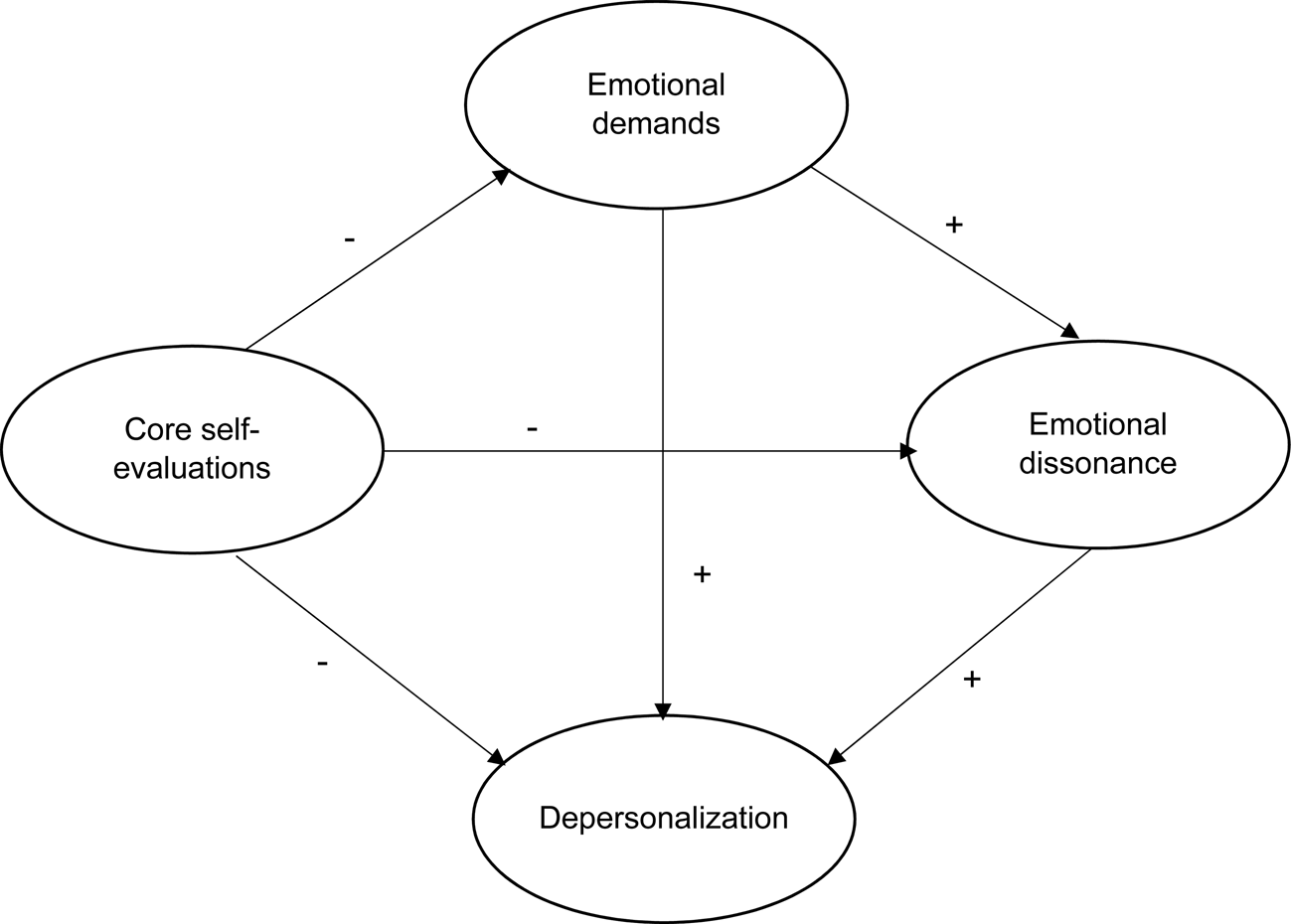
This study explores the effects of personality traits in the emotional labor process by examining the role of CSEs in the mechanisms through which employees perceive and react to emotional labor. Drawing on the principles of the JD-R theory, the self-verification theory, the empirical findings, and the theoretical rationale outlined in the previous section, this study hypothesizes that those individuals with less positive CSEs will tend to perceive their jobs as more emotionally demanding, thus being more prone to experiencing emotional dissonance and, as a result, depersonalization. The relationships proposed in this paper are summarized in Figure 1.
Hypothesized model linking CSEs, emotional demands, emotional dissonance, and depersonalization.

Method
Participants
Participants were a non-random sample of 423 teachers, aged between 22 and 68 (M = 41.52, SD = 10.76) years old. They worked in primary schools (22.70%), secondary schools (37.83%), and in higher education institutions (39.48%). Most participants were female (82.27%) and participants' average tenure ranged between 1 and 43 years (M = 14.52, SD = 10.31). Regarding their educational level, 60.52% of the respondents had a college degree (in Argentina, this means 4 or more years of university education), 27.42% had a master's degree, and 12.06% had a PhD.
Procedure
The data for this study were collected in educational institutions within the metropolitan area of Buenos Aires. Following approval of the study by the National Scientific and Technical Research Council, Argentina (record no. 2703/18),Footnote 1 potential participants were contacted through a networking approach (see Lazzaro-Salazar, Reference Lazzaro-Salazar2019). The deans of two medium-sized universities, as well as the headmasters of several primary and secondary schools, were asked to send online invitations of the survey to their staff. In turn, respondents were also asked to share the invitations with their colleagues. Eligible participants had to (a) be currently employed in either primary, secondary, or higher education institutions, and (b) work for at least 20 h a week. The online survey included a description of the purposes of the study and a consent form. Access to the online survey was only granted if consent to participate in the study was given by clicking on the ‘yes’ option of the consent form. Responses to the survey were anonymous.
Variables and instruments
Core self-evaluations
Participants' CSEs were measured using Judge et al.'s (Reference Judge, Erez, Bono and Thoresen2003) CSES. It consisted of 12 items (e.g., ‘I determine what will happen in my life’), with a response scale ranging from 1 (totally disagree) to 5 (totally agree). The internal consistency was α = .81. It is worth mentioning that the Spanish version of the CSES has exhibited adequate psychometric properties in several studies (e.g., Beléndez, Gómez, López, & Topa, Reference Beléndez, Gómez, López and Topa2018; Pujol-Cols & Dabos, Reference Pujol-Cols and Dabos2019) and has been used multiple times in the Argentinian context (e.g., Pujol-Cols, Reference Pujol-Cols2019; Pujol-Cols & Lazzaro-Salazar, Reference Pujol-Cols and Lazzaro-Salazar2020).
Emotional labor
Emotional labor was examined in terms of emotional requirements (i.e., the job-based requirements for emotional displays with others imposed on the individual by the job; see Grandey & Gabriel, Reference Grandey and Gabriel2015). Following Lewig and Dollard (Reference Lewig and Dollard2003), both qualitative and quantitative components of emotional labor were measured (also see Morris & Feldman, Reference Morris and Feldman1997). First, respondents' perceptions of emotional demands were examined with the emotional demand sub-scale of the Spanish Psychosocial Risk Questionnaire COPSOQ-ISTAS 21 (Moncada & Llorens, Reference Moncada and Llorens2004), which consisted of three items (e.g., ‘Overall, is your job emotionally demanding?’), plus one item (e.g., ‘Do you encounter situations on board that personally affect you?’) developed by Bakker, Demerouti, and Verbeke (Reference Bakker, Demerouti and Verbeke2004). Second, participants' emotional dissonance was assessed by asking them ‘How often are you confronted with the following situations during your work?’ and providing three items (e.g., ‘Having to show certain feelings to people that do not correspond with the way you feel at that moment’) developed by Zapf, Vogt, Seifert, Mertini, and Isic (Reference Zapf, Vogt, Seifert, Mertini and Isic1999). In all cases, participants were asked to respond on a 5-point rating scale ranging from 1 (never) to 5 (always). The internal consistency estimates of the emotional demand scale and the emotional dissonance scale were α = .76 and α = .77, respectively. It should be noted that the COPSOQ-ISTAS 21, which is an adaptation of the Copenhagen Psychosocial Questionnaire (Kristensen, Hannerz, Høgh, & Borg, Reference Kristensen, Hannerz, Høgh and Borg2005), has been successfully validated in numerous countries and organizational settings (e.g., Alvarado et al., Reference Alvarado, Pérez-Franco, Saavedra, Fuentealba, Alarcón, Marchetti and Aranda2012; Moncada, Llorens, Navarro, & Kristensen, Reference Moncada, Llorens, Navarro and Kristensen2005; Pujol-Cols & Arraigada, Reference Pujol-Cols and Arraigada2017) and has been used successfully in previous studies in Argentina (e.g., Pujol-Cols & Lazzaro-Salazar, Reference Pujol-Cols and Lazzaro-Salazar2018; Pujol-Cols & Lazzaro-Salazar, Reference Pujol-Cols and Lazzaro-Salazar2020).
Depersonalization
Participants' level of depersonalization was examined by using the depersonalization subscale included in the Maslach Burnout Inventory (MBI)-Educators Survey (Maslach, Jackson, & Leiter, Reference Maslach, Jackson and Leiter1996). This subscale comprised of five items (e.g., ‘I feel I treat some students as if they were impersonal objects’) and a response scale ranging from 1 (never) to 5 (everyday). The internal consistency of the depersonalization scale was α = .75. The psychometric properties of the Spanish version of the MBI have been tested multiple times in many Spanish-speaking countries around the world (e.g., Fernández-Arata, Juárez García, & Merino Soto, Reference Fernández-Arata, Juárez García and Merino Soto2015; Millán de Lange & D Aubeterre López, Reference Millán de Lange and D Aubeterre López2012), including Argentina (e.g., Gilla, Belén Giménez, Moran, & Olaz, Reference Gilla, Belén Giménez, Moran and Olaz2019).
Control variables
As suggested by one anonymous reviewer, participants' levels of depersonalization may be affected by the number of hours they work per week. In this sense, longer working hours may contribute to the depletion of individuals' energy and other resources, which, if persistent over time, may lead to the experience of extreme states of fatigue and, as a result, of depersonalization (Maslach & Leiter, Reference Maslach and Leiter2016). The relationship between the number of hours worked per week by employees and their experience of depersonalization has been previously demonstrated (e.g., Balch et al., Reference Balch, Shanafelt, Dyrbye, Sloan, Russell, Bechamps and Freischlag2010; Kunaviktikul, Wichaikhum, Nantsupawat, Nantsupawat, Chontawan, & Klunklin, Reference Kunaviktikul, Wichaikhum, Nantsupawat, Nantsupawat, Chontawan and Klunklin2015; Lim, Kim, Kim, Yang, & Lee, Reference Lim, Kim, Kim, Yang and Lee2010). Based on this evidence, the amount of hours worked by the individual per week was included in the structural equation modeling analysis as a control variable (it was operationalized as a dummy variable that equaled to 1 if the participant had a full-time job; see Becker, Atinc, Breaugh, Carlson, Edwards, & Spector, Reference Becker, Atinc, Breaugh, Carlson, Edwards and Spector2016).
Analysis
Since all of the variables included in this study were measured at the same time, which may cause common method bias, Harman's one factor test was conducted as a preliminary step (see Podsakoff, MacKenzie, Lee, & Podsakoff, Reference Podsakoff, MacKenzie, Lee and Podsakoff2003). Then, a structural equation modeling analysis with observed and latent variables was performed in Amos (22) to test the hypotheses of the study. A partial disaggregation model was used by creating parcels of items, that is to say, an aggregate-level indicator that is calculated as the average score of two or more items (Bandalos, Reference Bandalos2002). As argued by Bakker, Tims, and Derks (Reference Bakker, Tims and Derks2012) ‘parceling is preferable over using more items as indicators of a construct as it reduces type I errors in the item correlations, reduces the likelihood of a priori model misspecification, takes fewer iterations to converge, and results in more stable solutions’ (p. 1367). Moreover, parceling not only is a widely used technique in organizational psychology/behavior and management research (Williams & O'Boyle, Reference Williams and O'Boyle2008) but is also preferred over other approaches (such as total disaggregation models), as it requires a smaller sample size, results in the estimation of fewer (and more stable) model parameters and improves variable to sample size ratios (for a more detailed discussion of the strengths of partial disaggregation models, see Bagozzi & Edwards, Reference Bagozzi and Edwards1998). Finally, as claimed by Bandalos (Reference Bandalos2002), ‘parceled solutions will typically result in better model fit than solutions at the item level’ (p. 80).
The model included one exogenous latent variable (i.e., CSEs), two endogenous latent variables (i.e., emotional demands and depersonalization), and one endogenous observed variable (i.e., emotional dissonance). The CSEs, emotional demands and depersonalization were entered in the model as latent variables with two indicators. For instance, the CSE latent variable was indicated by two parcels that included six items each. To compare the models, different goodness of fit indices were estimated, including χ2 (Chi-square), CFI (comparative fit index), GFI (goodness of fit index), NFI (normed fit index), TLI (Tucker–Lewis index), RMR (root mean square residual), SRMR (standardized root mean residual), and RMSEA (root mean square error of approximation). According to Byrne (Reference Byrne2001), CFI, GFI, NFI, and TLI values greater than .90, and RMSEA, RMR, and SRMR values as high as .08 indicate a satisfactory fit (also see Hooper, Coughlan, & Mullen, Reference Hooper, Coughlan and Mullen2008; Hu & Bentler, Reference Hu and Bentler1999).
Results
Descriptive analysis
Table 1 presents the means, standard deviations, internal consistency levels, and correlations among the variables of the study. As this table shows, the reliabilities exceeded the conventional level of acceptance of .70 (Nunnally, Reference Nunnally1978). Furthermore, all of the correlations among the variables of interest were moderate and statistically significant. As expected, the CSEs displayed negative and statistically significant correlations with emotional dissonance and depersonalization. Moreover, emotional demands were found to be positively correlated with emotional dissonance and depersonalization. Finally, emotional dissonance exhibited a non-zero correlation with depersonalization.
Means, standard deviations, correlations, and reliability levels

M, mean; SD, standard deviation; CSEs, core self-evaluations.
All correlations are statistically significant at the p < .001 level (two tailed). The internal consistency of each scale is reported on the main diagonal in italics. The shared variance between scales (squared correlations) is reported in brackets.
Common method bias
Harman's one factor test was conducted to examine whether the data were affected by the common method bias. Results revealed that one single factor accounted only for 24.98% of the variance, suggesting that the common method bias did not significantly affect the results (see Podsakoff et al., Reference Podsakoff, MacKenzie, Lee and Podsakoff2003).
Discriminant validity of the scales
As shown in Table 1, the correlations among the variables of study were moderate in all cases (all of them were lower than .50). However, to further test whether emotional demands and emotional dissonance were indeed distinct constructs, two competing models were compared using structural equation modeling in Amos (22). In the first model, emotional demands and emotional dissonance were entered as two latent variables covarying with each other. In the second model, all the observed variables were hypothesized to load onto the latent construct of emotional demands. The results revealed that the model of emotional demands and emotional dissonance as two distinct but related factors provided good fit to the data: χ2(13, N = 423) = 124.92, p < .01, CFI = .90, GFI = .93. The model with emotional dissonance included under the emotional demand factor provided a poorer fit: χ2(14, N = 423) = 242.52, p < .01, CFI = .79, GFI = .83. The χ2 difference test between models 1 and 2 was significant, χ2(1, N = 423) = 117.6, p < .001, suggesting that the model with emotional demands and emotional dissonance as separate factors provide a better fit to the data, thus demonstrating the discriminant validity of both scales.
Structural equation modeling results
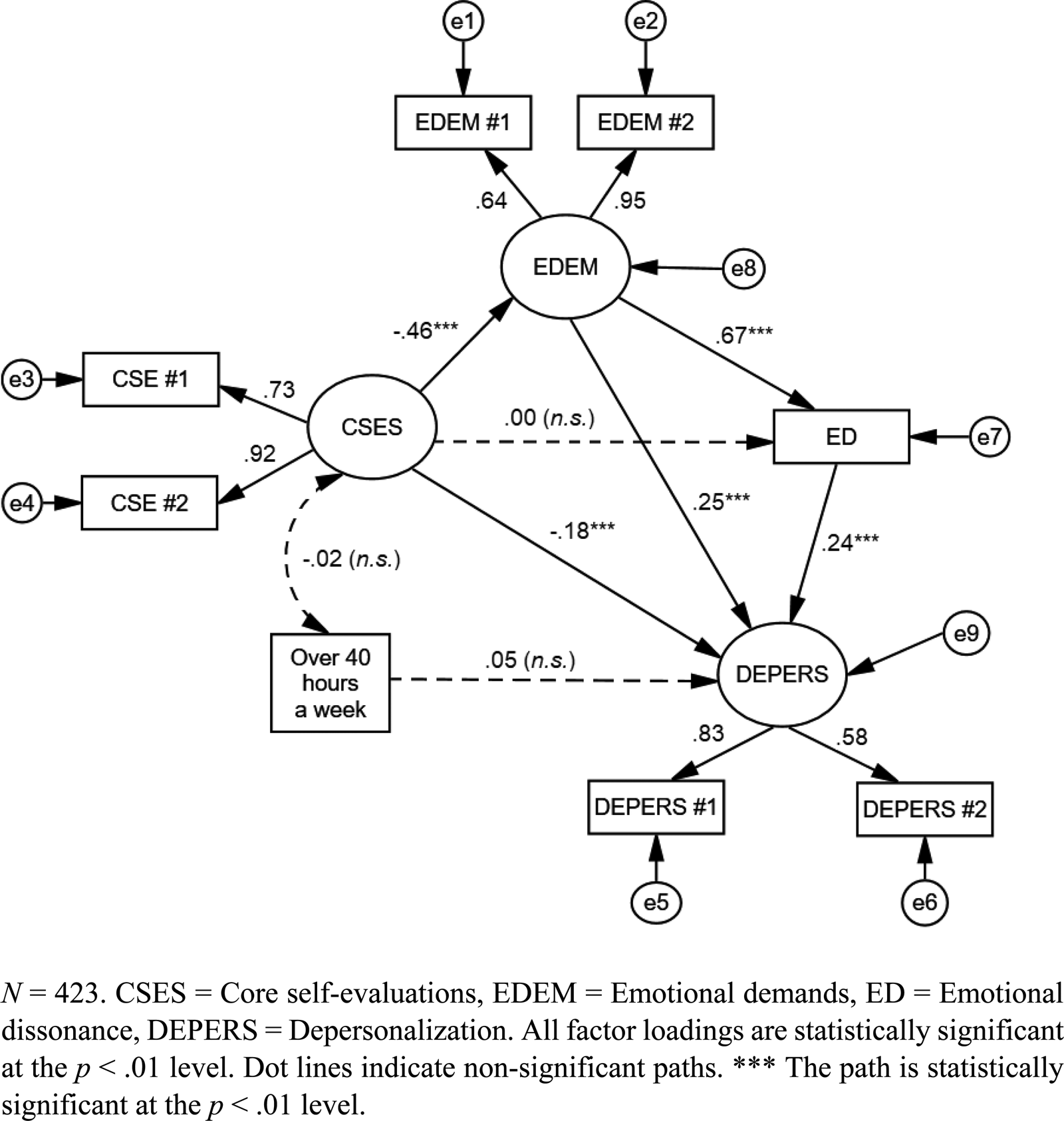
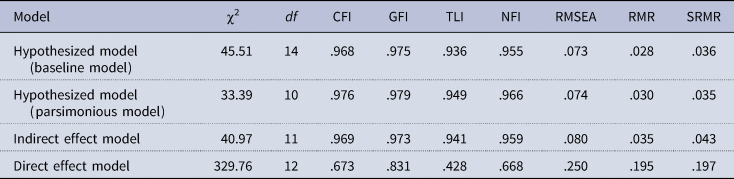
The results of the structural equation modeling analysis indicated that the hypothesized model provided a satisfactory fit to the data: χ2(14, N = 423) = 45.51, p < .01, CFI = .968, GFI = .975, TLI = .936, NFI = .955, RMSEA = .073, RMR = .028, SRMR = .036 (Figure 2). The results showed that the CSEs were negatively related to emotional demands. Emotional demands were a significant predictor of emotional dissonance, which, in turn, was significantly related to depersonalization. The direct path linking the CSEs to emotional dissonance was not statistically significant, suggesting that the effects of the CSEs on emotional dissonance are fully mediated by individuals' perceptions of emotional demands. Moreover, as expected, there was a direct effect of the CSEs on depersonalization. Finally, the relationship between working hours and depersonalization was not statistically significant.
Standardized solution (maximum likelihood estimates) for the hypothesized model linking CSEs, emotional demands, emotional dissonance, and depersonalization.

To test whether the overall fit of the hypothesized model could be improved, all of the paths that were non-significant were dropped (Table 2). The results showed that this model provided similar fit to the data: χ2(10, N = 423) = 33.39, p < .01, CFI = .976, GFI = .979, TLI = .949, NFI = .966, RMSEA = .074, RMR = .030, SRMR = .035. The χ2 differences were used to compare both models. Results revealed that the χ2 difference test was statistically significant, χ2(4, N = 423) = 12.12, p < .05. Thus, the most parsimonious model was accepted. The results of the most parsimonious model indicated that the CSEs were negatively related to emotional demands. Emotional demands, in turn, were a significant predictor of emotional dissonance, which was found to be significantly related to depersonalization. Finally, there was a negative, direct effect of the CSEs on depersonalization.
Results of the structural equation modeling analysis (maximum likelihood estimates)
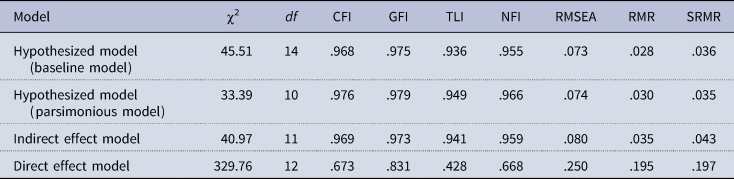
df, degrees of freedom.
Besides the hypothesized model, two additional models were tested. First, the indirect effect model, which dropped the direct path from the CSEs to depersonalization (see Table 2), provided an acceptable but relatively poorer fit to the data: χ2(11, N = 423) = 40.97, p < .01, CFI = .969, GFI = .973, TLI = .941, NFI = .959, RMSEA = .080, RMR = .035, SRMR = .043. The χ2 differences were used to compare the indirect model with the hypothesized model. Results revealed that the χ2 difference test was significant, χ2(1, N = 423) = 7.58, p < .01, indicating that the hypothesized model fitted the data better than the alternative model. Second, the direct effect model, which included only the direct paths from the CSEs, emotional demands, and emotional dissonance to depersonalization (Table 2), exhibited a very poor fit to the data: χ2(12, N = 423) = 329.76, p < .01, CFI = .673, GFI = .831, TLI = .428, NFI = .668, RMSEA = .250, RMR = .195, SRMR = .197. Moreover, the χ2 difference test revealed that the hypothesized model fitted significantly better to the data than the alternative model: χ2(2, N = 423) = 296.37, p < .01.
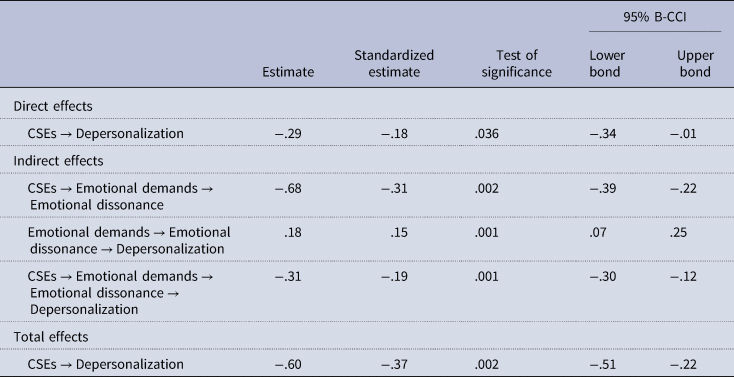
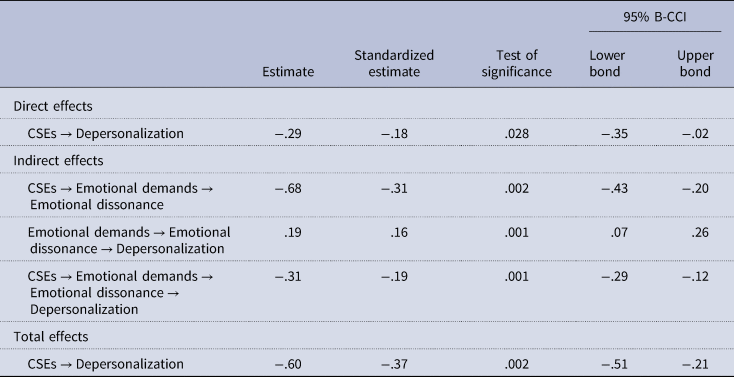
This study proposed that CSEs would have an impact on depersonalization through the emotional labor process. Following the procedure recommended by MacKinnon (Reference MacKinnon2008), a bootstrap analysis using a maximum likelihood estimation method (1,000 bootstrapped samples) was performed in Amos (22) to test this hypothesis (Table 3; also see Appendix for supplementary analysis). First, the results revealed that the indirect effect of the CSEs on emotional dissonance through emotional demands was significant (standardized estimate = −.31, p < .01, −.39 ⩽ B-CCI ⩽ .22). Second, the indirect effect of emotional demands on depersonalization through emotional dissonance was also significant (standardized estimate = .15, p < .01, .07 ⩽ B-CCI ⩽ .25), which supported hypotheses H1 and H2. Furthermore, the results of the bootstrap analysis showed that the sequential mediation effect was also significant (standardized estimate = −.19, p < .01, −.30 ⩽ B-CCI ⩽ −.12). Finally, there was a direct effect of the CSEs on depersonalization (standardized estimate = −.18, p < .05, −.34 ⩽ B-CCI ⩽ −.01), which supported hypothesis H3. Thus, these results provided support to the hypothesized sequential mediation effect from the CSEs to depersonalization through perceptions of emotional demands and emotional dissonance, which supported hypothesis H4.
Direct, indirect, and total effects of CSEs on depersonalization (parsimonious model)

95% B-CCI, 95% bias-corrected confidence interval.
Discussion
Theoretical contributions
The literature in this field shows that the evidence regarding the effects of emotional labor on employees' well-being has been inconsistent and elusive (Chi et al., Reference Chi, Grandey, Diamond and Krimmel2011; Seery & Corrigall, Reference Seery and Corrigall2009). In this regard, some recent studies have posited that the differential pattern of relationships among some components of the emotional labor process, such as job-related emotional demands, and individuals' well-being may be explained by, for instance, their personality traits (Grandey & Melloy, Reference Grandey and Melloy2017; Humphrey, Ashforth, & Diefendorff, Reference Humphrey, Ashforth and Diefendorff2015). Thus, the current paper attempted to bridge this gap between the previous studies to further explore the effects of personality traits in the emotional labor process by shedding light on the role of CSEs in the relationships among emotional demands, emotional dissonance, and depersonalization, which have not been examined in previous research. In doing so, this study also extended the JD-R theory by showing that CSEs may act as a personal resource that affect employees' perceptions and reactions to emotional labor.
First, the findings of this study revealed that depersonalization is explained by both dispositional and situational antecedents. Thus, the results showed that both quantitative and qualitative components of emotional labor (i.e., emotional demands and emotional dissonance, respectively) were positively related to depersonalization, indicating that increasing emotional labor was associated with higher depersonalization. Moreover, CSEs were found to be negatively related to depersonalization, suggesting that those individuals with more positive self-regards were less likely to adopt a negative, cynical, dehumanized, distant and indifferent attitude toward their job. Taken together, these findings not only are consistent with previous research (e.g., Kenworthy et al., Reference Kenworthy, Fay, Frame and Petree2014) but also suggest that future studies should consider both situational antecedents and individual differences when examining the emotional labor process (see Kammeyer-Mueller et al., Reference Kammeyer-Mueller, Rubenstein, Long, Odio, Buckman, Zhang and Halvorsen-Ganepola2013).
Regarding the effects of emotional demands on depersonalization, the findings of this study demonstrated that this relationship is partially mediated by feelings of emotional dissonance. Indeed, the results showed that the persistent exposure to emotional demands is likely to lead to emotional dissonance, which, in turn, may lead to a depersonalized attitude toward the job. This is consistent with previous research that reported that those jobs that require individuals to make a sustained emotional effort tend to cause not only emotional dissonance but also negative outcomes (e.g., Van Dijk & Brown, Reference Van Dijk and Brown2006), as changing one's real feelings and/or displaying inauthentic, socially desirable emotions are costly processes, both psychologically and physiologically, and involve a depletion of energy and valuable personal resources (Bechtoldt et al., Reference Bechtoldt, Rohrmann, De Pater and Beersma2011).
In addition to the direct effects of CSEs, the current study also demonstrated an indirect effect on depersonalization through the emotional labor process. More specifically, the results showed that those individuals with more positive CSEs tend to perceive the emotional aspects of their job as less demanding (i.e., there is a negative relationship between CSEs and emotional demands), which reduces individuals' likelihood of experiencing emotional dissonance and, in turn, depersonalization. Thus, the findings of the current study not only are consistent with previous research that suggest that personality traits are certainly relevant to explain the emotional labor process (e.g., Chi et al., Reference Chi, Grandey, Diamond and Krimmel2011; Gabriel et al., Reference Gabriel, Daniels, Diefendorff and Greguras2015; Kammeyer-Mueller et al., Reference Kammeyer-Mueller, Rubenstein, Long, Odio, Buckman, Zhang and Halvorsen-Ganepola2013; Kiffin-Petersen, Jordan, & Soutar, Reference Kiffin-Petersen, Jordan and Soutar2011) but also make a substantial contribution to the organizational literature by shedding light on the mechanisms through which CSEs affect individuals' perceptions and reactions to emotional labor.
Overall, the results suggested that those individuals with more positive CSEs are more likely to make a successful person–environment fit with those occupations that are highly demanding, both cognitively and emotionally, such as the teaching profession studied here. In this sense, individuals with such positive CSEs may simply enjoy the emotional aspects of their job rather than experience them as a burden (Pujol-Cols & Lazzaro-Salazar, Reference Pujol-Cols and Lazzaro-Salazar2018). Moreover, since these individuals are more prone to experiencing work engagement while working (Tims & Akkermans, Reference Tims and Akkermans2017), they may simply get so absorbed in their work role that they internalize certain performance-related behaviors, such as dealing with emotionally demanding situations, until the point they become natural or instinctive (see Kammeyer-Mueller et al., Reference Kammeyer-Mueller, Rubenstein, Long, Odio, Buckman, Zhang and Halvorsen-Ganepola2013). Finally, these individuals are most likely to engage in deep acting more often than in surface acting when facing emotionally demanding situations. These individuals may then be in a better position to perform emotional work roles (Kammeyer-Mueller, Judge, & Scott, Reference Kammeyer-Mueller, Judge and Scott2009), and they are, as a consequence, less likely to experience emotional dissonance and negative states when exposed to highly emotional situations (Kiffin-Petersen, Jordan, & Soutar, Reference Kiffin-Petersen, Jordan and Soutar2011).
Implications for practice
In addition to these theoretical contributions, the findings of this study have at least two further implications that are worth mentioning, albeit briefly. First, since CSEs have proven to play a key role in the way individuals perceive and react to emotional labor, organizations may consider including a thorough evaluation of candidates' personality traits when filling in emotionally demanding positions. This evaluation should be made as part of the personnel selection process and may involve, for instance, running various psychometric tests, conducting individual interviews with psychologists or specialists in human resource management, and proposing real and/or simulated situations to the candidate to assess how they response to them. Although personality assessment is frequently used in some industries, it continues to be a surprisingly uncommon practice in some emotionally demanding occupations, such as the teaching profession studied in this paper.
Second, the paper hopes to make a point of the importance of investigating outcomes of emotional labor such as depersonalization to balance scholarly attention toward psychological phenomena related to employees' well-being even when they may have a weaker impact on organizational effectiveness and outcomes. In light of this, occupational well-being is not only a crucial determinant of employees' functioning and job performance within the organization but also a vital aspect of their personal life as it contributes to their feelings of happiness, life satisfaction, and self-worth that transcend the workplace context and have an impact on their personal relations and other spheres of life. Thus, we believe that the motivation behind investigations of employees' psycho-emotional states and resources should be driven by not only a concern for their impact on job performance and organizational outcomes (such as productivity and client satisfaction), but also a preoccupation for individuals' well-being more holistically. A multi-layered approach to researching psychological phenomena in the organization (such as the one developed in this study) that moves beyond the ‘relatively simplistic stimulus-response model’ of occupational well-being that assumes that ‘employees are passive and simply react to the working conditions they are exposed to’ (Bakker & Demerouti, Reference Bakker, Demerouti, Diener, Oishi and Tay2018: 1) would help advance an integral understanding of well-being in organizations (consider Küpers, Reference Küpers2005).
Limitations and future research directions
Finally, in order to explore lines of future research, it is necessary to address some of the limitations of this study. First, this study used cross-sectional data, which means that a causal inference cannot be drawn. Indeed, in the same way that this paper proposed that individuals with more positive CSEs may perceive the emotional aspects of their job as less demanding, thus being less likely to experience emotional dissonance and depersonalization, the inverse path is also plausible. Then, it is possible that those individuals who had been exposed to excessive, sustained, and chronic emotional demands and emotional dissonance until the point they reached a state of depersonalization may show more negative evaluations of themselves, as the aforementioned processes are expected to drain individuals' energy and personal resources over time (Nguyen & Stinglhamber, Reference Nguyen and Stinglhamber2018). Future studies should further test the models proposed in this paper by employing a longitudinal design.
Second, all of the measures used in this study were self-reported. Since self-report scales may be susceptible to social desirability bias, future research could incorporate other independent measures of the variables of interest. For instance, depersonalization could be measured by combining self-reports, clinical interviews by a therapist, and reports from a significant other. Moreover, emotional demands could be assessed by combining non-participatory observation and a thorough, systematic analysis of the job description.
Third, this study focused on one of the core dimensions of burnout that was expected to be highly related to emotional labor, that is, depersonalization. In this regard, future studies should adopt a positive psychology approach and examine the personality factors, contextual factors, and interactional dynamics that enable individuals to experience positive states and well-being, such as affective job satisfaction, instead of focusing exclusively on negative phenomena (consider Humphrey, Ashforth, & Diefendorff, Reference Humphrey, Ashforth and Diefendorff2015).
Fourth, the structural equation modeling analysis was conducted by using a partial disaggregation approach. Although parceling is a widely used technique in organizational psychology/behavior and management research, particularly when working with small to moderate sample sizes (as in the case of this study), some scholars have argued that this approach may present some limitations that are worth mentioning (for a detailed discussion of this matter see Hall, Snell, & Foust, Reference Hall, Snell and Foust1999; Little, Cunningham, Shahar, & Widaman, Reference Little, Cunningham, Shahar and Widaman2002; Meade & Kroustalis, Reference Meade and Kroustalis2006). On the one hand, parceling may sometimes prove to be inadequate when dealing with multidimensional constructs (it is more effective when constructs are likely to be unidimensional, as in the case of this study). On the other hand, the effectiveness of parceling may be sensitive to changes in the method chosen for building the sets of parcels (the most frequently used method is random assignment, as used in this study). With these considerations in mind, future studies could further test the models proposed in this paper by using a total disaggregation approach. Such approach, however, will require a considerably larger sample size (see Bagozzi & Edwards, Reference Bagozzi and Edwards1998).
Fifth, our model measured emotional labor only in terms of emotional job requirements, specifically in terms of perceptions of emotional demands and feelings of emotional dissonance as mediators. Following Grandey and Gabriel (Reference Grandey and Gabriel2015), future research could adopt a more dynamic perspective and explore the interplay among emotional requirements, emotional regulation strategies, and emotional performance. Future studies could also examine the effects of individual differences in connection with other work situations that involve emotional demands, activate emotional regulation, trigger various emotional responses and, therefore, may also involve an emotional labor process (e.g., mobbing, bullying, harassment, or other abusive behaviors; see Moroni & Dabos, Reference Moroni and Dabos2014).
Finally, and although the model proposed in this study drew on the principles of the JD-R theory, it only included measures of personal resources, emotional demands, and affective reactions to emotional labor and did not examine the role of, for instance, job resources in these dynamics. Thus, future studies could also analyze the mediating or moderating influence of specific job resources, such as social support, supervisory support, and/or family support, in the emotional labor process, bearing in mind that testing a model of such complexity would require a larger and more heterogeneous sample of individuals.
Concluding remarks
The effects of individual differences in the processes through which employees react to emotional labor have been insufficiently accounted for in the existent literature. By simultaneously examining the effects of CSEs in the relationships among emotional demands, emotional dissonance, and depersonalization, this study sheds light on the mechanisms that explain why some employees with certain personality traits may experience emotional labor differently from others. The findings of this research demonstrated that personality plays a vital role in explaining employees' reactions to emotional labor and, therefore, its effects should be properly accounted for in future research. From a practical point of view, the results of this study suggested that managers should carefully assess the personality of candidates during personnel selection, especially when filling emotionally demanding positions. Moreover, organizations should design strategies to help improve and/or boost the less stable personality traits of their employees, as these may help individuals to cope with the most challenging emotional aspects of their job.
Acknowledgements
This research is supported by the National Scientific and Technical Research Council (Consejo Nacional de Investigaciones Científicas y Técnicas, CONICET, Argentina), Postdoctoral project entitled ‘Emotional Labor and Burnout: Exploring the role of Personality and Coping Strategies’ (record no. 2703/18). We would like to thank the teachers who participated in this study, as well as Mariana Cols, Gabriel Gonzalez, Elisa Luna, and Andrea Melo for their valuable help in the early stages of the data collection.
Appendix: Supplementary analysis
Table A.1 presents the results of the direct, indirect, and total effects of CSEs on depersonalization for the baseline model.
Direct, indirect, and total effects of CSEs on depersonalization (baseline model)

Lucas Pujol-Cols is a Postdoctoral Research Fellow at the National Scientific and Technical Research Council (CONICET), Argentina, and a lecturer of Organizational Behavior and of Research Methods at Universidad Nacional de Mar del Plata (UNMDP) and Universidad Nacional del Centro de la Provincia de Buenos Aires (UNICEN), Argentina. He is also a Research Associate at Universidad Católica del Maule (UCM), Chile. His research interests include employee–employer relationships in the context of knowledge-based organizations and the mechanisms that underlie the effects of working conditions and personality traits on employees' attitudes, intentions, behaviors, and wellbeing.
Guillermo E. Dabos is a Full Professor of Organizational Behavior and Research Methods at Universidad Nacional del Centro de la Provincia de Buenos Aires, UNICEN's Business School, where he also serves as Secretary of Science and Technology and Academic Director of the Doctoral Program in Management and Organizations. In addition, he has been appointed as Principal Professor of Organizational Behavior and Research Affiliate at Universidad de San Andrés and Associate Editor of Academia (ARLA, Emerald), the official journal of the Latin American Council of Business Schools (CLADEA). His current research focuses on psychological and normative contracts in the changing employment relationships, career transitions, and social networks in knowledge-intensive organizations. He holds a PhD in Groups, Organizational Effectiveness and Technology from Carnegie Mellon University.
Mariana Lazzaro-Salazar is a research associate of the Language in the Workplace Project, Victoria University of Wellington, New Zealand. She is also a researcher for the Vice Chancellor's Office for Research and Postgraduate Studies, the vice-president of the Ethics Committee and a member of the PhD Programs in Education, and in Psychology, and MA program in Mental Health at Universidad Católica del Maule, Chile. She is also a member of the board of the Gender and Workplace Discourse Research Network group. Mariana's research has focused on organizational communication and relational phenomena. Some of her recent work involves the investigation of psychosocial risks and professional integration of foreign physicians in Chile and the role of core self-evaluations in the stress-coping process in Argentinian managers.