Child-stripping was an act of theft of clothes, by force or deceit, carried out against a young child. According to Victorian characterizations the crime was usually committed by elderly females, such as Charles Dickens’ Mrs Brown, the ugly rag-and-bone picker who stole Florence Dombey's clothes:Footnote 1
‘I want that pretty frock, Miss Dombey’, said Good Mrs Brown, ‘and that little bonnet, and a petticoat or two, and anything else you can spare. Come! Take ‘em off!’
Florence obeyed, as fast as her trembling hands would allow; keeping all the while, a frightened eye on Mrs Brown. When she had divested herself of all the articles of apparel mentioned by that lady, Mrs B. examined them at leisure and seemed tolerably well satisfied with their quality.
‘Humph!’ she said, running her eyes over the child's slight figure, ‘I don't see anything else – except the shoes. I must have the shoes, Miss Dombey.’Footnote 2
Henry Mayhew, possibly influenced by Dickens,Footnote 3 also observed that the crime was carried out by ‘old debauched hags who lay in watch for the opportunity to accost children in the streets’.Footnote 4 James McLevy, the Irish-born Edinburgh detective, reminiscing in prose more lurid than Dickens’, reckoned that ‘[t]he depredators were of course women’: ‘hags’ and ‘cast-off Fancies, not genteel enough for being leagued with respectable thieves, and yet below the summer heat of love – trulls or trollops – trogganmongers during day, and troglodytes during the night’.Footnote 5
While crimes involving theft met with generalized censure among property-respecting Victorians, the hardened and heartless nature of child-stripping amplified anger.Footnote 6 The critical tone of newspapers is neatly characterized by the Glasgow title of the 1840s which described child-stripping as an ‘abhorrent species’, a ‘cowardly system of theft’.Footnote 7 Recidivism and multiple offending laid even heavier emphasis upon the seemingly immoral nature of the perpetrators and placed them beyond societal preferences and norms. Recidivism featured strongly in 1838 when Sarah Armstrong of Glasgow was transported for seven years for repeatedly stripping children.Footnote 8 The same was true in 1843, when 22-year-old Eliza Hanson was apprehended after a three-month spree.Footnote 9 A decade later a woman in Gateshead re-offended immediately after being released from prison and was promptly returned to gaol.Footnote 10 In 1855, Elizabeth Wilson endured a court case of ‘somewhat animate appearance’ because 19 victims and their mothers attended to see justice dished out.Footnote 11 In 1861, Mary M'Donald was given nine months for seven offences, while Margaret Macintosh (or Hayward) of Edinburgh was brought up in 1883 on no less than ten charges.Footnote 12 Still more repetitive were the escapades of a Middlesex woman called Green, against whom six cases were brought, with the court being told she may have committed 40 or 50 others.Footnote 13 Yet, perhaps the most prolific child-stripper uncovered in this research was Elizabeth Potter of Salford who, in 1886, stripped a succession of children almost every day for two months. Potter's case is more remarkable than these others because she was just 14 years old herself when the authorities apprehended her. Her profile challenges contemporary wisdom because she was not an old woman predating upon children. The following discussion argues that, far from the domain of aged women, child-stripping was a crime of older female children upon younger ones.
In seeking to throw light on the youthful dimensions of child-stripping, the article contributes to a wider discussion of juvenile crime in the Victorian city and of the ways in which adult criminals and their child variants came to be dealt with differently as the century progressed, with children increasingly committed to reformatories or industrial schools. The discussion also raised the question of how a child was defined. In education and at work, childhood had an upper age of around 12 years: before this age, most children were in school; after it, most went to work.Footnote 14 But in law, 14 years was the age at which a child became legally doli capax – capable of discerning good from evil.Footnote 15 While younger children could be declared capable in this way and so sent to prison, it was rare. Once offenders reached 14 years of age, however, they became more likely to face imprisonment with the law and conventional morality regarding them as adult and therefore increasingly irredeemable.Footnote 16
To some extent, the fear and loathing engendered by child-stripping suggests echoes of the larger moral panics concerning urban crime more generally.Footnote 17 Concerns intensified in the 1830s and 1840s amidst a belief that juvenile crime epidemics were of relatively recent vintage. Newspapers, our main sources of evidence, reflected concomitant fears that society was in decline, and encouraged the kind of public feverishness which occasionally manifested itself in reprisals. Yet, though the public and press could express intense anger, punishment regimes did not match these viewpoints. Rather, child-stripping, child-prostitution and feral gang culture contributed to reform movements and provided evidence for charities bent on the redemption of children. In an interesting twist on Foucault's notion of a nineteenth-century shift from the disciplining of the body to the disciplining of the mind, and in a context mirroring Ignatieff's work on the rise of the modern penitentiary, we will also observe that while adult child-strippers received severe prison sentences, often with hard labour, child offenders instead received short, sharp periods of imprisonment followed by long periods of mental disciplining in reformatories and industrial schools – a pattern shaped by changing legislative orthodoxy.Footnote 18
It has recently been argued that reformatories and industrial schools were not simply sites of punishment. While Victorian regimes were hardly soft, and some institutions were uncommonly brutal, the view that institutionalization equated with simple models of social control has yielded in the face of criticism. Reformatories and industrial schools were places of protection for children, shaped by an ideal of improvement accompanied by, and contributing to, modern notions of childhood.Footnote 19 While child-stripping, which was widely viewed as a particularly pernicious crime, tested the limits of improving ideologies, the principles of protection and rescue, which were deployed in the case of Elizabeth Potter, were also maintained for many others like her. With strong criminal tendencies starkly on display at a young age, Potter required correction, not punishment alone, and received a sentence of 14 days’ hard labour followed by three years in a reformatory.Footnote 20
Sources, context and nature
Digitized newspapers provide an unmatched national overview of crime trends, making hundreds of instances of this obscure crime available by searching for words or phrases. No other source provides such vivid narratives of so elusive a crime as does the press, while official reports and annual institutional returns mention the crime only occasionally. Thus, what we offer here is a methodological fresh way of examining a cultural phenomenon with utility beyond the scope of this case-study. The research draws upon a comprehensive sweep of the 47 titles in phase I of the British Library's digitized Nineteenth-Century Newspapers collection (phase I), and the online archives of both the Times and the Scotsman. In each case, these archives have allowed us to search for a term – ‘child-stripping’ – to assess its patterns and meanings. During this research, 335 hits were gleaned for this term. Once duplicate press occurrences were removed, there were 282 separate reports detailing 269 unique cases: 6 in The Times, 13 in the Guardian, fourteen in the Scotsman and the rest spread across the British Library sample of newspapers.
Our findings counter the contemporary image of the child-stripper as a Mrs Brown figure. Depictions of the predatory old crone fit only some cases. As we shall see, where ages were listed or could be imputed from descriptions, a majority of offenders were young or adolescent girls, and this fact shaped the intensity and nature of responses to the crime. The true representation of child-stripping escaped contemporaries and also evaded the majority of historians. Griffin offers a case in point: ‘a particularly nasty offence which adults committed was that of child-stripping – enticing young children to a secluded place, stealing their cloths and pawning them’.Footnote 21 Only Handley approached the reality when he stated that ‘Child-stripping to procure money for drink was rife. Even children of eight and ten stripped the clothes.’Footnote 22
Incidents and detections of child-stripping rose rapidly in the early nineteenth century,Footnote 23 thus mapping on to wider fears about children and crime. By the 1830s, newspapers were remarking on these increases.Footnote 24 Rates of stripping children grew in line with the broader peaks of working-class criminality that crested in the 1850s and 1860s (Figure 1).Footnote 25 Modern policing and the employment of detectives played some part in a continuing rise in the successful prosecution of all forms of crime. As child-stripping came into the public gaze, it stimulated a pitch of moral revulsion out of line with detection rates. Despite the attention to child-strippers in the Victorian press, official statistical returns suggest the crime was a small part of the wider range of petty thefts. In 1847, child-stripping accounted for only 1 in 744 crimes of theft in Edinburgh prison.Footnote 26 In Glasgow, from the mid-1860s to the mid-1870s, a total of 1,692 convictions for child-stripping were recorded: 3 per cent of a little over 50,000 thefts (Table 1). Clearly, this represents an imbalance with the numbers of cases finding their way into newspaper reportage.
Patterns of detection in child-stripping cases, 1800–1900 The data in Figures 1–5 and Map 1 are based on analysis on a database of 269 reports of child-stripping constructed from the British Library Nineteenth-Century Newspapers, 1800–1900, and the online archives of The Times, the Manchester Guardian and the Scotsman.

Proportion of thefts in Glasgow recorded as ‘child-stripping’, 1866–73

Source: 1875 [C.1143] Information Furnished at the Request of Her Majesty's Secretary of State for the Home Department by the Authorities of the Cities of Edinburgh and Glasgow, and of the Borough of Liverpool, with Regard to the Operation of their Respective Improvements and Sanitary Acts, Table Showing the Number of Thefts Reported to the Police as Having Been Committed in the City of Glasgow during the Years 1866 to 1873, 24.
The statistics, however, offer only one insight into child-stripping. Evidence suggests that the crime occurred more than numbers of court cases and imprisonments implied. Under-counting was caused by several factors. Since most incidents of the crime occurred in quiet places, the risk of detection was reduced. By definition, too, many of the crimes were perpetrated against children who were too young to be reliable witnesses and so were not allowed to take an oath.Footnote 27 In Liverpool, in 1850, there were nearly a dozen cases in a week against a variety of women, but nearly all failed because the evidence of young children was inadequate. Conversely, there were only nine convictions for child-stripping in Glasgow, in 1855, because, James D. Burns claimed, ‘the crime is generally protected by the secret circumstances under which it is perpetrated’. Consequently, the cases brought to court would ‘not be a tithe of those undetected’.Footnote 28 Problems of detection also revealed working-class mistrust of the police.Footnote 29
An appreciation that children could behave criminally was not a Victorian invention. The criminality of young people has been acknowledged since the sixteenth century. Only in the early nineteenth century, however, was the concept of juvenile delinquency developed.Footnote 30 Prior to that, child criminals were largely punished the same way as adults, with sentences of imprisonment, transportation or whipping. During the nineteenth century, in a departure from this convention, public morality shifted towards reformism with Victorians recognizing, and seeking to ameliorate, the social malaise they thought was at the heart of juvenile crime. Crucially, this aggravated form of theft moved from being one sent up for trial to one summarily dealt with by magistrates,Footnote 31 notably under the terms of the Summary Jurisdiction Act (1847), which allowed children under 14 to be dealt with summarily – a facility extended three years later to persons up to 16 years. Furthermore, across our period, violent responses to the crime diminished; for children, imprisonments became less common; and reformatories became the standard response.Footnote 32 Such changes were a direct consequence of the Youthful Offenders Act (1854), which gave all courts the power to append spells in reformatories to any custodial sentence given out to a child.Footnote 33
From both the perspectives of the perpetrator and the victim, child-stripping provides further evidence of ‘the child in danger’,Footnote 34 a category created by family breakdown and the more general pressures of modern urban society. The reformatory was one response to the existence of such children. Child-strippers were thus one of several categories of children whom the state and private charities hope to rescue from criminality.Footnote 35 The quest to save children conformed to Foucauldian notions that the disciplining of the mind gained primacy over barbaric physical punishments upon the body. Additionally, modern preoccupations with the environmental, rather than psychological, causes of criminality became prevalent in this period. Poverty and modern urban environments became recognized factors; while, at the same time, ‘popular rhetoric sought an explanation for juvenile crime with recidivism at its core’ since ‘persistent juvenile offending became an emblem for social breakdown and domestic instability’.Footnote 36
The early part of the nineteenth century had also witnessed the development of a classification of criminals, including juveniles, ‘by their crime’, ‘the extent of their delinquency’ and ‘into distinct moral categories’.Footnote 37 Most thinking on juvenile crime projected male, Artful Dodger-like characters as the principal nuisance.Footnote 38 The historiography certainly focuses far more on boys than girls, just as the Victorians themselves did, which is understandable since, in criminal activities, young males out-numbered females.Footnote 39 Moreover, King's exhaustive quantitative study shows that female crime actually fell in the earlier part of the century.Footnote 40 The institutionalization of juvenile offenders, which was another feature of Victorian penology, led to a growing bureaucracy of counting and collecting, and this certainly began to reveal the number of girls who themselves were recidivist criminals. However, girls never achieved the prominence of boys. Contemporary logic concluded that, among criminals, boys tended towards thieving and girls towards prostitution.Footnote 41 Child-stripping offences therefore suggest a break with this norm.
Common themes emerged in cases of child-stripping, with episodes often running in epidemic spurts until the perpetrators were caught or disappeared. Many acts were part of cycles of crime, with individuals or gangs working a patch until detection or departure.Footnote 42 As incidents rose, parents were issued with warnings: that a woman decoyed a little girl in the neighbourhood of her home in High St, to the fields near St George's Market, where she ‘stripped her of several articles of clothes’.Footnote 43 The Caledonian Mercury, in 1861, warned parents and authorities to be vigilant about young boys claiming to laugh off the offence as high jinks. ‘Adult criminals may be afraid to indulge in the mean and dastardly trade; but the task may be assigned to boys who, at the worst, will be held as engagement in a frolic.’Footnote 44
All cases involving the removal of a young child's clothes by force or deception, accompanied by ‘specious promises and threats’,Footnote 45 were called child-stripping. Sometimes, the perpetrators used force and threats. Such was the case in Liverpool, in 1833, when a woman ‘brutally tore’ a child's ‘ear rings through the flesh’ while she was in the process of taking her clothes.Footnote 46 Or in Glasgow, in 1836, when in a case against woman ‘charged with an immense number of acts of stripping children’, it was reported that on one occasion when she lured a boy from the Gorbals to Calton, ‘[t]he poor thing . . . caught cold, and died soon after’.Footnote 47 Preventing the victim informing on the perpetrator doubtless influenced a case in Tranmere, in 1859, when an old woman stripped a boy of three and half years and threatened to ‘put him down a great hole and cover him up’ if he moved from the field in which the act was committed. The frightened boy stayed for so long in the cold, damp conditions that he needed to be revived with warm tea and spirits.Footnote 48 Open spaces also came into play in the case of Martha M'Neill, who, in 1860, ‘was found in a field . . . almost in a state of nudity, and with . . . arms and legs torn, as . . . if she had been dragged through a hedge’ while her ‘pink frock, with white braid, and a check slip’ were stolen.Footnote 49 And like some Georgian criminal stealing to order for the wig-maker, Charlotte Avis both stripped a child and cut its long hair.Footnote 50 Avis’ victim was missing for several days and the perpetrator ‘was hooted by the people who crowded Bow-street to see her taken from the court’.Footnote 51
Child-strippers worked best in bustling, anonymous streets, alleys or dark passages nearby, with closely packed wynds, back-streets and canal tow-paths commonly utilized by offenders to commit the act. Even then, the child-strippers favour ‘distant places, where they are not known and cannot easily be traced’.Footnote 52 Quiet corners near fields or parks, not so heavily frequented by passers-by, also were sites of perpetration. In Scotland, the common stairwells of tenement buildings were sufficiently dark and discrete to be desired theatres of activity.Footnote 53 Thus, a woman was convicted of the crime after a boatman found the near-naked child she had abandoned near the Birmingham canal.Footnote 54 The use of such spaces was captured in one of three cases recorded in Belfast in one July week, 1869. Two children were enticed with promises of gifts of sweets and a horse to the Custom House steps, where one was stripped totally naked, and the other partially so, by a woman.Footnote 55
Class dimensions were significant. On the one hand, child-stripping was a crime of the destitute, a measure of wider social problems, with the press sometimes noting the pathetic state of offenders such as Martha Jones, ‘a poor emaciated looking female’ who was committed for trial. Equally in Preston, a child-stripper was described as being ‘in a destitute condition . . . [and] probably for want of sufficient nourishment was unable to firmly to meet the consequences of her crime’.Footnote 56 Child-stripping was a crime pursued for hard currency, with the respectable poor being victimized by the unrespectable poor. Thus, it was committed against children whose relatively fine clothing was commented on; or else against children whose parents were listed as being in well-paid trades, such as John Morrison, a skilled pattern-drawer whose half-daughter was stripped in Glasgow in 1848.Footnote 57
Those who stripped children quickly moved the goods on for small sums of money at pawn-brokers or other stores, with third-party fences sometimes dealing with these transactions.Footnote 58 Generally, the stolen clothes found their way to ‘wee pawns’, often in Irish neighbourhoods, such as Trongate, Glasgow,Footnote 59 an area described in 1851 by Revd George Buchanan as ‘more than one-half Popish’.Footnote 60 The case of Mary Ann Barker suggests the importance of the pawn-shop, for, ‘[w]hen apprehended, a large number of pawn tickets were found upon her relating to children's clothes’.Footnote 61 The complicity of pawnbrokers ensured that many of them were brought into court to answer charges of receiving stolen goods. The judge at Belfast Quarter Sessions in April 1837 blamed them squarely: ‘there was a great state of demoralization among the youth of the town’ which can be ‘attributed to the number of pawnbrokers in Belfast, who offered a ready receptacle for any goods that might be improperly come by’.Footnote 62 Or in one case, a marine store dealer who paid just a penny for some fine clothes presented to him by two respectable children who had stripped them from a child. The court deferred judgment on whether or not to commit him for trial.Footnote 63
Sentences for adult child-strippers could be severe, including transportation or up to seven years’ penal servitude. Yet, the Victorian response was much less draconian than the Georgian one had been. The more extraordinary case uncovered by this research occurred in 1741, when Mary Harris, a woman of ‘but 24 years of age, though looked like one of 50’, whose destruction by ‘Ruin’ or ‘Ginn’ led her to commit crimes, including child-stripping. She was executed at Tyburn on 16 September.Footnote 64 In 1828, 39-year-old Anne McGee stripped a child, blamed the circumstances on drink and declared hopefully: ‘I leave myself to the mercy of the Court. I was intoxicated, and had the child in the yard, not knowing what I was doing.’ The court was unmoved and transported her for life.Footnote 65 As well as being less severe, later punishments also became more consistent. While most offenders received sentences of up to three months’ imprisonment, child offenders also sometimes received custodial sentences. In March 1847, the 13-year-old Elizabeth Ness received a sentence of 60 days’ imprisonment.Footnote 66
Who were the child-strippers?
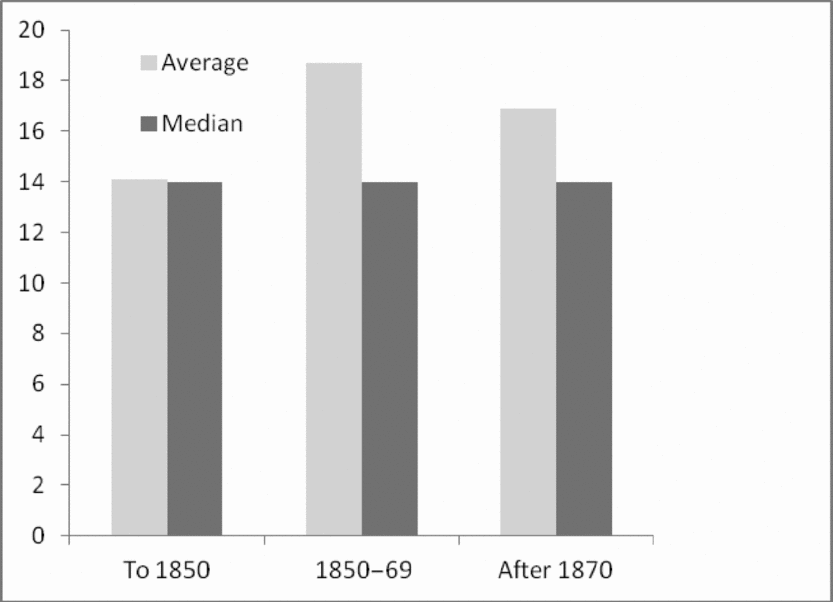
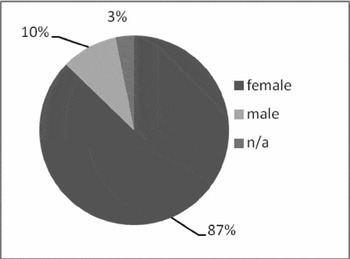
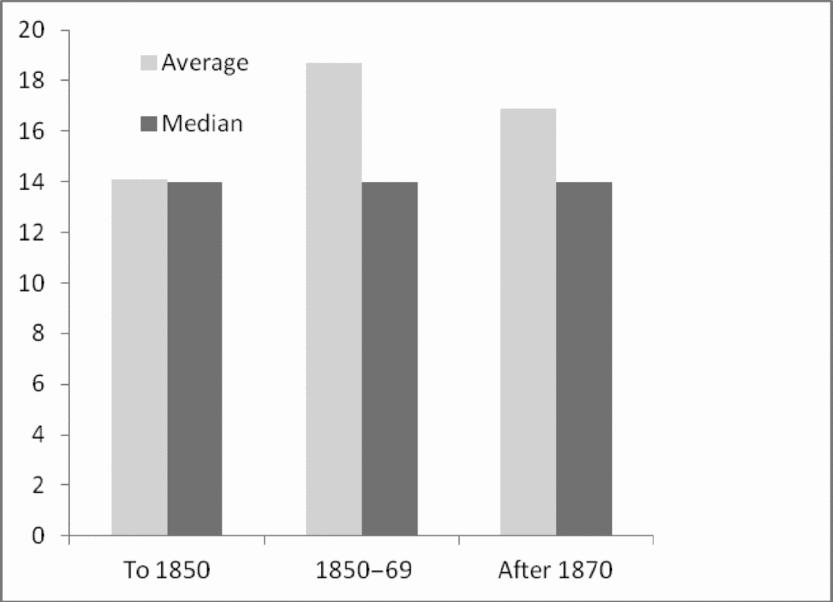
When charting the ages of child-strippers, the presence of older women in our survey skews averages upwards, since the oldest recorded offender was 65 years old and others in their forties appear in press reports. Generating a simple average of all data yields an age of 17 years. However, a median age analysis – one which determines the middle figure and so excludes the peaks and troughs – produced the more reliable age of 14 years (Figure 2). Among those whose ages were not recorded, there often were elements within descriptions which allow us to ascertain whether offenders were adults or children, such as the ‘four very young girls and a boy’ who in 1838 were brought before the courts in Edinburgh.Footnote 67 By adding together the two groups of children – those identified by a specific age and those confidently imputed to be children from descriptive data, young offenders – we reveal that children constituted 96 offenders. Females were resoundingly in the majority as offenders in child-stripping cases, accounting for 87 per cent of perpetrators in this study. A majority of victims were also female (Figures 3 and 4). Thus, whether the child-stripper was an old woman or a young child, we can see that this was a crime of a weak portion of society against one which was weaker still. Victims were as young as two or three years old, with an average age of just four. Pursuance of the crime posed few physical risks to the perpetrators unless they were caught.
Average and median age of child-stripping offenders
Gender of offenders

Gender of victims

Our evidence of child-stripping comes universally from cities and large towns, though not the metropolis. There was, however, much anecdotal evidence of child-stripping in London, and some of the earliest accounts pertain to the capital.Footnote 68 However, the move from court trial to summary justice at the magistrates’ court, especially for child criminals, means that London's national newspapers were not reporting the crime. This was not true of the regional press. Incidents of child-stripping were most prevalent in Glasgow, Liverpool and Edinburgh (see Map 1). Whilst there may be some bias towards central Scotland because of the number of papers covering these places, this is discounted as an explanation since the low levels of child-stripping prosecutions in London (for which eight titles are available) suggests that the proportion of papers in particular towns is not itself enough to explain the heaping of cases. Aberdeen and Belfast came next in the rankings.
Distribution of child-stripping events, 1800–1900

So how do we explain these patterns? Liverpool and Glasgow were the two largest conurbations outside the metropolis. Increasingly efficiently policed, and housing the largest populations of poor and working-class people beyond London, and with sizeable, transient populations, these places were perhaps ripe for a crime which thrived on the anonymity and complexity of urban spaces. In general, urbanization, with its concomitants of crowded, impersonal vistas and socially disaffected youths living beyond family units have been identified as important in these cities, all of which had high levels of juvenile offending more generally.Footnote 69
Child-stripping events rose in line with the rising tide of Irish immigration around the famine, which in turn occurred at a crisis point in British urban history. A certain amount of evidence suggests many of the perpetrators and victims had Irish names and many crimes were committed in the poorest parts of towns, where the Irish were most numerous. Belfast's position as a centre of child-stripping endorses the Irish connection. Unlike in London, where the Irish were numerically large but proportionately small, the Irish-born of Glasgow and Liverpool accounted for around one fifth of the overall urban population – far more if we count the elusive second generation. Whilst King casts doubt on the once common assertions about the correlation between migration and crime, with not even the Irish appearing over-represented among juvenile committals, the fact is that most Irish migrants travelled directly to Britain in the mid-nineteenth century, with most of their children born after migration.Footnote 70 Consequently, criminal statistics would not capture the offspring as Irish.
Moreover, observers certainly attributed a good deal of crime to the larger ethnic group rather than restricting it the Irish-born one. In the late 1840s, it was reckoned that the Irish and those of Irish parentage comprised half of the prison population of Liverpool.Footnote 71 The Liverpool magistrate, Edward Rushton, attributed this to the rise of ‘Irish misery’.Footnote 72 Equally, in London, Mayhew and Binny felt nine-tenths of ‘habitual criminals’ were second- or later-generation ‘Irish-Cockneys’.Footnote 73 In Glasgow, the parish of Tron in the Trongate and Saltmarket area, the population of which was nearly half Irish-born in the years after the famine, was a common site of street crime, such as child-stripping.Footnote 74 Moreover, Irish communities produced more committals in the period of the famine and after, and the Irish were generally heavily over-represented in prisons and summary dismissals in northern England.Footnote 75
Society in general certainly attributed street crimes, such as acts of violence and petty larceny, to the Irish. Notions of the uncivilized, barbarous life-styles of the Irish in mid-century Britain were deep-rooted in wider society, fostering a belief that the Irish brought violence, drunkenness, vice and crime with them.Footnote 76 Police forces were particularly vigilant in patrolling Irish areas. Thus, perhaps it is not surprising that impressionistic data highlights the Irish names of offenders. Such was most colourfully the case with four of the five child-strippers apprehended in the Edinburgh case recounted by McLevy: Catherine Lang, Helen Duff, Mary and Margaret Joice (Joyce) and Catherine Finnie (Finney).Footnote 77 On apprehending these women, McLevy recalled the victims’ mothers’ anger: ‘so furious were the hen-mothers, that unless we had taken good care of our sparrow-hawks, there would that day have been more stript [sic] than Phemy and her brother-victim’.Footnote 78 It was also true of three siblings called M'Evoy (aged 10, 12 and 13) who systematically stripped smaller children in Manchester ‘at the institution of their mother’.Footnote 79 In 1851, Mary Coffee (Cuffey, Coffey) was referred to more directly as ‘an Irish woman of forbidding appearance’.Footnote 80 Moreover, since the name Bridget was virtually never associated with non-Irish women in Britain,Footnote 81 we can assume the nativity of Bridget Doran, who, in 1841, received a sentence of 10 years’ transportation for stripping children.Footnote 82 Similarly, a small boy was lured away by a woman with an Irish accent who promised to show him a rocking-horse but instead stripped his clothes.Footnote 83 And there is no questioning the nativity of 22-year-old Patrick Nolan; a ‘hefty Irishman’ was charged at Whitehaven with the same crime.Footnote 84 Whilst there was no immediate Irish association for a young girl named Brown who showed artfulness and deceit in spinning stories to a soldier who caught her stripping a child and to the magistrate who interrogated her, one of her associates was a women, with the Irish name, M'Marty, who also evaded the court's questions.Footnote 85 Whilst Savage is a name we can link to Irish roots, the suggestion is strengthened by a reference in court to the fact that, unless someone could provide evidence to support her, a woman named Amelia Savage ‘would not be allowed to remain in this country’ after she was accused of taking a frock and pinafore from a four-year-old girl.Footnote 86
Young and adolescent child-strippers
Despite the desire of some officials to beat crime out of young offenders, many Victorians bridled at the idea of lashing children. Yet, child-stripping constituted something of a moral Rubicon so that such compassion was not always extended to child-stripping youngsters, a fact captured succinctly in the words of one respondent, known only as Mr E.S. of Mascharg, in his depositions to the Reformatories and Industrial Schools Commission, who stated: ‘I am very clearly of the opinion that children of tender years should not be sent to reformatories at all.’ On being asked to define ‘“tender years”’, he responded: ‘up to 12, unless they were very much depraved children’. He then defined depravity: ‘what we should call ill-disposed bad children’. He then provided a case to illustrate his point: ‘One of the children sent to the reformatory for girls lately, for instance, at 11 years of age had been guilty of 15 acts, I think, of child stripping.’Footnote 87 Cases of the crime thus claimed an importance beyond mere numbers since child-stripping involved a vital moral crossing point.
Many of the young perpetrators came from dysfunctional families, were living independently of their parents or had run away from home. Emma Thompson (13), originally from Glasgow, had lived independently of her family for some weeks in Manchester before being caught in the act of child-stripping in Liverpool. She was described as ‘one of the worst girls brought before this court in a long time’.Footnote 88 Still other offenders were children whom parents could not control. When Anne Ridley was despatched to prison for two months and then to a reformatory, her father, ‘an ordinary labouring man’, thanked the court for dealing with a problem child who kept running away from home. He blamed events on his ‘bad wife’. He had two other children to look after and confessed not to know what to do with his errant third child.Footnote 89 Then there were the children of ‘dissipated parents’, as was the case with another convicted child-stripper, Eliza Ryrie (12), who had left home to prowl the streets and beg.Footnote 90
Child criminals also demonstrated a degree of recidivism which evoked concern.Footnote 91 Elizabeth Anne Warburton of Salford, a 16-year-old girl, was brought up with 16 cases against her.Footnote 92 Theresa M'Corry of Glasgow, a girl, probably of Irish stock, aged about 14 – who had eight or nine cases of child-stripping against her on the south side of the Clyde and others pending in the central district – demonstrated both hardness and cunning when she stripped a child before returning it to her mother only to claim a shilling reward.Footnote 93 A truly Dickensian picture is created by the activities of a gang of four Liverpudlian youths aged between 10 and 14 who specialized in robbing and pledging shoes.Footnote 94 The small size and young ages of some of these criminals also elicited comment since they were ‘scarcely visible above the dock’.Footnote 95 Similarly, Belfast's John Loughlin was described as ‘a highly-distinguished member of the Lilliputian corps of thieves’ well known to police and courtrooms alike.Footnote 96 On a similar scale was a young girl fallen in more ways than one, a prostitute of about 16 years’ old, who ‘looked hardly so old’.Footnote 97 It is unsurprising that magistrates, judges and journalists began to notice cases of cruel crimes committed against children by such ‘youthful criminals’. Footnote 98
Reforming the juvenile child-strippers
Child-stripping was one of a mosaic of street crimes which focused authorities and reformers on what they saw as the awful state of the lower sorts of society. Penal morality usually resulted in punishment for such crimes: only rarely was leniency shown in, for example, the case of first offences.Footnote 99 Over time, though, a gradually more progressive dimension emerged. Indeed, since the early nineteenth century there had evolved ‘a dynamic relationship between the burgeoning state and private philanthropy’.Footnote 100 Throughout the middle of the century there was a steady drift from whipping and lengthy imprisonment to short, sharp shock imprisonments followed by long spells in special schools. Although progressive ideas were taking hold, not all child criminals were treated in an enlightened way. Certainly, the press in Belfast favoured an enlightened approach: ‘We cannot go on tolerating the barbarianism of flogging young criminals into harder and more dangerous depravities, or the folly of apprenticing them in jails to the trade of the burglar, the incendiary or the assassin’.Footnote 101 For 1847–48, annual prison returns showed that, in all prisons in England and Wales, a sizeable minority of child offenders were committed to prison and ‘whipped in prison pursuant with the sentence’.Footnote 102 Whipping remained a common outcome for child perpetrators of child-stripping in the 1850s when it began to become more clearly associated with younger criminals but when industrial schools and reformatories were not yet widespread. Thus, in 1857, in Manchester, Michael Hannon was ‘privately whipped’ for stripping two children (aged three and five years) of their capes.Footnote 103 While incarceration in schools intended to reform the character had generally replaced brutal corporal punishments, the administration of the lash did not die out altogether. Indeed, magistrates had significant powers to enact variations. Moreover, even progressive officials, such as sheriff of Glasgow Walter C. Spens, who professed ‘a strong repugnance to flogging, chiefly from the view that it may utterly and absolutely pervert the nature of the child’, nevertheless appended a proviso: ‘unless the description of the charge infers a nature distinctly perverted, e.g. such as systematic child-stripping’.Footnote 104
As the century progressed, punishments for adults and children began to differ. Thus, a 12-year-old called James Smith was brought up before Belfast bench in the mid-1860s, charged with stealing children's cloth, along with an accomplice, Mary M'Mullan, 29, who was charged with receiving the clothes. The court heard that Smith was ‘a very precocious youth, the constant associate of thieves [who] was in the habit of enticing young children into out-of-the-way places where he took portions of their clothes from them’. M'Mullan was sentenced to three months’ penal servitude, while the boy received a month plus five years in a reformatory.Footnote 105 A 10-year-old girl named O'Neill, who was apprehended during a spate of incidents in Belfast, in 1869, had been engaged systematically ‘in denuding children of their clothing’. Detectives discovered 10 suits of children's clothing during their investigations and she was sentenced to 14 days’ imprisonment and five years in a ‘Roman Catholic Reformatory’.Footnote 106 A similar verdict was reached in the case of another 10-year-old, whose mother, it was feared, ‘had prompted her to commit the crime’, though the mother denied this. Mr O'Donnell, the magistrate, claimed that ‘if the girl was young in years, she appeared to be old in crime’, adding that the child required ‘better care than her mother seemed to give her’. The mother offered to send the girl to Russia with her aunt. However, the magistrate ‘expressed his intention of sending her to a reformatory’. Whilst he held his final sentence over till further cases could be brought against her, O'Donnell finished with a telling comment: ‘Amongst a juvenile predatory class, the practice of stealing clothes has become a sort of criminal epidemic.’Footnote 107
By the mid-1860s, annual prison reports for Ireland noted a decline in the imprisonment of juvenile offenders.Footnote 108 To some extent, this was due simply to the rise in numbers of reform schools. In the same decade, there were 62 reform schools in Britain, an increase from just eight in 1854.Footnote 109 A further shift occurred as the number of children in reformatories dropped with more being sent to industrial schools to learn a trade.Footnote 110 However, there was some concern that industrial schools primarily benefited large towns and cities.Footnote 111 By the mid-1880s, there were still around 60 reformatories in England and Scotland but more than 140 industrial schools.Footnote 112 In a broader sense, such institutions worked with and within families, as well as against families whose influence was considered unsatisfactory. Thus, in 1881, when a nine-year-old named Eliza Quinn was charged with taking a younger girl's shawl, the mother was brought before the bench to explain that since her husband was absent, she had to work and so could not look after the child all day. Consequently, the magistrate ruled that the child should be sent to the Roman Catholic Industrial School.Footnote 113
Epidemics of the crime drew opprobrious forebodings in the press. The notion that newspapers shaped the terms of any moral panic arising from perceived depravity was certainly attested to by the over-blown language used to assess one epidemic of child-stripping. The case of a gang, whose members went on a spree in Birmingham, in the spring of 1894, offers a case in point:
It sounds an anachronism in these Fin de Siècle days to speak of kidnappers in the streets of Birmingham. We should as soon look for pirates in the Straits of Dover, Highwaymen on Hounslow Heath or Brigands in the highlands of Scotland. There seems to be no room for doubt, however, that ‘the best governed city in the world’ is temporarily with some pests of this pernicious character and that numbers of young children have lately been decoyed away from their homes or friends . . . and cruelly used . . . stripped of their clothes . . . before being cruelly turned adrift.Footnote 114
The discontent of the editor was wide-ranging as he tried to capture most aspects of the crime. The comment about the ‘best governed city’ expressed annoyance that in Joseph Chamberlain's reformed municipality the police did so little to prevent the crime. Editorializing about the older associates and gangs behind these young criminals, and the bribes and decoys used, the paper wondered if the perpetrators’ ‘youth and innocence’ were keys to their ‘felonious little plans’. Amidst this furore in Birmingham, one of the alleged perpetrators, a 12-year-old thief called Leah Scandrett was apprehended by police for multiple instances of child-stripping. No matter the indignation engendered by Scandrett, her punishments were consistent. Reformation of her character remained a hope. Thus, she was sent briefly to prison before being detained in a reformatory for five years.Footnote 115
Finally, though, individual officials could show humanity. Isabella Spicer, aged 12 years, and Anne Gardner, 11 years, were shown no such sympathy, even though they had stripped a younger girl of her apparel. After hearing the case, the common sergeant ‘suggested the propriety of sending both to the House of Occupation, Bethl[eh]em, to try to redeem them to the paths of morality’.Footnote 116 However, one of the youngest recidivist offenders was nine-year-old Mary Borthwick of Edinburgh who was sent to prison for 60 days for five cases of stripping children between the ages of two and five.Footnote 117 The degree of variance went much further than this. In 1863, when a ‘little girl’ from Belfast called Sara Smith was brought up on her first charge, she was dismissed with a caution.Footnote 118 Despite being ‘a chubby faced, but withal cunning looking urchin’, George Morton, aged 12, of Manchester was dismissed from court on the promise that his step-father would take better care of him in future.Footnote 119 Yet much later, in Liverpool, a 15-year-old girl, Catherine M'Coy of Wavertree, was sent to prison, not reformatory or industrial school, for six months.Footnote 120
Conclusions
Child-stripping peaked in the 1850s and 1860s, dying back, but not disappearing, in the later Victorian period. This crime excited the parents of the victims, raised the ire of the public and press and fired passions in courtrooms and prisons.Footnote 121 Since these events occurred in epidemic spates, the degree of local panic and anger was understandable. Crowds of mothers gathered at courts baying for revenge and the press rode waves of moral panic. The press recorded real-life Dickensian Mrs Brown figures,Footnote 122 but these were not the norm. Child-stripping is best characterized as a crime of the young upon those who were younger still. The shocking revelation that young children would rob infants of their clothes amplified the intensity with which reformers sought to define childhood and protect children, working with, within and around the family. But penal orthodoxies defied the populist urges of press and victims’ parents. As the century progressed, legislation enacted in the 1840s and 1850s enabled a more benign and progressive response to child criminals which we have sought to demonstrate here, with the reformatory and industrial school becoming important outcomes for youthful offenders. With the rise of reformatories and industrial schools, not prisons, we see an interesting slant on Foucault's idea of reforming the mind.
Yet, many commentators saw any form of institution preferable to the savagery of the street. In his journal, the governor of Edinburgh prison quoted a prison-visiting missionary whose view it was that, despite the hardship of prison life, it was better than the abject conditions on the outside which led so many offspring of profligate parents to find their way into a life of crime. Child-stripping cropped up in the telling of one particularly pathetic narrative which was used to make the case for separate reform schools for such children:
I remember being touched by what a very young girl said a few months ago. The poor child was not quite eight years old, and yet had been committed to prison accused of the serious offence of child-stripping . . . [I] asked her if she wished for anything and she eagerly said, ‘I wish my little brother was here’; and on being asked why, she replied, ‘because he would get some porridge.’Footnote 123
It was the horrid spectre of so young a child locked up which prompted moral reflection on the purpose of prisons for young offenders and of the need for special schools to provide the kinds of guidance in life which poverty-stricken communities, neglectful parents, unfortunate associates, bad luck or wilfulness had denied them. This little girl was the embodiment of the child in danger; though by her own admission, she enjoyed advantage over her brother who was on the outside. It was the emergence of a world of Dickensian youth criminals, which created a new reasoning over correction methods. Surely acts of child-stripping committed by often very young children provided clinching evidence, even though picking pockets and criminal gangs conducting all manner of thievery were much more common?