INTRODUCTION
The species of Leptostraca (Crustacea: Malacostraca: Phyllocarida) can be characterized, in part, by a movable rostrum, six pairs of pleopods, striking uropods, and a bivalved carapace that covers the eight pairs of thoracopods and partially covers seven abdominal segments. In recent years, the number of newly described species belonging to the Leptostraca has increased gradually: Nebalia mortoni Lee & Bamber, Reference Lee and Bamber2011 from Hong Kong, N. koreana Song et al., Reference Song, Moreira and Min2012, N. pseudotroncosoi Song et al., Reference Song, Moreira and Min2013 from South Korea, and N. mediterranea Koçak & Moreira, Reference Koçak and Moreira2015 from Turkey (Lee & Bamber, Reference Lee and Bamber2011; Song et al., Reference Song, Moreira and Min2012, Reference Song, Moreira and Min2013; Koçak & Moreira, Reference Koçak and Moreira2015). Consequently, 59 extant different leptostracan taxa (including subspecies) from 11 genera in four families have been recorded to date. Among them, more than half of the species (35 species) are included in the genus Nebalia Leach, Reference Leach1814 (Mess, Reference Mess2015). The genus Nebalia has been reported in diverse habitats, such as estuarine mudflats (Haney & Martin, Reference Haney and Martin2005; Moreira et al., Reference Moreira, Koçak and Katagan2007), sea grass beds (Dahl, Reference Dahl1985), sponges (Ortiz et al., Reference Ortiz, Winfield and Chazaro-Olvera2011), sandy bottoms with algal mats (Song et al., Reference Song, Moreira and Min2012, Reference Song, Moreira and Min2013), organic-rich muddy sediments in harbours, gravel beaches, lagoons, and a variety of subtidal sedimentary substrata (Moreira et al., Reference Moreira, Díaz-Agras, Candás, Señarís and Urgorri2009).
Here, we describe a new species of Nebalia collected from South Korea, Nebalia dolsandoensis sp. nov., and we provide a key to the species of the genus Nebalia. In addition, we provide the partial sequence of the mitochondrial cytochrome c oxidase subunit I (CO1) gene from the new species as a molecular characteristic.
MATERIALS AND METHODS
Sample collection
All specimens were collected by light traps in 2011. The traps were made of polyvinylchloride (PVC) pipe and were 30–35 cm in length and 8.5 cm in diameter, with a narrow entrance approximately 3.3 cm in diameter to prevent the entry of unwanted larger animals (Song et al., Reference Song, Moreira and Min2013). Traps were submerged 4–10 m for 2 h at night and a scuba diving lantern (Model D14 7457M; LED LENSER; Germany) was used as the light source. The specimens described in this paper were collected from Dolsando Island, Jeollanam-do, South Korea. The sampling site was located in a harbour with sediment characterized as organic-rich muddy sand with several types of seaweeds. All specimens were preserved in 95% ethyl alcohol directly. The type series of Nebalia dolsandoensis sp. nov. has been deposited in the National Institute of Biological Resources (NIBR) and Inha University, South Korea.
Morphological analysis
The specimens were transferred to glycerin for dissection, examined and dissected under a stereomicroscope (Model SZX-7; Olympus, Tokyo, Japan). Figures of dissected appendages were made with the drawing tube connected to a light microscope (Model DM 2500; Leica, X50-630, Wetzlar, Germany). Figures of the whole body were made using a drawing tube attached to a stereomicroscope (Olympus SZX-12). Measurements of all appendages and whole body length were done with a stage micrometer (Leica, Germany) and an ocular micrometer.
The total length (TL) was measured from the articulation between the rostrum and carapace to the posterior end of the uropods excluding setation; the dorsal carapace length (DCL) was considered as the distance between the articulation of the rostrum and the margin of the posterodorsal cleft; the lateral carapace length (LCL) was considered as the distance along the lateral surface between the anteriormost and posteriormost margin; the carapace height (CH) was measured between the dorsal and ventral margin; the rostrum length (RL)was measured along the midline.
Molecular analysis
DNA was extracted from appendages of specimens using DNeasy Blood and Tissue Kits (Qiagen, Valencia, CA) according to the manufacturer's instructions. A DNA fragment from the CO1 that was 565 bp long was amplified by the polymerase chain reaction (PCR) method using the primers: LCO1490 5′-GGTCAACAAATCATAAAG ATATTGG-3′ and HCO2198 5′-TAAACTTCAGGGTGACCAAAAAATCA-3′ (Folmer et al., Reference Folmer, Black, Hoeh, Lutz and Vrijenhoek1994). PCR amplification was conducted under the following conditions: 3 min at 94°C, 35 cycles of 95°C for 15 s, 42°C for 30 s, and 72°C for 90 s, with a final 72°C extension reaction for 7 min. PCR products were purified using the QIAquick PCR purification Kit (Qiagen) and were sequenced with an ABI3100 automated sequencer (PerkinElmer, Foster City, CA).
RESULTS
SYSTEMATICS
Order LEPTOSTRACA Claus, Reference Claus1880
Family NEBALIIDAE Samouelle, Reference Samouelle1819
Genus Nebalia Leach, Reference Leach1814
Nebalia dolsandoensis sp. nov.
(Figures 1–5)
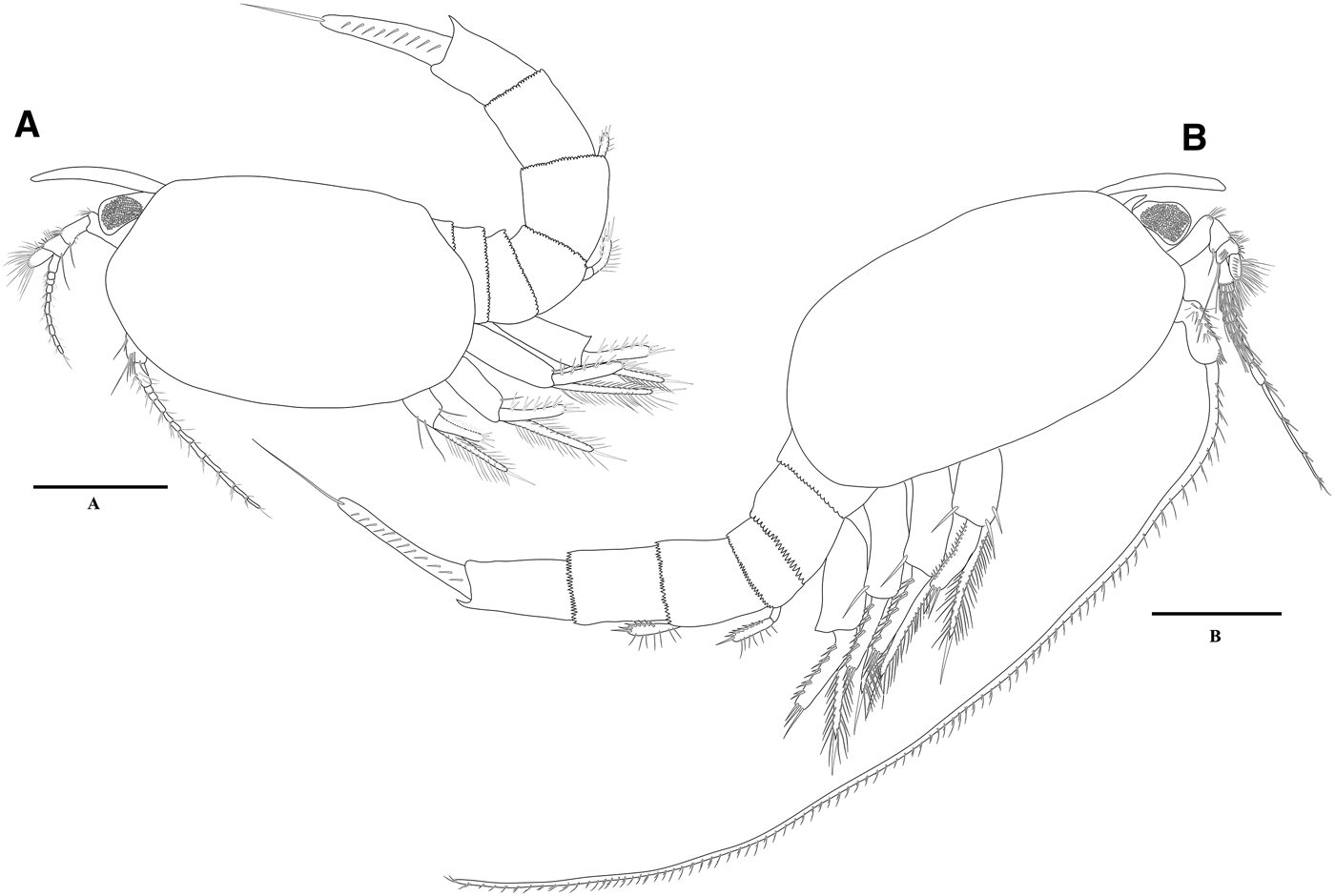
Nebalia dolsandoensis sp. nov.: (A) ovigerous female holotype, lateral view; (B) male allotype, lateral view. Scale bar: A, B, 1 mm.

Nebalia dolsandoensis sp. nov., holotype, ovigerous female: (A) rostrum, dorsal view; (B) eye, lateral view; (C) antennule, lateral view; (D) antenna, lateral view; (E) antenna, third article, external side, lateral view. Scale bars: A, C, D, 0.2 mm; B, E, 0.1 mm.

Nebalia dolsandoensis sp. nov., holotype, ovigerous female: (A) mandibular palp; (B) first maxilla; (C) first maxilla, proximal endite; (D) first maxilla, distal endite; (E) second maxilla; (F) thoracopod 6, showing setation; (G) thoracopod 1; (H) thoracopod 2; (I) thoracopod 3; (J) thoracopod 4; (K) thoracopod 5; (L) thoracopod 7; (M) thoracopod 8. Scale bars: A, B, F–M, 0.2 mm; C–E, 0.1 mm. G, H, epipod not drawn; G–M, endopod and epipod setae not drawn.

Nebalia dolsandoensis sp. nov., holotype, ovigerous female: (A) pleopod 1, lateral view (only half of setae of spine row illustrated); (B) pleopod 2, lateral view; (C) pleopod 3, lateral view; (D) pleopod 4, lateral view; (E) pleopod 5, ventral view; (F) pleopod 6, ventral view; (G) pleonites 4–7, posterior lateral border, denticles; (H) anal plates, ventral view; (I) pleonite 7, anal somite and uropods, ventral view. Scale bars: A–D, 0.2 mm; E–H, 0.1 mm; I, 0.5 mm.

Nebalia dolsandoensis sp. nov., allotype, male: (A) antennule, lateral view; (B) antenna, third article, external side, lateral view; (C) mandible article 3, setation; (D) first maxilla, proximal endite; (E) first maxilla, distal endite; (F) pleonites 4–7, posterior lateral border, denticles; (G) pleopod 1, lateral view; (H) pleopod 5, ventral view; (I) pleopod 6, ventral view. Scale bars: A, C, G, 0.2 mm; B, D–F, H, I, 0.1 mm.

TYPE MATERIAL
Holotype (NIBRIV 0000323110): Ovigerous female (Figure 1A), RL 1.0 mm, DCL 1.9 mm, LCL 2.7, CH 1.6, TL 7.0 mm; Dolsando Island, Jeollanam-do, South Korea, 34°35′N, 127° 48′E; ~10 m depth.
Allotype (NIBRIV 0000323111): Male (Figure 1B) RL 1.0, DCL 2.6, LCL 3.2, CH 1.7, TL 7.7 mm; same sampling locality as holotype.
Paratypes: 1 female (NIBRIV0000326264) and 2 males (NIBRIV0000326265, NIBRIV0000326266), same sampling locality as holotype. All types collected by Hong S. S. on 23 June 2011.
DIAGNOSIS OF FEMALE
Rostrum relatively short, length nearly 2.1 times width. Eye not lobed or subdivided, with heavy dark pigmentation. Antennule fourth article with four distal robust setae. Antennular flagellum with up to nine articles in mature female; antenna article 3 with two thin setae and five robust setae on external lateral side. Denticles along pleonites 3–7 posterior dorsal margins distally rounded or truncated. Pleopod 4 protopod with even posterior margin, lacking serrations. Anal plates with striking lateral ‘shoulder’. Uropods distinctly short, about 0.6 times as long as pleonite 7 and the anal somite combined.
DESCRIPTION OF FEMALE HOLOTYPE
TL 7.0 mm; carapace (Figure 1A) extending back to the middle of the pleonite 3 along the sides. LCL 2.7 mm; carapace about 1.6 times longer than high. Rostrum (Figure 2A) relatively short, clearly past beyond distal margin of eyestalk; about 2.1 times as long as wide; nearly triangular. Compound eye (Figure 2B) somewhat elliptical; ommatidial part extending about three-quarters of total length of eyestalk, pigmentation present on almost entire ommatidial part.
Antennule (Figure 2C) peduncle four-segmented. First article stout, shorter than eyestalk. Second article with (1) plumose seta on anterior margin of proximal fourth; (2) cluster of four simple setae and six plumose setae on lateral surface; (3) subterminal cluster of about 13 short and long simple setae and one plumose seta. Third article shorter than the second, widest distally, with cluster of about 11 simple setae on anterior distal margin; one long simple seta and three short simple setae on posterior margin. Fourth article shorter than third, with (1) three simple setae on anterior margin; (2) four spine-like setae distally; (3) one simple seta on posterior distal margin, clearly longer than antennular scale. Antennular scale elliptical, 2.1 times as long as wide, with (1) row of five simple setae along medial surface; (2) row of setae with uneven teeth along margin of distal half; (3) numerous simple setae of different lengths. Flagellum well-developed, with nine articles, slightly shorter than peduncle; each article (excepting last article) with (1) 3–4 aesthetascs and one simple seta on anterodistal margin; (2) one long simple seta arising from posterodistal margin, directed backwards; and last article with four simple setae on distal margin.
Antenna (Figure 2D) peduncle three-segmented. First article with dorsal hump, distinctly small acute distal process. Second article slightly rectangular, with large distal acute process. Third article slightly longer than second, with different pattern of setae along medial anterior margin (Figure 2E): (1) proximal row of about 4–5 simple setae and one plumose seta on inner side; (2) 13 robust setae along proximal half; (3) two thin setae and five robust setae longer and thicker than those of (2); (4) nine long simple setae each associated with two robust setae of (2), four setae next to the distalmost setae of (2); (5) terminal row of five thick setae, increasing distally in length, the distalmost next to four simple setae; and one long plumose seta on posterior margin; cluster of 10–11 plumose setae along distal inner margin. Flagellum well-developed, composed of 12 articles; each article with four simple setae, one distinctly shorter and thinner than the others, oriented posteriorly.
Mandible (Figure 3A) palp three-segmented. Second article about 1.2 times longer than first, with two distally plumose setae: (1) one at mid-length on lateral side; (2) other seta subterminally. Third article somewhat longer than second, with margins slightly parallel; proximal half of anterior margin with row of quite short simple setae; posterior margin with three types of setae: (1) row of distally plumose setae arising from ending of proximal quarter extending to proximal half; (2) row of longer setae than those of (1), extending along distal half, distally plumose; (3) about 8–9 curved, dentate setae on distal margin.
First maxilla (Figure 3B) proximal endite with rounded medial margin bearing distally plumose setae. Distal endite (Figure 3D) larger than proximal endite (Figure 3C); medial margin with two plumose setae and two types of setae: (1) about 15–17 setae of increasing size with three teeth along distal posterior margin also provided with some smaller teeth; (2) about 7–8 spatulate setae. Palp well-developed, with proximal cluster of 5–6 setae and 11–12 widely spaced setae along its whole length.
Second maxilla (Figure 3E) protopod with four endites with plumose setae; endites 1 and 3 the largest, nearly subequal in size; endites 2 and 4 smaller than both 1 and 3; fourth endite the smallest, with five plumose setae. Endopod two-segmented, longer than exopod; first article 1.3 times as long as second one, lateral and medial margins with numerous plumose setae; second article with two terminal setae distally. Exopod somewhat longer than the first article of endopod; medial margin with numerous plumose setae, two distalmost setae at least as long as exopod.
Thoracopods (Figure 3F–M) endopod clearly longer than exopod, with numerous plumose setae along anterior margin. Distal article of endopod expanded, somewhat oriented backwards, with about 7–8 long plumose setae, with recurved apex. Exopod with 3–14 plumose setae along posterior margin. Thoracopod 8 epipod strikingly smaller than those of thoracopods 1–7.
Pleonites (Figure 4G) 4–7 with denticles along posterior dorsal margin; denticles with somewhat parallel sides, distally rounded or truncated.
Pleopod 1 (Figure 4A) composed of protopod, endopod and exopod. First pleopod protopod with posterior margin even, lacking serrations, with three basal simple setae: (1) long seta arising subdistally; (2) slightly thicker seta near the base of endopod; (3) one seta near the base of exopod, almost reaching the distal end of exopod spine-row; and posterior margin with one long simple seta on proximal fourth. Endopod two-segmented, longer than exopod; lateral and medial margins of second article each with about 30–34 plumose setae, 7–8 short setae on proximal medial margin with three small humps along distal half (see Song et al., Reference Song, Moreira and Min2012, Figure 7J); distal margin with one long, stout terminal seta. Exopod about 0.7 times length of protopod; with row of about 22–25 serrate spines along lateral margin (‘spine-row’), each spine with small tridentate tip, central tooth bifid; four robust setae on distolateral margin, two long alternating with other two short robust setae; medial margin with numerous plumose setae.
Pleopods 2, 3 similar (Figure 4B, C), protopods with 1–3 simple setae along posterior margin on proximal third; 3–4 simple setae on anterior proximal margin; cluster of 4–5 long setae subdistally near the base of endopod; one thick seta near the base of exopod; posterior margin even. Endopod longer than exopod, two-segmented; proximal article short, provided with appendix interna with one margin more or less expanded; lateral and medial margins of distal article each with about 30–33 plumose setae, ending in one stout seta. Exopod with a row of 5–6 pairs of thick setae, each pair consisting of one long and one shorter, with short plumose seta between setae pairs; medial border with row of long plumose setae, three distal thick setae, increasing distally in length.
Pleopod 4 (Figure 4D) protopod with four simple setae along anterior margin on proximal fourth; 5–6 short simple setae on posterior margin proximally, setae appearing jointed at midlength; cluster of 3–4 long setae subdistally next to endopod base; posterior margin even, posterolateral corner with acute projection. Setation and setae pairs on margins of endopod and exopod similar to pleopods 2–3.
Pleopod 5 (Figure 4E) uniramous, two-segmented; second article about 3.7 times as long as wide, with six robust setae along distolateral and terminal borders, increasing distally in length; 27–30 simple setae along medial and distal borders, setae appearing jointed at midlength. Pleopod 6 (Figure 4F) uniramous, consisting of only one article, with five robust setae along distolateral and terminal borders, increasing distally in length. Medial and terminal borders with ‘jointed’ setae same as those of pleopod 5.
Anal somite (Figures 1A & 4I) anal somite short, as long as pleonite 7. Anal plates (Figure 4H) with noticeably broad lateral ‘shoulder’. Uropods (Figures 1A & 4I) distinctly short, about 0.6 times as long as pleonite 7 and anal somite combined, with about 18–20 robust setae along lateral margin increasing distally in length, about 11–12 simple setae and plumose setae on lateral inner margin, cluster of three short setae on distolateral inner border.
DESCRIPTION OF MALE ALLOTYPE
TL 7.7 mm (Figure 1B), RL 1.0, DCL 2.6, LCL 3.2, CH 1.7 mm.
Male differing from female in the following features:
Carapace (Figure 1B) shape more or less rectangular, distinctly less elliptical. Antennule (Figure 5A) flagellum distinctly longer than peduncle; each article with numerous and longer aesthetascs (3–4 aesthetascs in female); antennular scale with seven pairs of simple setae along medial surface (five simple setae in female). Antenna (Figures 1B & 5B) flagellum distinctly longer, with more than 70 articles, articulation vague, nearly reaching the uropods; third article antennal peduncle with lateral row of setae showing different distribution pattern. Mandible (Figure 5C) third article with much shorter setae on distal margin. First maxilla (Figure 5D, E) with strikingly different setation in endites 1, 2. Pleonites 6–7 (Figure 5F) with distally acute denticles on posterior margin (distally rounded in female). Pleopod 1 (Figure 5G) exopod lateral margin with row of spines (‘spine-row’) of different appearance: spines smooth, lacking tiny tridentate tip and bifid central tooth. Pleopods 5–6 (Figure 5H, I) with each ramus bearing 10 and seven thick setae respectively (female up to six); pleopod 5 second article distinctly longer than that of female, about 4.9 times as long as wide (3.7 times as long as wide in female).
MOLECULAR DATA
The 565 base pairs of CO1 (GenBank accession numbers: KT229637 and KT229638) were obtained from holotype and allotype of N. dolsandoensis sp. nov. Sequence alignment did not contain any insertion or deletion. No insertions or deletions were found after sequence alignment. No stop codon was detected during amino acid translation with the invertebrate mitochondrial genetic code.
HABITAT
This species has been collected in a site at 10.0 m depth corresponding to a sedimentary bottom of muddy sand with many types of seaweeds.
DISTRIBUTION
To date, Nebalia dolsandoensis sp. nov. is only known from the south coasts of Korea.
ETYMOLOGY
The species name ‘dolsandoensis’ is derived from the name of the type locality where the specimens were collected.
KEY TO THE SPECIES OF THE GENUS NEBALIA
This is based on mature females, because some characteristics have variation during development, and also male specimens have a lot of variation when moulting (Dahl, Reference Dahl1985). So, it does not include descriptions based on male specimens (holotype): N. biarticulata Ledoyer, Reference Ledoyer1997; N. dahli Kazmi & Tirmizi, Reference Kazmi and Tirmizi1989; N. ilheoensis Kensley, Reference Kensley1976; N. villalobosi Ortiz, Winfield & Chazaro-Olvera, Reference Ortiz, Winfield and Chazaro-Olvera2011 (Kensley, Reference Kensley1976; Kazmi & Tirmizi, Reference Kazmi and Tirmizi1989; Ledoyer, Reference Ledoyer1997; Ortiz et al., Reference Ortiz, Winfield and Chazaro-Olvera2011).
-
1. Eyes with strongly developed dorsal papilla2
-
– Eyes with lacking dorsal papilla6
-
-
2. Pleonites 6–7 posterior dorsal margin with distally acute denticlesN. antarctica Dahl, Reference Dahl1990
-
– Pleonites 6–7 posterior dorsal margin with distally rounded denticles3
-
-
3. Anal plates with indistinct or lacking lateral ‘shoulder’4
-
– Anal plates with distinct lateral ‘shoulder’5
-
-
4. Carapace length <3 mm; pleopod 1 peduncle with terminal dorsal spine reaching past middle of exopod spine-row N. longicornis Thomson, Reference Thomson1879
-
– Carapace length >5 mm; pleopod 1 peduncle with terminal dorsal spine not reaching to middle of exopod spine-row N. cannoni Dahl, Reference Dahl1990
-
-
5. Uropods clearly short, not much longer than anal somite; antennule flagellum about half as long as peduncleN. falklandensis Dahl, Reference Dahl1990
-
– Uropods relatively long, subequal in length to pleon segment 7 and anal somite combined; antennule flagellum much shorter than peduncleN. patagonica Dahl, Reference Dahl1990
-
-
6. Eyes bearing 2 or 3 lobes 7
-
– Eyes lacking lobes, not subdivided10
-
-
7. Eyes with two developed lobes (eye clearly bilobed eye)8
-
– Eyes with 2–3 small distal lobes9
-
-
8. Total length of mature female >8 mm; antennule flagellum slightly shorter than peduncle; ommatidia only in eye lower lobeN. schizophthalma Haney et al., Reference Haney, Hessler and Martin2001
-
– Total length of mature female <5 mm; antennule flagellum distinctly shorter than peduncle; ommatidia along distal 2/3 of eyeN. daytoni Vetter, Reference Vetter1996
-
-
9. Pleonites 6–7 posterior dorsal margin with distally acute denticles; pleopod 4 posterior margin crenate; total length of mature female <5 mm N. troncosoi Moreira et al., Reference Moreira, Cacabelos and Domínguez2003
-
– Pleonites 6–7 posterior dorsal margin with distally rounded denticles; pleopod 4 posterior margin even; total length of mature female >7 mm N. pseudotroncosoi Song et al., Reference Song, Moreira and Min2013
-
-
10. Pleonites 6–7 posterior dorsal margin with distally truncated. (It is described in original description of N. mortoni that pleonites 6–7 posterior dorsal margin distally squared. However, it is some ambiguous and need to be further examined.)N. mortoni Lee & Bamber, Reference Lee and Bamber2011
-
– Pleonites 6–7 posterior dorsal margin with distally acute or rounded denticles11
-
-
11. Second maxilla exopod not reaching end of endopod first articleN. clausi Dahl, Reference Dahl1985
-
– Second maxilla exopod reaching or surpassing end of endopod first article12
-
-
12. Supraorbital plate over-reaching proximal edge of ommatidial areaN. lagartensis Escobar-Briones & Villalobos-Hiriart, Reference Escobar-Briones and Villalobos-Hiriart1995
-
– Supraorbital plate short, not reaching or just reaching proximal edge of ommatidial area13
-
-
13. Fourth article of antennule with 1–2 spine-like seta14
-
– Fourth article of antennule with more than three spine-like setae26
-
-
14. Pleonites 6–7 posterior dorsal margin with distally acute or sub-acute denticles15
-
– Pleonites 6–7 posterior dorsal margin with distally rounded denticles21
-
-
15. Pleonites 6–7 posterior dorsal margin with distally sub-acute denticles; antennular flagellum composed of >14 articlesN. gerkenae Haney & Martin, Reference Haney and Martin2000
-
– Pleonites 6–7 posterior dorsal margin with distally acute denticles; antennular flagellum composed of <12 articles16
-
-
16. Uropods clearly long, slightly longer than pleon segments 6, 7 and anal somite combined N. marerubri Wägele, Reference Wägele1983
-
– Uropods relative short, as long as pleon segment 7 and anal somite combined17
-
-
17. Anal plate with indistinct lateral ‘shoulder’18
-
– Anal plate with distinct lateral ‘shoulder’19
-
-
18. Pleopod 1 peduncle terminal dorsal spine reaching nearly to end of exopod spine-rowN. borealis Dahl, Reference Dahl1985
-
– Pleopod 1 peduncle terminal dorsal spine reaching at most to half of exopod spine-row N. neocaledoniensis Ledoyer, Reference Ledoyer2000
-
-
19. Pleopod 1 peduncle terminal dorsal spine reaching nearly to end of exopod spine-row N. melanophthalma Ledoyer, Reference Ledoyer2000
-
– Pleopod 1 peduncle terminal dorsal spine reaching at most to half of exopod spine-row20
-
-
20. Rostrum relatively long, 2.5–2.8 times as long as wide; antenna peduncle third article with plumose setae mediallyN. strausi Risso, Reference Risso1826
-
– Rostrum relatively short and wide, 1.8 times as long as wide; antenna peduncle third article with simple setae mediallyN. brucei Olesen, Reference Olesen1999
-
-
21. Antennular flagellum composed of >13 articles N. kensleyi Haney & Martin, Reference Haney and Martin2005
-
– Antennular flagellum composed of <11 articles22
-
-
22. Pleopod 4 posterior margin with serrations23
-
– Pleopod 4 posterior margin even (no serrations)25
-
-
23. Pleopod 1 peduncle terminal dorsal spine reaching nearly to end of exopod spine-row; ommatidia present in distal half of eyeN. deborahae Bochert & Zettler, Reference Bochert and Zettler2012
-
– Pleopod 1 peduncle terminal dorsal spine reaching at most half of exopod spine-row; ommatidia distributed over central part of eye24
-
-
24. Eyes oval; antennular scale about 2.15 times as long as wide; antenna peduncle third article with three thick distalmost setae; antennal flagellum with 11 articles N. mediterranea Koçak & Moreira, Reference Koçak and Moreira2015
-
– Eyes sub-rectangular; antennular scale long about 2.7 times as long as wide; antenna peduncle third article with three thin distalmost setae; antennal flagellum with 11 articlesN. abyssicola Ledoyer, Reference Ledoyer1997
-
-
25. Uropods clearly short, slightly longer than anal somite; antennule fourth article with two spine-like setaeN. capensis Barnard, Reference Barnard1914
-
– Uropods relatively long, as long as pleon segment 7 and anal somite combined; antennule fourth article with one spine-like seta N. reboredae Moreira et al., Reference Moreira, Díaz-Agras, Candás, Señarís and Urgorri2009
-
-
26. Pleonites 6–7 posterior dorsal margin with distally acute denticles27
-
– Pleonites 6–7 posterior dorsal margin with distally rounded denticles28
-
-
27. Total length of mature female >10 mm; pleopod 4 posterior margin with eight acute serrations N. hessleri Martin et al., Reference Martin, Vetter and Cash-Clark1996
-
– Total length of mature female <5 mm; pleopod 4 posterior margin with 2–3 acute serrations N. kocatasi Moreira et al., Reference Moreira, Koçak and Katagan2007
-
-
28. Anal plate with indistinct lateral ‘shoulder’29
-
– Anal plate with distinct lateral ‘shoulder’30
-
-
29. Total length of mature female <10 mm; pleopod 4 posterior margin with 3–4 serrations N. herbstii Leach, Reference Leach1814
-
– Total length of mature female >10 mm; pleopod 4 posterior margin even (no serrations) N. koreana Song et al., Reference Song, Moreira and Min2012
-
-
30. Uropods clearly short, about 0.6 times as long as pleon segment 7 and anal somite combined; antennule fourth article with four spine-like setae N. dolsandoensis sp. nov.
-
– Uropods relatively long, as long as pleon segment 7 and anal somite combined; antennule fourth article with three spine-like setaeN. bipes (Fabricius, Reference Fabricius1780)
-
REMARKS
Nebalia dolsandoensis sp. nov. is distinguished from other known species of Nebalia by the following unique combination of characteristics: antennular flagellum with up to only nine articles in the mature female; the fourth article of the antennule has up to four spine-like setae; pleonites 3 to 7 have rounded denticles along the posterior dorsal margins; the protopod of pleopod 4 posterior margin is even; uropods are distinctly short, about 0.6 times as long as pleonite 7 and the anal somite combined; the anal plates have a noticeably broad lateral ‘shoulder’.
Nebalia dolsandoensis sp. nov. has a similar external body appearance to that of N. bipes (Fabricius, Reference Fabricius1780). However, the new species differs from N. bipes in (1) the relative length of uropods vs. pleon segment 7 and anal somite combined; and (2) the number of spine-like setae on the fourth article of the antennule. In N. bipes, uropods are as long as pleon segment 7 and anal somite combined while the new species has shorter uropods, which are about 0.6 times as long as pleon segment 7 and anal somite combined. Furthermore, mature females of N. bipes have a fourth article of antennule which bears three spine-like setae instead of four as it happens in the new species. Nebalia dolsandoensis sp. nov. is also similar to N. koreana Song et al., Reference Song, Moreira and Min2012. However, the new species differs from N. koreana by having an antennular flagellum which bears fewer articles (9 vs. 14–16 articles), and females are smaller (TL 7.0 vs. 10.5 mm). In addition, the new species has anal plates with a noticeably broad lateral ‘shoulder’, which is lacking in N. koreana.
FINANCIAL SUPPORT
This work was supported by grants from the National Institute of Biological Resources (NIBR), funded by the Ministry of Environment (MOE) of the Republic of Korea (NIBR No. 2013-02-001) and Inha University research grant.