Introduction
Hypertension is a substantial worldwide public health problem and is the leading cause of mortality and morbidity for cardiovascular and kidney diseases (He and Whelton Reference He and Whelton1997). In a study of worldwide data, Kearney et al. (Reference Kearney, Whelton, Reynolds, Muntner, Whelton and He2005) reported that approximately 26 per cent of the world's adult population in 2000 had elevated blood pressure and this was expected to reach almost 30 per cent, or 1.56 billion people, by 2025 (Kearney et al. Reference Kearney, Whelton, Reynolds, Muntner, Whelton and He2005). In China, the overall rate of hypertension was 27.2 per cent but the rate increased with age. For instance, the prevalence rate of high blood pressure for men in 2000 was 10.6 per cent, but this increased to 53.2 per cent for those aged 70 years and over. For women, the prevalence rate was nearly 11 times higher for elderly women than for young adults (Kearney et al. Reference Kearney, Whelton, Reynolds, Muntner, Whelton and He2005). The magnitude of the burden of hypertension contributes to the risk of developing cardiovascular diseases, which account for 38 per cent of the total mortality in China (Ministry of Public Health 2004). The World Health Organization reported that mortality rates for total cardiovascular disease in the Chinese population ranked in the top ten of the world (Liu Reference Liu2007), and mortality and morbidity rates increased significantly between 1990 and 2010 (Yang et al. Reference Yang, Wang, Zeng, Gao, Liang, Zhou, Wan, Yu, Jiang, Naghavi, Vos, Wang, Lopez and Murray2013), reflecting lifestyle changes and urbanisation.
The causes of hypertension in China are strongly associated with obesity, high sodium consumption and physical inactivity (Wu et al. Reference Wu, Huxley, Li, Anna, Xie, Yao, Woodward, Li, Chalmers, Gao, Kong and Yang2008). Unfortunately, approximately 50 per cent of Chinese seniors are unable to access health insurance and consequently receive no treatment, whether their condition is diagnosed or not (Smith, Strauss and Zhao Reference Smith, Strauss and Zhao2014). Prior to 2003, only urban employees had health insurance and most of the Chinese population could not access it. In 2008, government-subsidised Urban Resident Insurance was extended to non-workers, such as children and elderly people, and by 2011, nearly 93 per cent of the Chinese population aged 45 and above were covered (Smith et al. Reference Smith, Strauss and Zhao2014).
For Chinese seniors, financial support from their children is a significant income source. This system now faces unprecedented challenges because of the increasing migration of young people to cities. Care of elderly people has become an issue because out-migration means children are not available to provide for the needs of their ageing parents.
Urbanisation has a major impact on food consumption with increased intake of fat, salt, oils and animal products, all of which are implicated in the development of hypertension (Ibrahim and Damasceno Reference Ibrahim and Damasceno2012). Additionally, urban lifestyles are characterised by decreased physical activity, excessive cigarette and alcohol consumption, and increased psychological stress from work and family, which are risk factors for elevated blood pressure (Ibrahim and Damasceno Reference Ibrahim and Damasceno2012). Modern China is in the transition to urbanisation and is experiencing changes in traditional food habits with higher consumption of fats and salt resulting in increased obesity, along with increased alcohol consumption and cigarette smoking (Cheng Reference Cheng2006) and reduced physical activity (Cheng Reference Cheng2005). These changes increase the risk of high blood pressure and cardiovascular diseases. The International Collaborative Study of Cardiovascular Disease (InterAsia) pointed out that among Chinese aged 65–74 years, 11 per cent were current smokers, higher than any other age group. The highest rate of current smokers was 62 per cent in a rural region (He et al. Reference He, Gu, Wu, Reynolds, Duan, Yao, Wang, Chen, Chen, Wildman, Klaq and Whelton2005). Similarly, a study of rural communities in China showed physical activity in seniors declined significantly as they became older. Alcohol consumption was nearly 20 per cent, with intake dropping among those aged 75 years and over, while obesity rates remained high (Song et al. Reference Song, Liang, Yan, Sun, Cai, Jiang and Qiu2014). These factors lead to a high rate of hypertension in Chinese elderly people.
There is mounting evidence that adequate consumption of fruit and vegetables reduces the risk of hypertension (Utsugi et al. Reference Utsugi, Ohkubo, Kikuya, Kurimoto, Sato, Suzuki, Metoki, Tsubono and Imai2008) and coronary heart disease (Joshipura et al. Reference Joshipura, Hu, Manson, Stampfer, Rimm, Speizer, Colditz, Ascherio, Spieqelman and Willett2001). A recent study in China found that in the period 1991–2009, over 95 per cent of Chinese seniors included vegetables in their daily diet, while the rate of fruit consumption increased to above 20 per cent by 2009. There was higher consumption of fruit in urban areas than in rural regions (Li et al. Reference Li, Li, Ma, Liu, Hui, Wen and Peng2012). The national policy Dietary Guidelines for Chinese Residents has been adopted to improve fruit and vegetable intake, with a recommended daily consumption of 300–500 grams (g) of vegetables and 100–200 g of fruit per person per day (Chinese Nutrition Society 2007). Nevertheless, fruit and vegetable consumption among Chinese seniors is still below levels recommended by the World Health Organization (Li et al. Reference Li, Li, Ma, Liu, Hui, Wen and Peng2012).
According to government policy, hypertension and related diseases are significant public health concerns, so the Chinese government has launched a nationwide plan to control cardiovascular disease, using hypertension as the entry point. Under the plan, now established in over 30 sites in nearly all provinces, hypertension is treated medically and public education campaigns are run in the media (National Center for Cardiovascular Disease 2005). A study in Zhejian found the plan was successful in reducing rates of mortality and morbidity for stroke and hypertension (National Center for Cardiovascular Disease 2005). To date, there has been little research in China on the extent of these underlying risk factors for hypertension.
The aim of this study was to explore various factors in relation to serum biomarkers, demographic factors, stress indicators and lifestyles associated with hypertension in the Chinese population.
Methods
Study sample
A population-based case-control design was employed in Hunan province, China. Five of 14 districts were randomly selected and persons aged 30 years and older were invited to participate in the study. Almost 9,000 people responded and 832 were selected to take part in the project, in which 416 normotensive controls were matched with an equal number of hypertensive cases on age (± three years), sex and ethnicity. The ethics committee of Hunan Geriatric Hospital, China approved the study (2011GH0003).
Physicians used a mercury column sphygmomanometer to determine blood pressure, with three measurements taken in the resting position and the mean used in the analysis. Participants were defined as having elevated blood pressure if their systolic blood pressure was ⩾140 millimetres of mercury (mmHg) or diastolic blood pressure ⩾90 mmHg, or if currently taking antihypertensive medications (Chobanian et al. Reference Chobanian, Bakris, Black, Cushman, Green, Izzo, Jones, Materson, Oparil, Wright and Roccella2003). Anthropometric measurements included body weight with lightweight clothes, height without shoes and waist circumference. Body Mass Index (BMI) was calculated using weight (kilograms) divided by the square of height (metres). Self-report questionnaires were used for demographic data (age, sex, education, marital status and number of children), lifestyle behaviours (smoking, passive smoking, alcohol use, coffee and tea) and psychological distress (job, life in general and married life). A self-report rating with a Likert scale from 1 (very little satisfied) to 7 (extremely satisfied) was used to classify stress levels.
Fasting serum chemistry analyses
Blood samples were collected after a 12-hour overnight fast and serum was separated by centrifugation and stored at −80°C in the laboratory of Hunan Geriatric Hospital, China. Plasma was analysed for fasting blood glucose (FBG), blood urea nitrogen (BUN), creatinine (Cr), uric acid (UA), triglycerides (TG), total cholesterol (TC), high-density lipoprotein cholesterol (HDL-C) and low-density lipoprotein cholesterol (LDL-C). Colorimetric methods were used for TG, TC, HDL-C, BUN, Cr and UA. LDL-C was measured by gas chromatography. Most serum biomarkers were dichotomised into normal or high levels, while UA and FBG were interpreted as normal, low or high. Reference ranges are presented in the results tables.
Data analyses
A descriptive analysis was performed using frequencies, means and standard deviations. Student t-test was used to test mean differences in biomarkers between cases and controls. Binary logistic regression was expressed as the relationship between potential variables and hypertension, and crude odds ratios (OR) with 95 per cent confidence intervals (CI) were calculated accordingly. Gender and age groups were stratified and OR values were determined against all indicators. Psychological distress (job pressure, satisfaction with married life and life in general) were stratified into quartiles, with the lowest quartile used as a reference group. Multivariate analysis was performed by adjusting for potential confounding factors that showed statistical significance in the univariate model, including age, sex, education, drinking coffee, drinking tea, smoking, alcohol use, life satisfaction, marriage satisfaction and BMI. SPSS for Windows (version 20.0, IBM Inc., New York, USA) was used for data analyses and a p value of 0.05 indicated statistical significance.
Results
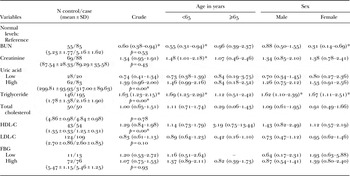
Mean levels of serum biomarkers for cases and controls are shown in Table 1. Three indicators demonstrated statistical significance, UA [t(830) = −2.70, p = 0.00)], TG [t(830) = −3.30, p = 0.00)] and HDL-C [t(830) = 4.42, p = 0.00)]. There were no significant differences in biochemical markers for renal function (BUN, Cr) and diabetes (FBG).
Odds ratios for potential serum biomarkers by age and gender

Notes: BUN: blood urea nitrogen. HDL-C: high-density lipoprotein cholesterol. LDL-C: low-density lipoprotein cholesterol. FBG: fasting blood glucose.
Significance level: * p < 0.05.
In relation to hypertension, BUN appeared to have a protective effect. Participants with hypertension were 40 per cent less likely to have high BUN levels. Similarly, when age was stratified, hypertensive participants aged less than 65 years were less likely to experience high BUN levels (OR = 0.55, 95% CI = 0.31–0.94). High BUN levels showed a stronger protective effect in females than males, OR = 0.31, 95% CI = 0.14–0.69, while elevated Cr levels were a risk factor for hypertension in persons aged less than 65 years, OR = 1.48, 95% CI = 1.01–2.18. However, there were no significant differences when gender was taken into account. It was not surprising that low UA levels conferred a protective effect against hypertension while high UA levels were associated with a high risk of hypertension. However, there were no statistically significant differences for crude OR values or when age and sex were taken into consideration.
Considering lipid profiles, high triglyceride levels were strongly associated with hypertension. Hypertensive participants were 63 per cent more likely to have hypertriglyceridemia, OR = 1.63, 95% CI = 1.23–2.15. Even when age and sex were stratified, high triglyceride levels had strongly significant associations with hypertension for persons aged less than 65 years (OR = 1.69, 95% CI = 1.25–2.29) and females (OR = 1.67, 95% CI = 1.11–2.51). Nevertheless, total cholesterol, HDL-C and LDL-C concentrations were less likely to be associated with hypertension, with no significant differences found. Hyperglycemia indicative of diabetes demonstrated no association with hypertension.
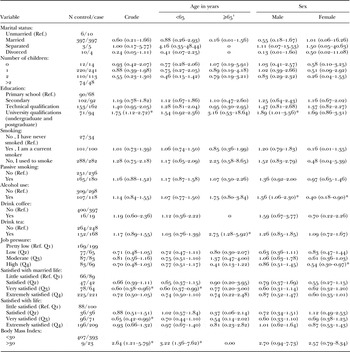
Table 2 shows the relationship between hypertension and demographic and lifestyle factors. Surprisingly, participants with university degrees were more likely to be at risk for elevated blood pressure than those with less education (OR = 1.75, 95% CI = 1.12–2.72), and males with high education were 89 per cent more likely to have high blood pressure (OR = 1.89, 95% CI = 1.01–3.56). BMI greater than 30 was strongly associated with hypertension (crude OR = 2.64, 95% CI = 1.21–5.79), particularly in participants aged 65 years and older (OR = 3.22, 95% CI = 1.36–7.62). Marital status and number of children were not associated with hypertension, nor were smoking and passive smoking. Alcohol consumption was a strong risk factor for male participants (OR = 1.56, 95% CI = 1.06–2.30), while conferring a protective effect against high blood pressure in females (OR = 0.40, 95% CI = 0.18–0.90). Surprisingly, drinking tea was a risk factor for hypertension, particularly in participants aged 65 years and over (OR = 2.75, 95% CI = 1.28–5.92), while drinking coffee showed no significant difference. High levels of job stress were 46 per cent less likely to be related to high blood pressure in females (OR = 0.54, 95% CI = 0.30–0.97). Satisfaction with married life and life in general conferred protective effects against hypertension; for instance, very satisfied with married life (OR = 0.60, 95% CI = 0.38–0.96) and very satisfied with life in general (OR = 0.65, 95% CI = 0.42–0.99).
Odds ratios for demographic and behavioural factors by age and gender
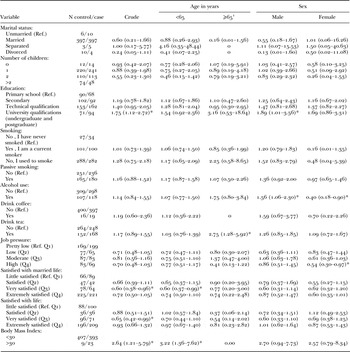
Notes: 1. 0 = zero to two participants. Ref.: reference category. Q1: 25th percentile. Q2: 50th percentile. Q3: 75th percentile. Q4: above the 75th percentile.
Significance level: * p < 0.05.
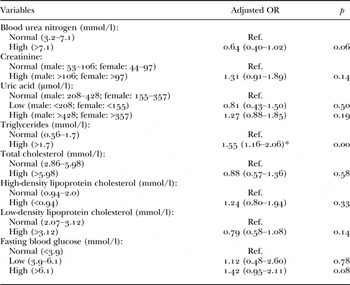
The model in Table 3 was adjusted for potential confounding factors that showed statistical significance in Table 2, including age, sex, BMI, education, drinking coffee, drinking tea, alcohol use, smoking, satisfaction with married life and satisfaction with life in general. High triglyceride level was the only variable strongly associated with hypertension. Patients with high blood pressure were 55 per cent more likely to have hypertriglyceridemia (OR = 1.55, 95% CI = 1.16–2.06). Interestingly, high levels of BUN, TC and LDL-C appeared as protective factors for high blood pressure even though there were no significant differences. High and low blood glucose levels both carried an increased risk of high blood pressure but the differences were not statistically significant.
Adjusted odds ratios (OR) for potential serum biomarkers
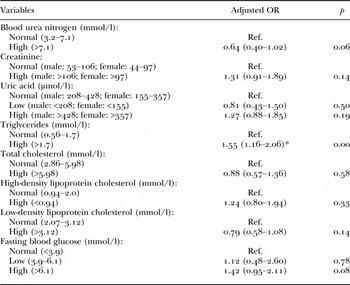
Notes: Adjusted for age, sex, education, coffee and tea drinking, alcohol use, smoking, satisfied with marriage, satisfied with life and Body Mass Index. mmol/l: millimoles per litre. μmol/l: micromoles per litre. Ref.: reference category.
Significance level: * p < 0.05.
Discussion
Hypertension and hypertriglyceridemia are indications of metabolic syndrome, which results from interaction between genes and environments. The main sources of serum triglyceride are dietary fat (exogenous) and the liver (endogenous). After meals, over 90 per cent of serum triglycerides are contained within the intestines in the form of chylomicrons, while during periods of fasting very low-density lipoproteins enter the bloodstream from the liver. Elevated serum triglyceride levels develop when there is an imbalance between the glucoregulatory and anti-lipolytic actions of insulin (Yki-Jarvinen and Taskinen Reference Yki-Jarvinen and Taskinen1988). Evidence indicates that an abnormal triglyceride level is the factor most significantly associated with elevated blood pressure (Laaksonen et al. Reference Laaksonen, Niskanen, Nyyssonen, Lakka, Laukkanen and Salonen2008). Likewise, the findings of the study clearly identified hypertriglyceridemia as a strong biomarker for developing high blood pressure. High serum triglyceride concentrations are claimed to be an independent risk factor for cardiovascular disease because of damage caused to cells lining arterial walls (Frontini et al. Reference Frontini, Srinivasan, Elkasabany and Berenson2001). Elevated serum triglycerides are not only associated with atherogenic lipoproteins (triglyceride-rich lipoprotein, small and dense LDL and low levels of HDL) but are also linked to non-lipid risk phenotypes, including insulin resistance and hypertension (Grundy Reference Grundy1998). Frontini and colleagues pointed out that persons with triglyceride levels above 150 milligrammes per decilitre have shown twice the risk of hypertension compared with those in the lowest percentile (Frontini et al. Reference Frontini, Srinivasan, Elkasabany and Berenson2001). Similarly, a study in Finland reported elevated triglyceride concentrations were most likely to be associated with the development of hypertension at seven-year follow-up (Laaksonen et al. Reference Laaksonen, Niskanen, Nyyssonen, Lakka, Laukkanen and Salonen2008). The possible mechanism may be endothelial dysfunction. Triglyceride-rich lipoproteins have been shown to be toxic to endothelial cells through an enhanced inflammatory response to cytokine activation (Ting et al. Reference Ting, Stice, Schaff, Hui, Rutledge, Knowlton, Passerini and Simon2007). Long-term damage may lead to increased peripheral vascular resistance and increased arterial stiffness, which are consequences of arterial hypertension. Nevertheless, the postulated mechanism for the relationship between hypertriglyceridemia and hypertension remains unclear and requires further study.
Additionally, the incidence of elevated blood pressure is linked to overall abdominal obesity, particularly central obesity (Niskanen et al. Reference Niskanen, Laaksonen, Nyyssönen, Punnonen, Valkonen, Fuentes, Tuomainen, Salonen and Salonen2004). In the study, elderly participants with high BMI and high education were more likely to have hypertension. This may be explained by the urbanisation that has improved Chinese living standards while leading to changed dietary habits. The Chinese urbanisation rate was 51.3 per cent in 2011 and is predicted to increase to nearly 60 per cent by 2020 (China Population and Development Research Center 2012). Urban residents are generally affluent and are moving away from their traditional lifestyles towards Western norms, including diets with more fat and animal-based products (Cui et al. Reference Cui, Huxley, Wu and Dibley2010; Reynolds et al. Reference Reynolds, Gu, Whelton, Wu, Duan, Mo and He2007). Chinese intakes of rice, flour and coarse grains have declined during the past two decades while consumption of fat and protein has increased in the same period (Gould Reference Gould2002; Ma et al. Reference Ma, Rae, Huang and Rozelle2004; Mendez and Popkin Reference Mendez and Popkin2004), especially in higher-income groups. People have higher incomes than previously and they satisfy their appetites with convenience foods, thus freeing up the time needed to earn even more (Pingali Reference Pingali2006). This also reduces the time spent on grocery shopping and meal preparation, while the status of dining out is rising (Watson Reference Watson and Watson1997). The changes in China from conventional consumption patterns towards Western-style convenience foods has been labelled ‘fashionable living’ in China and across Asia (Veeck and Veeck Reference Veeck and Veeck2000; Yan Reference Yan and Watson1997). There has been exponential growth in fast-food restaurants across China during the last few decades, and there were approximately 1,000 such restaurants in 2006 (Cheng Reference Cheng2005). The high fat content of fast food leads to hyperlipidemia, hypertriglyceridemia, increased BMI and weight gain, which are all associated with hypertension and the risk of cardiovascular disease (French, Harnack and Jeffery Reference French, Harnack and Jeffery2000; Jeffery and French Reference Jeffery and French1998). However, other behavioural factors linked to elevated blood pressure should also be taken into consideration, including increased cigarette smoking, alcohol consumption and physical inactivity. People at risk of hypertension need information to help them reduce their risk factors.
Conclusion
Hypertension in China is identified as the most important risk factor for cardiovascular disease, particularly stroke, and it affects older adults in both cities and in regional areas. Urbanisation and the adoption of Westernised lifestyles have strongly affected traditional consumption habits and behaviours among seniors in China, resulting in significantly high rates of high blood pressure. Even though the Chinese government has launched an awareness campaign and improved treatments to control elevated blood pressure, the success rate of reducing morbidity and mortality from hypertension is still low. In order to control hypertension, using biomarkers aligning with changing lifestyles may be provided of paramount to lower rates of hypertension in China.
Acknowledgement
This research was funded by National Natural Foundation of China (project approval number 81202281), the Science and Technology Program Fund in the Hunan province of China (number 2011SK3178) and the Personnel Training Fund in Hunan province of China (grant agreement number 2012RS4018). Ther are no conflicts of interest.