Introduction
Recent decades have seen significant developments in the genetic selection of the meat-type fowl, i.e., broilers (Havenstein et al., Reference HAVENSTEIN, FERKET, SCHIEDELER and LARSON1994, Reference HAVENSTEIN, FERKET and QURESHI2003a) and turkeys (Havenstein et al., Reference HAVENSTEIN, FERKET, GRIMES, QURESHI and NESTOR2007), which has led to rapid growth, accompanied by increased feed efficiency and metabolic rate (Janke et al., Reference JANKE, TZSCHENTKE and BOERJAN2004), which provides the poultry industry with heavy domestic fowl in relatively short growth periods. Such development logically necessitates parallel increases in the size of the cardiovascular and respiratory systems, as well as enhancements in their functional efficiency. However, inferior development of such major systems (Havenstein et al., Reference HAVENSTEIN, FERKET and and QURESHI2003b) has led to relatively low capability to balance energy expenditure and body water balance under extreme environmental conditions. Thus, acute exposure of chickens to extreme conditions (hot spells) has resulted in major economic losses. During the late 19th and the 20th centuries the global mean surface temperature increased by 0.8-1.7°C (U.S. National Climatic Center, 2001), and scientists expect that there will be a further increase of 0.6-2.5°C during the next 50 years. This situation, in which growth rate improves annually, accompanied by increased heat production, and future increases in global surface temperatures are foreseen, demands an efficient and economical means to improve the acquisition of thermotolerance by domestic fowl exposed to hot climates.
Birds are homeotherms, and so are able to maintain their body temperature (Tb) within a narrow range. However, an increase in body temperature above the regulated range, as a result of exposure to environmental conditions and/or excessive metabolic heat production, may lead to a cascade of irreversible thermoregulatory events that could be lethal for the bird. To sustain thermal tolerance and avoid the deleterious consequences of thermal stresses, three direct responses are elicited:
1. The rapid thermal stress response-RTSR characterized by minutes to hours response (Parsell and Lindquist, Reference PARSELL and LINDQUIST1994; Yahav et al., Reference YAHAV, STRASCHNOW, PLAVNIK and HURWITZ1997a),
2. Acclimation/acclimatization characterized by days to weeks response (Horowitz, Reference HOROWITZ2002; Yahav et al., Reference YAHAV, STRASCHNOW, PLAVNIK and HURWITZ1997a),
3. Embryonic or post-hatch thermal manipulation (TM), based on epigenetic adaptation during the perinatal period and based on timing (Nichelmann et al., Reference NICHELMANN, HÖCHEL and TZSCHENTKE1999; Piestun et al., Reference PIESTUN, SHINDER, RUZAL, HALEVY, BRAKE and YAHAV2008b; Tzschentke et al., Reference TZSCHENTKE, BASTA and NICHELMANN2001; Tzschentke and Basta, Reference TZSCHENTKE and BASTA2002; Yahav and Hurwitz, Reference YAHAV and HURWITZ1996).
This review will focus on physiological and molecular responses elicited as a result of an elevation of ambient temperature (Ta), which enable the domestic fowl to cope with such changes in the environment.
The rapid heat stress response
The rapid heat stress response (RHSR) is an immediate response to heat stress, where it initiates the recruitment of body resources to maintain an animal's dynamic steady state. This response cannot be maintained for a long period, therefore, under continuous severe heat stress, a cascade of events may lead to heat stroke. This section will underline the physiological and cellular mechanisms involved in the effort to control Tb under acute heat stress.
Extensive studies have been applied to experimental animal models, i.e., rats and mice (Horowitz, Reference HOROWITZ1998, Reference HOROWITZ2002), but less information is available for domestic fowls. These birds, especially the highly productive agricultural fowls, differ to some extent from other homeotherms in their ability to maintain a sufficiently dynamic steady state despite severe changes in the environment (Yahav, Reference YAHAV2000). This is attributed to the enhanced development inherent in the genetic selection for production.
physiological responses
The thermoregulatory system in homeotherms operates at a very high gain, to control Tb within a relatively narrow range. During heat exposure the thermoregulatory system relies on the cardiovascular system to redistribute the blood flow in such a way that tissues and organs important for heat loss will receive an augmented supply. In birds, heat is dissipated through respiratory-evaporative mechanisms (Richards, Reference RICHARDS1968, Reference RICHARDS1970, Reference RICHARDS1976; Seymour, Reference SEYMOUR1972; Marder and Arad, Reference MARDER and ARAD1989), an evaporative cutaneous mechanism (Webster and King, Reference WEBSTER and KING1987; Ophir et al., Reference OPHIR, ARIELI, MARDER and HOROWITZ2002) and sensible heat loss via radiation, convection (Yahav et al., Reference YAHAV, SHINDER, J. and COHEN2005) and conductance (Wolfenson et al., Reference WOLFENSON, BACHRACH, MAMAN, GRABER and ROZENBOIM2001). Evaporative heat loss via panting is associated with loss of body water content, therefore dehydration can reduce heat loss via this pathway, as well as through the extensive passive cutaneous evaporation. Panting is also associated with respiratory alkalosis, which may affect the evaporation (Yahav et al., Reference YAHAV, GOLDFELD, PLAVNIK and HURWITZ1995). An increase in sensible heat loss may reduce the intensity of evaporative heat loss, thereby contributing to better acquisition of thermotolerance at high Ta.
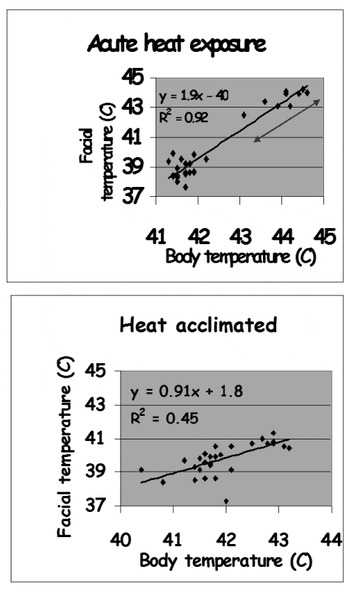
One of the immediate heat-stress responses is the development of hyperthermia (Etches et al., Reference ETCHES, JOHN and VERRINDER-GIBBINS1995), which initiates redistribution of the blood flow so as to increase the flow to the skin, especially to the non-feathered areas of chickens (Wolfenson et al., Reference WOLFENSON, FREI, SNAPIR and BERMAN1981; Wolfenson, Reference WOLFENSON1986; Yahav et al., Reference YAHAV, LUGER, CAHANER, DOTAN, RUZAL and HURWITZ1998, Reference YAHAV, STRASCHNOW, D., SHINDER, TANNY and COHEN2004b, Reference YAHAV, SHINDER, J. and COHEN2005) and to the upper respiratory passageways (Wolfenson et al., Reference WOLFENSON, FREI, SNAPIR and BERMAN1981) in order to transport heat from the viscera to the periphery. Subsequently the elevation in skin temperature enables efficient heat loss by radiation, convection and conduction as a result of enhancement of the main driving force for this kind of heat loss, i.e., the gradient between surface temperature and Ta. The pattern of hyperthermia development and the increase in blood flow to the skin that causes an increase in skin temperature is illustrated for broilers in Figure 1.
Broiler chickens, that were acutely exposed to 35°C, exhibited a significantly high correlation between the development of hyperthermia and the increase in facial surface temperature, as measured by infrared thermal imaging radiometer. During 2 h of acute heat exposure, the facial surface temperature followed the increase in body temperature with a lag of approximately 2°C. Although sensible heat loss (SHL) plays an important role in balancing heat accumulation in the body, evaporative cooling still plays a pivotal role (Hillman et al., Reference HILLMAN, SCOTT and VAN TIENHOVEN1985). During acute heat exposure chickens suffer from dehydration as a result of the high rate of panting (Etches et al., Reference ETCHES, JOHN and VERRINDER-GIBBINS1995) and passive water loss from the cutaneous surfaces, which depends on the rate of ventilation (Yahav et al., Reference YAHAV, SHINDER, J. and COHEN2005). Such dehydration may dramatically affect the functioning of the blood system, leading to heat stroke. During the first stages of acute heat stress, before the development of dehydration, whereas the blood supply to the skin and the upper respiratory passageways is elevated, there is no impairment of the blood supply to other important tissues. This is mainly because of the increase in cardiac output that results from the increased heart rate and stroke volume, and the redistribution of blood flow among tissues, whereby blood flow is diverted from non-vital tissues. The increase in heart rate and the resulting enhanced venous return support an overall increase in cardiac output that more rapidly refills the arterial pressure reservoir and prevents further reduction in arterial pressure (Whittow et al., Reference WHITTOW, STURKIE and STEIN1964; Sturkie, Reference STURKIE1967; Darre and Harrison, Reference DARRE and HARRISON1987; Zhou, Reference ZHOU2000). However, as dehydration sets in, depletion of the blood volume causes a reduction in venous pressure which, in turn, diminishes blood flow to the skin and the upper respiratory tract, thereby affecting the efficacy of the heat-loss routes. This will lead to a severe hyperthermia which in domestic fowl may reach 46°C prior to death (Yahav unpublished data). Severe hyperthermia is accompanied by detrimental changes at the cellular and molecular levels, which lead to the fatal cascade of events characterized by decreased blood pressure, brain hypoxia, neuronal dysfunction, cell fatigue, etc. (Hales et al., Reference HALES, HUBBARD and GAFFIN1996).
The effects of acute heat exposure to 35°C (for 2 h) - (upper graph) versus heat acclimation to the same temperature; (lower graph) on broiler's body and facial temperatures, and the correlation between the two parameters.

An additional combined mechanism involves the modulation of heat production. Heat production – thermogenesis – is regulated by the thyroid hormones and the neuronal sympathetic system (Silva, Reference SILVA2006), and it will decline in response to the duration and the level of heat stress, to prevent excessive accumulation of heat in the body. The rate of metabolic activity and hence the amount of oxygen required by the bird are related to the ambient temperature (Freeman, Reference FREEMAN1964; Kühn et al., 1984; Buys et al., Reference BUYS, SCHEELE, KWAKERNAAK and DECUYPERE1999). The metabolic rate is associated with the secretion of the hormone thyroxine (T4), secreted by the thyroid gland, which is deiodinated to triiodothyronine (T3) in all tissues. Triiodothyronine is the main metabolism-stimulating hormone (McNabb and King, Reference MCNABB and KING1993; Gabarrou et al., Reference GABARROU, DUCHAMP, WILLIAMS and GĖRAERT1997) that has been found to be associated with temperature regulation (McNabb and King, Reference MCNABB and KING1993; Carew et al., Reference CAREW, EVARTS and ALSTER1998; Gonzales et al., Reference GONZALES, BUYSE, SARTORI, LODDI and DECUYPERE1999; Yahav, Reference YAHAV2000). Under acute heat stress, the main and immediately activated mechanism to reduce T3 and, thereby, heat production involves the reduction of deiodination of peripheral T4 to T3.
Collectively, an immediate increase in heat loss by evaporation and SHL, coupled with changes in the cardiovascular system and a significant reduction in heat production form the physiological response that enables the chicken to cope with acute exposure to heat stress.
cellular responses
The cellular response to heat stress can be divided into two phases. The first phase protects the cells in the short term, for up to approximately 1 h, and can be characterized by activation of pathways that involve the adenosine receptor, mitochondrial kATP-dependent channels and various kinases (Bogin et al., Reference BOGIN, PEH, AVIDAR, ISRAELI and CAHANER1996, Reference BOGIN, PEH, AVIDAR, ISRAELI, KEVKHAYE, LOMBARDI and CAHANER1997; Hausenloy and Yellon, Reference HAUSENLOY and YELLON2006).
The second phase is the delayed one, with a long-lasting response that involves the expression of the heat shock genes and their encoded heat shock proteins (HSPs) (Jaattela and Wissing, Reference JAATTELA and WISSING1992; Parsell and Lindquist, Reference PARSELL and LINDQUIST1994). Members of the ‘superfamily’ of HSPs are among the most conserved proteins known in phylogeny, with respect to both function and structure (reviewed by Lindquist and Craig, Reference LINDQUIST and CRAIG1988; Gething and Sambrook, Reference GETHING and SAMBROOK1992; Jaattela and Wissing, Reference JAATTELA and WISSING1992; Welch, Reference WELCH1993). These proteins act as molecular chaperones by binding to other cellular proteins, assisting intracellular transport and folding, preventing protein denaturation or helping the cell to cope with denaturated proteins, preventing aggregation of these denaturated proteins and facilitating their renaturation (Feige and Polla, Reference FEIGE and POLLA1994). The various families of HSPs (HSP 110, 90, 70, 60, 47, and small HSPs ranging from 16 to 40 kDa) include both proteins that are present prior to heat treatment but whose synthesis is enhanced by it (constitutive HSPs), and proteins whose synthesis becomes detectable only following stress (inducible HSPs). The HSP 70 family is among the most prominent of heat-induced proteins (Parsell and Lindquist, Reference PARSELL and LINDQUIST1994), and HSP70 was recognized for its prominent cytoprotective function (Volloch and Rits, Reference VOLLOCH and RITS1999). It was well established that there is a close correlation between the induction of these proteins and increased thermotolerance (Li and Laszlo, Reference LI and LASZLO1985; Wang and Edens, Reference WANG and EDENS1998; Yahav et al., Reference YAHAV, A., HOREV, BAR-ILAN, GENINA and FRIEDMAN-EINAT1997b).
The expression of HSPs is primarily regulated by Heat-Shock Transcription Factor (HSF) (Morimoto, Reference MORIMOTO1998). In avian cells the stress induced transcription of heat shock is mediated by HSF1 and HSF3 (Naki, Reference NAKI1999; Shabtay and Arad, Reference SHABTAY and ARAD2006). The thermal sensor that triggers the HSP response seems to be the occurrence of thermal sensation at the membrane level.
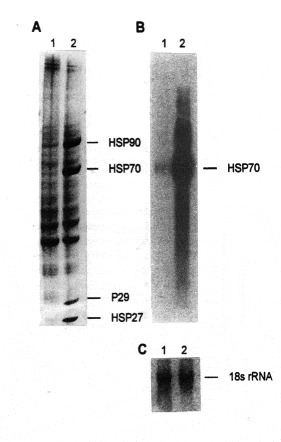
In a study to improve broilers’ thermotolerance, Yahav and Hurwitz (Reference YAHAV and HURWITZ1996) showed that thermal conditioning at the age of 3 or 5 days improved acquisition of thermotolerance in broilers exposed to heat stress at 6 weeks of age. The improved thermotolerance was characterized by the development of relatively mild hyperthermia, suggesting better ability to maintain Tb than that of the control chickens. This was coupled with lower HSP70, HSP90 and HSP27 production in the heart and lungs of the mildly hyperthermic chickens (Yahav et al., Reference YAHAV, A., HOREV, BAR-ILAN, GENINA and FRIEDMAN-EINAT1997b). The association between Tb and in ovo production of HSPs in broilers is illustrated in Figure 2; significant increases in HSP70, HSP90 and HSP27 occur in the lungs of severely hyperthermic broilers (Tb = 46.4°C) in comparison with HSP production in mildly hyperthermic ones (Tb = 43.1°C). Furthermore, Friedman-Einat et al. (Reference FRIEDMAN-EINAT, HABERFELD, SHAMAI, HOREV, HURWITZ and YAHAV1996) found a new member of the small HSP family, with apparent molecular weight of 29 kDa, in 6-week-old heat-stressed broilers. This protein appeared after 3 h of in vivo heat stress, suggesting that it has a specific role of "second-stage defence protein".
Heat shock proteins (HSPs) 27, 29, 70 and 90 kDa produced in lung tissues of broiler chickens exposed to 35°C at the age of 35 days. (A) HSPs in severely hyperthermic chicken (lane 1; Tb = 46.4°C); HSPs in moderately hyperthermic chicken (lane 2; Tb = 43.1°C). (B) Analysis of HSP70 mRNA level. (According to Yahav et al., Reference YAHAV, A., HOREV, BAR-ILAN, GENINA and FRIEDMAN-EINAT1997b).

Together, the duration and severity of heat stress determine the HSP response, and the outcome for the cell can be one of the two: survival or death.
It can be concluded that the physiological and cellular array of the body responses to acute heat stress reduces the deleterious consequences of heat stress for a short period. Inability to cope with heat stress results in heat stroke.
Acclimation/acclimatization
Acclimation is defined as physiological or behavioural changes occurring within the lifetime of an organism, which reduce the strain or enhance the tolerance of strain caused by experimentally induced stressful changes, in particular, climatic factors (IUPS Thermal Commission, Reference IUPS THERMAL COMMISSION2001). Whereas acclimation refers to experimental procedures, acclimatization refers to natural processes. Heat acclimation comprises an array of autonomically controlled physiological mechanisms working in concert to enhance heat endurance (Horowitz, Reference HOROWITZ2002). Heat acclimation/acclimatization can be characterized as an expansion of the dynamic thermoregulatory range of the bird. Basically, it involves expansion of the body core temperature safety margins; increase of heat loss; and decrease of heat production. These result from concerted procedures at all levels of the body to induce a new level of homeostasis, which efficiently improves thermotolerance in the new hot environment.
Heat acclimation/acclimatization is initiated in response to persistent or repeated challenge of the thermoregulatory system by moderate heat, and has a long-acting effect. In rats, a biphasic model for acclimation has been suggested (Horowitz, Reference HOROWITZ1998), in which the first phase is short (1-5 days) and the second extends over >3 wk. Although there is no evidence for two phases of acclimation in birds, it seems that 4-7 days may be sufficient for efficient control of Tb in broilers (Yahav et al., Reference YAHAV, STRASCHNOW, PLAVNIK and HURWITZ1996), turkeys (Yahav, Reference YAHAV1999) and laying hens (Yahav et al., Reference YAHAV, SHINDER, RAZPAKOVSKI, RUSAL and BAR2000) exposed to hot environmental conditions. However, changes in the cardiovascular system in broilers can be detected only after approximately 2-3 wk (Yahav et al., Reference YAHAV, STRASCHNOW, PLAVNIK and HURWITZ1997a).
The thermoregulatory features of acclimation include changes that differ to some extent from those of RHSR. The vasomotor response, which includes skin vasodilatation, coincides with vasoconstriction in the visceral organs, but it differs from the RHSR in that, despite the vasoconstriction in the viscera, the blood flow to these organs can continue as during pre-acclimation, as a consequence of systemic blood pressure adjustment. In such a situation, improvement of the adjustment of the temperature of the visceral organs will contribute to improved heat endurance. The effect of peripheral vasodilatation during acclimation to hot environmental conditions exhibited its significant advantage when ventilation was applied: ventilation at an optimal rate was found significantly to affect the performance of broilers (Yahav et al., Reference YAHAV, SHINDER, J. and COHEN2005), turkeys (Yahav et al., Reference YAHAV, RUZAL and SHINDER2007) and laying hens (Ruzal and Yahav, unpublished data), via the improvement of SHL. However, it must be noted that the level of vasodilatation that results from acclimation is relatively low compared with that associated with the RHSR. This is illustrated in Figure 1 (lower graph), which shows that the facial surface temperature was significantly lower than that found in RHSR broilers.
Heat acclimation induces further adaptations in the circulatory system. These adaptations are manifested in reduced heart rate (Forrest et al., Reference FORREST, WILL, SCHMIDT, JUDGE and BRISKEY1968; Sturkie et al., Reference STURKIE, LIN and OSSORIO1970) and enhanced stroke volume, which suggest increased cardiac efficiency. In mammals, including humans, the enhancement of the cardiac output was found to be related to increased venous blood return, which enabled the cardiac filling pressure to reach values that could lead to elevated stroke volume (Senay et al., Reference SENAY, MITCHELL and WYNDHAM1976). These changes were attributed to expansion of plasma volume. Plasma volume expansion has been mainly attributed to a build-up of increased plasma protein concentration, which alters the balance between capillary hydrostatic pressure and colloid osmotic pressure. Expansion of plasma volume as a result of acclimation to high Ta was demonstrated by Whittow et al. (Reference WHITTOW, STURKIE and STEIN1964), May et al. (Reference MAY, DEATON, REECE, MITLIN and KUBENA1971), and Yahav et al. (Reference YAHAV, STRASCHNOW, PLAVNIK and HURWITZ1997a). Chickens are capable of maintaining vascular volume following perturbations such as haemorrhage (Kovach et al., Reference KOVACH, SZASZ and PILMAYER1969; Wyse and Nickerson, Reference WYSE and NICKERSON1971), sodium depletion (Harris and Koike, Reference HARRIS and KOIKE1977) or dehydration (Koike et al., Reference KOIKE, PRYOR and NELDON1983). However, the significant plasma expansion during acclimation to constant or diurnal cyclic high Ta in broilers supports both the cardiovascular changes and the need to provide fluid for heat dissipation by panting (Marder and Arad, Reference MARDER and ARAD1989).
Another important feature of heat acclimation is the significant reduction in heat production. This was monitored in different species, such as broilers (Yahav et al., Reference YAHAV, STRASCHNOW, PLAVNIK and HURWITZ1996) and turkeys (Yahav, Reference YAHAV1999) by measuring plasma T3 concentration. In all cases acclimation to high Ta was accompanied by significant reduction in plasma T3 concentration, mainly as a consequence of the reduction in the thyroid gland activity.
It could be concluded that heat acclimation might serve as an efficient tool to improve the acquisition of thermotolerance. However, the process of heat acclimation, at least in broilers, is rendered rather impracticable by the early marketing age of broilers, coupled with: (a) the necessity to keep the environmental temperature controlled up to the age of 21 d for brooding; (b) the deleterious effect of heat acclimation on broiler performance; and (c) the enormous cost of temperature-controlled poultry houses. The relatively efficient thermoregulatory capacity of turkeys and laying hens induced during heat acclimation has transient negative effects on growth and egg production, respectively, but the long productive period might provide sufficient time to use heat acclimation in these species.
The limitations outlined above have led to the investigations of how to adopt epigenetic temperature adaptation efficiently in broilers.
The epigenetic approach
Epigenetic temperature adaptation is based on the assumption that environmental factors, especially Ta, have a strong influence on the determination of the ‘set-point’ for physiological control systems during “critical developmental phases.” Dörner (Reference DÖRNER1974) first described this as the ‘determination rule’. Thermosensitive neurons in the preoptic anterior hypothalamus (PO/AH) integrate afferent temperature signals from various areas of the body, in order to elicit appropriate thermoregulatory responses via control of physiological, endocrinological, and behavioural responses and, thereby, to keep the core Tb relatively constant (Boulant, Reference BOULANT1996).
Epigenetic adaptation, which has been defined as a lifelong adaptation that occurs during prenatal (embryogenesis) or early post-hatching ontogeny, takes place within critical developmental phases that affect gene expression (Nichelmann and Tzschentke, Reference NICHELMANN and TZSCHENTKE2002; Tzschentke and Basta, Reference TZSCHENTKE and BASTA2002; Tzschentke et al., Reference TZSCHENTKE, BASTA, JANKE and MAIER2004; Tzschentke and Plagemann, 2006) and seems to be a suitable means of reaching the goal of improved acquisition of thermotolerance in broilers. During early development most functional systems evolve from an open-loop system without feedback to a closed control system with feedback (‘transformation rule’) (Dörner, Reference DÖRNER1974). Thermal manipulation during the critical phases of this development process may induce alterations in the thermoregulatory control system.
post-hatching thermal manipulations
Broiler chicks complete their brain and body temperature regulation development at the age of 10 days post-hatching (Arad and Itsaki-Glucklish, Reference ARAD and ITSAKI-GLUCKLISH1991). During this period body and brain temperatures are maintained at a lower level than in adult chickens. Subsequently, as age increases, the difference between body and brain temperatures increases linearly and significantly. The epigenetic response has been successfully modulated by early-age thermal manipulation (TM) of post-hatching chicks, by exploiting the incomplete maturation of the thermoregulatory system: TM involving exposure of a 3 day old broiler to 37-38°C at 60-80% relative humidity (RH) for 24 h, was found to improve acquisition of thermotolerance. The improvement achieved was manifested in the ability of the TM chicks to reduce heat production efficiently during exposure to acute thermal challenge at marketing age (Yahav and Hurwitz, Reference YAHAV and HURWITZ1996). This was accompanied by:
(i) an alteration in sensible heat loss through convection and radiation (Yahav et al., Reference YAHAV, SHINDER, J. and COHEN2005; Table 1);
(ii) a significant reduction in the stress level of the TM chickens, as indicated by their plasma corticosterone concentration; and
(iii) pronounced decrease in the 27-, 70- and 90-kDa heat-shock proteins (HSPs) in the heart muscle and lung tissue of TM chickens during thermal challenge (Yahav et al., Reference YAHAV, A., HOREV, BAR-ILAN, GENINA and FRIEDMAN-EINAT1997b).
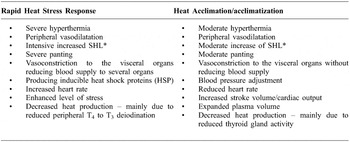
A summary of physiological and molecular changes that occur as a result of exposure to acute heat stress (Rapid Heat Stress Response – RHSR) or as a result of acclimation/acclimatization to heat.

*SHL – sensible heat loss
It has been suggested that the induction of HSPs was correlated with Tb, and that the HSP response was not part of the long-term mechanism elicited by the early-age TM. The reduction in heat production, coupled with increased SHL, enabled relatively slow development of hyperthermia and thus dramatically reduced mortality. The TM at 3 d of age also induced compensatory growth, leading to improvement of performance and muscle growth, because of proliferation of skeletal muscle satellite cells during TM (Halevy et al., Reference HALEVY, KRISPIN, LESHEM, MCMURTRY and YAHAV2001). It was further found to affect the post-TM development of the gastrointestinal tract positively (Uni et al., Reference UNI, GAL-GARBER, GEYRA, SKLAN and YAHAV2001). The effect of TM on the chicks’ PO/AH was studied with reference to two genes: the R-Ras3 and the brain-derived neurotrophic factor (BDNF). The R-Ras3 belongs to the small GTP-binding protein subfamily and is activated by multiple extracellular stimuli. The Ras subfamily controls a variety of cellular events that culminate in gene transcription; it plays essential roles in cell proliferation, differentiation and survival, and modulation of synaptic functions. The BDNF binds specifically to the TrK-B receptor and initiates tyrosine phosphorylation that activates the phosphotyrosine-binding site. This initiates the internal cellular pathway of RAS, and results in transduction of genes involved in neuronal growth and maintenance. In the chick PO/AH significant increases in expression of the R-Ras3 (Labunskay and Meiri, Reference LABUNSKAY and MEIRI2006), brain-derived neurotrophic factor (BDNH) (Katz and Meiri, Reference KATZ and MEIRI2006) and 14-3-3ε (Meiri, Reference MEIRI2008) were detected during TM, which suggests that these genes are involved in TM.
However, uniform post-hatch temperature manipulation is difficult to achieve, whereas the use of such manipulations during incubation could be more efficient and uniform if the interaction between the mechanics of incubation and embryological development could be adequately understood.
pre-hatching thermal manipulations
The hypotheses underlying these studies are that:
(i) during embryogenesis, it is possible to induce long-lasting physiological memory, based on epigenetic adaptation;
(ii) long-lasting memory can be defined, most probably, as alteration in the hypothalamic threshold response to changes in the environment; and
(iii) TM during sensitive embryogenesis periods, by means of specific levels and durations of heat exposure, will impart improve thermotolerance during the bird's entire life span.
In contrast to the uniform temperature of commercial incubation, incubation conditions in nature are non-uniform, as a result of searching for food, escaping from predators, and non-uniform nest insulation (Webb, Reference WEBB1987). This may be one of the reasons why birds in the wild are better able to cope with extreme environmental temperatures.
It was previously reported that exposing embryos to high or low temperatures during incubation improved their capacity to adapt to hot or cold environments, respectively, in the post-hatching phase (Nichelmann et al., Reference NICHELMANN, LANGE, PIROW, LANGBEIN and HERRMANN1994; Tzschentke and Basta, Reference TZSCHENTKE and BASTA2002; Moraes et al., Reference MORAES, MALEHIROS, BRUGGEMANN, COLLIN, TONA, VAN AS P., ONAGBESAN, BUYSE, DECUYPERE and MACARI2003; Yahav et al., Reference YAHAV, COLLIN, SHINDER and PICARD2004a).
Three critical parameters have to be considered in the approach to TM during chick embryogenesis: (i) the critical phase; (ii) the temperature level; and (iii) the duration of exposure.
Determination of the critical phase of embryogenesis that would enable successful application of TM to improve the acquisition of thermotolerance was based on the hypothesis that the ‘set point’ or ‘response threshold’ of controlling systems could be altered most efficiently during the development/maturation of the hypothalamus-hypophyseal-thyroid axis (thermoregulation) and/or the hypothalamus-hypophyseal-adrenal axis (stress).
In recent experiments (Piestun et al., Reference PIESTUN, SHINDER, HALEVY and YAHAV2008a, b) TM at 39.5°C and 65% RH was applied continuously (treatment 24H) or intermittently for 12 h per day (treatment 12H) to broiler embryos between periods E7 and E16 (inclusive). After hatching, chicks were raised under standard conditions to 35 d of age and then subjected to thermal challenge (35°C for 4 h).
A significant decline in hatchability was recorded in the 24H TM broiler eggs. This resulted mainly from embryos that initiated external piping but were not able to complete it, most probably as a result of insufficient accumulation of glycogen in the liver and the Musculus complexus (Christensen et al., Reference CHRISTENSEN, WINELAND, FASENKO and DONALDSON2001). The hatched chicks of the 24H TM treatment were further characterized by lower chick quality and significantly lower body weight, whereas the 12H treatment did not significantly affect hatchability or chick quality (Piestun et al., Reference PIESTUN, SHINDER, RUZAL, HALEVY, BRAKE and YAHAV2008b).
Application of TM, either continuously in treatment 24H or intermittently in treatment 12H, caused a significant decline in the metabolic rate of the hatched chicks. This was manifested in a significantly reduced Tb, accompanied by significantly reduced plasma T4 and T3 concentrations (Piestun et al., Reference PIESTUN, SHINDER, HALEVY and YAHAV2008a). Although T3 is the most potent hormone with regard to the chick's metabolic rate, the fact that plasma T4 concentration was also significantly reduced in the hatched TM chicks suggests that the activity of the thyroid gland was reduced upon hatching, which emphasizes the significant effect of TM in reducing the metabolic rate (Yahav et al., Reference YAHAV, COLLIN, SHINDER and PICARD2004a). Most studies have demonstrated an improvement in thermotolerance during the first ten days post-hatching. However, chicks that had been exposed to TM during embryogenesis and then raised to marketing age did not exhibit a long-lasting improvement in thermotolerance. Although thermally treated chicks had significantly lower Tb immediately post-hatching, it persisted only until 4 or 5 weeks of age, after which the beneficial effect diminished. Furthermore, heat challenge of TM chickens at 42 d of age did not reveal any thermal advantages in these chickens (Collin et al., Reference COLLIN, BERRI, TESSERAUD, REQUENA, CASSY, CROCHET, DUCLOS, RIDEAU, TONA, BUYSE, BRUGGEMANN, DECUYPERE, PICARD and YAHAV2007; Tona et al., Reference TONA, ONAGBESAN, BRUGGMANN, COLLIN, BERRI, DUCLOS, TESSERAUD, BUYSE, DECUYPERE and YAHAV2008).
Piestun et al. (Reference PIESTUN, SHINDER, RUZAL, HALEVY, BRAKE and YAHAV2008b) demonstrated for the first time that adopting E7 to E16 as the “critical phase” for TM of chick embryos significantly enhanced thermotolerance. In their study, thermal challenge of 35 day old broilers at 35°C for 4 h resulted in a significant improvement in the acquisition of thermotolerance in both the 12H and 24H TM treatments; an improvement that was characterized by a significantly lower level of stress, as indicated by the level of plasma corticosterone, and by a mortality rate that was half that of the control chickens.
This accumulating evidence shows that the epigenetic adaptation approach, and its association with changes in the incubation environment, with emphasis on fine-tuning the level and duration of stress to coincide with the ‘critical phase’, can elicit efficient epigenetic temperature adaptation in broiler chickens.
In conclusion, domestic fowls, being homeotherms, can face changes in their environment by using different strategies. However, it must be clear that the advantages of each of these strategies may couple with disadvantages related to either thermotolerance or production – two contradict procedures.
Acknowledgement
This research was partially supported by research grant No. IS-3836-06R from BARD, the United States – Israel Binational Agricultural Research and Development Fund, and by grant No. 356-0416 from the Egg and Poultry Board of Israel. The authors wish to thank D. Shinder, M. Ruzal, M. Giloh and Y. Piestun for their assistance, each one in his own way.