1. INTRODUCTION
Commercial sex, or the exchange of sexual services for compensation, has taken place from ancient times to the present, as sex is a primal instinct for most human beings; where there are people, commercial sex transpires. However, even under the inextinguishable demand for the sex industry, the debate over whether commercial sex should be legalized continues around the world. Over time, Taiwan’s sex industry has undergone multiple changes: from licensed prostitution to the abolition of prostitution, fining of prostitutes rather than their clients, and Interpretation No. 666 of the Justices of the Constitutional Court, Judicial Yuan (hereafter “J.Y. Interpretation No. 666”), such that its sex industry is now cornered. This arose from the inaction of the Legislative and Executive Yuans and their political infighting. The red-light district that should have been established has become nothing more than an illusion that is within sight yet beyond reach for sex workers. In the face of the government’s sluggishness and inaction, the people who are sacrificed are sex workers at the lowest stratum of society.
In this paper, the discussion is mainly divided into three sections. The next section describes the development of Taiwan’s commercial sex industry. The third part explains the views and practices of various feminisms regarding the commercial sex industry. Finally, the fourth section, after analyzing local experiences and reviewing both domestic and overseas literature, offers recommendations for a feasible empowerment system that should be introduced in Taiwan under the new “Social Order Maintenance Act” (hereafter “SOM Act”).
The period under investigation ranges from the Qing dynasty to the year 2000. Contemporaneous literature is drawn upon to reinforce descriptions of the perceptions of commercial sex during this period. In addition to providing an in-depth investigation of the social facts, this paper analyses the legal problems of the SOM Act and J.Y. Interpretation No. 666, the most important of which is whether commercial sex can be regarded as work. Further, this paper seeks to comb through the context of the commercial sex industry from a more macro perspective so as to clarify the essence of various feminisms and their respective views towards the commercial sex industry. After investigating views for and against the industry, this paper incorporates such views into a formulation of where the contemporary Taiwanese commercial sex industry should move as its next step. On this basis, the present paper recommends a commercial sex policy that best suits present-day Taiwan, namely in the direction of constructing empowerment and subjectivity.
2. HISTORICAL DEVELOPMENT OF TAIWAN’S SEX INDUSTRY, PREDICAMENTS OF SEX WORKERS, AND J.Y. INTERPRETATION NO. 666
2.1 Development of Taiwan’s Commercial Sex Industry
Huang Chun-Ming’s novel, Sayonara, Good-Bye, minutely portrays a scene in which Japanese tourists visit a Taiwanese brothel in the 1970s. The protagonist is assigned by his company to “entertain” a group of Japanese men by procuring prostitutes for them. His boss instructs him:
Who doesn’t know that Jiaoxi is far away, the prostitutes there aren’t as beautiful as those in Beitou, and the hotel facilities are also poor? Their purpose is to have something different—Banba and his fellows are a “manslut club.” They have been in Taiwan five times, and this is their sixth visit. Banba had selected Jiaoxi when he came to Taiwan.
A rough picture of Taiwan’s sex industry can be sketched from this passage. Although chronologically it appeared after World War II, sex work thrived, with foreign tourists specifically coming to the land for this purpose and as many as six times. The excerpt shows that Taiwan’s sex industry in this period is worth observing.
The question remains: in which period did Taiwan’s sex industry begin and how did it develop? Moreover, in addition to its meticulous depiction in literary works, what is the picture of Taiwan’s sex industry in Taiwanese history and how is it controlled and managed by public power?
Sex work is an ancient industry and the people engaged therein are termed “prostitutes,” “whores,” or “sex workers.” In Chinese characters, the former two specifically refer to women in light of the use of the glyph “girl,” connoting the stigma for women who engage in the sex industry. However, to accord with the vocabulary used in the literature of different periods, this paper will use the terms together under different contexts. In the modern sense, “sex worker” will be the primary term used in discussion; however, in the section on the analysis of the industry’s history, “whore” and “prostitute” will be used to highlight the predicament of women in their respective times. The sex workers that are referred to in this paper are “improper women” who provide sexual services, with a broad consideration of sexual behaviours.Footnote 1 Additionally, the “sex industry” referred to herein focuses on its practitioners, namely sex workers; as a result, licensed prostitutes, unlicensed prostitutes, self-employed businesses, and collective businesses are all within the scope of the present study.
This paper takes the modern period as the standard in re-examining the regulation policy concerning Taiwan’s sex work and the current social circumstances. The following sections will describe the policies of the governments for regulating sex work in Taiwan during the Qing dynasty’s rule, Japanese colonial rule, and the postwar period, consecutively.
2.1.1 Commercial Sex in the Qing Dynasty
The prostitution system in Taiwanese society has a long history, with some critics considering it “deep-rooted.”Footnote 2 In the Taipei district, in the first half of the nineteenth century, immigrants from south Fujian and Quanzhou moved to Taiwan to open up a wasteland in response to the “Restrictions on Immigration to Taiwan.” However, as the decree forbade them to bring their spouses, Taiwanese society was flooded with luohanjiao, or single men. As these men could not solve their physiological needs from within, they sought channels from without, which hence became one of the reasons for the flourishing of the sex industry.Footnote 3 Further, owing to the developed system of canals, a market was formed in the Bangka district. With the growing numbers of merchants and tourists, social demands also increased substantially, and brothels emerged accordingly.Footnote 4 The government at the time had not devised regulatory measures and, as a result, unlicensed prostitutes fended for themselves without much intervention from the government.Footnote 5
2.1.2 Japanese Colonial Rules
During the period of Japanese colonial rule, the Japanese government, out of concern for public morals and urban appearance, intervened to regulate the sex industry. Two main methods were adopted: (1) urban planning and assembling special zones and (2) licensing and unannounced inspections.Footnote 6
The Japanese government had once attempted to set up a special prostitute zone in Jiujianzaijian (today’s Nanjing West Road) to manage prostitution, but the long-term laxity in enforcement rendered it to exist in name alone. Further, the Japanese government enforced the urban-planning decree in areas in which the sex industry had not existed in the past, such as the Bangka district; by contrast, Twatutia, where the sex industry had been present for a long time, was brought into regulation considerably later. Thus, although the Japanese government sought to impose regulation, it still unavoidably retained part of its governing characteristics that partook of privately owned and privately run colouration. The Japanese government set up a yūkaku in Bangka for the entertainment of the public, which included restaurants, dance saloons, and brothels. These business facilities could only be established after their cases had been reviewed by the authorities and the government also established an inspection system (i.e. the licensed-prostitute examination system) in Twatutia and Wanhua. The duties of the inspection authorities comprised creating licensed-prostitute registers, conducting regular physical examinations, and issuing official licences (business permits) to licensed prostitutes. However, prostitutes who were not licensed did not come under this purview. Unlicensed prostitutes in Taiwan were restricted by the Police Offence Law and faced the possibility of being banned or sanctioned by the police.Footnote 7
At a glance, the inspection system appeared to be an official public department; however, it was in actuality a semi-governmental organization that participated in both governmental and non-governmental colouration. If a client wished to take a geisha out, this would be arranged by the inspection agency and an entertainment tax would be levied. The modus operandi of the inspection organization embraced both public authority for regulating the physical health and movement of the geisha and privately run methods for profit-making; thus, it came with the benefits of both. However, the three agencies of the inspection authorities were all established in Taipei and it is difficult to imagine that these agencies were sufficient to extend the banning of unlicensed prostitutes to all of Taiwan. Further, the Japanese government did not have a complete set of laws and regulations regarding the prostitution system and certain areas were still overlooked by the law and police force. This period was both the heyday of the geisha and the beginning of their decline. Thereafter, newly emerging cafés and ryotei became places of enjoyment for men and, as the new rich emerged while the gentry faded out, the geisha ultimately came to their demise.Footnote 8
According to cultural and historical records, under the influence of Shanghai and Tokyo, cafés began to gain popularity in Taiwan in the 1930s.Footnote 9 These cafés could be divided into two categories: those with hostesses (i.e. waitresses) to entertain the customers and those without hostesses. The café referred to here is different from its modern meaning, as its nature was more similar to a pub. The consumption mode of this type of “café” differed from that of general whorehouses in that prostitution was not the main business; only physical touch was permitted in the shops. Some critics even consider the selling point of this type of café to be “the creation of an ambience analogous to that of love centring on the hostess” and “an illusion of having a rush of excitement.”Footnote 10 For cafés, commercial sex was not the focus of the scope of business. However, this did not mean that commercial sex disappeared entirely and, if both parties consented, it could take place outside the café or in private.
It is worth noticing that the café owners were not the employers of hostesses, but rather provided places for the latter to solicit customers. The nature of cafés was more akin to places of matchmaking. Apart from being popular in the 1930s, the vogue of cafés continued until the 1970s and became a featured part of Taiwan’s sex industry.Footnote 11
Regardless of the forms, the different faces of the sex industry discussed above show that the industry went along with human nature in taking delight in food and sex, and, hence, could not be completely banned. Every effort of the government to target the sex industry eventually failed, as societal demand had not decreased.
2.1.3 The Post-War Period
Since the 1920s, the abolition of prostitution has been headed by the Taiwanese Cultural Association.Footnote 12 Postwar Taiwan also inherited this tide of emancipation and the National Council of Women of Taiwan appealed to the government to abolish prostitution. In 1946, the Taiwan Provincial Administrative Executive Office responded, a speech was made by Chen I, and one of the main points expressed was improving the personality of women. Therefore, any occupation that was an affront to their personality would be strictly prohibited; simultaneously, the problem of women’s unemployment that followed from this prohibition was to be avoided. Subsequently, the authorities, namely the Department of Home Affairs, issued a document to counties and cities that stipulated a deadline for the removal of waitresses, dance saloons, and licensed prostitutes.Footnote 13 The main point of Chen I’s speech was the move to “rectify the mores,” as it was called. However, notwithstanding the strict official stand, the measures to ban prostitution remained unsuccessful.
In 1949, the government issued the “Regulations Governing Hotels, Restaurants, and Waiters in All Counties and Cities of the Province of Taiwan” legislation, designating prostitutes and dancing girls as “waitpersons” instead; however, this did not include any change in their nature. According to the news reports, the government permitted the setting-up of “special wine-houses,” which not only served food and wine to customers, but also allowed customers to trade sex with the “waitpersons” in the attached rooms.Footnote 14 These “special wine-house waitresses” had to undergo weekly physical check-ups to avoid transmitting venereal diseases to their clients.Footnote 15 This resulted in the waitpersons’ private engagement in prostitution, with the policy of prohibiting prostitution returning to where it had begun.Footnote 16 Thus, these special wine-houses did not fare as well as expected in their business and had to struggle for survival because of their nature, which lay between a restaurant and an unlicensed brothel, along with their high prices. This system of “licensed prostitutes in disguise” directed by the government eventually failed.Footnote 17
In 1956, the Taiwan provincial government promulgated the “Regulations Governing the Prostitutes in the Province of Taiwan” legislation, announcing the abolition of the special restaurants and renaming them as prostitute households. It urged local governments to establish a prostitute zone, outside of which unlicensed prostitutes and waitperson–prostitutes of special restaurants would be strictly banned. Local governments could issue licences to prostitute households, who could not house unlicensed prostitutes for the purpose of receiving patrons.Footnote 18 In the 1960s, the government issued the “Prostitution Management Measures for All Counties and Cities in the Taiwan Province” legislation, which abolished the special restaurants. From the first article of its General Principles, the legislative purposes were to ban prostitution and help prostitutes to lead a new lease of life. The original intention of the government was prohibitionism, but it later changed to regulationism with measures such as the following: whorehouses and individual prostitutes had to be licensed before they could start their businesses; prostitutes had to receive medical check-ups; and the income ratio between whorehouses and prostitutes was stipulated with a view to providing better employment conditions for prostitutes. However, the legislative purpose of “helping prostitutes lead a new lease of life” only sought to weaken the strength of public accusations against women of “low social status” with its positive meaning but failed to enable the women who left the sex industry to truly extricate themselves from low-paid jobs. Nonetheless, the business licence system persisted for a long time and was finally discontinued in 2002.
2.1.4 Rules since the 1960s
One can see the features of the sex industry in the period from the 1960s to the 1970s from literary works as well as cultural and historical records. In addition to the typical sex workers, prostitutes, and whorehouses, the café business experienced its second apogee after its first in the 1930s. Early reports related to the cafés show that most of the writing was linked to the phenomenon of pornography. Although literati cafés were considerably popular in this period, reports related to literature-and-art cafés were rarely seen. Instead, what was profusely written about and exaggerated were sex cafés, and the word “café” had a peculiar meaning in Taiwan at the time.Footnote 19 The features of the café in this period can be revealed from Wang Ting-Chun’s essay:
Mr Yang heard the giggling below. He stopped, looking at some cunning eyes and asked, “Is there something laughable?”
“Have you ever been to a café?” a student asked.
“Always.”
The students burst into laughter.
“What? Can’t I go?”
“No!”
“Why?”
“Because cafés are bad places.”
“Oh!” It now dawned on Mr Yang. “Have you been to such places?”
“No!”
“As you haven’t, how do you know they are bad?”
The replies that followed were messy: heard from parents, from teachers, from radio, got it from newspapers ….
“I also got it.” Mr Yang assumed an air of sudden realisation. “Cafés are places gentlemen cannot go.”
Wang Ting-Chun’s depiction illustrates that the impression of cafés in society was vastly different from what it is today, as they were classified in the category of “objectionable facilities.”Footnote 20 The difference between cafés and whorehouses lay in the fact that “mistresses” of the former did not need to accompany customers’ drinking and singing, and their working hours were not late at night. This attracted many married women to join in “to make some money, whether big or small,” thereby resulting in the formation of a special culture.Footnote 21 The phenomenon of pornography in the cafés had a very close relationship with Taiwan’s long-standing prostitution industry and cafés were only facilities for the same business in disguise.Footnote 22 Furthermore, cafés became part of the tourist industry, which can be seen in the portrayal of a café in Huang Chun-Ming’s novel:
This is the door that leads to that café.…This is a very famous one! In our Japan, it too is very famous! … It has mistresses from various places, and they play different kinds of tricks.… On such matters, tourists know better than locals, for those kinds of places are for businesses serving tourists, not locals. It’s no wonder.Footnote 23
In the 1970s, when people gradually became more open-minded, this type of erotic café also became a secret space for young people’s sexual exploration. From kissing to caressing and mutual masturbation, such activities in these cafés became a routine formula, including even sexual intercourse. Ho Chun-Jui called this type of café the most historically significant landmark of the sexual culture in the 1970s.Footnote 24
Moreover, as seen at the beginning of this section, Beitou Hot Spring was one of the indicative locations of Taiwan’s sex industry. Whether during Japanese colonial rule or the postwar period, the prosperity of Beitou Hot Spring never declined. In 1967, Time magazine published a report on Beitou Hot Spring, launching it onto international print. However, this infuriated Chiang Chung-cheng and the government.Footnote 25 The report included a photograph of an American soldier bathing with two waitresses, captioned as “Taiwanese characteristics,” prompting Japanese tourists to identify Beitou as an important tourist site in Taipei. This patent evaluation caused a severe loss of face for the government and, for a time, calls to abolish prostitution greatly increased.Footnote 26
The report originated from the background of the time: in 1965, the Vietnam War was underway and American soldiers who had fought in the war for three months were eligible for a five-day leave through the Rest and Recuperation (R&R) Programme; their vacations in the Far East were funded by the American government.Footnote 27 That Taiwan was included on the list of R&R destinations was by no means accidental. Chiang Chung-cheng, to welcome the American soldiers, particularly instructed that taxis, the hotel industry, and medical examinations of whorehouses be put in order. This clearly had to do with the tacit official acquiescence or even assistance. According to statistics, in the 1960s, over 200,000 American soldiers visited Taiwan, bringing in more than a billion NTD in foreign-exchange income.Footnote 28 Although there are no statistics specific to Beitou Hot Spring, based on the world’s impression during this period, there was a strong possibility that the success of the tourist industry was related to Taiwan’s sex industry.
The splendour was not confined solely to Beitou and Jiaoxi in this period. Hualien in the eastern half of Taiwan was also within the scope of vacation for American soldiers. The novelist Wang Chen-Ho mentioned the following in his interview:
Remember that the first time when the American soldiers came to Hualien for their vacation on warships, the entire Hualien City came to bustle about.… The whole city was very colourful and filled with an air of happiness, and what eventually was eye-opening to the people of Hualien was the appearance of a bar before them.… The “reckless lust” of the bargirls working inside stunned us Hualien people. Moreover, their “look at me today” kind of lasciviousness, and the pompous air accompanying the American soldiers and military police who pranced around in and out the bar left a deep impression on me.… The American soldiers in Vietnam had actually spent their vacation in Hualien, which also had built a bar to meet their “urgent” needs. My novel is about how this bar was structured. This structuring process, and the characters involved, and the arrangement of the plot are all fictional.Footnote 29
Subsequently, with this memoir as the basis, Wang Chen-Ho wrote the famous nativist novel Rose, Rose, I Love You, relating the story of training bargirls within five days so that they could take charge on their own and serve American soldiers. From the details in his interview, at the time, Taiwan received substantial numbers of American soldiers with open arms to spend their vacations on the island. In addition to the contemporary background, it is almost certain that the unhindered development of Taiwan’s tourist industry was connected to political factors. The Taiwanese government, for the sake of an international political alliance, tolerated the hectic growth of the sex industry yet without putting in place effective management. It merely treated the sex industry as a political tool and neglected the unfavourable situations of the sex workers. Once the pressure of public opinions resurfaced, it swiftly abandoned the sex workers and implemented prohibitive measures.
Take Beitou as an example. In October 1977, the Taipei city government passed a resolution in the twenty-fifth meeting of the eighth session of the second Taipei city council: “It consents to maintaining the status quo for two years, which should start on the day that the Council announces it, and thereafter, it should not be further extended for any reason.” The whorehouses in Beitou were then abolished in 1979. However, in the 1980s, as prostitution was abolished in Beitou, sex workers went to other locations in Taipei, consequently igniting a discussion over the restoration of the system of licensed prostitutes. Chen Shui-bian, a city councillor at the time, approved of establishing a special zone modelled after (West) Germany but not of limiting such a zone to Beitou.Footnote 30 Endless controversy followed and the debate continued into the 1990s.
In 1997, Taipei City Mayor Chen Shui-bian, facing questioning in the city council by councillors who accused the Taipei city government of “cracking down on pornography on the one hand, while issuing prostitution licences on the other,” responded by “stopping the issuing of licences to prostitutes.” Half a year later, the city council abolished the “Regulations Governing the Prostitutes in Taipei City” in the third reading. However, as the expected buffer-period proposal and supporting measures had not been given due attention, they were withdrawn. In October of the same year, licensed prostitution and women’s groups, such as the Garden of Hope Foundation, End Child Prostitution and Trafficking, Taipei Women’s Rescue Foundation, and the Awakening Foundation, continued the struggle. Under joint initiatives, they proposed terms that carried a buffer period through the help of non-government organizations. After the city council passed the resolution, the city government refused to reconsider it. When Ma Ying-jeou took office as Taipei City Mayor, he approved the buffer-period terms but, within two years, the licensed prostitution system was still abolished. At the same time, driven by circumstances, other counties and cities stopped issuing prostitution licences and the licensed prostitution system eventually came to an end in 2001.Footnote 31
2.2 Development of the Regulation of Commercial Sex: The Old Social Order Maintenance Act, J.Y. Interpretation No. 666, and the New Social Order Maintenance Act
2.2.1 Legislative History of the Social Order Maintenance Act: The Appearance of Subsection 1, Section 1 of Article 80
The SOM Act was enacted to replace the Act Governing the Punishment of Police Offences. The latter was severely criticized by the public as its regulatory codes violated the separation of powers, giving excessive power to the police. Further, as a result of the severance of diplomatic ties with the US in 1970, the ruling party in 1978 proposed important reforms, with the Act Governing the Punishment of Police Offences coming under the purview of reform.Footnote 32 Since the Act had been enforced for more than 40 years, the Ministry of the Interior proposed to abolish it on the grounds that the social structure of Taiwan had undergone important changes but, for the sake of maintaining public order and public morals and ensuring social peace, it sought to draft a social order maintenance Bill.Footnote 33
The Ministry of the Interior invited institutions and scholars to draft the gist of the new law and, after discussions in nine committee meetings, one of the main points formulated after revisions clearly stated the following:
With the existing Act Governing the Punishment of Police Offences as the basis, in light of the social conditions of Taiwan, and taking reference from the laws and regulations of different countries, a new law is to be formulated to confer power on the police to maintain social order.Footnote 34
As for the provision of punishing prostitutes but not their clients, the coming SOM Act would preserve it as it had existed in subsection 3, section 1, Article 64 of the annulled Act Governing the Punishment of Police Offences, which referred to “any individual who engages in sexual conduct or cohabitation, sex procurement, or providing accommodation for such deeds.”
In 1987, the Executive Yuan introduced the Social Order Maintenance Bill. Subsection 1, section 1 of Article 87 of the Bill was the same as the old Act Governing the Punishment of Police Offences: “Any of the following behaviours shall be punishable by detention for seven days or a fine of not more than NTD 10,000: (1) Being engaged in sex conduct or cohabitation with the intent of financial gains.”Footnote 35 Later, the Congress resolved to pass the proposal to the Internal Administration Committee, the Foreign and National Defence Committee, and the Judiciary and Organic Laws and Statutes Committee for review.Footnote 36 During the review, differences emerged among the members of the Congress. Some considered the existence of the sex industry as necessary given the inherent demand for sex in society and, thus, if the government was given the power to ban it, it would interfere with the private lives of the people and provide unworthy constables with the chance to enrich themselves; therefore, they advocated removing that provision. There were also some critics who favoured punishing both prostitutes and their clients. Ultimately, the majority supported the provision of punishing prostitutes but not their clients in the Bill of the Executive Yuan.Footnote 37
2.2.2 J.Y. Interpretation No. 666: The Twilight Zone of Imposing or Not Imposing a Penalty
After the abolition of the licensed prostitution system, those prostitutes who had been licensed lost both government protection and regulation and went underground. They not only had to face an employment plight, but also became the target of punishment for illegal commercial sex because of the provision that penalized only prostitutes but not their clients. The abolition of the licensed prostitution system did not eliminate commercial sex from Taiwanese society, but rather drove the sex industry underground and illegal. Apart from the passive governance of making the occasional prohibition, the industry was hardly visible and was, for the most part, unseen by society. In 2009, two Summary Court judges of the Yilan District Court, in trying a prostitution case, were sympathetic to the situation of the prostitutes and questioned the related provision of the SOM Act as contradicting the principle of equality of the Constitution. The judges ordered a stay of proceedings and filed a petition for constitutional interpretation.Footnote 38
In the same year, J.Y. Interpretation No. 666 by the Constitutional Court expressly stated that subsection 1, section 1, Article 80 of the SOM Act (which stipulates punishment for “any individual who engages in sexual conduct or cohabitation with the intent of financial gain,” i.e. sex workers, as the targets to be penalized for commercial sex) violated the principle of equality prescribed by Article 7 of the Constitution. They declared that it should cease to be effective within two years.Footnote 39 The justices disclosed their position in several opinion letters. This paper will take their reasoning as its core and, together with a discussion of their opinion letters and scholars’ commentaries, re-examine the making of J.Y. Interpretation No. 666. The following briefly summarizes the gist of the interpretation:
1. Equal protection is the core argument of J.Y. Interpretation No. 666. The position adopted by the justices is that differences exist in the social experiences of the party who provides the consideration and the party who intends to acquire a financial gain for engaging in commercial sex, and, therefore, the two cannot be considered identical. However, this does not alter the innate character that commercial sex is completed through the joint acts of both parties. Thus, in legislation, penalizing only sex workers is not equal. This is the first main point of the reasoning.
2. Most sex workers have the dual identities of being economically disadvantaged and female. Therefore, penalizing sex workers only is evidently unacceptable to target females.
3. Finally, government may implement different kinds of management, counselling, and protection measures for sex workers and assist them in searching for new jobs. Moreover, for public good, government could regulate or restrict commercial sex by effective ways under the principle of proportionality. Penalizing sex workers only is not an effective and appropriate way to reach the regulation purpose.
In this interpretation, justices in the Constitutional Court based their discourse on the principle of equality. From the second main point in the discussion, one seems to be able to derive the conclusion that sex workers should not be penalized. Superimposing the principle of equality on it, one should arrive at the conclusion that both prostitutes and their clients will not be punished. However, towards the end of the reasoning, the justices raised the legislative recommendation that “[to avoid commercial sex activities] infringing on important public interests including moral issue, the state when necessary, regulate or restrict commercial sex.” This seems to overturn the above conjecture and return the discourse to the twilight zone of “penalise both the prostitute and the client” and “no penalising of the prostitute nor the client.”
In terms of theoretical thinking, the controversies elicited by this interpretation are as follows. First, what are good morals in modern times? Should morals be regulated by penalties? Second, what is at stake in sex work: sexual autonomy or occupational freedom (right to sex work)?
a) The Difficulty in Defining Good Morals
There is a considerable amount of uncertainty with respect to good morals. However, can the aforementioned be placed on the same intellectual level with the view that the content of good morals changes per different temporal–spatial backgrounds and is therefore difficult to identify? Justice Yeh Pai-Hsiu’s critique can be seen in his opinion:
Since the majority of opinions of this interpretation have not examined why the legislators have to resort to punitive methods to prohibit commercial sex activities when they seek to maintain good morals, this means that recognising abstract sexual moral sentiments as a constitutional legislative purpose is no different from directly acknowledging the legitimacy of the legislative purpose of the law from the fact of its existence.Footnote 40
Thus, the justice understood that only identifying “good morals” as the ground of the constitutionality of the legislative purpose without substantially ascertaining their content is a crude and dangerous theory. Justice Hsu Tsung-Li also frankly said: “This is no different from making the review of the legitimacy of the legislation completely irrelevant.”Footnote 41
However, although the justices admitted their dereliction of duty, questions remained concerning the exact nature of good morals and the inclusion of sex work according to a modern understanding of such morals. A reading of Justice Chen Hsin-Min’s concurring opinion shows that he admits a qualitative change in good morals, such as the social and even legal evaluations of abortion, homosexuality, and pornographic movies, which already differ from those in the past. In the latter part of his opinion, he takes Germany as an example, writing that prostitution has already become legal in Germany.Footnote 42 Could it therefore be boldly inferred that the justices did not deny room for the existence of sex work in public morality?
Compared to the opinions of other justices, which are filled with metaphors, Justice Hsu Yu-Hsiu, at the beginning of her opinion, cited a survey by the Berlin Administrative Court, the results of which show that behaviour in terms of commercial sex did not violate good morals in the minds of the surveyed non-government organizations. Justice Hsu then directly questioned the attacks on whether sex can be considered a commodity. Distinguishing between “sex” and “humans,” she separates them by free will: as long as humans have free will and possess sexual autonomy with the protection of the Constitution, “whatever sex is used to exchange for, no one is reduced to an object dominated by others;” moreover, “that sex as the object of exchange as a commodity is not tantamount to humans being a commodity.” Thus, as long as sexual autonomy is under protection, under such conditions, there is nothing in sex work that should be “considered shameful” by the public. Sex and human dignity can be independent of each other through sexual autonomy, as a result of which sex work should become part of good morals.
b) A Big Debate—Are Commercial Sex Workers Entitled to the Right of Occupational Freedom?
Supporters for considering sex work as falling under the protection of occupational freedom advocate that the recognition of occupational freedom in Article 15 of the Constitution should be loosely reviewed. They also resolve the problem of the order of application for sexual autonomy and right to sex work by means of the “hierarchical concept,” advocating sexual autonomy as a personality right; in this respect, occupational freedom partakes of the nature of a special law, which should be given priority in its application. In principle, “the economic activities people engage in to eke out a living” alone are sufficient to come under its scope, and there is no need to tint it with an extensive amount of moral or value judgement.Footnote 43
Those who consider this interpretation as involving sexual autonomy affirm that
autonomous sexual behaviours, whether for profit or not, are within the scope of personality right: legislators must only legislate to restrict them when public order and public interests are at stake. However, such behaviours are still under the protection of Article 23 of the Constitution.Footnote 44
According to the interpretation of scholars, as long as sex workers are adults, whether they have the intent of financial gain or not, they all enjoy sexual autonomy. This view is also accepted by some justices.Footnote 45
This logic should naturally lead to the argument that neither sex workers nor their clients are to be penalized. However, in reality, there is no trace of sexual autonomy in the interpretation; instead, it appears frequently in the opinions, which is perplexing. Some critics argue that this is the bias produced by the mechanism design of the Justices of the Constitutional Court, which gives greater voice to the dissenting vote that ultimately leads to the strange phenomenon of “minority rule.”Footnote 46 A different approach in opinions of No. 666 focused on equal protection instead of occupational freedom.
Some critics are in favour of centring the discussion on differential treatments under the principle of equality, whereas others argue that the focus should be on occupational freedom, namely the right to sex work. The approach of sexual autonomy is excluded from the discussion, as the emphasis of this interpretation should be “whether sexual behaviours can be considered an occupation” rather than the behaviours themselves.Footnote 47 These two approaches are explained separately below:
1. Approach of equal right—some critics consider that this interpretation denies commercial sex the status of a constitutional right because it makes no mention of whether the exchange of sexual services belongs to the freedoms or rights under constitutional protection, but rather grounds the interpretation in whether the targets of administrative penalties accord with the principle of equality. This already states the clear position that commercial sex can be prohibited and regulated, which comprises nothing more than the problems of how to regulate and whether penalties can be imposed for subsequent legislation.Footnote 48 In the final section of the reasoning, the interpretation emphasizes gender differences, which goes beyond the regulatory dimension and the original problem of differential treatment of prostitutes and their clients investigated from the perspective of the principle of equality. Seemingly, it shifts to addressing the problem of penalizing women but not men. Simply put, the problem of the nature of sex work should focus on whether it can be a constitutional right.Footnote 49
2. Approach of occupational freedom—it should be noted that, according to Taiwan’s constitutional system, the right to work itself should pertain to social rights, which are not exactly the same ideology as occupational freedom. However, such freedom can be inferred from Article 22 of the Constitution and the legal principle of general freedoms. Therefore, advocates for the right to work should champion occupational freedom to explore the nature of this right. Thus, the discussion in this section will substitute the right to work with occupational freedom—a point that should be declared first.Footnote 50
Some scholars hold that the emphasis of this interpretation should be the problem of whether law should be used to prohibit commercial sex. Therefore, the discussion should focus on whether the disputed provision that restricts the “occupational freedom” of sex workers is constitutional rather than on the constitutionality of the differential treatment of sex workers and their clients with regard to penalties. Further, there is a theory advocating that the disputed provision is about the problem of commercial sex for financial gain, which has nothing to do with consensual sexual intercourse and is therefore unrelated to sexual autonomy in the broad sense.Footnote 51
In addition, for occupational freedom itself, what should be discussed is the internal boundary of the occupation, which means whether commercial sex is a form of “occupation.” In principle, all profit-making activities should be within the scope protected by occupational freedom. Thus, commercial sex, if not forbidden by law, should be protected. However, with reference to other occupations prohibited by legal norms, the element is typically based on their substantive illegality, such as theft, according to which penalties are imposed. The regulation of commercial sex as an occupation with no substantive illegality by administrative law has already been considered unconstitutional by some critics. In other words, the SOM Act has interfered with occupational freedom.Footnote 52
2.2.3 An Unfortunate Change to No. 666: The New Amendment Penalties for Both Prostitutes and Their Clients
In response to J.Y. Interpretation No. 666, Taiwan’s Congress had to amend subsection 1, section 1, Article 80 of the SOM Act in two years. It did. Unfortunately, Taiwan’s Congress amended the provision from “engaging in sex conduct or cohabitation with the intent of financial gain” in the old Act to new elements of “being engaged in commercial sex. The punishment does not apply to circumstances prescribed in paragraphs 1–3 of Article 91–1 of local government regulations.”Footnote 53
In other words, outside the legal red-light districts, both prostitutes and their clients are targets of penalization. Commercial sex is only allowed within legalized red-light districts established by local governments. In this new law, Taiwan’s Congress adopted the mode of punishing commercial sex, abandoning the spirit of No. 666 that includes the necessity for protecting disadvantaged groups. The new law entrusted the police agency with the task of managing such affairs forcefully but forwent the possibility of providing protection and counselling through a social-welfare approach.Footnote 54
Congress hoped to delegate the power of establishing red-light districts to local governments in order for them to communicate with society. Unfortunately, local governments refused to set up such districts, for many reasons, such as “setting up such districts will cause harm to community development” or “ people of our community are simple, honest, and sincere and we do not want immoral activities in the neighbourhood.”Footnote 55 Though Keelung City was willing to open the discussion on this issue, the city government and city council remained divided. In this manner, local governments rendered the measure of the central government meaningless. The entire country was seen as if there were no red-light districts, which eventually led to the current situation in which all exchanges of commercial sex in Taiwan, without exception, are treated as acts violating the administrative procedures of the SOM Act.Footnote 56 This not only completely nullifies J.Y. Interpretation No. 666, but also means that sex workers continue to face the oppression of being penalized. How should this problem be solved? The following section will first examine the issue from the varying perspectives of feminism and then propose a different model to serve as a reference for future constitutional amendment and research.
3. BRIEF INTRODUCTION TO PLURALISTIC FEMINISM AND PERSPECTIVES ON SEX WORKERS
Although feminists were dedicated to improving women’s status through concerted efforts, there has been a considerable number of disagreements on the issues of sex workers in commercial sex. The various feminist schools and groups on commercial sex and its regulation are summarized as the following.
3.1 Radical Feminism
3.1.1 The Central Idea of Radical Feminism
Radical feminists believe that “women’s oppression is the most fundamental form of oppression,” which is a typical case of all forms of oppression.Footnote 57 Moreover, radical feminists believe that women’s oppression is the result of the power, domination, class, and competition of a patriarchal system. Some minor changes are not enough to protect women, and only fundamentally overturning the system and constructing a society based on the perspectives of women can possibly terminate the oppression and domination that women face.Footnote 58
3.1.2 Perspectives of Radical Feminism on the Commercial Sex Industry
Radical feminists strongly criticize commercial sex. They contend that the entire industry is the product of male domination, which will only worsen the situation for women and deepen the subordinate position of women to men.Footnote 59 Laurie Shrage argues that the idea that prostitution oppresses women comes not only from the women who are struggling, but also from the established undesirable customs of society in general, which strengthens and manipulates the hegemony that oppresses women. Kathleen Barry, in her book The Prostitution of Sexuality, depicts the sex industry as a dark industry. Rather than being victimless as liberal feminists believe, the sex industry encourages men to reduce women to pure images or objects, and most women would choose to leave the industry if their abilities permitted it.Footnote 60
a) Sex Work Is Not Work but Victimization by Male Dominance
Sex workers often pursue the lowest occupation without a choice or unwillingly and under economic pressure.Footnote 61 MacKinnon, a prominent radical feminist jurist, once wrote that women in prostitution are denied every imaginable civil right in every imaginable and unimaginable manner.Footnote 62 Since the commercial sex industry is illegal in most countries, sex workers often suffer from violence such as beating, coercion, and rape from their clients when engaging in sexual activities. They are dominated by male superiority in an extremely unsafe environment. However, sex workers cannot be protected because their work situation violates the law. Because men often hold superior social and economic positions, they occupy higher positions and receive larger salaries, whereas women (particularly lower-class women) are often forced to choose a career that pushes them further into the chasm to earn their daily bread.Footnote 63 Therefore, on the one hand, sex workers are criticized and despised by the public; on the other hand, commercial sex has no guarantee of safety or fair compensation, thereby resulting in sex workers becoming a group without human dignity.Footnote 64
b) Sex Workers Are Exploited by Traffickers, Pimps, and the Regime
Sex workers place most of their labour into engaging in sexual activities. Some argue that sex workers themselves are exploited when they engage in sexual activities; for example, the greater part of monetary gains may be taken away by traffickers, pimps, and call-stations, leaving only a small portion of the money for the sex workers.Footnote 65 Thus, sex workers are not guaranteed adequate profits for their hard work. Furthermore, sex workers are at high risk for sexually transmitted diseases (STDs) as well as death.Footnote 66 The recent murder of four prostitutes by American police is one such example.Footnote 67 Moreover, even if women in the commercial sex industry wanted to leave the profession, stigmatized labels will follow them wherever they go.Footnote 68
3.1.3 Perspectives of Radical Feminists on Commercial Sex Policy: Sex Workers Should Be Decriminalized and the Sex Industry Should Gradually Shrink
The most common answer of sex workers in response to the question “What do you need?” is “[to] leave the prostitution industry.”Footnote 69 However, women who engage in sex work are one of the most underprivileged groups of society. What abilities and opportunities can cast aside the shadow of the past? (A notable exception is the American erotic actress Carrera, who is a member of the Mensa Club.Footnote 70) In the meantime, even if sex workers would like to enter other industries, these women do not have the skills that other workers in society should have. Radical feminists believe that sex workers cannot leave on their own initiative. According to the research, once women enter the sex industry, very few can leave, excluding those who have natural endowments.
While sex workers remain criminalized, only a few will put labels on pimps and traffickers who once worked as sex agents. Conversely, radical feminists criticize sex workers who cannot be separated from the industry.Footnote 71 It is not the sex workers themselves that radical feminists deny; relatively speaking, radical feminists affirm the actual status of sex workers. The existence of sex work itself is what is confronted. However, what should be criticized is the exploitation and discrimination of the overall system of the commercial sex industry itself. Radical feminists agree that sex workers should have a free feminist view of organizing trade unions and improving working conditions, but this does not mean that the commercial sex industry should be praised or allowed to expand. On the contrary, it is hoped that the sex industry will gradually shrink.Footnote 72
3.2 Liberal Feminism
3.2.1 The Central Idea of Liberal Feminism
Liberal feminism advocates that women and men should be treated equally and encourages women to enter the workplace, compete directly with men, and gain a sense of reward and achievement in the competition. However, this is also why liberal feminism is criticized. Its theories of rights and equality are male-centric and require women to adapt to male standards. Liberal feminism lacks conceptualizations of sex, sexuality, and gender. For example, it is akin to regarding maternity leave for women as sick leave for men and insisting that women’s bodies be neutralized according to the standards of men or insisting that women are physiologically distinct from men but without a benchmark to explain the difference. Apart from this, there are notable differences between liberal feminism and radical feminism on the issue of pornographic media. Liberal feminism, based on the perspective and principle of freedom of speech, holds that everyone has the right and freedom to watch pornography, even if the pornography is harmful.Footnote 73
3.2.2 Perspectives of Liberal Feminism on the Commercial Sex Industry
Under the liberal feminist ideology, commercial sex is regarded as a type of consensual contract. As in any private transaction, sex workers have the freedom to decide whether to enter into a qualitative contract with others. This contract is akin to a general person looking for professional assistance for their own needs, and the professions may include doctors, lawyers, hydropower workers, or technicians. Those who seek professional help do not care about the individual, but the skill. Liberal feminists believe that the rights of individuals should be more important than public welfare. Similarly, John Stuart Mill believes that the government should not interfere in the private affairs of the people. Through the application of liberalization, women can enjoy the same rights and freedoms as men and liberate themselves.Footnote 74
Liberal feminism opposes the idea of special protection for victims’ images as prostitutes. It also opposes radical feminism, which emphasizes the integrity of prostitutes rather than observing the subjectivity of prostitutes from the perspective of individual uniqueness. Sex workers and clients should be regarded as the conclusion of a contract and viewed from the perspective of contract theory, with an emphasis on individualism, equality of opportunity, and the free market. The sex industry should be regarded as self-cultivation, economic independence, and a free channel for a solely profitable career.Footnote 75
a) Sex Workers Are Service Professionals under Voluntary Choice
Liberal feminists stress that sex is a means for sex workers to earn money through labour. More importantly, the views of sex workers should be based on their own perspectives and not on the outside views of scholars in terms of judging people within the system.Footnote 76 COYOTE, a well-known free women’s prostitution group in the US, was founded in 1937 by the first contemporary American prostitute to publicly declare free feminism. Its purpose is to abolish all laws on commercial sex, to reshape prostitution as a secure and trustworthy industry, and to treat prostitutes as equally guaranteed as ordinary workers.Footnote 77 Liberal feminists believe that the reason sex workers are paid is because of the time that these workers spend, their labour, and their sexual skills. Such work is considered by the liberal feminist group to fall under the same category as that of engineers writing programs, actors performing on stage, and lawyers writing complaints in offices, namely that of skilled labour.Footnote 78
Furthermore, liberal feminist groups believe that, apart from the abolition of laws for sex workers, laws on pimps and procuresses should be abolished. Instead, general labour laws should be adopted to protect and address the exploitation of sex workers and the dangers of their work environment. Sex workers are encouraged to organize trade unions or committees to safeguard their rights and interests, establish rules to restrict brothels such as those run by third parties, and let the rules establish how the sex industry should operate. This may also include information on how often to undergo a health check-up, the relationship between employers and employees, and the operation of trade unions. The reason why sex workers are vulnerable to exploitation, abuse, and discrimination is because they are not recognized by law; when encountering problems, sex workers cannot ask for help, and neither can they enjoy the protection of labour insurance, health insurance, pensions, and so on.Footnote 79
b) Sex Work Should Be Cut from the Victim: Two Different Perspectives
Liberal feminists refute radical feminists, who believe that women should be particularly protected, particularly in terms of sex. Liberal feminists do not believe that women who are sex workers have no choice but to engage in prostitution; moreover, liberal feminists do not agree with radical feminists who do not regard sex work as a profession in which women use professional and technical abilities to earn their own money.Footnote 80
Liberal feminist groups disagree with radical feminists such as Kathleen Barry, Andrea Dworkin, and Catherine Mackinnon, who refuse to admit that women voluntarily choose to engage in sex work. Relatively speaking, liberal feminists do not believe that all sex workers are forced to engage in sex work, but may enter the industry out of free will; moreover, sex work should be regarded as a legitimate occupation; and, finally, women have the right and opportunity to enter the sex industry. If deprived of this right, it is a violation of their fundamental human rights. Liberal feminist groups demand that sex workers be viewed from the point of view of the sex worker; in other words, the theory of sex workers should be developed by sex workers rather than by outsiders who judge them and then treat them as victims. Radical feminists should not fabricate the experiences of sex workers out of thin air.Footnote 81
3.2.3 Perspectives of the Liberal Feminist Policy on Commercial Sex: Expand Protection in the Industry, Decriminalize Sex Work, and Educate the Public
Liberal feminist groups demand that women have the right to choose what and how to work. Sex workers hate not the sex work itself, but the stigmatization brought about by it. Therefore, the state should strive to eliminate the stigma of sex work and educate the public with respect to a proper cognition of the profession. No one is a victim in the process of commercial sex and no one is harmed, whether the individual or society as a whole. Instead, the state should protect the labour safety of sex workers and help provide the social insurance and respect that they deserve when they engage in sex work.Footnote 82 In addition, the state’s erroneous legislation on sex workers is akin to the state’s attitude toward drunken driving, drugs, gambling, etc. The state relies too heavily on criminal law to influence a person’s behaviour or underestimates the possibility of a person’s self-discipline. Such misconceptions lead to the exhaustion of limited criminal-law resources by the state and fail to address genuine problems, such as violence or impoverishment.Footnote 83
Liberal feminist groups demand that sex work be decriminalized from criminal law, which includes two policies. Some countries such as Sweden only implement the decriminalization of sex workers; clients and pimps remain within the scope of the criminal law. By contrast, the law of New Zealand has completely decriminalized all sex workers, including clients, prostitutes, and business operators.Footnote 84 Liberal feminist groups believe that only comprehensive decriminalization can redefine sex work as a purely service-based occupation. Only in this manner can sex work extract itself from all labels and prejudices, and subsequently be regulated and taxed appropriately by law; consequently, sex workers can enjoy health insurance and the same benefits as other workers in general.Footnote 85 In the entire process of law enforcement, the state spends substantial resources on the sex industry in cases in which there are often no criminal connotations or victims. Thus, in this system, the real victims are only those who pay taxes conscientiously.Footnote 86
3.3 Social Feminism and Marxist Feminism
Social feminism originated in the 1970s. Social feminism and liberal feminism are the earliest two trends of thought in Western feminism. The difference is that social feminism attaches importance to equality, whereas liberal feminism attaches importance to freedom.Footnote 87 Marxist feminism can be regarded as a branch of social feminism, although there are some subtle differences; therefore, the two will be discussed here together.Footnote 88
3.3.1 The Central Idea of Social Feminism and Marxist Feminism
a) Social Feminism
Generally speaking, social feminism holds that women’s oppression arises from capitalism because it places women at an economic disadvantage and strengthens the phenomenon of low salary and the neglect of women in its hierarchical structure.Footnote 89 It is also a two-system theory, which holds that the patriarchal and capitalism systems are two different systems, each of which oppresses women and the combination of which will lead to greater exploitation.Footnote 90 This dual-system theory opposes Marxist feminism, which distils women’s oppression into a single factor of wage and labour, and should be analyzed separately from the patriarchal and capitalist systems.Footnote 91
b) Marxist Feminism
Marxist feminists believe that capitalism is the source of mutilation of women.Footnote 92 This is because, in the pre-capitalist era, marriage was regarded as an economic partnership but, in the capitalist era, a disparity formed between men and women’s status because men worked outside the home as the main source of family labour and economy, while the position of women was gradually stunted as they were locked within the family.Footnote 93 Therefore, if women want to change gender inequality, the first condition is not to act against the patriarchal system, but to fight against capitalism. When women achieve economic independence, such as through domestic remuneration and wage equality, the oppression of women will be solved naturally.Footnote 94
3.3.2 Perspective of Social Feminism and Marxist Feminism on the Commercial Sex Industry
Both social feminism and Marxist feminism oppose the existence of the commercial sex industry and believe that sex workers are victims of the entire system. For social feminists, sex workers are victims of social corruption because capitalism creates a class system, materializes sex workers, and places them in a lower social position, and they are treated as negligible screws under the giant machine of capitalism.Footnote 95
Marxist feminism holds that sex work is also a form of labour, so sex workers are also exploited by capitalism. In other words, it is possible to argue that sex workers are akin to all workers; all workers are classified and exploited by wages just as sex workers are.Footnote 96 Although sex workers may believe in their freedom, from a macro perspective, they are merely oppressed under capitalism.Footnote 97
3.3.3 Perspective of Social Feminism and Marxist Feminism on Commercial Sex Policy
Both social feminists and Marxist feminists oppose commercial sex industries. They believe that the existence of capitalism has resulted in the oppression of women. Therefore, by replacing capitalism with socialism, the class system, wage inequality, and other phenomena can be deconstructed, thereby liberating the status of women. One of the most well-known social feminist groups in the UK is the English Collective of Prostitutes, which was founded by sex workers and former sex workers in 1975. It is believed that women’s lack of funds leads them to engage in sex work. Therefore, what should be blamed is the lack of financial support for sex workers rather than sex work itself.Footnote 98
3.4 Existential Feminism
3.4.1 The Central Idea of Existential Feminism
Existential feminism arises from Simone de Beauvoir’s 1949 book, The Second Sex. It refuses to continue to lay women aside in “second place” in a society dominated by men. Women should not be the second sex in society and should enjoy equal status and rights as men.Footnote 99
3.4.2 Prospective of Existential Feminism on the Commercial Sex Industry
From the perspective of existential feminism, sex work does not make women the victims of men or society. On the contrary, sex work provides women with an avenue to free themselves from their dependence on men and, more importantly, it strengthens women’s initiative and autonomy.Footnote 100 Women deserve the same freedoms and rights as men but, before that ideal era arrives, sex work is merely a method to provide instant freedom and feedback. In the context of commercial sex, men may believe that they subordinate and subdue women because of their strength and characteristics, but this idea is rather fallacious for existential feminists; the situation should be considered the opposite in the commercial sex industry. It is the woman who owns the man because the woman is paid in the process.Footnote 101
3.4.3 The Perspective of Existential Feminism on Commercial Sex Policy
By discussing the existence of the female subject, existential feminism holds that, in the commercial sex industry, it is women who possess men. Whether through the satisfaction of desire or the acquisition of money, women regain their subjectivity through sexual work. Existential feminism holds that sex workers are therefore empowered and free, and that the commercial sex industry operates as a general business.Footnote 102 Therefore, existential feminism supports the commercial sex industry because it supports any means and forms that enable women to regain their subjectivity and freedom. It holds that the commercial sex industry provides women with competitiveness and allows them to become self-employed workers or entrepreneurs. Since sex workers use their abilities to obtain monetary compensation, the commercial sex industry should be decriminalized as a whole, including clients, intermediaries, and sex workers. As a result, sex work should continue to exist.Footnote 103
4. LEGISLATIVE MODELS OF ASIAN COUNTRIES AND A POSSIBLE SOLUTION UNDER THE NEW SOCIAL ORDER MAINTENANCE ACT IN TAIWAN
Having analyzed the views of various feminist schools on the regulation of commercial sex, this paper now explores how Japan and Singapore, which are close to Taiwan, interpret and regulate their sex-related industries. On the one hand, Japan colonized Taiwan for 50 years; on the other hand, Singapore’s Chinese community is the largest ethnic group in their population. These contexts provide a contrast to Taiwan. The two countries can also be used as a reference for discussing what model Taiwan should adopt under the new SOM Act to properly develop and cultivate sex workers. It is hoped that Taiwan can properly establish the subjectivity and initiative of sex workers from the bottom to top and construct its entire commercial sex industry from local perspectives and ideas of Taiwan.
4.1 A Brief Introduction of Commercial Sex Law and Industry in Japan
4.1.1 Japanese Public Morals Industry Profile: Distinguishing between Late-Night Workers and Sex Workers
When people mention the Japanese commercial sex industry, the “public morals industry” (fūzoku) is primarily considered. However, the commercial sex industry is only one of the forms under the category of the public morals industry, among which are increasingly detailed differences that deserve to be studied.Footnote 104 In Japan, the “public morals industry” is not the same as general sex work in the West. It can be divided into a dichotomy of low sex content and high sex content. The former is commonly called “night work” in Japan. Night work mainly refers to female workers who offer customers light food, alcohol, and intimate companionship on an hourly basis in bars and clubs. Through this low-sexual-content model, customers can receive intimate emotional satisfaction. The role of women in this is not to satisfy the sexual desire of the customers through a narrow definition of sexual activity, but to provide customers with a fantasy. In this situation, the client can become the person he wants to be and can construct an appearance that he wants to present to the late-night worker, and the late-night worker can, in turn, satisfy his need for this fantasy.Footnote 105
The high-sex-content, red-light industry is often referred to as sei-fūzoku in Japan. It can be further subdivided based on various categories of providing sexual services, such as physical stores and non-store retail. A typical example of the former is the soapland, where sex workers bathe with customers. During the bathing sessions, sex workers use their bodies to be intimate with clients, sometimes including foreplay and oral sex.Footnote 106 An example of the latter is the deri-heru, where a sex worker is dispatched to a designated area through an appointment and accompanies the client intimately for a few hours. Owing to the current regulation in Japan that prohibits sexual intercourse, the physical store-based public morals industry is easier to ban; therefore, the operating model is limited, resulting in the flourishing of the non-store retail-style business model. However, even if the law restricts commercial sex, it still cannot prevent sex workers from spontaneously conducting a narrow definition of sexual activities with clients. Motives for commercial sex can include coercion, current state of mind, as well as money.Footnote 107
From the perspective of night workers, they are self-employed and do not belong to bars or clubs. However, their business model is based on paying clubs and bars rental fees or usage fees. Bars or clubs do not act as intermediaries or controllers. Night workers operate, nurture, and maintain their relationships with customers. This self-operated model enables them to exert a greater decision-making power consciously.Footnote 108 In this manner, the night workers, through their intimate companionship and service, mainly provide psychological needs and consolation to their clients. By selling their womanhood, such as the purity and energy of young women, night workers make male clients feel that their masculine desires are satisfied. In these cases, foreplay and narrowly defined sexual activities are not sold.Footnote 109 Consequently, there is a difference in the role of victims between Japan and the West, the latter of which frequently regards sex workers as victims; but, in Japan, the clients are often considered the victims in such low-sex-content jobs because they pay money and fall into the emotional illusion created by the night workers. Night workers sometimes receive more money from their clients by selling the illusion of love, so the definition of victim can be said to be inverted here.Footnote 110
4.1.2 Red-Light Industry Control Model in Japan
The Japanese pornography industry belongs to the category of the public morals industry (fūzoku). It is legally known as a “special business related to sexual customs” and abbreviated as the “customs industry.” During the Meiji period, the abolition of prostitution began slowly in Japan, but it was not until after World War II that the central government unified its legislation. It enacted the Entertainment Business Control Law in 1948 and the Anti-Prostitution Law in 1956. After several amendments, these two laws evolved into the current Businesses Affecting Public Morals Regulation Law and Prostitution Prevention Law, respectively.Footnote 111 From Japan’s attitude toward commercial sex, it is evident that Japan is a country that prohibits commercial sex. There are three laws regarding the public morals industry in Japan. In addition to the regulations mentioned above, there is a Child Welfare Law. Although Japan has forbidden commercial sex for more than 50 years, owing to its tolerant attitude towards the sex industry, the effect of these laws on sex crimes and sexual slavery is very limited.Footnote 112
Although Japan is a country where commercial sex is prohibited, the law only punishes sex workers (prostitutes) and not sex consumers (those whoring). The establishment of this system is similar to that of Taiwan’s previous SOM Act, which was interpreted by Constitutional Court Justices No. 666. However, because of the far-reaching development of Japanese sexual customs and culture, the attitude toward the sex industry is more tolerant and law enforcers exercise considerable discretion in the implementation of laws and regulations, which have little practical significance. Therefore, at present and in practice, Japan still has a unique culture when it comes to the sex industry.
As mentioned above, although Japan has a set of special laws (Prostitution Prevention Law) and supplementary laws (Businesses Affecting Public Morals Regulation Law), when sexual trade activities are actually involved, the object of punishment is only the sex worker; further, there are only three types of behaviour that are punishable by law and the punishment provisions are rather flexible. This paper argues that it is difficult for such a normative model to achieve the effectiveness of regulation. Moreover, Japan has a long history of sexual customs and culture, and people do not harbour a strong disgust towards sexual culture. Therefore, although Japan focuses on combating minors and human trafficking in the sex industry, law-enforcement agencies tend to turn a blind eye to adults’ commercial sex. As a result, we may say that, regarding commercial sex in Japan, there has been a gap between the written laws and the reality.
4.2 Commercial Sex Industry of Singapore’s Model
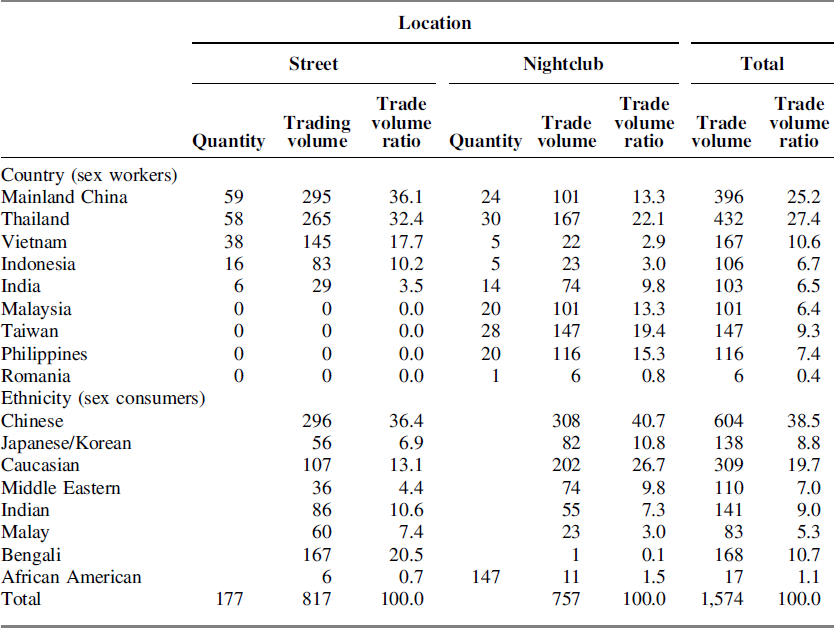
Since 1819, Singapore’s sex-worker population has grown to a considerable degree, mostly because of its labour structure. A large number of foreign workers have entered Singapore’s job market, which has led to a significant increase in the proportion of sexual demand. At the same time, in poorer neighbouring countries such as mainland China, Thailand, and Vietnam, while under the patriarchal structure, young women have had to sacrifice themselves to maintain their basic living standards and enter Singapore’s commercial sex market as foreign sex workers. Details of the same are shown in Table 1.Footnote 113 As a result, Singapore is a country that agrees to commercial sex. The most famous example of commercial sex in Singapore is found in the red-light district of Geylang. Migrant sex workers, after a complete physical examination by a qualified medical institution to confirm their health, receive special working passes issued by the Anti-Prostitution Unit of Singapore Police Department; these are also known as the Yellowcard and are valid for two years. When the deadline expires, these sex workers must return to their own country and cannot enter Singapore as sex workers for life.Footnote 114

When engaging in the sex-trading business in Geylang, if there is no special cause during the period, the sex worker can only live on the business premises and cannot stay outside overnight. Six months prior to working in Singapore, the sex workers must have a monthly physical examination including blood and urine tests. After six months, sex workers should have a physical examination every three months. The sex workers must immediately stop working or be repatriated if any infection or related STD is found. During the working period, sex workers must abide by the rules of the business premises; for example, male sex buyers must use condoms. Operators are allowed to refuse sexual intercourse in case of a violation of regulations.Footnote 115
Although Singapore is more open to commercial sex than Japan, it controls the age, status, and qualifications of sex workers through strict laws, effectively monitors infectious diseases, and strictly prohibits those without special work permits from engaging in commercial sex. It stipulates that only those who have special work permits legally issued by the state can engage in commercial sex and that special work permits have a validity of two years. Further, according to the provisions of the Women’s Charter, Singapore will not tolerate those who violate the laws of sexual trade and the state can whip criminals if deemed necessary.
4.3 A Possible/Workable Model for Taiwan: Sister Cooperative Model Based on Sisterhood and Mutual Assistance
Suppose that we accept that gender equality is a goal of social policy; the question is whether the current laws regarding commercial sex, the amended SMO Article 81 punishing both sex workers and clients when commercial sex happened outside the legal red-light district (in fact there is no legal red-light district in Taiwan now), promotes gender equality. The answer is clear: no. Scholar Debra Satz addresses three problems in punishing prostitutes. First, the prohibition of prostitutes renders some of the women who engage in the practice vulnerable.Footnote 116 For example, poor sex workers who need financial support may seek assistance from pimps or underground banking. Second, women are disproportionately punished for engaging in commercial sex.Footnote 117 Even under the current Taiwanese law that punishes both sex workers and clients when commercial sex happens outside the legal red-light district, police can more easily target the sellers rather than the buyers.Footnote 118 Finally, punishing prostitutes thrives as a black-market activity in which pimps substitute laws as the mechanism for enforcing contracts; it thereby makes the lives of prostitutes worse than they might otherwise be.Footnote 119
Accordingly, as scholar Iris Young pointed out in Justice and the Politics of Difference, injustice refers primarily to two forms of disabling constraints—oppression and domination, where oppression infringes an individual’s self-development and domination infringes an individual’s self-determination.Footnote 120 From the “empowerment” perspective, a better approach to sex workers is to empower their situation instead of reinforcing constraints on them. Enhancing the self-value and subjectivity of sex workers in the commercial sex industry would be the advocate of this research.
Through the course of J.Y. Interpretation No. 666 and the amendment of the SOM Act in the past, by referring to the policies of Japan and Singapore as well as the trend of feminism in the commercial sex industry, we can see that, at present, the central government wants to raise the controversial issue of special commercial sex zones with the local legislation. Given the local legislation vacuum, on the one hand, not only would this be a constitutionally allowed achievement, but it would also consolidate an ingenious balance of political power.Footnote 121 However, this balance would be at the expense of vulnerable sex workers at the lowest level of society. This situation creates a phantom mirage, leaving sex workers to wither in the desert with no legal protection.
Since sex work is an ancient industry that has not disappeared, it is impossible to fully criminalize it. Instead, the government should actively address the current problems and formulate an approach for establishing the special zones. Not only can the government comply with the desire to protect and promote social justice, but it can also support the empowerment of sex workers. This model does not encourage people to enter the commercial sex industry, but refers to the function of Japanese laws to properly protect and counsel women so that workers in the commercial sex industry can have the right to free choice. Cultivation can be applied in the midst of the model, so that sex workers also have the freedom to leave the commercial sex industry at will.
First, the groups that currently have the most urgent need for aid must be identified.Footnote 122 According to extant literature, the commercial sex industry can be classified into categories such as the nightclub business model and street prostitution. Different types of sex workers confront various degrees of problems. Among them, the most vulnerable and those without organizations are those at the bottom level, namely street prostitution. In particular, this can be seen from how the police were cracking down on primarily middle-aged individuals before the reformation of the SOM Act.Footnote 123 To avoid a monopoly by the privileged or business-advantaged groups after the complete legalization of the exclusive zone, which could lead elderly individuals to be more vulnerable after the legalization of commercial sex, by integrating the idea of seeking a centralized management of the Daily Spring Group in the past and the sex workers themselves, it is preferable to organize small, self-employed labour co-operatives first.Footnote 124 This is referred to herein as the “Sister Cooperative.”
The operating model of the Sister Cooperative is based on mutual assistance and co-operation. Sex workers raise funds from the bottom up, operate collaboratively, work together, and share the benefits. They can apply for business licences from the government as a unit of the co-operative. Compared to the commercial sex model controlled by the government in Singapore, the model proposed herein is slightly different. Singapore’s government takes command to avoid sexual exploitation, sexual slavery, and infectious diseases, and uses the licence system to strictly control and manage commercial sex activities.
However, the co-operative model in this paper, unlike the Singapore model that operates in a top-down fashion, emphasizes bottom-up cultivation. The co-operative members allocate a certain portion of their earnings as a public fund every month. The fund is subsequently used to rent a friendlier environment as a workplace, hire people for environmental sanitation and regular cleaning, handle financial or other such affairs, and arrange for work partners of the same co-operative to conduct regular physical examinations. In this manner, the freedom of work of sex workers is not only respected, but also cultivated by way of sharing resources and co-operation, as a means to complement government agencies for the deficiency in the protection and supervision of sex workers.
It is worth noting that such a Sister Cooperative operating model, on the one hand, guarantees subjectivity and freedom to sex workers and, on the other, is about empowering people who seek to leave the industry. This is so that sex work does not follow the path stated in the radical-feminism critique, namely that, once one enters the sex industry, they will never leave it.Footnote 125 Since it is impossible to obliterate the commercial sex industry, the commercial sex industry itself is diverse. The COYOTE and WISPER groups in the US were created by former sex workers; the former believes that sex work involves freedom of choice, whereas the latter considers that sex work is caused by oppression. Finding a way in and out with respect to professional freedom and personality oppression is an important issue. Therefore, the best method is to allow whoever wants to become involved in the industry to enter and whoever wants to leave the industry to exit. However, similarly to requesting hypochondriacs to “take it easy,” sex workers wanting to leave the sex industry autonomously is a fantasy. The only method for sex workers who believe that the commercial sex industry is exploiting them to leave the industry is to empower them and to rebuild them from the ground up.Footnote 126 The exact methods to use are left for the legislators to determine and specify in amendments to the law but, among these solutions, this paper posits that a certain percentage of cleaning and clerical staff in sister co-operatives may be employed from among former sex workers. Through such employment, former sex workers can learn skills that they may have never touched before, such as file management, document literacy, and time management, to cultivate their subjectivity, initiative, and diversity, so that those who wish to leave the sex industry can nurture their energy in sister co-operatives to connect with the outside world.Footnote 127
Moreover, for large-scale commercial sex firms, this paper proposes that the government should establish a competent authority to uniformly register the management operators and their sex workers. In addition, legal commercial sex venues should be established in areas that have been coexisting peacefully with the sex industry; this does not exclude the development of the economy related to the commercial sex industry. The competent authority shall verify and issue registration licences to non-illegal groups and sex workers who are verified as adults to engage in the sex industry based on their livelihood needs. It also excludes the application of Articles 80 and 81 of the SOM Act and Article 231 of the Criminal Law.Footnote 128 The competent authorities should also regularly monitor whether the operators comply with the relevant provisions of the construction, fire, and labour ordinance. However, sex workers are required to conduct health examinations on a regular basis to facilitate the control of infectious diseases. Thus, sex workers will have more autonomy in their interactions with the operator, law enforcement, and customers. Moreover, sex workers are protected from violence, drugs, and STDs by the public authority of the police. However, illegal commercial sex outside the commercial sex zone should be strictly prohibited to fulfil the effectiveness of commercial sex control.
4.4 The Awareness of the State Involvement
Along with the establishment of the commercial sex zone, another question remains to be resolved: where does the basis for national regulation come from and to what extent is regulation required? Here it is possible to define the scope and legitimize the regulatory basis of the professional freedom interpretation developed by the grand justice in the past. The Constitution of Taiwan refers only to the right to work but does not explicitly declare professional freedom. Doctrinal interpretation and the interpretation of the grand justice deduces its connotation through Article 15 of the Constitution and advocates the right to work in favour of the Constitution indicates that people have the freedom to choose what type of work to do. Additionally, the grand justice of Taiwan may have referred to the German “three-stage review” theory to divide professional freedom into “occupational freedom” and “freedom to choose occupation,” wherein the latter is further subdivided into subjective and objective elements and regulated with different degrees of control. According to Interpretation No. 649 of the Justices of the Constitutional Court, Judicial Yuan, in the restriction of the occupational freedom, the state enforces the freedom of occupation concerning the method, time, and place of engagement, and, based on the interest of the general public, legislators may restrict it to a certain extent.Footnote 129
Based on the aforementioned, commercial sex has the essence of exchange consideration and survival, and is clearly protected by occupational freedom,Footnote 130 but national legislators can still impose restrictions on the general public interest. “General public interest” is a broad term here and the connotations of the term are not fixed. The state may begin from the public interest of avoiding other crimes, the prevention and treatment of STDs, and anti-trafficking.Footnote 131 For example, when an act of commercial sex itself involves violations of the Criminal Code, the wrongful act is punished by the Criminal Code alone. Alternatively, relevant provisions can be amended on the prevention and control of infectious diseases in commercial sex, and different norms set for different social facts concerning sex workers and customers, which in turn allows the law to regulate a single wrongful act rather than assembling layer upon layer of restrictions on the right to work of sex workers, which would result in discrimination and prejudice against sex work in the overall law.Footnote 132
Furthermore, the new SOM Act requires that a “special zone” should be established. Under the premise of “not modifying the SOM Act,” to comply with the special zone, the zone can be interpreted as a “specific zone prohibition mode.” Namely, in certain areas such as schools, public institutions, and residential areas, “the establishment of sister cooperative commercial sex venues is prohibited” but “other areas are allowed to register for the configuration” so that, in form, it still conforms to the special zone requirements under the current law.
In summary, the attitude and suggestion of the current regulation of commercial sex in Taiwan are under the “legalization and regulation” mode. The competent authorities should indicate the legal areas and commercial sex must be conducted in a licensed business venue. At the same time, the illegal commercial sex of minors and human trafficking are strictly prohibited, and prevention laws with strict punishments are enforced to prevent such illegal activities. More importantly, the right of sex work is admitted and sex workers are integrated into the social-welfare nets such as taxes, medical insurances, and national pensions. For those who intend to leave the commercial sex industry but have no ability to stand on their own, assistance such as placement and employment counselling will be provided, so that the rights and interests of sex workers can be perfectly secured and the ideal of gender equality can be realized across the region.
5. CONCLUSION
The debate on the commercial sex industry has been taking place for several years. However, if the dispute remains at the ideological level, it will not benefit sex workers. This paper attempts to organize the context of the notion of “growing again with the spring breeze” of the commercial sex industry from its long history, with a reminder that the commercial sex industry cannot effectively be banned. Furthermore, how to protect sex workers, manage them properly, and take the public interest into account are major issues. Since the introduction of J.Y. Interpretation No. 666, the special zone has never appeared in practice, whether because of deliberate reservation through legislative discretion or a reluctance to be involved in the dispute since the amendment of the SOM Act. Both prostitutes and clients are punished in the current situation of Taiwan’s commercial sex control. This does not help address the difficulties of sex workers in any way, shape, or form.
On the premise that the existing model is no longer sufficient to achieve an effective and reasonable management of the commercial sex industry, this paper proceeds from the history of the commercial sex industry in Taiwan, analyzes the perspectives of the theories and genre of feminist jurisprudence on this issue, and refers to the policy implementations of Japan and Singapore. Finally, with “cultivation” at its core, we propose the Sister Cooperative model, hoping that it will break the deadlock of the past decade and be used by both governmental organizations and academic communities. This paper expects sex workers to be able to receive the same protection and treatment as other professions after the generalization of the commercial sex industry, thereby eliminating the long-standing stigma of sex work and enabling each individual to enhance the subjectivity of the work in modern society and to escape oppression. Even under such a model, a reluctance to accept management or the existence of underground commercial sex industries may still remain; however, the Sister Cooperative model comparatively could empower sex workers and effectively reduce the risk of domination and oppression for them.