Introduction
“NO PICTURES”—The Daily Times editorial headline on June 8, 1950 was as abrupt as the incident that prompted it. Spurred by complaints that “photographers obstructed the view of a few spectators” at a recent ceremony, British colonial officials in Lagos unexpectedly banned press photographers from future public events and ceremonies. In an atypical move for the conservative-leaning newspaper, The Daily Times column blasted the autocratic decision, arguing that as a service to the public interest, the photographers’ work was far more important than any inconveniences suffered by a few attendees. In closing, the column resolutely stated:
[The Daily Times] are not only fighting this issue on our own behalf. Others concerned were banned from yesterday’s historic ceremony. We are fighting for freedom of the Press in Nigeria. The sooner high-handed officials realise that the Press cannot be used as a doormat, the better. This ridiculous ban on photographers must be lifted at once.
With this full-throated declaration, The Daily Times positioned itself as a critical voice, and anointed a growing contingent of local photographers with the protections of press freedom, while condemning the government’s attempt to violate those (newly) endowed rights. Responding to this pen-lashing, colonial officials quickly reversed course and reopened public political events to press photographers.Footnote 1 Against the backdrop of past attempts at press censorship and ongoing political negotiations for Nigerian independence, the ideological and material importance of this concession cannot be overstated. As a result of this brief but significant dispute, colonial officials in Lagos effectively acknowledged that photography was a (pictorial) dimension of expressive speech and conduct, and therefore protected by the same freedom as the printed press. But how did this emerging occupation of press photography come to be so emphatically centered as an asset to the public interest, a fixture in political discourse, and most importantly, as a contested practice in the city?
The uncelebrated triumph of The Daily Times over the colonial ban of photographers in 1950 was only the latest in a series of defining moments for the photographic history (and the broader visual record) of Lagos, which had played out in the press in previous decades. Taking a close look at photojournalism archives of Lagos, this article attends to three of those moments: an earlier 1936 restriction on press photographers enacted by British colonial officials, a 1942 court case filed against West African Pilot, and the ill-advised ban in 1950. Each of these episodes reveals the ways that this emergent photographic practice in the press was defined by contests before and after production—on questions of credentials, copyright, and press conduct. These contests developed between photojournalists and an evolving cast of colonial officials, editors, and judiciaries, over legal precedent and colonial policies. At each juncture, the recurring figure of Olalekan Onatade—a freelancer and a provincial transplant to Lagos whose career unfolded at the center of these historic moments—offers a lens into an unattended history of indigenous photojournalists who negotiated this professional frontier in the press and trailblazed a far-reaching terrain in the visual record of Lagos. Ultimately, this essay contends that these moments were contests for control of local press, a key institution/pillar in the Nigerian nation-state project. As all parties competed for influence over a mass visual culture—and through it, the emerging middle class that consumed it—class inequities were revealed at each of these formative stages of photojournalism in Nigeria.
The study starts in 1936, with the earliest and most consequential effort by British officials in Lagos to regulate a growing number of photographers who supplied pictures to commercial clients. By enacting a little-known policy, a handful of colonial officials effectively established and defined what it meant to be a “press photographer.” In doing so, they established a burden of proof that worsened professional rifts between established photographers and their amateur/freelance counterparts and underscored disparities within a growing Nigerian middle class. At this critical yet conflicted moment—during a contest before photographic production, which birthed the occupation of photojournalism in Lagos—informal workers like Olalekan Onatade emerged as professional casualties. The article proceeds with a 1942 court case that put Onatade at odds with the West African Pilot over control of copyright over his photographs. The verdict in this case set important legal precedents regarding the business of press photography, and illuminated a contest after production—that is, a dispute about image use, which has continued to frustrate contemporary archival efforts to attribute photographs to their creators. Surfaced in this moment was a tension between the elite class of Nigerians, newspaper owners like Zik, who exercised control over the media at the expenses of provincial and proletarian workers, like Onatade. As presses like the Pilot revolutionized the circulation of photographs across an emerging nation-state, business practices of their owners/publishers often obscured and limited the creative ownership of the working photographers on whose proofs/images they relied. Finally, this essay concludes with the ill-considered ban on Nigerian press photographers in 1950 that, in the context of the devolution of colonial power, underscored British efforts to shape the conduct of press to their will. Importantly, unlike the earlier restriction of 1936, this effort was met with swift objections that consecrated photojournalism as ideologically akin to the written press while framing the ban as an extension of the nationalist fight for independence—in this case, from British influence on a vibrant media culture. The fact that the alarm was sounded by The Daily Times, where Onatade was employed as an in-house press photographer and reporter, again centered his career within a pivotal historic moment. Importantly, each of these formative moments in photojournalism represents a contest for control of African-owned newspapers advanced by British and elite Nigerians at the expense of an emerging and largely provincial photographic labor force. What follows is an interrogation of the convergence of print and visual culture, and the conditions of production in which this union was grounded.
The rise of photojournalism in Nigeria
Long considered as invaluable subjects of literary and historical study, early West African newspapers are rarely interrogated for their contributions to local photographic histories.Footnote 2 This oversight is especially notable considering that early newspapers proliferated in tandem with the spread of camera technologies across the West African coast. Though local African photographers often used the press to advertise their services in the late nineteenth century, photographs did not actually appear in newspapers circulating in Lagos until the early 1900s, and even then, primarily in foreign-printed papers like The London Illustrated News, the Elder Dempster Magazine, and West Africa. Footnote 3 Launched in 1926, The Nigerian Daily Times was the first locally published daily newspaper, whose “tabloid size … attractive display style and its picture-spread” marked the earliest, though irregular, appearance of photographs in the Lagos press.Footnote 4 Circulation of the conservative-leaning paper remained uncontested for nearly a decade until the 1937 emergence of the progressive Nigerian-owned West African Pilot, which introduced even more innovative visual and journalistic devices, including an expanded use of photographs and sensational headline formulas (Omu Reference Omu1978, 87). Moreover, the Pilot consciously addressed populist and increasingly anti-colonial audiences across Nigeria with an editorial voice, reporting, and pictorial features that placed the concerns and faces of clerks alongside those of prominent African lawyers and politicians (Coker Reference Coker1968, 20). With its commitment to photojournalism—a combination of visual and textual devices—the circulation of the Pilot overtook that of the Daily Times within a month of its launch. With nationalist sentiments on the rise, the Pilot enjoyed a commanding nationwide circulation that immersed its readership in visual news even as competitors quickly sprinted to keep up.
The popularity of newspapers in the 1930s was due, in part, to several well-documented factors, including shifts in literacy, demographics, and the economy that occurred over many years in Lagos. As colonial involvement in public education increased between 1920 and 1937, the number of (and enrolments in) primary schools more than doubled, and similarly, swelled eight-fold for secondary schools.Footnote 5 Indeed, throughout the 1930s, migration from the provinces grew rapidly as this newly formed subset of educated Nigerians moved into Lagos seeking greater access to opportunities commensurate with their higher levels of schooling (Zachernuk Reference Zachernuk2000, 85). However, provincial arrivals to Lagos found themselves facing job retrenchment and competing for government and commercial clerkships with more established Sierra Leonian repatriates, or “native foreigners,” who had dominated the professional workforce for decades. Combined with uncertainties introduced by the economic depression of 1929, these challenges convened a growing generation of nationalist-minded middle class, who formed trade and labor unions, professional and economic associations, communal progress unions, and political parties while lobbying for “better jobs and conditions for native Nigerians, as opposed to foreigners and ‘native foreigners’” (Zachernuk Reference Zachernuk2000, 85–86; see also James Reference James2018, 575).Footnote 6 It was mainly this emerging cohort of Nigerians and “youths” that the West African Pilot, in particular, targeted through its editorial, literary, and visual innovations (Barber Reference Barber, Peterson, Hunter and Newell2016, 173).
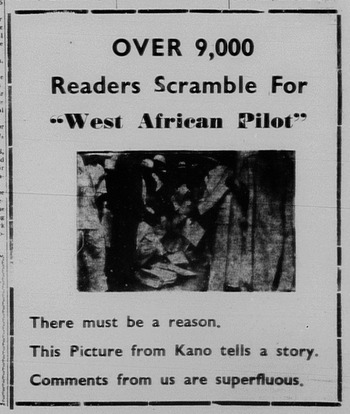
These abovementioned factors also played a significant role in setting the conditions that allowed the Pilot to dominate photojournalism so decisively in such a brief period of time. Among its most distinctive strategies, the Pilot both addressed this emerging cohort and invited them into the pages of the paper through its robust photographic content. In a set of self-referential photo-ads that appeared in early issues of the Pilot, the paper showcased its audiences and modes of editorial address. In one example, a snapshot of a newspaper seller being mobbed by Pilot customers is boldly captioned “OVER 9,000 Readers Scramble For ‘West African Pilot.’ There must be a reason. This Picture from Kano tells a story. Comments from us are superfluous” (Figure 1).Footnote 7 With its leading captions, the Pilot prompted readers to consider the “exhibition value” of the photograph and the narratives that the paper chose to attach to its contents (Benjamin Reference Benjamin1969, 226; Newton Reference Newton2001). In another example, a photograph—of a rural scene in which a seated man holds a copy of the Pilot as a friend reads over his shoulder—is framed by the words: “The ‘West African Pilot’ Is Read By All Classes Of People. Is this picture not a proof?” (Figure 2).Footnote 8
“OVER 9,000 Readers Scramble For ‘West African Pilot.’ There must be a reason. This Picture from Kano tells a story. Comments from us are superfluous.” [Advertisement]. West African Pilot, October 19, 1938.

“The West African Pilot Is Read By All Classes of People. Is this picture not a proof?” [Advertisement]. West African Pilot, October 12, 1938.

Indeed, the photograph in the advertisement was presented as “a proof” in more ways than one: first, as visual evidence of the Pilot’s ranging readership and geographic reach and, second, as “photo proof” specifically selected from an array of possible images, suggesting the ways that photographers and editors alike shaped the photographic program of the paper. These ads reinforced the importance of a pictorial mode of address and persuasion in the editorial voice that the Pilot directed to its readers. Moreover, the language of the ads suggests that, much like the motto of the paper—“Show the Light and the People Will Find the Way”—the editors presented the pictures created by the luminous glare of the camera as “proof” that the Pilot was a paper that addressed all Nigerians.Footnote 9 Other ads invited readers to insert themselves into the very pages of the paper: that is, pay to have their photographs transformed into half-tone blocks that could be printed in newspapers, as well as almanacs, and calendars.Footnote 10 One such service was offered by Olateju Advertising Agency, an enterprise run by manager and publisher Mr. S.O. Longe, the first Advertising Manager of the Pilot (Figure 3). S.O. Longe was likely a shortened form of Solomon Osagie Alonge, who later became the first official photographer to the royal court of the Benin Kingdom.Footnote 11 Indeed, subsequent issues of the Pilot printed photographs of “Regular Readers” with short biographical captions detailing their names, locations, as well as their educational and occupational achievements to date. Through these visual strategies, the Pilot’s readers became the subjects of the news as well as its consumers.
Olateju Advertising Agency [Advertisement]. West African Pilot, September 9, 1938.

As illustrated by S.O. Alonge’s Benin origins, at various points, the Pilot itself was staffed by the very provincial audiences that it sought to address, and as a result, the paper sponsored lesser-known indigenous producers of an emerging photographic press archive. In the absence of highly sought-after government posts and commercial clerkships, provincial arrivals worked as “letter writers, private teachers, importers, medical dispensers, auctioneers, booksellers, and photographers” (Zachernuk Reference Zachernuk2000, 84).Footnote 12 Without the studio aspirations of their forerunners, they worked as amateurs and freelance photojournalists within a bustling informal sector.Footnote 13 While existing scholarship has focused on newspaper owners and official clearinghouses of press photographs—that is, government institutions, corporate agencies, and studio photographers—the integral contributions of emergent provincial actors who produced the earliest photojournalism archives have been largely overlooked (Kunstmann Reference Kunstmann2014, 528; Brennen and Hardt Reference Brennen and Hardt1999, 12). These independent Lagos-based photographers provided unique (not stock) photographs of local personalities, events, and candid scenes to the Pilot, and a handful of widely circulating foreign papers like The Comet, West Africa, West African Review, and The Daily Herald (Staples, Kaplan, and Freyer Reference Staples, Kaplan and Freyer2017, 29).Footnote 14 Their arrival onto the local pictorial landscape simultaneously introduced a genre of photographic work, a distinct cohort of freelance photographers, and an indigenous photographic press archive in Lagos. Moreover, these activities positioned Lagos as the center and the primary subject of this budding visual profession of press photography in Nigeria.
Arguably, press photographs fall into a category that Patricia Hayes has posited as “empty photographs,” that is, “those pictures about which it was thought nothing more needed to be asked, known, or pursued for now and the foreseeable future….” Often dismissed as “bad,” “boring,” or repetitious photographs, these might include certain administration images, missionary photographs, or in this case, press pictures (Hayes Reference Hayes2015, 189–90). These images stand in contradistinction to aesthetically striking or “effusive” images that more often ignite scholarly imaginations. However, ignoring this category of “empty” pictures produces “an entire realm of historical unconscious” that perpetuates blind spots in our broader historical purview. Invoking noted anthropologist Michel-Rolph Trouillot (Reference Trouillot1995), these blind spots constitute [visual] silences that enter the process of historical production at crucial pre-photographic moments of creation and post-photographic junctures of assembly, retrieval, and retrospective significance. Beyond the recounting above, this article attends to pre-photographic conflicts and conditions that defined the emergence of press photographers and made it possible for press pictures to be taken at all. After, even as papers like the Pilot became central to the circulation of photographs in Lagos, the business practices that they adopted often obscured the control with which they assembled massive archives of press pictures using the work of African producers, whose authorship was subsequently erased. Codified in the courts, these practices continue to disrupt scholarly efforts to retrieve the work of these photographers and to understand press photography as a profession and historical practice that was central to Lagos’s long visual record. Indeed, as newspapers became critical to the flow of photographs at this time, the conditions and moments that made photojournalism possible in the city were illegible to most readers at the time and remained that way for contemporary scholars today.
A policy defines a profession: Press photographers in 1936
One of the earliest efforts by the colonial government to restrict the access of photographers in an official capacity in the 1930s also chronicled a moment of pre-photographic contention that shaped this emergent occupation. In July 1936, Governor Bourdillon made an unspecified complaint to the Chief Secretary of the Government that “some inconvenience” had recently been caused to him and his wife by the “pressing attentions of Press Photographers on ceremonial occasions.” The tone of the complaint gave the impression that press photographers were becoming an unruly, mobbing presence at these official events, from the perspective of staid colonial officials. The governor’s grievance set in motion a sequence of decisions that was intended to “restrain the activities of photographers within such limits as will ensure that [they did] not detract from the dignity of official ceremonies.”Footnote 15 A new policy devised by the Inspector-General of the Police—the first ever state-sponsored attempt to regulate this emerging profession—decreed that no more than eight recognized press photographers be issued armbands (marked “Press” or “Official”) for each occasion. Furthermore, before the armbands were issued, recipients would be interviewed by the Commissioner of the Colony to be “instructed as regards to the necessary decorum to be observed by them in order to ensure that their activities do not in any way detract from the dignity of the official ceremony for which the special facilities have been granted.” Lastly, the edict detailed that police would be on hand to ensure that photographers without armbands would not be allowed beyond the public viewing areas.
Importantly, colonial officials placed overwhelming emphasis on photographers’ existing body of work as proof of their credentials. Addressed to “professional photographers,” a letter describing this new policy was circulated to a list of sixteen “selling photographers in Lagos and Ebute Metta,” which was provided by the Commissioner for Police. The roster of names was sectioned into “A,” “B,” and “C” divisions—a hierarchical ranking sorted by standing or prominence.Footnote 16 Crucially, the list effectively conflated individuals’ entrepreneurial influence as “selling photographers”—that is, practitioners who also sold their photographs to press agents, printing houses, or newspapers—with their standing as a “professional photographer.”Footnote 17 Moreover, several names were excluded from this “official” tally of sixteen photographers. And as replies poured in from those included on the list, as well as a few who were excluded, a clearer picture of the simmering tensions within the local network of photographers emerged, hinting at possible reasons for these omissions. In eager responses, various photographers asserted their bona fides, with some even applauding the restrictive efforts of colonial officials. In one particularly lengthy letter, M.B. Banjoko (a photographer, enlarger, and dealer prominently positioned on the colonial list) claimed that those who prompted the initial complaint were:
“not professional photographers in the true sense of the words … for such as are really professionally trained photographers (there being, of course, very few of them in this Colony) ought to have studied thoroughly the rules upon which the principles governing their attitudes and movements, socially and professionally, on [which] public functions rest.”Footnote 18 (emphasis added)
Though his response may have been calibrated to curry favor with the administration, Banjoko’s characterization of the dynamic between “professional” and amateur photographers is illuminating. He pointedly bemoaned the fact that “there [was] no possible means for reproach and correction by [fellow photographers], since our Union has become dissolved.” Banjoko’s sentiments were echoed by C.A. Enwere, who implicated “those amateur photographers who have nothing to do at home during the hours or occasions of ceremonies.”Footnote 19 Enwere also lamented the recent demise of the photographers’ union, which meant that those responsible could not be reprimanded by their peers. Repeated mentions of a defunct union suggests that there was less cohesion among photographers in the late 1930s than there may have been in the past, and moreover, that those who considered themselves to be “professionals” blamed a growing cohort of untrained freelancers and amateurs, in large part, for the changing (read: diminishing) standards of the vocation. Overwhelmingly, those who were recognized as “professional” photographers by the colonial government were amenable to colonial efforts to set parameters on who could have access to ceremonial events of interest, be considered official press photographers, and ultimately, participate in this emerging practice. The result was that, for a while, amateurs, freelancers, and provincial arrivals like Olalekan Onatade were scapegoated and excluded from such spaces and opportunities.
Originally from Abeokuta and of Egba descent, Olalekan Onatade was among the provincial arrivals who migrated to Lagos in the 1930s. From his home in Abeokuta, Onatade wrote to Herbert Macaulay in August 1931 to ask the popular elder statesman for help “to secure a post, either in your press, or anywhere. ‘Beggar must not be a chooser.’ I just want to work, no matter what kind. I enclosed my photograph herewith.” Considering his clear interest in photography and the press, Onatade’s openness to any paid post underscores the widespread economic scarcity of the time. It’s not clear if or how Macaulay responded to his appeal. However, Onatade had a pivotal opportunity in 1935, when he took part in a tour of Nigeria with members of the Berlin-based Terra Films Expedition Party led by Lars Birbach.Footnote 20 Originally deployed to produce a “sound picture of Nigeria for release in England and America,” the team expected to be in Nigeria for at least six months. However, the group was delayed in Lagos “owing to Hitler’s ban on money going out of Germany.” Though the project eventually got underway in July 1935, the expedition abruptly ended when the team was recalled to Germany on short notice. As a result, they were forced to “hurriedly sell their lorries and unwanted equipment.” It is likely that Onatade acquired his first camera and the early training that laid the foundation for his long career, through his association with this expedition team. Even as some colonial British governors were focused on repelling subversive pro-communist figures and texts at their border, modern technologies (like, printing presses, films, cameras, etc.) travelled freely and offered tools with which Africans could produce their own narratives and archives. After this unusual introduction to the profession, Onatade worked as a freelance photographer from 1936 through 1938, taking extensive tours of southern and northern Nigeria to collect pictures for various newspapers. By 1938, he had provided photographs to foreign-owned, locally circulating papers like The Comet, The Daily Times, the Crown Colonist, West Africa, and West African Review. He even claimed to be the “representative of some British Press Agents and an American Photo Bureau as West African residential Press Photographer.”Footnote 21
Among his far-flung freelancing work, Onatade sent dozens of photographs to the London-based socialist newspaper The Daily Herald in the mid-1930s. To increase readership and circulation, the paper had invested in halftone printing in the previous decade.Footnote 22 In 1934, the paper announced a £2,500 Free Snapshot competition and subsequently published a series of short articles—attributed to “the Daily Herald Art Editor,” Mr. Leonard Spooner—offering readers advice on how to take better pictures and emulate well-known press photographers.Footnote 23 As one of the most widely circulated foreign papers in West Africa, it’s not surprising that Onatade would be aware of the paper and its photographic ambitions. Among the photographs that Onatade sent to the paper was one of his earliest portraits (Figure 4). In the picture, he stands against a plain backdrop, holding a German-made Voigtlander Brillant twin-reflex camera—likely one that he obtained from the Terra Films expedition team. The metal frame and embellished design on the finder hood confirm that this Brillant model—marketed towards novice photographers—was produced between 1932 and 1937. As the camera had no self-timing capabilities, the photograph was taken by another, unidentified photographer, suggesting further histories to be uncovered. With Onatade posed as a subject of this news picture as well as its creator, the portrait called attention to the increasing visibility of photographers in the visual record of Lagos. In a handwritten note attached to the photograph—a suggested caption, of sorts—Onatade framed the picture, his audience, and his purpose in his own words: “‘He wants to give his reader public the latest news in pictures, so the native photographer moved to our quarters’ write an [sic] European resident in West Africa.” Like the picture itself, his words centered his efforts to cultivate visual literacy among “his reader public,” with the understanding that audiences viewed and read photographs much like the printed stories in newspapers. In this way, Onatade and other photojournalists, helped to create a mass visual culture with a mind towards the semi-literate working-class and middle-class audiences that consumed it. Onatade’s textual and visual self-representation as a journalist-photographer illustrated this awareness and was an important counterpoint to the constraints imposed by local colonial officials on his growing career.
[“He wants to give his reader public the latest news in pictures…”]. The Daily Herald Archive, National Media Museum (UK).

Despite his extensive résumé, Onatade’s persistent requests for an armband and official access to ceremonial events were denied by colonial officials in Lagos over a six-month period. Onatade requested access to official events on October 26, 1936 (to which officials responded: “This man is not on the list…”), February 20, 1937, and May 6, 1937. Each time, he added increasingly professional flourishes to his letter: an ink stamp reading “Olalekan Onatade, Journalist Photographer, LAGOS W. Africa” and then stationary emblazoned with two detailed illustrations of his camera flanking his credential; “Olalekan Onatade, Journalist-Photographer & Supplier of Press Photographs relating to work and life in West Africa, Specialist in Nigerian Studies” (Figure 5). His applications were refused. It is possible that his earlier affiliation with a Berlin-based film crew earned him a scarlet letter with the British colonial government, which was, by this time, locked in diplomatic hostilities with Germany. These repeated “official” rejections likely played a role in his decision to seek a post at West African Pilot in July 1938.Footnote 24 After assuming this post, Onatade’s official affiliation with the Pilot appeared to grant him the access that he had been so long denied. No longer a freelancer with numerous at-will clients, he became an in-house photojournalist employed directly by a local newspaper.
Two examples of Onatade Olalekan’s stationary. Nigerian National Archives, University of Ibadan.

The constraints imposed upon press photographers in 1936 revealed a host of contests before production—that is, pre-photographic conflicts and conditions that made it (im-)possible for photographs to be taken at all. This moment reveals the struggles of colonial officials to define and control photojournalism, as a new occupational category that emerged in and around Lagos in the 1930s. To a large extent, colonial interest in this profession had a great deal to do with pervasive efforts to shape the formation of major institutions of a Nigerian nation-state project, like the press. And while colonial regulatory efforts coincided with the devolution of colonial power and growing anti-colonial sentiments, they also overlapped with the formation of a Nigerian middle class. Importantly, the policies of colonial officials towards this emergent vocation surfaced tensions within this middle class, most notably between established professional photographers and their amateur, freelance, and provincial counterparts. Perhaps, unwittingly, by using the metric of established “selling photographers” and a perceived record of practice as “proof” for who ought to be credentialed as a press journalist, the colonial policy made it impossible for photographers without (post-photographic) evidence of an existing oeuvre, a network of clients, or local reputation, to apply for official access to this emerging occupation. And where, in the past, the colonial government had tried (and failed) to enforce restrictions on well-established practices of written press, the inchoate work of press photography was particularly vulnerable to such high-handed interventions in the context of a weakened newspaper industry, which, prior to the launch of West African Pilot, had not taken full advantage of local commercial photography. This lack of discernment was further reflected in the muted, and tractable responses of the press and professional photographers to these colonial constraints.Footnote 25 By the 1940s, the arena in which defining contests for this emergent profession took place shifted from the colonial government to the courts.
The business of press photography: Onatade v. Zik’s Press Ltd, 1942
While the 1930s set the criteria for who could be considered a press photographer, the 1940s introduced the matter of the contest after production, by which the business practices that defined the new profession were codified. What negotiations were undertaken as pictures passed from the hands of photographers to the desks of newspaper editors to the newspapers pages held by readers? How did post-photographic disputes shape this emergent occupation? The most important of these contests was arguably the May 8, 1942 lawsuit brought by Olalekan Onatade against Zik’s Press Ltd and Nnamdi Azikiwe. Commonly called Zik, the owner and founding editor of West African Pilot hailed from eastern Nigeria, though he was educated in the United States and worked as a journalist there as well as in the Gold Coast (Coker Reference Coker1968, 41). Upon his return to Nigeria in 1934, Zik cultivated a reputation as the midwife of a new mode of editorial and visual news. Alongside his popular reputation as an anti-colonial nationalist and populist, the 1942 court case suggested that he was also a shrewd and unyielding businessperson.
Onatade’s lawsuit sought to recover the copyright to eighty-three photographs and £100 in damages for the publication of others produced during and after his employment with the Pilot. Essentially, the lawsuit would set the precedent for determining copyright and publishing rights between press photographers and newspapers. The case was heard by Chief Justice William Butler Lloyd, and Onatade was represented by the preeminent lawyer, Adeyemo Alakija (also of Egba lineage) while Azikiwe and Zik’s Press Ltd were represented by Mr. Ian Cameron of the European firm, Irving and Bonnar. Indeed, for the Pilot, the case was so important that the paper warned that “the future of pictorial journalism in British West Africa [was] endangered.”Footnote 26
In addition to the judicial precedents set by the case, the proceedings also revealed the details of Onatade’s early association with the West African Pilot, and practices adopted by the Pilot to secure its photographic content. In the first few months after its November 1937 launch, the Pilot mostly published photographs of international—British, American, Liberian, and Ghanaian—figures intermingled with significantly fewer portraits of Nigerian personalities. In these early days, the editors likely relied on a limited range of pictures from mainstream sources such as the British Public Relations Department, other government information services, as well as private agencies like the West African Photographic Service.Footnote 27 However, by March 1938, the Pilot had hired an in-house professional photo-engraver and assistant editor, Mr. W. O’Dwyer, in preparation to upscale its visual capacities.Footnote 28 In June 1938, just a month before Onatade was hired, the Pilot purchased fifteen photographs from him as a freelancer, a small preview of the massive archive to come.Footnote 29 Subsequently, Onatade was employed by the Pilot from July to September 1938, and again from December 1939 through January 1941, during which he produced an unspecified, but significant number of pictures for Zik’s Press Ltd.Footnote 30 In the intervening months of his employment (between September 1938 and December 1939), he supplied the Pilot with more than fifty photographs as a freelance photographer. Judging from this broad timeline and general estimates, Onatade made indispensable contributions to the early photographic archive of the West African Pilot, which, for reasons illuminated below, have remained obscured until now.
During the court hearing, it became clear that, as one of the earliest journalist photographers, the parameters of Onatade’s employment were as ill-defined as his claim to copyrights. According to court reporters, he was initially hired as a File Clerk (with his duties including indexing and photography), then later rehired as a Sales and Advertising Clerk.Footnote 31 In court, Alakija argued that because the Pilot didn’t hire his client, Onatade, specifically as a press photographer, the paper had no copyright claims over the images that he produced while working there. Adding to this ambiguity, in between his stints working for the Pilot, Onatade’s portrait was included among the staff pictures—many of which he likely photographed—that were published in the Pilot’s November 1938 Anniversary Supplement. In that picture—the only known portrait of him without his camera—Onatade posed wearing a European suit and tie, and staring confidently at the viewer (Figure 6). Captioned “Olalekan Onatade, Press Photographer,” the picture gave every indication that Onatade was the resident cameraman for the newspaper, even though he was not exclusively employed by the Pilot at the time. Nonetheless, Onatade was portrayed in this photo spread as a photographer among his peers, as a journalist and contributor to an African-owned press and the subsequent histories of Lagos that it produced. Ultimately, Judge Lloyd resolved the confusion in court by reasoning that since Onatade was only known to Zik as a photographer and was hired because of his work in that field, he was expected to continue as a photographer while employed (exclusively or as a freelancer) by the Pilot. Importantly, even as the paper enjoyed increasing recognition for its use of photojournalism, it did not have a job opening for the fledgling profession of press photographer.
Staff pictures, with Mr. Olalekan Onatade, Press Photographer, pictured in the second row, center. [Anniversary Supplement]. West African Pilot, November 23, 1938.

Further obscuring this employment history, none of the transactions between Onatade and Zik were contractually documented. According to court records, photographic assignments were worked out on a case-by-case basis which led to conflicting understandings about mutual arrangements. As a practice, the Pilot periodically purchased small lots of photographs from Onatade and funded materials (film, printing paper, developing chemicals/fees, half-tone blocks, etc.) that facilitated his work and its publication. But while Onatade assumed that he was simply selling prints (at 1 shilling per image) and temporary publishing rights to the press, Zik argued that he was purchasing perpetual publishing rights and the copyright to the images.Footnote 32 In his defense, Zik produced receipts for the purchased photographs, signed by Onatade. It was unclear if the precise terms of the publication were ever clarified in these receipts, and Onatade’s lawyer, Alakija, pragmatically argued that “it was inconceivable that a copyright was sold for one shilling.”Footnote 33 Literally calling attention to the “exhibition value” of the photographs, Zik entered the proofs of the contested pictures (marked with stamps and “dockets” indicating publication plans) into evidence. The markings on the fifty-three photographs were crucial to the case. Fifteen pictures purchased in June 1938 and the twenty-two that were bought after he was terminated, were stamped with “Olalekan Onatade, Journalist-Photographer” and “COPYRIGHT PHOTO” indicating that Onatade retained copyright ownership and had only sold publication rights. However, for the sixteen photographs that Onatade produced during his employment, which only bore the photographer’s stamp, Zik’s Press Ltd claimed full copyright.Footnote 34 The “dockets” were short descriptive captions that Onatade habitually attached to his photographs, which may not have indicated that they were meant to be published, but rather, included as suggestions for how the picture could be addressed to readers. In a final decisive move, Zik’s defense invoked a provision in Section 5 of the Imperial Copyright Law of 1911, which granted copyright to the person who ordered the creation of the image, or who employed the author/photographer—Zik’s Press Ltd. Ultimately, his superior resources—from the legal knowledge of his lawyers to his control of key evidence—worked to Zik’s advantage while Onatade was stripped of creative control over his photographs.
In his final judgement on May 13, 1942, Judge Lloyd ruled in favor of Zik’s Press Ltd, and ordered Onatade to pay 10 guineas in costs after the case was dismissed.Footnote 35 Lloyd determined that “if a photographer sells his photographs to a newspaper specifically for publication purposes, only the publication right is sold and the same is irrevocable although his exclusive copyright may not be affected by the sale.”Footnote 36 That is, though Onatade retained exclusive copyright to his freelance photographs, the Pilot had effectively purchased the rights to publish them in perpetuity without ever having to pay additional fees.Footnote 37 Importantly, the Pilot was granted full copyright ownership of all the photographs taken while Onatade was employed with the press. If Onatade were to sell the images to another press, the Pilot could keep them from being published. With this judgment, newspapers like West African Pilot were granted a great deal of power over the publication of photographs in the press while photojournalists were sidelined.
The Pilot was perceptive in its appraisal of how pivotal this case would be to photojournalism in Nigeria, specifically, and British West Africa, in general. For one, because of the court-sanctioned transfer of photographic publishing rights and copyright to the commissioning newspapers, images did not need to be attributed to their creators—making it nearly impossible to accurately identify the work of individual press photographers in Nigeria’s press archives.Footnote 38 This consequence continues to plague scholarly efforts to investigate these important photographic histories. Moreover, the ruling effectively endorsed Zik and the Pilot’s fledgling photographic practices while also defining the legal limits of the authorial rights of press photographers, like Onatade. Alongside his reputation as a populist icon and democratizing pioneer, Zik was also an elite newspaper owner who did not hesitate to deploy his resources against a former subordinate and worker. While employment with the Pilot granted him access to official status as a press photographer, at this juncture of post-photographic contestation, Onatade became a casualty of the transactional processes in the emerging profession. Even as the Pilot revolutionized an unprecedented circulation of photographs through the press, in the long term its legal victory over Onatade ultimately served to obscure an important paper trail of photographic history in Lagos, and Nigeria, writ large.
Beyond his work with the Pilot, Onatade continued to use the press and his camera to cultivate anticolonial debates and local audiences. In fact, he expanded beyond photography and into the “journalist” side of his self-styled “Journalist-Photographer” title. For a time, he worked as a reporter for The Daily Service briefly, before joining the staff of the newly renamed, expanded, and reorganized Nigerian Daily Times in 1948.Footnote 39 Shortly thereafter, he began working as the in-house photographer at the newspaper and found himself at the center of yet another turning point in Nigeria’s long photographic history.
An ill-advised ban: “No pictures” in 1950
Against the backdrop of political agitation for Nigerian independence and tense constitutional negotiations, the 1950 colonial ban on press photographers signaled yet another moment of pre-photographic contestation at a critical juncture for the country. Like its 1936 precursor, the ban began with a complaint about the behavior of press photographers, which was registered by a spectator at an official event. On April 25, 1950, after a Passing Parade at Police College in Ikeja, P.J. Rogers—the British Representative for British-American Tobacco Company Ltd and an Editorial Advisor to The Daily Times—wrote to Harold Cooper, the Press Relations Officer for Lagos, to complain that the event was “to a large degree spoilt by Photographers following His Excellency everywhere he went and getting between the spectators who after all, had gone a long way to see this ceremony and the Troops being reviewed.” In response, Rogers suggested that photographs be taken during rehearsal and that “no cameramen be allowed beyond the line of spectators.”Footnote 40 In response, “prompted by [a] desire to ensure the dignity of the ceremony,”Footnote 41 the Commissioner of the Colony, E.A. Carr, made the decision to immediately ban all photographers from future official events.
In the uproar that followed this fateful decision, The Daily Times—taking the liberty to speak on behalf of local papers—condemned the decision as a violation of public interest and tied the colonial treatment of press photographers to the ongoing nationalist agitations for independence. On June 8, 1950, a photographer for The Daily Times—likely, the recently hired Onatade—was turned away from the highly anticipated annual King’s Birthday Parade and returned to the paper empty-handed.Footnote 42 The following day, the paper published an editorial that blasted the abrupt colonial policy. Scoffing at the reasons for the ban, the Times retorted: “What does not seem to be realised is that the 50,000 people who look for photographs of big events in the ‘Daily Times’ are far more important than the handful of spectators at the ceremony itself.” Here, with a strategic call to democratic egalitarianism that evoked British claims to pro-imperial liberalism, the highly circulating newspaper elevated the needs of a broader reading public above the desires of those few attendees (Newell Reference Newell2016, 105). In its pointed commentary, The Daily Times observed that the broader “reading” public were now the primary audience for photographers—a marked shift from previous decades when the profession was driven by the patronage of individual clients. Moreover, the editorial framed the plight of press photographers in terms of professional and nationalist solidarity, writing that:
“[we] are not only fighting the issue on our own behalf. Others concerned were banned from yesterday’s historic ceremony. We are fighting for the freedom of the Press of Nigeria. The sooner high-handed officials realise that the Press cannot be used as a doormat, the better. This ridiculous ban on photographers must be lifted at once.”
With its bold demand for a free press in the emerging nation, the commentary in the Times ideologically bridged the fight for press freedom and the ongoing political negotiations for national freedom. And though they couched their objections to photojournalists in terms of preserving the dignity of ceremonial events and a lack of press etiquette, the reaction of British officials seemed linked to feelings about the movement towards self-government. In a letter justifying the ban, the Commissioner of the Colony commented that while he was “well aware of the freedom of press given to Press photographers in Europe, the different behaviors of such photographers can only lead [him] to the assumption that Nigerian photographers have not yet learned the standard of etiquette and good taste which are expected of the representatives of the newspaper.”Footnote 43 The condescending implication being that the fourth estate in colonial Nigeria was not yet ready to be unsupervised, perhaps, like the country itself was not prepared for independence. This patronizing concern goes to the heart of the efforts of the colonial officials to shape the conduct of the African press.
With the policy under fire, correspondence among colonial officials revealed contradicting and competing positions that emanated from their postwar efforts to manage the African press through public relations. In the years leading up to the Lagos colonial government’s ban on press photographers, the Colonial Office in London attempted to adopt a practice of persuasive public relations to manage the influential flow of news materials through “robust trans-colonial literary networks … connecting disparate reading communities with one another through the British Empire” (Newell Reference Newell2016, 103, 111).Footnote 44 However, high-ranking local colonial officials in colonies like Nigeria resisted and continued to rely on the same repressive methods of intervention and control that they had used since the 1930s.Footnote 45 As recently as 1942, Governor Bernard Bourdillon of Lagos (1935–43) had attempted to ban leaks by government employees, curtail the use of pseudonyms in the press, and force editors to disclose their sources (Newell Reference Newell2016, 109). Though this effort was rebuffed by the Colonial Office, it captured the mentality of imperial paternalism towards the press, which persisted through the administration of Bourdillon’s successors, Sir Arthur Richards (1943–48) and Sir John Macpherson (1948–53), whose senior staff—the Commissioner for the Colony and the Police Commissioner—proposed the ban on press photographers in 1950. In internal discussions, Harold Cooper, the Public Relations Officer posted to Lagos by the Colonial Office, found their prohibition to be excessive and argued that the policy for press photographers in Lagos should not be more restrictive than that for their counterparts in the UK. Echoing the points enumerated by the Times, the Public Relations Office advocated for the presence of press photographers at public events and accused the Commissioner of being more concerned with “preventing activities which might detract from the dignity of the proceedings” than he was with the unobstructed views of spectators. Cooper further aligned the interests of the local African press with those of his own office, arguing that people who could not attend public events relied on seeing “pictures of them either in newspapers or in window displays organized by this department” (C.C. 1834, no 17007-326).
However, as Stephanie Newell has noted, in spite of these internal contentions within the colonial administration, “the relationship between censorship and public relation … was not one of genuine contradiction [as] both activities involved curtailment” (2016, 113). In the end, the Public Relations Office established a new policy that was very similar to the one adopted in 1936; that is, access to official events would be limited to six photographers who were employed by local newspapers. These select few would only be permitted access after Public Relations representatives “instructed” them about appropriate behavior. The new policy was shared with an unspecified number of newspaper editors. As such, these editors became the “official” intermediaries between press photographers and colonial officials. In this way, press photography was codified as a regulated profession. In the past, freelance photographers were granted some access, but with this new policy, they were entirely excluded. This latest restriction overdetermined the pre-photographic parameters of the visual record of Lagos—that is, it precluded the very possibility of the photographic event and the ability of all but a few African actors to participate in their own processes of (visual) historicization. Suddenly denied access to pictures, The Daily Times embraced press photography and ushered in a momentous shift in the political and professional parameters of visual freedom on the verge of colonial independence in Lagos.
Conclusion
Since the nineteenth century, Lagos newspapers have been central drivers of public discourse and, consequently, invaluable sources for historical studies. However, newspapers are rarely consulted for their significant role in the visual record of the region. In fact, the emergence of press photography in 1930s Lagos marked the inception of a genre of photographic production, a new category of African photographers, expansive indigenous photographic archives, and visual as well as social relations. Through the press, photographers reached (literate and illiterate) audiences, or “reader publics,” with the “news in pictures.” And though newspapers were integral to the spread of photography, conversely, they have also obscured a great deal of this visual history.
By examining three historic moments in this emergent practice—the 1936 inaugural colonial policy, the Onatade v. Azikiwe court case in 1942, and the attempted ban of 1950—it becomes apparent that press photography was deeply shaped by contests before and after photographic production that defined the public visual record in Lagos. Scholars of African photography should stay attuned not only to the photographs in newspapers but also to the broader histories that shaped their production, circulation, and the shifting legal scaffolding erected to regulate their creation. Such scaffolding profoundly shaped the direction of Lagos’s long visual record. Over several decades, this essay attended to the colonial policies, the legal decisions, and political constraints that limited the access and activities of press photographers and ultimately determined what could be documented and by whom in Lagos and surrounding regions. Early efforts by Lagos officials to credential “press photographers” resulted in a 1936 colonial policy that restricted access to public events based on a list of “selling photographers,” and revealed frictions among middle-class amateur and “professional” photographers vying for recognition. While this policy defined the relationship between press photographers and the Lagos colonial state, the court ruling in the 1942 Onatade v. Azikiwe lawsuit codified the dealings between press photographers and their employers in questions of authorship and publishing rights. Importantly, because photographers need not be identified under the terms of the court ruling, too many of those press photographers who contributed to these early archives are lost to history. And though the ban on press photographers in 1950 was quickly reversed, the incident and corresponding response revealed how central the practice had become to public discourse, for the press and its readers. Moreover, it affirmed that navigating the emerging terrain of press photography meant a gradual transition from individual clients to public viewership. Ultimately, this last moment and the ones before it presage the later struggles that postcolonial Nigerian governments would continue to have in controlling the press.Footnote 46
The visual histories printed in local newspapers are crucial to the visual record of Lagos. Though the historical moments examined in this article centered on Lagos, these incidents had far-reaching implications for distant interior provinces in the country, while also reflecting concerns that cut across the UK and far-flung British colonies. For the provincial youth who migrated to the city in search of work and representation in the 1930s, cameras and newspapers that they encountered became the foundation for a category of visual record.